

Enterprise + UX + Agile
Making It Work Today, Tomorrow, And Beyond
cc: Scott McKittrick - https://www.flickr.com/photos/12505291@N08
About Me
• Sr. Director Interaction Design and
Research, Active Network
• Close to 25 years in enterprise
software, 15 in UX
• 25+ publications
• Authored UX Agile best practice for
Vista Equity
cc: Fefa Guerra - https://www.flickr.com/photos/73573770@N04
About Active Network
• 2000+ employees
• 30+ products spanning consumer
to back office software
• Millions of users daily
• 14 interaction designers and
researchers (we’re hiring!)
cc: Fefa Guerra - https://www.flickr.com/photos/73573770@N04
Today's Agenda
• Why is this so hard?
• Many paths
• Infusing Agile with UX design for
the Enterprise
• Learn From My Fail (#LFMF)
• Reading the tea leaves
cc: Fefa Guerra - https://www.flickr.com/photos/73573770@N04
Enterprise + UX + Agile
Why Is This So Hard?
cc: DVIDSHUB - https://www.flickr.com/photos/28650594@N03
No Seat At The Table
• The agile manifesto did not originally
allow for UX design as a unique discipline
• The definition of UX design varies widely,
so level setting can be challenging
• There is a perception that making room
for UX design "interrupts" the flow and
introduces too many artifacts
cc: hjl - https://www.flickr.com/photos/92605333@N00
Working at Scale
• Enterprise struggles to scale agile
(for one model, see the Scaled
Agile Framework (SAFe))
• Enterprise also struggles to
understand how to prioritize and
implement UX design
cc: Ben Sutherland - https://www.flickr.com/photos/60179301@N00
Enterprise + UX + Agile
Many Paths
cc: ericsoco - https://www.flickr.com/photos/34427466510@N01
Agile UX
• Breaking down problems into
consumable bits
• Testing those bits before they go to
development
• Working in defined cycles
cc: washingtonydc - https://www.flickr.com/photos/30734489@N00
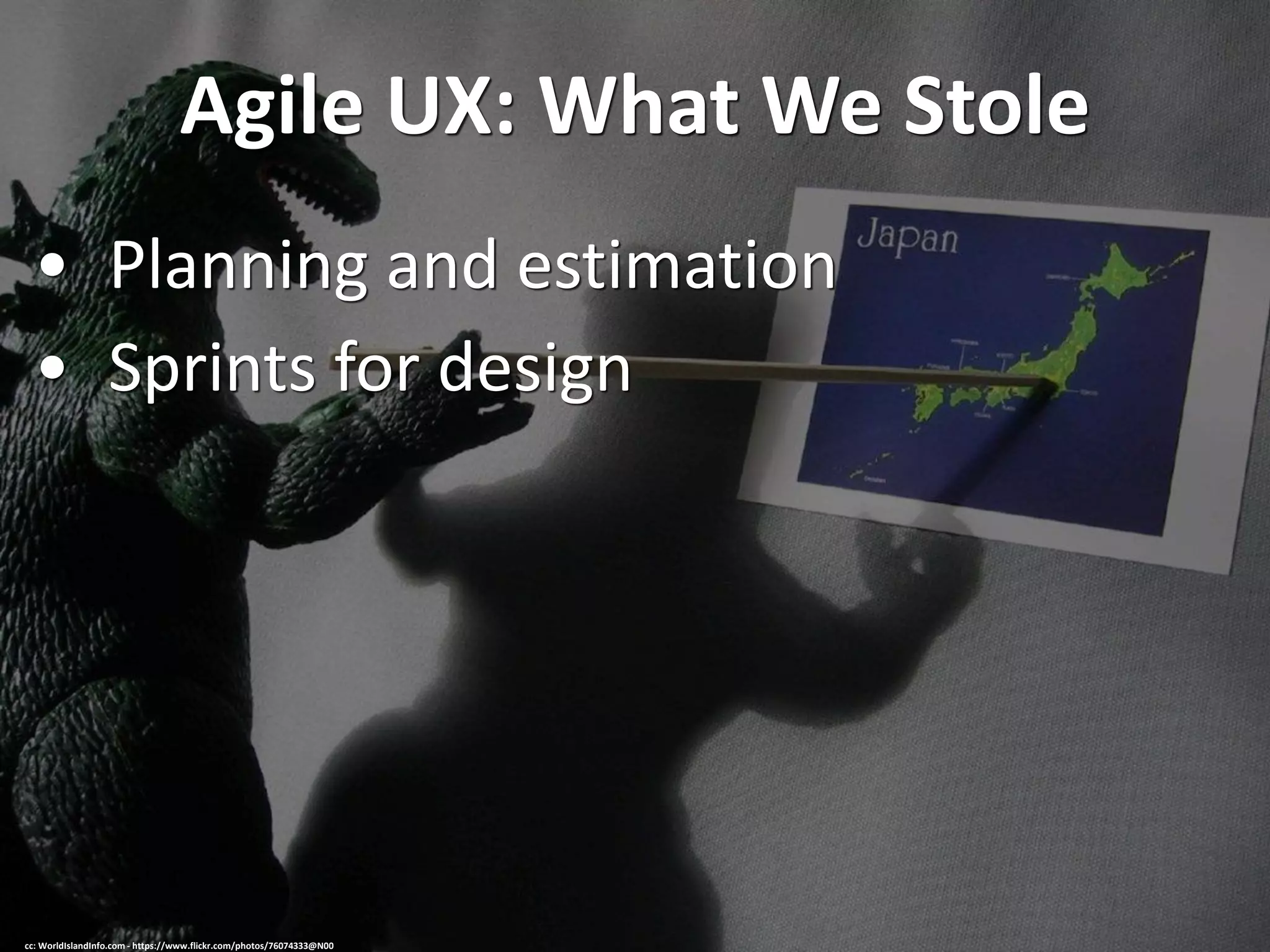
Agile UX: What We Stole
• Planning and estimation
• Sprints for design
cc: WorldIslandInfo.com - https://www.flickr.com/photos/76074333@N00
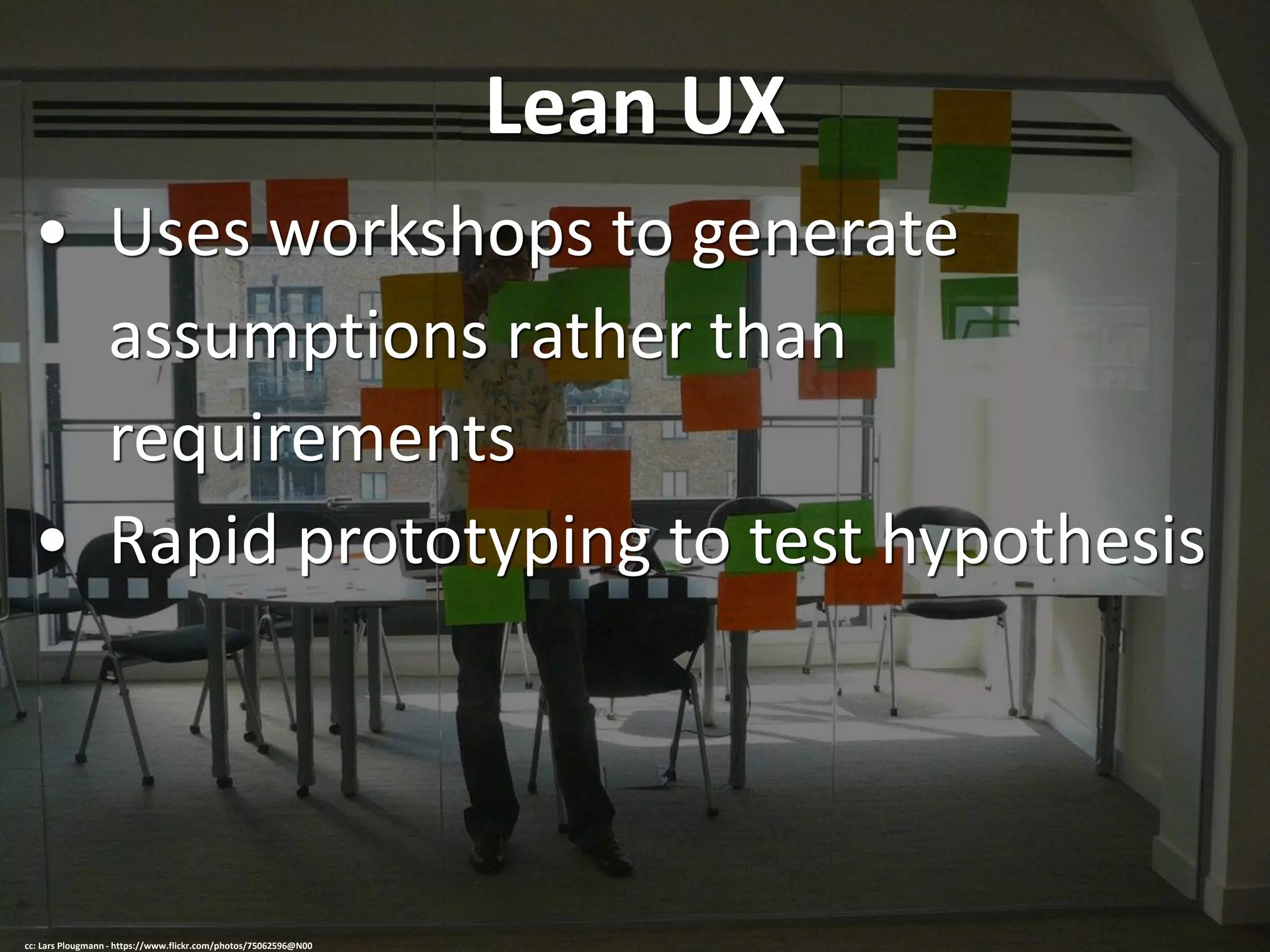
Lean UX
• Uses workshops to generate
assumptions rather than
requirements
• Rapid prototyping to test hypothesis
cc: Lars Plougmann - https://www.flickr.com/photos/75062596@N00
Lean UX: What We Stole
• Workshops (lightning)
• Guerilla/hallway testing
cc: Ruth and Dave - https://www.flickr.com/photos/95142644@N00
Enterprise + UX + Agile
Infusing Agile with Design
cc: Matt Bernius - https://www.flickr.com/photos/99402954@N00
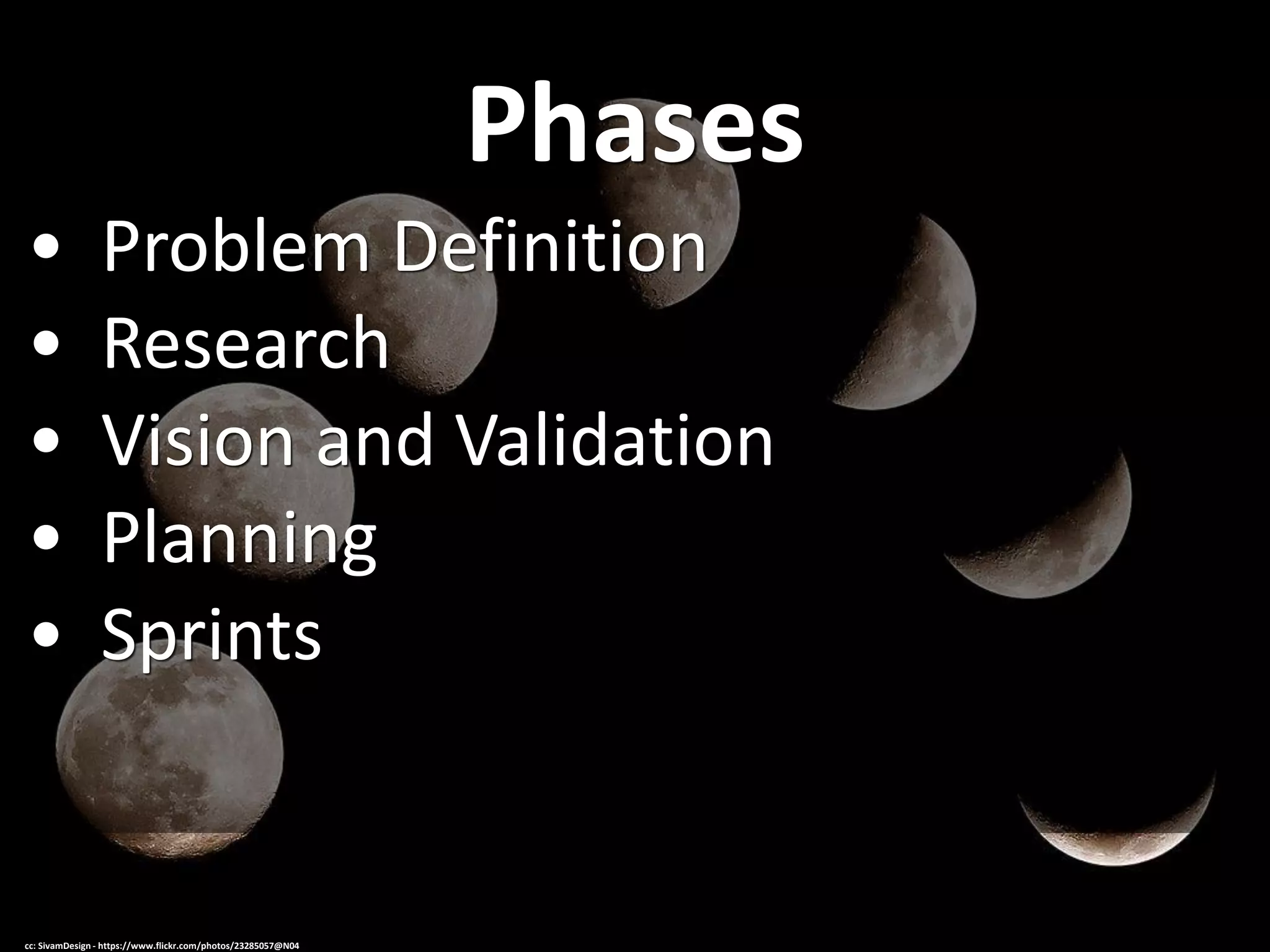
Phases
• Problem Definition
• Research
• Vision and Validation
• Planning
• Sprints
cc: SivamDesign - https://www.flickr.com/photos/23285057@N04
Problem Definition
• Understand the opportunity
• Define the problem
• High level requirements
• Business case
• Market analysis
cc: ccPixs.com - https://www.flickr.com/photos/86530412@N02
When CONTEXT, ACTOR wants/needs to ACTION but they
are prevented by BARRIER which causes IMPACT that
SEVERITY. CONSTANTS remain steady. However, VARIABLES
changes DELTA.
cc: Andi Licious - https://www.flickr.com/photos/32722794@N07
When bringing on new members, the recreation
center owner wants to have a system to stay in contact
with their new members and let them know about
features of the membership and classes, but they are
prevented by limited time and resources which causes
30% of new members to drop their membership after
a trial period leading to a 15% loss of revenue. The
owner will not be able to hire more or better staff.
However, they have a budget available for software
equivalent to 2% of their membership price.
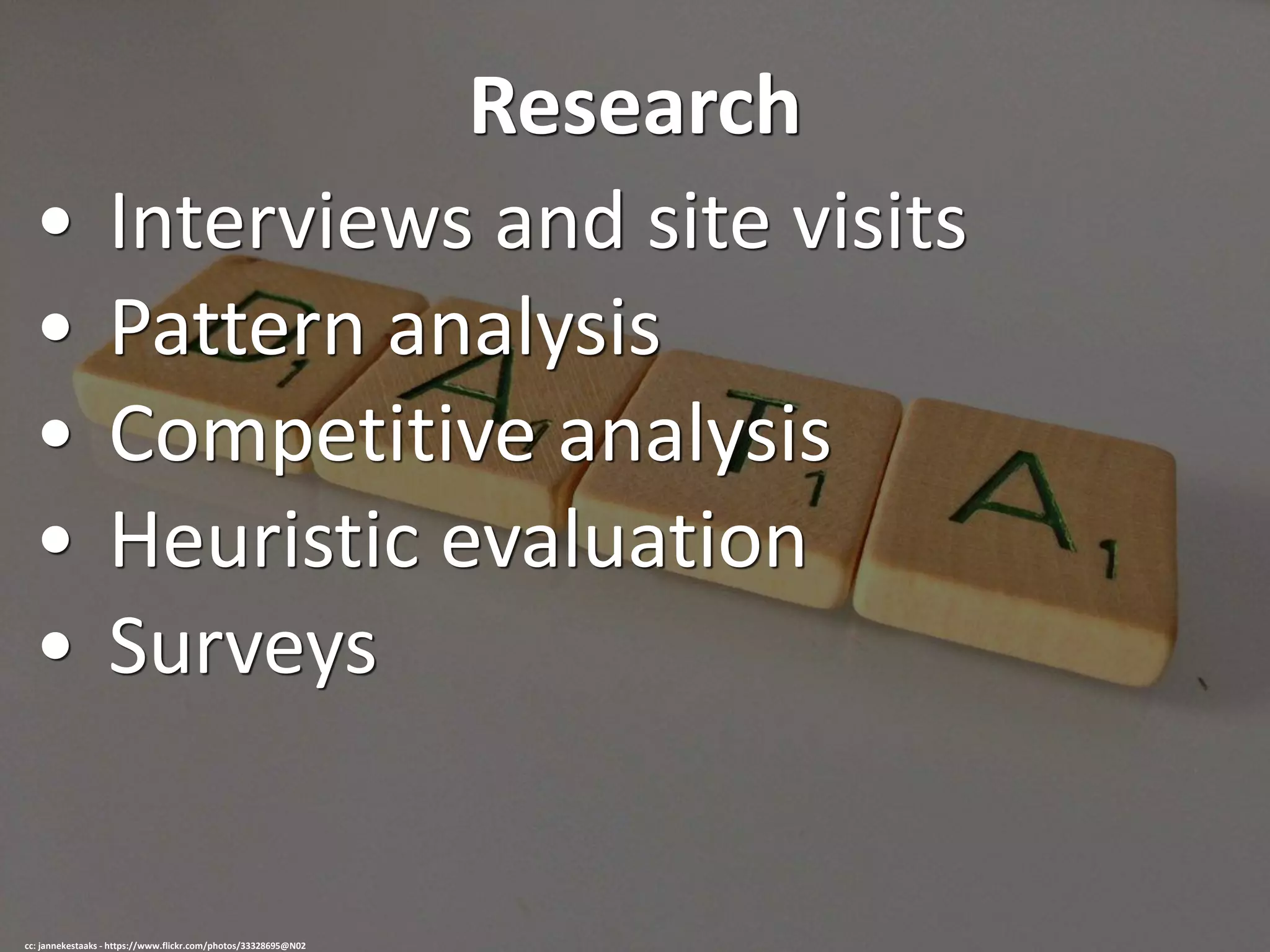
Research
• Interviews and site visits
• Pattern analysis
• Competitive analysis
• Heuristic evaluation
• Surveys
cc: jannekestaaks - https://www.flickr.com/photos/33328695@N02
Vision and Validation
• Ideation and explorations
• High-level customer validation
• Epic definition
cc: chrismar - https://www.flickr.com/photos/14334258@N00
Planning
• Grooming and estimation
• User stories with acceptance criteria
• Dependency flags
cc: JohannesLundberg - https://www.flickr.com/photos/25054287@N07
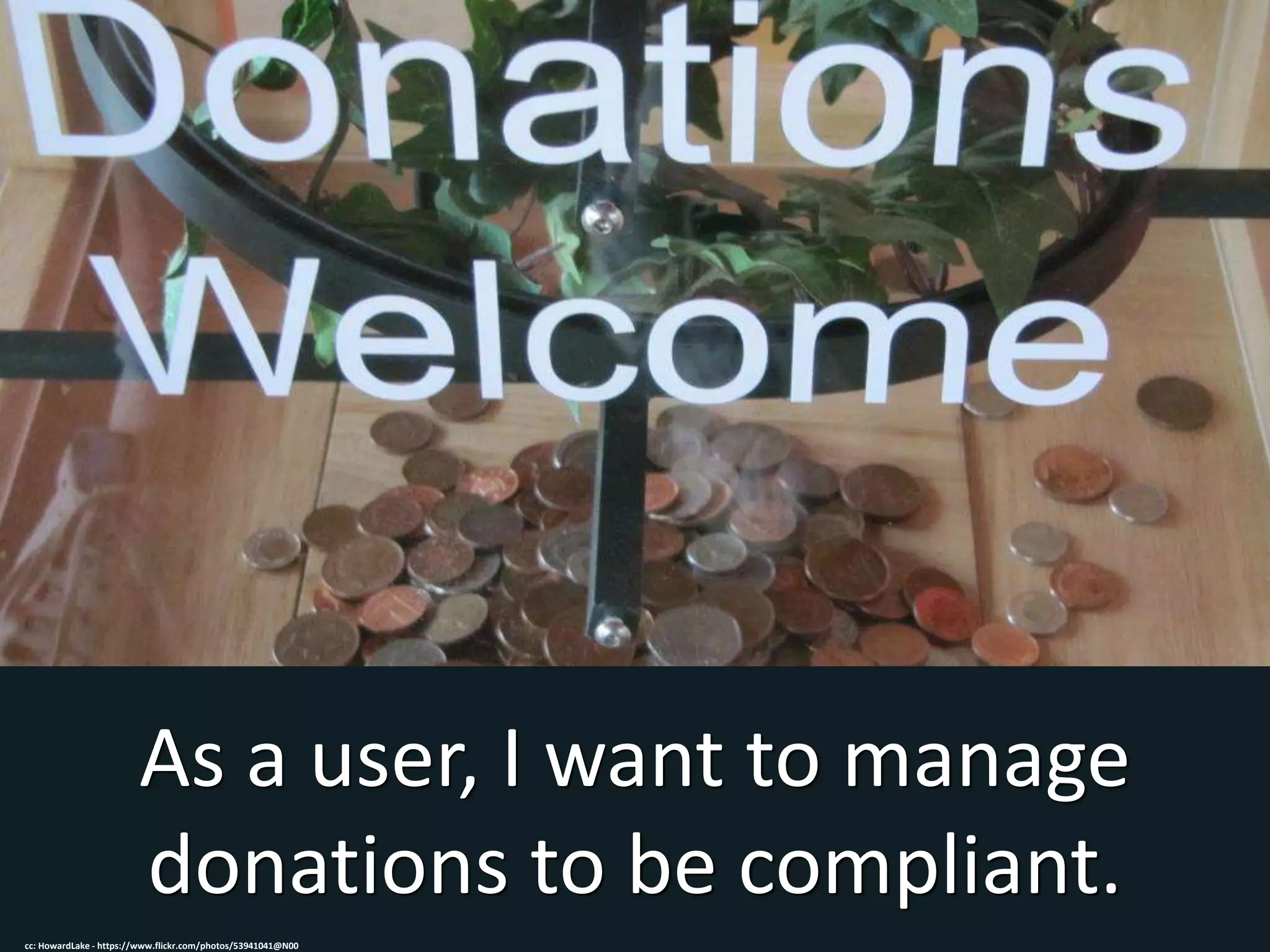
As a user, I want to manage
donations to be compliant.
cc: HowardLake - https://www.flickr.com/photos/53941041@N00
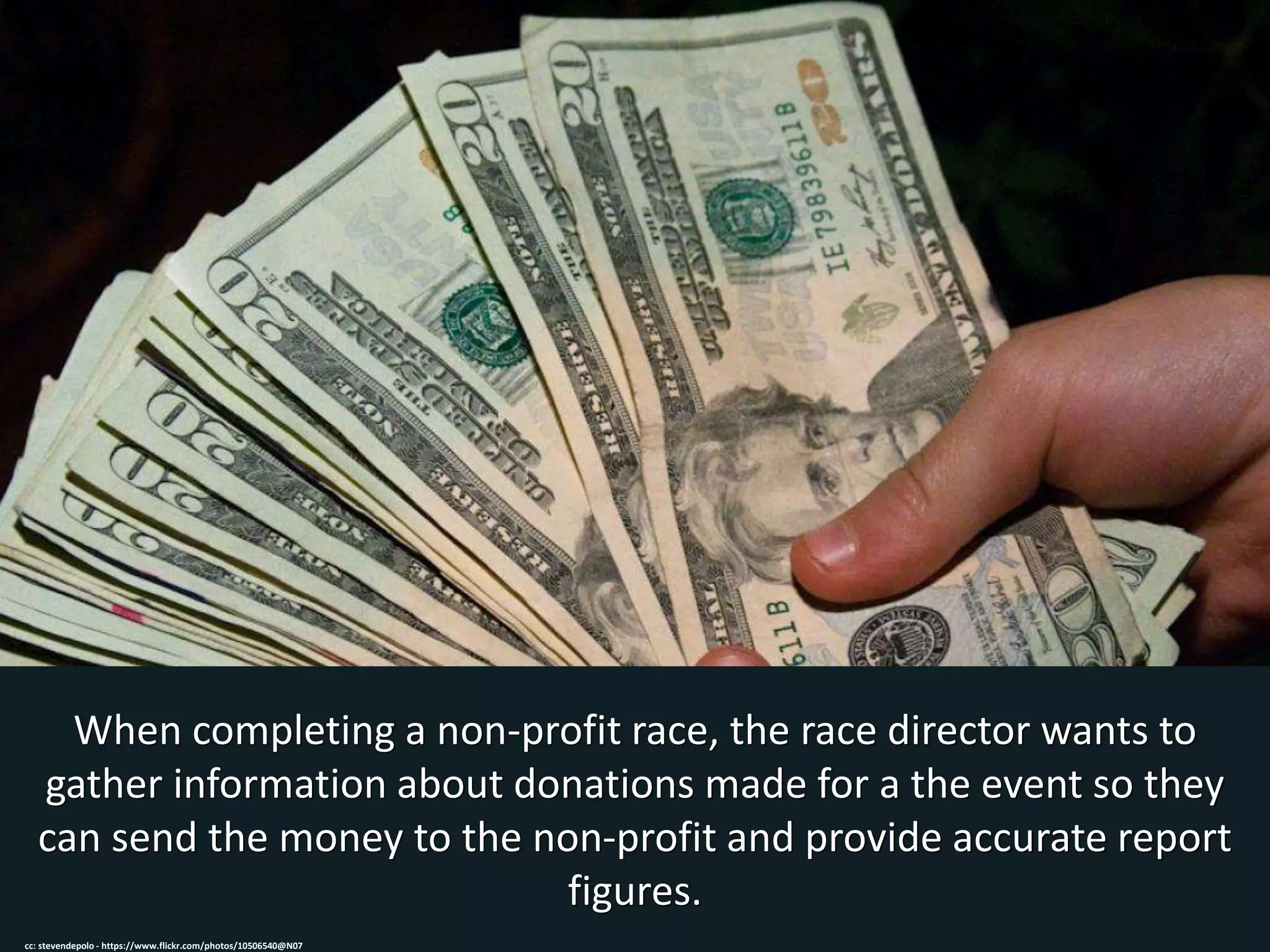
When completing a non-profit race, the race director wants to
gather information about donations made for a the event so they
can send the money to the non-profit and provide accurate report
figures.
cc: stevendepolo - https://www.flickr.com/photos/10506540@N07
As a user, I want a toggle button somewhere on the
screen that is not labeled and does visually nothing
when activated.
cc: kate e. did - https://www.flickr.com/photos/67637588@N00
When a suspicious customer purchases a hunting license,
the cashier wants a way to flag the sale without alerting the
customer so that the sale can be examined later by
administrators.
cc: ialla - https://www.flickr.com/photos/29795849@N00
Sprints
• Two types of sprints: Foundational and
Functional
• Foundational Sprints create items necessary
for the Functional Sprints: wireframes and
visual comps, back-end services, APIs, etc.
• Functional Sprints use items from the
Foundational Sprints to create an MVP.
• If the groundwork has been done properly,
we can usually generate at least 2 Functional
sprints worth of work from 1 Foundational
sprint.
cc: roolrool - https://www.flickr.com/photos/71317184@N00
Enterprise + UX + Agile
Learn From My Fail (LFMF)
cc: felixtsao - https://www.flickr.com/photos/43163345@N06
"I'll Just Do It"
• Product Manager wanted to skip research
and planning
• Decided to create the designs himself
because he "knew what the customers
wanted"
• Attached designs to the development story
without letting UX know - found out when
development called with questions.
cc: Jhong Dizon | Photography - https://www.flickr.com/photos/27636029@N05
LFMF: Clear Responsibilities
• Product Manager did not have a
clear idea of what UX was
responsible for and why
• Project Manager did not know who
could provide designs
• Learning: Define who does what
for every thing (RACI)
cc: quinn.anya - https://www.flickr.com/photos/53326337@N00
"I deliberately left this vague"
• Product manager provided story with
no requirements
• Designer accepted the story and
produced a design - that missed eight
key requirements that came out
during review
• Designer had to overhaul the design
twice and delay development.
cc: cobalt123 - https://www.flickr.com/photos/66606673@N00
LFMF: Clearly Define Problems
• Product Manager confused "not
providing a solution" with "not defining
the problem"
• Designer did not ask any questions
• Learning: If every little thing isn't clear,
ask. Lightening workshops have helped
everyone learn how to do better
definitions.
cc: Michael Dales - https://www.flickr.com/photos/68497070@N00
"Oh, I forgot to mention..."
• Product Manager decided to skip the twice
weekly standups for design because she “didn’t
have time.”
• For a large story, the designers worked an entire
long sprint (3 weeks) in solitude before showing
their work during the sprint design review.
• Seeing the designs, the product manager
realized she had forgotten to include several
things in the requirements, including an entire
asset type, that, in turn, required a complete
redesign.
cc: @Doug88888 - https://www.flickr.com/photos/29468339@N02
LFMF: Constant Communication
• Product Manager had made
assumptions about what others knew
• Designers had made assumptions
about what they knew
• Learning: Check in early and often.
Seeing the solution come to life
brings realizations – you make time
to save time.
cc: Wiertz SĂŠbastien - https://www.flickr.com/photos/36169570@N08
Enterprise + UX + Agile
Reading the Tea Leaves
cc: Ingrid Truemper - https://www.flickr.com/photos/46406260@N00
Improving Estimation
• Quantifying effort improves
understanding
• Accurate estimates provide
predictability and accountability
• Good estimations require practice and
understanding of both the craft and
the problem
cc: Capt Kodak - https://www.flickr.com/photos/35114754@N00
Measuring Impact
• Knowing what success looks like
ensures you know when you're
successful
• Measuring success of design
quantitatively ties your deliverables to
the success of the business
• Good measurements require an
understanding of business needs and
goals as well as research techniques
cc: MattiaMc - https://www.flickr.com/photos/78332974@N06
Rigorously Defining Problems
• Rigorous problem definitions ensures
superior design
• More constraints improve focus and
efficiency
• Good problem definition requires
solid, data-based understanding of
both user and business needs
cc: wburris - https://www.flickr.com/photos/95104082@N00
Dr. Rebecca Baker
rebecca.baker@activenetwork.com
cc: an untrained eye - https://www.flickr.com/photos/26312642@N00
A Few Resources on Agile and UX
• Welcome to the Scaled Agile Framework
http://www.scaledagileframework.com/about/
• Treder, M. Lean UX vs. Agile UX: Is there a difference?
https://www.uxpin.com/studio/blog/lean-ux-vs-agile-ux-is-there-a-
difference/
• Interaction Design Foundation, A Simple Introduction to Lea UX
https://www.interaction-design.org/literature/article/a-simple-
introduction-to-lean-ux
• Agile UX http://www.agile-ux.com/
A Few Resources on Critical Thinking
• Critical Thinking for UX Designers
http://www.slideshare.net/stephenpa/critical-thinking-forux-
designers-workshop
• Become a Better Designer Through Critical
Thinkinghttp://www.vanseodesign.com/web-design/critical-
thinking/
• A Plea for More Critical Thinking in Design, Please
http://www.fastcompany.com/1327667/plea-more-critical-
thinking-design-please
• CriticalThinking.Net http://www.criticalthinking.net/index.html
A Few Resources on Problem Definition
• Rosenhead, J. (1996)What's the problem? An introduction to
problem structuring methods Interfaces 26 (6), 117-131
• Portigal, S. (2016) Doorbells, Danger, and Dead Batteries: User
Research War Stories. Rosenfeld Media.
• Quesenbery, W. and Brooks, K. (2010) Storytelling for User
Experience. Brooklyn, NY: Rosefeld Media, LLC
• Hackos, J. and Redish, J. (1998) User and Task Analysis for Interface
Design. New York, NY: John Wiley & Sons, Inc.
• Spool, J. (2014, Oct 01) Promise, Vision, Scenario and User. [Blog
post] Retrieved from
http://www.uie.com/articles/promise_vision_scenario/
• Inchauste, F. (2010, Jan 29) Better UX with Story Telling. Smashing
Magazine. Retrieved from
http://www.smashingmagazine.com/2010/01/29/better-user-
experience-using-storytelling-part-one/

Enterprise, Agile, and UX: Making It Work Today, Tomorrow, and Beyond

  • 1.
    Enterprise + UX+ Agile Making It Work Today, Tomorrow, And Beyond cc: Scott McKittrick - https://www.flickr.com/photos/12505291@N08
  • 2.
    About Me • Sr.Director Interaction Design and Research, Active Network • Close to 25 years in enterprise software, 15 in UX • 25+ publications • Authored UX Agile best practice for Vista Equity cc: Fefa Guerra - https://www.flickr.com/photos/73573770@N04
  • 3.
    About Active Network •2000+ employees • 30+ products spanning consumer to back office software • Millions of users daily • 14 interaction designers and researchers (we’re hiring!) cc: Fefa Guerra - https://www.flickr.com/photos/73573770@N04
  • 4.
    Today's Agenda • Whyis this so hard? • Many paths • Infusing Agile with UX design for the Enterprise • Learn From My Fail (#LFMF) • Reading the tea leaves cc: Fefa Guerra - https://www.flickr.com/photos/73573770@N04
  • 5.
    Enterprise + UX+ Agile Why Is This So Hard? cc: DVIDSHUB - https://www.flickr.com/photos/28650594@N03
  • 6.
    No Seat AtThe Table • The agile manifesto did not originally allow for UX design as a unique discipline • The definition of UX design varies widely, so level setting can be challenging • There is a perception that making room for UX design "interrupts" the flow and introduces too many artifacts cc: hjl - https://www.flickr.com/photos/92605333@N00
  • 7.
    Working at Scale •Enterprise struggles to scale agile (for one model, see the Scaled Agile Framework (SAFe)) • Enterprise also struggles to understand how to prioritize and implement UX design cc: Ben Sutherland - https://www.flickr.com/photos/60179301@N00
  • 8.
    Enterprise + UX+ Agile Many Paths cc: ericsoco - https://www.flickr.com/photos/34427466510@N01
  • 9.
    Agile UX • Breakingdown problems into consumable bits • Testing those bits before they go to development • Working in defined cycles cc: washingtonydc - https://www.flickr.com/photos/30734489@N00
  • 10.
    Agile UX: WhatWe Stole • Planning and estimation • Sprints for design cc: WorldIslandInfo.com - https://www.flickr.com/photos/76074333@N00
  • 11.
    Lean UX • Usesworkshops to generate assumptions rather than requirements • Rapid prototyping to test hypothesis cc: Lars Plougmann - https://www.flickr.com/photos/75062596@N00
  • 12.
    Lean UX: WhatWe Stole • Workshops (lightning) • Guerilla/hallway testing cc: Ruth and Dave - https://www.flickr.com/photos/95142644@N00
  • 13.
    Enterprise + UX+ Agile Infusing Agile with Design cc: Matt Bernius - https://www.flickr.com/photos/99402954@N00
  • 14.
    Phases • Problem Definition •Research • Vision and Validation • Planning • Sprints cc: SivamDesign - https://www.flickr.com/photos/23285057@N04
  • 15.
    Problem Definition • Understandthe opportunity • Define the problem • High level requirements • Business case • Market analysis cc: ccPixs.com - https://www.flickr.com/photos/86530412@N02
  • 16.
    When CONTEXT, ACTORwants/needs to ACTION but they are prevented by BARRIER which causes IMPACT that SEVERITY. CONSTANTS remain steady. However, VARIABLES changes DELTA. cc: Andi Licious - https://www.flickr.com/photos/32722794@N07
  • 17.
    When bringing onnew members, the recreation center owner wants to have a system to stay in contact with their new members and let them know about features of the membership and classes, but they are prevented by limited time and resources which causes 30% of new members to drop their membership after a trial period leading to a 15% loss of revenue. The owner will not be able to hire more or better staff. However, they have a budget available for software equivalent to 2% of their membership price.
  • 18.
    Research • Interviews andsite visits • Pattern analysis • Competitive analysis • Heuristic evaluation • Surveys cc: jannekestaaks - https://www.flickr.com/photos/33328695@N02
  • 19.
    Vision and Validation •Ideation and explorations • High-level customer validation • Epic definition cc: chrismar - https://www.flickr.com/photos/14334258@N00
  • 20.
    Planning • Grooming andestimation • User stories with acceptance criteria • Dependency flags cc: JohannesLundberg - https://www.flickr.com/photos/25054287@N07
  • 21.
    As a user,I want to manage donations to be compliant. cc: HowardLake - https://www.flickr.com/photos/53941041@N00
  • 22.
    When completing anon-profit race, the race director wants to gather information about donations made for a the event so they can send the money to the non-profit and provide accurate report figures. cc: stevendepolo - https://www.flickr.com/photos/10506540@N07
  • 23.
    As a user,I want a toggle button somewhere on the screen that is not labeled and does visually nothing when activated. cc: kate e. did - https://www.flickr.com/photos/67637588@N00
  • 24.
    When a suspiciouscustomer purchases a hunting license, the cashier wants a way to flag the sale without alerting the customer so that the sale can be examined later by administrators. cc: ialla - https://www.flickr.com/photos/29795849@N00
  • 25.
    Sprints • Two typesof sprints: Foundational and Functional • Foundational Sprints create items necessary for the Functional Sprints: wireframes and visual comps, back-end services, APIs, etc. • Functional Sprints use items from the Foundational Sprints to create an MVP. • If the groundwork has been done properly, we can usually generate at least 2 Functional sprints worth of work from 1 Foundational sprint. cc: roolrool - https://www.flickr.com/photos/71317184@N00
  • 26.
    Enterprise + UX+ Agile Learn From My Fail (LFMF) cc: felixtsao - https://www.flickr.com/photos/43163345@N06
  • 27.
    "I'll Just DoIt" • Product Manager wanted to skip research and planning • Decided to create the designs himself because he "knew what the customers wanted" • Attached designs to the development story without letting UX know - found out when development called with questions. cc: Jhong Dizon | Photography - https://www.flickr.com/photos/27636029@N05
  • 28.
    LFMF: Clear Responsibilities •Product Manager did not have a clear idea of what UX was responsible for and why • Project Manager did not know who could provide designs • Learning: Define who does what for every thing (RACI) cc: quinn.anya - https://www.flickr.com/photos/53326337@N00
  • 29.
    "I deliberately leftthis vague" • Product manager provided story with no requirements • Designer accepted the story and produced a design - that missed eight key requirements that came out during review • Designer had to overhaul the design twice and delay development. cc: cobalt123 - https://www.flickr.com/photos/66606673@N00
  • 30.
    LFMF: Clearly DefineProblems • Product Manager confused "not providing a solution" with "not defining the problem" • Designer did not ask any questions • Learning: If every little thing isn't clear, ask. Lightening workshops have helped everyone learn how to do better definitions. cc: Michael Dales - https://www.flickr.com/photos/68497070@N00
  • 31.
    "Oh, I forgotto mention..." • Product Manager decided to skip the twice weekly standups for design because she “didn’t have time.” • For a large story, the designers worked an entire long sprint (3 weeks) in solitude before showing their work during the sprint design review. • Seeing the designs, the product manager realized she had forgotten to include several things in the requirements, including an entire asset type, that, in turn, required a complete redesign. cc: @Doug88888 - https://www.flickr.com/photos/29468339@N02
  • 32.
    LFMF: Constant Communication •Product Manager had made assumptions about what others knew • Designers had made assumptions about what they knew • Learning: Check in early and often. Seeing the solution come to life brings realizations – you make time to save time. cc: Wiertz Sébastien - https://www.flickr.com/photos/36169570@N08
  • 33.
    Enterprise + UX+ Agile Reading the Tea Leaves cc: Ingrid Truemper - https://www.flickr.com/photos/46406260@N00
  • 34.
    Improving Estimation • Quantifyingeffort improves understanding • Accurate estimates provide predictability and accountability • Good estimations require practice and understanding of both the craft and the problem cc: Capt Kodak - https://www.flickr.com/photos/35114754@N00
  • 35.
    Measuring Impact • Knowingwhat success looks like ensures you know when you're successful • Measuring success of design quantitatively ties your deliverables to the success of the business • Good measurements require an understanding of business needs and goals as well as research techniques cc: MattiaMc - https://www.flickr.com/photos/78332974@N06
  • 36.
    Rigorously Defining Problems •Rigorous problem definitions ensures superior design • More constraints improve focus and efficiency • Good problem definition requires solid, data-based understanding of both user and business needs cc: wburris - https://www.flickr.com/photos/95104082@N00
  • 37.
    Dr. Rebecca Baker rebecca.baker@activenetwork.com cc:an untrained eye - https://www.flickr.com/photos/26312642@N00
  • 38.
    A Few Resourceson Agile and UX • Welcome to the Scaled Agile Framework http://www.scaledagileframework.com/about/ • Treder, M. Lean UX vs. Agile UX: Is there a difference? https://www.uxpin.com/studio/blog/lean-ux-vs-agile-ux-is-there-a- difference/ • Interaction Design Foundation, A Simple Introduction to Lea UX https://www.interaction-design.org/literature/article/a-simple- introduction-to-lean-ux • Agile UX http://www.agile-ux.com/
  • 39.
    A Few Resourceson Critical Thinking • Critical Thinking for UX Designers http://www.slideshare.net/stephenpa/critical-thinking-forux- designers-workshop • Become a Better Designer Through Critical Thinkinghttp://www.vanseodesign.com/web-design/critical- thinking/ • A Plea for More Critical Thinking in Design, Please http://www.fastcompany.com/1327667/plea-more-critical- thinking-design-please • CriticalThinking.Net http://www.criticalthinking.net/index.html
  • 40.
    A Few Resourceson Problem Definition • Rosenhead, J. (1996)What's the problem? An introduction to problem structuring methods Interfaces 26 (6), 117-131 • Portigal, S. (2016) Doorbells, Danger, and Dead Batteries: User Research War Stories. Rosenfeld Media. • Quesenbery, W. and Brooks, K. (2010) Storytelling for User Experience. Brooklyn, NY: Rosefeld Media, LLC • Hackos, J. and Redish, J. (1998) User and Task Analysis for Interface Design. New York, NY: John Wiley & Sons, Inc. • Spool, J. (2014, Oct 01) Promise, Vision, Scenario and User. [Blog post] Retrieved from http://www.uie.com/articles/promise_vision_scenario/ • Inchauste, F. (2010, Jan 29) Better UX with Story Telling. Smashing Magazine. Retrieved from http://www.smashingmagazine.com/2010/01/29/better-user- experience-using-storytelling-part-one/