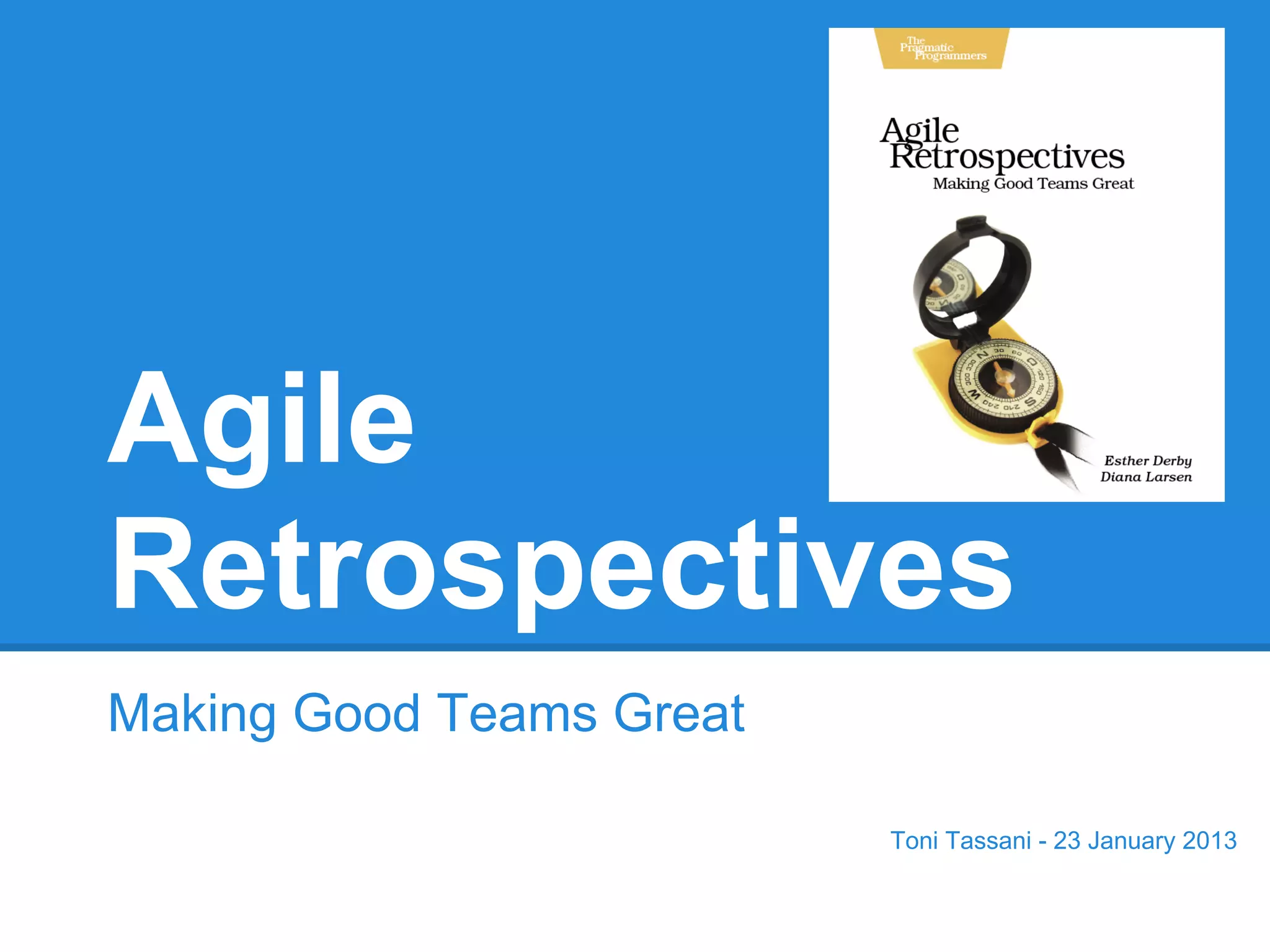
Agile
Retrospectives
Making Good Teams Great

                          Toni Tassani - 23 January 2013
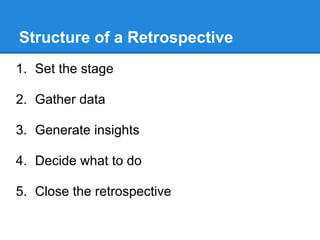
Structure of a Retrospective
1. Set the stage

2. Gather data

3. Generate insights

4. Decide what to do

5. Close the retrospective
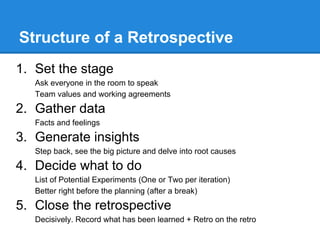
Structure of a Retrospective
1. Set the stage
   Ask everyone in the room to speak
   Team values and working agreements

2. Gather data
   Facts and feelings

3. Generate insights
   Step back, see the big picture and delve into root causes

4. Decide what to do
   List of Potential Experiments (One or Two per iteration)
   Better right before the planning (after a break)

5. Close the retrospective
   Decisively. Record what has been learned + Retro on the retro
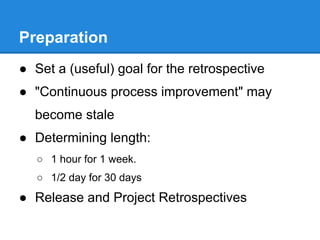
Preparation
● Set a (useful) goal for the retrospective
● "Continuous process improvement" may
  become stale
● Determining length:
   ○ 1 hour for 1 week.
   ○ 1/2 day for 30 days
● Release and Project Retrospectives
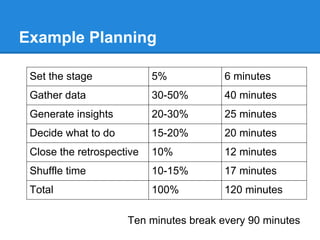
Example Planning

 Set the stage             5%           6 minutes
 Gather data               30-50%       40 minutes
 Generate insights         20-30%       25 minutes
 Decide what to do         15-20%       20 minutes
 Close the retrospective   10%          12 minutes
 Shuffle time              10-15%       17 minutes
 Total                     100%         120 minutes

                     Ten minutes break every 90 minutes
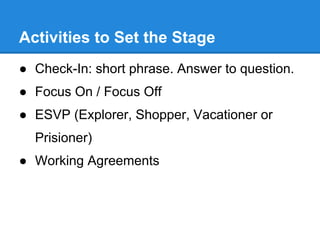
Activities to Set the Stage
● Check-In: short phrase. Answer to question.
● Focus On / Focus Off
● ESVP (Explorer, Shopper, Vacationer or
  Prisioner)
● Working Agreements
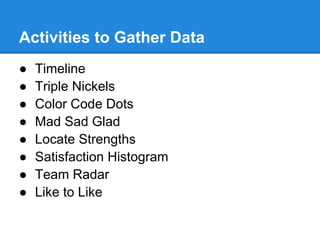
Activities to Gather Data
●   Timeline
●   Triple Nickels
●   Color Code Dots
●   Mad Sad Glad
●   Locate Strengths
●   Satisfaction Histogram
●   Team Radar
●   Like to Like
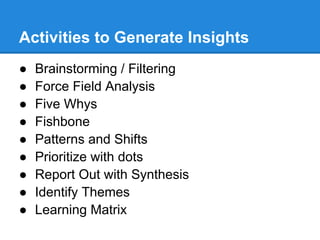
Activities to Generate Insights
●   Brainstorming / Filtering
●   Force Field Analysis
●   Five Whys
●   Fishbone
●   Patterns and Shifts
●   Prioritize with dots
●   Report Out with Synthesis
●   Identify Themes
●   Learning Matrix
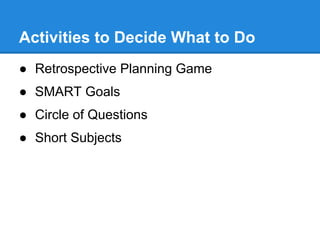
Activities to Decide What to Do
● Retrospective Planning Game
● SMART Goals
● Circle of Questions
● Short Subjects
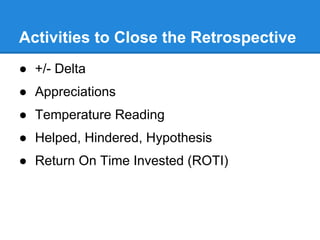
Activities to Close the Retrospective
● +/- Delta
● Appreciations
● Temperature Reading
● Helped, Hindered, Hypothesis
● Return On Time Invested (ROTI)
Thank you

Agile retrospectives

  • 1.
    Agile Retrospectives Making Good TeamsGreat Toni Tassani - 23 January 2013
  • 2.
    Structure of aRetrospective 1. Set the stage 2. Gather data 3. Generate insights 4. Decide what to do 5. Close the retrospective
  • 3.
    Structure of aRetrospective 1. Set the stage Ask everyone in the room to speak Team values and working agreements 2. Gather data Facts and feelings 3. Generate insights Step back, see the big picture and delve into root causes 4. Decide what to do List of Potential Experiments (One or Two per iteration) Better right before the planning (after a break) 5. Close the retrospective Decisively. Record what has been learned + Retro on the retro
  • 4.
    Preparation ● Set a(useful) goal for the retrospective ● "Continuous process improvement" may become stale ● Determining length: ○ 1 hour for 1 week. ○ 1/2 day for 30 days ● Release and Project Retrospectives
  • 5.
    Example Planning Setthe stage 5% 6 minutes Gather data 30-50% 40 minutes Generate insights 20-30% 25 minutes Decide what to do 15-20% 20 minutes Close the retrospective 10% 12 minutes Shuffle time 10-15% 17 minutes Total 100% 120 minutes Ten minutes break every 90 minutes
  • 6.
    Activities to Setthe Stage ● Check-In: short phrase. Answer to question. ● Focus On / Focus Off ● ESVP (Explorer, Shopper, Vacationer or Prisioner) ● Working Agreements
  • 7.
    Activities to GatherData ● Timeline ● Triple Nickels ● Color Code Dots ● Mad Sad Glad ● Locate Strengths ● Satisfaction Histogram ● Team Radar ● Like to Like
  • 8.
    Activities to GenerateInsights ● Brainstorming / Filtering ● Force Field Analysis ● Five Whys ● Fishbone ● Patterns and Shifts ● Prioritize with dots ● Report Out with Synthesis ● Identify Themes ● Learning Matrix
  • 9.
    Activities to DecideWhat to Do ● Retrospective Planning Game ● SMART Goals ● Circle of Questions ● Short Subjects
  • 10.
    Activities to Closethe Retrospective ● +/- Delta ● Appreciations ● Temperature Reading ● Helped, Hindered, Hypothesis ● Return On Time Invested (ROTI)
  • 11.