

Retrospectives
Agile Ottawa Meetup Oct 2015
Foundations of Great Retrospectives
Safety
Retros examine ‘what could have gone better’
Emotions and defensiveness can come into play
Failures happen in complex environments (like your organization)
It is easy to look back and find causes - but not vice versa
Most failures are a result of unpredictable interactions in a complex adaptive
system
Foundations of Great Retrospectives
Safety - The Blameless Post-Mortem
What actions were taken over time?
For each contributor
What effects were observed?
Expected results?
Assumptions made?
Understanding of events as they occurred?
Foundations of Great Retrospectives
Have an agenda
Have a goal
What has happened recently? Do we want to reduce build failures?
Plan your activities
Know how much time you are going to use for each step
Set the stage - 6 min
Gather data - 40 min
Foundations of Great Retrospectives
Understanding facilitation
Manage the process, not the content
Ask for permission to interrupt - ‘time check, we have another minute’
Introduce activities, monitor the activity, then debrief
Manage the meeting dynamics
Parking tangential conversation
Stopping the blame game, encourage ‘I’ language
Foundations of Great Retrospectives
Facilitation skills
Active listening
Positive attitude
Professional behaviour
Competent with activities and tools
Well prepared, well organized
Retrospective Structure
1. Set the stage
2. Gather data
3. Generate insights
4. Decide what to do
Set the stage
Greet people as they come in
Welcome
Thanks for the time
State the goal
Remind people of the meeting length
Ask everyone to say something
Psychologically, people are more engaged and willing to participate
Set the stage
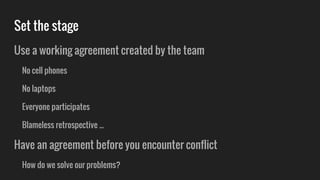
Use a working agreement created by the team
No cell phones
No laptops
Everyone participates
Blameless retrospective ...
Have an agreement before you encounter conflict
How do we solve our problems?
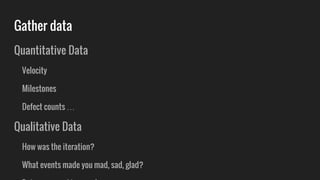
Gather data
Quantitative Data
Velocity
Milestones
Defect counts …
Qualitative Data
How was the iteration?
What events made you mad, sad, glad?
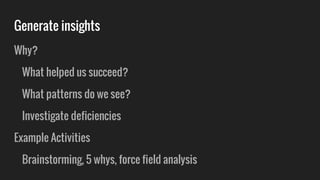
Generate insights
Why?
What helped us succeed?
What patterns do we see?
Investigate deficiencies
Example Activities
Brainstorming, 5 whys, force field analysis
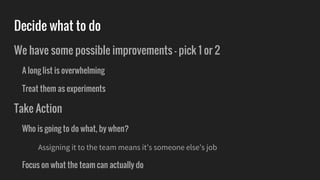
Decide what to do
We have some possible improvements - pick 1 or 2
A long list is overwhelming
Treat them as experiments
Take Action
Who is going to do what, by when?
Assigning it to the team means it’s someone else’s job
Focus on what the team can actually do
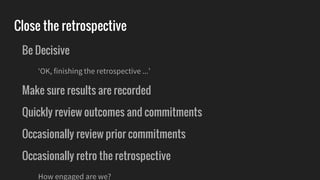
Close the retrospective
Be Decisive
‘OK, finishing the retrospective ...’
Make sure results are recorded
Quickly review outcomes and commitments
Occasionally review prior commitments
Occasionally retro the retrospective
How engaged are we?
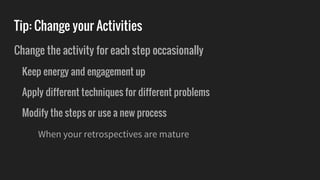
Change the activity for each step occasionally
Keep energy and engagement up
Apply different techniques for different problems
Modify the steps or use a new process
When your retrospectives are mature
Tip: Change your Activities
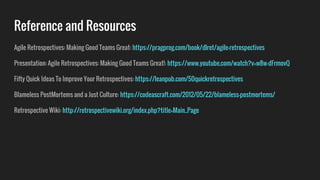
Reference and Resources
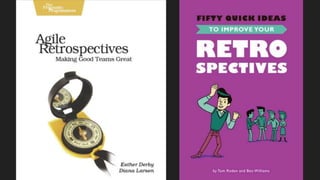
Agile Retrospectives: Making Good Teams Great: https://pragprog.com/book/dlret/agile-retrospectives
Presentation: Agile Retrospectives: Making Good Teams Great!: https://www.youtube.com/watch?v=w8w-dFrmovQ
Fifty Quick Ideas To Improve Your Retrospectives: https://leanpub.com/50quickretrospectives
Blameless PostMortems and a Just Culture: https://codeascraft.com/2012/05/22/blameless-postmortems/
Retrospective Wiki: http://retrospectivewiki.org/index.php?title=Main_Page

Retrospectives - Agile Ottawa Meetup

  • 1.
  • 3.
    Foundations of GreatRetrospectives Safety Retros examine ‘what could have gone better’ Emotions and defensiveness can come into play Failures happen in complex environments (like your organization) It is easy to look back and find causes - but not vice versa Most failures are a result of unpredictable interactions in a complex adaptive system
  • 4.
    Foundations of GreatRetrospectives Safety - The Blameless Post-Mortem What actions were taken over time? For each contributor What effects were observed? Expected results? Assumptions made? Understanding of events as they occurred?
  • 5.
    Foundations of GreatRetrospectives Have an agenda Have a goal What has happened recently? Do we want to reduce build failures? Plan your activities Know how much time you are going to use for each step Set the stage - 6 min Gather data - 40 min
  • 6.
    Foundations of GreatRetrospectives Understanding facilitation Manage the process, not the content Ask for permission to interrupt - ‘time check, we have another minute’ Introduce activities, monitor the activity, then debrief Manage the meeting dynamics Parking tangential conversation Stopping the blame game, encourage ‘I’ language
  • 7.
    Foundations of GreatRetrospectives Facilitation skills Active listening Positive attitude Professional behaviour Competent with activities and tools Well prepared, well organized
  • 8.
    Retrospective Structure 1. Setthe stage 2. Gather data 3. Generate insights 4. Decide what to do
  • 9.
    Set the stage Greetpeople as they come in Welcome Thanks for the time State the goal Remind people of the meeting length Ask everyone to say something Psychologically, people are more engaged and willing to participate
  • 10.
    Set the stage Usea working agreement created by the team No cell phones No laptops Everyone participates Blameless retrospective ... Have an agreement before you encounter conflict How do we solve our problems?
  • 11.
    Gather data Quantitative Data Velocity Milestones Defectcounts … Qualitative Data How was the iteration? What events made you mad, sad, glad?
  • 12.
    Generate insights Why? What helpedus succeed? What patterns do we see? Investigate deficiencies Example Activities Brainstorming, 5 whys, force field analysis
  • 13.
    Decide what todo We have some possible improvements - pick 1 or 2 A long list is overwhelming Treat them as experiments Take Action Who is going to do what, by when? Assigning it to the team means it’s someone else’s job Focus on what the team can actually do
  • 14.
    Close the retrospective BeDecisive ‘OK, finishing the retrospective ...’ Make sure results are recorded Quickly review outcomes and commitments Occasionally review prior commitments Occasionally retro the retrospective How engaged are we?
  • 15.
    Change the activityfor each step occasionally Keep energy and engagement up Apply different techniques for different problems Modify the steps or use a new process When your retrospectives are mature Tip: Change your Activities
  • 16.
    Reference and Resources AgileRetrospectives: Making Good Teams Great: https://pragprog.com/book/dlret/agile-retrospectives Presentation: Agile Retrospectives: Making Good Teams Great!: https://www.youtube.com/watch?v=w8w-dFrmovQ Fifty Quick Ideas To Improve Your Retrospectives: https://leanpub.com/50quickretrospectives Blameless PostMortems and a Just Culture: https://codeascraft.com/2012/05/22/blameless-postmortems/ Retrospective Wiki: http://retrospectivewiki.org/index.php?title=Main_Page

Editor's Notes

  • #5 ‘Fear is the mind killer’
  • #6 ‘Fear is the mind killer’