Scrum ofScrums
Patterns Library
David Hanson
ANE 101, February 2021
1
Agile 101:
Scrum ofScrums
David Hanson
dphanson63@yahoo.com
linkedin.com/in/david-hanson/
slideshare.net/DavidHanson5
About the session and me
When scalingAgile, an effective
Scrum of Scrums is fundamental to
success.This session will review
common patterns for Scrum of
Scrums, with varied purpose and
format. Successful practices,
learned experience, potential anti-
patterns, and alternatives to Scrum
of Scrums will be discussed.
David Hanson has established 8
Scrum of Scrums for 4
organizations over the past 8 years
as an Agile coach or Scrum master.
About you
What’s your experience scaling
Agile?
Are you practicing Scrum of
Scrums?
Are you considering Scrum of
Scrums?
Has your Scrum of Scrums been
effective?
What are you hoping to learn?
2
Scrum of
Scrums
3
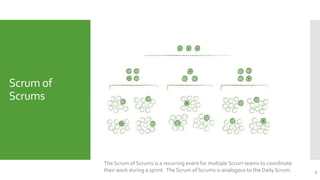
The Scrum of Scrums is a recurring event for multiple Scrum teams to coordinate
their work during a sprint. The Scrum of Scrums is analogous to the Daily Scrum.
Scrum of
Scrums
Patterns
• Standard
• Scaled Daily Scrum (Sutherland)
• Nexus (Schwaber)
• MyVariation
• Walk-the-board
• Anti-patterns &Values
• Appendix: Alternatives, Global, SAFe, MetaScrum
4
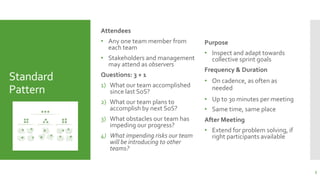
Standard
Pattern
Attendees
• Any one team member from
each team
• Stakeholders and management
may attend as observers
Questions: 3 + 1
1) What our team accomplished
since last SoS?
2) What our team plans to
accomplish by next SoS?
3) What obstacles our team has
impeding our progress?
4) What impending risks our team
will be introducing to other
teams?
Purpose
• Inspect and adapt towards
collective sprint goals
Frequency & Duration
• On cadence, as often as
needed
• Up to 30 minutes per meeting
• Same time, same place
After Meeting
• Extend for problem solving, if
right participants available
5
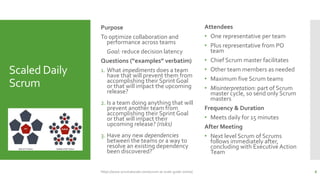
Scaled Daily
Scrum
Purpose
To optimize collaboration and
performance across teams
Goal: reduce decision latency
Questions (“examples” verbatim)
1. What impediments does a team
have that will prevent them from
accomplishing their Sprint Goal
or that will impact the upcoming
release?
2. Is a team doing anything that will
prevent another team from
accomplishing their Sprint Goal
or that will impact their
upcoming release? (risks)
3. Have any new dependencies
between the teams or a way to
resolve an existing dependency
been discovered?
Attendees
• One representative per team
• Plus representative from PO
team
• Chief Scrum master facilitates
• Other team members as needed
• Maximum five Scrum teams
• Misinterpretation: part of Scrum
master cycle, so send only Scrum
masters
Frequency & Duration
• Meets daily for 15 minutes
After Meeting
• Next level Scrum of Scrums
follows immediately after,
concluding with Executive Action
Team
6
https://www.scrumatscale.com/scrum-at-scale-guide-online/
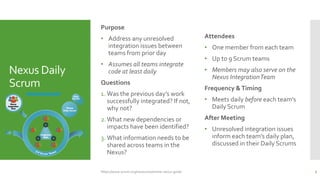
Nexus Daily
Scrum
Purpose
• Address any unresolved
integration issues between
teams from prior day
• Assumes all teams integrate
code at least daily
Questions
1. Was the previous day’s work
successfully integrated? If not,
why not?
2.What new dependencies or
impacts have been identified?
3. What information needs to be
shared across teams in the
Nexus?
Attendees
• One member from each team
• Up to 9 Scrum teams
• Members may also serve on the
Nexus IntegrationTeam
Frequency &Timing
• Meets daily before each team’s
Daily Scrum
After Meeting
• Unresolved integration issues
inform each team’s daily plan,
discussed in their Daily Scrums
7
https://www.scrum.org/resources/online-nexus-guide
A
Bended Rules
Approach
Purpose
• Meet collective commitments, no
excuses, w/o management
Attendees
• Two members from each team,
one speaker, one listener
• Up to five teams participate
• Chief SM as facilitator
• Optional: Shared cross-team
resources as participant
• Optional: Chief PO as observer
• Management invited as observer
Prompts
1. Obstacles want help with
2. Dependencies want to highlight
3. Risks to other teams
4. Current focus; yesterday, today,
tomorrow
Frequency & Duration
• Meet two or three times weekly
• If twice/week keep to 30 min
• If thrice/week keep to 20 min
Whiteboard
• Same time, same place with
whiteboard
• CSM records keywords for next
meeting and insures prior
meeting issues resolved
After Meeting
• Participants determine when to
meet for problem solving before
meeting adjourns
• CSM escalates to EAT as required
8
This “bended rules” pattern evolved over the course of a year starting from the “standard” pattern for our SoS.
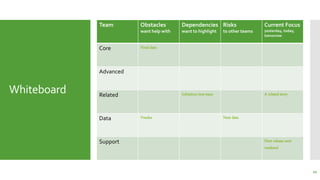
Whiteboard
Team Obstacles
want help with
Dependencies
want to highlight
Risks
to other teams
Current Focus
yesterday, today,
tomorrow
Core Need data
Advanced
Related Infrastruc-ture team A related story
Data Vendor Next data
Support Next release next
weekend
10
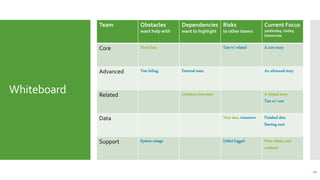
Whiteboard
Team Obstacles
want help with
Dependencies
want to highlight
Risks
to other teams
Current Focus
yesterday, today,
tomorrow
Core Need data Test w/ related A core story
Advanced Test failing External team An advanced story
Related Infrastruc-ture team A related story
Test w/ core
Data Next data, tomorrow Finished data
Starting next
Support System outage Defect logged Next release next
weekend
11
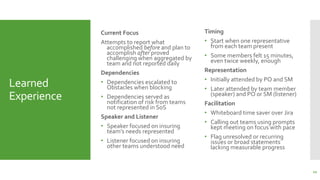
Learned
Experience
Current Focus
Attempts to report what
accomplished before and plan to
accomplish after proved
challenging when aggregated by
team and not reported daily
Dependencies
• Dependencies escalated to
Obstacles when blocking
• Dependencies served as
notification of risk from teams
not represented in SoS
Speaker and Listener
• Speaker focused on insuring
team’s needs represented
• Listener focused on insuring
other teams understood need
Timing
• Start when one representative
from each team present
• Some members felt 15 minutes,
even twice weekly, enough
Representation
• Initially attended by PO and SM
• Later attended by team member
(speaker) and PO or SM (listener)
Facilitation
• Whiteboard time saver over Jira
• Calling out teams using prompts
kept meeting on focus with pace
• Flag unresolved or recurring
issues or broad statements
lacking measurable progress
12
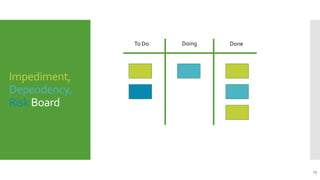
Impediment,
Dependency,
Risk Board
To Do Doing Done
13
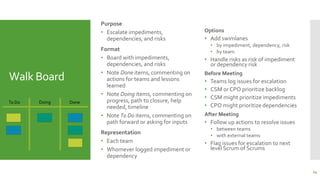
Walk Board
Purpose
• Escalate impediments,
dependencies, and risks
Format
• Board with impediments,
dependencies, and risks
• Note Done items, commenting on
actions for teams and lessons
learned
• Note Doing items, commenting on
progress, path to closure, help
needed, timeline
• Note To Do items, commenting on
path forward or asking for inputs
Representation
• Each team
• Whomever logged impediment or
dependency
Options
• Add swimlanes
• by impediment, dependency, risk
• by team
• Handle risks as risk of impediment
or dependency risk
Before Meeting
• Teams log issues for escalation
• CSM or CPO prioritize backlog
• CSM might prioritize impediments
• CPO might prioritize dependencies
After Meeting
• Follow up actions to resolve issues
• between teams
• with external teams
• Flag issues for escalation to next
level Scrum of Scrums
To Do Doing Done
14
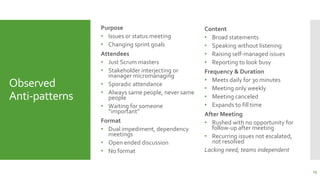
Observed
Anti-patterns
Purpose
• Issues or status meeting
• Changing sprint goals
Attendees
• Just Scrum masters
• Stakeholder interjecting or
manager micromanaging
• Sporadic attendance
• Always same people, never same
people
• Waiting for someone
“important”
Format
• Dual impediment, dependency
meetings
• Open ended discussion
• No format
Content
• Broad statements
• Speaking without listening
• Raising self-managed issues
• Reporting to look busy
Frequency & Duration
• Meets daily for 30 minutes
• Meeting only weekly
• Meeting canceled
• Expands to fill time
After Meeting
• Rushed with no opportunity for
follow-up after meeting
• Recurring issues not escalated,
not resolved
Lacking need; teams independent
15
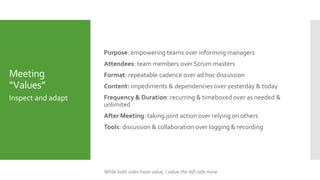
Meeting
“Values”
Purpose: empowering teams over informing managers
Attendees: team members over Scrum masters
Format: repeatable cadence over ad hoc discussion
Content: impediments & dependencies over yesterday & today
Frequency & Duration: recurring & timeboxed over as needed &
unlimited
After Meeting: taking joint action over relying on others
Tools: discussion & collaboration over logging & recording
Inspect and adapt
While both sides have value, I value the left side more.
Appendix
Alternatives
Onshore-Offshore
SAFe Scrum of Scrums
Product Owner Cadence
Done Right, DoneWrong
17
Scrum of
Scrums
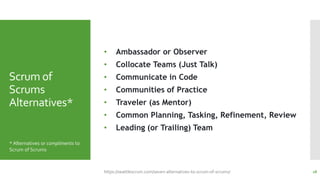
Alternatives*
• Ambassador or Observer
• Collocate Teams (Just Talk)
• Communicate in Code
• Communities of Practice
• Traveler (as Mentor)
• Common Planning, Tasking, Refinement, Review
• Leading (or Trailing) Team
18
https://seattlescrum.com/seven-alternatives-to-scrum-of-scrums/
* Alternatives or compliments to
Scrum of Scrums
Onshore-
Offshore
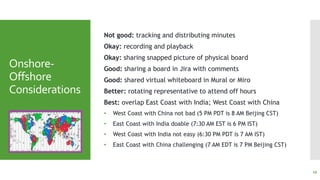
Considerations
Not good: tracking and distributing minutes
Okay: recording and playback
Okay: sharing snapped picture of physical board
Good: sharing a board in Jira with comments
Good: shared virtual whiteboard in Mural or Miro
Better: rotating representative to attend off hours
Best: overlap East Coast with India; West Coast with China
• West Coast with China not bad (5 PM PDT is 8 AM Beijing CST)
• East Coast with India doable (7:30 AM EST is 6 PM IST)
• West Coast with India not easy (6:30 PM PDT is 7 AM IST)
• East Coast with China challenging (7 AM EDT is 7 PM Beijing CST)
19
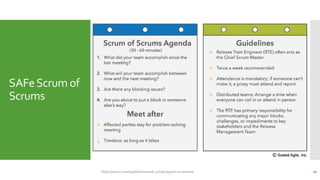
SAFeScrum of
Scrums
20
https://www.scaledagileframework.com/program-increment/
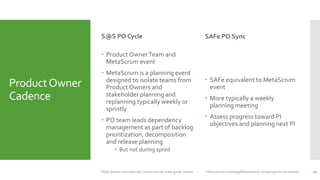
ProductOwner
Cadence
S@S PO Cycle
 Product OwnerTeam and
MetaScrum event
 MetaScrum is a planning event
designed to isolate teams from
Product Owners and
stakeholder planning and
replanning typically weekly or
sprintly
 PO team leads dependency
management as part of backlog
prioritization, decomposition
and release planning
 But not during sprint
SAFe PO Sync
 SAFe equivalent to MetaScrum
event
 More typically a weekly
planning meeting
 Assess progress toward PI
objectives and planning next PI
21
https://www.scrumatscale.com/scrum-at-scale-guide-online/ https://www.scaledagileframework.com/program-increment/
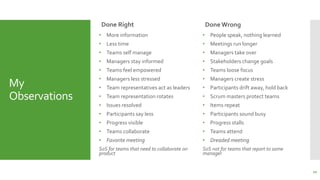
My
Observations
Done Right
• More information
• Less time
• Teams self manage
• Managers stay informed
• Teams feel empowered
• Managers less stressed
• Team representatives act as leaders
• Team representation rotates
• Issues resolved
• Participants say less
• Progress visible
• Teams collaborate
• Favorite meeting
SoS for teams that need to collaborate on
product
Done Wrong
• People speak, nothing learned
• Meetings run longer
• Managers take over
• Stakeholders change goals
• Teams loose focus
• Managers create stress
• Participants drift away, hold back
• Scrum masters protect teams
• Items repeat
• Participants sound busy
• Progress stalls
• Teams attend
• Dreaded meeting
SoS not for teams that report to same
manager
22

Scrum of Scrums Patterns Library

  • 1.
    Scrum ofScrums Patterns Library DavidHanson ANE 101, February 2021 1
  • 2.
    Agile 101: Scrum ofScrums DavidHanson dphanson63@yahoo.com linkedin.com/in/david-hanson/ slideshare.net/DavidHanson5 About the session and me When scalingAgile, an effective Scrum of Scrums is fundamental to success.This session will review common patterns for Scrum of Scrums, with varied purpose and format. Successful practices, learned experience, potential anti- patterns, and alternatives to Scrum of Scrums will be discussed. David Hanson has established 8 Scrum of Scrums for 4 organizations over the past 8 years as an Agile coach or Scrum master. About you What’s your experience scaling Agile? Are you practicing Scrum of Scrums? Are you considering Scrum of Scrums? Has your Scrum of Scrums been effective? What are you hoping to learn? 2
  • 3.
    Scrum of Scrums 3 The Scrumof Scrums is a recurring event for multiple Scrum teams to coordinate their work during a sprint. The Scrum of Scrums is analogous to the Daily Scrum.
  • 4.
    Scrum of Scrums Patterns • Standard •Scaled Daily Scrum (Sutherland) • Nexus (Schwaber) • MyVariation • Walk-the-board • Anti-patterns &Values • Appendix: Alternatives, Global, SAFe, MetaScrum 4
  • 5.
    Standard Pattern Attendees • Any oneteam member from each team • Stakeholders and management may attend as observers Questions: 3 + 1 1) What our team accomplished since last SoS? 2) What our team plans to accomplish by next SoS? 3) What obstacles our team has impeding our progress? 4) What impending risks our team will be introducing to other teams? Purpose • Inspect and adapt towards collective sprint goals Frequency & Duration • On cadence, as often as needed • Up to 30 minutes per meeting • Same time, same place After Meeting • Extend for problem solving, if right participants available 5
  • 6.
    Scaled Daily Scrum Purpose To optimizecollaboration and performance across teams Goal: reduce decision latency Questions (“examples” verbatim) 1. What impediments does a team have that will prevent them from accomplishing their Sprint Goal or that will impact the upcoming release? 2. Is a team doing anything that will prevent another team from accomplishing their Sprint Goal or that will impact their upcoming release? (risks) 3. Have any new dependencies between the teams or a way to resolve an existing dependency been discovered? Attendees • One representative per team • Plus representative from PO team • Chief Scrum master facilitates • Other team members as needed • Maximum five Scrum teams • Misinterpretation: part of Scrum master cycle, so send only Scrum masters Frequency & Duration • Meets daily for 15 minutes After Meeting • Next level Scrum of Scrums follows immediately after, concluding with Executive Action Team 6 https://www.scrumatscale.com/scrum-at-scale-guide-online/
  • 7.
    Nexus Daily Scrum Purpose • Addressany unresolved integration issues between teams from prior day • Assumes all teams integrate code at least daily Questions 1. Was the previous day’s work successfully integrated? If not, why not? 2.What new dependencies or impacts have been identified? 3. What information needs to be shared across teams in the Nexus? Attendees • One member from each team • Up to 9 Scrum teams • Members may also serve on the Nexus IntegrationTeam Frequency &Timing • Meets daily before each team’s Daily Scrum After Meeting • Unresolved integration issues inform each team’s daily plan, discussed in their Daily Scrums 7 https://www.scrum.org/resources/online-nexus-guide
  • 8.
    A Bended Rules Approach Purpose • Meetcollective commitments, no excuses, w/o management Attendees • Two members from each team, one speaker, one listener • Up to five teams participate • Chief SM as facilitator • Optional: Shared cross-team resources as participant • Optional: Chief PO as observer • Management invited as observer Prompts 1. Obstacles want help with 2. Dependencies want to highlight 3. Risks to other teams 4. Current focus; yesterday, today, tomorrow Frequency & Duration • Meet two or three times weekly • If twice/week keep to 30 min • If thrice/week keep to 20 min Whiteboard • Same time, same place with whiteboard • CSM records keywords for next meeting and insures prior meeting issues resolved After Meeting • Participants determine when to meet for problem solving before meeting adjourns • CSM escalates to EAT as required 8 This “bended rules” pattern evolved over the course of a year starting from the “standard” pattern for our SoS.
  • 9.
    Whiteboard Team Obstacles want helpwith Dependencies want to highlight Risks to other teams Current Focus yesterday, today, tomorrow Core Need data Advanced Related Infrastruc-ture team A related story Data Vendor Next data Support Next release next weekend 10
  • 10.
    Whiteboard Team Obstacles want helpwith Dependencies want to highlight Risks to other teams Current Focus yesterday, today, tomorrow Core Need data Test w/ related A core story Advanced Test failing External team An advanced story Related Infrastruc-ture team A related story Test w/ core Data Next data, tomorrow Finished data Starting next Support System outage Defect logged Next release next weekend 11
  • 11.
    Learned Experience Current Focus Attempts toreport what accomplished before and plan to accomplish after proved challenging when aggregated by team and not reported daily Dependencies • Dependencies escalated to Obstacles when blocking • Dependencies served as notification of risk from teams not represented in SoS Speaker and Listener • Speaker focused on insuring team’s needs represented • Listener focused on insuring other teams understood need Timing • Start when one representative from each team present • Some members felt 15 minutes, even twice weekly, enough Representation • Initially attended by PO and SM • Later attended by team member (speaker) and PO or SM (listener) Facilitation • Whiteboard time saver over Jira • Calling out teams using prompts kept meeting on focus with pace • Flag unresolved or recurring issues or broad statements lacking measurable progress 12
  • 12.
  • 13.
    Walk Board Purpose • Escalateimpediments, dependencies, and risks Format • Board with impediments, dependencies, and risks • Note Done items, commenting on actions for teams and lessons learned • Note Doing items, commenting on progress, path to closure, help needed, timeline • Note To Do items, commenting on path forward or asking for inputs Representation • Each team • Whomever logged impediment or dependency Options • Add swimlanes • by impediment, dependency, risk • by team • Handle risks as risk of impediment or dependency risk Before Meeting • Teams log issues for escalation • CSM or CPO prioritize backlog • CSM might prioritize impediments • CPO might prioritize dependencies After Meeting • Follow up actions to resolve issues • between teams • with external teams • Flag issues for escalation to next level Scrum of Scrums To Do Doing Done 14
  • 14.
    Observed Anti-patterns Purpose • Issues orstatus meeting • Changing sprint goals Attendees • Just Scrum masters • Stakeholder interjecting or manager micromanaging • Sporadic attendance • Always same people, never same people • Waiting for someone “important” Format • Dual impediment, dependency meetings • Open ended discussion • No format Content • Broad statements • Speaking without listening • Raising self-managed issues • Reporting to look busy Frequency & Duration • Meets daily for 30 minutes • Meeting only weekly • Meeting canceled • Expands to fill time After Meeting • Rushed with no opportunity for follow-up after meeting • Recurring issues not escalated, not resolved Lacking need; teams independent 15
  • 15.
    Meeting “Values” Purpose: empowering teamsover informing managers Attendees: team members over Scrum masters Format: repeatable cadence over ad hoc discussion Content: impediments & dependencies over yesterday & today Frequency & Duration: recurring & timeboxed over as needed & unlimited After Meeting: taking joint action over relying on others Tools: discussion & collaboration over logging & recording Inspect and adapt While both sides have value, I value the left side more.
  • 16.
    Appendix Alternatives Onshore-Offshore SAFe Scrum ofScrums Product Owner Cadence Done Right, DoneWrong 17
  • 17.
    Scrum of Scrums Alternatives* • Ambassadoror Observer • Collocate Teams (Just Talk) • Communicate in Code • Communities of Practice • Traveler (as Mentor) • Common Planning, Tasking, Refinement, Review • Leading (or Trailing) Team 18 https://seattlescrum.com/seven-alternatives-to-scrum-of-scrums/ * Alternatives or compliments to Scrum of Scrums
  • 18.
    Onshore- Offshore Considerations Not good: trackingand distributing minutes Okay: recording and playback Okay: sharing snapped picture of physical board Good: sharing a board in Jira with comments Good: shared virtual whiteboard in Mural or Miro Better: rotating representative to attend off hours Best: overlap East Coast with India; West Coast with China • West Coast with China not bad (5 PM PDT is 8 AM Beijing CST) • East Coast with India doable (7:30 AM EST is 6 PM IST) • West Coast with India not easy (6:30 PM PDT is 7 AM IST) • East Coast with China challenging (7 AM EDT is 7 PM Beijing CST) 19
  • 19.
  • 20.
    ProductOwner Cadence S@S PO Cycle Product OwnerTeam and MetaScrum event  MetaScrum is a planning event designed to isolate teams from Product Owners and stakeholder planning and replanning typically weekly or sprintly  PO team leads dependency management as part of backlog prioritization, decomposition and release planning  But not during sprint SAFe PO Sync  SAFe equivalent to MetaScrum event  More typically a weekly planning meeting  Assess progress toward PI objectives and planning next PI 21 https://www.scrumatscale.com/scrum-at-scale-guide-online/ https://www.scaledagileframework.com/program-increment/
  • 21.
    My Observations Done Right • Moreinformation • Less time • Teams self manage • Managers stay informed • Teams feel empowered • Managers less stressed • Team representatives act as leaders • Team representation rotates • Issues resolved • Participants say less • Progress visible • Teams collaborate • Favorite meeting SoS for teams that need to collaborate on product Done Wrong • People speak, nothing learned • Meetings run longer • Managers take over • Stakeholders change goals • Teams loose focus • Managers create stress • Participants drift away, hold back • Scrum masters protect teams • Items repeat • Participants sound busy • Progress stalls • Teams attend • Dreaded meeting SoS not for teams that report to same manager 22

Editor's Notes

  • #4 https://www.mountaingoatsoftware.com/agile/scrum/roles/team https://www.mountaingoatsoftware.com/articles/advice-on-conducting-the-scrum-of-scrums-meeting
  • #7 To optimize collaboration and performance, the Scaled Daily Scrum event mirrors the Daily Scrum, in that it is a forum to discuss how teams can work together more effectively, what has been done, what will be done, what is going wrong & why, and what the group is going to do about it. The main talking points of a Daily Scrum are the progress of items in the Sprint Backlog and impediments to getting them done. In a scaled setting, the Scrum of Scrums needs to understand collective progress and be responsive to impediments raised by participating teams. Prior version added (paraphrased): Has team learned anything new to be shared with other teams? Goal: reducing decision latency
  • #9 This pattern in use at SSGA since 2014. Held late morning, included representatives from US, UK, and India.
  • #10 Animate dependency becoming obstacle Animate obstacle escalating and helping Animate obstacle resolved
  • #11 Animate dependency becoming obstacle Animate obstacle escalating and helping Animate obstacle resolved
  • #12 Animate dependency becoming obstacle Animate obstacle escalating and helping Animate obstacle resolved
  • #17 Format: prompts or questions Frequency & duration: total 1 hour/week: 30 min 2 days, 20 min 3 days, 15 min 4 days Tools: whiteboard and marker or Jira and keyboard
  • #19 https://seattlescrum.com/seven-alternatives-to-scrum-of-scrums/
  • #21 Scrum of Scrums The Release Train Engineer (RTE) typically facilitates a weekly (or more frequently, as needed) Scrum of Scrums (SoS) event. The SoS helps coordinate the dependencies of the ARTs and provides visibility into progress and impediments. The RTE, representatives from each team (often the Scrum Master), and others (where appropriate) meet to review their progress toward milestones and PI objectives, and dependencies among the teams. The event is timeboxed for 30-60 minutes and is followed by a ‘meet after’ where individuals who want to do a deeper dive into specific problems can remain behind. A suggested agenda for the SoS event is shown in Figure 3. © Scaled Agile, Inc. Include this copyright notice with the copied content.
  • #22 PO Sync In a manner similar to the SoS, a PO sync is often held for Product Owners and Product Management. This event typically occurs weekly, or more frequently, as needed. The PO sync is also timeboxed (30 – 60 minutes) and is followed by a meet after to solve any problems. The PO sync may be facilitated by the RTE or a Product Manager. The purpose is to get visibility into how well the ART is progressing toward meeting its PI objectives, to discuss problems or opportunities with Feature development, and to assess any scope adjustments. The event may also be used to prepare for the next PI (see below) and may include Program Backlog refinement and Weighted Shortest Job First (WSJF) prioritization ahead of the next PI planning event. Note: As illustrated in Figure 2, sometimes the SoS and PO sync are combined into one event, referred to as an ART sync. © Scaled Agile, Inc. Include this copyright notice with the copied content. Read the FAQs on how to use SAFe content and trademarks here: https://www.scaledagile.com/about/about-us/permissions-faq/ Explore Training at: https://www.scaledagile.com/training/calendar/
  • #23 Speak to four bullets at a time