1
Chris Chan
Agile Innovation
Thinking Like A Startup
2
I AM
@c2reflexions
c2reflexions.com Conference
www.agilecoachcampaustralia.org
Meetup User Groups
Agile Coaching Circles: www.meetup.com/AgileCoach
Lean Coffee: www.meetup.com/Melbourne-Lean-Coffee
Large-Scale Scrum (LeSS): www.meetup.com/LargeScaleScrum
3
What does innovation mean?
Chris Chan | @c2reflexions
4
“Coming up with something
new and useful”
Chris Chan | @c2reflexions
(it’s profitable application of creativity)
5
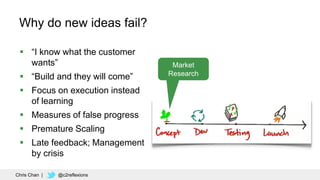
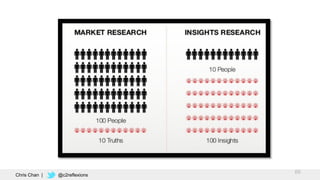
Why do new ideas fail?
 “I know what the customer
wants”
 “Build and they will come”
 Focus on execution instead
of learning
 Measures of false progress
 Premature Scaling
 Late feedback; Management
by crisis
Market
Research
Chris Chan | @c2reflexions
6
2 questions that
“real” innovation
KILL “What’s the ROI?”
and
“When will I see it?”
Chris Chan | @c2reflexions
7
Chris Chan | @c2reflexions
8
Pace of Change around us overtakes organisation’s rate of learning
-- Eddie Obeng
Chris Chan | @c2reflexions
9
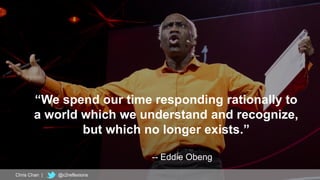
“We spend our time responding rationally to
a world which we understand and recognize,
but which no longer exists.”
-- Eddie Obeng
Chris Chan | @c2reflexions
10
Are you’re a responsive organisation?
Chris Chan | @c2reflexions
11
Chris Chan | @c2reflexions
Responsive Organizations are built to learn
and respond rapidly through the open flow
of information;
encouraging experimentation and learning
on rapid cycles;
and organizing as a network of employees,
customers, and partners motivated by
shared purpose.
www.responsive.org/manifesto
12
How do you explore new opportunities in an
existing enterprise business?
Chris Chan | @c2reflexions
13
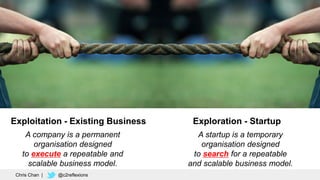
Exploration - StartupExploitation - Existing Business
A company is a permanent
organisation designed
to execute a repeatable and
scalable business model.
A startup is a temporary
organisation designed
to search for a repeatable
and scalable business model.
Chris Chan | @c2reflexions
14
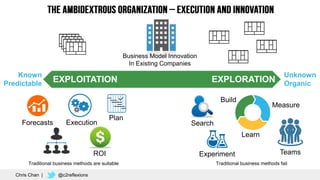
Business Model Innovation
In Existing Companies
EXPLOITATION EXPLORATION
Known
Predictable
Unknown
Organic
Execution
ROI
Plan
Forecasts
Traditional business methods are suitable
Search
Experiment
Build
Measure
Learn
Traditional business methods fail
Teams
Chris Chan | @c2reflexions
15
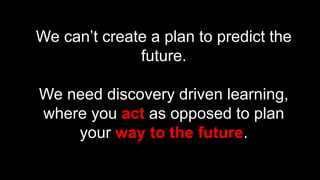
We can’t create a plan to predict the
future.
We need discovery driven learning,
where you act as opposed to plan
your way to the future.
16
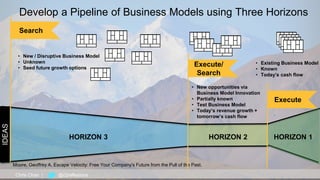
Develop a Pipeline of Business Models using Three Horizons
HORIZON 1HORIZON 2HORIZON 3
Chris Chan | @c2reflexions
IDEAS
Moore, Geoffrey A. Escape Velocity: Free Your Company's Future from the Pull of the Past.
Execute
• Existing Business Model
• Known
• Today’s cash flow
Execute/
Search
• New opportunities via
Business Model Innovation
• Partially known
• Test Business Model
• Today’s revenue growth +
tomorrow’s cash flow
Search
• New / Disruptive Business Model
• Unknown
• Seed future growth options
17
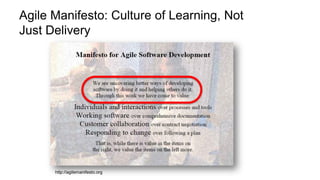
Agile Manifesto: Culture of Learning, Not
Just Delivery
http://agilemanifesto.org
18
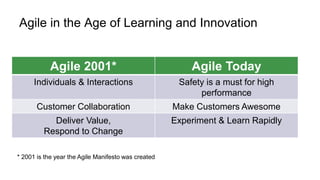
Agile in the Age of Learning and Innovation
Agile 2001* Agile Today
Individuals & Interactions Safety is a must for high
performance
Customer Collaboration Make Customers Awesome
Deliver Value,
Respond to Change
Experiment & Learn Rapidly
* 2001 is the year the Agile Manifesto was created
19
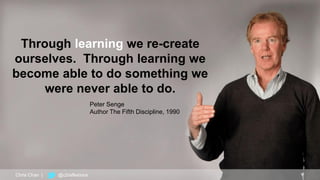
Through learning we re-create
ourselves. Through learning we
become able to do something we
were never able to do.
Peter Senge
Author The Fifth Discipline, 1990
Chris Chan | @c2reflexions
20
ExplorationExploitation
21
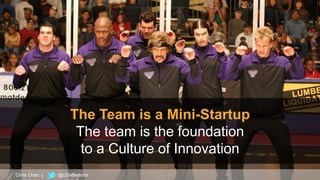
The Team is a Mini-Startup
The team is the foundation
to a Culture of Innovation
Chris Chan | @c2reflexions
Is your team really a team?
23
Two prerequisites to becoming a team:
1. Team Purpose
2. Interdependence among members
25
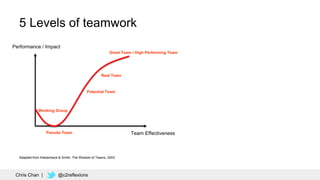
Performance / Impact
Adapted from Katzenback & Smith, The Wisdom of Teams, 2003
Working Group
Team Effectiveness
Potential Team
Pseudo Team
Real Team
Great Team / High Performing Team
5 Levels of teamwork
Chris Chan | @c2reflexions
26
Performance / Impact
Working Group
Team EffectivenessPseudo Team
Great Team / High Performing Team
5 Levels of teamwork
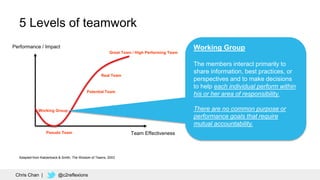
Working Group
The members interact primarily to
share information, best practices, or
perspectives and to make decisions
to help each individual perform within
his or her area of responsibility.
There are no common purpose or
performance goals that require
mutual accountability.
Potential Team
Real Team
Adapted from Katzenback & Smith, The Wisdom of Teams, 2003
Chris Chan | @c2reflexions
27
Performance / Impact
Working Group
Team EffectivenessPseudo Team
Great Team / High Performing Team
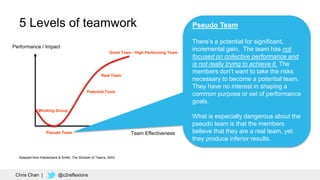
5 Levels of teamwork Pseudo Team
There’s a potential for significant,
incremental gain. The team has not
focused on collective performance and
is not really trying to achieve it. The
members don’t want to take the risks
necessary to become a potential team.
They have no interest in shaping a
common purpose or set of performance
goals.
What is especially dangerous about the
pseudo team is that the members
believe that they are a real team, yet
they produce inferior results.
Potential Team
Real Team
Adapted from Katzenback & Smith, The Wisdom of Teams, 2003
Chris Chan | @c2reflexions
28
Performance / Impact
Working Group
Team EffectivenessPseudo Team
Great Team / High Performing Team
5 Levels of teamwork
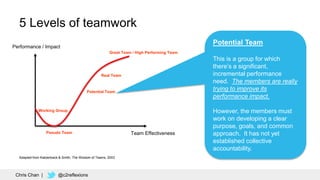
Potential Team
This is a group for which
there’s a significant,
incremental performance
need. The members are really
trying to improve its
performance impact.
However, the members must
work on developing a clear
purpose, goals, and common
approach. It has not yet
established collective
accountability.
Potential Team
Real Team
Adapted from Katzenback & Smith, The Wisdom of Teams, 2003
Chris Chan | @c2reflexions
29
Performance / Impact
Working Group
Team EffectivenessPseudo Team
Great Team / High Performing Team
5 Levels of teamwork
Real Team
This is a small number of
people with complementary
skills who are equally
committed to a common
purpose, goals, and working
approach for which they hold
themselves mutually
accountable.
Potential Team
Real Team
Adapted from Katzenback & Smith, The Wisdom of Teams, 2003
Chris Chan | @c2reflexions
30
Performance / Impact
Working Group
Team EffectivenessPseudo Team
Great Team / High Performing Team
5 Levels of teamwork High Performing Team
This has all the characteristics of
a real team, but the members are
deeply committed to one
another’s personal growth and
development. They far out-
perform all other teams. The
members form powerful
relationships. Moving from a real
team to a high performance team
requires a very strong personal
commitment.
They outperform all reasonable
expectations given its
membership
Potential Team
Real Team
Adapted from Katzenback & Smith, The Wisdom of Teams, 2003
Chris Chan | @c2reflexions
31
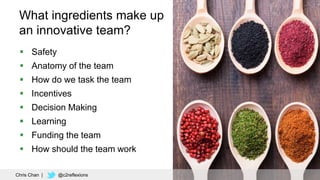
What ingredients make up
an innovative team?
 Safety
 Anatomy of the team
 How do we task the team
 Incentives
 Decision Making
 Learning
 Funding the team
 How should the team work
Chris Chan | @c2reflexions
32
Chris Chan | @c2reflexions
33
People Operations (HR)
 Dubbed ‘Project Aristotle’
 2 year study
 200+ interviews
 250 attributes
 180+ active Google teams
https://rework.withgoogle.com/blog/five-keys-to-a-successful-google-team/
Chris Chan | @c2reflexions
34
We were pretty confident that we'd find the
perfect mix of individual traits and skills
necessary for a stellar team.
Who is on a team matters less than how
the team members interact, structure their
work, and view their contributions
Julia Rozovsky, Google People Operations Analyst
Chris Chan | @c2reflexions
35
Chris Chan | @c2reflexions
36
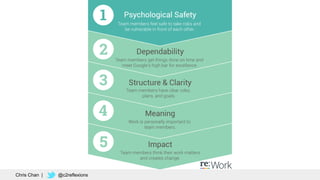
Psychological safety was far and
away the most important of the five
dynamics we found -- it’s the
underpinning of the other four.
Chris Chan | @c2reflexions
37
Feeling safe in the workplace
helps encourage the spirit of
experimentation so critical for
innovation.
https://hbr.org/2015/12/proof-that-positive-work-cultures-are-more-productive
Amy Edmondson, Harvard
Chris Chan | @c2reflexions
38
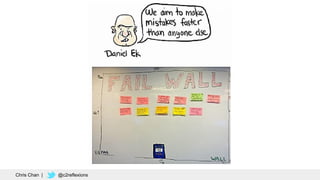
In a startup ‘fear of failure’ drives
speed and urgency.
In a large company ‘fear of failure’
inhibits speed and risk.
Steve Blank
39
Chris Chan | @c2reflexions
40
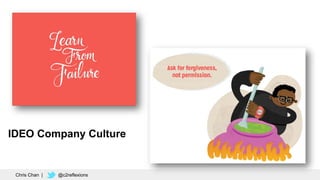
IDEO Company Culture
Chris Chan | @c2reflexions
41
Blameless Retrospectives
 Requires Psychological Safety
 View mistakes, errors, slips,
lapses, etc. with a perspective of
learning
 Learn the facts without fear of
punishment or retribution
 Critical for “real” continuous
improvement and learning
42
Retrospective Prime Directive
Regardless of what we discover, we
understand and truly believe that everyone
did the best job he or she could, given what
was known at the time, his or her skills and
abilities, the resources available, and the
situation at hand
www.retrospectives.com/pages/retroPrimeDirective.html
43
Anatomy of a Team
 Small (Amazon two pizza team)
 Co-located (reduce feedback loop &
hand-offs)
 Dedicated team members
 Cross Functional (T-Shaped People)
• Exploit specialisation where possible,
break it when it becomes a bottleneck
Chris Chan | @c2reflexions
44
Task Teams to Achieve Business Outcomes
 Business outcomes are measurable changes to
customer behaviour. They are objective measures to
success.
 Give teams a problem to solve, not a solution to
implement.
 Specify “true north” and let teams figure out how to
achieve the goals and move the needle.
 Empower teams, not individuals.
Chris Chan | @c2reflexions
45
Re-defining “Done”
Agile 2001 Style
Chris Chan | @c2reflexions
46
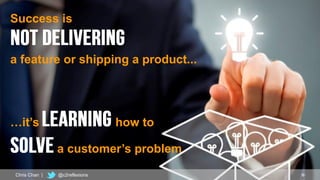
Success is
a feature or shipping a product...
…it’s how to
a customer’s problem
Chris Chan | @c2reflexions
47
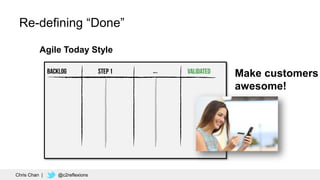
Re-defining “Done”
Agile Today Style
Chris Chan | @c2reflexions
Make customers
awesome!
48
Photo: Andiyan Lutfi
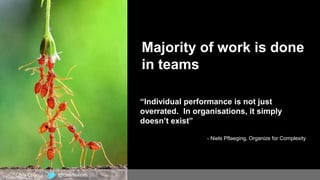
Majority of work is done
in teams
“Individual performance is not just
overrated. In organisations, it simply
doesn’t exist”
- Niels Pflaeging, Organize for Complexity
Chris Chan | @c2reflexions
49
Team Based Incentives
 Teams are accountable for the
outcomes (not output)
 Value arises from the interaction
between various individuals, or
within teams.
 Collective applied competencies
and abilities in the system that
make a difference.
50
IDEO Company Culture
Chris Chan | @c2reflexions
51
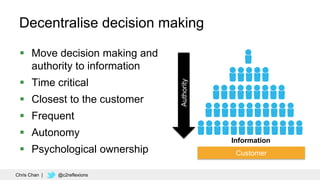
Decentralise decision making
 Move decision making and
authority to information
 Time critical
 Closest to the customer
 Frequent
 Autonomy
 Psychological ownership Customer
Information
Authority
Chris Chan | @c2reflexions
52
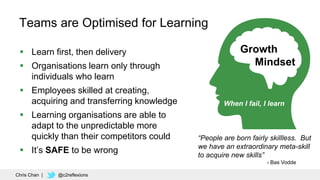
Teams are Optimised for Learning
 Learn first, then delivery
 Organisations learn only through
individuals who learn
 Employees skilled at creating,
acquiring and transferring knowledge
 Learning organisations are able to
adapt to the unpredictable more
quickly than their competitors could
 It’s SAFE to be wrong
Growth
Mindset
When I fail, I learn
Chris Chan | @c2reflexions
“People are born fairly skillless. But
we have an extraordinary meta-skill
to acquire new skills”
- Bas Vodde
53
Change the Funding Model
What we say is that we don’t exactly know what we’re going to
do, but we know there is an opportunity to do something.
We have tried to move away from highly defined business cases
that state this is exactly what you’ll get, as teams feel very
constricted by that.
It’s a simple, high-level target that you then give to the team,
along with funding, to get going. They then feel less constrained
and feel more able to experiment and innovate.
- Cameron Gogh, Australia Post GM, Digital Delivery Centre
Capacity Funded Investment
Chris Chan | @c2reflexions
www.cmo.com.au/article/595460/making-digital-new-way-innovating-australia-post
54
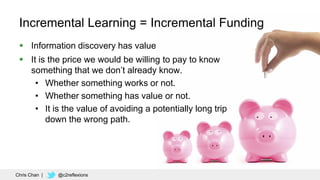
Incremental Learning = Incremental Funding
 Information discovery has value
 It is the price we would be willing to pay to know
something that we don’t already know.
• Whether something works or not.
• Whether something has value or not.
• It is the value of avoiding a potentially long trip
down the wrong path.
Chris Chan | @c2reflexions
55Fund Teams to Achieve Business Outcomes,
Not Pieces of Work
Stakeholders &
Investment Committee
Small bite, continuous funding blocks
Team
What have we learned?
What outcomes did we achieve?
What other experiments do we need?
What have we learned about benefits and
costs?
secure funding
Chris Chan | @c2reflexions
Decisions based on objective observations & evidence
Change Customer Behaviour,
Measure outcomes (move the needle)
& Validate Business Model
56
And finally…..
…..how should the team work?
Chris Chan | @c2reflexions
57
ExplorationExploitation
DESIGN THINKING
What was the best gift you have received?
Why?
Chris Chan | @c2reflexions
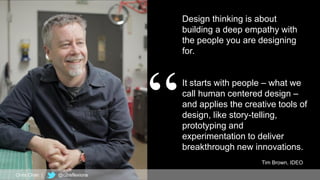
Design thinking is about
building a deep empathy with
the people you are designing
for.
It starts with people – what we
call human centered design –
and applies the creative tools of
design, like story-telling,
prototyping and
experimentation to deliver
breakthrough new innovations.
Tim Brown, IDEO
Chris Chan | @c2reflexions
62
Chris Chan | @c2reflexions
63
Chris Chan | @c2reflexions
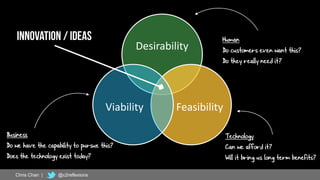
Desirability
FeasibilityViability
Human
Do customers even want this?
Do they really need it?
Technology
Can we afford it?
Will it bring us long term benefits?
Business
Do we have the capability to pursue this?
Does the technology exist today?
Chris Chan | @c2reflexions
65
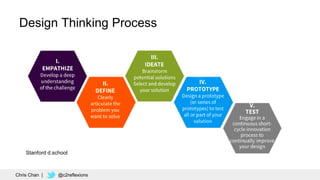
Design Thinking Process
Chris Chan | @c2reflexions
Stanford d.school
66
Chris Chan | @c2reflexions
67
Chris Chan | @c2reflexions
LEAN STARTUP
69
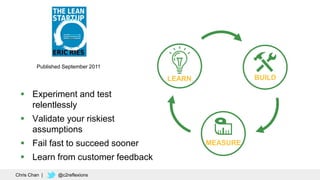
Published September 2011
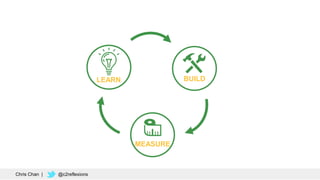
BUILDLEARN
MEASURE
 Experiment and test
relentlessly
 Validate your riskiest
assumptions
 Fail fast to succeed sooner
 Learn from customer feedback
Chris Chan | @c2reflexions
70
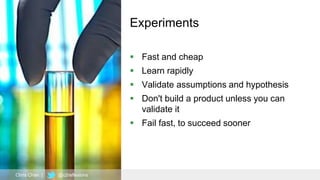
Experiments
 Fast and cheap
 Learn rapidly
 Validate assumptions and hypothesis
 Don't build a product unless you can
validate it
 Fail fast, to succeed sooner
Chris Chan | @c2reflexions
71
Failure is Success if we Learn from It
Breakthrough insights are usually
hidden within failed experiments.
“There is no such thing as a failed
experiment – only unexpected outcomes.”
- Buckminster Fuller, Architect & Inventor
Chris Chan | @c2reflexions
72
Unexpected Outcomes need to be Declared Upfront
“If you simply plan on seeing what happens,
you will always succeed at seeing what
happens.”
- Eric Ries, The Lean Startup
Chris Chan | @c2reflexions
73
BUILDLEARN
MEASURE
Chris Chan | @c2reflexions
Δ
74
BUILDLEARN
MEASURE
Chris Chan | @c2reflexions
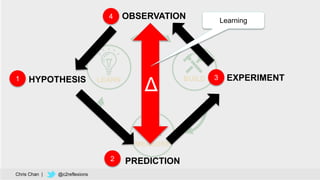
HYPOTHESIS1
PREDICTION2
EXPERIMENT3
OBSERVATION4
Δ
Learning
75
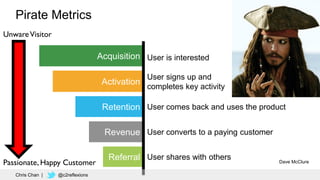
Pirate Metrics
Acquisition
Activation
Retention
Revenue
Referral
User is interested
User comes back and uses the product
User converts to a paying customer
User shares with others
User signs up and
completes key activity
Dave McClure
Chris Chan | @c2reflexions
UnwareVisitor
Passionate, Happy Customer
76
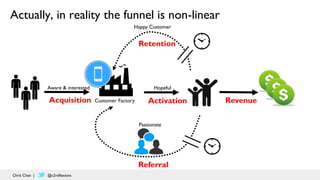
Chris Chan | @c2reflexions
Hopeful
Activation Revenue
Happy Customer
Retention
Passionate
Referral
Actually, in reality the funnel is non-linear
Aware & interested
Acquisition Customer Factory
77
Chris Chan | @c2reflexions
78
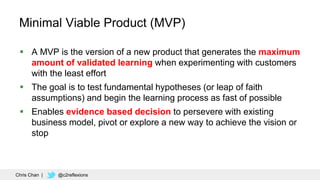
Minimal Viable Product (MVP)
 A MVP is the version of a new product that generates the maximum
amount of validated learning when experimenting with customers
with the least effort
 The goal is to test fundamental hypotheses (or leap of faith
assumptions) and begin the learning process as fast of possible
 Enables evidence based decision to persevere with existing
business model, pivot or explore a new way to achieve the vision or
stop
Chris Chan | @c2reflexions
79
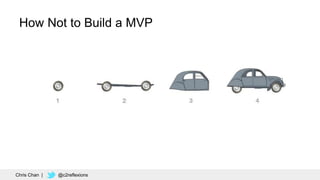
How Not to Build a MVP
Chris Chan | @c2reflexions
80
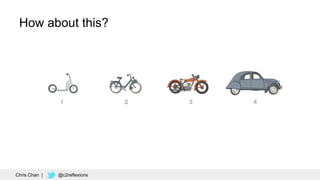
Is this how to build an MVP?
Chris Chan | @c2reflexions
81
How about this?
Chris Chan | @c2reflexions
82
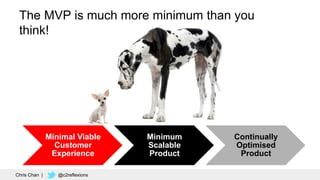
The MVP is much more minimum than you
think!
Minimal Viable
Customer
Experience
Minimum
Scalable
Product
Continually
Optimised
Product
Chris Chan | @c2reflexions
83
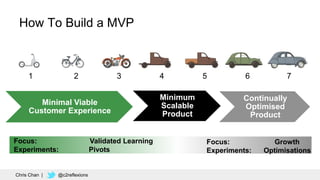
How To Build a MVP
Chris Chan | @c2reflexions
Minimal Viable
Customer Experience
Minimum
Scalable
Product
Continually
Optimised
Product
1 2 3 4 5 6 7
Focus: Validated Learning
Experiments: Pivots
Focus: Growth
Experiments: Optimisations
with real customers, partners and vendors
Get out of the building and
Test
each hypothesis
Chris Chan | @c2reflexions
85
It’s all about the Evidence
 Prove you have a consistent customer
problem
 Prove your solution will solve the
customer problem
 Prove that you can acquire customers
 Prove that customers will pay
 Prove that you can deliver the solution for
less than what the customer will pay
 Prove that you can scale (only after
proving other points)
Don’t scale execution until
you’ve
VERIFIED
the business model or
changed customer
behaviour
Seeking benefits/profit too early is a pre-optimisation trap
BUSINESS MODEL
INNOVATION
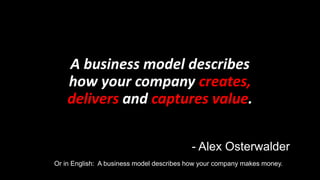
A business model describes
how your company creates,
delivers and captures value.
- Alex Osterwalder
Or in English: A business model describes how your company makes money.
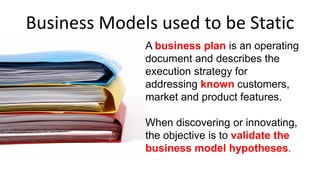
Business Models used to be Static
A business plan is an operating
document and describes the
execution strategy for
addressing known customers,
market and product features.
When discovering or innovating,
the objective is to validate the
business model hypotheses.
90
Chris Chan | @c2reflexions
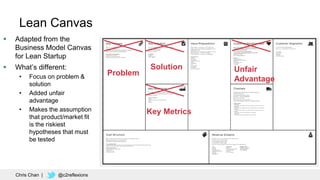
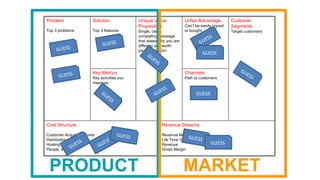
Lean Canvas
 Adapted from the
Business Model Canvas
for Lean Startup
 What’s different:
• Focus on problem &
solution
• Added unfair
advantage
• Makes the assumption
that product/market fit
is the riskiest
hypotheses that must
be tested
Problem
Solution
Key Metrics
Unfair
Advantage
Cost Structure
Customer Acquisition costs
Distribution costs
Hosting
People, etc.
Revenue Streams
Revenue Model
Life Time Value
Revenue
Gross Margin
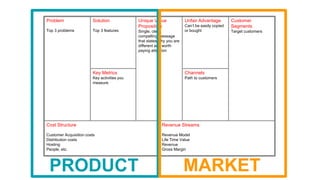
Problem
Top 3 problems
Solution
Top 3 features
Key Metrics
Key activities you
measure
Unique Value
Proposition
Single, clear,
compelling message
that states why you are
different and worth
paying attention
Unfair Advantage
Can’t be easily copied
or bought
Channels
Path to customers
Customer
Segments
Target customers
PRODUCT MARKET
Cost Structure
Customer Acquisition costs
Distribution costs
Hosting
People, etc.
Revenue Streams
Revenue Model
Life Time Value
Revenue
Gross Margin
Problem
Top 3 problems
Solution
Top 3 features
Key Metrics
Key activities you
measure
Unique Value
Proposition
Single, clear,
compelling message
that states why you are
different and worth
paying attention
Unfair Advantage
Can’t be easily copied
or bought
Channels
Path to customers
Customer
Segments
Target customers
PRODUCT MARKET
GUESS
GUESS
GUESS
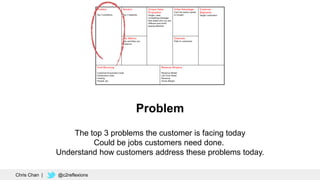
Problem
The top 3 problems the customer is facing today
Could be jobs customers need done.
Understand how customers address these problems today.
Chris Chan | @c2reflexions
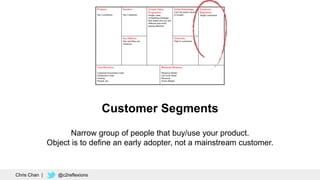
Customer Segments
Narrow group of people that buy/use your product.
Object is to define an early adopter, not a mainstream customer.
Chris Chan | @c2reflexions
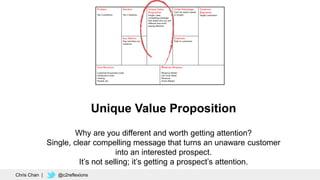
Unique Value Proposition
Why are you different and worth getting attention?
Single, clear compelling message that turns an unaware customer
into an interested prospect.
It’s not selling; it’s getting a prospect’s attention.
Chris Chan | @c2reflexions
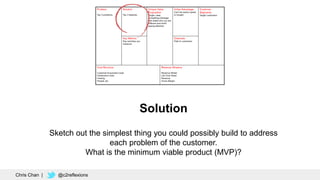
Solution
Sketch out the simplest thing you could possibly build to address
each problem of the customer.
What is the minimum viable product (MVP)?
Chris Chan | @c2reflexions
Channels
How does the customer learn about the product?
SEO, Direct Sales, Tradeshows/Events, Blog, Meetups
Chris Chan | @c2reflexions
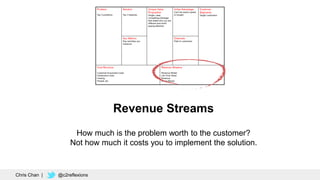
Revenue Streams
How much is the problem worth to the customer?
Not how much it costs you to implement the solution.
Chris Chan | @c2reflexions
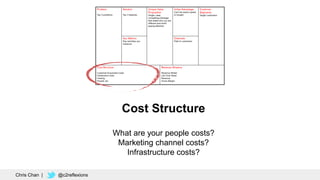
Cost Structure
What are your people costs?
Marketing channel costs?
Infrastructure costs?
Chris Chan | @c2reflexions
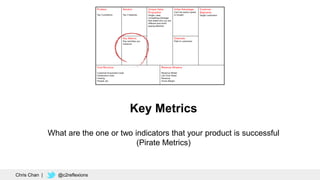
Key Metrics
What are the one or two indicators that your product is successful
(Pirate Metrics)
Chris Chan | @c2reflexions
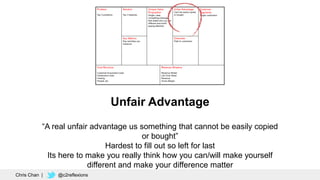
Unfair Advantage
“A real unfair advantage us something that cannot be easily copied
or bought”
Hardest to fill out so left for last
Its here to make you really think how you can/will make yourself
different and make your difference matter
Chris Chan | @c2reflexions
10
2
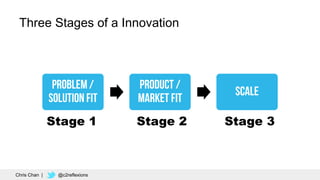
Three Stages of a Innovation
Stage 1 Stage 2 Stage 3
Chris Chan | @c2reflexions
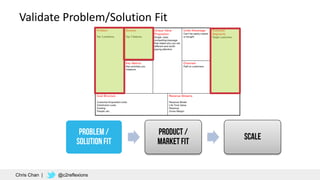
Validate Problem/Solution Fit
Do I have a problem worth solving?Chris Chan | @c2reflexions
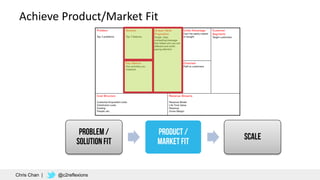
Achieve Product/Market Fit
I have built something people want?
Chris Chan | @c2reflexions
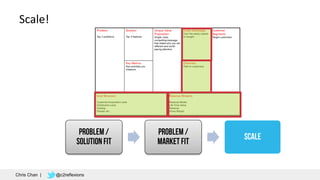
Scale!
How do I accelerate growth?
Chris Chan | @c2reflexions
10
6
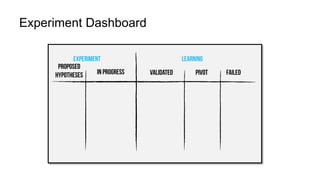
Experiment Dashboard
10
7
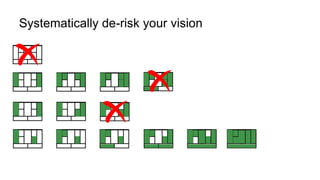
Systematically de-risk your vision
INTEGRATING IT ALL
10
9
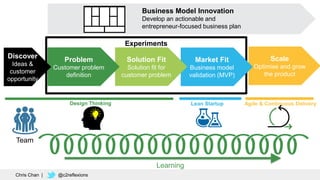
Experiments
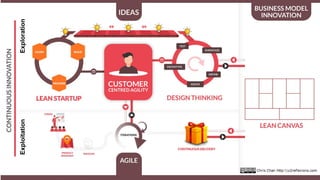
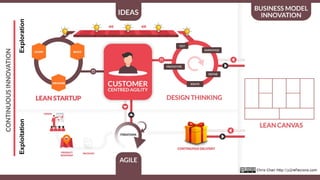
Lean StartupDesign Thinking Agile & Continuous Delivery
Business Model Innovation
Develop an actionable and
entrepreneur-focused business plan
Scale
Optimise and grow
the product
Market Fit
Business model
validation (MVP)
Solution Fit
Solution fit for
customer problem
Problem
Customer problem
definition
Discover
Ideas &
customer
opportunity
Chris Chan | @c2reflexions
Learning
Team
LEARNING has to be core in your corporate DNA.
The only SUSTAINABLE competitive advantage is
the ability to learn faster than our competitor.
Its about building a learning mindset that enables
your organisation to adapt continuously.
Chris Chan | @c2reflexions
11
1
FASTEST
Chris Chan | @c2reflexions
Lessons Learned
• Innovation is as odd to the execution machine
inside of existing companies
• Companies need different policies, procedures
and incentives designed for innovation
• Teams are foundation to innovation
• 4 interrelated approaches for innovation
– Design Thinking
– Lean Startup
– Agile
– Lean Canvas
• Create a culture of learning and experimentation
Chris Chan | @c2reflexions
11
3
@c2reflexions
c2reflexions.comI hope to be a disruptive force
to those who think the way
we develop products and
services is just fine

Agile innovation and Thinking Like a Startup

  • 1.
  • 2.
    2 I AM @c2reflexions c2reflexions.com Conference www.agilecoachcampaustralia.org MeetupUser Groups Agile Coaching Circles: www.meetup.com/AgileCoach Lean Coffee: www.meetup.com/Melbourne-Lean-Coffee Large-Scale Scrum (LeSS): www.meetup.com/LargeScaleScrum
  • 3.
    3 What does innovationmean? Chris Chan | @c2reflexions
  • 4.
    4 “Coming up withsomething new and useful” Chris Chan | @c2reflexions (it’s profitable application of creativity)
  • 5.
    5 Why do newideas fail?  “I know what the customer wants”  “Build and they will come”  Focus on execution instead of learning  Measures of false progress  Premature Scaling  Late feedback; Management by crisis Market Research Chris Chan | @c2reflexions
  • 6.
    6 2 questions that “real”innovation KILL “What’s the ROI?” and “When will I see it?” Chris Chan | @c2reflexions
  • 7.
    7 Chris Chan |@c2reflexions
  • 8.
    8 Pace of Changearound us overtakes organisation’s rate of learning -- Eddie Obeng Chris Chan | @c2reflexions
  • 9.
    9 “We spend ourtime responding rationally to a world which we understand and recognize, but which no longer exists.” -- Eddie Obeng Chris Chan | @c2reflexions
  • 10.
    10 Are you’re aresponsive organisation? Chris Chan | @c2reflexions
  • 11.
    11 Chris Chan |@c2reflexions Responsive Organizations are built to learn and respond rapidly through the open flow of information; encouraging experimentation and learning on rapid cycles; and organizing as a network of employees, customers, and partners motivated by shared purpose. www.responsive.org/manifesto
  • 12.
    12 How do youexplore new opportunities in an existing enterprise business? Chris Chan | @c2reflexions
  • 13.
    13 Exploration - StartupExploitation- Existing Business A company is a permanent organisation designed to execute a repeatable and scalable business model. A startup is a temporary organisation designed to search for a repeatable and scalable business model. Chris Chan | @c2reflexions
  • 14.
    14 Business Model Innovation InExisting Companies EXPLOITATION EXPLORATION Known Predictable Unknown Organic Execution ROI Plan Forecasts Traditional business methods are suitable Search Experiment Build Measure Learn Traditional business methods fail Teams Chris Chan | @c2reflexions
  • 15.
    15 We can’t createa plan to predict the future. We need discovery driven learning, where you act as opposed to plan your way to the future.
  • 16.
    16 Develop a Pipelineof Business Models using Three Horizons HORIZON 1HORIZON 2HORIZON 3 Chris Chan | @c2reflexions IDEAS Moore, Geoffrey A. Escape Velocity: Free Your Company's Future from the Pull of the Past. Execute • Existing Business Model • Known • Today’s cash flow Execute/ Search • New opportunities via Business Model Innovation • Partially known • Test Business Model • Today’s revenue growth + tomorrow’s cash flow Search • New / Disruptive Business Model • Unknown • Seed future growth options
  • 17.
    17 Agile Manifesto: Cultureof Learning, Not Just Delivery http://agilemanifesto.org
  • 18.
    18 Agile in theAge of Learning and Innovation Agile 2001* Agile Today Individuals & Interactions Safety is a must for high performance Customer Collaboration Make Customers Awesome Deliver Value, Respond to Change Experiment & Learn Rapidly * 2001 is the year the Agile Manifesto was created
  • 19.
    19 Through learning were-create ourselves. Through learning we become able to do something we were never able to do. Peter Senge Author The Fifth Discipline, 1990 Chris Chan | @c2reflexions
  • 20.
  • 21.
    21 The Team isa Mini-Startup The team is the foundation to a Culture of Innovation Chris Chan | @c2reflexions
  • 22.
    Is your teamreally a team?
  • 23.
  • 24.
    Two prerequisites tobecoming a team: 1. Team Purpose 2. Interdependence among members
  • 25.
    25 Performance / Impact Adaptedfrom Katzenback & Smith, The Wisdom of Teams, 2003 Working Group Team Effectiveness Potential Team Pseudo Team Real Team Great Team / High Performing Team 5 Levels of teamwork Chris Chan | @c2reflexions
  • 26.
    26 Performance / Impact WorkingGroup Team EffectivenessPseudo Team Great Team / High Performing Team 5 Levels of teamwork Working Group The members interact primarily to share information, best practices, or perspectives and to make decisions to help each individual perform within his or her area of responsibility. There are no common purpose or performance goals that require mutual accountability. Potential Team Real Team Adapted from Katzenback & Smith, The Wisdom of Teams, 2003 Chris Chan | @c2reflexions
  • 27.
    27 Performance / Impact WorkingGroup Team EffectivenessPseudo Team Great Team / High Performing Team 5 Levels of teamwork Pseudo Team There’s a potential for significant, incremental gain. The team has not focused on collective performance and is not really trying to achieve it. The members don’t want to take the risks necessary to become a potential team. They have no interest in shaping a common purpose or set of performance goals. What is especially dangerous about the pseudo team is that the members believe that they are a real team, yet they produce inferior results. Potential Team Real Team Adapted from Katzenback & Smith, The Wisdom of Teams, 2003 Chris Chan | @c2reflexions
  • 28.
    28 Performance / Impact WorkingGroup Team EffectivenessPseudo Team Great Team / High Performing Team 5 Levels of teamwork Potential Team This is a group for which there’s a significant, incremental performance need. The members are really trying to improve its performance impact. However, the members must work on developing a clear purpose, goals, and common approach. It has not yet established collective accountability. Potential Team Real Team Adapted from Katzenback & Smith, The Wisdom of Teams, 2003 Chris Chan | @c2reflexions
  • 29.
    29 Performance / Impact WorkingGroup Team EffectivenessPseudo Team Great Team / High Performing Team 5 Levels of teamwork Real Team This is a small number of people with complementary skills who are equally committed to a common purpose, goals, and working approach for which they hold themselves mutually accountable. Potential Team Real Team Adapted from Katzenback & Smith, The Wisdom of Teams, 2003 Chris Chan | @c2reflexions
  • 30.
    30 Performance / Impact WorkingGroup Team EffectivenessPseudo Team Great Team / High Performing Team 5 Levels of teamwork High Performing Team This has all the characteristics of a real team, but the members are deeply committed to one another’s personal growth and development. They far out- perform all other teams. The members form powerful relationships. Moving from a real team to a high performance team requires a very strong personal commitment. They outperform all reasonable expectations given its membership Potential Team Real Team Adapted from Katzenback & Smith, The Wisdom of Teams, 2003 Chris Chan | @c2reflexions
  • 31.
    31 What ingredients makeup an innovative team?  Safety  Anatomy of the team  How do we task the team  Incentives  Decision Making  Learning  Funding the team  How should the team work Chris Chan | @c2reflexions
  • 32.
    32 Chris Chan |@c2reflexions
  • 33.
    33 People Operations (HR) Dubbed ‘Project Aristotle’  2 year study  200+ interviews  250 attributes  180+ active Google teams https://rework.withgoogle.com/blog/five-keys-to-a-successful-google-team/ Chris Chan | @c2reflexions
  • 34.
    34 We were prettyconfident that we'd find the perfect mix of individual traits and skills necessary for a stellar team. Who is on a team matters less than how the team members interact, structure their work, and view their contributions Julia Rozovsky, Google People Operations Analyst Chris Chan | @c2reflexions
  • 35.
    35 Chris Chan |@c2reflexions
  • 36.
    36 Psychological safety wasfar and away the most important of the five dynamics we found -- it’s the underpinning of the other four. Chris Chan | @c2reflexions
  • 37.
    37 Feeling safe inthe workplace helps encourage the spirit of experimentation so critical for innovation. https://hbr.org/2015/12/proof-that-positive-work-cultures-are-more-productive Amy Edmondson, Harvard Chris Chan | @c2reflexions
  • 38.
    38 In a startup‘fear of failure’ drives speed and urgency. In a large company ‘fear of failure’ inhibits speed and risk. Steve Blank
  • 39.
    39 Chris Chan |@c2reflexions
  • 40.
    40 IDEO Company Culture ChrisChan | @c2reflexions
  • 41.
    41 Blameless Retrospectives  RequiresPsychological Safety  View mistakes, errors, slips, lapses, etc. with a perspective of learning  Learn the facts without fear of punishment or retribution  Critical for “real” continuous improvement and learning
  • 42.
    42 Retrospective Prime Directive Regardlessof what we discover, we understand and truly believe that everyone did the best job he or she could, given what was known at the time, his or her skills and abilities, the resources available, and the situation at hand www.retrospectives.com/pages/retroPrimeDirective.html
  • 43.
    43 Anatomy of aTeam  Small (Amazon two pizza team)  Co-located (reduce feedback loop & hand-offs)  Dedicated team members  Cross Functional (T-Shaped People) • Exploit specialisation where possible, break it when it becomes a bottleneck Chris Chan | @c2reflexions
  • 44.
    44 Task Teams toAchieve Business Outcomes  Business outcomes are measurable changes to customer behaviour. They are objective measures to success.  Give teams a problem to solve, not a solution to implement.  Specify “true north” and let teams figure out how to achieve the goals and move the needle.  Empower teams, not individuals. Chris Chan | @c2reflexions
  • 45.
    45 Re-defining “Done” Agile 2001Style Chris Chan | @c2reflexions
  • 46.
    46 Success is a featureor shipping a product... …it’s how to a customer’s problem Chris Chan | @c2reflexions
  • 47.
    47 Re-defining “Done” Agile TodayStyle Chris Chan | @c2reflexions Make customers awesome!
  • 48.
    48 Photo: Andiyan Lutfi Majorityof work is done in teams “Individual performance is not just overrated. In organisations, it simply doesn’t exist” - Niels Pflaeging, Organize for Complexity Chris Chan | @c2reflexions
  • 49.
    49 Team Based Incentives Teams are accountable for the outcomes (not output)  Value arises from the interaction between various individuals, or within teams.  Collective applied competencies and abilities in the system that make a difference.
  • 50.
    50 IDEO Company Culture ChrisChan | @c2reflexions
  • 51.
    51 Decentralise decision making Move decision making and authority to information  Time critical  Closest to the customer  Frequent  Autonomy  Psychological ownership Customer Information Authority Chris Chan | @c2reflexions
  • 52.
    52 Teams are Optimisedfor Learning  Learn first, then delivery  Organisations learn only through individuals who learn  Employees skilled at creating, acquiring and transferring knowledge  Learning organisations are able to adapt to the unpredictable more quickly than their competitors could  It’s SAFE to be wrong Growth Mindset When I fail, I learn Chris Chan | @c2reflexions “People are born fairly skillless. But we have an extraordinary meta-skill to acquire new skills” - Bas Vodde
  • 53.
    53 Change the FundingModel What we say is that we don’t exactly know what we’re going to do, but we know there is an opportunity to do something. We have tried to move away from highly defined business cases that state this is exactly what you’ll get, as teams feel very constricted by that. It’s a simple, high-level target that you then give to the team, along with funding, to get going. They then feel less constrained and feel more able to experiment and innovate. - Cameron Gogh, Australia Post GM, Digital Delivery Centre Capacity Funded Investment Chris Chan | @c2reflexions www.cmo.com.au/article/595460/making-digital-new-way-innovating-australia-post
  • 54.
    54 Incremental Learning =Incremental Funding  Information discovery has value  It is the price we would be willing to pay to know something that we don’t already know. • Whether something works or not. • Whether something has value or not. • It is the value of avoiding a potentially long trip down the wrong path. Chris Chan | @c2reflexions
  • 55.
    55Fund Teams toAchieve Business Outcomes, Not Pieces of Work Stakeholders & Investment Committee Small bite, continuous funding blocks Team What have we learned? What outcomes did we achieve? What other experiments do we need? What have we learned about benefits and costs? secure funding Chris Chan | @c2reflexions Decisions based on objective observations & evidence Change Customer Behaviour, Measure outcomes (move the needle) & Validate Business Model
  • 56.
    56 And finally….. …..how shouldthe team work? Chris Chan | @c2reflexions
  • 57.
  • 59.
  • 60.
    What was thebest gift you have received? Why? Chris Chan | @c2reflexions
  • 61.
    Design thinking isabout building a deep empathy with the people you are designing for. It starts with people – what we call human centered design – and applies the creative tools of design, like story-telling, prototyping and experimentation to deliver breakthrough new innovations. Tim Brown, IDEO Chris Chan | @c2reflexions
  • 62.
    62 Chris Chan |@c2reflexions
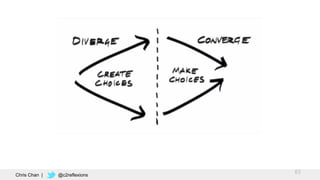
  • 63.
    63 Chris Chan |@c2reflexions
  • 64.
    Desirability FeasibilityViability Human Do customers evenwant this? Do they really need it? Technology Can we afford it? Will it bring us long term benefits? Business Do we have the capability to pursue this? Does the technology exist today? Chris Chan | @c2reflexions
  • 65.
    65 Design Thinking Process ChrisChan | @c2reflexions Stanford d.school
  • 66.
    66 Chris Chan |@c2reflexions
  • 67.
    67 Chris Chan |@c2reflexions
  • 68.
  • 69.
    69 Published September 2011 BUILDLEARN MEASURE Experiment and test relentlessly  Validate your riskiest assumptions  Fail fast to succeed sooner  Learn from customer feedback Chris Chan | @c2reflexions
  • 70.
    70 Experiments  Fast andcheap  Learn rapidly  Validate assumptions and hypothesis  Don't build a product unless you can validate it  Fail fast, to succeed sooner Chris Chan | @c2reflexions
  • 71.
    71 Failure is Successif we Learn from It Breakthrough insights are usually hidden within failed experiments. “There is no such thing as a failed experiment – only unexpected outcomes.” - Buckminster Fuller, Architect & Inventor Chris Chan | @c2reflexions
  • 72.
    72 Unexpected Outcomes needto be Declared Upfront “If you simply plan on seeing what happens, you will always succeed at seeing what happens.” - Eric Ries, The Lean Startup Chris Chan | @c2reflexions
  • 73.
  • 74.
    74 BUILDLEARN MEASURE Chris Chan |@c2reflexions HYPOTHESIS1 PREDICTION2 EXPERIMENT3 OBSERVATION4 Δ Learning
  • 75.
    75 Pirate Metrics Acquisition Activation Retention Revenue Referral User isinterested User comes back and uses the product User converts to a paying customer User shares with others User signs up and completes key activity Dave McClure Chris Chan | @c2reflexions UnwareVisitor Passionate, Happy Customer
  • 76.
    76 Chris Chan |@c2reflexions Hopeful Activation Revenue Happy Customer Retention Passionate Referral Actually, in reality the funnel is non-linear Aware & interested Acquisition Customer Factory
  • 77.
    77 Chris Chan |@c2reflexions
  • 78.
    78 Minimal Viable Product(MVP)  A MVP is the version of a new product that generates the maximum amount of validated learning when experimenting with customers with the least effort  The goal is to test fundamental hypotheses (or leap of faith assumptions) and begin the learning process as fast of possible  Enables evidence based decision to persevere with existing business model, pivot or explore a new way to achieve the vision or stop Chris Chan | @c2reflexions
  • 79.
    79 How Not toBuild a MVP Chris Chan | @c2reflexions
  • 80.
    80 Is this howto build an MVP? Chris Chan | @c2reflexions
  • 81.
    81 How about this? ChrisChan | @c2reflexions
  • 82.
    82 The MVP ismuch more minimum than you think! Minimal Viable Customer Experience Minimum Scalable Product Continually Optimised Product Chris Chan | @c2reflexions
  • 83.
    83 How To Builda MVP Chris Chan | @c2reflexions Minimal Viable Customer Experience Minimum Scalable Product Continually Optimised Product 1 2 3 4 5 6 7 Focus: Validated Learning Experiments: Pivots Focus: Growth Experiments: Optimisations
  • 84.
    with real customers,partners and vendors Get out of the building and Test each hypothesis Chris Chan | @c2reflexions
  • 85.
    85 It’s all aboutthe Evidence  Prove you have a consistent customer problem  Prove your solution will solve the customer problem  Prove that you can acquire customers  Prove that customers will pay  Prove that you can deliver the solution for less than what the customer will pay  Prove that you can scale (only after proving other points)
  • 86.
    Don’t scale executionuntil you’ve VERIFIED the business model or changed customer behaviour Seeking benefits/profit too early is a pre-optimisation trap
  • 87.
  • 88.
    A business modeldescribes how your company creates, delivers and captures value. - Alex Osterwalder Or in English: A business model describes how your company makes money.
  • 89.
    Business Models usedto be Static A business plan is an operating document and describes the execution strategy for addressing known customers, market and product features. When discovering or innovating, the objective is to validate the business model hypotheses.
  • 90.
    90 Chris Chan |@c2reflexions Lean Canvas  Adapted from the Business Model Canvas for Lean Startup  What’s different: • Focus on problem & solution • Added unfair advantage • Makes the assumption that product/market fit is the riskiest hypotheses that must be tested Problem Solution Key Metrics Unfair Advantage
  • 91.
    Cost Structure Customer Acquisitioncosts Distribution costs Hosting People, etc. Revenue Streams Revenue Model Life Time Value Revenue Gross Margin Problem Top 3 problems Solution Top 3 features Key Metrics Key activities you measure Unique Value Proposition Single, clear, compelling message that states why you are different and worth paying attention Unfair Advantage Can’t be easily copied or bought Channels Path to customers Customer Segments Target customers PRODUCT MARKET
  • 92.
    Cost Structure Customer Acquisitioncosts Distribution costs Hosting People, etc. Revenue Streams Revenue Model Life Time Value Revenue Gross Margin Problem Top 3 problems Solution Top 3 features Key Metrics Key activities you measure Unique Value Proposition Single, clear, compelling message that states why you are different and worth paying attention Unfair Advantage Can’t be easily copied or bought Channels Path to customers Customer Segments Target customers PRODUCT MARKET GUESS GUESS GUESS
  • 93.
    Problem The top 3problems the customer is facing today Could be jobs customers need done. Understand how customers address these problems today. Chris Chan | @c2reflexions
  • 94.
    Customer Segments Narrow groupof people that buy/use your product. Object is to define an early adopter, not a mainstream customer. Chris Chan | @c2reflexions
  • 95.
    Unique Value Proposition Whyare you different and worth getting attention? Single, clear compelling message that turns an unaware customer into an interested prospect. It’s not selling; it’s getting a prospect’s attention. Chris Chan | @c2reflexions
  • 96.
    Solution Sketch out thesimplest thing you could possibly build to address each problem of the customer. What is the minimum viable product (MVP)? Chris Chan | @c2reflexions
  • 97.
    Channels How does thecustomer learn about the product? SEO, Direct Sales, Tradeshows/Events, Blog, Meetups Chris Chan | @c2reflexions
  • 98.
    Revenue Streams How muchis the problem worth to the customer? Not how much it costs you to implement the solution. Chris Chan | @c2reflexions
  • 99.
    Cost Structure What areyour people costs? Marketing channel costs? Infrastructure costs? Chris Chan | @c2reflexions
  • 100.
    Key Metrics What arethe one or two indicators that your product is successful (Pirate Metrics) Chris Chan | @c2reflexions
  • 101.
    Unfair Advantage “A realunfair advantage us something that cannot be easily copied or bought” Hardest to fill out so left for last Its here to make you really think how you can/will make yourself different and make your difference matter Chris Chan | @c2reflexions
  • 102.
    10 2 Three Stages ofa Innovation Stage 1 Stage 2 Stage 3 Chris Chan | @c2reflexions
  • 103.
    Validate Problem/Solution Fit DoI have a problem worth solving?Chris Chan | @c2reflexions
  • 104.
    Achieve Product/Market Fit Ihave built something people want? Chris Chan | @c2reflexions
  • 105.
    Scale! How do Iaccelerate growth? Chris Chan | @c2reflexions
  • 106.
  • 107.
  • 108.
  • 109.
    10 9 Experiments Lean StartupDesign ThinkingAgile & Continuous Delivery Business Model Innovation Develop an actionable and entrepreneur-focused business plan Scale Optimise and grow the product Market Fit Business model validation (MVP) Solution Fit Solution fit for customer problem Problem Customer problem definition Discover Ideas & customer opportunity Chris Chan | @c2reflexions Learning Team
  • 110.
    LEARNING has tobe core in your corporate DNA. The only SUSTAINABLE competitive advantage is the ability to learn faster than our competitor. Its about building a learning mindset that enables your organisation to adapt continuously. Chris Chan | @c2reflexions
  • 111.
  • 112.
    Lessons Learned • Innovationis as odd to the execution machine inside of existing companies • Companies need different policies, procedures and incentives designed for innovation • Teams are foundation to innovation • 4 interrelated approaches for innovation – Design Thinking – Lean Startup – Agile – Lean Canvas • Create a culture of learning and experimentation Chris Chan | @c2reflexions
  • 113.
    11 3 @c2reflexions c2reflexions.comI hope tobe a disruptive force to those who think the way we develop products and services is just fine