Aggregate Data Models
• Aggregate means a collection of objects
that are treated as a unit.
•In NoSQL Databases, an aggregate is a
collection of data that interact as a unit.
•Easy to manage data storage over the
clusters as the aggregate data or unit can
now reside on any of the machines.
•It does not support ACID transactions.
Types of Aggregate Data Models
The Aggregate Data Models in NoSQL are majorly
classified into 4 Data Models listed below:
 Key-Value Model
 Document Model
 Column Family Model
 Graph-Based Model
Key-Value Model
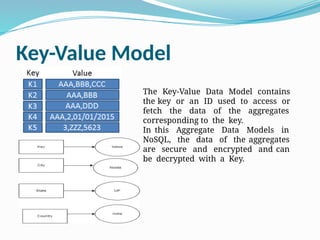
The Key-Value Data Model contains
the key or an ID used to access or
fetch the data of the aggregates
corresponding to the key.
In this Aggregate Data Models in
NoSQL, the data of the aggregates
are secure and encrypted and can
be decrypted with a Key.
Use Cases
 These Aggregate Data Models in NoSQL Database
are used for storing the user session data.
 Key Value-based Data Models are used for
maintaining schema-less user profiles.
 It is used for storing user preferences and
shopping cart data.
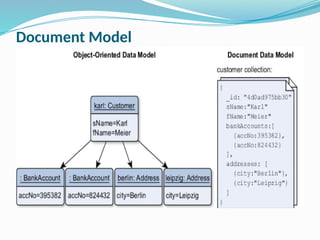
Document Model
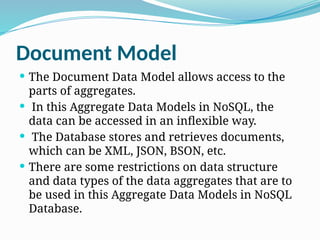
Document Model
 The Document Data Model allows access to the
parts of aggregates.
 In this Aggregate Data Models in NoSQL, the
data can be accessed in an inflexible way.
 The Database stores and retrieves documents,
which can be XML, JSON, BSON, etc.
 There are some restrictions on data structure
and data types of the data aggregates that are to
be used in this Aggregate Data Models in NoSQL
Database.
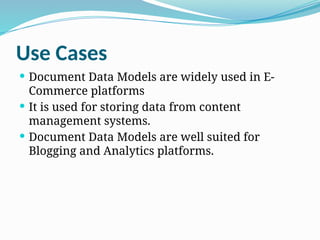
Use Cases
 Document Data Models are widely used in E-
Commerce platforms
 It is used for storing data from content
management systems.
 Document Data Models are well suited for
Blogging and Analytics platforms.
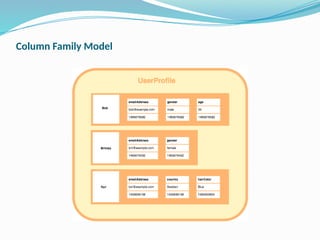
Column Family Model
Column Family Model
 Column family is an Aggregate Data Models in
NoSQL Database usually with big-table style Data
Models that are referred to as column stores.
 It is also called a two-level map as it offers a two-
level aggregate structure. In this Aggregate Data
Models in NoSQL, the first level of the Column
family contains the keys that act as a row
identifier that is used to select the aggregate data.
 Whereas the second level values are referred to
as columns.
Use Cases
 Column Family Data Models are used in systems
that maintain counters.
 These Aggregate Data Models in NoSQL are used
for services that have expiring usage.
 It is used in systems that have heavy write
requests.
Graph-Based Model
Graph-Based Model
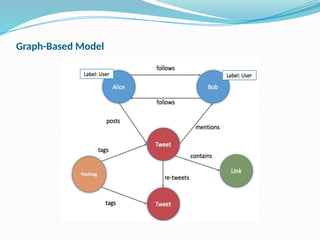
 Graph-based data models store data in nodes
that are connected by edges.
 These Aggregate Data Models in NoSQL are
widely used for storing the huge volumes of
complex aggregates and multidimensional data
having many interconnections between them.
Use Cases
 Graph-based Data Models are used in social
networking sites to store interconnections.
 It is used in fraud detection systems.
 This Data Model is also widely used in Networks
and IT operations.
Example of Aggregate Data Model
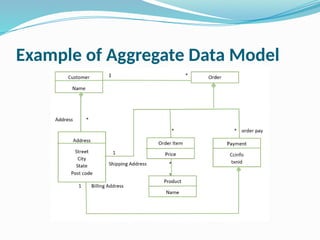
 Customer and Orders link between them
represent an aggregate.
 The diamond shows how data fit into the
aggregate structure.
 Customer contains a list of billing address
 Payment also contains the billing address
 The address appears three times and it is copied
each time
 The domain is fit where we don’t want to change
shipping and billing address.
Advantage
 It can be used as a primary data source for
online applications.
 Easy Replication.
 No single point Failure.
 It provides fast performance and horizontal
Scalability.
 It can handle Structured semi-structured and
unstructured data with equal effort.
Disadvantage
 No standard rules.
 Limited query capabilities.
 Doesn’t work well with relational data.
 Not so popular in the enterprise.
 When the value of data increases it is difficult to
maintain unique values.

Aggregate Data Model in NoSQL database.pptx

  • 1.
    Aggregate Data Models •Aggregate means a collection of objects that are treated as a unit. •In NoSQL Databases, an aggregate is a collection of data that interact as a unit. •Easy to manage data storage over the clusters as the aggregate data or unit can now reside on any of the machines. •It does not support ACID transactions.
  • 2.
    Types of AggregateData Models The Aggregate Data Models in NoSQL are majorly classified into 4 Data Models listed below:  Key-Value Model  Document Model  Column Family Model  Graph-Based Model
  • 3.
    Key-Value Model The Key-ValueData Model contains the key or an ID used to access or fetch the data of the aggregates corresponding to the key. In this Aggregate Data Models in NoSQL, the data of the aggregates are secure and encrypted and can be decrypted with a Key.
  • 4.
    Use Cases  TheseAggregate Data Models in NoSQL Database are used for storing the user session data.  Key Value-based Data Models are used for maintaining schema-less user profiles.  It is used for storing user preferences and shopping cart data.
  • 5.
  • 6.
    Document Model  TheDocument Data Model allows access to the parts of aggregates.  In this Aggregate Data Models in NoSQL, the data can be accessed in an inflexible way.  The Database stores and retrieves documents, which can be XML, JSON, BSON, etc.  There are some restrictions on data structure and data types of the data aggregates that are to be used in this Aggregate Data Models in NoSQL Database.
  • 7.
    Use Cases  DocumentData Models are widely used in E- Commerce platforms  It is used for storing data from content management systems.  Document Data Models are well suited for Blogging and Analytics platforms.
  • 8.
  • 9.
    Column Family Model Column family is an Aggregate Data Models in NoSQL Database usually with big-table style Data Models that are referred to as column stores.  It is also called a two-level map as it offers a two- level aggregate structure. In this Aggregate Data Models in NoSQL, the first level of the Column family contains the keys that act as a row identifier that is used to select the aggregate data.  Whereas the second level values are referred to as columns.
  • 10.
    Use Cases  ColumnFamily Data Models are used in systems that maintain counters.  These Aggregate Data Models in NoSQL are used for services that have expiring usage.  It is used in systems that have heavy write requests.
  • 11.
  • 12.
    Graph-Based Model  Graph-baseddata models store data in nodes that are connected by edges.  These Aggregate Data Models in NoSQL are widely used for storing the huge volumes of complex aggregates and multidimensional data having many interconnections between them.
  • 13.
    Use Cases  Graph-basedData Models are used in social networking sites to store interconnections.  It is used in fraud detection systems.  This Data Model is also widely used in Networks and IT operations.
  • 14.
  • 15.
     Customer andOrders link between them represent an aggregate.  The diamond shows how data fit into the aggregate structure.  Customer contains a list of billing address  Payment also contains the billing address  The address appears three times and it is copied each time  The domain is fit where we don’t want to change shipping and billing address.
  • 16.
    Advantage  It canbe used as a primary data source for online applications.  Easy Replication.  No single point Failure.  It provides fast performance and horizontal Scalability.  It can handle Structured semi-structured and unstructured data with equal effort.
  • 17.
    Disadvantage  No standardrules.  Limited query capabilities.  Doesn’t work well with relational data.  Not so popular in the enterprise.  When the value of data increases it is difficult to maintain unique values.