NOSQL DATABASE
Not Only SQL DATABASE
Submitted By:
Shikha Singla
M.Tech(1st Sem)
Information technology
 Modern RDBMS simply don’t scale to internet traffic. So, the main
solutions are-
 Scaling Up(Vertical Scaling)- Adding resources to a single node
in a system.
 Scaling Out(Horizontal Scaling)- Adding more nodes to a single
system, multi-node database solution. Different approaches are-
• Master Slave
• Sharding
• Multi Master Replication
• In Memory database
• No Joins
NEED OF NOSQL
 High prices from RDBMS vendors.
 These days Sites like Digg, Facebook and EBay have data sets 10s or
100s of TB large.
 Reduce object-relational impedance
Need of NOSQL(cont.)
 CARLO STROZZI used the term NOSQL in 1998 to name his
lightweight, Open Source Relational Database.
 ERIC EVANS, a rack space employee, reintroduced the term
NOSQL in 2009 to discuss the open source distributed database.
HISTORY OF NOSQL
 Stands for Not Only SQL.
 Having non-relational flat file database.
 May not require fixed table schema.
 Horizontally scalable-easily add more information.
 Avoid JOIN operation.
 Relaxation of ACID properties.
 Distributed in nature.
INTRODUCTION
 Several NOSQL systems use a Distributed architecture like
Master/Slave, Master/Master,Masterless.
 Based on Distributed Hash Tables.
 Easily scale out by adding more servers & failure of a server can
be tolerated.
 Provide full ACID guarantee by adding a supplementary
middleware layer.
ARCHITECTURE of NOSQL
 Main movement of NOSQL- Having three main properties of a
system:
 Consistency
 Availability
 Partitions
 To scale out, you have to Partition. That leaves either
Consistency or Availability , you would choose availability over
consistency in almost all cases.
 You can have at most two of these three properties for any
shared-data system.
CAP THEOREM
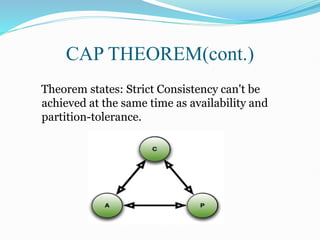
Theorem states: Strict Consistency can't be
achieved at the same time as availability and
partition-tolerance.
CAP THEOREM(cont.)
 NOSQL database leaves consistency to achieve better availability
& partitioning, this resulted in system know as BASE.
 BASE , as opposed to ACID, having three properties:
 Basically Available
 Soft-state
 Eventually consistent
 When no updates occur for a long period of time, eventually all
updates will propagate through the system and all the nodes will
be consistent.
EVENTUAL CONSISTENCY
NOSQL databases can be categorized according to their
data model into the following four categories:
Key-Value-stores
Document-stores
Graph Databases
 Big Table-Column Implementation
NOSQL DATA MODELS
 Simplest form of NoSQL store- Each key is mapped to a value
containing arbitrary data.
 This store has no knowledge of the contents of its payload and
simply delivers the data to the application.
 Mainly used to encapsulate the information .
 Key-value stores is a very simple query model, usually consisting
of set, get, and delete primitives.
 Main applications based on this store:
 Redis
 Level DB
 Memcache DB
KEY VALUE STORE
 Key-document stores map a key to some document that contains
structured information.
 They store lists and dictionaries, which can be embedded
recursively inside one-another.
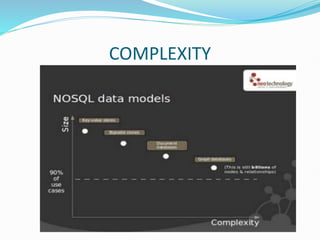
 Freedom and complexity of document stores are two key points:
o Developers have a lot of freedom in modeling their documents
o Application-based query logic can become complex.
 Main applications based on this store:
 Mongo DB
 Couch DB
 Riak
DOCUMENT STORE
 To avoid JOIN operation in RDBMS, Graph Databases are used.
 Graph Database is modeled using three basic building blocks:
 Node as vertex
 Relationship as edge
 Property as attribute
 Graph theory has seen a great usefulness and relevance in many
problems across various domains.
 Main applications based on this store:
 Neo4J
 InfoGrid
 HyperGraphDB
GRAPH DATABASE
 In this Model, a key identifies a row, which contains data stored in
one or more Column Families.
 Within a Column Family, each row can contain multiple columns.
 The values within each column are timestamped, so that several
versions of a row-column mapping can live within a Column Family.
 The model naturally supports sparse column placement.
 It is particularly good at modeling historical data with timestamps.
 Main applications based on this store:
 Cassandra
 HBase
 Hyper Table
BIG TABLE-COLUMN
IMPLEMENTATION
COMPLEXITY
 Cheap & easy to implement due to open source.
 Easy to distribute
 Scale to available memory
 Have individual query language rather than using a
standard query language
 Flexible data model
 ACID support is not required for product listing, status
update etc
 Developer friendly-More developer centric interface
ADVANTAGES OF NOSQL
 Cassandra-: It is developed at Facebook & written in java. It
uses Column Oriented & Eventual Consistency model.
 MongoDB-: It is an open source , high-performance,
schema-free, document-oriented database written in
the C++ programming language. It manages collections
of JSON-like documents.
 In Yahoo ,Google or Amazon, you have had your data
served via a NoSQL solution.
 In eBay or Twitter, you have indirectly used NOSQL
datastores.
APPLICATIONS OF NOSQL
REFERENCES
 http://www.julianbrowne.com
 http://www.odbms.org
 http://nosql.mypopescu.com
 http://nosql-database.org
 http://www.infoq.com
 http:// www.nosqldatabases.com
 http://highscalability.com
THANK YOU
QUERIES?

Presentation on NoSQL Database related RDBMS

  • 1.
    NOSQL DATABASE Not OnlySQL DATABASE Submitted By: Shikha Singla M.Tech(1st Sem) Information technology
  • 2.
     Modern RDBMSsimply don’t scale to internet traffic. So, the main solutions are-  Scaling Up(Vertical Scaling)- Adding resources to a single node in a system.  Scaling Out(Horizontal Scaling)- Adding more nodes to a single system, multi-node database solution. Different approaches are- • Master Slave • Sharding • Multi Master Replication • In Memory database • No Joins NEED OF NOSQL
  • 3.
     High pricesfrom RDBMS vendors.  These days Sites like Digg, Facebook and EBay have data sets 10s or 100s of TB large.  Reduce object-relational impedance Need of NOSQL(cont.)
  • 4.
     CARLO STROZZIused the term NOSQL in 1998 to name his lightweight, Open Source Relational Database.  ERIC EVANS, a rack space employee, reintroduced the term NOSQL in 2009 to discuss the open source distributed database. HISTORY OF NOSQL
  • 5.
     Stands forNot Only SQL.  Having non-relational flat file database.  May not require fixed table schema.  Horizontally scalable-easily add more information.  Avoid JOIN operation.  Relaxation of ACID properties.  Distributed in nature. INTRODUCTION
  • 6.
     Several NOSQLsystems use a Distributed architecture like Master/Slave, Master/Master,Masterless.  Based on Distributed Hash Tables.  Easily scale out by adding more servers & failure of a server can be tolerated.  Provide full ACID guarantee by adding a supplementary middleware layer. ARCHITECTURE of NOSQL
  • 7.
     Main movementof NOSQL- Having three main properties of a system:  Consistency  Availability  Partitions  To scale out, you have to Partition. That leaves either Consistency or Availability , you would choose availability over consistency in almost all cases.  You can have at most two of these three properties for any shared-data system. CAP THEOREM
  • 8.
    Theorem states: StrictConsistency can't be achieved at the same time as availability and partition-tolerance. CAP THEOREM(cont.)
  • 9.
     NOSQL databaseleaves consistency to achieve better availability & partitioning, this resulted in system know as BASE.  BASE , as opposed to ACID, having three properties:  Basically Available  Soft-state  Eventually consistent  When no updates occur for a long period of time, eventually all updates will propagate through the system and all the nodes will be consistent. EVENTUAL CONSISTENCY
  • 10.
    NOSQL databases canbe categorized according to their data model into the following four categories: Key-Value-stores Document-stores Graph Databases  Big Table-Column Implementation NOSQL DATA MODELS
  • 11.
     Simplest formof NoSQL store- Each key is mapped to a value containing arbitrary data.  This store has no knowledge of the contents of its payload and simply delivers the data to the application.  Mainly used to encapsulate the information .  Key-value stores is a very simple query model, usually consisting of set, get, and delete primitives.  Main applications based on this store:  Redis  Level DB  Memcache DB KEY VALUE STORE
  • 12.
     Key-document storesmap a key to some document that contains structured information.  They store lists and dictionaries, which can be embedded recursively inside one-another.  Freedom and complexity of document stores are two key points: o Developers have a lot of freedom in modeling their documents o Application-based query logic can become complex.  Main applications based on this store:  Mongo DB  Couch DB  Riak DOCUMENT STORE
  • 13.
     To avoidJOIN operation in RDBMS, Graph Databases are used.  Graph Database is modeled using three basic building blocks:  Node as vertex  Relationship as edge  Property as attribute  Graph theory has seen a great usefulness and relevance in many problems across various domains.  Main applications based on this store:  Neo4J  InfoGrid  HyperGraphDB GRAPH DATABASE
  • 14.
     In thisModel, a key identifies a row, which contains data stored in one or more Column Families.  Within a Column Family, each row can contain multiple columns.  The values within each column are timestamped, so that several versions of a row-column mapping can live within a Column Family.  The model naturally supports sparse column placement.  It is particularly good at modeling historical data with timestamps.  Main applications based on this store:  Cassandra  HBase  Hyper Table BIG TABLE-COLUMN IMPLEMENTATION
  • 15.
  • 16.
     Cheap &easy to implement due to open source.  Easy to distribute  Scale to available memory  Have individual query language rather than using a standard query language  Flexible data model  ACID support is not required for product listing, status update etc  Developer friendly-More developer centric interface ADVANTAGES OF NOSQL
  • 17.
     Cassandra-: Itis developed at Facebook & written in java. It uses Column Oriented & Eventual Consistency model.  MongoDB-: It is an open source , high-performance, schema-free, document-oriented database written in the C++ programming language. It manages collections of JSON-like documents.  In Yahoo ,Google or Amazon, you have had your data served via a NoSQL solution.  In eBay or Twitter, you have indirectly used NOSQL datastores. APPLICATIONS OF NOSQL
  • 18.
    REFERENCES  http://www.julianbrowne.com  http://www.odbms.org http://nosql.mypopescu.com  http://nosql-database.org  http://www.infoq.com  http:// www.nosqldatabases.com  http://highscalability.com
  • 19.
  • 20.