Aggregate Data Models
Data Model: Model through which we identify and manipulate
our data. It describes how we interact with the data in the
database.
Storage model: Model which describes how the database
stores and manipulates the data internally.
In NoSQL “data model” refer to the model by which the
database organizes data more formally called a metamodel.
The dominant data model is relational data model which
uses set of tables:
• Each table has rows
• Each row representing entity
• Column describe entity
• Column may refer to relationship
NoSQL move away from the relational model.
Each NoSQL solution has a different model that it
uses:
1. Key-value
2. Document
3. Column-family
4. Graph
Out of this first three share a common characteristic
of their data models which is called as aggregate
orientation.
Aggregates
The relational model takes the information to store and
divides it into tuples.
A tuple is a limited data structure:
• You cannot nest one tuple within another to get nested
records.
• You cannot put a list of values or tuples within another.
Aggregate model recognizes that often we need to operate
on data that have a more complex structure than a set of
tuples.
• It has complex record that allows lists and other record
structures to be nested inside it.
• key-value, document, and column-family databases all
make use of this more complex record.
• Common term use for this complex record is “aggregate.”
Definition:
• In Domain-Driven Design, an aggregate is a collection
of related objects that we wish to treat as a unit. It
is a unit for data manipulation and
management of consistency. Typically, we like to
update aggregates with atomic operations and
communicate with our data storage in terms of
aggregates.
Advantages of Aggregate:
• Dealing in aggregates makes easy to handle operating
on a cluster, since the aggregate makes a natural
unit for replication and sharding.
• Aggregates are also often easier for application
programmers to work with, since they
often manipulate data through aggregate structures.
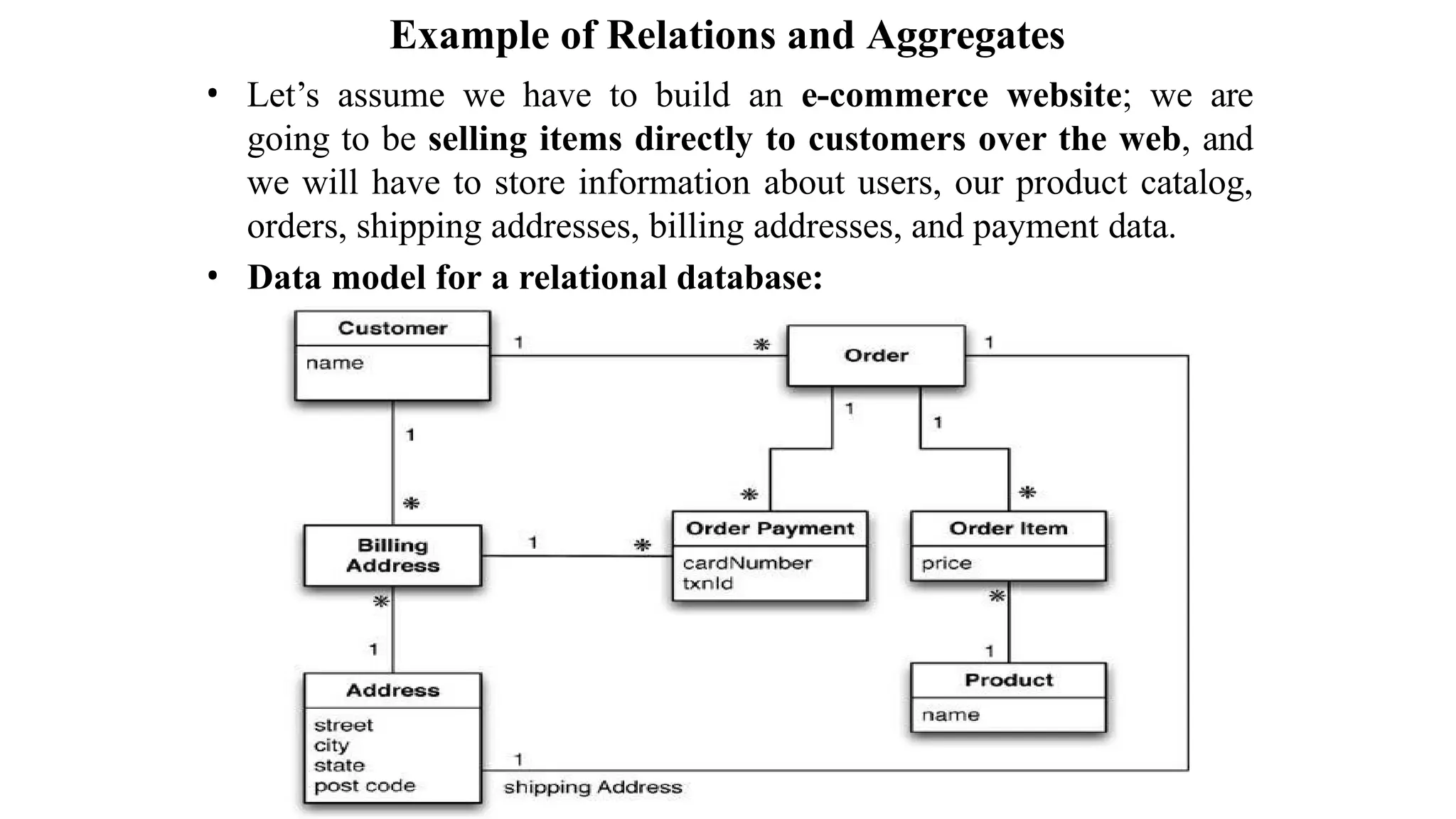
Example of Relations and Aggregates
• Let’s assume we have to build an e-commerce website; we are
going to be selling items directly to customers over the web, and
we will have to store information about users, our product catalog,
orders, shipping addresses, billing addresses, and payment data.
• Data model for a relational database:
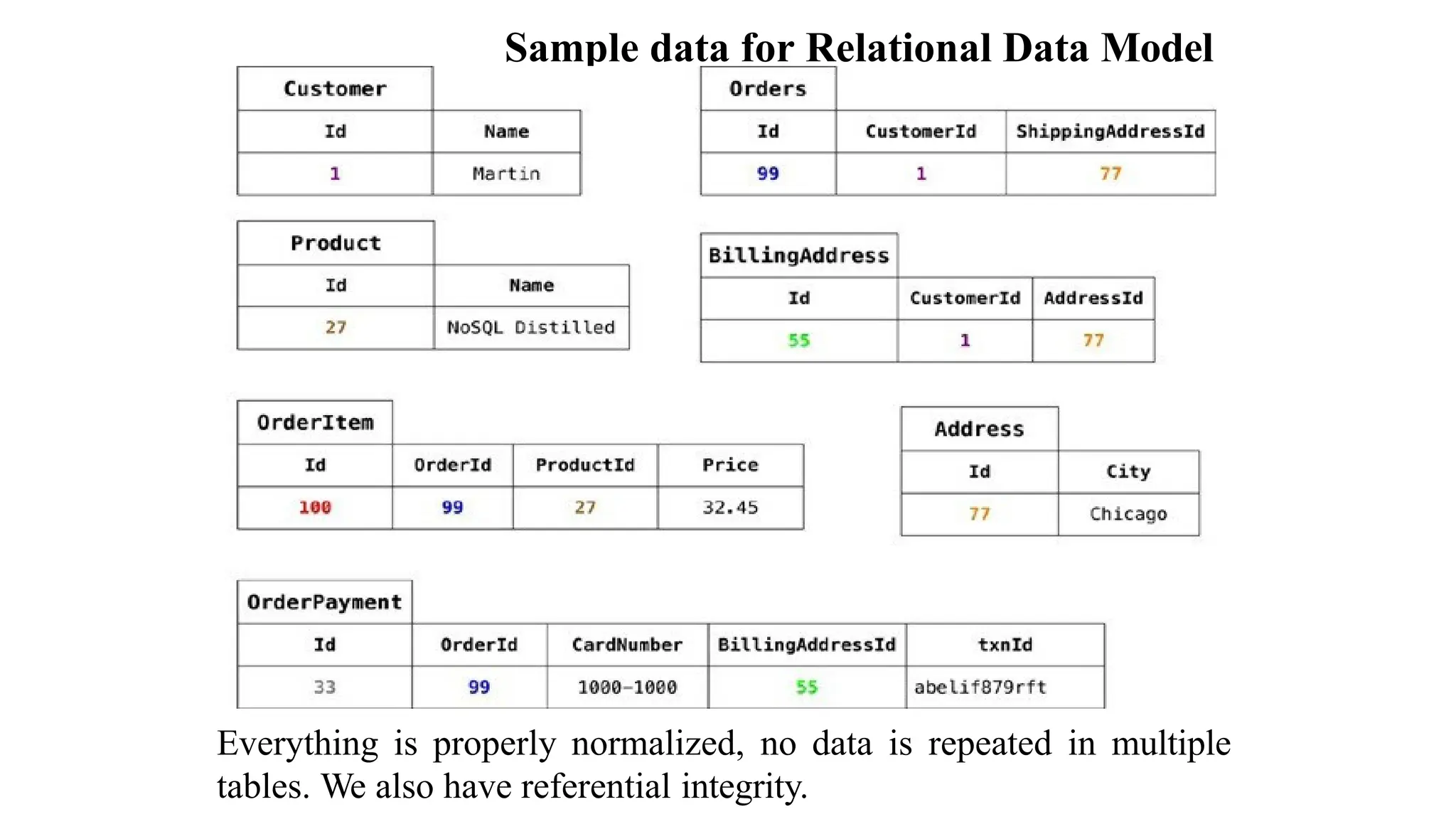
Sample data for Relational Data Model
Everything is properly normalized, no data is repeated in multiple
tables. We also have referential integrity.
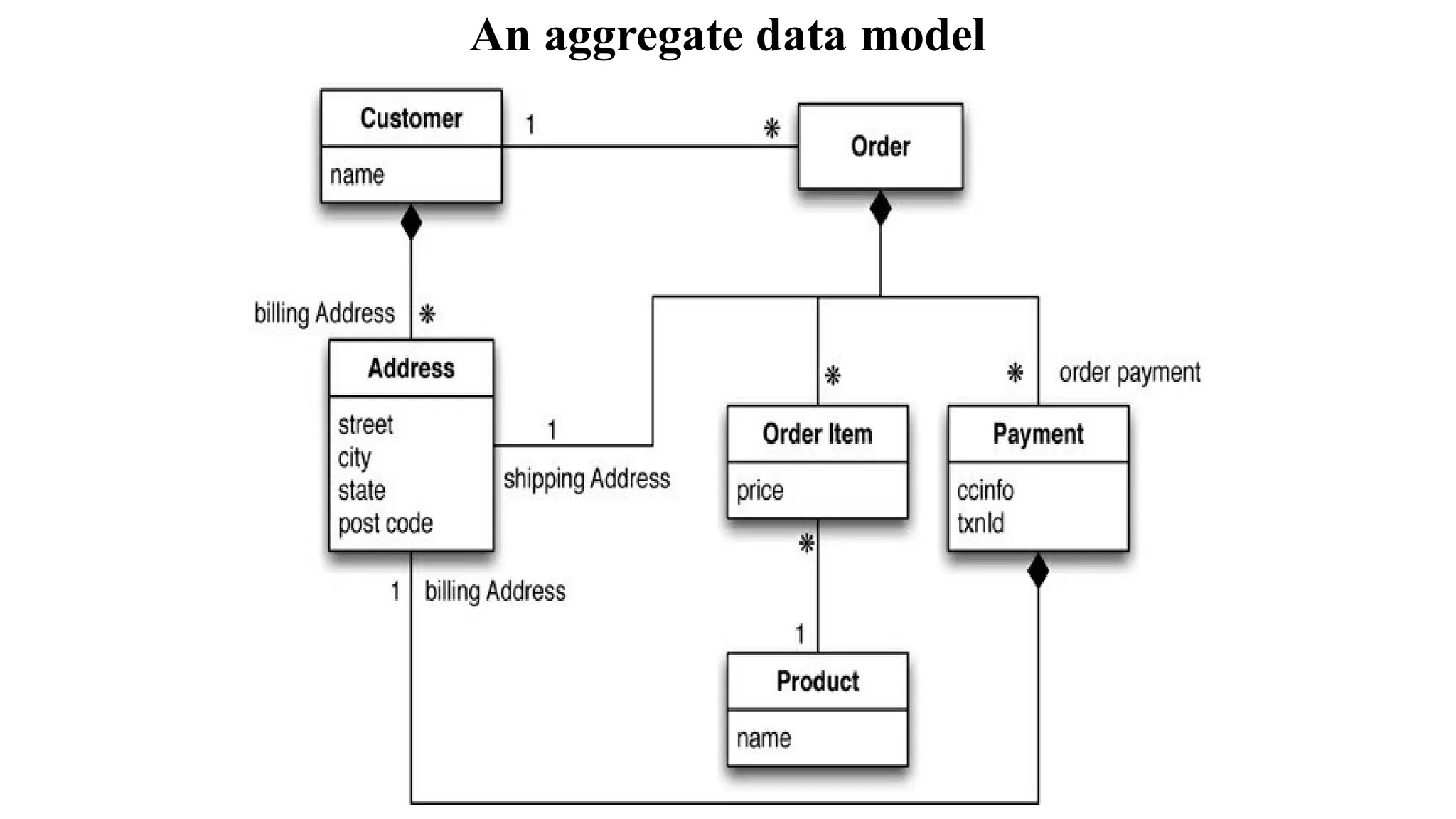
An aggregate data model
Sample Data for aggregate data model
// in customers
{
“id":1,
"name":"Martin", "billingAddress":
[{"city":"Chicago"}]
}
// in orders
{ "id":9
9,
"custome
rId":1,
"orderIt
ems":[
{
"productId":27,
"price": 32.45,
"productName":
"NoSQL
Distilled"
}],
"shippingAddress":
[{"city":"Chicago"}]
"orderPayment":[
{
"ccinfo":"1000-
1000-1000-
1000",
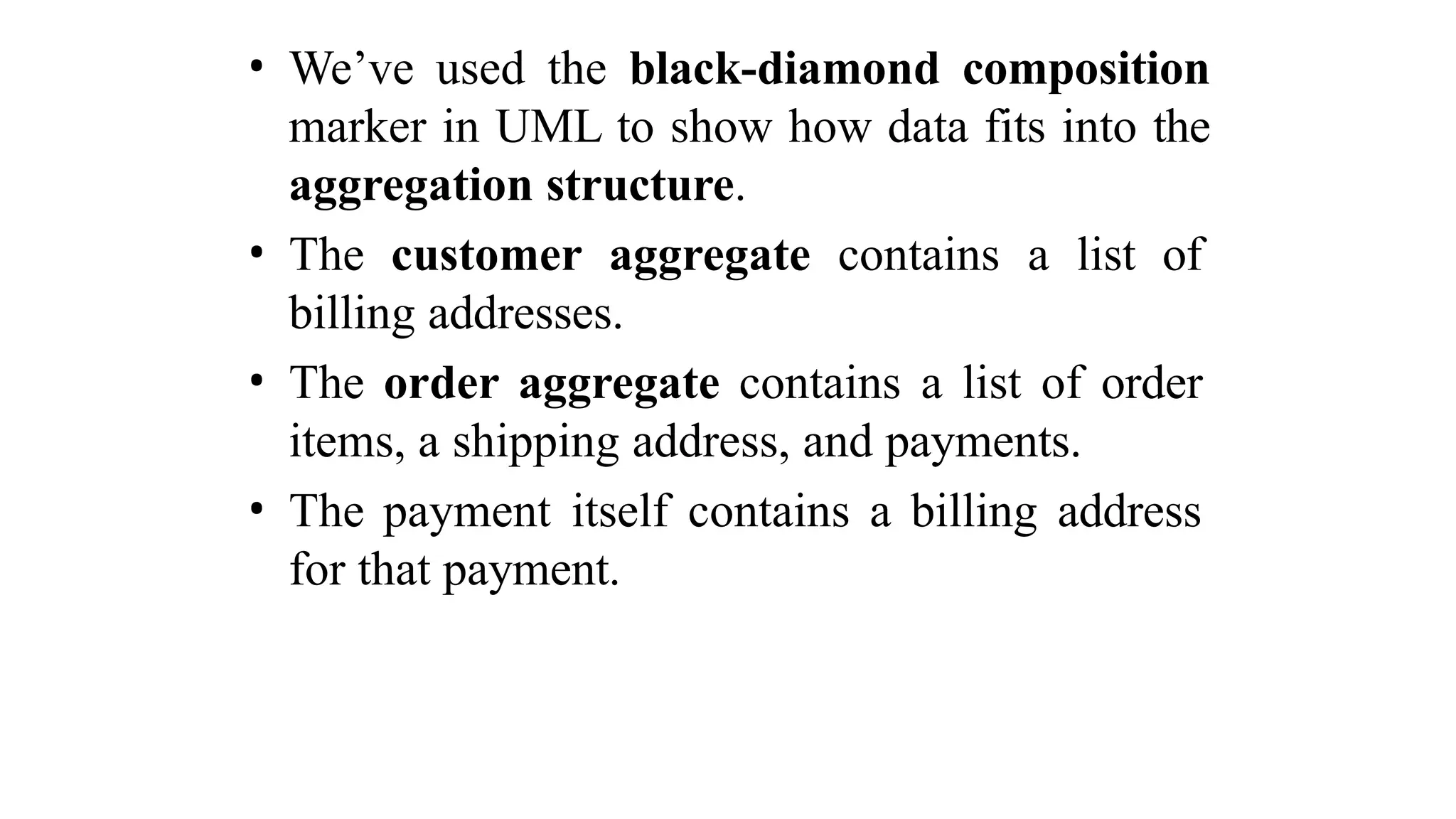
• We’ve used the black-diamond composition
marker in UML to show how data fits into the
aggregation structure.
• The customer aggregate contains a list of
billing addresses.
• The order aggregate contains a list of order
items, a shipping address, and payments.
• The payment itself contains a billing address
for that payment.
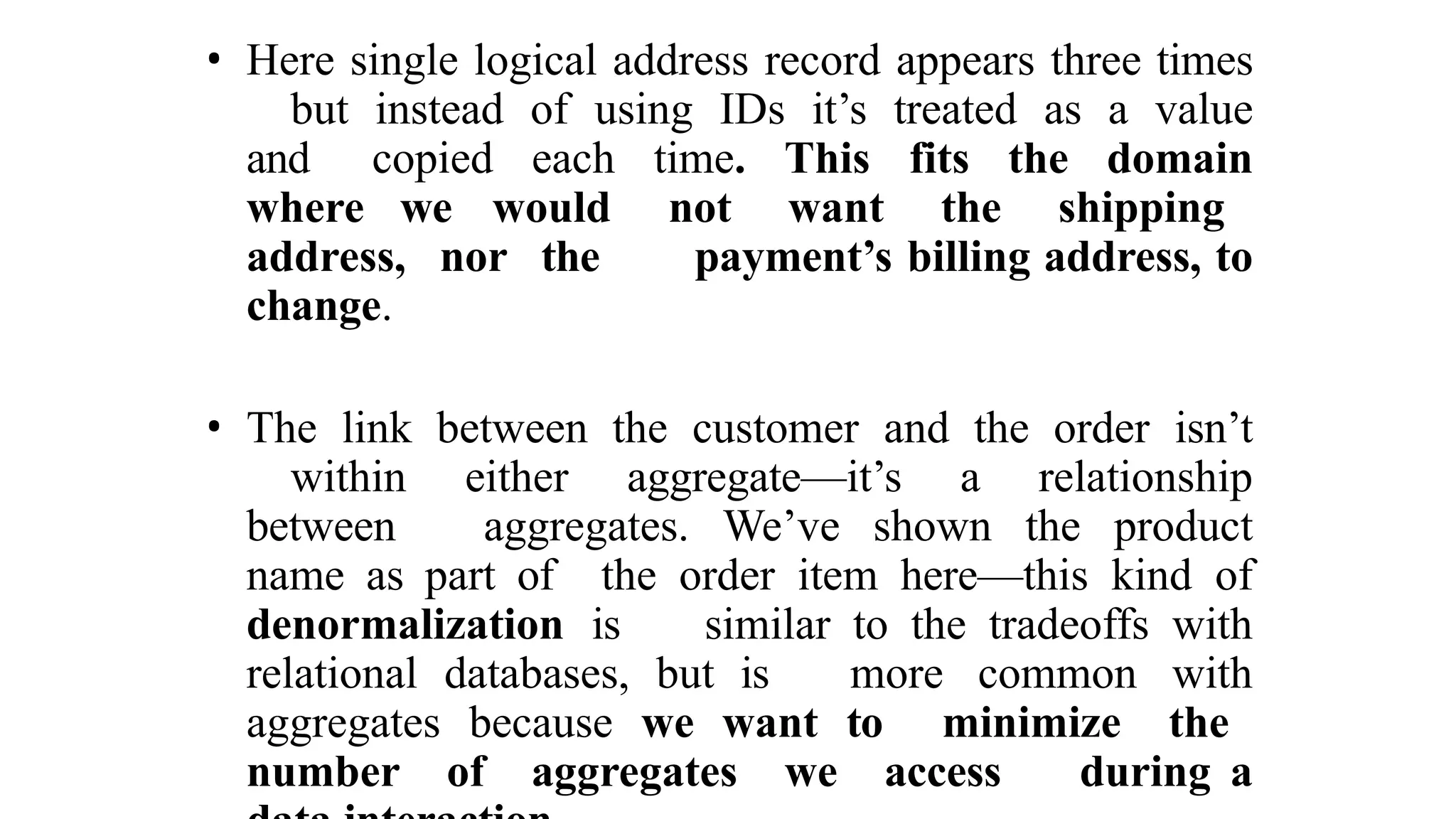
• Here single logical address record appears three times
but instead of using IDs it’s treated as a value
and copied each time. This fits the domain
where we would not want the shipping
address, nor the payment’s billing address, to
change.
• The link between the customer and the order isn’t
within either aggregate—it’s a relationship
between aggregates. We’ve shown the product
name as part of the order item here—this kind of
denormalization is similar to the tradeoffs with
relational databases, but is more common with
aggregates because we want to minimize the
number of aggregates we access during a
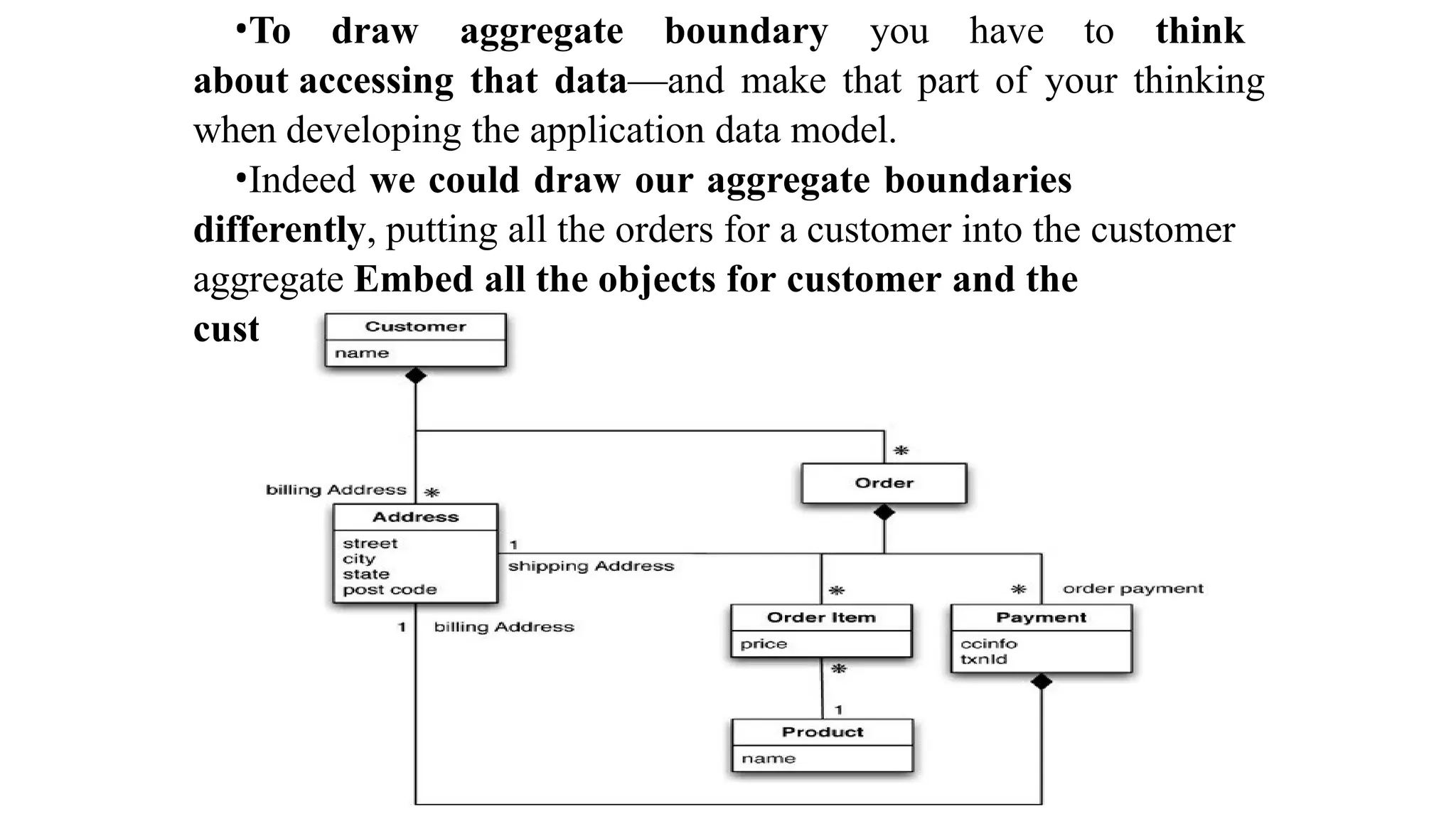
•To draw aggregate boundary you have to think
about accessing that data—and make that part of your thinking
when developing the application data model.
•Indeed we could draw our aggregate boundaries
differently, putting all the orders for a customer into the customer
aggregate Embed all the objects for customer and the
customer’s orders
Sample Data for above aggregate data model
// in customers
{ "customer":
{
"id": 1,
"name": "Martin",
"billingAddress": [{"city": "Chicago"}],
"orders": [
{
"id":99,
"customerId":1,
"orderItems":[
{
"productId":27,
"price": 32.45,
"productName":
"NoSQL
Distilled"
}],
"shippingAddress":
[{"city":"Chicago"}]
"orderPayment":[
{
"ccinfo":"1000-
1000-1000-
1000",
"txnId":"abelif879rft",
• There’s no universal answer for how to draw your
aggregate boundaries. It depends entirely on how
you tend to manipulate your data.
• If you tend to access a customer together with all of
that customer’s orders at once, then you would
prefer a single aggregate.
• However, if you tend to focus on accessing a single
order at a time, then you should prefer having
separate aggregates for each order.
Consequences of Aggregate Orientation
• Relational databases have no concept of aggregate within their data
model, so we call them aggregate-ignorant. In the NoSQL world,
graph databases are also aggregate-ignorant. Being aggregate-
ignorant is not a bad thing. It’s often difficult to draw aggregate
boundaries well, particularly if the same data is used in many
different contexts.
• An order makes a good aggregate when a customer is making and
reviewing orders, and when the retailer is processing orders.
• However, if a retailer wants to analyze its product sales over the
last few months, then an order aggregate becomes a trouble. To
get to product sales history, you’ll have to dig into every aggregate
in the database. So an aggregate structure may help with some
data interactions but be an obstacle for others.
• An aggregate-ignorant model allows you to easily look at
the data in different ways, so it is a better choice
when you don’t have a primary structure for
manipulating your data.
• The aggregate orientation helps greatly with running on
a cluster.
• If we’re running on a cluster, we need to minimize how
many nodes we need to query when we are
gathering data.
• By explicitly including aggregates, we give the database
important information about which bits of data will
be manipulated together, and thus should live on the
same node.
Aggregates have an important consequence for transactions:
• Relational databases allow you to manipulate any combination of
rows from any tables in a single transaction. Such transactions are
called ACID transactions.
• Many rows spanning many tables are updated as a single operation.
This operation either succeeds or fails in its entirety, and concurrent
operations are isolated from each other so they cannot see a partial
update.
• It’s often said that NoSQL databases don’t support ACID
transactions and thus sacrifice consistency, but they support
atomic manipulation of a single aggregate at a time.
• This means that if we need to manipulate multiple aggregates in an
atomic way, we have to manage that ourselves in the application
code. Graph and other aggregate-ignorant databases usually do
support ACID transactions similar to relational databases.
Key-Value and Document Data Models
• Key-value and document databases were strongly
aggregate-oriented means we think these databases
as primarily constructed through aggregates.
• Both of these types of databases consist of lots of
aggregates with each aggregate having a key or
ID that’s used to get at the data.
• Riak and Redis database are examples of key-value
databases.
• MongoDB and CouchDB are most popular document
based databases.

Aggregate Data Models.pptxszfsfsfsafsafsafasf

  • 1.
    Aggregate Data Models DataModel: Model through which we identify and manipulate our data. It describes how we interact with the data in the database. Storage model: Model which describes how the database stores and manipulates the data internally. In NoSQL “data model” refer to the model by which the database organizes data more formally called a metamodel. The dominant data model is relational data model which uses set of tables: • Each table has rows • Each row representing entity • Column describe entity • Column may refer to relationship
  • 2.
    NoSQL move awayfrom the relational model. Each NoSQL solution has a different model that it uses: 1. Key-value 2. Document 3. Column-family 4. Graph Out of this first three share a common characteristic of their data models which is called as aggregate orientation.
  • 3.
    Aggregates The relational modeltakes the information to store and divides it into tuples. A tuple is a limited data structure: • You cannot nest one tuple within another to get nested records. • You cannot put a list of values or tuples within another. Aggregate model recognizes that often we need to operate on data that have a more complex structure than a set of tuples. • It has complex record that allows lists and other record structures to be nested inside it. • key-value, document, and column-family databases all make use of this more complex record. • Common term use for this complex record is “aggregate.”
  • 4.
    Definition: • In Domain-DrivenDesign, an aggregate is a collection of related objects that we wish to treat as a unit. It is a unit for data manipulation and management of consistency. Typically, we like to update aggregates with atomic operations and communicate with our data storage in terms of aggregates. Advantages of Aggregate: • Dealing in aggregates makes easy to handle operating on a cluster, since the aggregate makes a natural unit for replication and sharding. • Aggregates are also often easier for application programmers to work with, since they often manipulate data through aggregate structures.
  • 5.
    Example of Relationsand Aggregates • Let’s assume we have to build an e-commerce website; we are going to be selling items directly to customers over the web, and we will have to store information about users, our product catalog, orders, shipping addresses, billing addresses, and payment data. • Data model for a relational database:
  • 6.
    Sample data forRelational Data Model Everything is properly normalized, no data is repeated in multiple tables. We also have referential integrity.
  • 7.
  • 8.
    Sample Data foraggregate data model // in customers { “id":1, "name":"Martin", "billingAddress": [{"city":"Chicago"}] } // in orders { "id":9 9, "custome rId":1, "orderIt ems":[ { "productId":27, "price": 32.45, "productName": "NoSQL Distilled" }], "shippingAddress": [{"city":"Chicago"}] "orderPayment":[ { "ccinfo":"1000- 1000-1000- 1000",
  • 9.
    • We’ve usedthe black-diamond composition marker in UML to show how data fits into the aggregation structure. • The customer aggregate contains a list of billing addresses. • The order aggregate contains a list of order items, a shipping address, and payments. • The payment itself contains a billing address for that payment.
  • 10.
    • Here singlelogical address record appears three times but instead of using IDs it’s treated as a value and copied each time. This fits the domain where we would not want the shipping address, nor the payment’s billing address, to change. • The link between the customer and the order isn’t within either aggregate—it’s a relationship between aggregates. We’ve shown the product name as part of the order item here—this kind of denormalization is similar to the tradeoffs with relational databases, but is more common with aggregates because we want to minimize the number of aggregates we access during a
  • 11.
    •To draw aggregateboundary you have to think about accessing that data—and make that part of your thinking when developing the application data model. •Indeed we could draw our aggregate boundaries differently, putting all the orders for a customer into the customer aggregate Embed all the objects for customer and the customer’s orders
  • 12.
    Sample Data forabove aggregate data model // in customers { "customer": { "id": 1, "name": "Martin", "billingAddress": [{"city": "Chicago"}], "orders": [ { "id":99, "customerId":1, "orderItems":[ { "productId":27, "price": 32.45, "productName": "NoSQL Distilled" }], "shippingAddress": [{"city":"Chicago"}] "orderPayment":[ { "ccinfo":"1000- 1000-1000- 1000", "txnId":"abelif879rft",
  • 13.
    • There’s nouniversal answer for how to draw your aggregate boundaries. It depends entirely on how you tend to manipulate your data. • If you tend to access a customer together with all of that customer’s orders at once, then you would prefer a single aggregate. • However, if you tend to focus on accessing a single order at a time, then you should prefer having separate aggregates for each order.
  • 14.
    Consequences of AggregateOrientation • Relational databases have no concept of aggregate within their data model, so we call them aggregate-ignorant. In the NoSQL world, graph databases are also aggregate-ignorant. Being aggregate- ignorant is not a bad thing. It’s often difficult to draw aggregate boundaries well, particularly if the same data is used in many different contexts. • An order makes a good aggregate when a customer is making and reviewing orders, and when the retailer is processing orders. • However, if a retailer wants to analyze its product sales over the last few months, then an order aggregate becomes a trouble. To get to product sales history, you’ll have to dig into every aggregate in the database. So an aggregate structure may help with some data interactions but be an obstacle for others.
  • 15.
    • An aggregate-ignorantmodel allows you to easily look at the data in different ways, so it is a better choice when you don’t have a primary structure for manipulating your data. • The aggregate orientation helps greatly with running on a cluster. • If we’re running on a cluster, we need to minimize how many nodes we need to query when we are gathering data. • By explicitly including aggregates, we give the database important information about which bits of data will be manipulated together, and thus should live on the same node.
  • 16.
    Aggregates have animportant consequence for transactions: • Relational databases allow you to manipulate any combination of rows from any tables in a single transaction. Such transactions are called ACID transactions. • Many rows spanning many tables are updated as a single operation. This operation either succeeds or fails in its entirety, and concurrent operations are isolated from each other so they cannot see a partial update. • It’s often said that NoSQL databases don’t support ACID transactions and thus sacrifice consistency, but they support atomic manipulation of a single aggregate at a time. • This means that if we need to manipulate multiple aggregates in an atomic way, we have to manage that ourselves in the application code. Graph and other aggregate-ignorant databases usually do support ACID transactions similar to relational databases.
  • 17.
    Key-Value and DocumentData Models • Key-value and document databases were strongly aggregate-oriented means we think these databases as primarily constructed through aggregates. • Both of these types of databases consist of lots of aggregates with each aggregate having a key or ID that’s used to get at the data. • Riak and Redis database are examples of key-value databases. • MongoDB and CouchDB are most popular document based databases.