Introduction to Firewall Analytics - Interfirewall and Transfirewall.pptx
1.
Introduction to Inter-Firewall&
Trans-Firewall Analytics
S.Ummul Hyrul Fathima M.E.,
Assistant Professor,
Dept. Of Computer Science & Engineering,
Mohamed Sathak Engineering College.
2.
Inter-Firewall Analytics
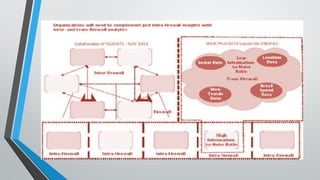
• Inter-firewallanalytics involve the examination and monitoring of
network traffic that moves between different segments of a
network, each protected by its own firewall or security perimeter.
• This analysis focuses on understanding the communication
patterns and potential threats that emerge when data crosses
these security boundaries.
• It aims to detect anomalies, unauthorized access, or malicious
activities that might occur during data transfer between different
zones.
3.
Inter-Firewall Analytics
• Keyaspects of inter-firewall analytics include:
1. Traffic Monitoring: Monitoring and analyzing data flows
between different security zones or segments of a network.
2. Anomaly Detection: Detecting unusual or suspicious traffic
patterns that might indicate unauthorized access or malicious
activity.
3. Access Control Verification: Ensuring that access controls and
security policies are consistently enforced across different zones.
4. Intrusion Detection and Prevention: Identifying and
mitigating potential intrusion attempts or security breaches that
occur when data crosses firewall boundaries.
5.
Trans-Firewall Analytics
• Trans-firewallanalytics extend the analysis to include data that
moves between different networks or security domains,
potentially involving external entities.
• This type of analysis focuses on understanding the behavior and
risks associated with data flows that traverse not only internal
network boundaries but also external connections.
6.
Trans-Firewall Analytics
• Keyaspects of trans-firewall analytics include:
1. External Threat Detection: Identifying and mitigating threats that
might arise when data enters or leaves the organization's network,
interacting with external entities.
2. Data Leakage Prevention: Ensuring sensitive or confidential
information is not inadvertently exposed when crossing network
boundaries.
3. Third-Party Risk Management: Assessing the security of
connections and interactions with external partners, vendors, or
service providers.
4. Malware and Threat Detection: Detecting potential malware,
viruses, or other malicious content that might be introduced from
external sources.
7.
Inter-Firewall Vs Trans-Firewall
Analytics
FeatureInter-Firewall Analytics Trans-Firewall Analytics
Scope
Within a single network or
Organization
Across multiple networks or
Organizations
Focus
Lateral movement, internal
threats, policy violations
Threats spanning multiple
security perimeters. Data
exfiltration, protocol
anomalies
Data Correlation Internal firewall logs and data
Threats spanning multiple
security perimeters. Data
Exfiltration protocol anomalies
Complexity
Generally less Complex to
Implement
More complex, specialized
tools and techniques
Security Needs
Suitable for Organizations
Crucial for handling sensitive
data or facing advanced




![Information and Network Security ppt Firewall_Security[1].pptx](https://cdn.slidesharecdn.com/ss_thumbnails/firewallsecurity1-251216060657-29a5c520-thumbnail.jpg?width=640&height=640&fit=bounds)


