Normalization in
DBMS: 1NF, 2NF, 3NF
and BCNF Ummul Hyrul
Fathima
Assistant Professor
Normalizati
on
Normalization is a process of organizing the data in database
to avoid data redundancy, insertion anomaly, update anomaly
& deletion anomaly. Let’s discuss about anomalies first then
we will discuss normal forms with examples.
Anomalies in
DBMS
There are three types of anomalies that occur when the
database is not normalized. These are – Insertion, update and
deletion anomaly. Let’s take an example to understand this.
Example
:
Suppose a manufacturing company stores the employee
details in a table named employee that has four attributes:
emp_id for storing employee’s id, emp_name for storing
employee’s name, emp_address for storing employee’s
address and emp_dept for storing the department details in
which the employee works. At some point of time the table
looks like this:
emp_id emp_name emp_address emp_dep
t
101 Rick Delhi D001
101 Rick Delhi D002
123 Maggie Agra D890
166 Glenn Chennai D900
166 Glenn Chennai D004
The above table is not normalized. We will see the problems that we face when a
table is not normalized.
Update
anomaly:
In the above table we have two rows for employee Rick as he
belongs to two departments of the company. If we want to
update the address of Rick then we have to update the same
in two rows or the data will become inconsistent. If somehow,
the correct address gets updated in one department but not
in other then as per the database, Rick would be having two
different addresses, which is not correct and would lead to
inconsistent data.
Insert
anomaly:
Suppose a new employee joins the company, who is under
training and currently not assigned to any department then
we would not be able to insert the data into the table if
emp_dept field doesn’t allow nulls.
Delete
anomaly:
Suppose, if at a point of time the company closes the
department D890 then deleting the rows that are having
emp_dept as D890 would also delete the information of
employee Maggie since she is assigned only to this
department.
To overcome these anomalies we need to normalize the data.
In the next section we will discuss about normalization.
Normalizati
on
Here are the most commonly used normal
forms:
▪ First normal form(1NF)
▪ Second normal form(2NF)
▪ Third normal form(3NF)
▪ Boyce & Codd normal form (BCNF)
First normal form
(1NF)
As per the rule of first normal form, an attribute (column)
of a table cannot hold multiple values. It should hold only
atomic values.
Example: Suppose a company wants to store the names and
contact details of its employees. It creates a table that looks
like this:emp_id emp_name emp_address emp_mobil
e
101 Herschel New Delhi 891231239
0
102 Jon Kanpur 881212121
2
990001222
2
103 Ron Chennai 777888121
2
104 Lester Bangalore 999000012
Two employees (Jon & Lester) are
having two mobile numbers so the
company stored them in the same
field as you can see in the table
above.
This table is not in 1NF as the rule
says “each attribute of a table must
have atomic (single) values”, the
emp_mobile values for employees
Jon & Lester violates that rule.
The 1NF
form:
emp_id emp_name emp_address emp_mobil
e
101 Herschel New Delhi 891231239
0
102 Jon Kanpur 881212121
2
102 Jon Kanpur 990001222
2
103 Ron Chennai 777888121
2
104 Lester Bangalore 999000012
3
104 Lester Bangalore 812345098
7
Second normal form
(2NF)
A table is said to be in 2NF if both the following conditions
hold:
▪ Table is in 1NF (First normal form)
▪ No non-prime attribute is dependent on the proper
subset of any candidate key of table.
An attribute that is not part of any candidate key is known
as non-
prime attribute.
Example
:
Suppose a school wants to store the data of teachers and the
subjects they teach. They create a table that looks like this:
Since a teacher can teach more than one subjects, the table
can have multiple rows for a same teacher.
teacher_id subject teacher_ag
e
111 Maths 38
111 Physics 38
222 Biology 38
333 Physics 40
333 Chemistry 40
Candidate Keys: { teacher_id,
subject } Non prime attribute:
teacher_age
The table is in 1 NF because each attribute has
atomic values. However, it is not in 2NF because non
prime attribute teacher_age is dependent on
teacher_id alone which is a proper subset of
candidate key. This violates the rule for 2NF as the
rule says “no non-prime attribute is dependent on
the proper subset of any candidate key of the table”.
The 2NF
Form
We can break it in two tables like
this:
teacher_details table:
eacher_id
teacher_age
teacher_subject table:
teacher_id
subject
Now the
tables
comply with
Second
111 38 111 Maths normal form (2NF).
222 38 111 Physics
333 40 222 Biology
333 Physics
333 Chemistry
Third Normal form
(3NF)
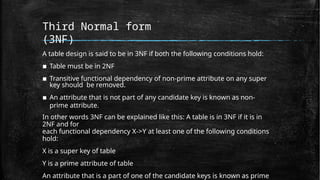
A table design is said to be in 3NF if both the following conditions hold:
▪ Table must be in 2NF
▪ Transitive functional dependency of non-prime attribute on any super
key should be removed.
▪ An attribute that is not part of any candidate key is known as non-
prime attribute.
In other words 3NF can be explained like this: A table is in 3NF if it is in
2NF and for
each functional dependency X->Y at least one of the following conditions
hold:
X is a super key of table
Y is a prime attribute of table
An attribute that is a part of one of the candidate keys is known as prime
Example
:
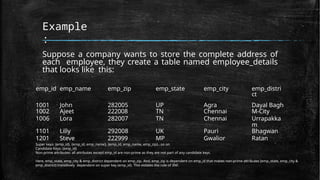
Suppose a company wants to store the complete address of
each employee, they create a table named employee_details
that looks like this:
emp_id emp_name emp_zip emp_state emp_city emp_distri
ct
1001 John 282005 UP Agra Dayal Bagh
1002 Ajeet 222008 TN Chennai M-City
1006 Lora 282007 TN Chennai Urrapakka
m
1101 Lilly 292008 UK Pauri Bhagwan
1201 Steve 222999 MP Gwalior Ratan
Super keys: {emp_id}, {emp_id, emp_name}, {emp_id, emp_name, emp_zip}…so on
Candidate Keys: {emp_id}
Non-prime attributes: all attributes except emp_id are non-prime as they are not part of any candidate keys.
Here, emp_state, emp_city & emp_district dependent on emp_zip. And, emp_zip is dependent on emp_id that makes non-prime attributes (emp_state, emp_city &
emp_district) transitively dependent on super key (emp_id). This violates the rule of 3NF.
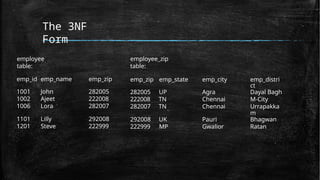
The 3NF
Form
employee
table:
employee_zip
table:
emp_id emp_name emp_zip emp_zip emp_state emp_city emp_distri
ct
1001 John 282005 282005 UP Agra Dayal Bagh
1002 Ajeet 222008 222008 TN Chennai M-City
1006 Lora 282007 282007 TN Chennai Urrapakka
m
1101 Lilly 292008 292008 UK Pauri Bhagwan
1201 Steve 222999 222999 MP Gwalior Ratan
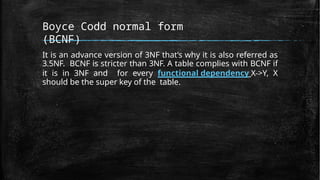
Boyce Codd normal form
(BCNF)
It is an advance version of 3NF that’s why it is also referred as
3.5NF. BCNF is stricter than 3NF. A table complies with BCNF if
it is in 3NF and for every functional dependency X->Y, X
should be the super key of the table.
Example
:
Suppose there is a company wherein employees work in more
than one department. They store the data like this:
emp_id emp_nationalit
y
emp_dept dept_type dept_no_of_em
p
1001 Austrian Production and planning D001 200
1001 Austrian stores D001 250
1002 American design and technical
support
D134 100
1002 American Purchasing department D134 600
Functional dependencies in the table above:
emp_id -> emp_nationality
emp_dept -> {dept_type, dept_no_of_emp}
Candidate key: {emp_id, emp_dept}
The table is not in BCNF as neither emp_id nor emp_dept alone
are keys.
The BCNF
Form
emp_nationality table:
emp_id
emp_nationality
100
1
100
2
Austrian
America
n
emp_dept table:
emp_dept dept_type dept_no_of_em
p
Production and
planning
D001 200
stores D001 250
design and technical support
D134 Purchasing department
D134
10
0
60
0
emp_dept_mapping
table:
emp_i
d
1001
1001
1002
1002
emp_dept
Production and
planning stores
design and technical
support Purchasing
department
Functional dependencies:
emp_id -> emp_nationality
emp_dept -> {dept_type,
dept_no_of_emp}
Candidate keys:
For first table: emp_id
For second table: emp_dept
For third table: {emp_id,
emp_dept}
This is now in BCNF as in both the functional dependencies left side
part is a key.

Four Types of Normalization in DBMS Explained

  • 1.
    Normalization in DBMS: 1NF,2NF, 3NF and BCNF Ummul Hyrul Fathima Assistant Professor
  • 2.
    Normalizati on Normalization is aprocess of organizing the data in database to avoid data redundancy, insertion anomaly, update anomaly & deletion anomaly. Let’s discuss about anomalies first then we will discuss normal forms with examples.
  • 3.
    Anomalies in DBMS There arethree types of anomalies that occur when the database is not normalized. These are – Insertion, update and deletion anomaly. Let’s take an example to understand this.
  • 4.
    Example : Suppose a manufacturingcompany stores the employee details in a table named employee that has four attributes: emp_id for storing employee’s id, emp_name for storing employee’s name, emp_address for storing employee’s address and emp_dept for storing the department details in which the employee works. At some point of time the table looks like this: emp_id emp_name emp_address emp_dep t 101 Rick Delhi D001 101 Rick Delhi D002 123 Maggie Agra D890 166 Glenn Chennai D900 166 Glenn Chennai D004 The above table is not normalized. We will see the problems that we face when a table is not normalized.
  • 5.
    Update anomaly: In the abovetable we have two rows for employee Rick as he belongs to two departments of the company. If we want to update the address of Rick then we have to update the same in two rows or the data will become inconsistent. If somehow, the correct address gets updated in one department but not in other then as per the database, Rick would be having two different addresses, which is not correct and would lead to inconsistent data.
  • 6.
    Insert anomaly: Suppose a newemployee joins the company, who is under training and currently not assigned to any department then we would not be able to insert the data into the table if emp_dept field doesn’t allow nulls.
  • 7.
    Delete anomaly: Suppose, if ata point of time the company closes the department D890 then deleting the rows that are having emp_dept as D890 would also delete the information of employee Maggie since she is assigned only to this department. To overcome these anomalies we need to normalize the data. In the next section we will discuss about normalization.
  • 8.
    Normalizati on Here are themost commonly used normal forms: ▪ First normal form(1NF) ▪ Second normal form(2NF) ▪ Third normal form(3NF) ▪ Boyce & Codd normal form (BCNF)
  • 9.
    First normal form (1NF) Asper the rule of first normal form, an attribute (column) of a table cannot hold multiple values. It should hold only atomic values. Example: Suppose a company wants to store the names and contact details of its employees. It creates a table that looks like this:emp_id emp_name emp_address emp_mobil e 101 Herschel New Delhi 891231239 0 102 Jon Kanpur 881212121 2 990001222 2 103 Ron Chennai 777888121 2 104 Lester Bangalore 999000012 Two employees (Jon & Lester) are having two mobile numbers so the company stored them in the same field as you can see in the table above. This table is not in 1NF as the rule says “each attribute of a table must have atomic (single) values”, the emp_mobile values for employees Jon & Lester violates that rule.
  • 10.
    The 1NF form: emp_id emp_nameemp_address emp_mobil e 101 Herschel New Delhi 891231239 0 102 Jon Kanpur 881212121 2 102 Jon Kanpur 990001222 2 103 Ron Chennai 777888121 2 104 Lester Bangalore 999000012 3 104 Lester Bangalore 812345098 7
  • 11.
    Second normal form (2NF) Atable is said to be in 2NF if both the following conditions hold: ▪ Table is in 1NF (First normal form) ▪ No non-prime attribute is dependent on the proper subset of any candidate key of table. An attribute that is not part of any candidate key is known as non- prime attribute.
  • 12.
    Example : Suppose a schoolwants to store the data of teachers and the subjects they teach. They create a table that looks like this: Since a teacher can teach more than one subjects, the table can have multiple rows for a same teacher. teacher_id subject teacher_ag e 111 Maths 38 111 Physics 38 222 Biology 38 333 Physics 40 333 Chemistry 40 Candidate Keys: { teacher_id, subject } Non prime attribute: teacher_age The table is in 1 NF because each attribute has atomic values. However, it is not in 2NF because non prime attribute teacher_age is dependent on teacher_id alone which is a proper subset of candidate key. This violates the rule for 2NF as the rule says “no non-prime attribute is dependent on the proper subset of any candidate key of the table”.
  • 13.
    The 2NF Form We canbreak it in two tables like this: teacher_details table: eacher_id teacher_age teacher_subject table: teacher_id subject Now the tables comply with Second 111 38 111 Maths normal form (2NF). 222 38 111 Physics 333 40 222 Biology 333 Physics 333 Chemistry
  • 14.
    Third Normal form (3NF) Atable design is said to be in 3NF if both the following conditions hold: ▪ Table must be in 2NF ▪ Transitive functional dependency of non-prime attribute on any super key should be removed. ▪ An attribute that is not part of any candidate key is known as non- prime attribute. In other words 3NF can be explained like this: A table is in 3NF if it is in 2NF and for each functional dependency X->Y at least one of the following conditions hold: X is a super key of table Y is a prime attribute of table An attribute that is a part of one of the candidate keys is known as prime
  • 15.
    Example : Suppose a companywants to store the complete address of each employee, they create a table named employee_details that looks like this: emp_id emp_name emp_zip emp_state emp_city emp_distri ct 1001 John 282005 UP Agra Dayal Bagh 1002 Ajeet 222008 TN Chennai M-City 1006 Lora 282007 TN Chennai Urrapakka m 1101 Lilly 292008 UK Pauri Bhagwan 1201 Steve 222999 MP Gwalior Ratan Super keys: {emp_id}, {emp_id, emp_name}, {emp_id, emp_name, emp_zip}…so on Candidate Keys: {emp_id} Non-prime attributes: all attributes except emp_id are non-prime as they are not part of any candidate keys. Here, emp_state, emp_city & emp_district dependent on emp_zip. And, emp_zip is dependent on emp_id that makes non-prime attributes (emp_state, emp_city & emp_district) transitively dependent on super key (emp_id). This violates the rule of 3NF.
  • 16.
    The 3NF Form employee table: employee_zip table: emp_id emp_nameemp_zip emp_zip emp_state emp_city emp_distri ct 1001 John 282005 282005 UP Agra Dayal Bagh 1002 Ajeet 222008 222008 TN Chennai M-City 1006 Lora 282007 282007 TN Chennai Urrapakka m 1101 Lilly 292008 292008 UK Pauri Bhagwan 1201 Steve 222999 222999 MP Gwalior Ratan
  • 17.
    Boyce Codd normalform (BCNF) It is an advance version of 3NF that’s why it is also referred as 3.5NF. BCNF is stricter than 3NF. A table complies with BCNF if it is in 3NF and for every functional dependency X->Y, X should be the super key of the table.
  • 18.
    Example : Suppose there isa company wherein employees work in more than one department. They store the data like this: emp_id emp_nationalit y emp_dept dept_type dept_no_of_em p 1001 Austrian Production and planning D001 200 1001 Austrian stores D001 250 1002 American design and technical support D134 100 1002 American Purchasing department D134 600 Functional dependencies in the table above: emp_id -> emp_nationality emp_dept -> {dept_type, dept_no_of_emp} Candidate key: {emp_id, emp_dept} The table is not in BCNF as neither emp_id nor emp_dept alone are keys.
  • 19.
    The BCNF Form emp_nationality table: emp_id emp_nationality 100 1 100 2 Austrian America n emp_depttable: emp_dept dept_type dept_no_of_em p Production and planning D001 200 stores D001 250 design and technical support D134 Purchasing department D134 10 0 60 0 emp_dept_mapping table: emp_i d 1001 1001 1002 1002 emp_dept Production and planning stores design and technical support Purchasing department Functional dependencies: emp_id -> emp_nationality emp_dept -> {dept_type, dept_no_of_emp} Candidate keys: For first table: emp_id For second table: emp_dept For third table: {emp_id, emp_dept} This is now in BCNF as in both the functional dependencies left side part is a key.