ECONOMICS OF
AGGLOMERATION
Department of Architecture
Land economics
Guided By , Prepared By ,
Dr. Jayant Kumar Miral B. Kaloliya
1
 Most important economies of scale for urban economics is
called Agglomeration
 An agglomeration economy exists when production is cheaper
because more activity is going on nearby
 Two types of agglomeration economies:
 Localization Economies
 Economies of scale that arise from have many firms in the same industry
locate near one another
 Urbanization Economies
 Economies of scale that arise from having many people located together,
regardless of the industry in which they work.
WHAT IS AGGLOMERATION?
2
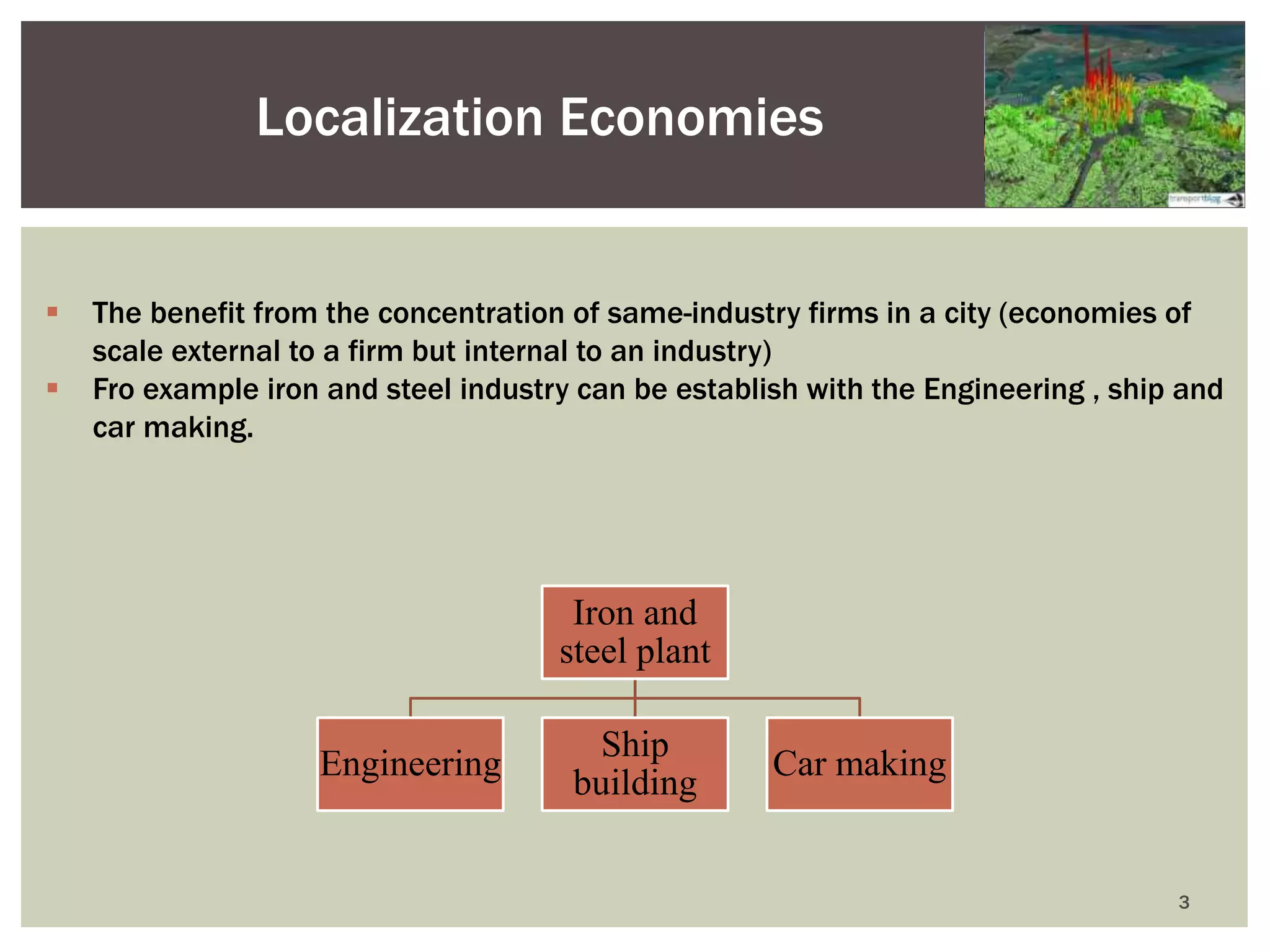
Localization Economies
 The benefit from the concentration of same-industry firms in a city (economies of
scale external to a firm but internal to an industry)
 Fro example iron and steel industry can be establish with the Engineering , ship and
car making.
Iron and
steel plant
Engineering
Ship
building
Car making
3
 The benefit from the concentration of different-industry firms in a
city (economies of scale external to an industry but internal to a city)
Urbanization Economies
Interdependent
Chemical plant
Textile
industry
Electronics
4
 What are intermediate inputs?
 Things used to make other things – Screens used to make
Televisions, Engines used for Cars.
 There are economies of scale associated with having all these
‘intermediate inputs’ located nearby.
 It is cheaper to make TVs when the screens don’t have to be shipped
long distances (ex of Localization Economies)
INTERMEDIATE INPUT
ECONOMIES OF SCALE
5
 Benefits from the concentration of workers (employment)
in cities. Such benefits increase workers’ productivity and
therefore wages
 Labor market localization economies: Benefits from
concentration of workers in the same industry (occupation) in a
city.
 Labor market urbanization economies: Benefits from
concentration of workers in different industries (occupations) in
a city.
LABOR MARKET AGGLOMERATION
ECONOMIES
6
 Positive impact on manufacturing, transport, storage, and
communication, and other services sectors, in varying magnitudes.
POSITIVE OF AGGLOMERATION
Inter-plant transport saving
Access to common pool of skilled labor
Presence of special training institutions
Presence of ancillary services
Research and development of collective facilities
Sharing cost of certain operation
7
(1) Agriculture
(2) Fishing
(3) Mining and Querying
(4) Manufacturing Registered
(5) Manufacturing Unregistered
(6) Construction;
(7) Electricity, Gas, and Water supply
(8) Railways
(9) Transport, Storage, Communication
(10) Trade, hotels, and restaurants
(11) Banking and insurance
(12) Real estate, ownership of dwellings, and business services
8
POSITIVE IMPACT SECTOR
 Are some negative consequences associated with clustering:
 Congestion
 Pollution
 Disease
 Crime
 High Rents
NEGATIVE IMPACT
9
Indian city are some example of the Agglomeration of Economic
 Surat – Gujarat (Diamond and Textile Industry),
 Morbi – Gujarat (Ceramic Industry),
 Namakkal – Karnataka (Transportation Industry)
 Tripur – Karnataka (Knitwear Industry)
10
EXAMPLE OF AGGLOMERATION
 Bhagat, R B. 2003. Urbanization in India: a Demographic
Reappraisal. International Union for Scientific Study of Population,
p.p.1-17.
 Bostic, R. 1997. Urban productivity and factor growth in the late
19th century. Journal of Urban Economics, 4, p.p. 38-55.
 Carlino, G.A. 1979. Increasing Returns to Scale in Metropolitan
Manufacturing. Journal of Regional Science, 19, p.p. 363-374.
 Ciccone, A. & R. Hall. 1996. Productivity and the density of
economic activity. American Economic Review, 86, p.p. 54-70.
REFERENCES
11
Thank you
12

Agglomeration of economics

  • 1.
    ECONOMICS OF AGGLOMERATION Department ofArchitecture Land economics Guided By , Prepared By , Dr. Jayant Kumar Miral B. Kaloliya 1
  • 2.
     Most importanteconomies of scale for urban economics is called Agglomeration  An agglomeration economy exists when production is cheaper because more activity is going on nearby  Two types of agglomeration economies:  Localization Economies  Economies of scale that arise from have many firms in the same industry locate near one another  Urbanization Economies  Economies of scale that arise from having many people located together, regardless of the industry in which they work. WHAT IS AGGLOMERATION? 2
  • 3.
    Localization Economies  Thebenefit from the concentration of same-industry firms in a city (economies of scale external to a firm but internal to an industry)  Fro example iron and steel industry can be establish with the Engineering , ship and car making. Iron and steel plant Engineering Ship building Car making 3
  • 4.
     The benefitfrom the concentration of different-industry firms in a city (economies of scale external to an industry but internal to a city) Urbanization Economies Interdependent Chemical plant Textile industry Electronics 4
  • 5.
     What areintermediate inputs?  Things used to make other things – Screens used to make Televisions, Engines used for Cars.  There are economies of scale associated with having all these ‘intermediate inputs’ located nearby.  It is cheaper to make TVs when the screens don’t have to be shipped long distances (ex of Localization Economies) INTERMEDIATE INPUT ECONOMIES OF SCALE 5
  • 6.
     Benefits fromthe concentration of workers (employment) in cities. Such benefits increase workers’ productivity and therefore wages  Labor market localization economies: Benefits from concentration of workers in the same industry (occupation) in a city.  Labor market urbanization economies: Benefits from concentration of workers in different industries (occupations) in a city. LABOR MARKET AGGLOMERATION ECONOMIES 6
  • 7.
     Positive impacton manufacturing, transport, storage, and communication, and other services sectors, in varying magnitudes. POSITIVE OF AGGLOMERATION Inter-plant transport saving Access to common pool of skilled labor Presence of special training institutions Presence of ancillary services Research and development of collective facilities Sharing cost of certain operation 7
  • 8.
    (1) Agriculture (2) Fishing (3)Mining and Querying (4) Manufacturing Registered (5) Manufacturing Unregistered (6) Construction; (7) Electricity, Gas, and Water supply (8) Railways (9) Transport, Storage, Communication (10) Trade, hotels, and restaurants (11) Banking and insurance (12) Real estate, ownership of dwellings, and business services 8 POSITIVE IMPACT SECTOR
  • 9.
     Are somenegative consequences associated with clustering:  Congestion  Pollution  Disease  Crime  High Rents NEGATIVE IMPACT 9
  • 10.
    Indian city aresome example of the Agglomeration of Economic  Surat – Gujarat (Diamond and Textile Industry),  Morbi – Gujarat (Ceramic Industry),  Namakkal – Karnataka (Transportation Industry)  Tripur – Karnataka (Knitwear Industry) 10 EXAMPLE OF AGGLOMERATION
  • 11.
     Bhagat, RB. 2003. Urbanization in India: a Demographic Reappraisal. International Union for Scientific Study of Population, p.p.1-17.  Bostic, R. 1997. Urban productivity and factor growth in the late 19th century. Journal of Urban Economics, 4, p.p. 38-55.  Carlino, G.A. 1979. Increasing Returns to Scale in Metropolitan Manufacturing. Journal of Regional Science, 19, p.p. 363-374.  Ciccone, A. & R. Hall. 1996. Productivity and the density of economic activity. American Economic Review, 86, p.p. 54-70. REFERENCES 11
  • 12.