THE REASON WHY I
T SHOULD BE AGLOMERATE
The reasons for agglomeration can be divided into three main categories
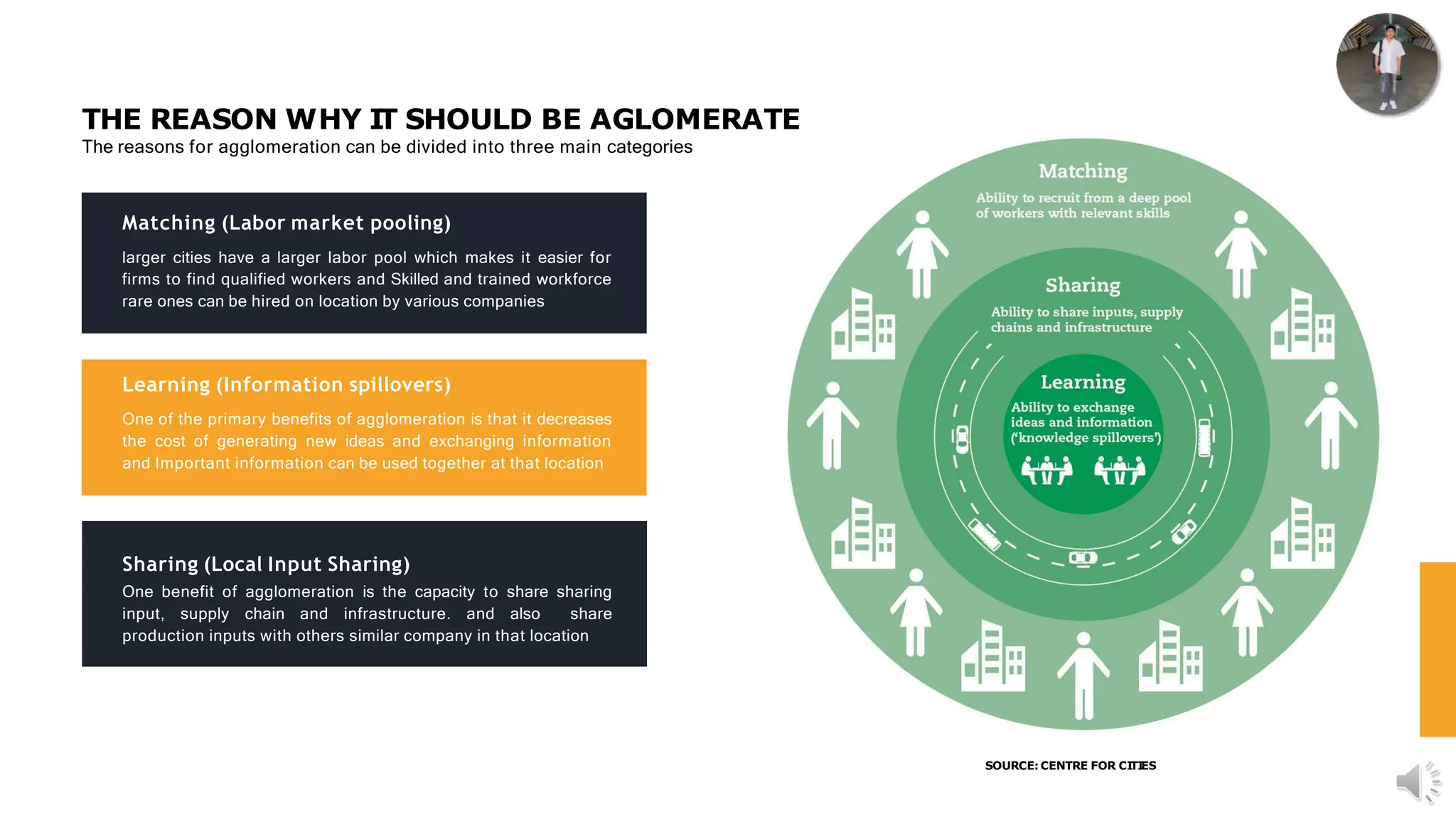
Matching (Labor market pooling)
larger cities have a larger labor pool which makes it easier for
firms to find qualified workers and Skilled and trained workforce
rare ones can be hired on location by various companies
Sharing (Local Input Sharing)
One benefit of agglomeration is the capacity to share sharing
input, supply chain and infrastructure. and also share
production inputs with others similar company in that location
Learning (Information spillovers)
One of the primary benefits of agglomeration is that it decreases
the cost of generating new ideas and exchanging information
and Important information can be used together at that location
SOURCE: CENTRE FOR CI
TI
ES
I
MPACTS OF
AGGLOMERATION
The cost of purchasing for each company becomes lower, By
gathering companies in one location then transportation
costs per unit will be lower, For example, one cellphone
truck only needs to go to one location there is BEC, if the
stores are spread out then it should be go to various places
These companies can use shared facilities which will be
more cheap when used together, For example: shared toilet,
shared cleaning service, shared canteen, joint repair service
etc
SCALE OF
AGGLOMERATION
It is often assumed that agglomeration
economies operate at the “metropolitan level.”
However, cities are not monocentric, but rather
polycentric and the effects of agglomeration are
not uniform across cities. Rather, within cities
there may be multiple agglomeration clusters
(Agarawal et al., 2012).
Agglomeration occurs at many different
geographic levels (Giuliano & Yuan, 2019).
LEVEL OF AGGLOMERATION
Geographical Agglomeration
an Agglomeration of businesses in a geographical
location where enough resources have accumulated
to give a competitive advantage to businesses in a
given economic branch.
Vertical Agglomeration
are alliances between businesses which belong to
different levels of the same supply chain.
Sectoral Agglomeration
an Agglomeration of businesses operating together
from within the same economic sector e.g. Silicon
Valley.
Horizontal Agglomeration
are built between businesses that compete for the
same market, e.g. multiple producers combing to
establish a retail shop.

Agglomeration Theory_compressed (3) (1).pptx

  • 2.
    THE REASON WHYI T SHOULD BE AGLOMERATE The reasons for agglomeration can be divided into three main categories Matching (Labor market pooling) larger cities have a larger labor pool which makes it easier for firms to find qualified workers and Skilled and trained workforce rare ones can be hired on location by various companies Sharing (Local Input Sharing) One benefit of agglomeration is the capacity to share sharing input, supply chain and infrastructure. and also share production inputs with others similar company in that location Learning (Information spillovers) One of the primary benefits of agglomeration is that it decreases the cost of generating new ideas and exchanging information and Important information can be used together at that location SOURCE: CENTRE FOR CI TI ES
  • 3.
    I MPACTS OF AGGLOMERATION The costof purchasing for each company becomes lower, By gathering companies in one location then transportation costs per unit will be lower, For example, one cellphone truck only needs to go to one location there is BEC, if the stores are spread out then it should be go to various places These companies can use shared facilities which will be more cheap when used together, For example: shared toilet, shared cleaning service, shared canteen, joint repair service etc
  • 4.
    SCALE OF AGGLOMERATION It isoften assumed that agglomeration economies operate at the “metropolitan level.” However, cities are not monocentric, but rather polycentric and the effects of agglomeration are not uniform across cities. Rather, within cities there may be multiple agglomeration clusters (Agarawal et al., 2012). Agglomeration occurs at many different geographic levels (Giuliano & Yuan, 2019).
  • 5.
    LEVEL OF AGGLOMERATION GeographicalAgglomeration an Agglomeration of businesses in a geographical location where enough resources have accumulated to give a competitive advantage to businesses in a given economic branch. Vertical Agglomeration are alliances between businesses which belong to different levels of the same supply chain. Sectoral Agglomeration an Agglomeration of businesses operating together from within the same economic sector e.g. Silicon Valley. Horizontal Agglomeration are built between businesses that compete for the same market, e.g. multiple producers combing to establish a retail shop.