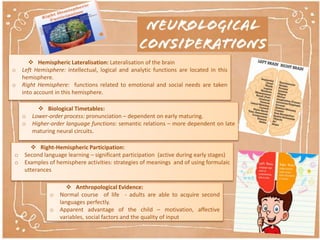
 Hemispheric Lateralisation: Lateralisation of the brain
o Left Hemisphere: intellectual, logical and analytic functions are located in this
hemisphere.
o Right Hemisphere: functions related to emotional and social needs are taken
into account in this hemisphere.
 Anthropological Evidence:
o Normal course of life - adults are able to acquire second
languages perfectly.
o Apparent advantage of the child – motivation, affective
variables, social factors and the quality of input
 Right-Hemispheric Participation:
o Second language learning – significant participation (active during early stages)
o Examples of hemisphere activities: strategies of meanings and of using formulaic
utterances
 Biological Timetables:
o Lower-order process: pronunciation – dependent on early maturing.
o Higher-order language functions: semantic relations – more dependent on late
maturing neural circuits.
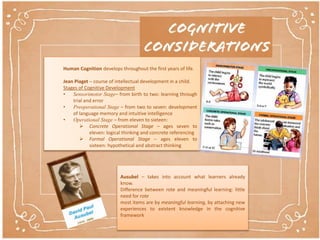
Human Cognition develops throughout the first years of life.
Jean Piaget – course of intellectual development in a child.
Stages of Cognitive Development
• Sensorimotor Stage– from birth to two: learning through
trial and error
• Preoperational Stage – from two to seven: development
of language memory and intuitive intelligence
• Operational Stage – from eleven to sixteen:
 Concrete Operational Stage – ages seven to
eleven: logical thinking and concrete referencing
 Formal Operational Stage – ages eleven to
sixteen: hypothetical and abstract thinking
Ausubel – takes into account what learners already
know.
Difference between rote and meaningful learning: little
need for rote
most items are by meaningful learning, by attaching new
experiences to existent knowledge in the cognitive
framework
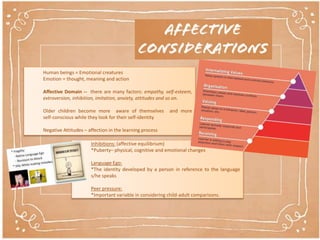
Human beings = Emotional creatures
Emotion = thought, meaning and action
Affective Domain -- there are many factors: empathy, self-esteem,
extroversion, inhibition, imitation, anxiety, attitudes and so on.
Older children become more aware of themselves and more
self-conscious while they look for their self-identity
Negative Attitudes – affection in the learning process
Inhibitions: (affective equilibrium)
*Puberty– physical, cognitive and emotional changes
Language Ego:
*The identity developed by a person in reference to the language
s/he speaks
Peer pressure:
*Important variable in considering child-adult comparisons.
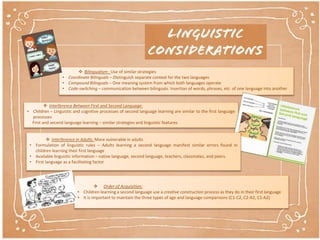
 Bilingualism : Use of similar strategies
• Coordinate Bilinguals – Distinguish separate context for the two languages
• Compound Bilinguals – One meaning system from which both languages operate
• Code-switching – communication between bilinguals. Insertion of words, phrases, etc. of one language into another
 Interference Between First and Second Language:
• Children – Linguistic and cognitive processes of second language learning are similar to the first language
processes
First and second language learning – similar strategies and linguistic features
 Interference in Adults: More vulnerable in adults
• Formulation of linguistic rules – Adults learning a second language manifest similar errors found in
children learning their first language
• Available linguistic information – native language, second language, teachers, classmates, and peers.
• First language as a facilitating factor
 Order of Acquisition:
• Children learning a second language use a creative construction process as they do in their first language
• It is important to maintain the three types of age and language comparisons (C1-C2, C2-A2, C1-A2)
Activity 1.2 e.t.practicum jeanneth calvache

Activity 1.2 e.t.practicum jeanneth calvache

  • 2.
     Hemispheric Lateralisation:Lateralisation of the brain o Left Hemisphere: intellectual, logical and analytic functions are located in this hemisphere. o Right Hemisphere: functions related to emotional and social needs are taken into account in this hemisphere.  Anthropological Evidence: o Normal course of life - adults are able to acquire second languages perfectly. o Apparent advantage of the child – motivation, affective variables, social factors and the quality of input  Right-Hemispheric Participation: o Second language learning – significant participation (active during early stages) o Examples of hemisphere activities: strategies of meanings and of using formulaic utterances  Biological Timetables: o Lower-order process: pronunciation – dependent on early maturing. o Higher-order language functions: semantic relations – more dependent on late maturing neural circuits.
  • 3.
    Human Cognition developsthroughout the first years of life. Jean Piaget – course of intellectual development in a child. Stages of Cognitive Development • Sensorimotor Stage– from birth to two: learning through trial and error • Preoperational Stage – from two to seven: development of language memory and intuitive intelligence • Operational Stage – from eleven to sixteen:  Concrete Operational Stage – ages seven to eleven: logical thinking and concrete referencing  Formal Operational Stage – ages eleven to sixteen: hypothetical and abstract thinking Ausubel – takes into account what learners already know. Difference between rote and meaningful learning: little need for rote most items are by meaningful learning, by attaching new experiences to existent knowledge in the cognitive framework
  • 4.
    Human beings =Emotional creatures Emotion = thought, meaning and action Affective Domain -- there are many factors: empathy, self-esteem, extroversion, inhibition, imitation, anxiety, attitudes and so on. Older children become more aware of themselves and more self-conscious while they look for their self-identity Negative Attitudes – affection in the learning process Inhibitions: (affective equilibrium) *Puberty– physical, cognitive and emotional changes Language Ego: *The identity developed by a person in reference to the language s/he speaks Peer pressure: *Important variable in considering child-adult comparisons.
  • 5.
     Bilingualism :Use of similar strategies • Coordinate Bilinguals – Distinguish separate context for the two languages • Compound Bilinguals – One meaning system from which both languages operate • Code-switching – communication between bilinguals. Insertion of words, phrases, etc. of one language into another  Interference Between First and Second Language: • Children – Linguistic and cognitive processes of second language learning are similar to the first language processes First and second language learning – similar strategies and linguistic features  Interference in Adults: More vulnerable in adults • Formulation of linguistic rules – Adults learning a second language manifest similar errors found in children learning their first language • Available linguistic information – native language, second language, teachers, classmates, and peers. • First language as a facilitating factor  Order of Acquisition: • Children learning a second language use a creative construction process as they do in their first language • It is important to maintain the three types of age and language comparisons (C1-C2, C2-A2, C1-A2)