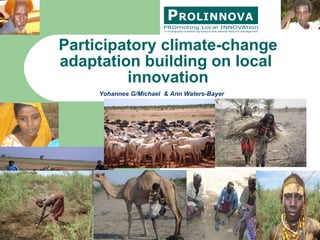

Participatory climate-change adaptation building on local  innovation Yohannes G/Michael  & Ann Waters-Bayer
Facing the reality of climate change Weather extremes  will occur more frequently Rising temperatures will favour agents of tropical diseases. Agricultural production could decline by 50% by 2020. By 2025, about 480 million people in Africa could be living in water-stressed areas. Many African crop farmers will be shifting to livestock-keeping Natural phenomenon is non liner and less predictable
Living with climatic variability Climatic variability is not a new phenomenon in Ethiopia From 1540 to 1800 AD, 26 major droughts and famines were recorded.  The “great Ethiopian famine” happened in the period 1889–92.  Pastoralist had been the victims and have developed mechanisms to cope with high climate variability. Thus, they were practising adaptation long before the concept of “climate change” emerged
Pastoralists’ adaptation to climate variability Pastoralists’ livelihoods primarily based on livestock that graze natural pasture. Globally, it is assumed that up to 200 million people are pastoralists. In Africa, it is assumed to be up to 40 million people In Ethiopia, up to 15 million and using more than 60% of the territory. Mobility is one of the most successful strategies used by most pastoralists.
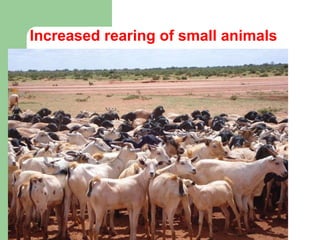
Pastoralists’ adaptation…(2) Mobility has multiple functions including:  - gaining access to water and pasture - avoiding pests and diseases - avoiding conflicts and risks of livestock raiding  - conserving biodiversity Pastoralists keep different animals in order to:   - reduce risks and improve overall productivity - obtain food, means of transport and income from marketing - exploit different ecological niches
Pastoralists’ adaptation…(3) Similarly, vegetation in the drylands has many purposes, such as: pasture, bee forage, materials for tools, medicinal plants, materials for rituals, wild fruits, fuelwood and early-warning indicators of impending drought General attributes of viable pastoral production systems are:  flexibility, dynamism, multi-functionality, complementarity and reciprocity in resource use
The paradox: productive and adaptable yet vulnerable pastoralists Traditional pastoral systems can produce up to ten times more food per unit area than can modern ranching.  In Ethiopia, pastoralists keep about three-quarters of all goats in the country, one quarter of the sheep, 20% of the cattle and all of the camels.  The livestock sector ranks second after coffee in generating foreign exchange for Ethiopia: up to US$ 50 million per annum.
The paradox…(2) Many policymakers in Ethiopia have a vision to settle the pastoralists, considering them to be backward, primitive and a cause of poverty and land degradation. Many of the prime areas used by pastoralists for dry-season grazing are allocated for government farms, private investors and national parks. This increasing marginalisation is making pastoralists more vulnerable to the effects of droughts and climate change. Moreover, insufficient attention is given to the deep-rooted knowledge and adaptation practices of pastoralists and their customary institutions for dealing with land-management issues.
Determinants of pastoralists’ vulnerability to climate change Change in responsibility for herd management  Herd size Livestock species kept Strength of customary socio-political institutions Geographical location of resource exploitation Land-use systems Particular emphasis by pastoralists on the degree of good governance in customary institutions
Why look at local innovation? Recognising local innovativeness leads to more equal partnership in R&D Local innovations are sources of valuable new knowledge based on deep-rooted experience Stimulates appropriate and pro-poor adaptation An entry point that increases self-confidence and motivation to adapt Greater likelihood of sustainability
P ROLINNOVA :  P RO moting Local I NNOVA tion in  ecologically oriented agriculture and NRM Global learning  network Functional since 2003 Members include more than 150 organisations of multiple stakeholders (state and non-state)  Currently, 18 countries involved
Vision A world in which women and men farmers play  decisive roles in research and development  for sustainable livelihoods Mission To foster a culture of  mutual learning  and  synergy  in local  innovation process in agriculture and NRM Goal  To develop and institutionalise partnerships and methods that  promote  processes of local innovation  for ecologically sound use of  natural resources
Approach and concepts in study on  local innovation and climate change P ROLINNOVA  initiated an exploratory study with funds made available by the Netherlands (DGIS). In 2008, some P ROLINNOVA  partners in Ethiopia, Nepal and Niger started studies on local innovation in the face of climate change.   This paper is based on results in Ethiopia from s emi-structured interviews and discussions with different stakeholders, both individuals and focus groups in Afar, Somali and S.Omo
Approach and concepts…(2) Innovation  Discovery of new and better ways of doing things  Not something inherited but could be building on existing technology / practice Could also involve modification of introduced technologies Every pastoralist has to be an innovator to some degree.
Approach and concepts…(3) Adaptation  A continuous learning process A response to actual or expected risks Integrates mitigation in its process Can be spontaneous or planned  Can involve technological or institutional/ management change or process  Can arise from a challenge or an opportunity
Challenges in understanding local innovation Difficulties in separating climate-change impacts from other pressures on pastoral systems Distinguishing between indigenous practices and local innovation Recognising small but possibly important changes Keeping a longer-term perspective Keeping pace with fast change
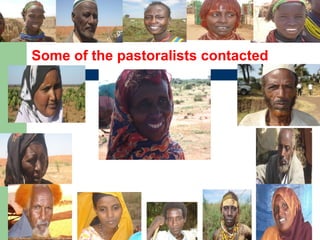
Some of the pastoralists contacted
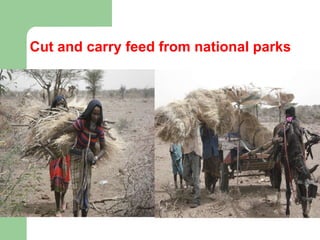
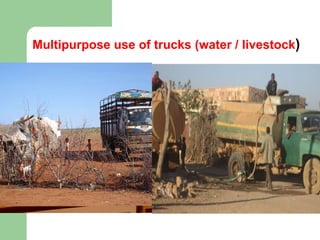
Pastoralists’ emerging responses  to climate change Developing their own cut and carry feeding system Settlement around water points Purchasing with credit Changing herd composition Settlement on islands in dryland lakes Diversification of livelihood sources Use of motor vehicles to transport water, fodder and/or animals Use of Traditional early warning systems Empowerment of traditional institutions
Major features of the local innovations Wide range of different types of innovation Group innovations Multi-functionality of innovations Diversification of livelihoods
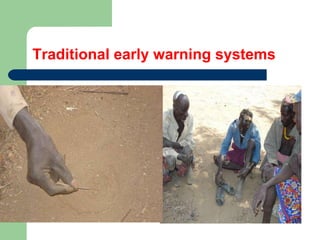
Traditional early warning systems
Cut and carry feed from national parks
Increased rearing of small animals
Multipurpose use of trucks (water / livestock )
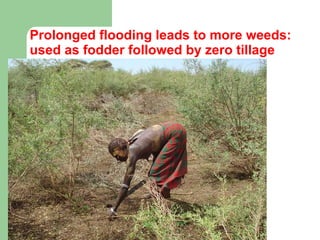
Prolonged flooding leads to more weeds: used as fodder followed by zero tillage
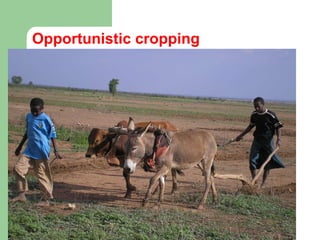
Opportunistic cropping
Lessons learned and the way forward Recognising local innovativeness by pastoralists provides an  entry point for a bottom-up approach  to supporting climate-change adaptation, starting with local capacities and ideas. Local innovation in adaptation to climate change needs to be assessed together with  other environmental, socio-economic and policy changes . Documentation of adaptation needed as  a continuous process  for a better understanding of community competence to adapt and of  need for joint experimentation and policy reorientation.
Lessons learned…(2) The focus should be not so much on specific innovations, but rather on documenting local  innovation as a process . Recognition of pastoralist innovation could lead to more  equal partnership  in formal research and development activities.  Results of such joint innovation processes would have a  higher likelihood of sustainability  than would starting interaction with external interventions that are foreign to the pastoralists.
Thank you

Yohannes GebreMichael: Participatory climate-change adaptation building on local innovation

  • 1.
    Participatory climate-change adaptationbuilding on local innovation Yohannes G/Michael & Ann Waters-Bayer
  • 2.
    Facing the realityof climate change Weather extremes will occur more frequently Rising temperatures will favour agents of tropical diseases. Agricultural production could decline by 50% by 2020. By 2025, about 480 million people in Africa could be living in water-stressed areas. Many African crop farmers will be shifting to livestock-keeping Natural phenomenon is non liner and less predictable
  • 3.
    Living with climaticvariability Climatic variability is not a new phenomenon in Ethiopia From 1540 to 1800 AD, 26 major droughts and famines were recorded. The “great Ethiopian famine” happened in the period 1889–92. Pastoralist had been the victims and have developed mechanisms to cope with high climate variability. Thus, they were practising adaptation long before the concept of “climate change” emerged
  • 4.
    Pastoralists’ adaptation toclimate variability Pastoralists’ livelihoods primarily based on livestock that graze natural pasture. Globally, it is assumed that up to 200 million people are pastoralists. In Africa, it is assumed to be up to 40 million people In Ethiopia, up to 15 million and using more than 60% of the territory. Mobility is one of the most successful strategies used by most pastoralists.
  • 5.
    Pastoralists’ adaptation…(2) Mobilityhas multiple functions including: - gaining access to water and pasture - avoiding pests and diseases - avoiding conflicts and risks of livestock raiding - conserving biodiversity Pastoralists keep different animals in order to: - reduce risks and improve overall productivity - obtain food, means of transport and income from marketing - exploit different ecological niches
  • 6.
    Pastoralists’ adaptation…(3) Similarly,vegetation in the drylands has many purposes, such as: pasture, bee forage, materials for tools, medicinal plants, materials for rituals, wild fruits, fuelwood and early-warning indicators of impending drought General attributes of viable pastoral production systems are: flexibility, dynamism, multi-functionality, complementarity and reciprocity in resource use
  • 7.
    The paradox: productiveand adaptable yet vulnerable pastoralists Traditional pastoral systems can produce up to ten times more food per unit area than can modern ranching. In Ethiopia, pastoralists keep about three-quarters of all goats in the country, one quarter of the sheep, 20% of the cattle and all of the camels. The livestock sector ranks second after coffee in generating foreign exchange for Ethiopia: up to US$ 50 million per annum.
  • 8.
    The paradox…(2) Manypolicymakers in Ethiopia have a vision to settle the pastoralists, considering them to be backward, primitive and a cause of poverty and land degradation. Many of the prime areas used by pastoralists for dry-season grazing are allocated for government farms, private investors and national parks. This increasing marginalisation is making pastoralists more vulnerable to the effects of droughts and climate change. Moreover, insufficient attention is given to the deep-rooted knowledge and adaptation practices of pastoralists and their customary institutions for dealing with land-management issues.
  • 9.
    Determinants of pastoralists’vulnerability to climate change Change in responsibility for herd management Herd size Livestock species kept Strength of customary socio-political institutions Geographical location of resource exploitation Land-use systems Particular emphasis by pastoralists on the degree of good governance in customary institutions
  • 10.
    Why look atlocal innovation? Recognising local innovativeness leads to more equal partnership in R&D Local innovations are sources of valuable new knowledge based on deep-rooted experience Stimulates appropriate and pro-poor adaptation An entry point that increases self-confidence and motivation to adapt Greater likelihood of sustainability
  • 11.
    P ROLINNOVA : P RO moting Local I NNOVA tion in ecologically oriented agriculture and NRM Global learning network Functional since 2003 Members include more than 150 organisations of multiple stakeholders (state and non-state) Currently, 18 countries involved
  • 12.
    Vision A worldin which women and men farmers play decisive roles in research and development for sustainable livelihoods Mission To foster a culture of mutual learning and synergy in local innovation process in agriculture and NRM Goal To develop and institutionalise partnerships and methods that promote processes of local innovation for ecologically sound use of natural resources
  • 13.
    Approach and conceptsin study on local innovation and climate change P ROLINNOVA initiated an exploratory study with funds made available by the Netherlands (DGIS). In 2008, some P ROLINNOVA partners in Ethiopia, Nepal and Niger started studies on local innovation in the face of climate change. This paper is based on results in Ethiopia from s emi-structured interviews and discussions with different stakeholders, both individuals and focus groups in Afar, Somali and S.Omo
  • 14.
    Approach and concepts…(2)Innovation Discovery of new and better ways of doing things Not something inherited but could be building on existing technology / practice Could also involve modification of introduced technologies Every pastoralist has to be an innovator to some degree.
  • 15.
    Approach and concepts…(3)Adaptation A continuous learning process A response to actual or expected risks Integrates mitigation in its process Can be spontaneous or planned Can involve technological or institutional/ management change or process Can arise from a challenge or an opportunity
  • 16.
    Challenges in understandinglocal innovation Difficulties in separating climate-change impacts from other pressures on pastoral systems Distinguishing between indigenous practices and local innovation Recognising small but possibly important changes Keeping a longer-term perspective Keeping pace with fast change
  • 17.
    Some of thepastoralists contacted
  • 18.
    Pastoralists’ emerging responses to climate change Developing their own cut and carry feeding system Settlement around water points Purchasing with credit Changing herd composition Settlement on islands in dryland lakes Diversification of livelihood sources Use of motor vehicles to transport water, fodder and/or animals Use of Traditional early warning systems Empowerment of traditional institutions
  • 19.
    Major features ofthe local innovations Wide range of different types of innovation Group innovations Multi-functionality of innovations Diversification of livelihoods
  • 20.
  • 21.
    Cut and carryfeed from national parks
  • 22.
    Increased rearing ofsmall animals
  • 23.
    Multipurpose use oftrucks (water / livestock )
  • 24.
    Prolonged flooding leadsto more weeds: used as fodder followed by zero tillage
  • 25.
  • 26.
    Lessons learned andthe way forward Recognising local innovativeness by pastoralists provides an entry point for a bottom-up approach to supporting climate-change adaptation, starting with local capacities and ideas. Local innovation in adaptation to climate change needs to be assessed together with other environmental, socio-economic and policy changes . Documentation of adaptation needed as a continuous process for a better understanding of community competence to adapt and of need for joint experimentation and policy reorientation.
  • 27.
    Lessons learned…(2) Thefocus should be not so much on specific innovations, but rather on documenting local innovation as a process . Recognition of pastoralist innovation could lead to more equal partnership in formal research and development activities. Results of such joint innovation processes would have a higher likelihood of sustainability than would starting interaction with external interventions that are foreign to the pastoralists.
  • 28.