Finland has provided long-term support for the develop-
ing countries’ efforts to attain better food security and
to promote sustainable management and use of natural
resources.
To improve food security, Finland supports developing
countries’ agricultural growth and related value chains. In
addition, Finland promotes agricultural research and sup-
ports farmers’ organizations. The aim is to improve the
livelihoods of smallholder farmers, focusing on wom-
en and youth. Investments in food processing
create new jobs and improve the quality and
safety of food products.
As hygiene-related diseases are among
the most serious health risks for peo-
ple living in developing countries, Fin-
land supports its partner countries
in developing safe and reliable water
and sanitation services. Finland is a
forerunner in the development of com-
munity-led approaches, which shows in a
high level of ownership, cost-efficiency and
improved sustainability.
In the energy sector, Finland supports renewable energy
solutions. Solar energy and bioenergy provide sustainable
sources of power even outside the electric grid, whereas
clean cooking solutions reduce smoke-related illnesses
and the application of modern technology in electricity
systems improves the efficiency and reliability of services.
Natural resources serve both as a basis for all develop-
ment, and also as a source of income. Sustainable man-
agement of water and land resources is a prerequisite for
industrial forestry and for domestic use of forest prod-
ucts. To promote sustainable forest management, Finland
supports biomass and carbon inventories, national forest
programmes and good sector governance, strengthen-
ing land rights and fair sharing of forest-based
benefits as well as sustainable value chains,
production and use of forests.
The impacts of climate change affect
most severely developing coun-
tries and the poorest people. Severe
droughts and increasing flood-
ing threaten the livelihoods and
lives of billions of people living
in flood-prone areas, like delta
regions, and in arid and semi-arid envi-
ronments. Therefore, Finland supports mit-
igation of and adaptation to climate change at
all levels: from international policy making to individual
projects at grass-root level. In addition to climate-specific
actions, all development cooperation supported by Fin-
land must be climate proof and climate smart.
FOOD SECURITY AND NATURAL
RESOURCES, INCLUDING ACCESS
TO WATER AND ENERGY
Cornerstones of sustainable development
Through its actions, Finland promotes:
•	 People’s improved possibilities to produce or buy food.
•	 Better access to high-quality water supply and access to and use of
	 decent toilets.
•	 Developing countries’ investments to sustainable energy solutions, growing
	 use of renewable energies and decreasing use of fossil energies.
•	 The sustainable management, use, protection and control of renewable natural
	 resources and ecosystems, such as forests and water bodies.
Sustainable
management of
natural resources
is fundamental to
all development.
ETHIOPIA
VIETNAM
KENYA
AFGHANISTAN
http://formin.finland.fi/developmentpolicy
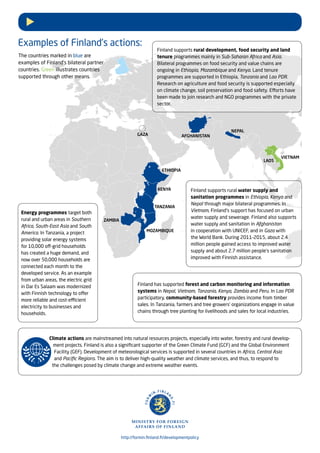
Finland supports rural water supply and
sanitation programmes in Ethiopia, Kenya and
Nepal through major bilateral programmes. In
Vietnam, Finland’s support has focused on urban
water supply and sewerage. Finland also supports
water supply and sanitation in Afghanistan
in cooperation with UNICEF, and in Gaza with
the World Bank. During 2011–2015, about 2.4
million people gained access to improved water
supply and about 2.7 million people’s sanitation
improved with Finnish assistance.
Finland supports rural development, food security and land
tenure programmes mainly in Sub-Saharan Africa and Asia.
Bilateral programmes on food security and value chains are
ongoing in Ethiopia, Mozambique and Kenya. Land tenure
programmes are supported in Ethiopia, Tanzania and Lao PDR.
Research on agriculture and food security is supported especially
on climate change, soil preservation and food safety. Efforts have
been made to join research and NGO programmes with the private
sector.
Energy programmes target both
rural and urban areas in Southern
Africa, South-East Asia and South
America. In Tanzania, a project
providing solar energy systems
for 10,000 off-grid households
has created a huge demand, and
now over 50,000 households are
connected each month to the
developed service. As an example
from urban areas, the electric grid
in Dar Es Salaam was modernized
with Finnish technology to offer
more reliable and cost-efficient
electricity to businesses and
households.
Finland has supported forest and carbon monitoring and information
systems in Nepal, Vietnam, Tanzania, Kenya, Zambia and Peru. In Lao PDR
participatory, community-based forestry provides income from timber
sales. In Tanzania, farmers and tree growers’ organizations engage in value
chains through tree planting for livelihoods and sales for local industries.
Examples of Finland’s actions:
GAZA
TANZANIA
MOZAMBIQUE
Climate actions are mainstreamed into natural resources projects, especially into water, forestry and rural develop-
ment projects. Finland is also a significant supporter of the Green Climate Fund (GCF) and the Global Environment
Facility (GEF). Development of meteorological services is supported in several countries in Africa, Central Asia
and Pacific Regions. The aim is to deliver high-quality weather and climate services, and thus, to respond to
the challenges posed by climate change and extreme weather events.
NEPAL
LAOS
ZAMBIA
The countries marked in blue are
examples of Finland’s bilateral partner
countries. Green illustrates countries
supported through other means.

Food security and natural resources

  • 1.
    Finland has providedlong-term support for the develop- ing countries’ efforts to attain better food security and to promote sustainable management and use of natural resources. To improve food security, Finland supports developing countries’ agricultural growth and related value chains. In addition, Finland promotes agricultural research and sup- ports farmers’ organizations. The aim is to improve the livelihoods of smallholder farmers, focusing on wom- en and youth. Investments in food processing create new jobs and improve the quality and safety of food products. As hygiene-related diseases are among the most serious health risks for peo- ple living in developing countries, Fin- land supports its partner countries in developing safe and reliable water and sanitation services. Finland is a forerunner in the development of com- munity-led approaches, which shows in a high level of ownership, cost-efficiency and improved sustainability. In the energy sector, Finland supports renewable energy solutions. Solar energy and bioenergy provide sustainable sources of power even outside the electric grid, whereas clean cooking solutions reduce smoke-related illnesses and the application of modern technology in electricity systems improves the efficiency and reliability of services. Natural resources serve both as a basis for all develop- ment, and also as a source of income. Sustainable man- agement of water and land resources is a prerequisite for industrial forestry and for domestic use of forest prod- ucts. To promote sustainable forest management, Finland supports biomass and carbon inventories, national forest programmes and good sector governance, strengthen- ing land rights and fair sharing of forest-based benefits as well as sustainable value chains, production and use of forests. The impacts of climate change affect most severely developing coun- tries and the poorest people. Severe droughts and increasing flood- ing threaten the livelihoods and lives of billions of people living in flood-prone areas, like delta regions, and in arid and semi-arid envi- ronments. Therefore, Finland supports mit- igation of and adaptation to climate change at all levels: from international policy making to individual projects at grass-root level. In addition to climate-specific actions, all development cooperation supported by Fin- land must be climate proof and climate smart. FOOD SECURITY AND NATURAL RESOURCES, INCLUDING ACCESS TO WATER AND ENERGY Cornerstones of sustainable development Through its actions, Finland promotes: • People’s improved possibilities to produce or buy food. • Better access to high-quality water supply and access to and use of decent toilets. • Developing countries’ investments to sustainable energy solutions, growing use of renewable energies and decreasing use of fossil energies. • The sustainable management, use, protection and control of renewable natural resources and ecosystems, such as forests and water bodies. Sustainable management of natural resources is fundamental to all development.
  • 2.
    ETHIOPIA VIETNAM KENYA AFGHANISTAN http://formin.finland.fi/developmentpolicy Finland supports ruralwater supply and sanitation programmes in Ethiopia, Kenya and Nepal through major bilateral programmes. In Vietnam, Finland’s support has focused on urban water supply and sewerage. Finland also supports water supply and sanitation in Afghanistan in cooperation with UNICEF, and in Gaza with the World Bank. During 2011–2015, about 2.4 million people gained access to improved water supply and about 2.7 million people’s sanitation improved with Finnish assistance. Finland supports rural development, food security and land tenure programmes mainly in Sub-Saharan Africa and Asia. Bilateral programmes on food security and value chains are ongoing in Ethiopia, Mozambique and Kenya. Land tenure programmes are supported in Ethiopia, Tanzania and Lao PDR. Research on agriculture and food security is supported especially on climate change, soil preservation and food safety. Efforts have been made to join research and NGO programmes with the private sector. Energy programmes target both rural and urban areas in Southern Africa, South-East Asia and South America. In Tanzania, a project providing solar energy systems for 10,000 off-grid households has created a huge demand, and now over 50,000 households are connected each month to the developed service. As an example from urban areas, the electric grid in Dar Es Salaam was modernized with Finnish technology to offer more reliable and cost-efficient electricity to businesses and households. Finland has supported forest and carbon monitoring and information systems in Nepal, Vietnam, Tanzania, Kenya, Zambia and Peru. In Lao PDR participatory, community-based forestry provides income from timber sales. In Tanzania, farmers and tree growers’ organizations engage in value chains through tree planting for livelihoods and sales for local industries. Examples of Finland’s actions: GAZA TANZANIA MOZAMBIQUE Climate actions are mainstreamed into natural resources projects, especially into water, forestry and rural develop- ment projects. Finland is also a significant supporter of the Green Climate Fund (GCF) and the Global Environment Facility (GEF). Development of meteorological services is supported in several countries in Africa, Central Asia and Pacific Regions. The aim is to deliver high-quality weather and climate services, and thus, to respond to the challenges posed by climate change and extreme weather events. NEPAL LAOS ZAMBIA The countries marked in blue are examples of Finland’s bilateral partner countries. Green illustrates countries supported through other means.