Prioritizing Species
and Actions Protocol
Rita Dixon
Idaho Department of Fish and
Game
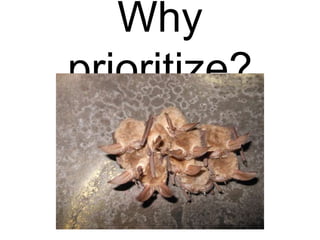
Why
prioritize?
MOST critical
needs
Species with
the GREATEST
conservation
need
PRECLUDE
the need to list
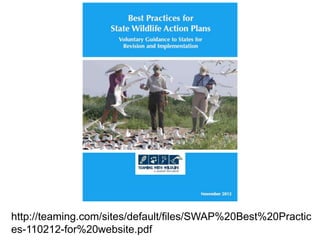
http://teaming.com/sites/default/files/SWAP%20Best%20Practic
es-110212-for%20website.pdf
“Best Practice” method or
technique, through
experience and research,
has consistently shown
results superior to those
achieved by other means
Joseph, L. N., R. F. Maloney, and H. P. Possingham. 2009. Optimal allocation of
resources among threatened species: a project prioritization protocol. Conservation
Biology 23:328–338.
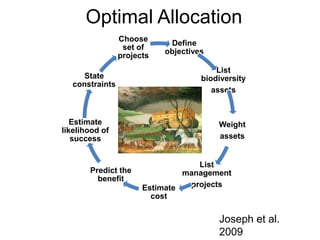
Define
objectives
List
biodiversity
assets
Weight
assets
List
management
projectsEstimate
cost
Predict the
benefit
Estimate
likelihood of
success
State
constraints
Choose
set of
projects
Joseph et al.
2009
Optimal Allocation
(1) Define objectives
e.g., To secure (over a period
of 50 years) the greatest
number of threatened species
of value given a limited budget
(2) List biodiversity assets of
interest
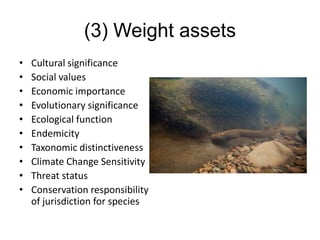
(3) Weight assets
• Cultural significance
• Social values
• Economic importance
• Evolutionary significance
• Ecological function
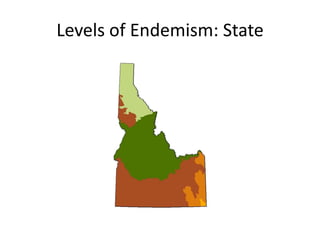
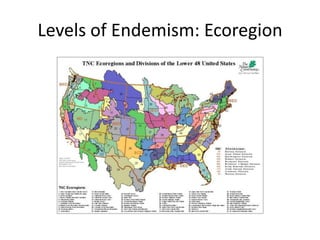
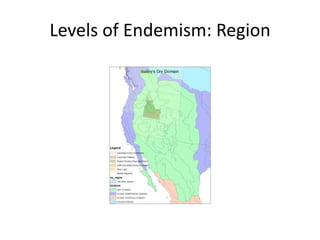
• Endemicity
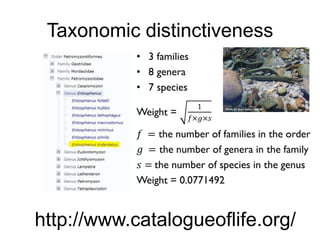
• Taxonomic distinctiveness
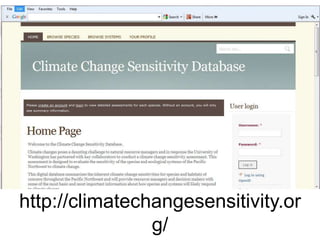
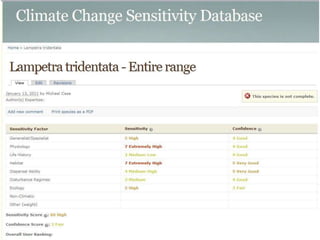
• Climate Change Sensitivity
• Threat status
• Conservation responsibility
of jurisdiction for species
Levels of Endemism: State
Levels of Endemism: Ecoregion
Levels of Endemism: Region
Taxonomic distinctiveness
http://www.catalogueoflife.org/
http://climatechangesensitivity.or
g/
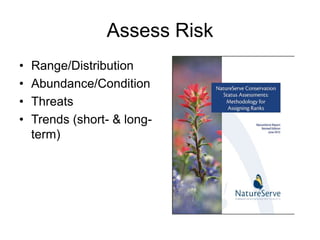
Assess Risk
• Range/Distribution
• Abundance/Condition
• Threats
• Trends (short- & long-
term)
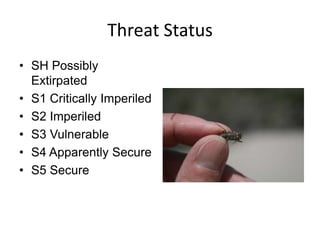
Threat Status
• SH Possibly
Extirpated
• S1 Critically Imperiled
• S2 Imperiled
• S3 Vulnerable
• S4 Apparently Secure
• S5 Secure
(4) List management projects
• Choose an appropriate project for each species
• Project is minimum set of all necessary actions for obtaining a
reasonable (≥95%) probability of securing the species over 50 y
• 4 compulsory components:
– outcome monitoring
– services and support
– project management
– infrastructure
• at least one optional intervention (e.g., captive breeding,
translocation, pest animal control, weed control, legal actions,
education)
• Specify precise location, intensity, and duration of management for
each action
(5) Calculate the cost of each
project
• Total estimated cost over a 10-year period
(i.e., SWAP revision period)
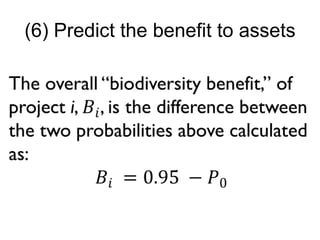
(6) Predict the benefit to assets
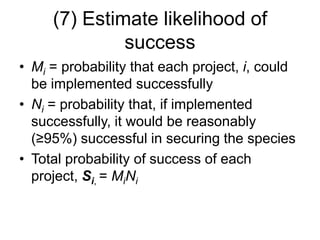
(7) Estimate likelihood of
success
• Mi = probability that each project, i, could
be implemented successfully
• Ni = probability that, if implemented
successfully, it would be reasonably
(≥95%) successful in securing the species
• Total probability of success of each
project, Si, = MiNi
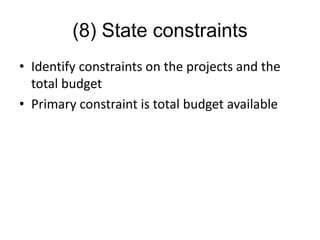
(8) State constraints
• Identify constraints on the projects and the
total budget
• Primary constraint is total budget available
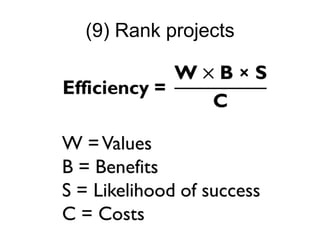
(9) Rank projects
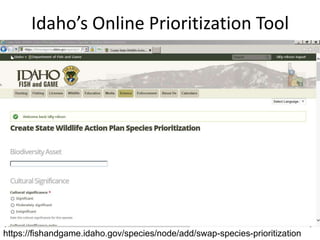
Idaho’s Online Prioritization Tool
https://fishandgame.idaho.gov/species/node/add/swap-species-prioritization
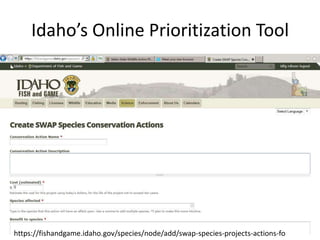
Idaho’s Online Prioritization Tool
https://fishandgame.idaho.gov/species/node/add/swap-species-projects-actions-fo

Dixon prioritization presentation 20130603

Editor's Notes

  • #12 Joseph et al. (2009) extended the work of Metrick and Weitzman’s 1998 Noah’s Ark framework to include the probability that the management will succeed