OUTLINE OF PRESENTATION Anantapur Region AF Ecology Centre Improving Livelihoods through Watershed Development Adapting to Climate Change Challenges ahead for Anantapur. Dr.Y.V.Malla Reddy, Director, AF-Ecology Centre. Presentation made in 2 nd  Conference on Adaptation  to Climate Change in Developing Countries  25 th  November, 2008, Hague
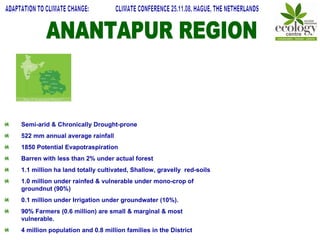
ANANTAPUR REGION Semi-arid & Chronically Drought-prone 522 mm annual average rainfall 1850 Potential Evapotraspiration Barren with less than 2% under actual forest 1.1 million ha land totally cultivated, Shallow, gravelly  red-soils 1.0 million under rainfed & vulnerable under mono-crop of  groundnut (90%) 0.1 million under Irrigation under groundwater (10%). 90% Farmers (0.6 million) are small & marginal & most vulnerable. 4 million population and 0.8 million families in the District ADAPTATION TO CLIMATE CHANGE:  CLIMATE CONFERENCE 25.11.08, HAGUE, THE NETHERLANDS
ABOUT AF-ECOLOGY CENTRE Founded by Father Vincent Ferrer in 1982 A fraternal Organisation of RDT AF is specialized in Watershed Development for the past 20 years. Project Area 235 villages, 60000 families Partner of ICCO & EED  Focus of work : Participatory Watershed Development Sustainable Agriculture (LEISA) Peoples institution Building Alternate livelihoods for youth & women Policy advocacy and public opinion building   ADAPTATION TO CLIMATE CHANGE:  CLIMATE CONFERENCE 25.11.08, HAGUE, THE NETHERLANDS
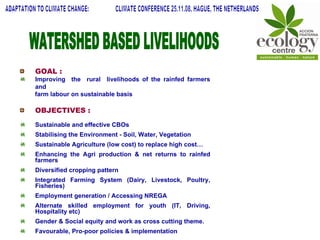
WATERSHED BASED LIVELIHOODS GOAL : Improving  the  rural  livelihoods of the rainfed farmers and  farm labour on sustainable basis OBJECTIVES : Sustainable and effective CBOs Stabilising the Environment - Soil, Water, Vegetation Sustainable Agriculture (low cost) to replace high cost… Enhancing the Agri production & net returns to rainfed farmers Diversified cropping pattern Integrated Farming System (Dairy, Livestock, Poultry, Fisheries) Employment generation / Accessing NREGA Alternate skilled employment for youth (IT, Driving, Hospitality etc) Gender & Social equity and work as cross cutting theme. Favourable, Pro-poor policies & implementation ADAPTATION TO CLIMATE CHANGE:  CLIMATE CONFERENCE 25.11.08, HAGUE, THE NETHERLANDS
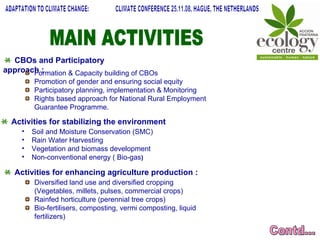
MAIN ACTIVITIES Contd... ADAPTATION TO CLIMATE CHANGE:  CLIMATE CONFERENCE 25.11.08, HAGUE, THE NETHERLANDS CBOs and Participatory approach : Formation & Capacity building of CBOs Promotion of gender and ensuring social equity Participatory planning, implementation & Monitoring  Rights based approach for National Rural Employment Guarantee Programme. Activities for stabilizing the environment Soil and Moisture Conservation (SMC) Rain Water Harvesting Vegetation and biomass development Non-conventional energy ( Bio-gas ) Activities for enhancing agriculture production : Diversified land use and diversified cropping (Vegetables, millets, pulses, commercial crops) Rainfed horticulture (perennial tree crops) Bio-fertilisers, composting, vermi composting, liquid fertilizers)
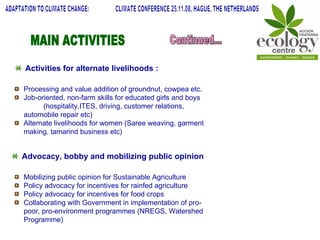
MAIN ACTIVITIES Continued... ADAPTATION TO CLIMATE CHANGE:  CLIMATE CONFERENCE 25.11.08, HAGUE, THE NETHERLANDS Activities for alternate livelihoods : Processing and value addition of groundnut, cowpea etc. Job-oriented, non-farm skills for educated girls and boys  (hospitality,ITES, driving, customer relations, automobile repair etc) Alternate livelihoods for women (Saree weaving, garment making, tamarind business etc) Advocacy, bobby and mobilizing public opinion Mobilizing public opinion for Sustainable Agriculture Policy advocacy for incentives for rainfed agriculture Policy advocacy for incentives for food crops Collaborating with Government in implementation of pro-poor, pro-environment programmes (NREGS, Watershed Programme)
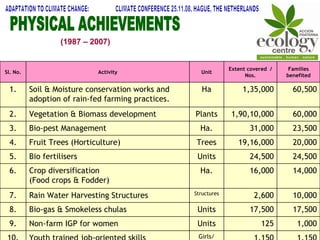
PHYSICAL ACHIEVEMENTS Contd... (1987 – 2007) ADAPTATION TO CLIMATE CHANGE:  CLIMATE CONFERENCE 25.11.08, HAGUE, THE NETHERLANDS 1,150 1,150 Girls/ Boys Youth trained job-oriented skills 10. 1,000 125 Units Non-farm IGP for women 9. 17,500 17,500 Units Bio-gas & Smokeless chulas 8. 10,000 2,600 Structures Rain Water Harvesting Structures 7. 14,000 16,000 Ha. Crop diversification  (Food crops & Fodder) 6. 24,500 24,500 Units Bio fertilisers 5. 20,000 19,16,000 Trees Fruit Trees (Horticulture) 4. 23,500 31,000 Ha. Bio-pest Management 3. 60,000 1,90,10,000 Plants Vegetation & Biomass development 2. 60,500 1,35,000 Ha Soil & Moisture conservation works and adoption of rain-fed farming practices. 1. Families benefited Extent covered  / Nos. Unit Activity Sl. No.
Net returns in rainfed farming increased to small & marginal farmers More rainfed farmers gained access to groundwater Women are able to participate in decisions at family and community levels Sustainable and remunerative employment to the farm labour Enhanced human dignity, self-worth & social status for women and the poor Education levels have improved Household, Food Security & Nutritional Security improved People health in general has improved. SUSTAINABLE IMPACT ON LIVELIHOODS ADAPTATION TO CLIMATE CHANGE:  CLIMATE CONFERENCE 25.11.08, HAGUE, THE NETHERLANDS Achievements vary family to family Droughts persists and affect livelihoods Policy environment not favorable for rain-fed areas Safety nets under pressure during droughts Persistant challenges Impacts
Soil health & land capability enhanced Vegetation & biomass enhanced Ground water enhanced Tree crops enhanced (Rainfed Horticulture) Bio-diversity & crop diversity enhanced. Use of chemical fertilisers and pesticides decreased Awareness of people on climate change & adaptation enhanced. SUSTAINABLE IMPACT ON ENVIRONMENT ADAPTATION TO CLIMATE CHANGE:  CLIMATE CONFERENCE 25.11.08, HAGUE, THE NETHERLANDS A lot more biomass is needed Ground water overexploitation is not controlled Afforestation is inadequate Environmental challenges
CHANGES FORSEEN IN CLIMATE IN ANANTAPUR REGION Shrinking duration of rainy season 6 months to 4 months (?). Decreased no. of rainy days (35 to 25) (?) Early rains and late rains are disappearing. Scantiness is increasing Per-rain volume & intensity is increasing Temperature variability is increasing  ADAPTATION TO CLIMATE CHANGE:  CLIMATE CONFERENCE 25.11.08, HAGUE, THE NETHERLANDS
IMPACT OF CLIMATE CHANGES ON LIVELIHOODS Impact on Agriculture Cropping season is shrinking Rain distribution is getting more unpredictable, affecting crops Pests and diseases are on the increase Land exposure to sun and denudation has increased Flora & Founa is affected – some species are getting extinct (eg. sparrows) 50% reduction in yields under rainfed crops are estimated by ICAR, by 2025 (?) Common property resources are depleting (grazing lands etc) Frequency & intensity of droughts is on the increase. ADAPTATION TO CLIMATE CHANGE:  CLIMATE CONFERENCE 25.11.08, HAGUE, THE NETHERLANDS
Intensive tree-based horticulture  (inadequate incentives) Insitu-rain water harvesting is promoted. Micro-irrigation (sprinklers, drip etc) Promoting Bio-fertilisers, Vermi Compost, Farm compost, Liquid fertilizers  (inadequate incentives) Promoting Integrated Farming System for  Dairy, Livestock, Poultry, Fisheries,  (need a lot more investments) Alternate skilled employment / income opportunities  (cultural barriers) Promoting awareness raising and stakeholder participation on mitigation & adaptation ......... Still a long way to go ADAPTATIONS BEING TRIED BY AF Continued... ADAPTATION TO CLIMATE CHANGE:  CLIMATE CONFERENCE 25.11.08, HAGUE, THE NETHERLANDS
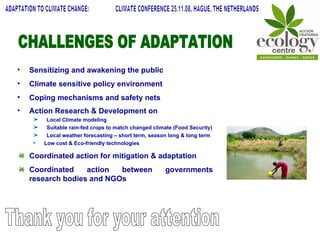
ADAPTATION TO CLIMATE CHANGE:  CLIMATE CONFERENCE 25.11.08, HAGUE, THE NETHERLANDS Sensitizing and awakening the public Climate sensitive policy environment Coping mechanisms and safety nets Action Research & Development on   Local Climate modeling Suitable rain-fed crops to match changed climate (Food Security) Local weather forecasting – short term, season long & long term Low cost & Eco-friendly technologies Coordinated action for mitigation & adaptation Coordinated action between governments research bodies and NGOs Thank you for your attention CHALLENGES OF ADAPTATION

Presentation Adaptation Conference 25th November 2008

  • 1.
    OUTLINE OF PRESENTATIONAnantapur Region AF Ecology Centre Improving Livelihoods through Watershed Development Adapting to Climate Change Challenges ahead for Anantapur. Dr.Y.V.Malla Reddy, Director, AF-Ecology Centre. Presentation made in 2 nd Conference on Adaptation to Climate Change in Developing Countries 25 th November, 2008, Hague
  • 2.
    ANANTAPUR REGION Semi-arid& Chronically Drought-prone 522 mm annual average rainfall 1850 Potential Evapotraspiration Barren with less than 2% under actual forest 1.1 million ha land totally cultivated, Shallow, gravelly red-soils 1.0 million under rainfed & vulnerable under mono-crop of groundnut (90%) 0.1 million under Irrigation under groundwater (10%). 90% Farmers (0.6 million) are small & marginal & most vulnerable. 4 million population and 0.8 million families in the District ADAPTATION TO CLIMATE CHANGE: CLIMATE CONFERENCE 25.11.08, HAGUE, THE NETHERLANDS
  • 3.
    ABOUT AF-ECOLOGY CENTREFounded by Father Vincent Ferrer in 1982 A fraternal Organisation of RDT AF is specialized in Watershed Development for the past 20 years. Project Area 235 villages, 60000 families Partner of ICCO & EED Focus of work : Participatory Watershed Development Sustainable Agriculture (LEISA) Peoples institution Building Alternate livelihoods for youth & women Policy advocacy and public opinion building ADAPTATION TO CLIMATE CHANGE: CLIMATE CONFERENCE 25.11.08, HAGUE, THE NETHERLANDS
  • 4.
    WATERSHED BASED LIVELIHOODSGOAL : Improving the rural livelihoods of the rainfed farmers and farm labour on sustainable basis OBJECTIVES : Sustainable and effective CBOs Stabilising the Environment - Soil, Water, Vegetation Sustainable Agriculture (low cost) to replace high cost… Enhancing the Agri production & net returns to rainfed farmers Diversified cropping pattern Integrated Farming System (Dairy, Livestock, Poultry, Fisheries) Employment generation / Accessing NREGA Alternate skilled employment for youth (IT, Driving, Hospitality etc) Gender & Social equity and work as cross cutting theme. Favourable, Pro-poor policies & implementation ADAPTATION TO CLIMATE CHANGE: CLIMATE CONFERENCE 25.11.08, HAGUE, THE NETHERLANDS
  • 5.
    MAIN ACTIVITIES Contd...ADAPTATION TO CLIMATE CHANGE: CLIMATE CONFERENCE 25.11.08, HAGUE, THE NETHERLANDS CBOs and Participatory approach : Formation & Capacity building of CBOs Promotion of gender and ensuring social equity Participatory planning, implementation & Monitoring Rights based approach for National Rural Employment Guarantee Programme. Activities for stabilizing the environment Soil and Moisture Conservation (SMC) Rain Water Harvesting Vegetation and biomass development Non-conventional energy ( Bio-gas ) Activities for enhancing agriculture production : Diversified land use and diversified cropping (Vegetables, millets, pulses, commercial crops) Rainfed horticulture (perennial tree crops) Bio-fertilisers, composting, vermi composting, liquid fertilizers)
  • 6.
    MAIN ACTIVITIES Continued...ADAPTATION TO CLIMATE CHANGE: CLIMATE CONFERENCE 25.11.08, HAGUE, THE NETHERLANDS Activities for alternate livelihoods : Processing and value addition of groundnut, cowpea etc. Job-oriented, non-farm skills for educated girls and boys (hospitality,ITES, driving, customer relations, automobile repair etc) Alternate livelihoods for women (Saree weaving, garment making, tamarind business etc) Advocacy, bobby and mobilizing public opinion Mobilizing public opinion for Sustainable Agriculture Policy advocacy for incentives for rainfed agriculture Policy advocacy for incentives for food crops Collaborating with Government in implementation of pro-poor, pro-environment programmes (NREGS, Watershed Programme)
  • 7.
    PHYSICAL ACHIEVEMENTS Contd...(1987 – 2007) ADAPTATION TO CLIMATE CHANGE: CLIMATE CONFERENCE 25.11.08, HAGUE, THE NETHERLANDS 1,150 1,150 Girls/ Boys Youth trained job-oriented skills 10. 1,000 125 Units Non-farm IGP for women 9. 17,500 17,500 Units Bio-gas & Smokeless chulas 8. 10,000 2,600 Structures Rain Water Harvesting Structures 7. 14,000 16,000 Ha. Crop diversification (Food crops & Fodder) 6. 24,500 24,500 Units Bio fertilisers 5. 20,000 19,16,000 Trees Fruit Trees (Horticulture) 4. 23,500 31,000 Ha. Bio-pest Management 3. 60,000 1,90,10,000 Plants Vegetation & Biomass development 2. 60,500 1,35,000 Ha Soil & Moisture conservation works and adoption of rain-fed farming practices. 1. Families benefited Extent covered / Nos. Unit Activity Sl. No.
  • 8.
    Net returns inrainfed farming increased to small & marginal farmers More rainfed farmers gained access to groundwater Women are able to participate in decisions at family and community levels Sustainable and remunerative employment to the farm labour Enhanced human dignity, self-worth & social status for women and the poor Education levels have improved Household, Food Security & Nutritional Security improved People health in general has improved. SUSTAINABLE IMPACT ON LIVELIHOODS ADAPTATION TO CLIMATE CHANGE: CLIMATE CONFERENCE 25.11.08, HAGUE, THE NETHERLANDS Achievements vary family to family Droughts persists and affect livelihoods Policy environment not favorable for rain-fed areas Safety nets under pressure during droughts Persistant challenges Impacts
  • 9.
    Soil health &land capability enhanced Vegetation & biomass enhanced Ground water enhanced Tree crops enhanced (Rainfed Horticulture) Bio-diversity & crop diversity enhanced. Use of chemical fertilisers and pesticides decreased Awareness of people on climate change & adaptation enhanced. SUSTAINABLE IMPACT ON ENVIRONMENT ADAPTATION TO CLIMATE CHANGE: CLIMATE CONFERENCE 25.11.08, HAGUE, THE NETHERLANDS A lot more biomass is needed Ground water overexploitation is not controlled Afforestation is inadequate Environmental challenges
  • 10.
    CHANGES FORSEEN INCLIMATE IN ANANTAPUR REGION Shrinking duration of rainy season 6 months to 4 months (?). Decreased no. of rainy days (35 to 25) (?) Early rains and late rains are disappearing. Scantiness is increasing Per-rain volume & intensity is increasing Temperature variability is increasing ADAPTATION TO CLIMATE CHANGE: CLIMATE CONFERENCE 25.11.08, HAGUE, THE NETHERLANDS
  • 11.
    IMPACT OF CLIMATECHANGES ON LIVELIHOODS Impact on Agriculture Cropping season is shrinking Rain distribution is getting more unpredictable, affecting crops Pests and diseases are on the increase Land exposure to sun and denudation has increased Flora & Founa is affected – some species are getting extinct (eg. sparrows) 50% reduction in yields under rainfed crops are estimated by ICAR, by 2025 (?) Common property resources are depleting (grazing lands etc) Frequency & intensity of droughts is on the increase. ADAPTATION TO CLIMATE CHANGE: CLIMATE CONFERENCE 25.11.08, HAGUE, THE NETHERLANDS
  • 12.
    Intensive tree-based horticulture (inadequate incentives) Insitu-rain water harvesting is promoted. Micro-irrigation (sprinklers, drip etc) Promoting Bio-fertilisers, Vermi Compost, Farm compost, Liquid fertilizers (inadequate incentives) Promoting Integrated Farming System for Dairy, Livestock, Poultry, Fisheries, (need a lot more investments) Alternate skilled employment / income opportunities (cultural barriers) Promoting awareness raising and stakeholder participation on mitigation & adaptation ......... Still a long way to go ADAPTATIONS BEING TRIED BY AF Continued... ADAPTATION TO CLIMATE CHANGE: CLIMATE CONFERENCE 25.11.08, HAGUE, THE NETHERLANDS
  • 13.
    ADAPTATION TO CLIMATECHANGE: CLIMATE CONFERENCE 25.11.08, HAGUE, THE NETHERLANDS Sensitizing and awakening the public Climate sensitive policy environment Coping mechanisms and safety nets Action Research & Development on Local Climate modeling Suitable rain-fed crops to match changed climate (Food Security) Local weather forecasting – short term, season long & long term Low cost & Eco-friendly technologies Coordinated action for mitigation & adaptation Coordinated action between governments research bodies and NGOs Thank you for your attention CHALLENGES OF ADAPTATION