A searchable vulnerability
assessment database
Robin O’Malley and Laura Thompson
USGS National Climate Change and Wildlife
Science Center, Reston, VA
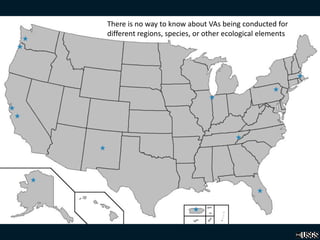
There is no way to know about VAs being conducted for
different regions, species, or other ecological elements
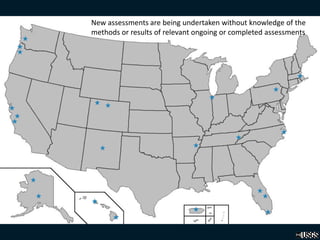
New assessments are being undertaken without knowledge of the
methods or results of relevant ongoing or completed assessments
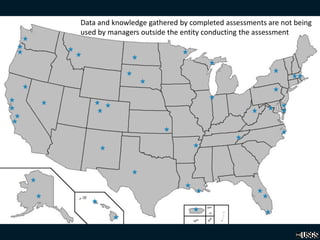
Data and knowledge gathered by completed assessments are not being
used by managers outside the entity conducting the assessment
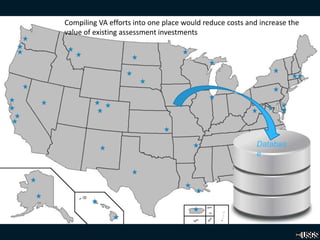
Compiling VA efforts into one place would reduce costs and increase the
value of existing assessment investments
Databas
e
Database scope
• Include VAs from:
– Federal agencies
– State agencies
– Local agencies
– Universities
– Nongovernmental organizations
• A process has begun to ensure compliance
with the Paperwork Reduction Act
Database scope
Focus will be on domestic VAs, but the
country boundaries will be “fuzzy” and allow
assessments that encompass parts of
Canada, Mexico, Caribbean, and insular
Pacific, etc.
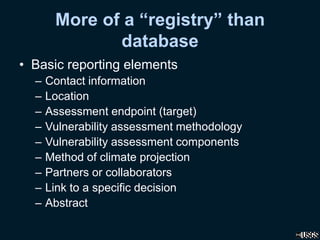
More of a “registry” than
database
• Basic reporting elements
– Contact information
– Location
– Assessment endpoint (target)
– Vulnerability assessment methodology
– Vulnerability assessment components
– Method of climate projection
– Partners or collaborators
– Link to a specific decision
– Abstract
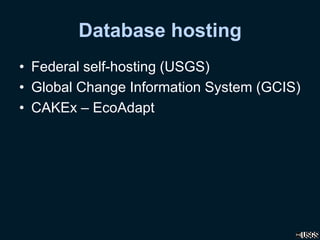
Database hosting
• Federal self-hosting (USGS)
• Global Change Information System (GCIS)
• CAKEx – EcoAdapt
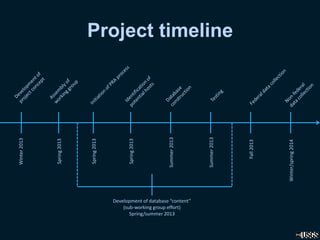
Project timeline
Winter2013
Spring2013
Development of database “content”
(sub-working group effort)
Spring/summer 2013
Spring2013
Spring2013
Summer2013
Fall2013
Winter/spring2014
Summer2013
Thompson nctc va database3

Thompson nctc va database3

  • 1.
    A searchable vulnerability assessmentdatabase Robin O’Malley and Laura Thompson USGS National Climate Change and Wildlife Science Center, Reston, VA
  • 2.
    There is noway to know about VAs being conducted for different regions, species, or other ecological elements
  • 3.
    New assessments arebeing undertaken without knowledge of the methods or results of relevant ongoing or completed assessments
  • 4.
    Data and knowledgegathered by completed assessments are not being used by managers outside the entity conducting the assessment
  • 5.
    Compiling VA effortsinto one place would reduce costs and increase the value of existing assessment investments Databas e
  • 6.
    Database scope • IncludeVAs from: – Federal agencies – State agencies – Local agencies – Universities – Nongovernmental organizations • A process has begun to ensure compliance with the Paperwork Reduction Act
  • 7.
    Database scope Focus willbe on domestic VAs, but the country boundaries will be “fuzzy” and allow assessments that encompass parts of Canada, Mexico, Caribbean, and insular Pacific, etc.
  • 8.
    More of a“registry” than database • Basic reporting elements – Contact information – Location – Assessment endpoint (target) – Vulnerability assessment methodology – Vulnerability assessment components – Method of climate projection – Partners or collaborators – Link to a specific decision – Abstract
  • 9.
    Database hosting • Federalself-hosting (USGS) • Global Change Information System (GCIS) • CAKEx – EcoAdapt
  • 10.
    Project timeline Winter2013 Spring2013 Development ofdatabase “content” (sub-working group effort) Spring/summer 2013 Spring2013 Spring2013 Summer2013 Fall2013 Winter/spring2014 Summer2013

Editor's Notes

  • #7 Individuals and institutions considering conducting vulnerability assessments. This includes a wide range of federal, state, local and other governmental entities, as well as nongovernmental organizations, universities, and other entities. The intent is to enable users to locate completed or ongoing VAs that share relevant characteristics with the users intended VA – for example, a fisheries manager in North Carolina could locate other studies of coldwater fish and climate change; or a Bureau of Land Management analyst may locate VAs conducted on a variety of resource types in her state. Either of these users might identify relevant methods for conducting their assessment, relevant conclusions or concerns raised in other assessments, and potential data sources that may have been assembled for other assessment