So, in practice, can ecotourism contribute to conservation?Or is it simply a marketing ploy, a case of environmental opportunism, a buzzword?
Eco-Tourism defined as:“Environmentally responsible travel and visitation to relatively undisturbed natural areas, in order to enjoy and appreciate nature (and any accompanying cultural features – both past and present) that promotes conservation, has low visitor impact, and provides for beneficially active socio-economic involvement of local populations. “–World Conservation Union’s Commission on National Parks and Protected Area—
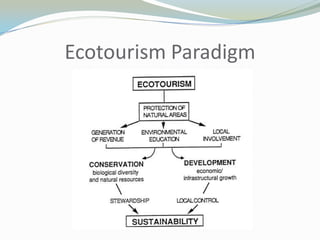
Ecotourism Paradigm
Generation of RevenuePotential Direct Value:Tourism earned  approx. $188, 518 million for developed countries , 4-22% brought in by nature tourism (1995)Potential Indirect Value:Soil conservation of tree cover in India $100-240/haCarbon Sequestration: $2000-4000/haCosts to manage w/o eco-tourism$1-3/ha/year recurrently, up to $18.5/ha/yearEnvironmental Damage costs w/eco-tourism$0.1-1.9/ha/year (in Costa Rica and Ecuador)
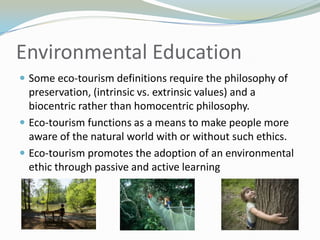
Environmental EducationSome eco-tourism definitions require the philosophy of preservation, (intrinsic vs. extrinsic values) and a biocentricrather than homocentric philosophy.Eco-tourism functions as a means to make people more aware of the natural world with or without such ethics.Eco-tourism promotes the adoption of an environmental ethic through passive and active learning
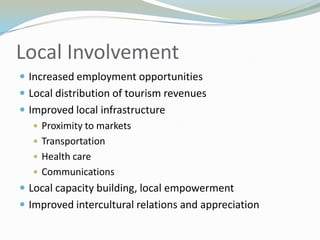
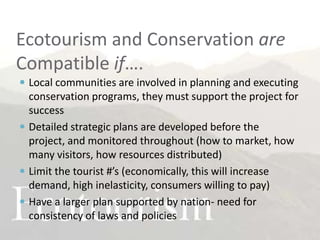
Local InvolvementIncreased employment opportunitiesLocal distribution of tourism revenuesImproved local infrastructureProximity to marketsTransportationHealth careCommunicationsLocal capacity building, local empowermentImproved intercultural relations and appreciation
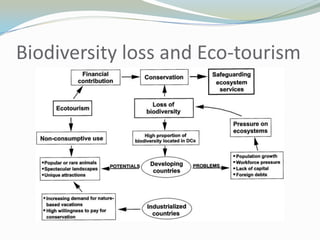
Biodiversity loss and Eco-tourism
Protection: How Much and Where?At least 12% of terrestrial surface representing all kinds of biomes needs to be conserved according to the World Commission on Environment and Development.Currently 5.2% of the earths surface is protectedEco/nature-tourism accounts for 15% of all tourism60-70 % of the world’s biodiversity is located in Brazil, Colombia, Ecuador, Peru, Mexico, Congo, Madagascar, China, India, Indonesia, Malaysia, and Austraila
Negative Impacts of ProtectionHigh opportunity costs due to lost development alternatives and loss of traditional activitiesLocal activities in protected areas are often illegalConserving extensive tracts of habitat politically difficult in the absence of sustainable revenue generation.Boundaries, alone,  may suggest that surrounding areas are free for exploitation
GrowthEcotourism is outpacing  conventional tourism by 15% per year.Developing Countries are become more popular destinationsDemand for undegraded nature will increase(will either pressure ecosystems or increase value)Costa Rica parks raised admission fees by a factor 0f 10Visitor numbers plummeted by 44%Total revenues increased substantially
The Role of Ecotourism in ConservationPanacea or Pandora’s BoxOliver Kruger
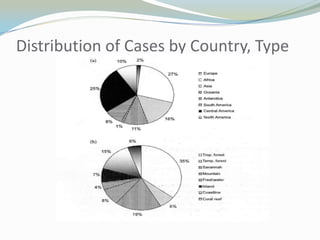
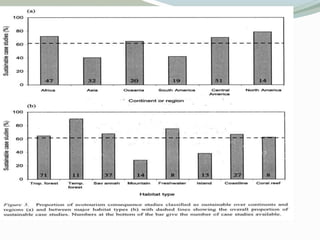
Meta Analysis of 188 Case StudiesHow are ecotourism case studies distributed over continents and habitats?What variables are correlated with a study being classified as sustainable by the author?  What is the relative importance of these in a multi factor analysis?What are the main (+) and (–) effects reported in case studies?  Can these be linked to the main reasons for sustainability?
Criteria for CasesCases had to be specific to an area and focus on the natural resources of the areaReport original observations or dataPublished in natural or social science journalsPurely theoretical studies omittedCases from 1981 to 2001Evaluated on ecological criteria alone*
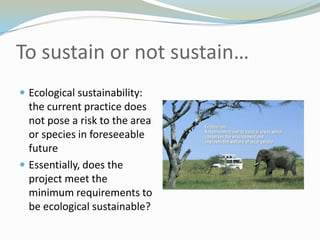
To sustain or not sustain…Ecological sustainability: the current practice does not pose a risk to the area or species in foreseeable futureEssentially, does the project meet the minimum requirements to be ecological sustainable?
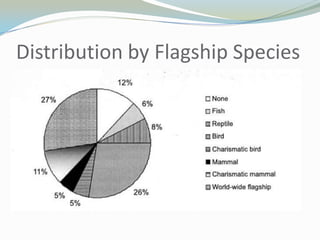
Variables ConsideredYear, Author Type (social or natural scientist) Author Affiliation with Institution of Country (yes or no)Continent/Region and Habitat Type (dummy variables = 1 or 0)Type of flagship species (7 categories)None
Fish
Reptile
Bird
Charismatic Bird
Mammal
Char. Mammal
Worldwide FlagshipVariables ContinuedLocal Community Involved (yes or no) based on:Revenue Sharing OccursDecision PowerLocal EmploymentursInvestigation method (Purely observational or repeatable method , 0 or 1)All of these into Multivariate Regression Analysis to evaluate relative importance
Distribution of Cases by Country, Type
Distribution by Flagship Species
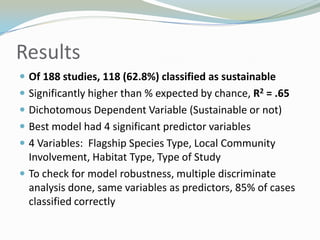
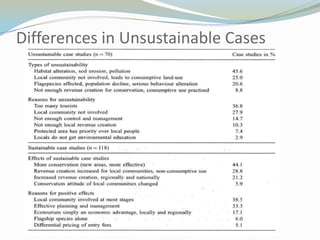
ResultsOf 188 studies, 118 (62.8%) classified as sustainableSignificantly higher than % expected by chance, R2 = .65Dichotomous Dependent Variable (Sustainable or not)Best model had 4 significant predictor variables4 Variables:  Flagship Species Type, Local Community Involvement, Habitat Type, Type of StudyTo check for model robustness, multiple discriminate analysis done, same variables as predictors, 85% of cases classified correctly

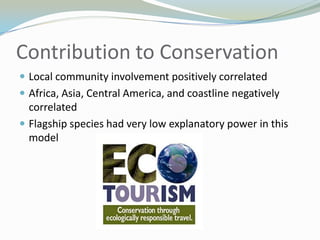
Conservation

  • 1.
    So, in practice,can ecotourism contribute to conservation?Or is it simply a marketing ploy, a case of environmental opportunism, a buzzword?
  • 2.
    Eco-Tourism defined as:“Environmentallyresponsible travel and visitation to relatively undisturbed natural areas, in order to enjoy and appreciate nature (and any accompanying cultural features – both past and present) that promotes conservation, has low visitor impact, and provides for beneficially active socio-economic involvement of local populations. “–World Conservation Union’s Commission on National Parks and Protected Area—
  • 3.
  • 4.
    Generation of RevenuePotentialDirect Value:Tourism earned approx. $188, 518 million for developed countries , 4-22% brought in by nature tourism (1995)Potential Indirect Value:Soil conservation of tree cover in India $100-240/haCarbon Sequestration: $2000-4000/haCosts to manage w/o eco-tourism$1-3/ha/year recurrently, up to $18.5/ha/yearEnvironmental Damage costs w/eco-tourism$0.1-1.9/ha/year (in Costa Rica and Ecuador)
  • 5.
    Environmental EducationSome eco-tourismdefinitions require the philosophy of preservation, (intrinsic vs. extrinsic values) and a biocentricrather than homocentric philosophy.Eco-tourism functions as a means to make people more aware of the natural world with or without such ethics.Eco-tourism promotes the adoption of an environmental ethic through passive and active learning
  • 6.
    Local InvolvementIncreased employmentopportunitiesLocal distribution of tourism revenuesImproved local infrastructureProximity to marketsTransportationHealth careCommunicationsLocal capacity building, local empowermentImproved intercultural relations and appreciation
  • 7.
  • 8.
    Protection: How Muchand Where?At least 12% of terrestrial surface representing all kinds of biomes needs to be conserved according to the World Commission on Environment and Development.Currently 5.2% of the earths surface is protectedEco/nature-tourism accounts for 15% of all tourism60-70 % of the world’s biodiversity is located in Brazil, Colombia, Ecuador, Peru, Mexico, Congo, Madagascar, China, India, Indonesia, Malaysia, and Austraila
  • 9.
    Negative Impacts ofProtectionHigh opportunity costs due to lost development alternatives and loss of traditional activitiesLocal activities in protected areas are often illegalConserving extensive tracts of habitat politically difficult in the absence of sustainable revenue generation.Boundaries, alone, may suggest that surrounding areas are free for exploitation
  • 10.
    GrowthEcotourism is outpacing conventional tourism by 15% per year.Developing Countries are become more popular destinationsDemand for undegraded nature will increase(will either pressure ecosystems or increase value)Costa Rica parks raised admission fees by a factor 0f 10Visitor numbers plummeted by 44%Total revenues increased substantially
  • 11.
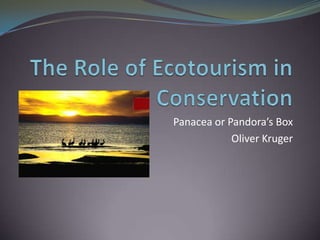
    The Role ofEcotourism in ConservationPanacea or Pandora’s BoxOliver Kruger
  • 12.
    Meta Analysis of188 Case StudiesHow are ecotourism case studies distributed over continents and habitats?What variables are correlated with a study being classified as sustainable by the author? What is the relative importance of these in a multi factor analysis?What are the main (+) and (–) effects reported in case studies? Can these be linked to the main reasons for sustainability?
  • 13.
    Criteria for CasesCaseshad to be specific to an area and focus on the natural resources of the areaReport original observations or dataPublished in natural or social science journalsPurely theoretical studies omittedCases from 1981 to 2001Evaluated on ecological criteria alone*
  • 14.
    To sustain ornot sustain…Ecological sustainability: the current practice does not pose a risk to the area or species in foreseeable futureEssentially, does the project meet the minimum requirements to be ecological sustainable?
  • 15.
    Variables ConsideredYear, AuthorType (social or natural scientist) Author Affiliation with Institution of Country (yes or no)Continent/Region and Habitat Type (dummy variables = 1 or 0)Type of flagship species (7 categories)None
  • 16.
  • 17.
  • 18.
  • 19.
  • 20.
  • 21.
  • 22.
    Worldwide FlagshipVariables ContinuedLocalCommunity Involved (yes or no) based on:Revenue Sharing OccursDecision PowerLocal EmploymentursInvestigation method (Purely observational or repeatable method , 0 or 1)All of these into Multivariate Regression Analysis to evaluate relative importance
  • 23.
    Distribution of Casesby Country, Type
  • 24.
  • 26.
    ResultsOf 188 studies,118 (62.8%) classified as sustainableSignificantly higher than % expected by chance, R2 = .65Dichotomous Dependent Variable (Sustainable or not)Best model had 4 significant predictor variables4 Variables: Flagship Species Type, Local Community Involvement, Habitat Type, Type of StudyTo check for model robustness, multiple discriminate analysis done, same variables as predictors, 85% of cases classified correctly