Advocating for Your Child
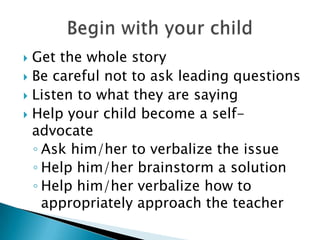
Get the whole storyBe careful not to ask leading questionsListen to what they are saying Help your child become a self-advocateAsk him/her to verbalize the issueHelp him/her brainstorm a solutionHelp him/her verbalize how to appropriately approach the teacherBegin with your child
Differentiated assignmentsSubject area accelerationCompacted curriculumPretestingKnow There Are Options
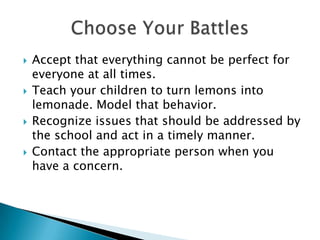
Accept that everything cannot be perfect for everyone at all times.Teach your children to turn lemons into lemonade. Model that behavior.Recognize issues that should be addressed by the school and act in a timely manner.Contact the appropriate person when you have a concern.Choose Your Battles
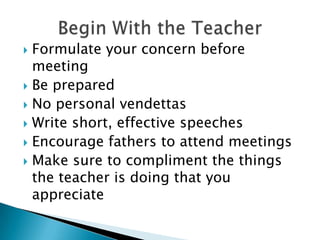
Formulate your concern before meetingBe preparedNo personal vendettasWrite short, effective speechesEncourage fathers to attend meetingsMake sure to compliment the things the teacher is doing that you appreciateBegin With the Teacher
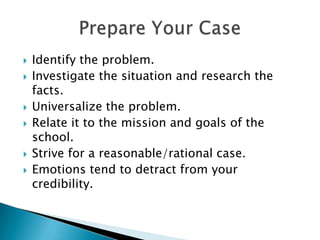
Identify the problem.Investigate the situation and research the facts.Universalize the problem.Relate it to the mission and goals of the school.Strive for a reasonable/rational case. Emotions tend to detract from your credibility.Prepare Your Case
Write a synopsis of the problem.State the problem as you interpret it.Present the evidence of the problem.List alternatives that might alleviate the problem.Be succinct. Use ‘we’ not ‘I’ and ‘you’.View the problem from others’ perspective.TeacherStudentPrincipalNever call when you are angry or very emotional.
Allow the person most directly involved the opportunity to hear your concern first.Call for an appointment but be prepared in case the person is available to talk then.Greet the person warmly.State your facts calmly and in order.Build bridges; do not burn them.If you’re happy with the results of the meeting, say so and say thank you.If not, move up the chain of command.Present Your Case
Talk to the GT CoordinatorTalk to the PrincipalTalk to the Director of InstructionWhen Talking to the Teacher Doesn’t Help
Remember, your child is watching how you handle the situation.You are demonstrating that you love them and consider education a priority.You are modeling that every human counts so respect others as well as yourself.You are teaching that problem solving involves creativity, logic, protocol, challenge, time, and commitment.Teaching Your Children
Texas Association for the Gifted and TalentedRaising Champions by M.F. Saylerwww.davidsongifted.orgReferences

Advocating for your child

  • 1.
  • 2.
    Get the wholestoryBe careful not to ask leading questionsListen to what they are saying Help your child become a self-advocateAsk him/her to verbalize the issueHelp him/her brainstorm a solutionHelp him/her verbalize how to appropriately approach the teacherBegin with your child
  • 3.
    Differentiated assignmentsSubject areaaccelerationCompacted curriculumPretestingKnow There Are Options
  • 4.
    Accept that everythingcannot be perfect for everyone at all times.Teach your children to turn lemons into lemonade. Model that behavior.Recognize issues that should be addressed by the school and act in a timely manner.Contact the appropriate person when you have a concern.Choose Your Battles
  • 5.
    Formulate your concernbefore meetingBe preparedNo personal vendettasWrite short, effective speechesEncourage fathers to attend meetingsMake sure to compliment the things the teacher is doing that you appreciateBegin With the Teacher
  • 6.
    Identify the problem.Investigatethe situation and research the facts.Universalize the problem.Relate it to the mission and goals of the school.Strive for a reasonable/rational case. Emotions tend to detract from your credibility.Prepare Your Case
  • 7.
    Write a synopsisof the problem.State the problem as you interpret it.Present the evidence of the problem.List alternatives that might alleviate the problem.Be succinct. Use ‘we’ not ‘I’ and ‘you’.View the problem from others’ perspective.TeacherStudentPrincipalNever call when you are angry or very emotional.
  • 8.
    Allow the personmost directly involved the opportunity to hear your concern first.Call for an appointment but be prepared in case the person is available to talk then.Greet the person warmly.State your facts calmly and in order.Build bridges; do not burn them.If you’re happy with the results of the meeting, say so and say thank you.If not, move up the chain of command.Present Your Case
  • 9.
    Talk to theGT CoordinatorTalk to the PrincipalTalk to the Director of InstructionWhen Talking to the Teacher Doesn’t Help
  • 10.
    Remember, your childis watching how you handle the situation.You are demonstrating that you love them and consider education a priority.You are modeling that every human counts so respect others as well as yourself.You are teaching that problem solving involves creativity, logic, protocol, challenge, time, and commitment.Teaching Your Children
  • 11.
    Texas Association forthe Gifted and TalentedRaising Champions by M.F. Saylerwww.davidsongifted.orgReferences

Editor's Notes

  • #3 Sara – kindergarten friend issue
  • #6 Mary – Shane long list of demands