ecnomic,ETHICAL &SOCIAL aspects  IN  ADVERTISING
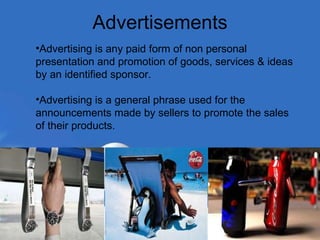
Advertisements Advertising is any paid form of non personal presentation and promotion of goods, services & ideas by an identified sponsor. Advertising is a general phrase used for the announcements made by sellers to promote the sales of their products.
Role of advertising in the economy Making  consumer aware of products and services Providing consumers with information to use to make purchase decisions Encouraging consumption and fostering economic growth
Economic impact of advertising Effects on Consumer Choice   -Differentiation   -Brand Loyalty Effects on product costs and prices -Advertising as an expense that increases the cost of  products -Increased differentiation Effects on Competition   -Barriers to entry   -Economies of scale
Economic benefits of advertising It is informative It builds brands It supports the media It reduces costs It facilitates the introduction of new products It provides employment opportunities.
Economic aspects Making Consumers Aware of Products and Services Providing Consumers With Information to Use to Make Purchase Decisions Encouraging Consumption and Fostering Economic Growth
Effects on Consumer Choice Differentiation Brand Loyalty Effects on Competition Barriers to entry Economies of scale Effects on product costs and prices Advertising as an expense that increases the cost of products Increased differentiation
Social advertising It is a process for influencing human behavior on a large scale using market principles for the purpose of social benefit rather than for commercial profit -BILL SMITH
Social aspects of advertising Advertising as a part of firm’s marketing effort operates in the society. It has to therefore follow the social norms. Key areas of debate regarding society and advertising are: Deception Manipulation Taste
Deception: it refers not only to the information content in advertising but may also arise from misplace emphasis in presentations. According to federal trade commission of the USA- “  Advertising as a whole must not create a misleading impression although every statement, separately considered, may be literally truthful”
Manipulation :- The freedom of choice of consumers is restricted by the power of advertising since it can manipulate buyers into making a decision against their will or interest. Manipulation is done through emotional appeals. These companies can utilize advanced and very scientific advertising techniques and thus make an impression on consumers.
Sometimes ads are offensive, tasteless, irritating, boring and so on. Sources of distaste Sexual Appeals Shock advertising
Some examples of the Advertisements with social aspects:- Grow-more-trees advertisements Drink milk Eat healthy food, eat eggs Mother’s milk is best for the baby Say no to drugs every time Get your child vaccinations in times


Advantages Helps in eradication  of social evil Helps in change of attitude of the people of society Helps change /improve reputation of a company
Ethics Ethics is a choice between good and bad, between right and wrong. Advertisement truth is to be viewed from consumers point of view . Advertisements should not be indecent and obscene.
Issues in Advertising ethics Puffery and Deception Puffery refers to exaggerated claim of a product’s superiority or the use of subjective or vague statements that may not be literally true. Deception is when the consumer is led to believe something which is not true
Some call for advertising to children be curtailed . Others would ban alcoholic beverage advertising. Marketers must carefully draw the line between advertising and entertainment.
Key areas of debate regarding ethics and advertising are: Truth in advertising Advertising to children Advertising controversial products
Truth in Advertising Deception is making false or misleading statements. Puffery ( commercial exaggeration ) is legal. Cannot legislate against emotional appeals
Advertising to Children—Issues Advertising promotes superficiality and materialism in children. Children are inexperienced and easy prey. Persuasion to children creates child-parent conflicts.
ADVERTISING CONTROVERSIAL PRODUCTS: There are still some products that are not acceptable by  majority of consumers.   -Tobacco -Alcohol -Gambling -Drugs
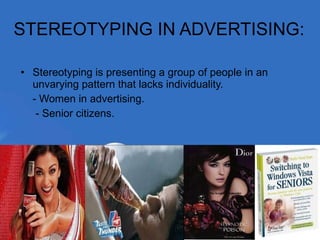
STEREOTYPING IN ADVERTISING: Stereotyping is presenting a group of people in an unvarying pattern that lacks individuality. - Women in advertising. - Senior citizens.
ETHICS IN ADVERTISING Advertising too has ethical values. Advertising communication is a mix of art and facts subservient to ethical principles In order to be consumer –oriented it should be truthful and ethical. Should not mislead the consumers. If so happens, credibility is lost. Advertisement truth is to be viewed from consumers point of view not in narrow legalistic frame.
Advertising should not be indecent and obscene. It’s a social process ,must honor time-tested norms of social behavior and should not affront our  moral sense. In order to enforce ethical code in INDIA we have ADVERTISING STANDARDS COUNCIL OF INDIA(ASCI)
ASCI It is inspired by a similar code of the Advertising standards authority(ASA),UK. It seeks to achieve the acceptance of fair advertising practices in the best interest of the ultimate consumer. GUIDELINES: To ensure the truthfulness and honesty of representation and claims made by advertisements and to safe guard against misleading advertising.
-To ensure that advertisements are not offensive to generally accepted standards of public decency. -To safeguard against indiscriminate use of advertising for promotion of products which are regarded as hazardous to society or to individuals to a degree or of a type which is unacceptable to society at large. -To ensure that advertisements observe fairness in competition so that the consumers need to be informed on choices in the market place and the canons of generally accepted competitive behaviour in business are both served.
Is advertising wasteful??? The role of advertising is to inform people that a product or service exists has been well established. People do need such information  and is passed onto them through advertising. Advertising is not wasteful, unless it really contains no information or tells the consumers something which they already know.
ECONOMY FUNCTION: Advertising stimulates the economy by informing many prospects about available products and services at a relatively low price. As a result, advertising helps advertisers decrease costs and increase profits, which can be distributed to more capital equipment and job offerings.  Furthermore, competitive advertising activities help consumers compare several brands with a lot of information, so it brings about the improvement of the overall product quality and the failure of inferior products.
We conclude that advertising is economically gainful but extend varies from one product to other and market situation ,competition and economic milieu-whether advertising is done in a mixed economy, a market economy or a controlled economy

Economic social_ethical_aspects-classppt

  • 1.
  • 2.
    Advertisements Advertising isany paid form of non personal presentation and promotion of goods, services & ideas by an identified sponsor. Advertising is a general phrase used for the announcements made by sellers to promote the sales of their products.
  • 3.
    Role of advertisingin the economy Making consumer aware of products and services Providing consumers with information to use to make purchase decisions Encouraging consumption and fostering economic growth
  • 4.
    Economic impact ofadvertising Effects on Consumer Choice -Differentiation -Brand Loyalty Effects on product costs and prices -Advertising as an expense that increases the cost of products -Increased differentiation Effects on Competition -Barriers to entry -Economies of scale
  • 5.
    Economic benefits ofadvertising It is informative It builds brands It supports the media It reduces costs It facilitates the introduction of new products It provides employment opportunities.
  • 6.
    Economic aspects MakingConsumers Aware of Products and Services Providing Consumers With Information to Use to Make Purchase Decisions Encouraging Consumption and Fostering Economic Growth
  • 7.
    Effects on ConsumerChoice Differentiation Brand Loyalty Effects on Competition Barriers to entry Economies of scale Effects on product costs and prices Advertising as an expense that increases the cost of products Increased differentiation
  • 8.
    Social advertising Itis a process for influencing human behavior on a large scale using market principles for the purpose of social benefit rather than for commercial profit -BILL SMITH
  • 9.
    Social aspects ofadvertising Advertising as a part of firm’s marketing effort operates in the society. It has to therefore follow the social norms. Key areas of debate regarding society and advertising are: Deception Manipulation Taste
  • 10.
    Deception: it refersnot only to the information content in advertising but may also arise from misplace emphasis in presentations. According to federal trade commission of the USA- “ Advertising as a whole must not create a misleading impression although every statement, separately considered, may be literally truthful”
  • 11.
    Manipulation :- Thefreedom of choice of consumers is restricted by the power of advertising since it can manipulate buyers into making a decision against their will or interest. Manipulation is done through emotional appeals. These companies can utilize advanced and very scientific advertising techniques and thus make an impression on consumers.
  • 12.
    Sometimes ads areoffensive, tasteless, irritating, boring and so on. Sources of distaste Sexual Appeals Shock advertising
  • 13.
    Some examples ofthe Advertisements with social aspects:- Grow-more-trees advertisements Drink milk Eat healthy food, eat eggs Mother’s milk is best for the baby Say no to drugs every time Get your child vaccinations in times
  • 14.
  • 15.
  • 16.
  • 17.
    Advantages Helps ineradication of social evil Helps in change of attitude of the people of society Helps change /improve reputation of a company
  • 18.
    Ethics Ethics isa choice between good and bad, between right and wrong. Advertisement truth is to be viewed from consumers point of view . Advertisements should not be indecent and obscene.
  • 19.
    Issues in Advertisingethics Puffery and Deception Puffery refers to exaggerated claim of a product’s superiority or the use of subjective or vague statements that may not be literally true. Deception is when the consumer is led to believe something which is not true
  • 20.
    Some call foradvertising to children be curtailed . Others would ban alcoholic beverage advertising. Marketers must carefully draw the line between advertising and entertainment.
  • 21.
    Key areas ofdebate regarding ethics and advertising are: Truth in advertising Advertising to children Advertising controversial products
  • 22.
    Truth in AdvertisingDeception is making false or misleading statements. Puffery ( commercial exaggeration ) is legal. Cannot legislate against emotional appeals
  • 23.
    Advertising to Children—IssuesAdvertising promotes superficiality and materialism in children. Children are inexperienced and easy prey. Persuasion to children creates child-parent conflicts.
  • 24.
    ADVERTISING CONTROVERSIAL PRODUCTS:There are still some products that are not acceptable by majority of consumers. -Tobacco -Alcohol -Gambling -Drugs
  • 25.
    STEREOTYPING IN ADVERTISING:Stereotyping is presenting a group of people in an unvarying pattern that lacks individuality. - Women in advertising. - Senior citizens.
  • 26.
    ETHICS IN ADVERTISINGAdvertising too has ethical values. Advertising communication is a mix of art and facts subservient to ethical principles In order to be consumer –oriented it should be truthful and ethical. Should not mislead the consumers. If so happens, credibility is lost. Advertisement truth is to be viewed from consumers point of view not in narrow legalistic frame.
  • 27.
    Advertising should notbe indecent and obscene. It’s a social process ,must honor time-tested norms of social behavior and should not affront our moral sense. In order to enforce ethical code in INDIA we have ADVERTISING STANDARDS COUNCIL OF INDIA(ASCI)
  • 28.
    ASCI It isinspired by a similar code of the Advertising standards authority(ASA),UK. It seeks to achieve the acceptance of fair advertising practices in the best interest of the ultimate consumer. GUIDELINES: To ensure the truthfulness and honesty of representation and claims made by advertisements and to safe guard against misleading advertising.
  • 29.
    -To ensure thatadvertisements are not offensive to generally accepted standards of public decency. -To safeguard against indiscriminate use of advertising for promotion of products which are regarded as hazardous to society or to individuals to a degree or of a type which is unacceptable to society at large. -To ensure that advertisements observe fairness in competition so that the consumers need to be informed on choices in the market place and the canons of generally accepted competitive behaviour in business are both served.
  • 30.
    Is advertising wasteful???The role of advertising is to inform people that a product or service exists has been well established. People do need such information and is passed onto them through advertising. Advertising is not wasteful, unless it really contains no information or tells the consumers something which they already know.
  • 31.
    ECONOMY FUNCTION: Advertisingstimulates the economy by informing many prospects about available products and services at a relatively low price. As a result, advertising helps advertisers decrease costs and increase profits, which can be distributed to more capital equipment and job offerings. Furthermore, competitive advertising activities help consumers compare several brands with a lot of information, so it brings about the improvement of the overall product quality and the failure of inferior products.
  • 32.
    We conclude thatadvertising is economically gainful but extend varies from one product to other and market situation ,competition and economic milieu-whether advertising is done in a mixed economy, a market economy or a controlled economy