AdvertisingAdvertising
Paid, non-personal communication through various media
by business firms, not-for-profit organizations, and
individuals who are identified in the advertising message
and who hope to inform or persuade members of a
particular audience
Types of AdvertisingTypes of Advertising
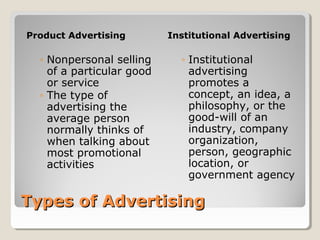
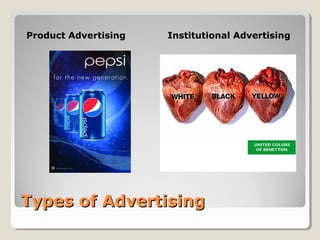
Product Advertising Institutional Advertising
◦ Nonpersonal selling
of a particular good
or service
◦ The type of
advertising the
average person
normally thinks of
when talking about
most promotional
activities
◦ Institutional
advertising
promotes a
concept, an idea, a
philosophy, or the
good-will of an
industry, company
organization,
person, geographic
location, or
government agency
Types of AdvertisingTypes of Advertising
Product Advertising Institutional Advertising
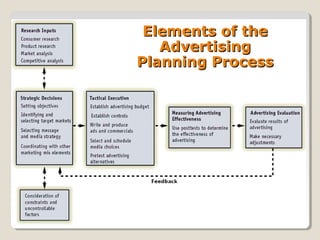
Elements of theElements of the
AdvertisingAdvertising
Planning ProcessPlanning Process
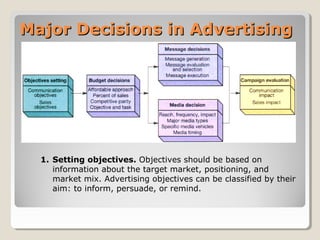
Major Decisions in AdvertisingMajor Decisions in Advertising
1. Setting objectives. Objectives should be based on
information about the target market, positioning, and
market mix. Advertising objectives can be classified by their
aim: to inform, persuade, or remind.
Informative advertising: used to introduce aInformative advertising: used to introduce a
new product category or when the objective isnew product category or when the objective is
to build primary demandto build primary demand
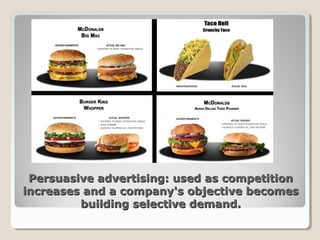
Persuasive advertising: used as competitionPersuasive advertising: used as competition
increases and a company's objective becomesincreases and a company's objective becomes
building selective demand.building selective demand.
Reminder advertising: used for matureReminder advertising: used for mature
products, because it keeps theproducts, because it keeps the
consumers thinking about the productconsumers thinking about the product
2. Setting the advertising budget. Factors to consider in
setting a budget are the stage in the product life cycle.
market share, competition and clutter, advertising frequency,
and product differentiation.
3. Creating the advertising message. Advertising can only
succeed if its message gains attention and communicates
well.
a) Message generation. Marketing managers must help
the advertising agency create a message that will be
effective with their target markets.
b) Message evaluation and selection. Messages should be
meaningful, distinctive, and believable.
c) Message execution. The impact of the message
depends on what is said and how it is said.
4. Selecting the advertising media
a) Deciding on reach, frequency, and impact.
b) Choosing among major media types. Choose among
newspapers, television, direct mail, radio, magazines, and
outdoor.
c) Selecting specific media vehicles. Costs should be
balanced against the media vehicles: audience quality,
ability to gain attention and editorial quality.
d) Deciding on media timing. The advertiser must decide
on how to schedule advertising over the course of a year
based on seasonal fluctuation in demand, lead time in
making reservations, and if they want to use continuity in
their scheduling or if they want to use a pulsing format.
5. Advertising evaluation. There are three major methods of
advertising pre-testing and two popular methods of post-
testing ads.
a)Pretesting
Direct rating. The advertiser exposes a consumer panel to
alternative ads and asks them to rate the ads.
Portfolio tests. The interviewer asks the respondent to recall all
ads and their contests after letting them listen to a portfolio of
advertisements.
Laboratory tests. Use equipment to measure consumers'
physiological reactions to an ads.
b) Posttesting
Recall tests. The advertiser asks people who have been exposed
to magazines or television programs to recall everything that they
can about the advertisers and products that they saw.
Recognition tests. The researcher asks people exposed to media
to point out the advertisements that they have seen.
c) Measuring the sales effect. The sales effect can be measured by
comparing past sales with past advertising expenditures and
through experiments.
Anastasiia VialovaAnastasiia Vialova
FRGTBFRGTB
1year MSc1year MSc
9a group9a group

Advertising

  • 1.
    AdvertisingAdvertising Paid, non-personal communicationthrough various media by business firms, not-for-profit organizations, and individuals who are identified in the advertising message and who hope to inform or persuade members of a particular audience
  • 2.
    Types of AdvertisingTypesof Advertising Product Advertising Institutional Advertising ◦ Nonpersonal selling of a particular good or service ◦ The type of advertising the average person normally thinks of when talking about most promotional activities ◦ Institutional advertising promotes a concept, an idea, a philosophy, or the good-will of an industry, company organization, person, geographic location, or government agency
  • 3.
    Types of AdvertisingTypesof Advertising Product Advertising Institutional Advertising
  • 4.
    Elements of theElementsof the AdvertisingAdvertising Planning ProcessPlanning Process
  • 5.
    Major Decisions inAdvertisingMajor Decisions in Advertising 1. Setting objectives. Objectives should be based on information about the target market, positioning, and market mix. Advertising objectives can be classified by their aim: to inform, persuade, or remind.
  • 6.
    Informative advertising: usedto introduce aInformative advertising: used to introduce a new product category or when the objective isnew product category or when the objective is to build primary demandto build primary demand
  • 7.
    Persuasive advertising: usedas competitionPersuasive advertising: used as competition increases and a company's objective becomesincreases and a company's objective becomes building selective demand.building selective demand.
  • 8.
    Reminder advertising: usedfor matureReminder advertising: used for mature products, because it keeps theproducts, because it keeps the consumers thinking about the productconsumers thinking about the product
  • 9.
    2. Setting theadvertising budget. Factors to consider in setting a budget are the stage in the product life cycle. market share, competition and clutter, advertising frequency, and product differentiation. 3. Creating the advertising message. Advertising can only succeed if its message gains attention and communicates well. a) Message generation. Marketing managers must help the advertising agency create a message that will be effective with their target markets. b) Message evaluation and selection. Messages should be meaningful, distinctive, and believable. c) Message execution. The impact of the message depends on what is said and how it is said.
  • 10.
    4. Selecting theadvertising media a) Deciding on reach, frequency, and impact. b) Choosing among major media types. Choose among newspapers, television, direct mail, radio, magazines, and outdoor. c) Selecting specific media vehicles. Costs should be balanced against the media vehicles: audience quality, ability to gain attention and editorial quality. d) Deciding on media timing. The advertiser must decide on how to schedule advertising over the course of a year based on seasonal fluctuation in demand, lead time in making reservations, and if they want to use continuity in their scheduling or if they want to use a pulsing format.
  • 11.
    5. Advertising evaluation.There are three major methods of advertising pre-testing and two popular methods of post- testing ads. a)Pretesting Direct rating. The advertiser exposes a consumer panel to alternative ads and asks them to rate the ads. Portfolio tests. The interviewer asks the respondent to recall all ads and their contests after letting them listen to a portfolio of advertisements. Laboratory tests. Use equipment to measure consumers' physiological reactions to an ads. b) Posttesting Recall tests. The advertiser asks people who have been exposed to magazines or television programs to recall everything that they can about the advertisers and products that they saw. Recognition tests. The researcher asks people exposed to media to point out the advertisements that they have seen. c) Measuring the sales effect. The sales effect can be measured by comparing past sales with past advertising expenditures and through experiments.
  • 12.