
Washington Roofing & Insulation
                            A Division of Washington Companies, Inc.

                                     Over 30 years of Experience
                                   in Polyurethane Spray Foam and
                                     Fluid-Applied Roof Coatings.
                                    Serving Kansas, Iowa, Missouri,
                                         Oklahoma and Texas
Corporate Office:                         Kansas City Branch Office:
                                                                       Midwest Service Office:
828 10th St - PO Box 1956                 8224 Marshall Drive
                                                                       Claremore, Oklahoma
Great Bend, KS 67530                      Lenexa, KS 66214
                                                                       Chuck Grubbs
800-383-3062 - 620-792-                   913-492-1577
                                                                       918-606-2233
2430                                      fax 913-492-4362
(fax) 620-792-2408
ADVANCES IN FLUID-APPLIED
       ROOFING
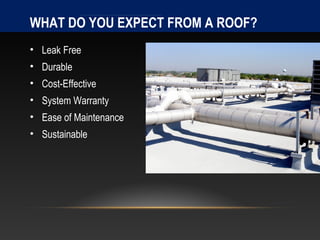
WHAT DO YOU EXPECT FROM A ROOF?
• Leak Free
• Durable
• Cost-Effective
• System Warranty
• Ease of Maintenance
• Sustainable
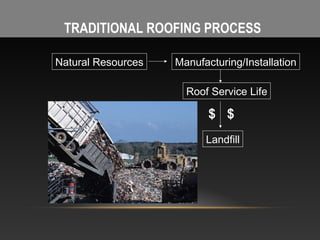
TRADITIONAL ROOFING PROCESS

Natural Resources   Manufacturing/Installation

                      Roof Service Life

                           $ $

                          Landfill
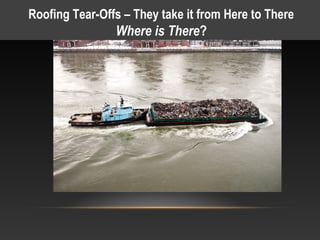
Roofing Tear-Offs – They take it from Here to There
                Where is There?
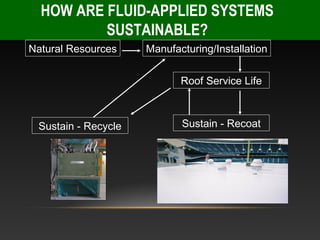
HOW ARE FLUID-APPLIED SYSTEMS
          SUSTAINABLE?
Natural Resources    Manufacturing/Installation


                            Roof Service Life


 Sustain - Recycle          Sustain - Recoat
THE KEYS
FLUID-APPLIED SYSTEMS

• Proven Performance
• Higher Performance
• Fully Sustainable
• Ease of Installation
• Ease of Maintenance
WHO ARE THE BEST CLIENTS?
• Low Slope Commercial / Industrial / Institutional


• Typically Own the Property for an Extended Period
    • National & International Corporations
    • Municipalities
    • Hospitals
    • Military
    • Multi-Facility Owners
WHY BUILDING OWNERS CHOOSE
          RESTORATION VS RE-ROOFING

• Technical and Economic Benefits

• Minimal Disruption During the Installation Process

• Ease of Maintenance

• Environmentally Friendly Systems

• Hybrid systems available if restoration alone not possible
TECHNICAL BENEFITS
• Liquid applied restorations provide a seamless system
  (seams are the weak points in any system)
• Highly reflective (among the most reflective in the industry
  averaging 85%-90% reflectivity)
• Cooler roof surface translates into Energy Savings & Cooler
  Interior
• Resistant to Ponding Water (some can handle 72-hour
  standing water)
• Easily renewed (Sustainable); easily repaired because
  material bonds to itself
EXPENSE LOWERING BENEFITS
• Save on the initial system compared to most “conventional”
  application methods
• Fully tax deductible as an operating expense, classified under
  maintenance
• Lower utility expenses
• Eliminate the expense of replacing the insulation
• Economical maintenance
• Long-term ROI improves due to lower cost of subsequent
  restorations
BUT WHITE ROOFS ARE ALL THE SAME. AREN’T
                 THEY?
  • Overlays require a cover board; fasteners create thermal
    gaps reducing effectiveness of new insulation
  • Long-term SRI is better for high-performance coatings
    than for many sheet goods
  • Emissivity of coated roofs comparable to or better than
    sheet goods
  • Condensation point is not raised into roof assembly with
    restoration
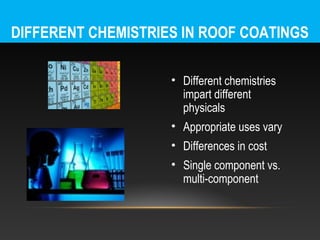
DIFFERENT CHEMISTRIES IN ROOF COATINGS

                    • Different chemistries
                      impart different
                      physicals
                    • Appropriate uses vary
                    • Differences in cost
                    • Single component vs.
                      multi-component
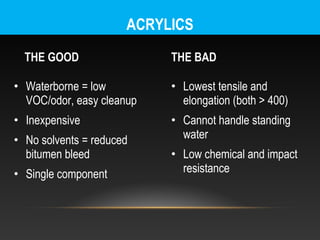
ACRYLICS
  THE GOOD                 THE BAD

• Waterborne = low         • Lowest tensile and
  VOC/odor, easy cleanup     elongation (both > 400)
• Inexpensive              • Cannot handle standing
• No solvents = reduced      water
  bitumen bleed            • Low chemical and impact
• Single component           resistance
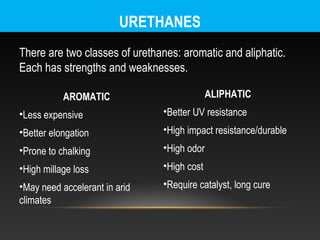
URETHANES
There are two classes of urethanes: aromatic and aliphatic.
Each has strengths and weaknesses.

           AROMATIC                         ALIPHATIC
•Less expensive                •Better UV resistance
•Better elongation             •High impact resistance/durable
•Prone to chalking             •High odor
•High millage loss             •High cost
•May need accelerant in arid   •Require catalyst, long cure
climates
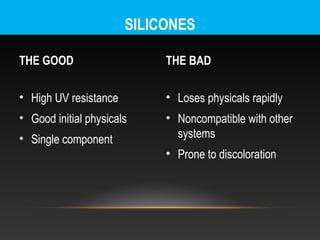
SILICONES

THE GOOD                    THE BAD

• High UV resistance        • Loses physicals rapidly
• Good initial physicals    • Noncompatible with other
• Single component            systems
                            • Prone to discoloration
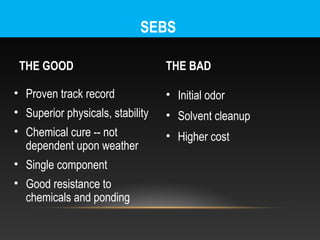
SEBS

 THE GOOD                         THE BAD

• Proven track record             • Initial odor
• Superior physicals, stability   • Solvent cleanup
• Chemical cure -- not            • Higher cost
  dependent upon weather
• Single component
• Good resistance to
  chemicals and ponding
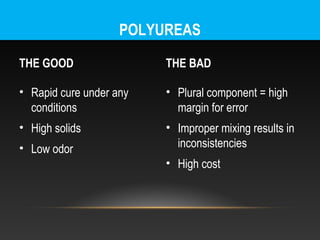
POLYUREAS

THE GOOD                 THE BAD

• Rapid cure under any   • Plural component = high
  conditions               margin for error
• High solids            • Improper mixing results in
• Low odor                 inconsistencies
                         • High cost
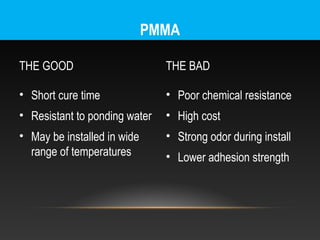
PMMA

THE GOOD                       THE BAD

• Short cure time              • Poor chemical resistance
• Resistant to ponding water   • High cost
• May be installed in wide     • Strong odor during install
  range of temperatures        • Lower adhesion strength
Chemistry lesson is over!!!
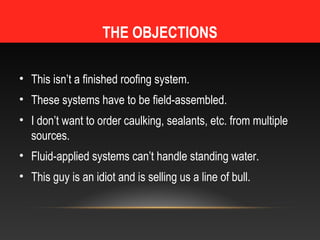
THE OBJECTIONS

• This isn’t a finished roofing system.
• These systems have to be field-assembled.
• I don’t want to order caulking, sealants, etc. from multiple
  sources.
• Fluid-applied systems can’t handle standing water.
• This guy is an idiot and is selling us a line of bull.
THE OBJECTIONS

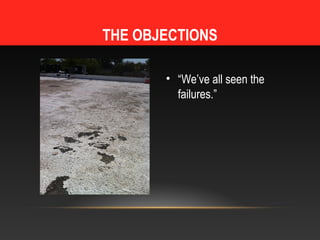
       • “We’ve all seen the
         failures.”
THE ADVANCES

• Fibered mastics now offer one-step seam and curb detailing.
  Some manufacturers now offer a complete system including
  caulking, emulsions, etc.
• There is no poly to tent or fishmouth. Random orientation of
  fibers means higher tensile strength and less sacrifice of
  elongation.
• Factory reps now trained in infrared analyses, moisture
  probes, newer substrates, etc. We are a resource for
  specifiers and contractors alike.
THE ADVANCES

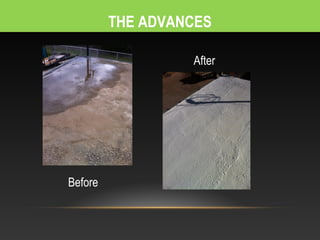
                  After


Before
• Simplified systems
   • Less room for error
   • More competitive bids—less labor!
   • Quicker installation = reduced disruption
   • Waterborne and high-performance systems available
   • Quality control improved by single-source manufacturing
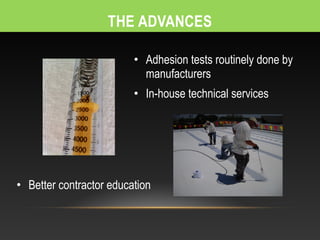
• Adhesion tests routinely done by
                           manufacturers
                         • In-house technical services


• Better contractor education
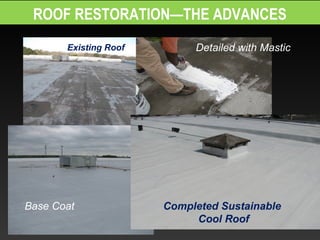
ROOF RESTORATION—THE ADVANCES
       Existing Roof        Detailed with Mastic


Base Coat              Completed Sustainable
                            Cool Roof
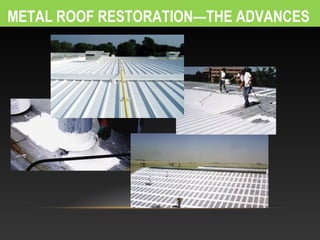
METAL ROOF RESTORATION—THE ADVANCES
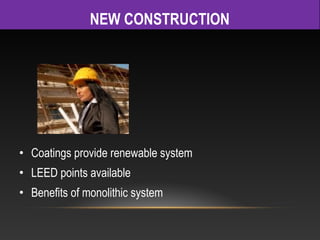
NEW CONSTRUCTION


• Coatings provide renewable system
• LEED points available
• Benefits of monolithic system
LIFE CYCLE COSTS
                        100,000 SF – 30 YEARS
• Single ply: $200k initial install + $250K overlay at 15 years + $350k
   re-roof at 30 years = $800k
• Fluid-applied: $250k initial install + $125k recoat X 3 (every 10 years)
   = $625k


        It’s time to consider this option!
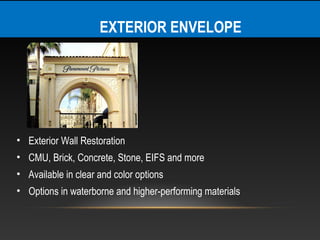
EXTERIOR ENVELOPE


• Exterior Wall Restoration
• CMU, Brick, Concrete, Stone, EIFS and more
• Available in clear and color options
• Options in waterborne and higher-performing materials
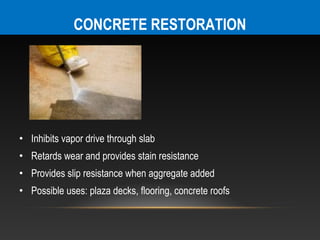
CONCRETE RESTORATION


• Inhibits vapor drive through slab
• Retards wear and provides stain resistance
• Provides slip resistance when aggregate added
• Possible uses: plaza decks, flooring, concrete roofs
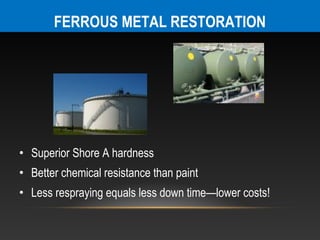
FERROUS METAL RESTORATION


• Superior Shore A hardness
• Better chemical resistance than paint
• Less respraying equals less down time—lower costs!
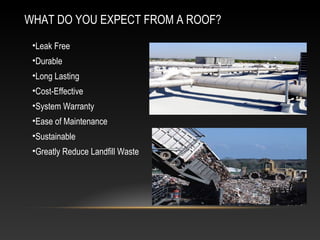
WHAT DO YOU EXPECT FROM A ROOF?
 •Leak Free
 •Durable
 •Long Lasting
 •Cost-Effective
 •System Warranty
 •Ease of Maintenance
 •Sustainable
 •Greatly Reduce Landfill Waste
THANK YOU FOR YOUR TIME!
          • Questions
         • Comments
         • Clarification
               Tim Steele
     Sustainable Restoration Specialist
    Thermo Manufacturing Systems, LLC

Advances in Fluid Applied Roofing

  • 1.
    Washington Roofing &Insulation A Division of Washington Companies, Inc. Over 30 years of Experience in Polyurethane Spray Foam and Fluid-Applied Roof Coatings. Serving Kansas, Iowa, Missouri, Oklahoma and Texas Corporate Office: Kansas City Branch Office: Midwest Service Office: 828 10th St - PO Box 1956 8224 Marshall Drive Claremore, Oklahoma Great Bend, KS 67530 Lenexa, KS 66214 Chuck Grubbs 800-383-3062 - 620-792- 913-492-1577 918-606-2233 2430 fax 913-492-4362 (fax) 620-792-2408
  • 2.
  • 3.
    WHAT DO YOUEXPECT FROM A ROOF? • Leak Free • Durable • Cost-Effective • System Warranty • Ease of Maintenance • Sustainable
  • 4.
    TRADITIONAL ROOFING PROCESS NaturalResources Manufacturing/Installation Roof Service Life $ $ Landfill
  • 5.
    Roofing Tear-Offs –They take it from Here to There Where is There?
  • 6.
    HOW ARE FLUID-APPLIEDSYSTEMS SUSTAINABLE? Natural Resources Manufacturing/Installation Roof Service Life Sustain - Recycle Sustain - Recoat
  • 7.
    THE KEYS FLUID-APPLIED SYSTEMS •Proven Performance • Higher Performance • Fully Sustainable • Ease of Installation • Ease of Maintenance
  • 8.
    WHO ARE THEBEST CLIENTS? • Low Slope Commercial / Industrial / Institutional • Typically Own the Property for an Extended Period • National & International Corporations • Municipalities • Hospitals • Military • Multi-Facility Owners
  • 9.
    WHY BUILDING OWNERSCHOOSE RESTORATION VS RE-ROOFING • Technical and Economic Benefits • Minimal Disruption During the Installation Process • Ease of Maintenance • Environmentally Friendly Systems • Hybrid systems available if restoration alone not possible
  • 10.
    TECHNICAL BENEFITS • Liquidapplied restorations provide a seamless system (seams are the weak points in any system) • Highly reflective (among the most reflective in the industry averaging 85%-90% reflectivity) • Cooler roof surface translates into Energy Savings & Cooler Interior • Resistant to Ponding Water (some can handle 72-hour standing water) • Easily renewed (Sustainable); easily repaired because material bonds to itself
  • 11.
    EXPENSE LOWERING BENEFITS •Save on the initial system compared to most “conventional” application methods • Fully tax deductible as an operating expense, classified under maintenance • Lower utility expenses • Eliminate the expense of replacing the insulation • Economical maintenance • Long-term ROI improves due to lower cost of subsequent restorations
  • 12.
    BUT WHITE ROOFSARE ALL THE SAME. AREN’T THEY? • Overlays require a cover board; fasteners create thermal gaps reducing effectiveness of new insulation • Long-term SRI is better for high-performance coatings than for many sheet goods • Emissivity of coated roofs comparable to or better than sheet goods • Condensation point is not raised into roof assembly with restoration
  • 13.
    DIFFERENT CHEMISTRIES INROOF COATINGS • Different chemistries impart different physicals • Appropriate uses vary • Differences in cost • Single component vs. multi-component
  • 14.
    ACRYLICS THEGOOD THE BAD • Waterborne = low • Lowest tensile and VOC/odor, easy cleanup elongation (both > 400) • Inexpensive • Cannot handle standing • No solvents = reduced water bitumen bleed • Low chemical and impact • Single component resistance
  • 15.
    URETHANES There are twoclasses of urethanes: aromatic and aliphatic. Each has strengths and weaknesses. AROMATIC ALIPHATIC •Less expensive •Better UV resistance •Better elongation •High impact resistance/durable •Prone to chalking •High odor •High millage loss •High cost •May need accelerant in arid •Require catalyst, long cure climates
  • 16.
    SILICONES THE GOOD THE BAD • High UV resistance • Loses physicals rapidly • Good initial physicals • Noncompatible with other • Single component systems • Prone to discoloration
  • 17.
    SEBS THE GOOD THE BAD • Proven track record • Initial odor • Superior physicals, stability • Solvent cleanup • Chemical cure -- not • Higher cost dependent upon weather • Single component • Good resistance to chemicals and ponding
  • 18.
    POLYUREAS THE GOOD THE BAD • Rapid cure under any • Plural component = high conditions margin for error • High solids • Improper mixing results in • Low odor inconsistencies • High cost
  • 19.
    PMMA THE GOOD THE BAD • Short cure time • Poor chemical resistance • Resistant to ponding water • High cost • May be installed in wide • Strong odor during install range of temperatures • Lower adhesion strength
  • 20.
  • 21.
    THE OBJECTIONS • Thisisn’t a finished roofing system. • These systems have to be field-assembled. • I don’t want to order caulking, sealants, etc. from multiple sources. • Fluid-applied systems can’t handle standing water. • This guy is an idiot and is selling us a line of bull.
  • 22.
    THE OBJECTIONS • “We’ve all seen the failures.”
  • 23.
    THE ADVANCES • Fiberedmastics now offer one-step seam and curb detailing. Some manufacturers now offer a complete system including caulking, emulsions, etc. • There is no poly to tent or fishmouth. Random orientation of fibers means higher tensile strength and less sacrifice of elongation. • Factory reps now trained in infrared analyses, moisture probes, newer substrates, etc. We are a resource for specifiers and contractors alike.
  • 24.
    THE ADVANCES After Before
  • 25.
    • Simplified systems • Less room for error • More competitive bids—less labor! • Quicker installation = reduced disruption • Waterborne and high-performance systems available • Quality control improved by single-source manufacturing
  • 26.
    • Adhesion testsroutinely done by manufacturers • In-house technical services • Better contractor education
  • 27.
    ROOF RESTORATION—THE ADVANCES Existing Roof Detailed with Mastic Base Coat Completed Sustainable Cool Roof
  • 28.
  • 29.
    NEW CONSTRUCTION • Coatingsprovide renewable system • LEED points available • Benefits of monolithic system
  • 30.
    LIFE CYCLE COSTS 100,000 SF – 30 YEARS • Single ply: $200k initial install + $250K overlay at 15 years + $350k re-roof at 30 years = $800k • Fluid-applied: $250k initial install + $125k recoat X 3 (every 10 years) = $625k It’s time to consider this option!
  • 31.
    EXTERIOR ENVELOPE • ExteriorWall Restoration • CMU, Brick, Concrete, Stone, EIFS and more • Available in clear and color options • Options in waterborne and higher-performing materials
  • 32.
    CONCRETE RESTORATION • Inhibitsvapor drive through slab • Retards wear and provides stain resistance • Provides slip resistance when aggregate added • Possible uses: plaza decks, flooring, concrete roofs
  • 33.
    FERROUS METAL RESTORATION •Superior Shore A hardness • Better chemical resistance than paint • Less respraying equals less down time—lower costs!
  • 34.
    WHAT DO YOUEXPECT FROM A ROOF? •Leak Free •Durable •Long Lasting •Cost-Effective •System Warranty •Ease of Maintenance •Sustainable •Greatly Reduce Landfill Waste
  • 35.
    THANK YOU FORYOUR TIME! • Questions • Comments • Clarification Tim Steele Sustainable Restoration Specialist Thermo Manufacturing Systems, LLC