Wound dressings
Dr Ammar Hashim
Pathophysiology
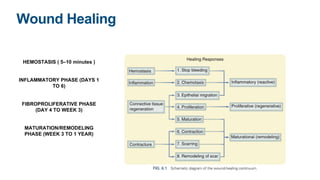
Wound Healing
HEMOSTASIS ( 5–10 minutes )
INFLAMMATORY PHASE (DAYS 1
TO 6)
FIBROPROLIFERATIVE PHASE
(DAY 4 TO WEEK 3)
MATURATION/REMODELING
PHASE (WEEK 3 TO 1 YEAR)
Sabiston Textbook of Surgery Schwartz’s Principles of Surgery
Dressing types
Moisture :
Speeds
epithelialization
Warmth :
Increased tensile
strength (better
perfusion)
Sabiston Textbook of Surgery
Occlusion of a wound with dressing material helps healing by controlling
the level of hydration and oxygen tension within the wound. It also
allows transfer of gases and water vapor from the wound surface to the
atmosphere.
Occlusion affects both the dermis and epidermis, and it has been shown
that exposed wounds are more inflamed and develop more necrosis than
covered wounds.
Occlusion also helps in dermal collagen synthesis and epithelial cell
migration and limits tissue desiccation
Schwartzâs Principles of Surgery
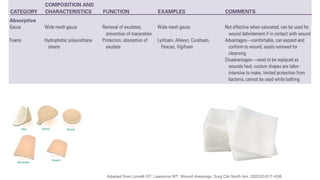
The ideal dressing does not exist, many types
of dressings help achieve certain goals
Schwartz’s Principles of Surgery
AO Manual of Soft-Tissue Management
Adapted from Lionelli GT, Lawrence WT. Wound dressings. Surg Clin North Am. 2003;83:617–638.
Adapted from
Lionelli GT,
Lawrence WT.
Wound dressings.
Surg Clin North
Am. 2003;83:617–
638.
Adapted from
Lionelli GT,
Lawrence WT.
Wound dressings.
Surg Clin North
Am. 2003;83:617–
638.
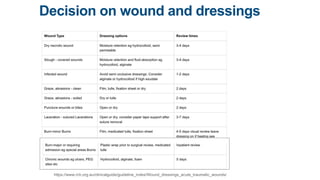
https://www.rch.org.au/clinicalguide/guideline_index/Wound_dressings_acute_traumatic_wounds/
Decision on wound and dressings
Hydrocolloid and Hydrogel Dressings
Hydrocolloid and hydrogel dressings attempt to combine the
benefits of occlusion and absorbency. Hydrocolloids and hydrogels
form complex structures with water, and fluid absorption occurs with
particle swelling, which aids in atraumatic removal of the dressing.
Absorption of exudates by the hydrocolloid dressing leaves a
yellowish-brown gelatinous mass after dressing removal that can be
washed off.
Hydrogels allow a high rate of evaporation without compromising
wound hydration, which makes them useful in burn wound treatment.
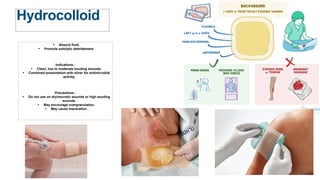
Hydrocolloid
▪ Absorb fluid.
▪ Promote autolytic debridement.
Indications :
▪ Clean, low to moderate exuding wounds.
▪ Combined presentation with silver for antimicrobial
activity.
Precautions :
▪ Do not use on dry/necrotic wounds or high exuding
wounds.
▪ May encourage overgranulation.
▪ May cause maceration.
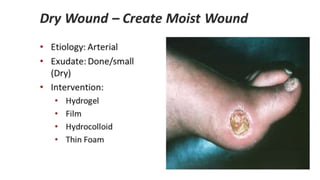
Hydrogel
▪ Rehydrate wound bed.
▪ Moisture control.
▪ Promote autolytic debridement.
▪ Cooling.
Indications:
▪ Dry/low to moderate exuding
wounds.
▪ Combined presentation with silver
for antimicrobial activity.
Precautions:
▪ Do not use on highly exuding
wounds or where anaerobic
infection is suspected.
▪ May cause maceration.
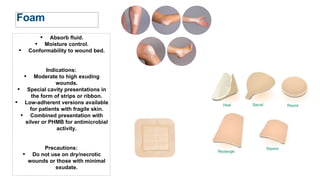
Foam
▪ Absorb fluid.
▪ Moisture control.
▪ Conformability to wound bed.
Indications:
▪ Moderate to high exuding
wounds.
▪ Special cavity presentations in
the form of strips or ribbon.
▪ Low-adherent versions available
for patients with fragile skin.
▪ Combined presentation with
silver or PHMB for antimicrobial
activity.
Precautions:
▪ Do not use on dry/necrotic
wounds or those with minimal
exudate.
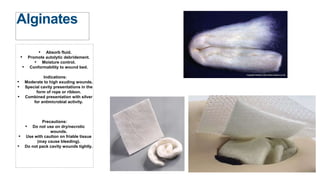
Alginates
▪ Absorb fluid.
▪ Promote autolytic debridement.
▪ Moisture control.
▪ Conformability to wound bed.
Indications:
▪ Moderate to high exuding wounds.
▪ Special cavity presentations in the
form of rope or ribbon.
▪ Combined presentation with silver
for antimicrobial activity.
Precautions:
▪ Do not use on dry/necrotic
wounds.
▪ Use with caution on friable tissue
(may cause bleeding).
▪ Do not pack cavity wounds tightly.
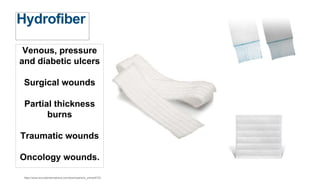
Hydrofiber
Venous, pressure
and diabetic ulcers
Surgical wounds
Partial thickness
burns
Traumatic wounds
Oncology wounds.
https://www.woundsinternational.com/download/wint_article/6723
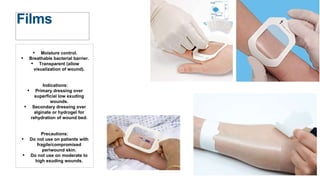
Films
▪ Moisture control.
▪ Breathable bacterial barrier.
▪ Transparent (allow
visualization of wound).
Indications:
▪ Primary dressing over
superficial low exuding
wounds.
▪ Secondary dressing over
alginate or hydrogel for
rehydration of wound bed.
Precautions:
▪ Do not use on patients with
fragile/compromised
periwound skin.
▪ Do not use on moderate to
high exuding wounds.
Medicated Dressings
Agents delivered in the dressings include benzoyl peroxide, zinc
oxide, neomycin, and bacitracin-zinc. These agents have been
shown to increase epithelialization by 28%.
Medicated Dressings
Silver-impregnated
Indications:
▪ Critically colonized wounds or clinical
signs of infection.
▪ Low to high exuding wounds.
▪ Combined presentation with foam
and alginates/CMC for increased
absorbency. Also in paste form.
Precautions :
▪ Some may cause discoloration.
▪ Known sensitivity.
▪ Discontinue after 2 weeks if no
improvement and reevaluate.
AO Manual of Soft-Tissue Management
Medicated Dressings
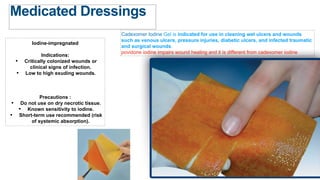
Iodine-impregnated
Indications:
▪ Critically colonized wounds or
clinical signs of infection.
▪ Low to high exuding wounds.
Precautions :
▪ Do not use on dry necrotic tissue.
▪ Known sensitivity to iodine.
▪ Short-term use recommended (risk
of systemic absorption).
Cadexomer Iodine Gel is indicated for use in cleaning wet ulcers and wounds
such as venous ulcers, pressure injuries, diabetic ulcers, and infected traumatic
and surgical wounds.
povidone iodine impairs wound healing and it is different from cadexomer iodine
Mechanical Devices
Sabiston Textbook of Surgery
Wound drainage
Non-draining wound can be covered with semiocclusive dressing.
Drainage of less than 1 to 2 mL/d may require a semiocclusive or absorbent
nonadherent dressing.
Moderately draining wounds (3–5 mL/d) can be dressed with a nonadherent primary
layer plus an absorbent secondary layer plus an occlusive dressing to protect normal
tissue.
Heavily draining wounds (>5 mL/d) require a similar dressing as moderately draining
wounds, but with the addition of a highly absorbent secondary layer.
Schwartz’s Principles of Surgery
Pressure sores
Pressure sores
Oxford handbook for Post-operative Complications
References
- Sabiston Textbook of Surgery
- Schwartz’s Principles of Surgery
- Oxford handbook for Post-operative Complications
- International Consensus. Acellular matrices for the treatment of wounds. An expert working group review.
Wounds International 2010. Available at http://woundsinternational.com (Accessed on March 2013).
- Reproduced with permission from: McCardle J, Chadwick P, Edmonds M, et al. International Best Practice
Guidelines: Wound Management in Diabetic Foot Ulcers. Wounds International, 2013. Copyright © 2013
Schofield Healthcare Media LTD. Available from: www.woundsinternational.com.
- AO Manual of Soft-Tissue Management
- Jeffrey E. Janis - Essentials of Plastic Surgery
Thank You

Wound dressing.pptx

  • 1.
  • 2.
  • 3.
    Wound Healing HEMOSTASIS (5–10 minutes ) INFLAMMATORY PHASE (DAYS 1 TO 6) FIBROPROLIFERATIVE PHASE (DAY 4 TO WEEK 3) MATURATION/REMODELING PHASE (WEEK 3 TO 1 YEAR)
  • 5.
    Sabiston Textbook ofSurgery Schwartz’s Principles of Surgery
  • 6.
  • 7.
    Moisture : Speeds epithelialization Warmth : Increasedtensile strength (better perfusion) Sabiston Textbook of Surgery
  • 8.
    Occlusion of awound with dressing material helps healing by controlling the level of hydration and oxygen tension within the wound. It also allows transfer of gases and water vapor from the wound surface to the atmosphere. Occlusion affects both the dermis and epidermis, and it has been shown that exposed wounds are more inflamed and develop more necrosis than covered wounds. Occlusion also helps in dermal collagen synthesis and epithelial cell migration and limits tissue desiccation Schwartzâs Principles of Surgery
  • 9.
    The ideal dressingdoes not exist, many types of dressings help achieve certain goals Schwartz’s Principles of Surgery
  • 10.
    AO Manual ofSoft-Tissue Management
  • 11.
    Adapted from LionelliGT, Lawrence WT. Wound dressings. Surg Clin North Am. 2003;83:617–638.
  • 12.
    Adapted from Lionelli GT, LawrenceWT. Wound dressings. Surg Clin North Am. 2003;83:617– 638.
  • 13.
    Adapted from Lionelli GT, LawrenceWT. Wound dressings. Surg Clin North Am. 2003;83:617– 638.
  • 14.
  • 18.
    Hydrocolloid and HydrogelDressings Hydrocolloid and hydrogel dressings attempt to combine the benefits of occlusion and absorbency. Hydrocolloids and hydrogels form complex structures with water, and fluid absorption occurs with particle swelling, which aids in atraumatic removal of the dressing. Absorption of exudates by the hydrocolloid dressing leaves a yellowish-brown gelatinous mass after dressing removal that can be washed off. Hydrogels allow a high rate of evaporation without compromising wound hydration, which makes them useful in burn wound treatment.
  • 19.
    Hydrocolloid ▪ Absorb fluid. ▪Promote autolytic debridement. Indications : ▪ Clean, low to moderate exuding wounds. ▪ Combined presentation with silver for antimicrobial activity. Precautions : ▪ Do not use on dry/necrotic wounds or high exuding wounds. ▪ May encourage overgranulation. ▪ May cause maceration.
  • 20.
    Hydrogel ▪ Rehydrate woundbed. ▪ Moisture control. ▪ Promote autolytic debridement. ▪ Cooling. Indications: ▪ Dry/low to moderate exuding wounds. ▪ Combined presentation with silver for antimicrobial activity. Precautions: ▪ Do not use on highly exuding wounds or where anaerobic infection is suspected. ▪ May cause maceration.
  • 21.
    Foam ▪ Absorb fluid. ▪Moisture control. ▪ Conformability to wound bed. Indications: ▪ Moderate to high exuding wounds. ▪ Special cavity presentations in the form of strips or ribbon. ▪ Low-adherent versions available for patients with fragile skin. ▪ Combined presentation with silver or PHMB for antimicrobial activity. Precautions: ▪ Do not use on dry/necrotic wounds or those with minimal exudate.
  • 22.
    Alginates ▪ Absorb fluid. ▪Promote autolytic debridement. ▪ Moisture control. ▪ Conformability to wound bed. Indications: ▪ Moderate to high exuding wounds. ▪ Special cavity presentations in the form of rope or ribbon. ▪ Combined presentation with silver for antimicrobial activity. Precautions: ▪ Do not use on dry/necrotic wounds. ▪ Use with caution on friable tissue (may cause bleeding). ▪ Do not pack cavity wounds tightly.
  • 23.
    Hydrofiber Venous, pressure and diabeticulcers Surgical wounds Partial thickness burns Traumatic wounds Oncology wounds. https://www.woundsinternational.com/download/wint_article/6723
  • 24.
    Films ▪ Moisture control. ▪Breathable bacterial barrier. ▪ Transparent (allow visualization of wound). Indications: ▪ Primary dressing over superficial low exuding wounds. ▪ Secondary dressing over alginate or hydrogel for rehydration of wound bed. Precautions: ▪ Do not use on patients with fragile/compromised periwound skin. ▪ Do not use on moderate to high exuding wounds.
  • 25.
    Medicated Dressings Agents deliveredin the dressings include benzoyl peroxide, zinc oxide, neomycin, and bacitracin-zinc. These agents have been shown to increase epithelialization by 28%.
  • 26.
    Medicated Dressings Silver-impregnated Indications: ▪ Criticallycolonized wounds or clinical signs of infection. ▪ Low to high exuding wounds. ▪ Combined presentation with foam and alginates/CMC for increased absorbency. Also in paste form. Precautions : ▪ Some may cause discoloration. ▪ Known sensitivity. ▪ Discontinue after 2 weeks if no improvement and reevaluate. AO Manual of Soft-Tissue Management
  • 27.
    Medicated Dressings Iodine-impregnated Indications: ▪ Criticallycolonized wounds or clinical signs of infection. ▪ Low to high exuding wounds. Precautions : ▪ Do not use on dry necrotic tissue. ▪ Known sensitivity to iodine. ▪ Short-term use recommended (risk of systemic absorption). Cadexomer Iodine Gel is indicated for use in cleaning wet ulcers and wounds such as venous ulcers, pressure injuries, diabetic ulcers, and infected traumatic and surgical wounds. povidone iodine impairs wound healing and it is different from cadexomer iodine
  • 28.
  • 29.
    Wound drainage Non-draining woundcan be covered with semiocclusive dressing. Drainage of less than 1 to 2 mL/d may require a semiocclusive or absorbent nonadherent dressing. Moderately draining wounds (3–5 mL/d) can be dressed with a nonadherent primary layer plus an absorbent secondary layer plus an occlusive dressing to protect normal tissue. Heavily draining wounds (>5 mL/d) require a similar dressing as moderately draining wounds, but with the addition of a highly absorbent secondary layer. Schwartz’s Principles of Surgery
  • 30.
  • 31.
    Pressure sores Oxford handbookfor Post-operative Complications
  • 32.
    References - Sabiston Textbookof Surgery - Schwartz’s Principles of Surgery - Oxford handbook for Post-operative Complications - International Consensus. Acellular matrices for the treatment of wounds. An expert working group review. Wounds International 2010. Available at http://woundsinternational.com (Accessed on March 2013). - Reproduced with permission from: McCardle J, Chadwick P, Edmonds M, et al. International Best Practice Guidelines: Wound Management in Diabetic Foot Ulcers. Wounds International, 2013. Copyright © 2013 Schofield Healthcare Media LTD. Available from: www.woundsinternational.com. - AO Manual of Soft-Tissue Management - Jeffrey E. Janis - Essentials of Plastic Surgery
  • 33.