Writing an essay - FCE
The essay should be well organised, with
an introduction and an appropriate
conclusion and should be written in
an appropriate register and tone.
Exam Advice
• Rephrase language in your own words where
possible.
• Use modal verbs and passive forms.
• Try to use a wide range of vocabulary within
the topic.
• Make your writing impersonal.
• While it is possible to argue only one point of
view (i.e. either agreeing or disagreeing on a
topic) as long as you bear in mind the other
point of view and back up your points, it is
probably easier to have a balanced discussion
comparing advantages and disadvantages, or
ideas for and against a topic.
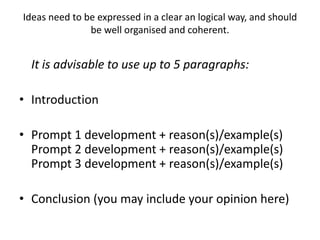
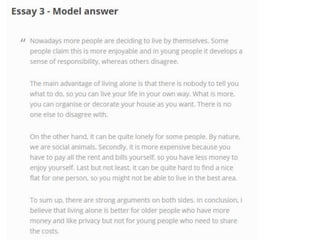
Ideas need to be expressed in a clear an logical way, and should
be well organised and coherent.
It is advisable to use up to 5 paragraphs:
• Introduction
• Prompt 1 development + reason(s)/example(s)
Prompt 2 development + reason(s)/example(s)
Prompt 3 development + reason(s)/example(s)
• Conclusion (you may include your opinion here)
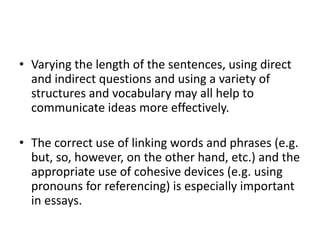
• Varying the length of the sentences, using direct
and indirect questions and using a variety of
structures and vocabulary may all help to
communicate ideas more effectively.
• The correct use of linking words and phrases (e.g.
but, so, however, on the other hand, etc.) and the
appropriate use of cohesive devices (e.g. using
pronouns for referencing) is especially important
in essays.
Hints
• [PLANNING]
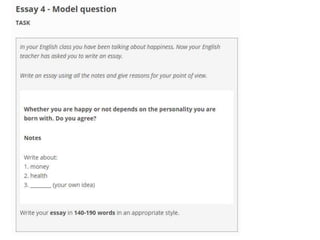
- Use the question to help you plan but try to avoid copying phrases from the input in Part 1.
Use your own words.
• [INTRODUCTION and CONCLUSION]
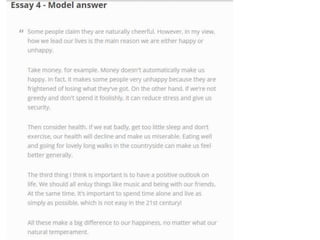
- Effective introductory and concluding paragraphs - In the introduction, state the topic
clearly, give a brief outline of the issue, saying why it is important or why people have different
opinions about it.
- DO NOT express your opinion at the beginning of your essay (develop you essay in such a
way that it guides the reader to the conclusion you draw).
- DO give your opinion in the final paragraph.
• [SECOND and THIRD PARAGRAPHS]
- Structure your argument. - Each new paragraph has one main idea, stated in a topic
sentence.
- Include relevant details to support the main idea: these might include examples, rhetorical
questions (do no overdo it), controversial or surprising statements...
• [GENERAL]
- DO use a relatively formal register and an objective tone. Do not be too emotional.
- In the exam, allow yourself time to check your grammar, spelling and punctuation thoroughly.
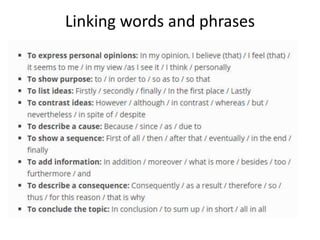
Linking words and phrases
Essay writing   FCE
Essay writing   FCE
Essay writing   FCE
Essay writing   FCE
Essay writing   FCE
Essay writing   FCE
Essay writing   FCE
Essay writing   FCE
Essay writing   FCE

Essay writing FCE

  • 1.
    Writing an essay- FCE The essay should be well organised, with an introduction and an appropriate conclusion and should be written in an appropriate register and tone.
  • 2.
    Exam Advice • Rephraselanguage in your own words where possible. • Use modal verbs and passive forms. • Try to use a wide range of vocabulary within the topic. • Make your writing impersonal.
  • 3.
    • While itis possible to argue only one point of view (i.e. either agreeing or disagreeing on a topic) as long as you bear in mind the other point of view and back up your points, it is probably easier to have a balanced discussion comparing advantages and disadvantages, or ideas for and against a topic.
  • 4.
    Ideas need tobe expressed in a clear an logical way, and should be well organised and coherent. It is advisable to use up to 5 paragraphs: • Introduction • Prompt 1 development + reason(s)/example(s) Prompt 2 development + reason(s)/example(s) Prompt 3 development + reason(s)/example(s) • Conclusion (you may include your opinion here)
  • 5.
    • Varying thelength of the sentences, using direct and indirect questions and using a variety of structures and vocabulary may all help to communicate ideas more effectively. • The correct use of linking words and phrases (e.g. but, so, however, on the other hand, etc.) and the appropriate use of cohesive devices (e.g. using pronouns for referencing) is especially important in essays.
  • 6.
    Hints • [PLANNING] - Usethe question to help you plan but try to avoid copying phrases from the input in Part 1. Use your own words. • [INTRODUCTION and CONCLUSION] - Effective introductory and concluding paragraphs - In the introduction, state the topic clearly, give a brief outline of the issue, saying why it is important or why people have different opinions about it. - DO NOT express your opinion at the beginning of your essay (develop you essay in such a way that it guides the reader to the conclusion you draw). - DO give your opinion in the final paragraph. • [SECOND and THIRD PARAGRAPHS] - Structure your argument. - Each new paragraph has one main idea, stated in a topic sentence. - Include relevant details to support the main idea: these might include examples, rhetorical questions (do no overdo it), controversial or surprising statements... • [GENERAL] - DO use a relatively formal register and an objective tone. Do not be too emotional. - In the exam, allow yourself time to check your grammar, spelling and punctuation thoroughly.
  • 7.

Editor's Notes

  • #2 http://www.examenglish.com/FCE/Cambridge_First_writing_part1.htm
  • #3 Objective First
  • #4 http://www.rubenvalero.com/english/content/fce-essay
  • #9 https://fceclass.files.wordpress.com/2014/01/samples-essay-and-report-2014.pdf
  • #11 http://www.rubenvalero.com/english/content/fce-essay