Advanced Perl Techniques Dave Cross Magnum Solutions Ltd [email_address]
Advanced Perl Techniques Advanced level training for Perl programmers Turn intermediate programmers into advanced programmers “ Modern” Perl Perl is not dying
Advanced Perl Techniques One day isn't enough time We'll be moving fairly fast Lots of pointers to other information Feel free to ask questions
What We Will Cover What's new in Perl 5.10 Testing including coverage analysis Database access DBIx::Class
What We Will Cover Profiling & Benchmarking Object oriented programming with Moose MVC Frameworks Catalyst
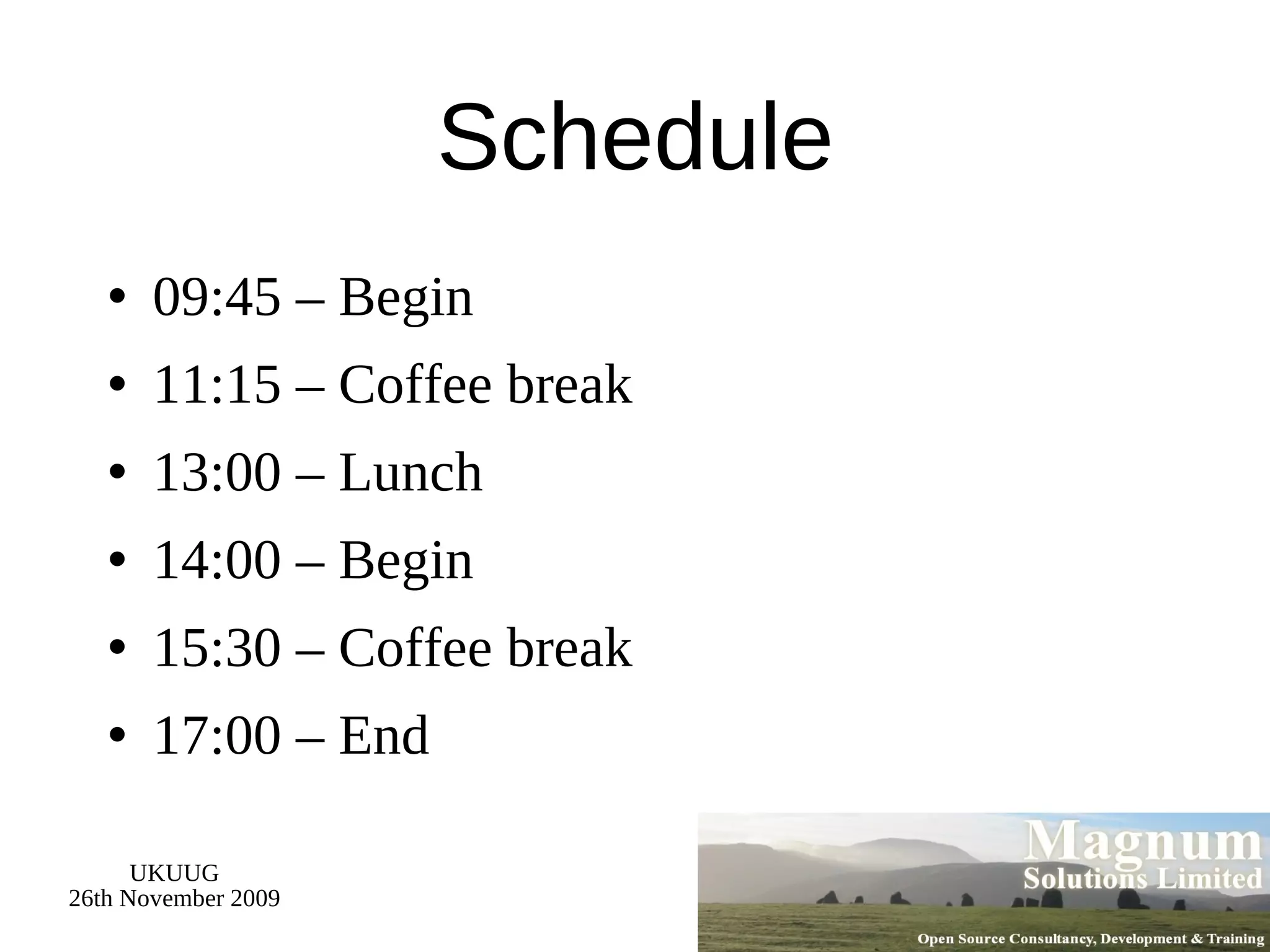
Schedule 09:45 – Begin 11:15 – Coffee break 13:00 – Lunch 14:00 – Begin  15:30 – Coffee break 17:00 – End
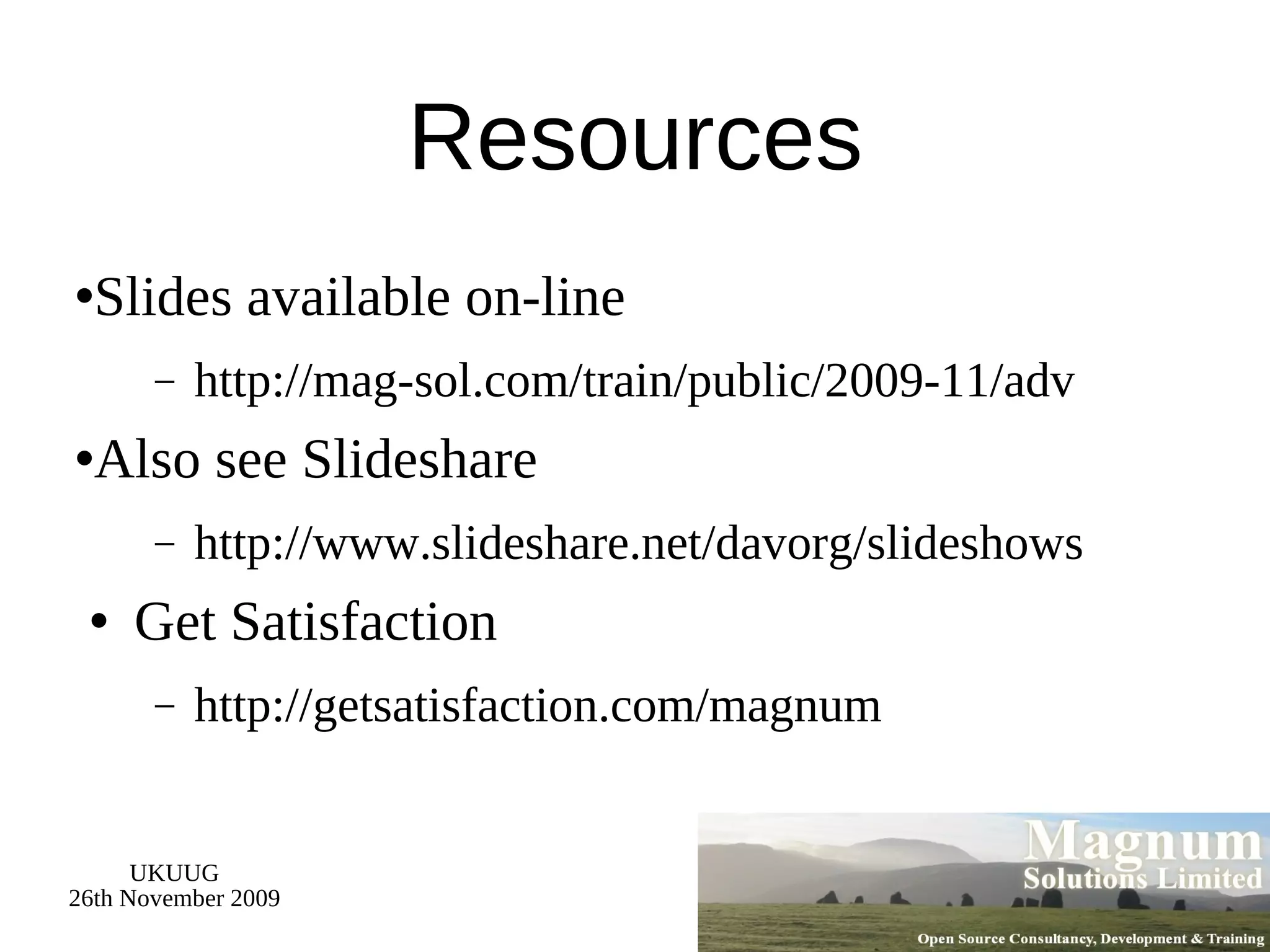
Resources Slides available on-line http://mag-sol.com/train/public/2009-11/adv Also see Slideshare http://www.slideshare.net/davorg/slideshows Get Satisfaction http://getsatisfaction.com/magnum
Perl 5.10
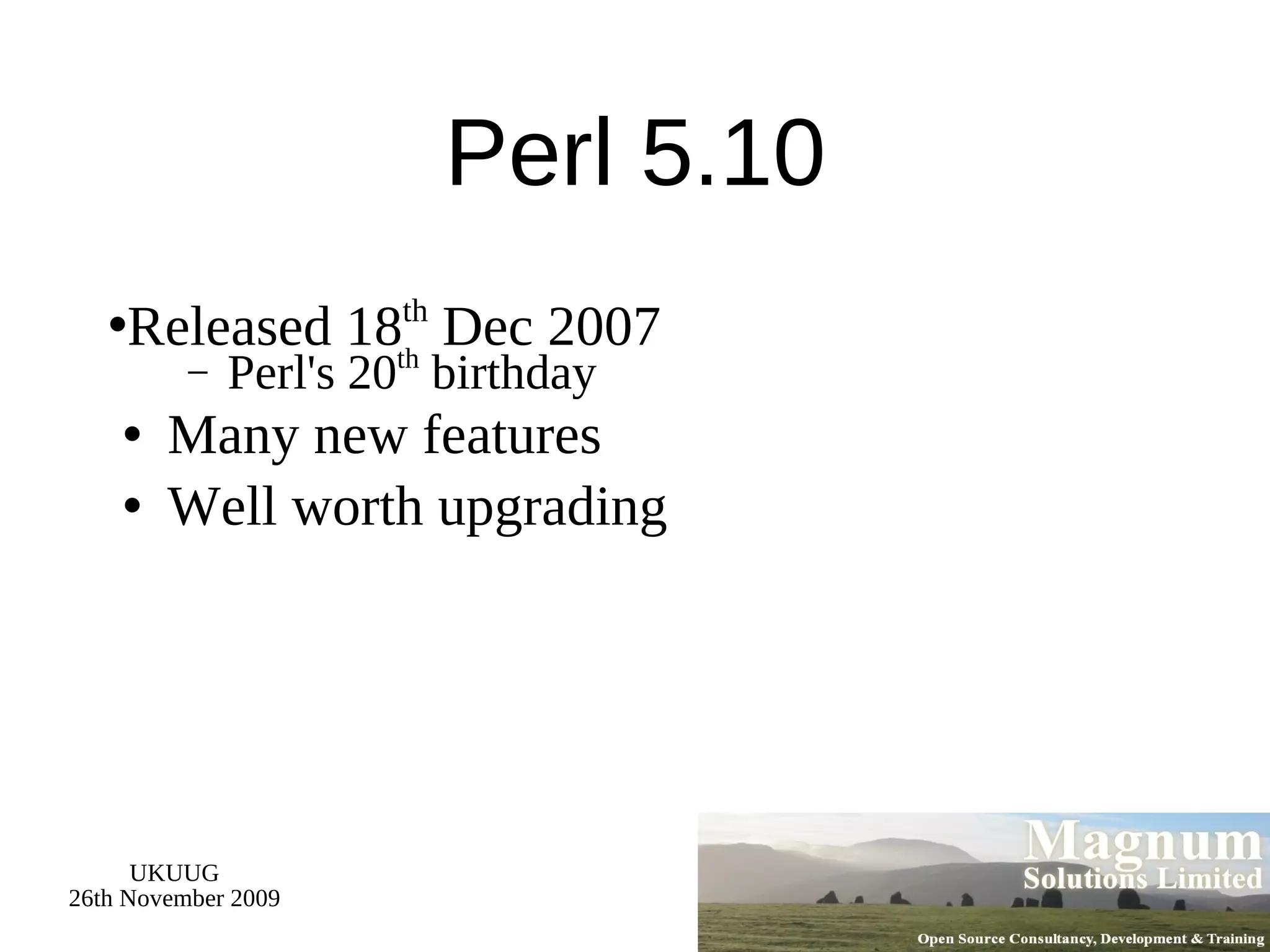
Perl 5.10 Released 18 th  Dec 2007 Perl's 20 th  birthday Many new features Well worth upgrading
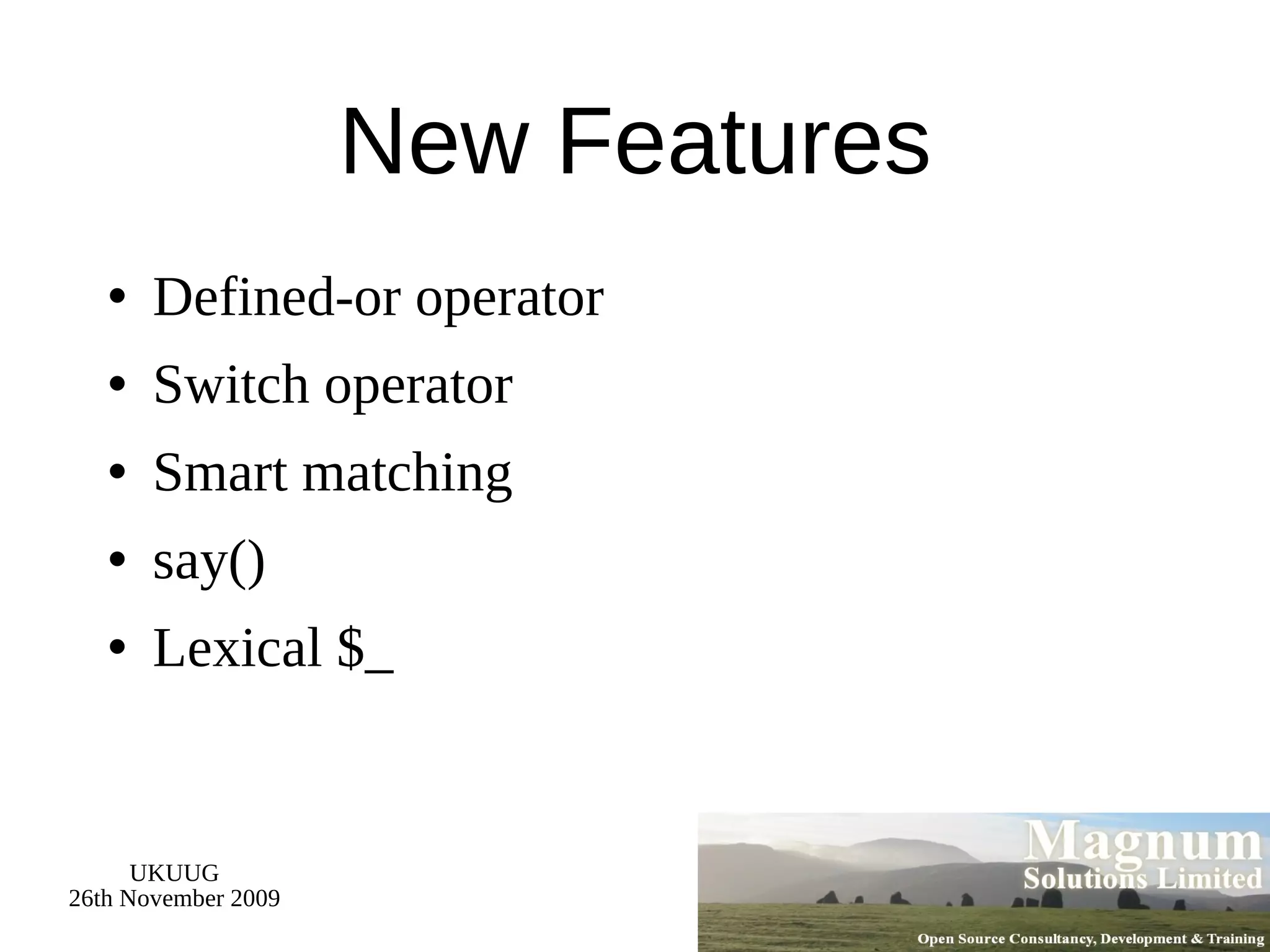
New Features Defined-or operator Switch operator Smart matching say() Lexical $_
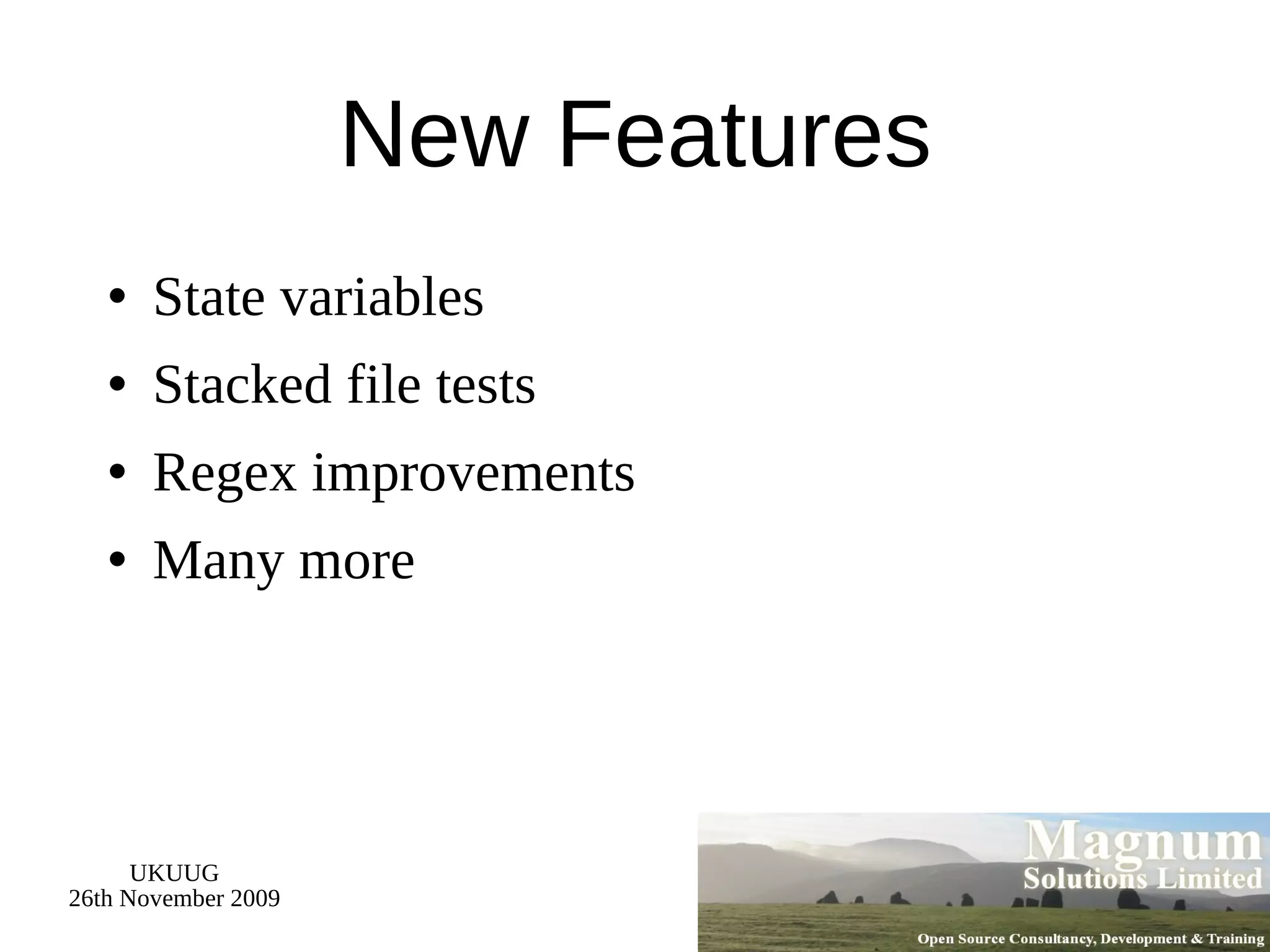
New Features State variables Stacked file tests Regex improvements Many more
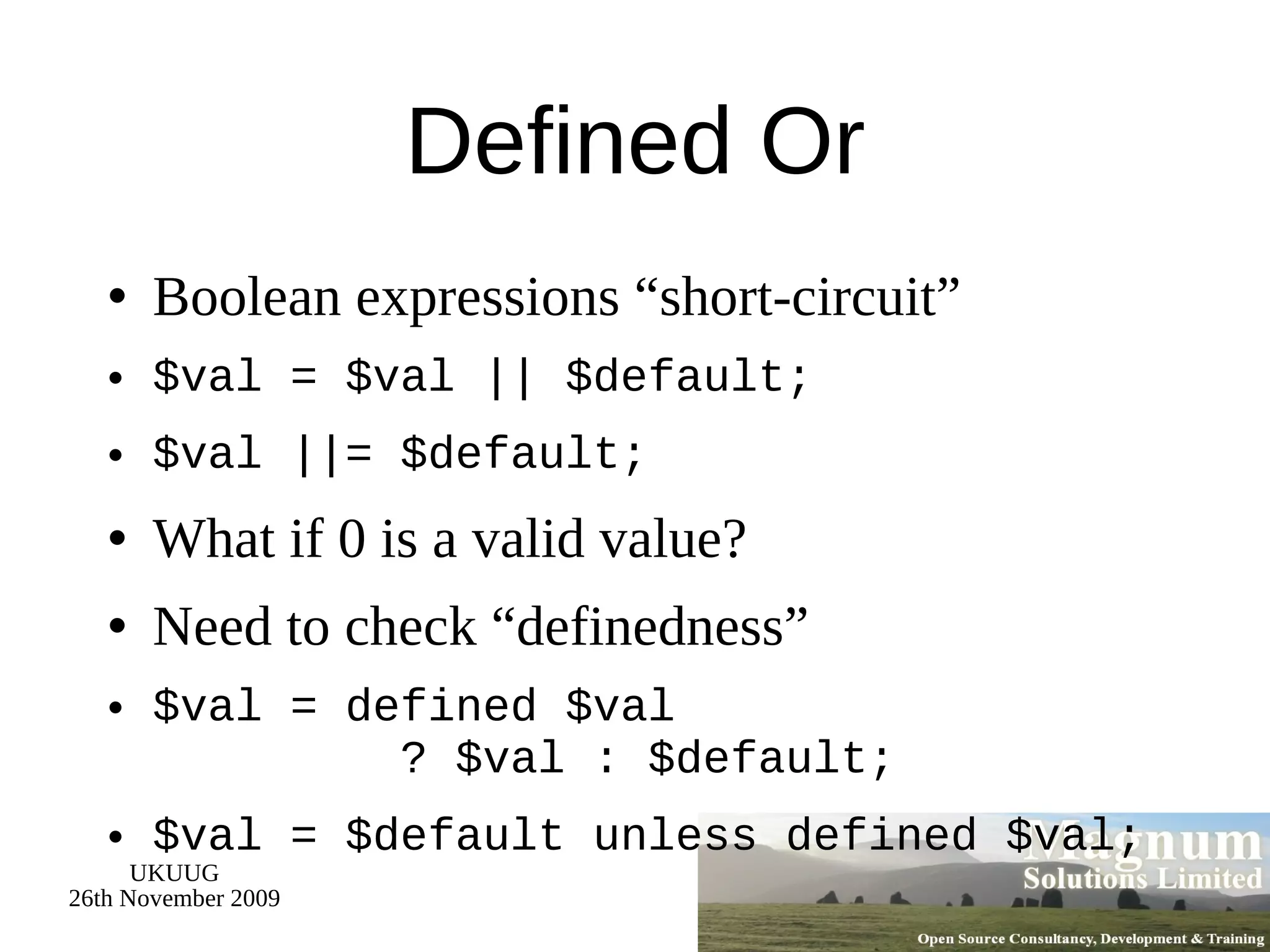
Defined Or Boolean expressions “short-circuit” $val = $val || $default; $val ||= $default; What if 0 is a valid value? Need to check “definedness” $val = defined $val   ? $val : $default; $val = $default unless defined $val;
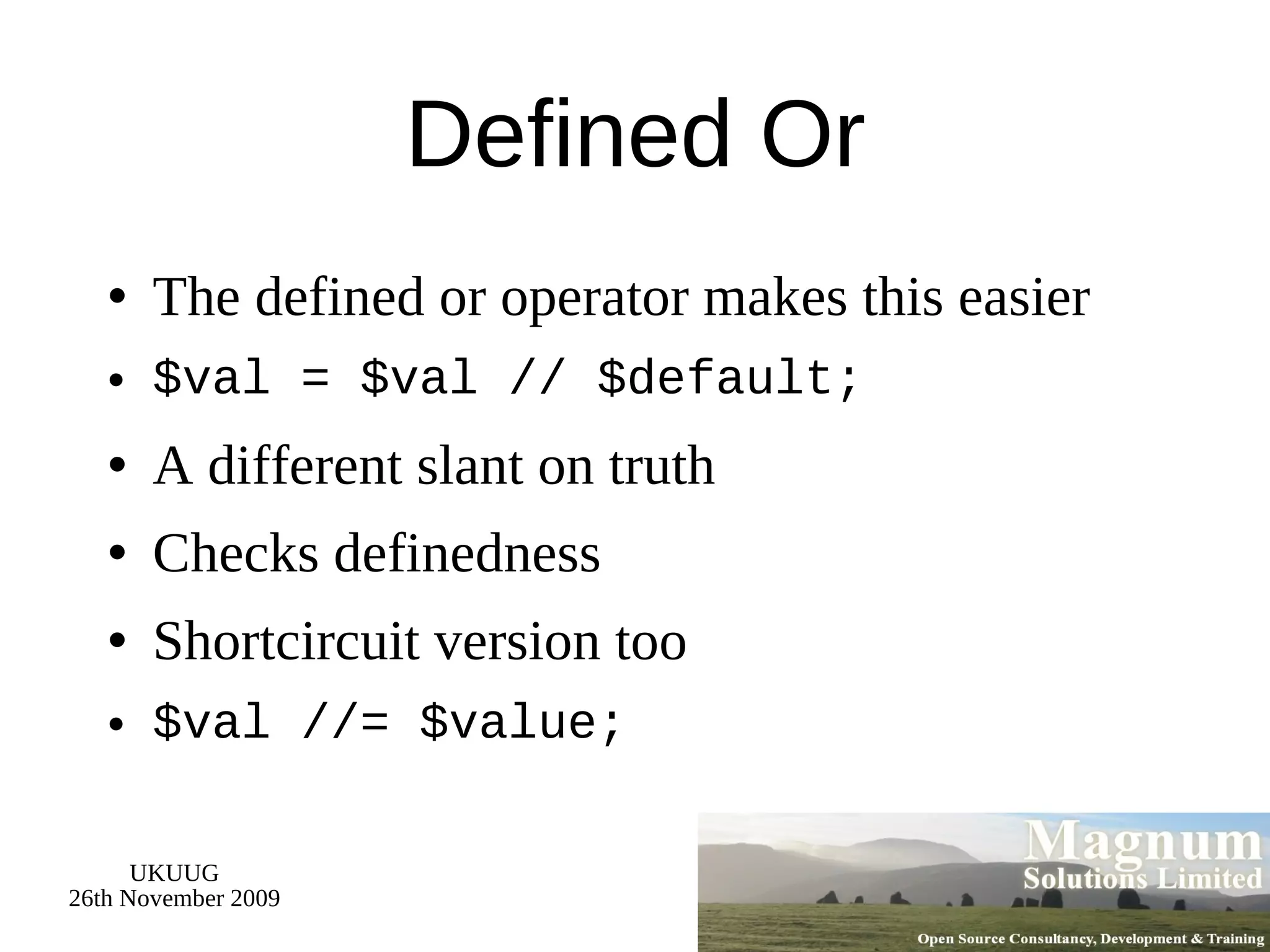
Defined Or The defined or operator makes this easier $val = $val // $default; A different slant on truth Checks definedness Shortcircuit version too $val //= $value;
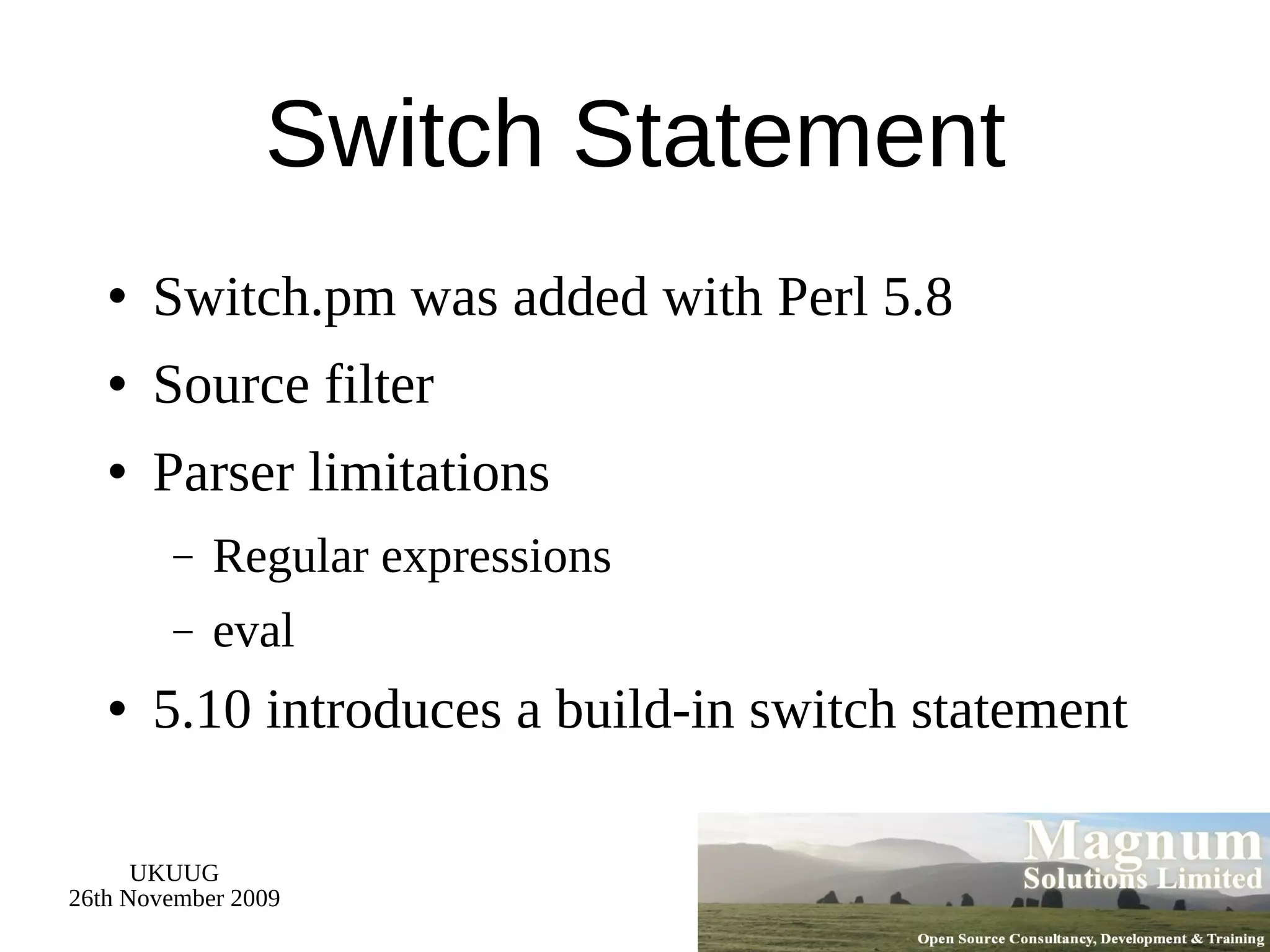
Switch Statement Switch.pm was added with Perl 5.8 Source filter Parser limitations Regular expressions eval 5.10 introduces a build-in switch statement
Given ... When Switch is spelled “given” Case is spelled “when” Powerful matching syntax
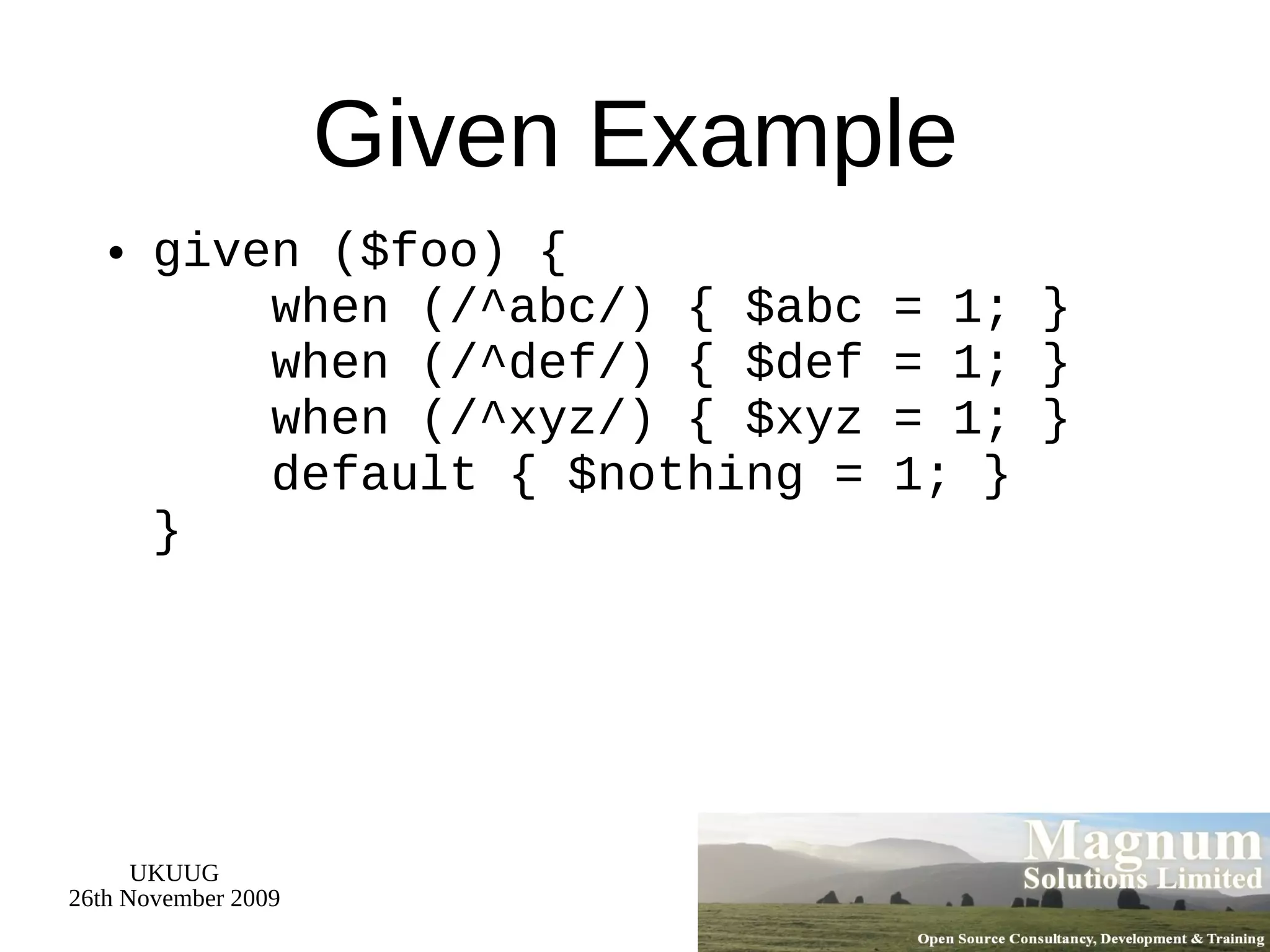
Given Example given ($foo) {   when (/^abc/) { $abc = 1; }   when (/^def/) { $def = 1; }   when (/^xyz/) { $xyz = 1; }   default { $nothing = 1; } }
New Keywords Four new keywords given when default continue
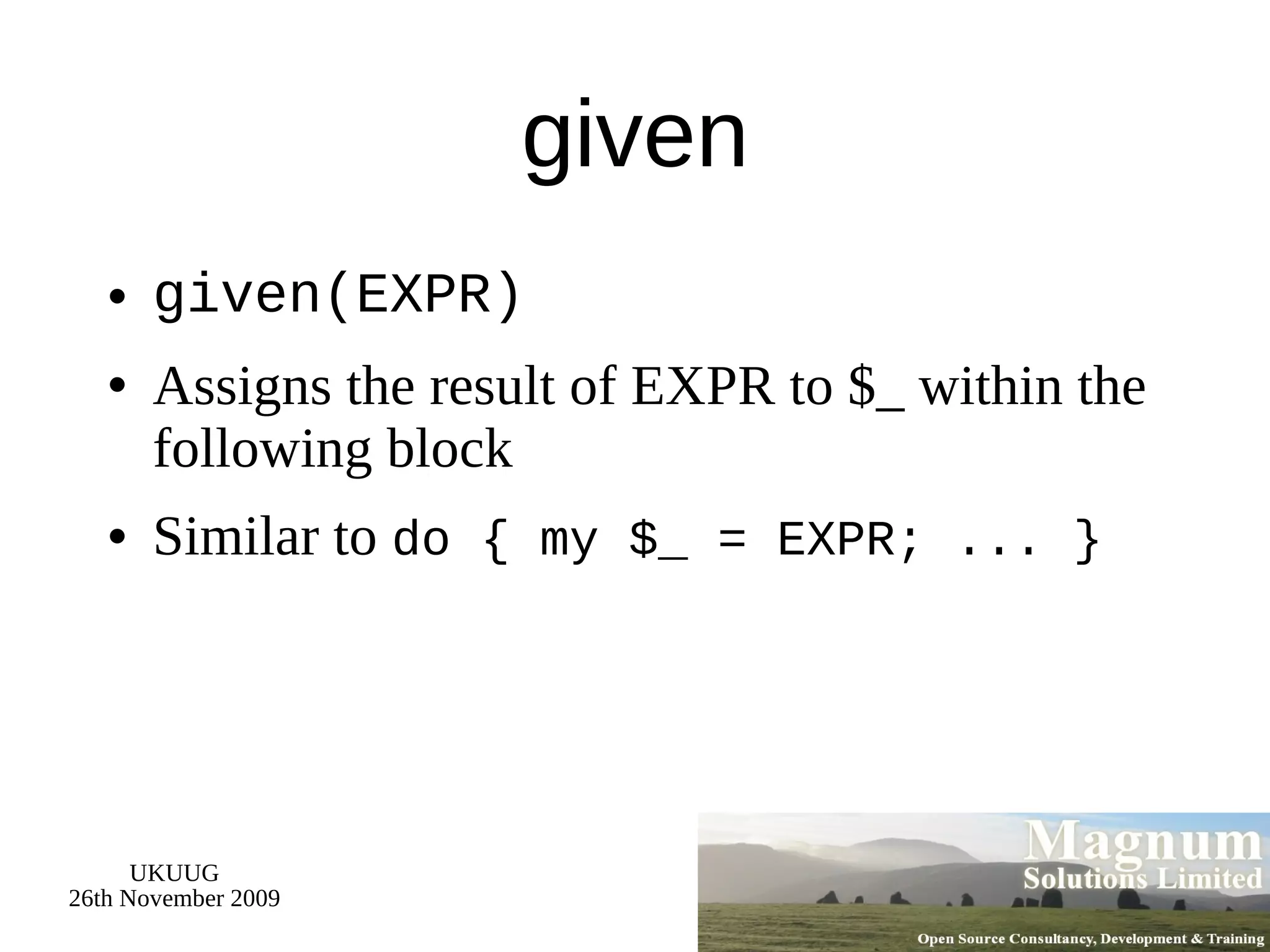
given given(EXPR) Assigns the result of EXPR to $_ within the following block Similar to  do { my $_ = EXPR; ... }
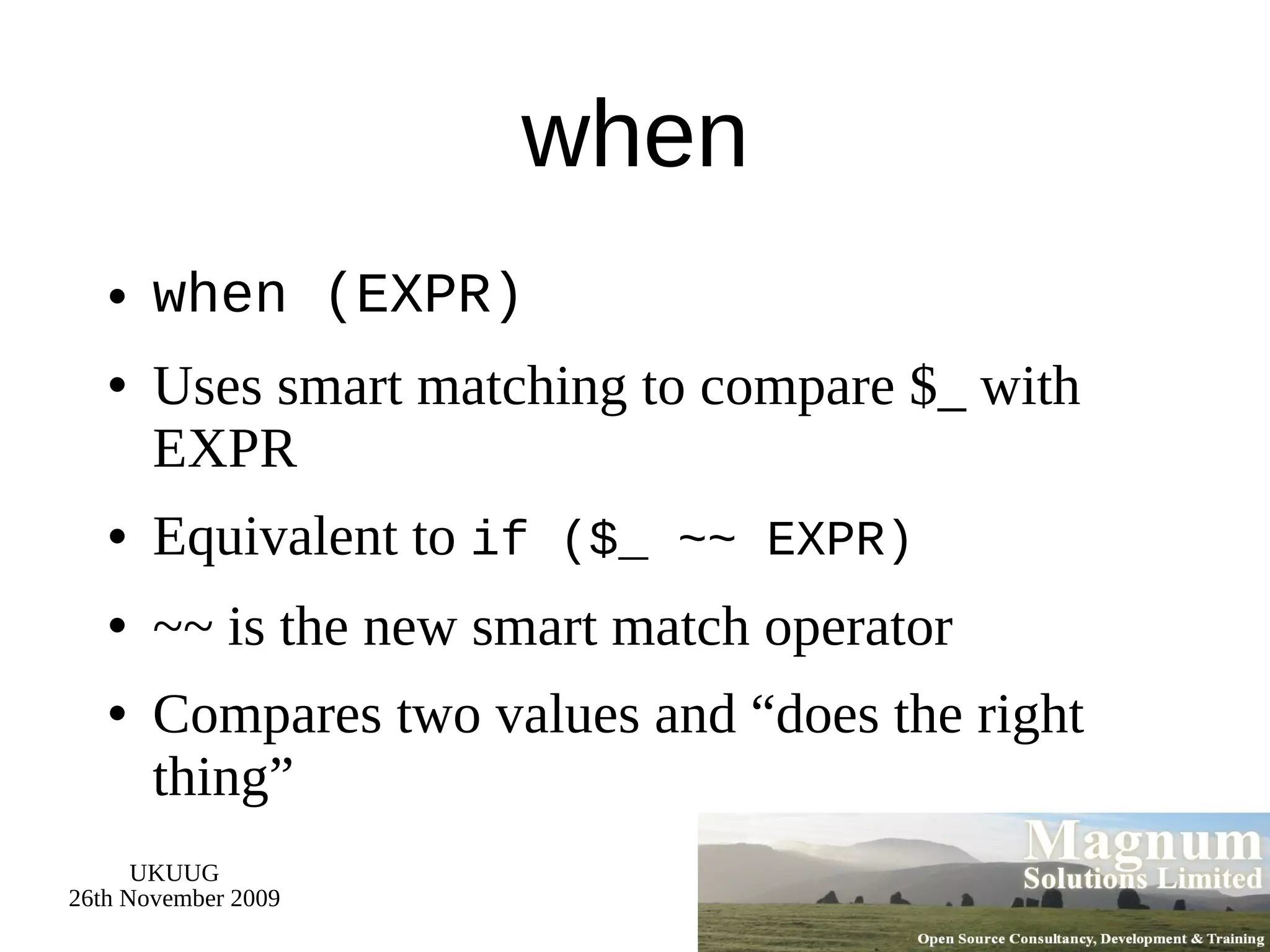
when when (EXPR) Uses smart matching to compare $_ with EXPR Equivalent to  if ($_ ~~ EXPR) ~~ is the new smart match operator Compares two values and “does the right thing”
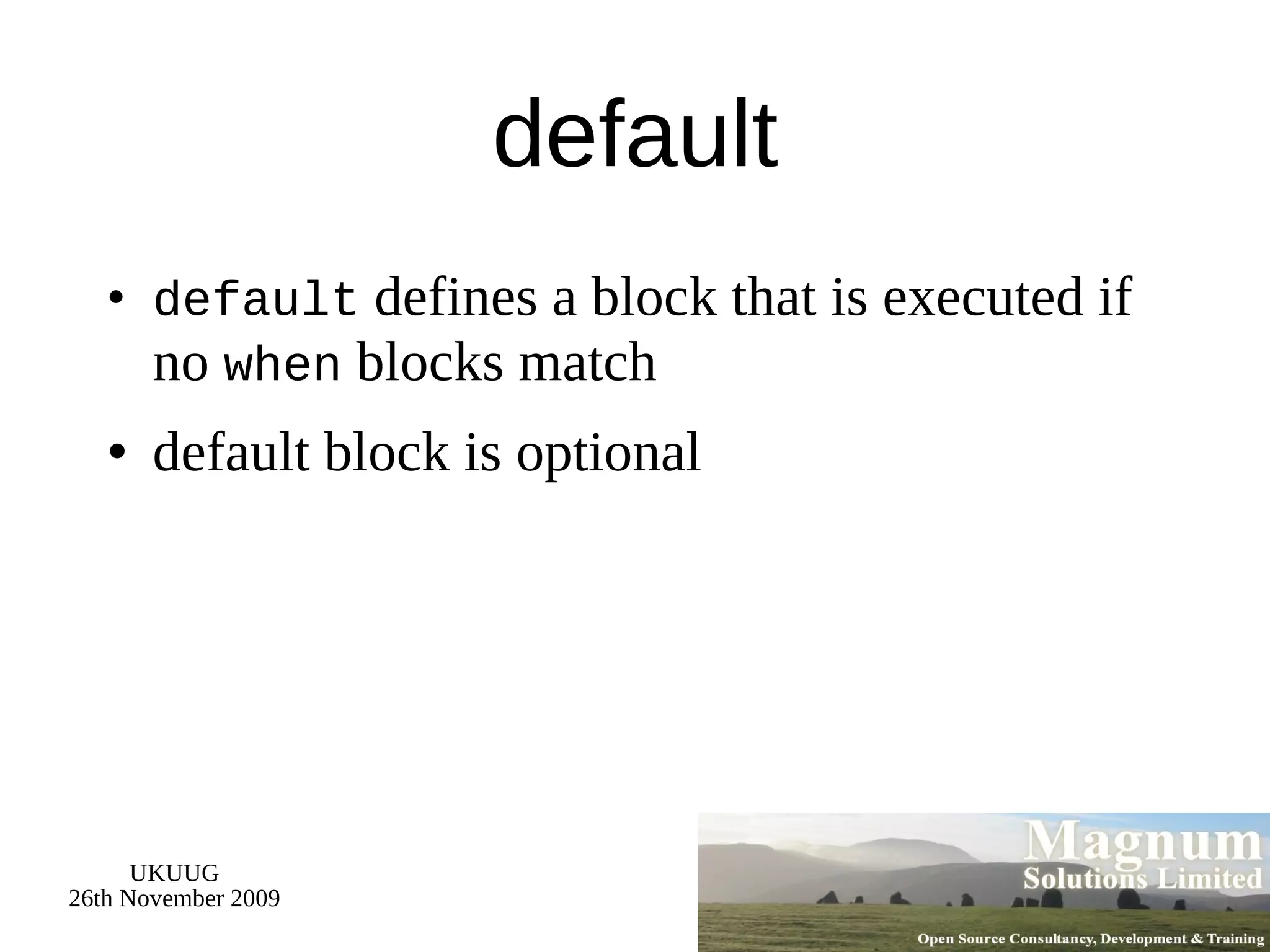
default default  defines a block that is executed if no  when  blocks match default block is optional
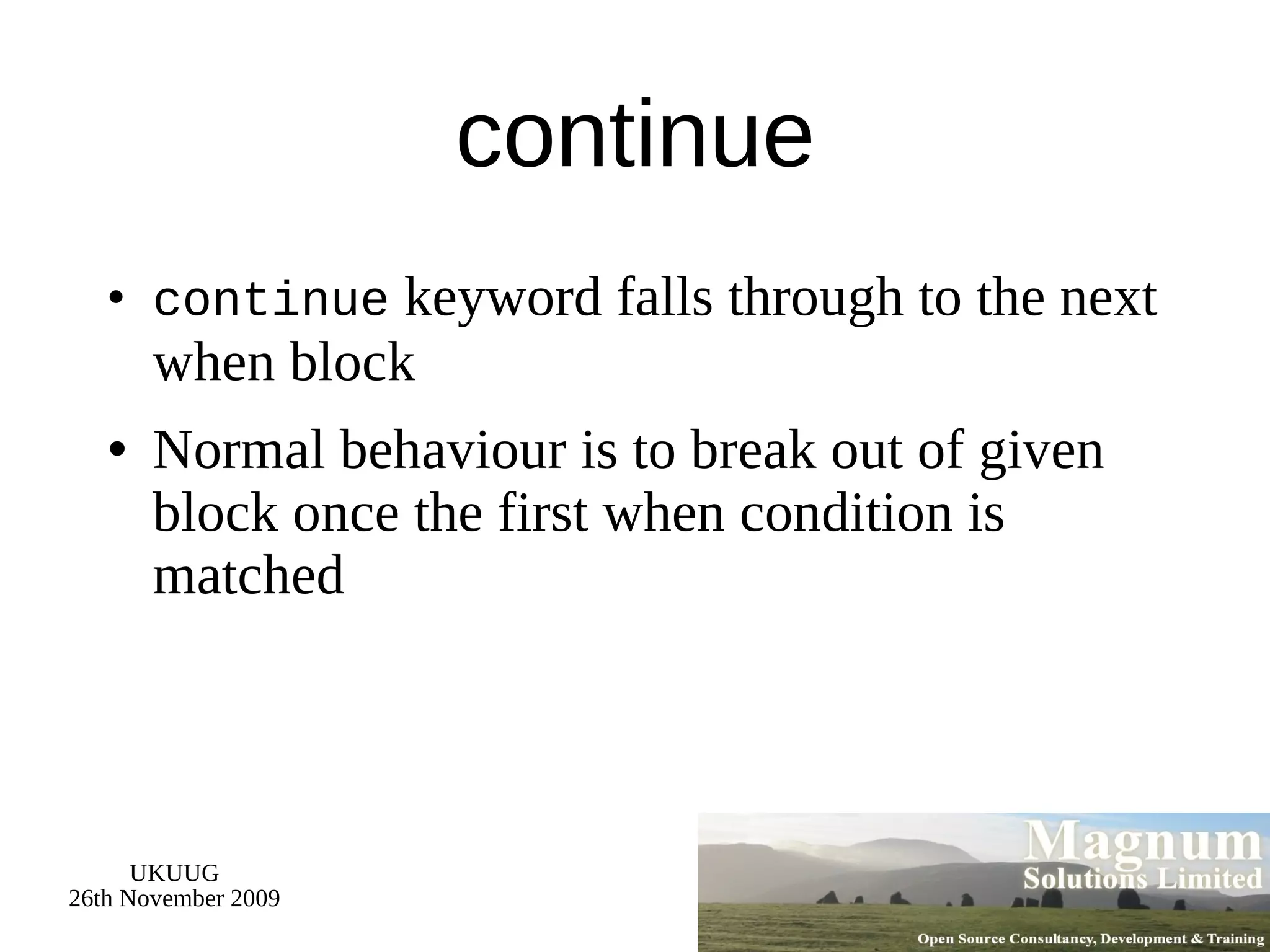
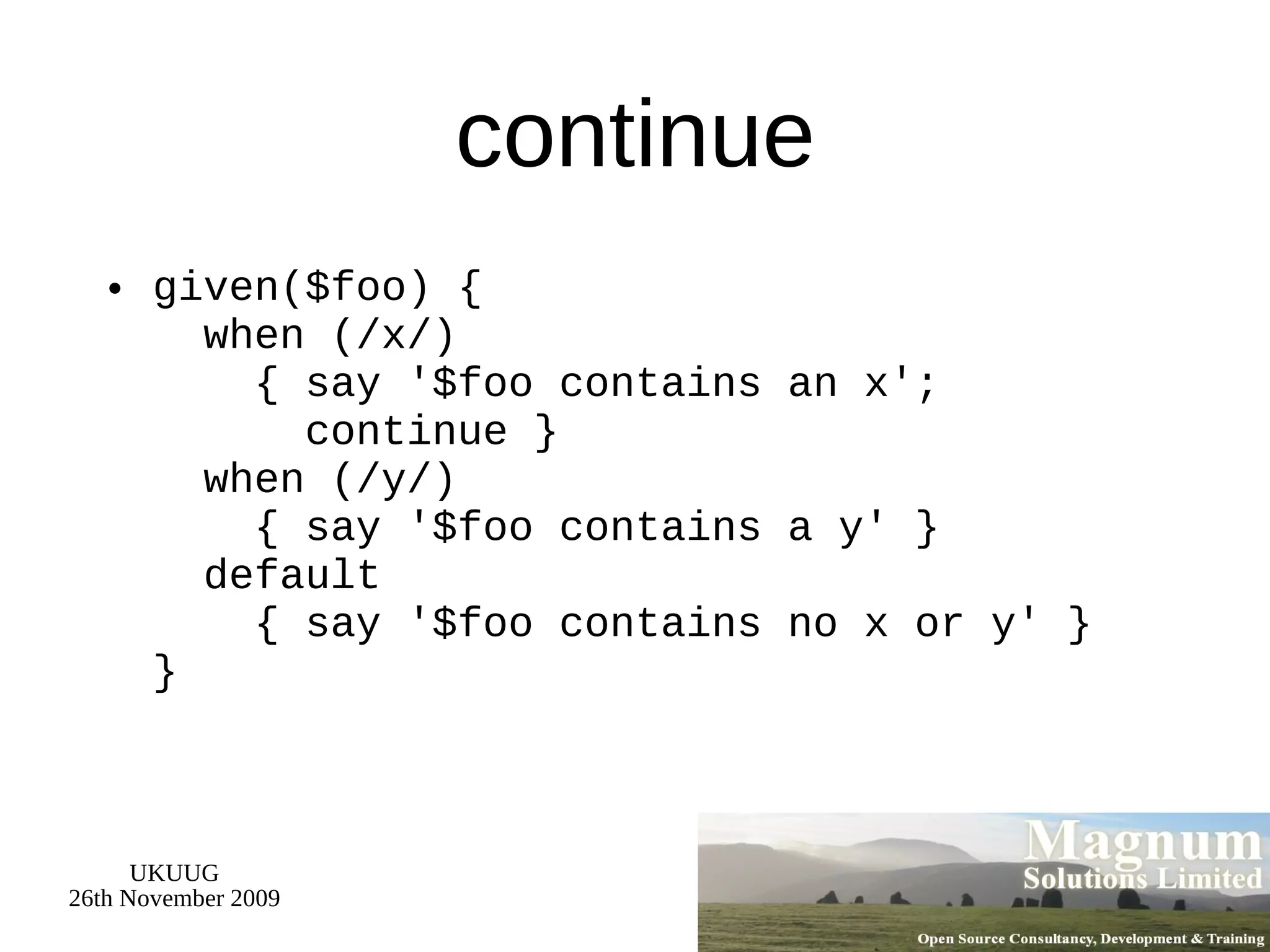
continue continue  keyword falls through to the next when block Normal behaviour is to break out of given block once the first when condition is matched
continue given($foo) {   when (/x/)   { say '$foo contains an x';   continue }   when (/y/)   { say '$foo contains a y' }   default   { say '$foo contains no x or y' } }
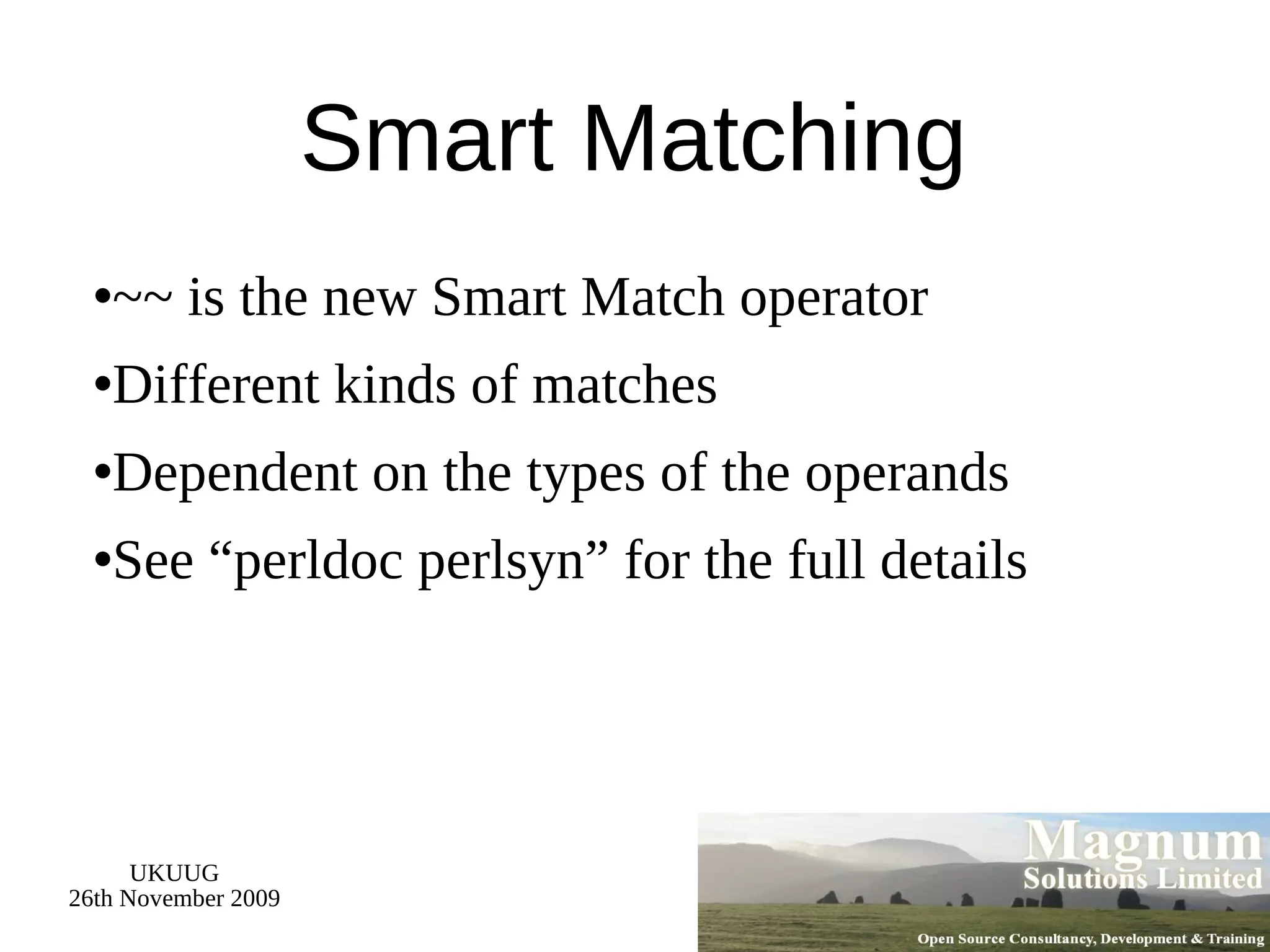
Smart Matching ~~ is the new Smart Match operator Different kinds of matches Dependent on the types of the operands See “perldoc perlsyn” for the full details
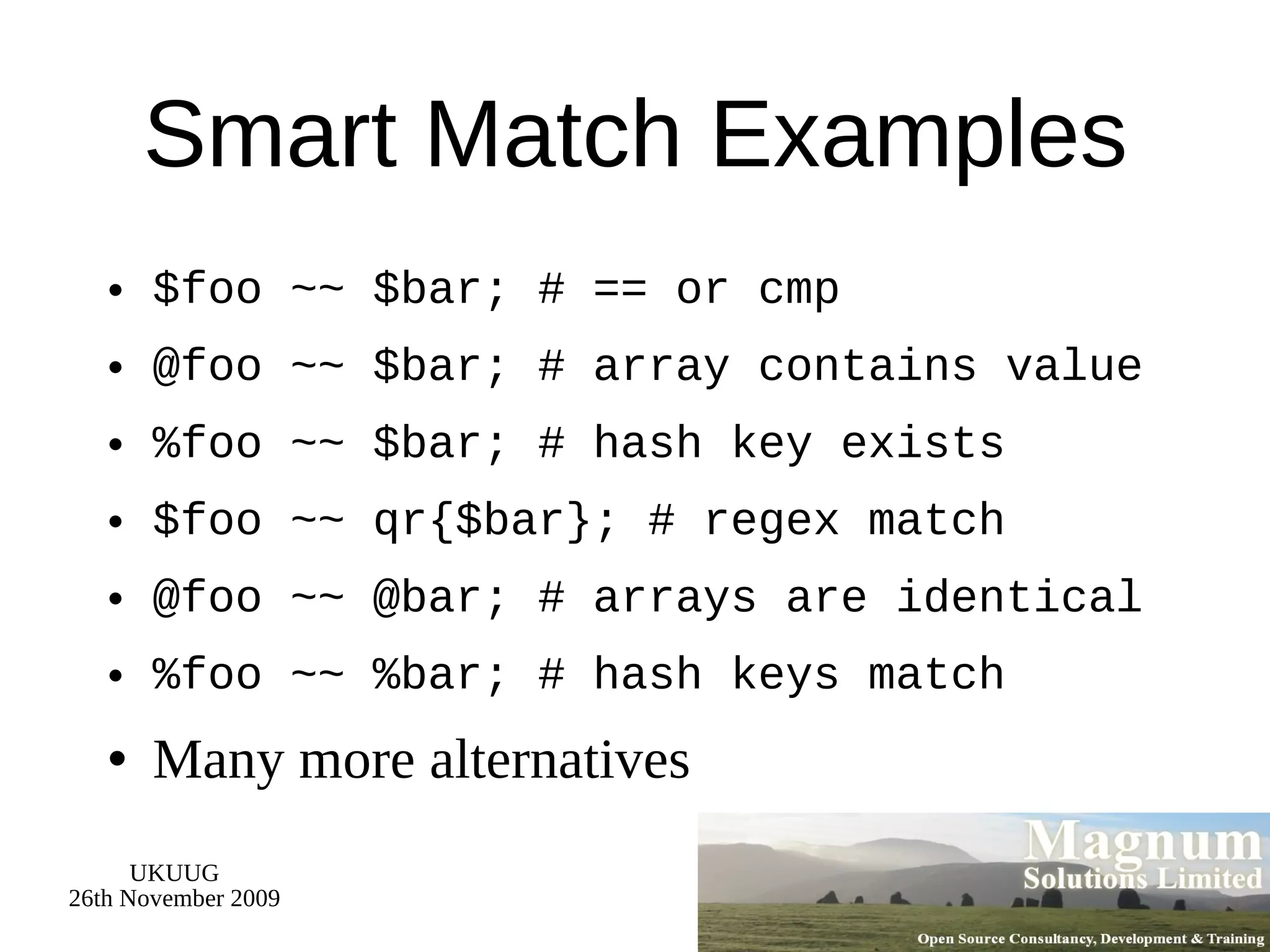
Smart Match Examples $foo ~~ $bar; # == or cmp @foo ~~ $bar; # array contains value %foo ~~ $bar; # hash key exists $foo ~~ qr{$bar}; # regex match @foo ~~ @bar; # arrays are identical %foo ~~ %bar; # hash keys match Many more alternatives
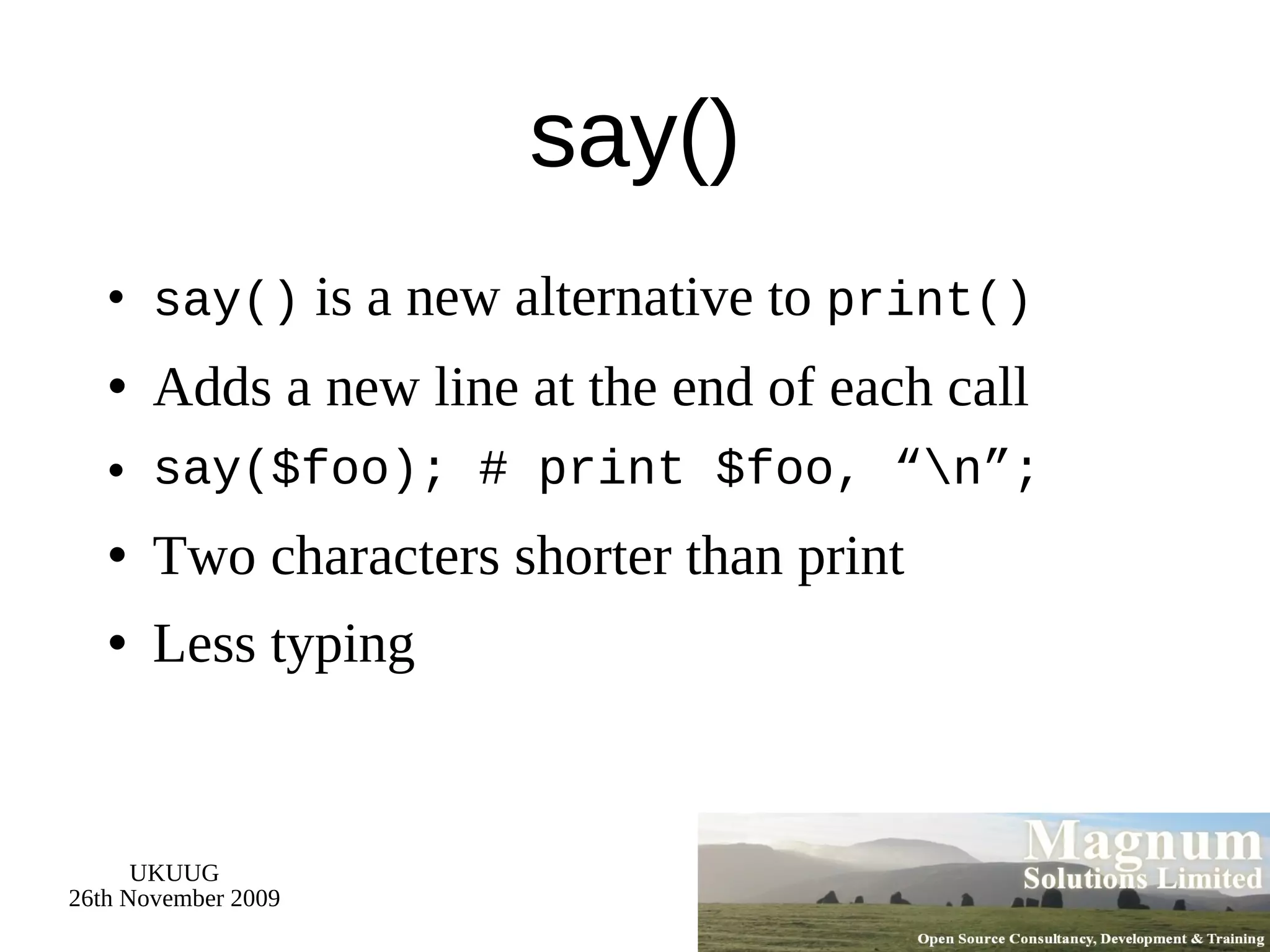
say() say()  is a new alternative to  print() Adds a new line at the end of each call say($foo); # print $foo, “\n”; Two characters shorter than print Less typing
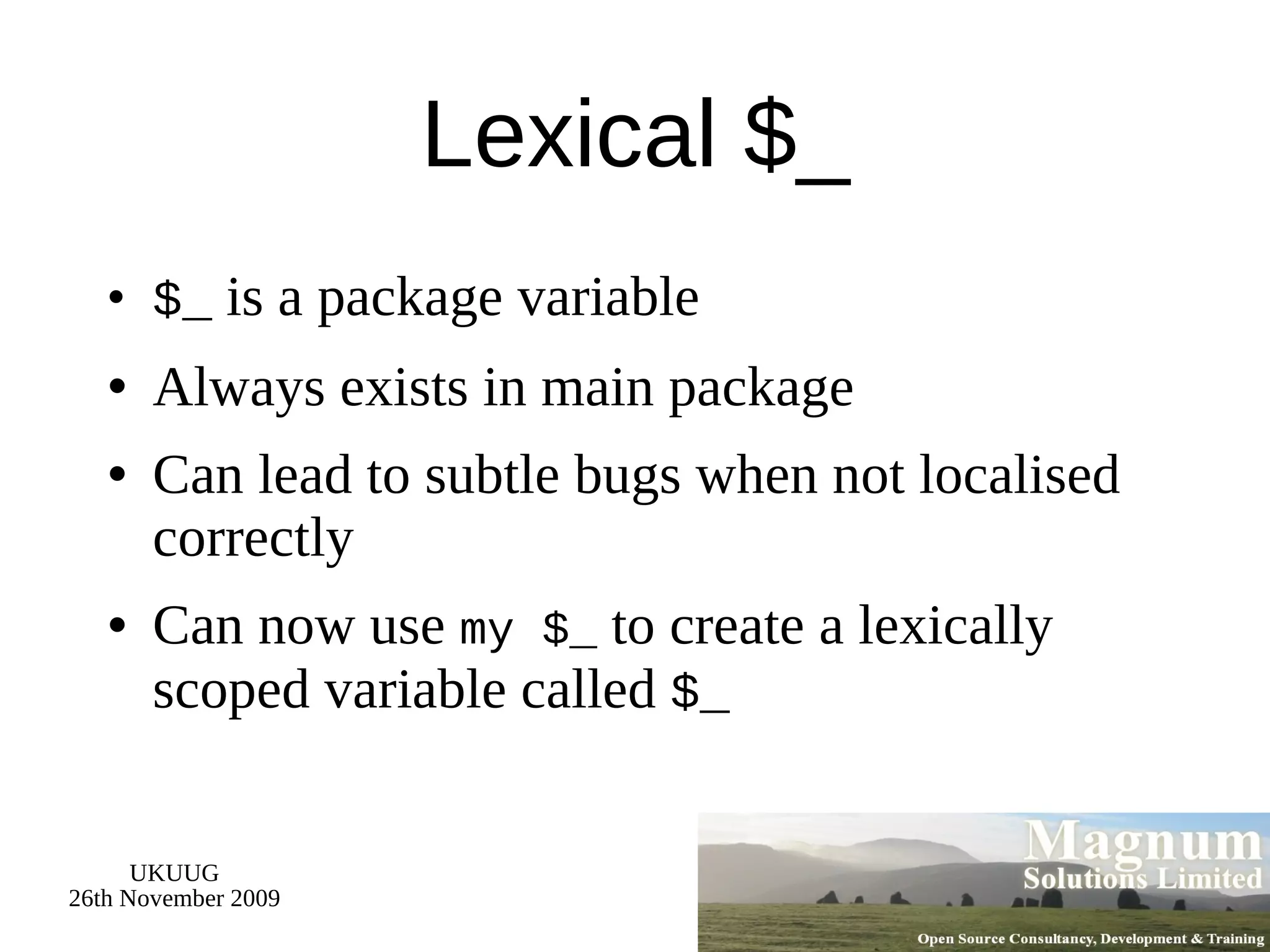
Lexical $_ $_  is a package variable Always exists in main package Can lead to subtle bugs when not localised correctly Can now use  my $_  to create a lexically scoped variable called  $_
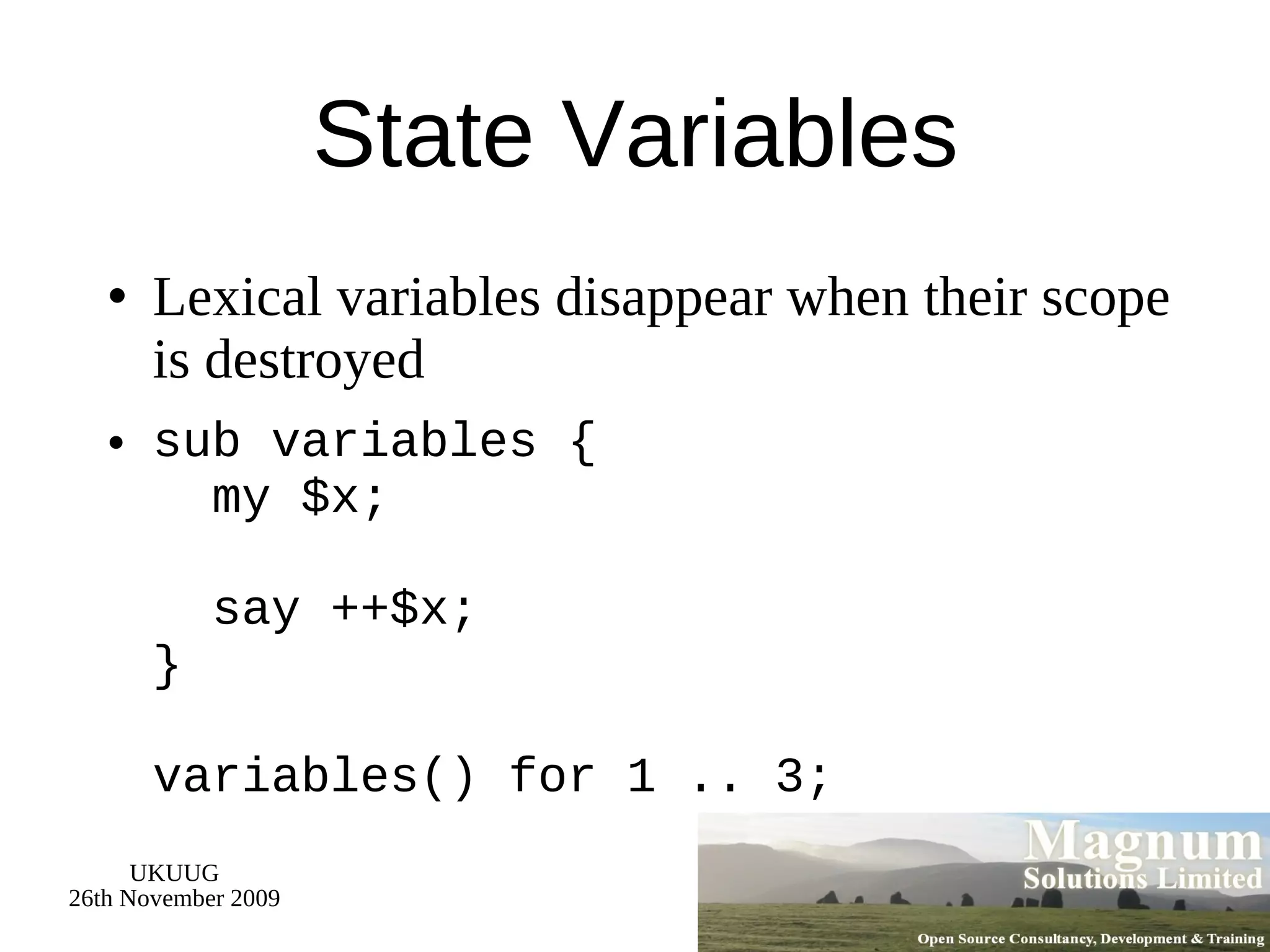
State Variables Lexical variables disappear when their scope is destroyed sub variables {   my $x;   say ++$x; } variables() for 1 .. 3;
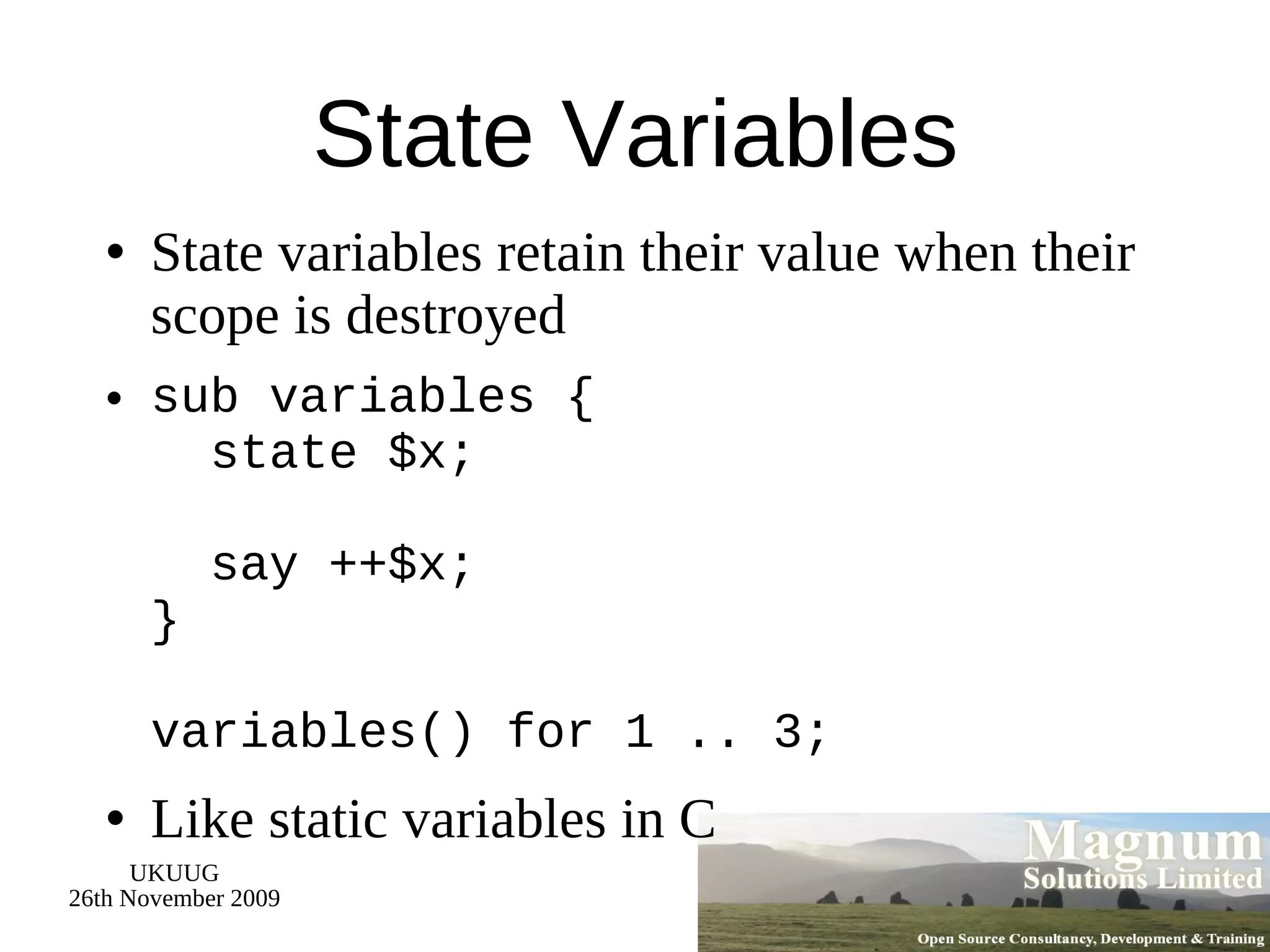
State Variables State variables retain their value when their scope is destroyed sub variables {   state $x;   say ++$x; } variables() for 1 .. 3; Like static variables in C
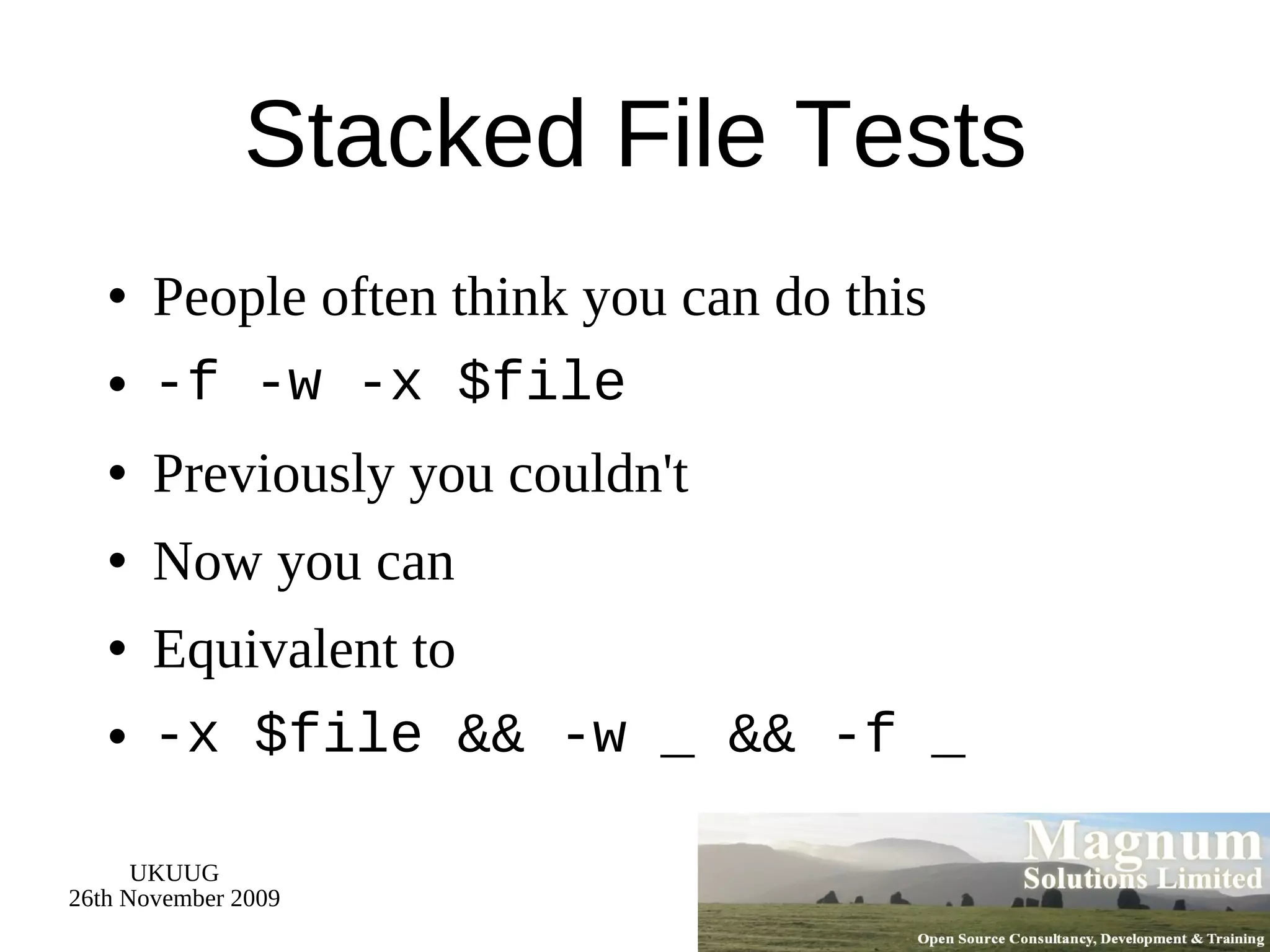
Stacked File Tests People often think you can do this -f -w -x $file Previously you couldn't Now you can Equivalent to -x $file && -w _ && -f _
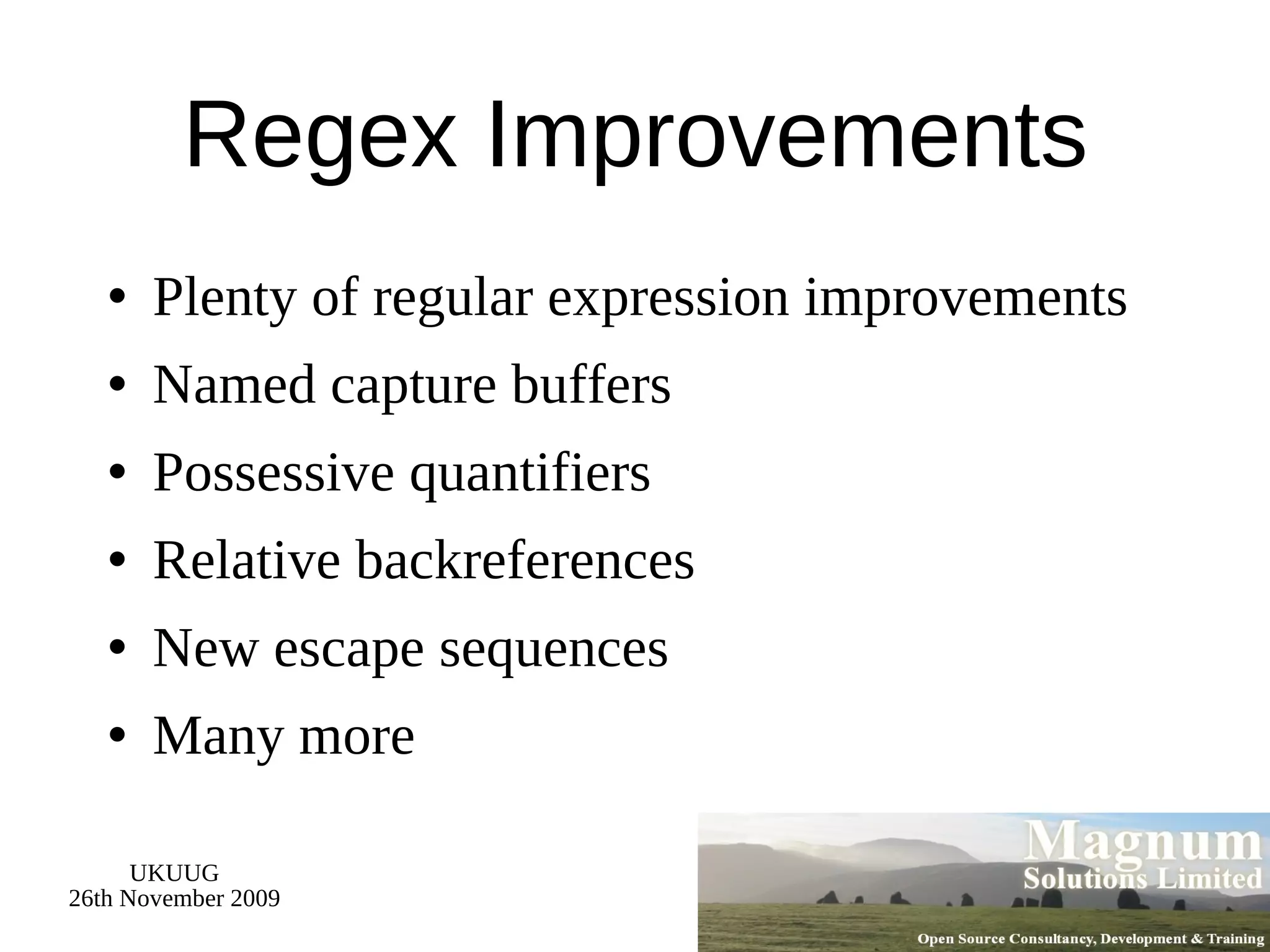
Regex Improvements Plenty of regular expression improvements Named capture buffers Possessive quantifiers Relative backreferences New escape sequences Many more
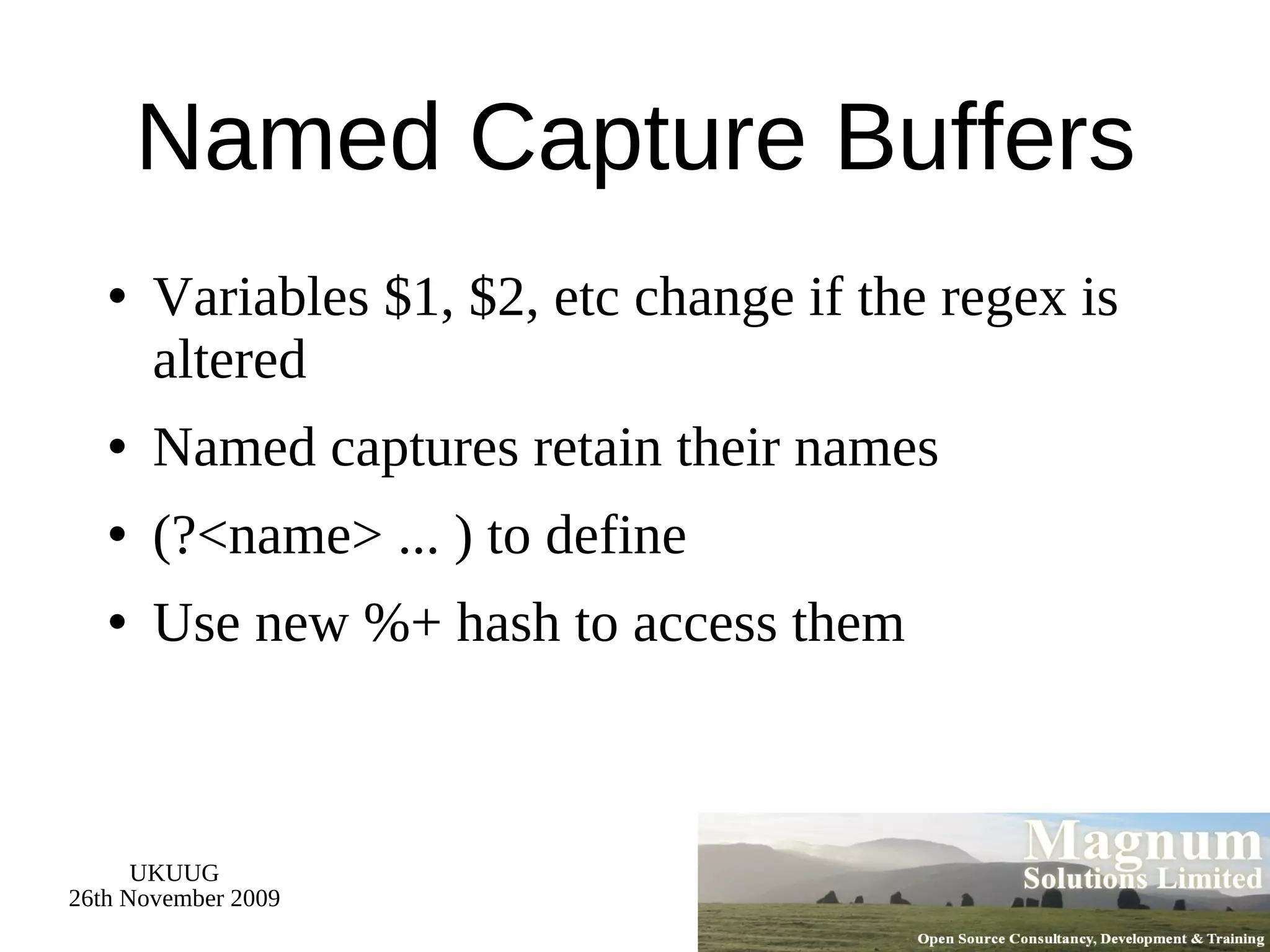
Named Capture Buffers Variables $1, $2, etc change if the regex is altered Named captures retain their names (?<name> ... ) to define Use new %+ hash to access them
Named Capture Example while (<DATA>) {   if (/(?<header>[\w\s]+)   :\s+(?<value>.+)/x) {   print &quot;$+{header} -> &quot;;   print &quot;$+{value}\n&quot;;   } }
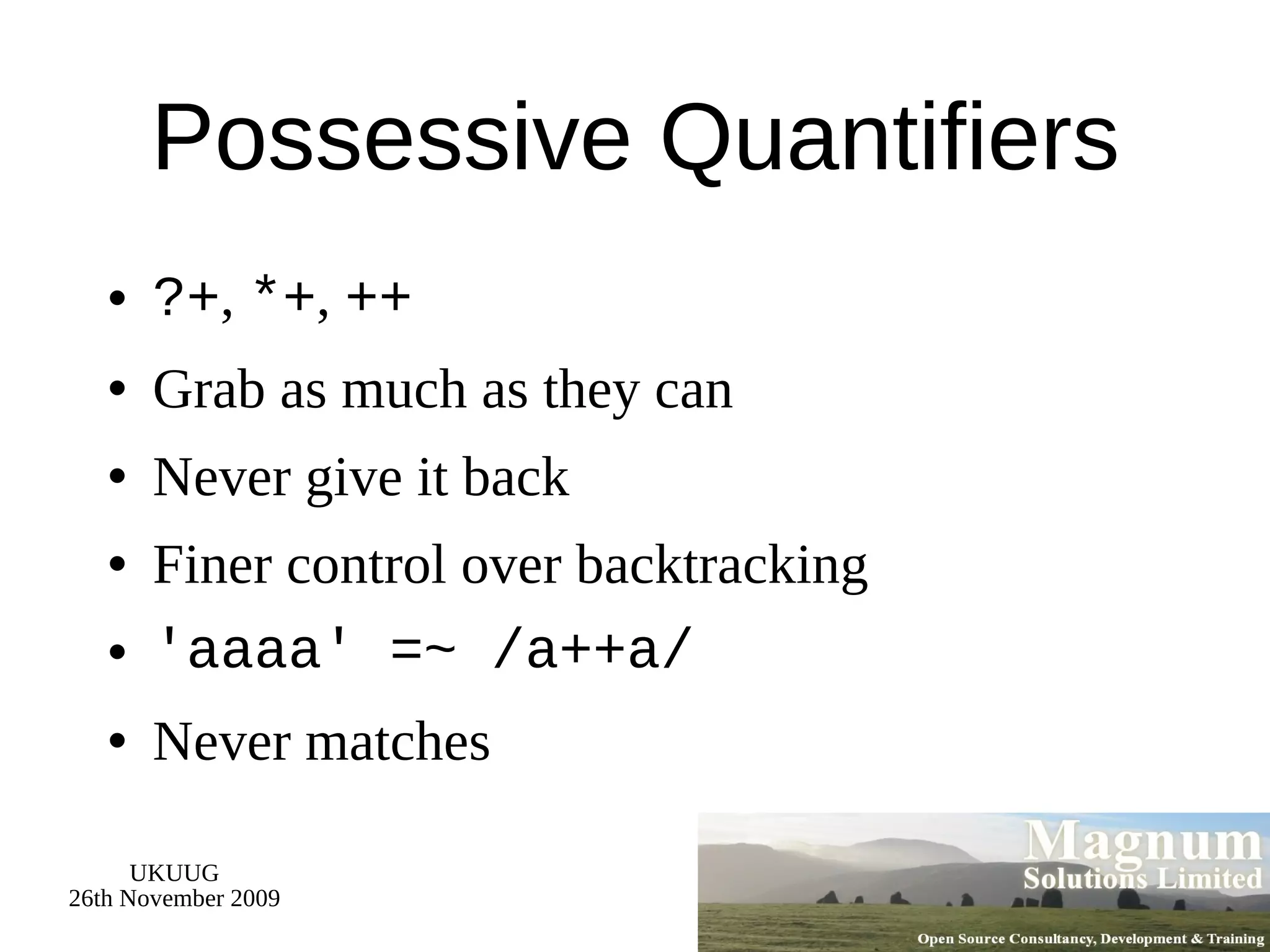
Possessive Quantifiers ?+ ,  *+ ,  ++ Grab as much as they can Never give it back Finer control over backtracking 'aaaa' =~ /a++a/ Never matches
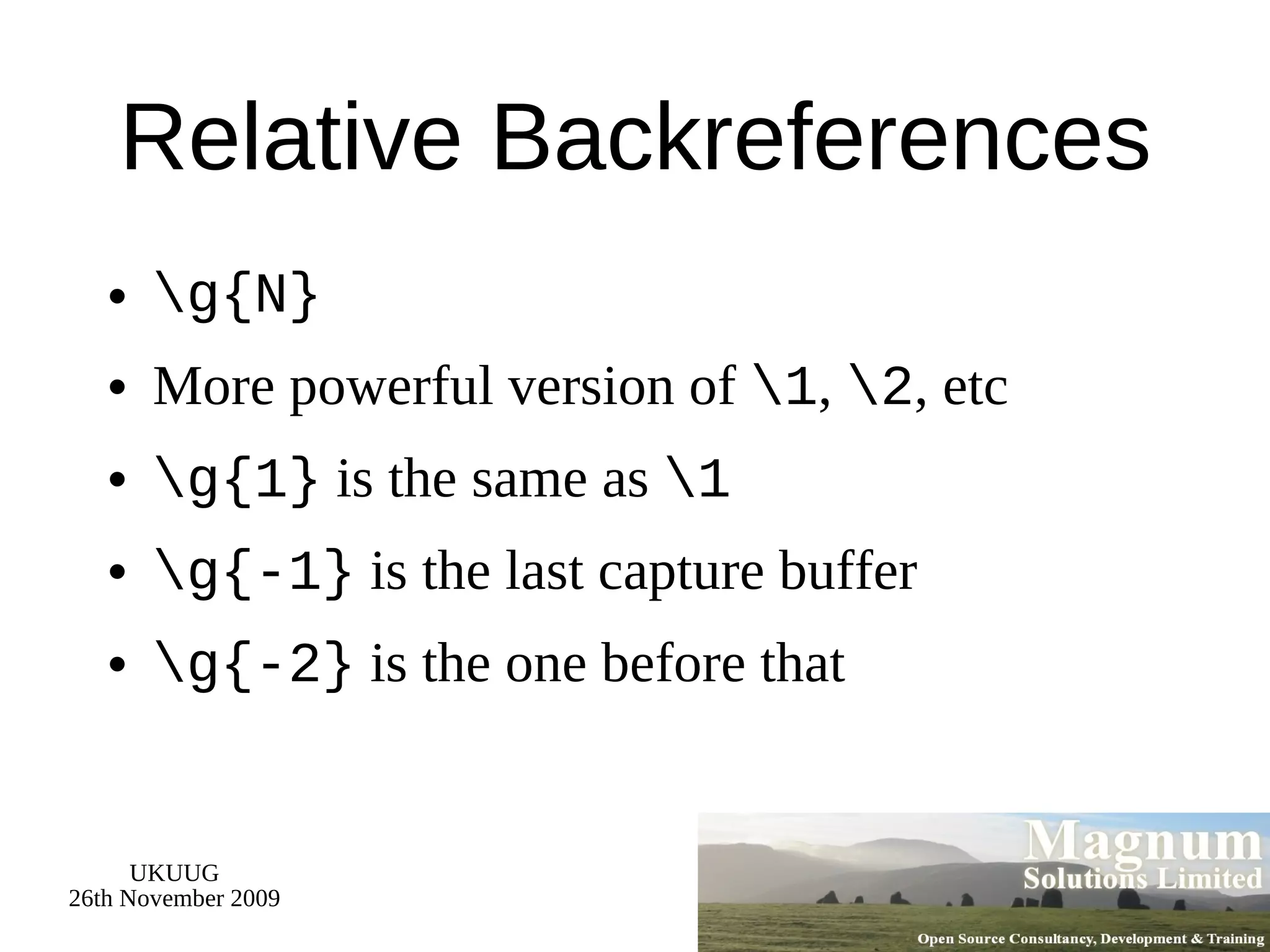
Relative Backreferences \g{N} More powerful version of  \1 ,  \2 , etc \g{1}  is the same as  \1 \g{-1}  is the last capture buffer \g{-2}  is the one before that
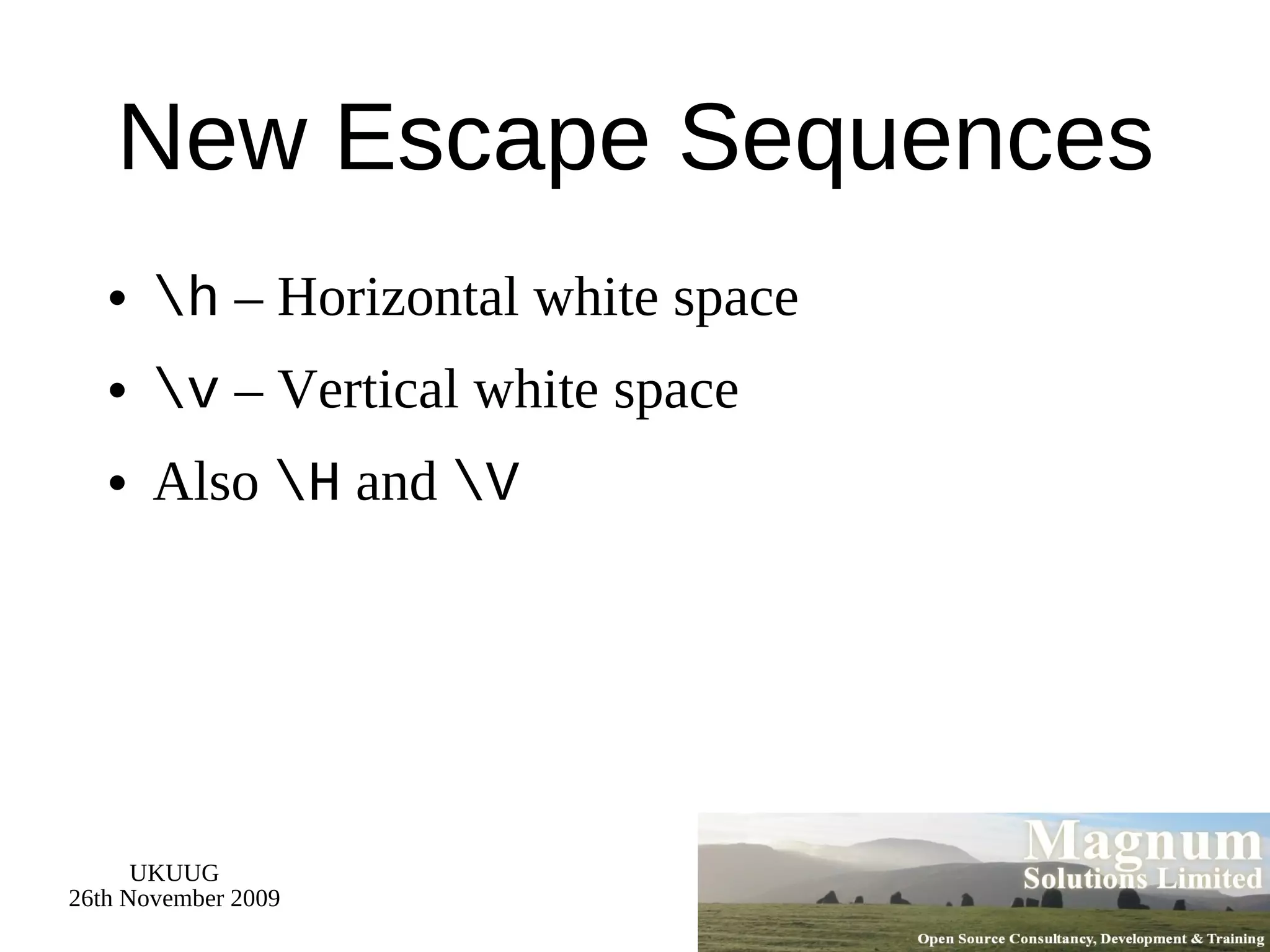
New Escape Sequences \h  – Horizontal white space \v  – Vertical white space Also  \H  and  \V
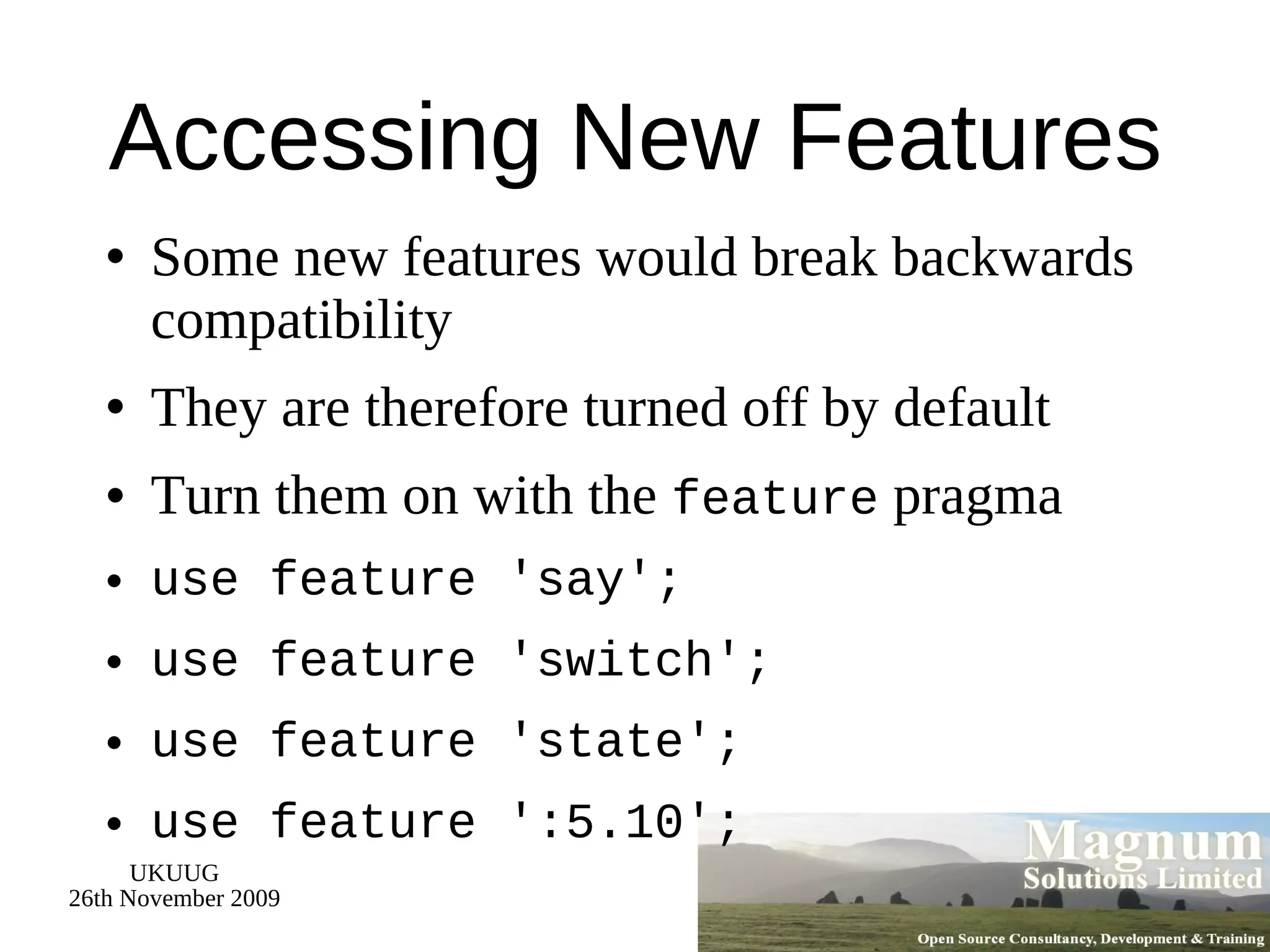
Accessing New Features Some new features would break backwards compatibility They are therefore turned off by default Turn them on with the  feature  pragma use feature 'say'; use feature 'switch'; use feature 'state'; use feature ':5.10';
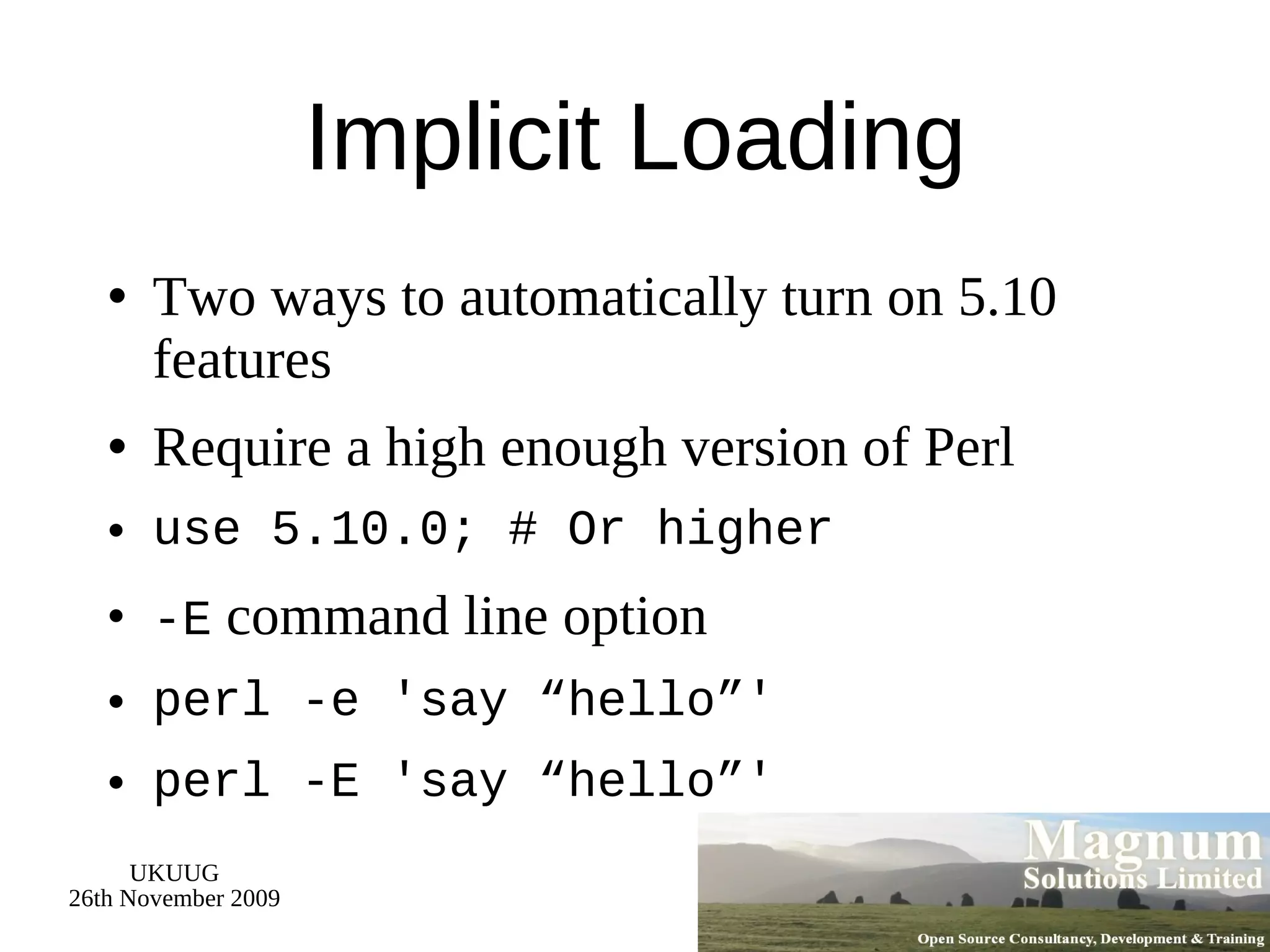
Implicit Loading Two ways to automatically turn on 5.10 features Require a high enough version of Perl use 5.10.0; # Or higher -E  command line option perl -e 'say “hello”' perl -E 'say “hello”'
Advanced Testing
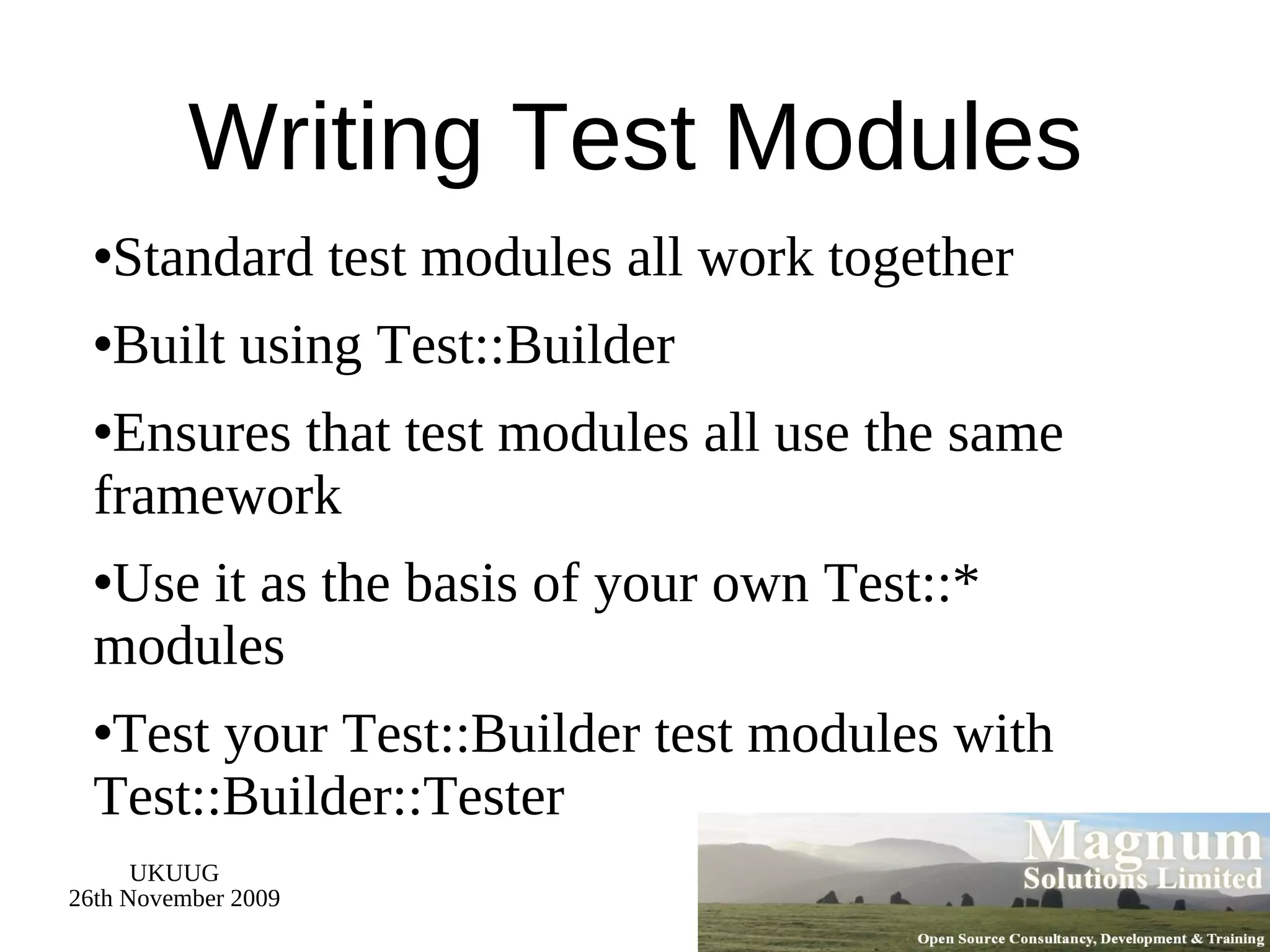
Writing Test Modules Standard test modules all work together Built using Test::Builder Ensures that test modules all use the same framework Use it as the basis of your own Test::* modules Test your Test::Builder test modules with Test::Builder::Tester
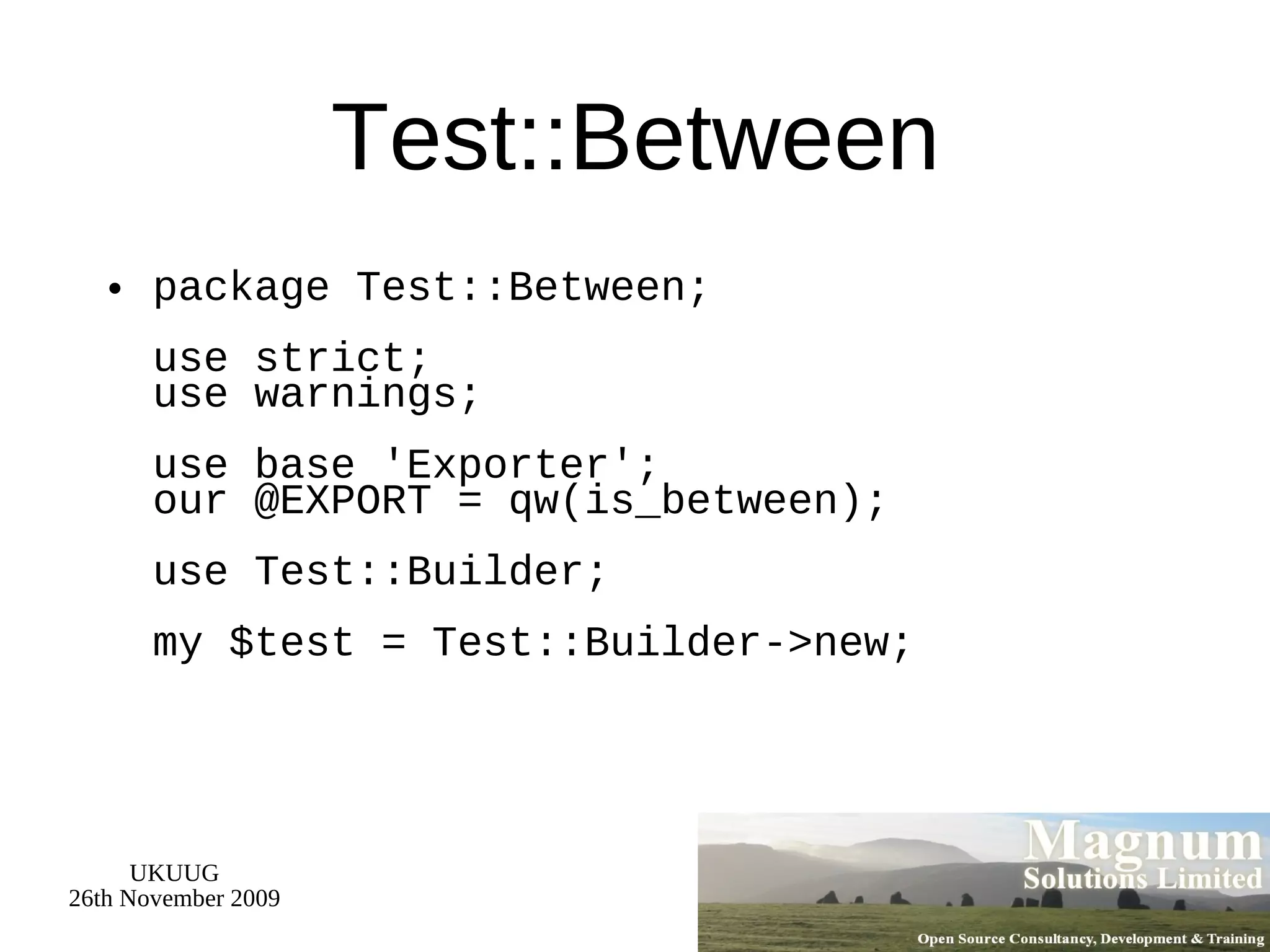
Test::Between package Test::Between; use strict; use warnings; use base 'Exporter'; our @EXPORT = qw(is_between); use Test::Builder; my $test = Test::Builder->new;
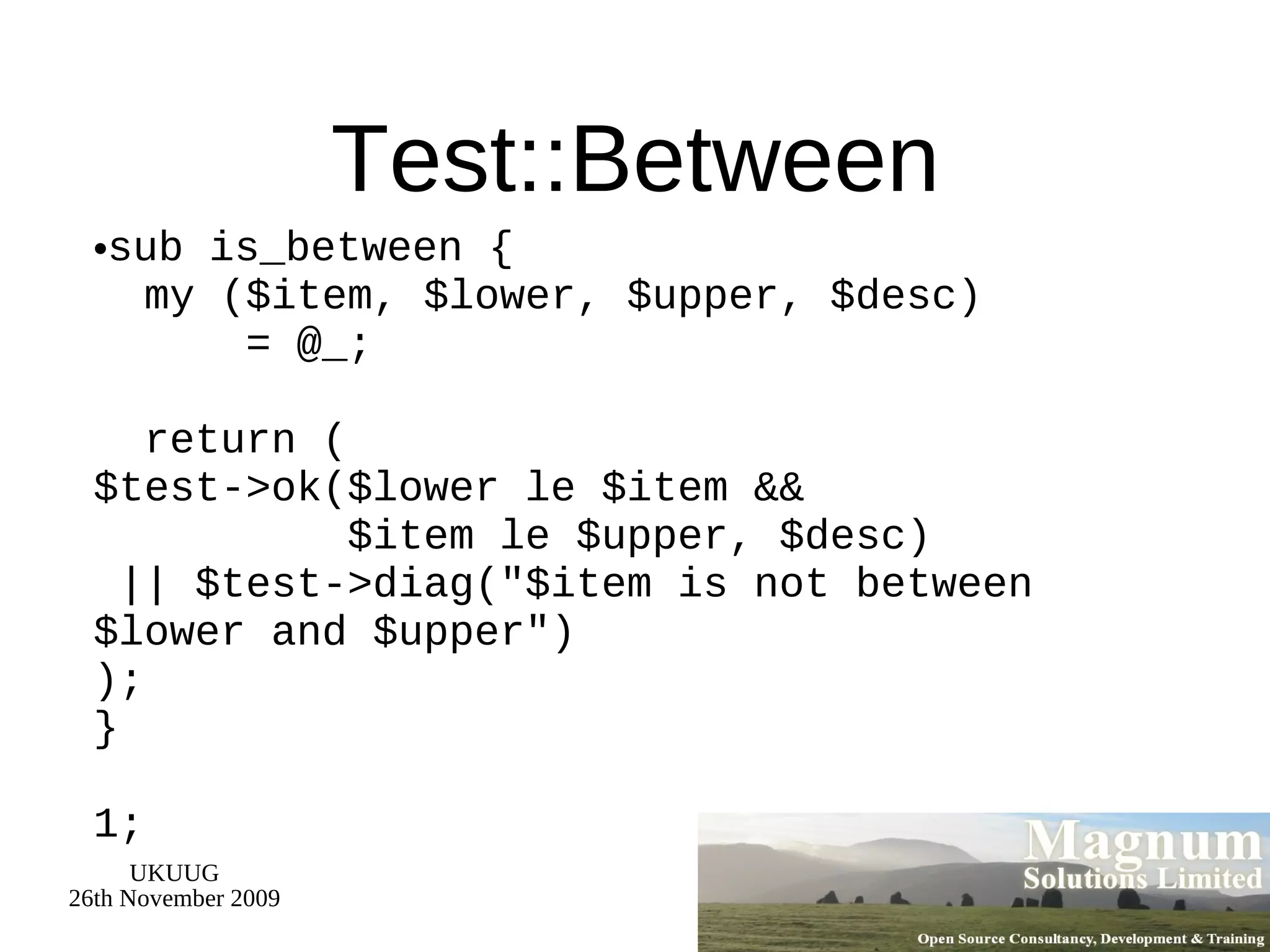
Test::Between sub is_between {   my ($item, $lower, $upper, $desc)   = @_;   return ( $test->ok($lower le $item &&   $item le $upper, $desc)  || $test->diag(&quot;$item is not between $lower and $upper&quot;) ); } 1;
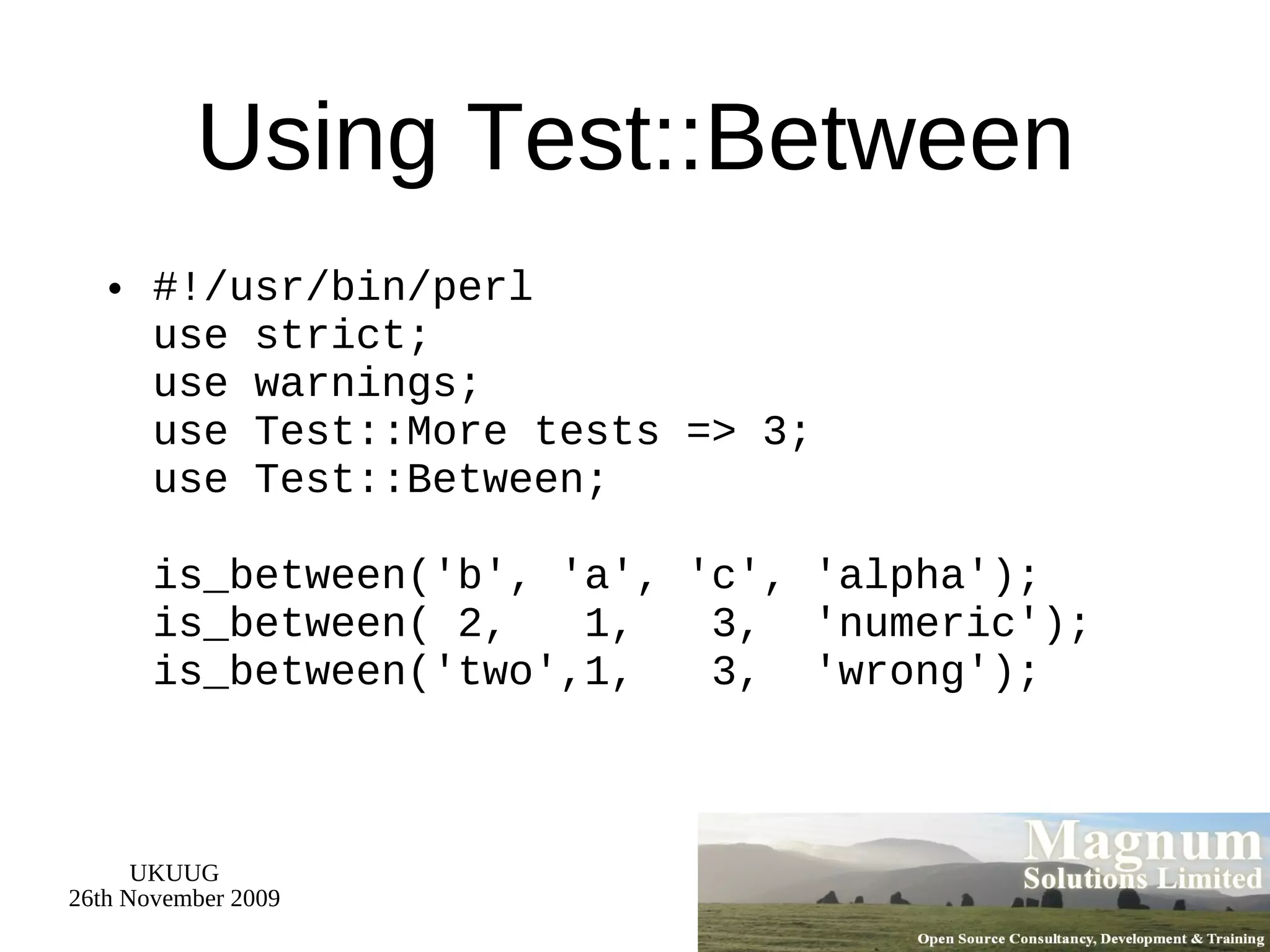
Using Test::Between #!/usr/bin/perl use strict; use warnings; use Test::More tests => 3; use Test::Between; is_between('b', 'a', 'c', 'alpha'); is_between( 2,  1,  3,  'numeric'); is_between('two',1,  3,  'wrong');
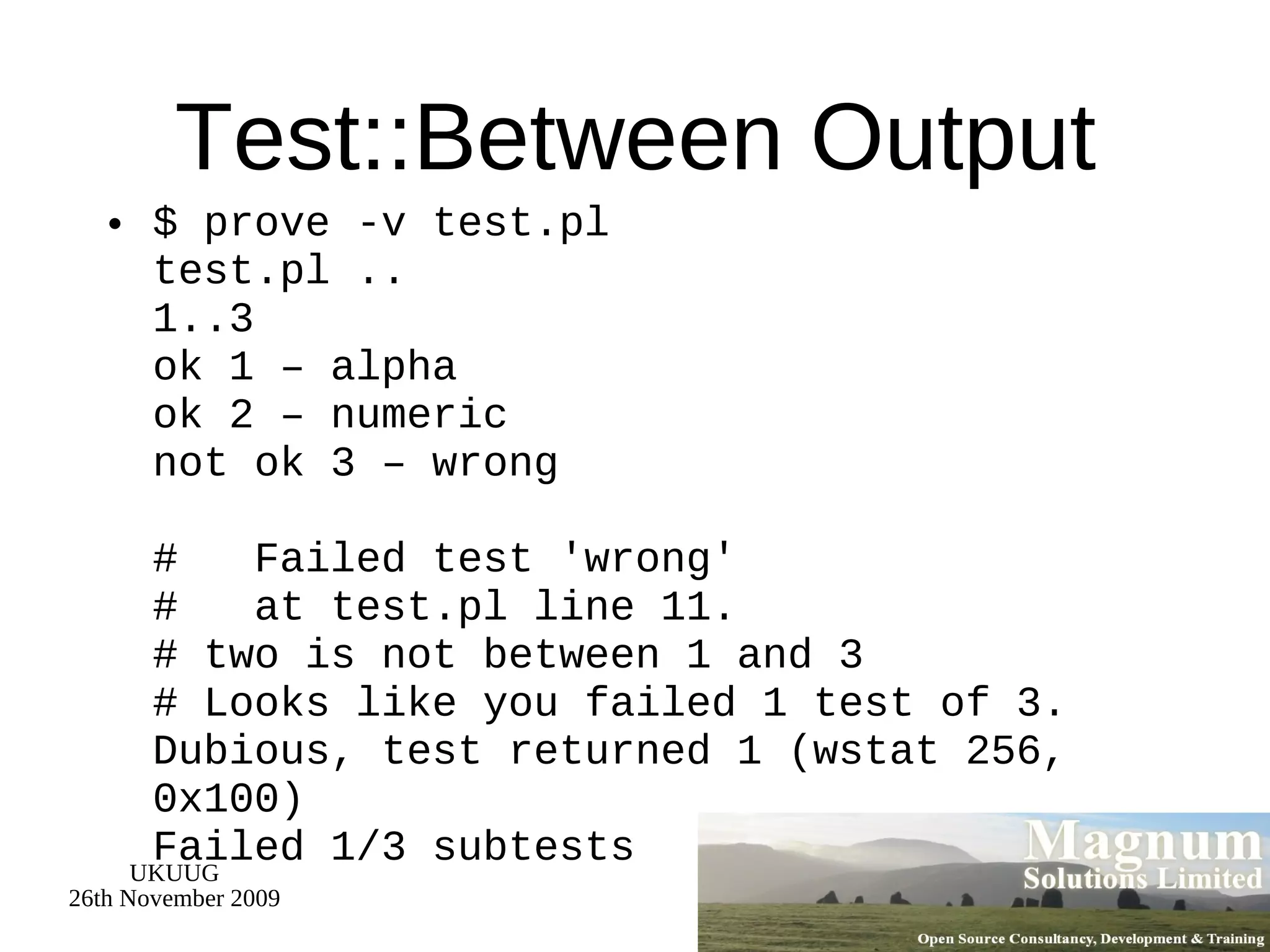
Test::Between Output $ prove -v test.pl test.pl ..  1..3 ok 1 – alpha ok 2 – numeric not ok 3 – wrong #  Failed test 'wrong' #  at test.pl line 11. # two is not between 1 and 3 # Looks like you failed 1 test of 3. Dubious, test returned 1 (wstat 256, 0x100) Failed 1/3 subtests
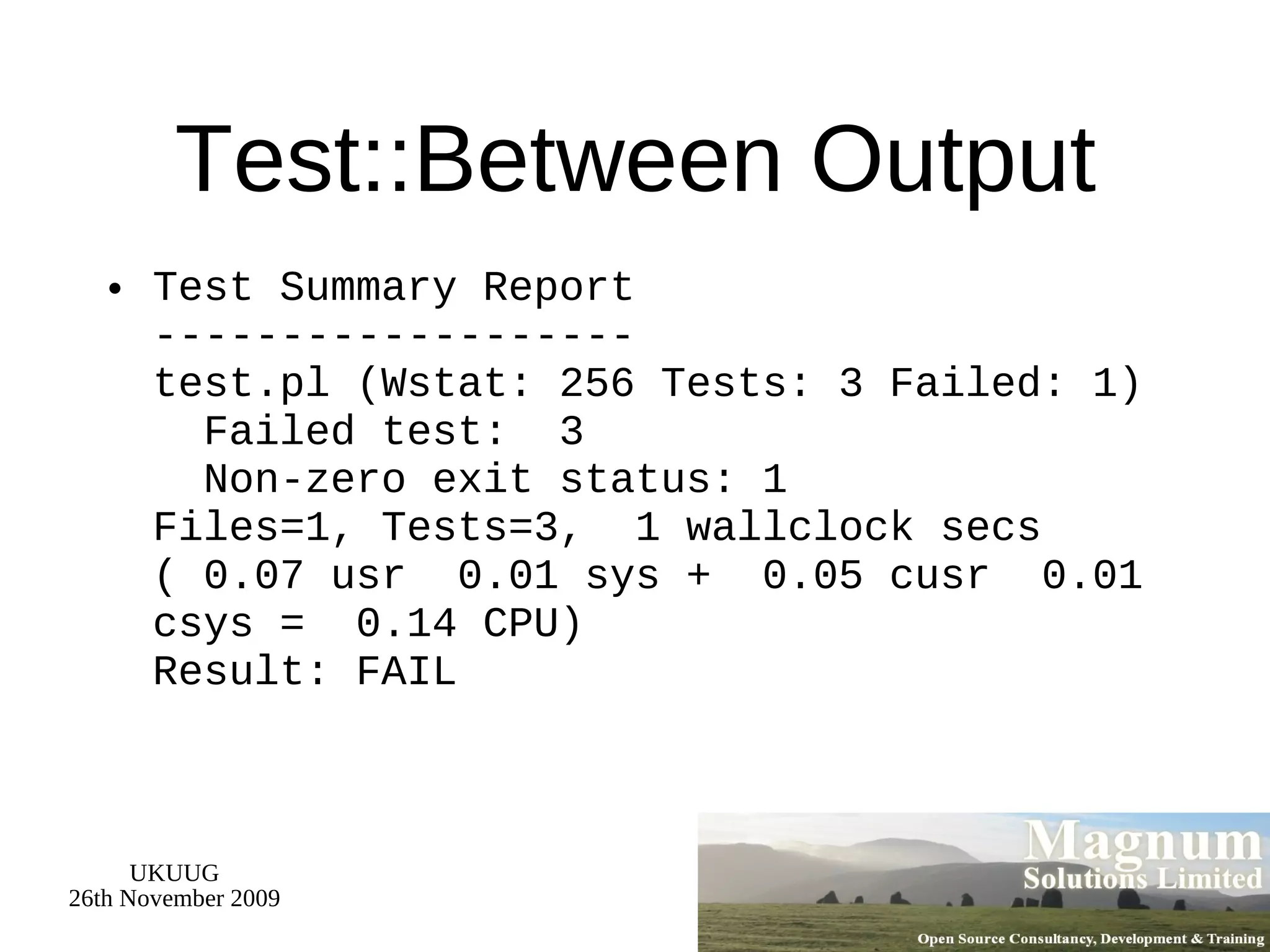
Test::Between Output Test Summary Report ------------------- test.pl (Wstat: 256 Tests: 3 Failed: 1)   Failed test:  3   Non-zero exit status: 1 Files=1, Tests=3,  1 wallclock secs ( 0.07 usr  0.01 sys +  0.05 cusr  0.01 csys =  0.14 CPU) Result: FAIL
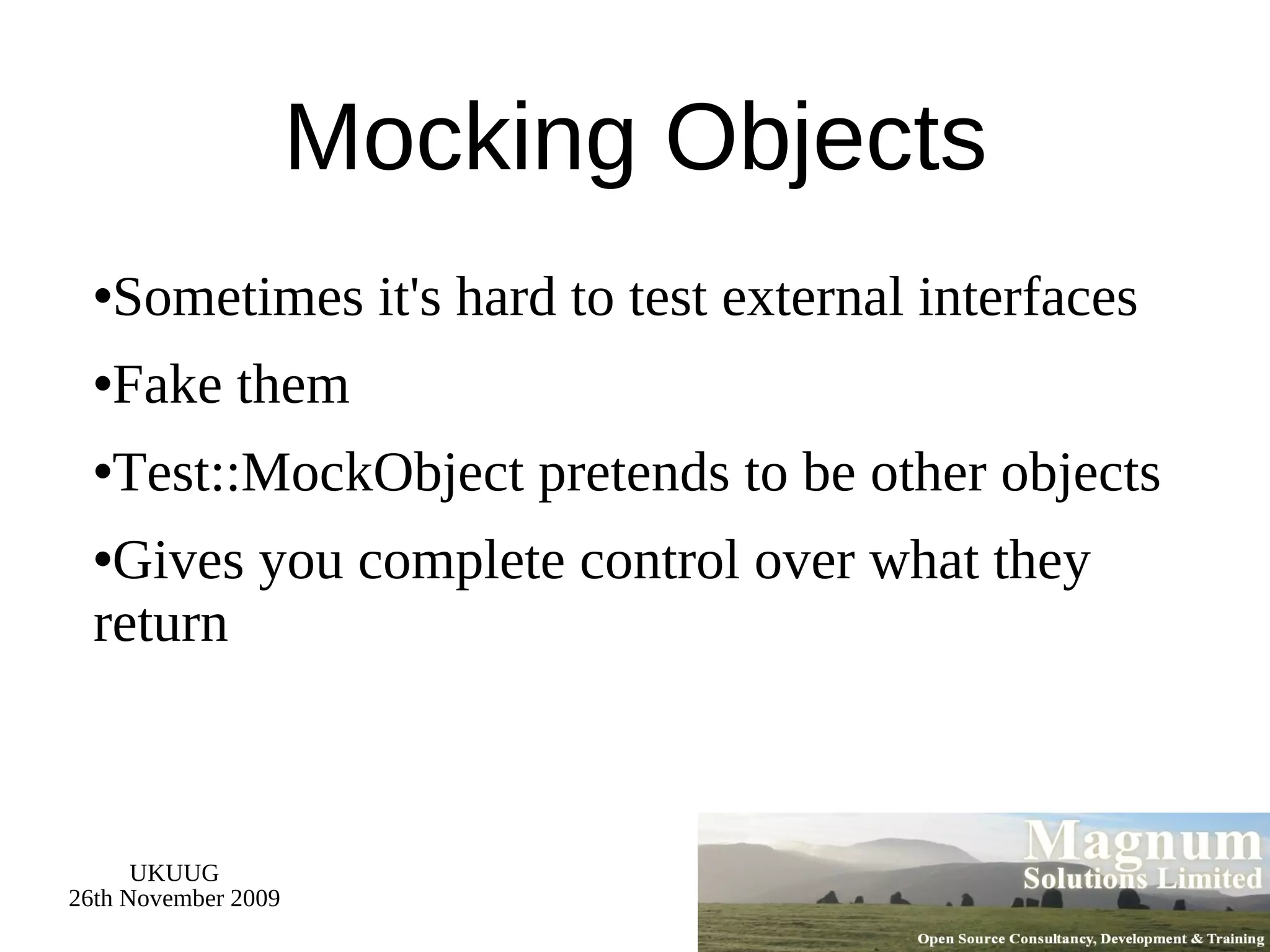
Mocking Objects Sometimes it's hard to test external interfaces Fake them Test::MockObject pretends to be other objects Gives you complete control over what they return
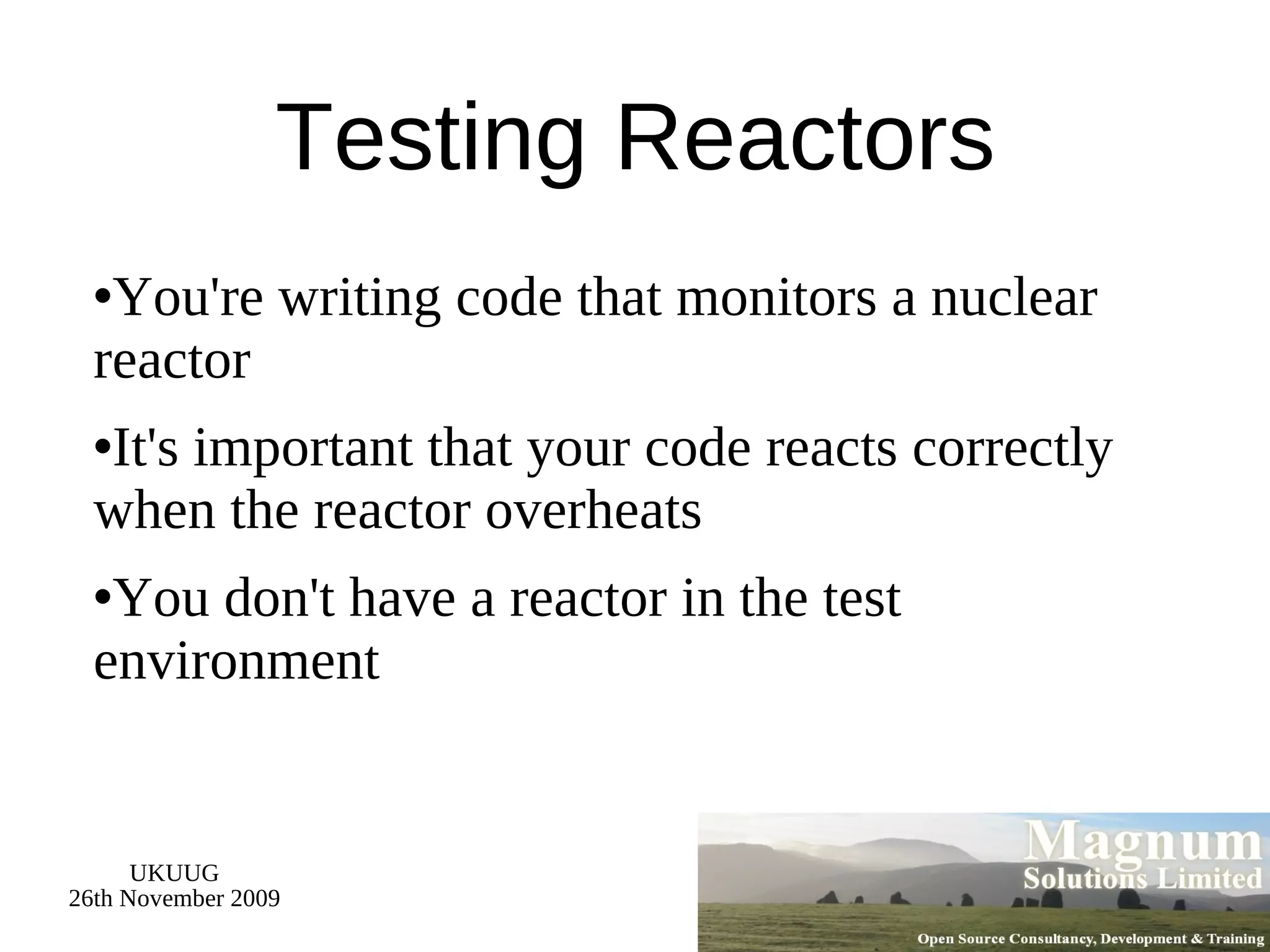
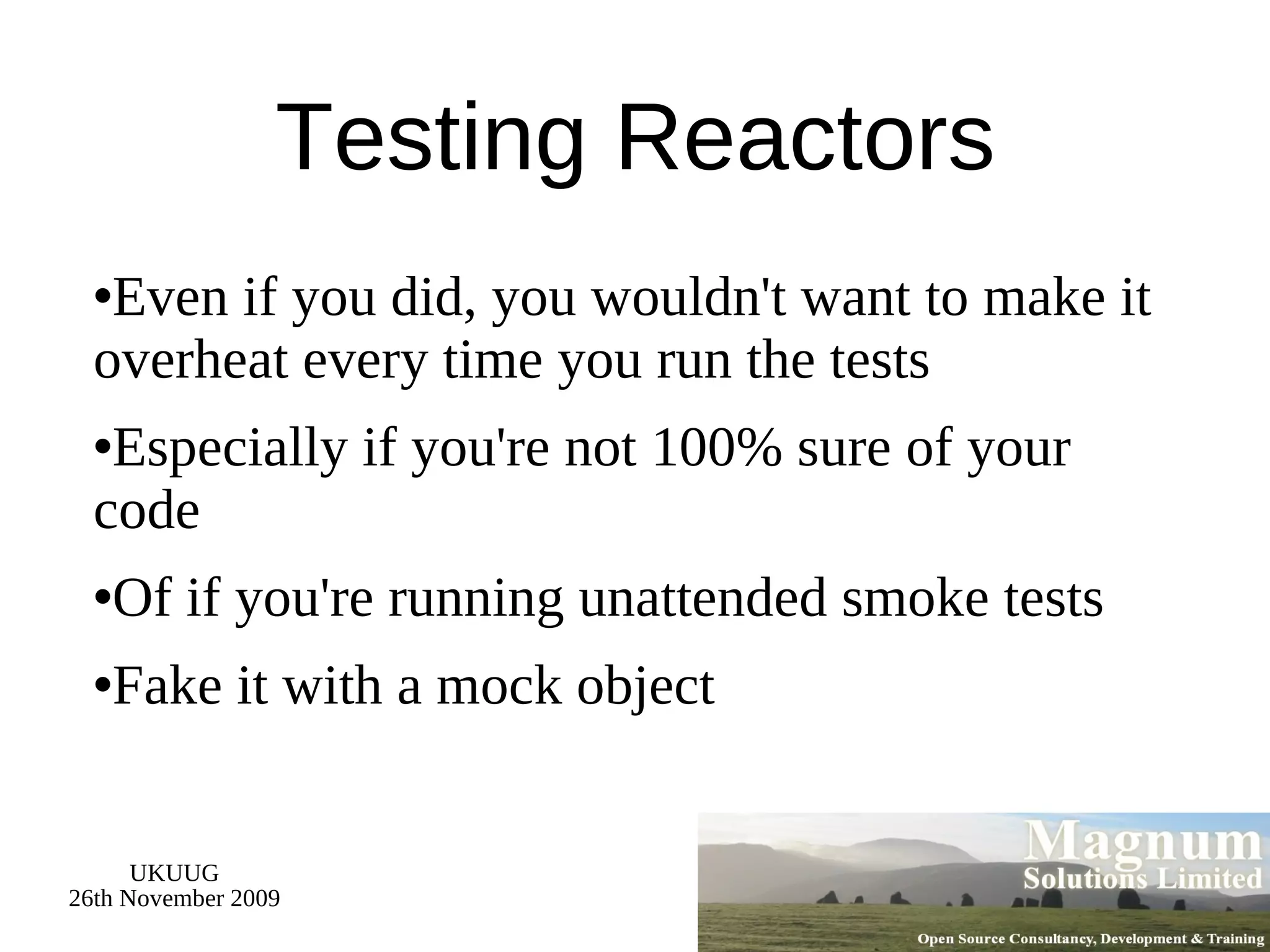
Testing Reactors You're writing code that monitors a nuclear reactor It's important that your code reacts correctly when the reactor overheats You don't have a reactor in the test environment
Testing Reactors Even if you did, you wouldn't want to make it overheat every time you run the tests Especially if you're not 100% sure of your code Of if you're running unattended smoke tests Fake it with a mock object
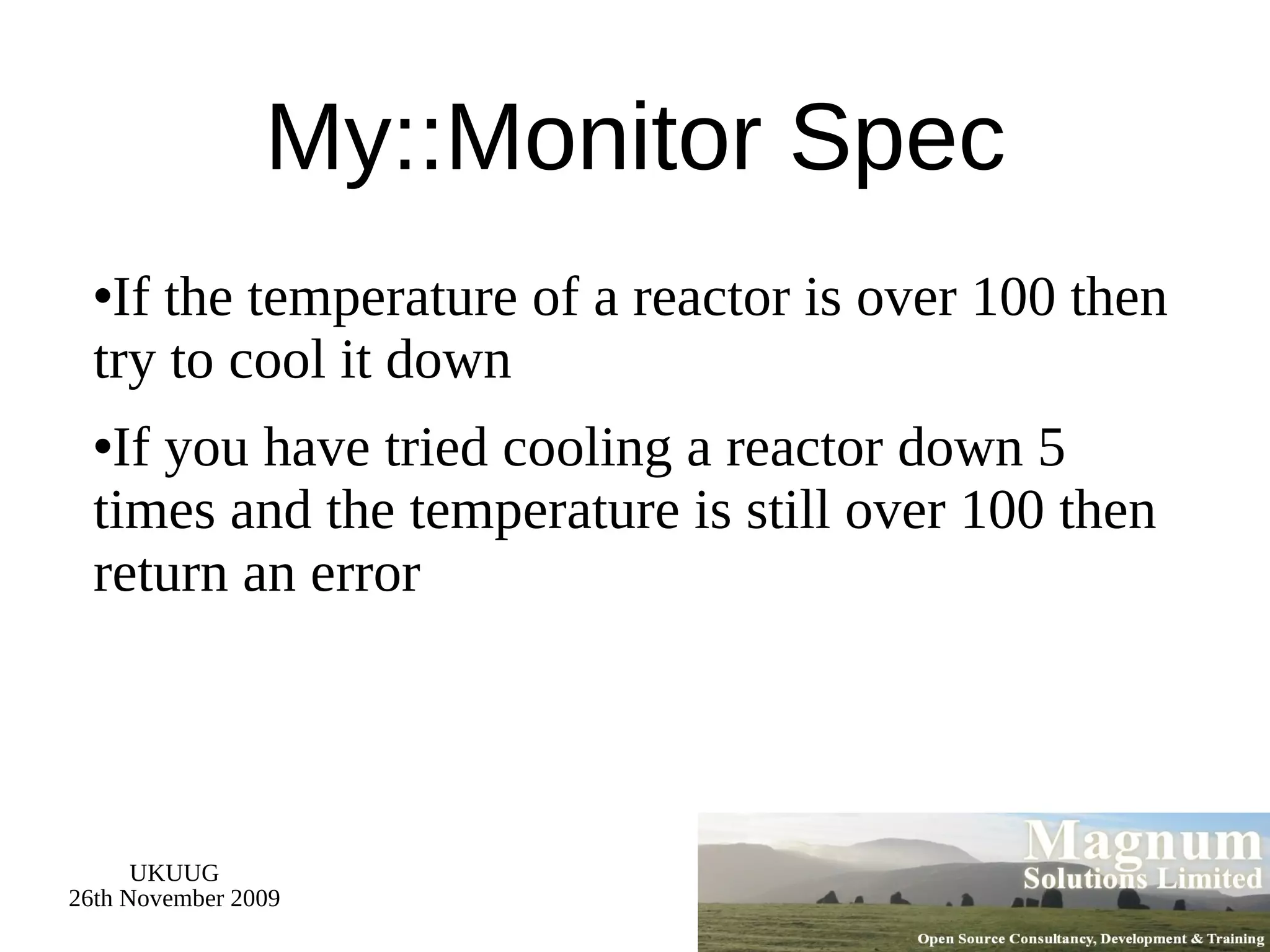
My::Monitor Spec If the temperature of a reactor is over 100 then try to cool it down If you have tried cooling a reactor down 5 times and the temperature is still over 100 then return an error
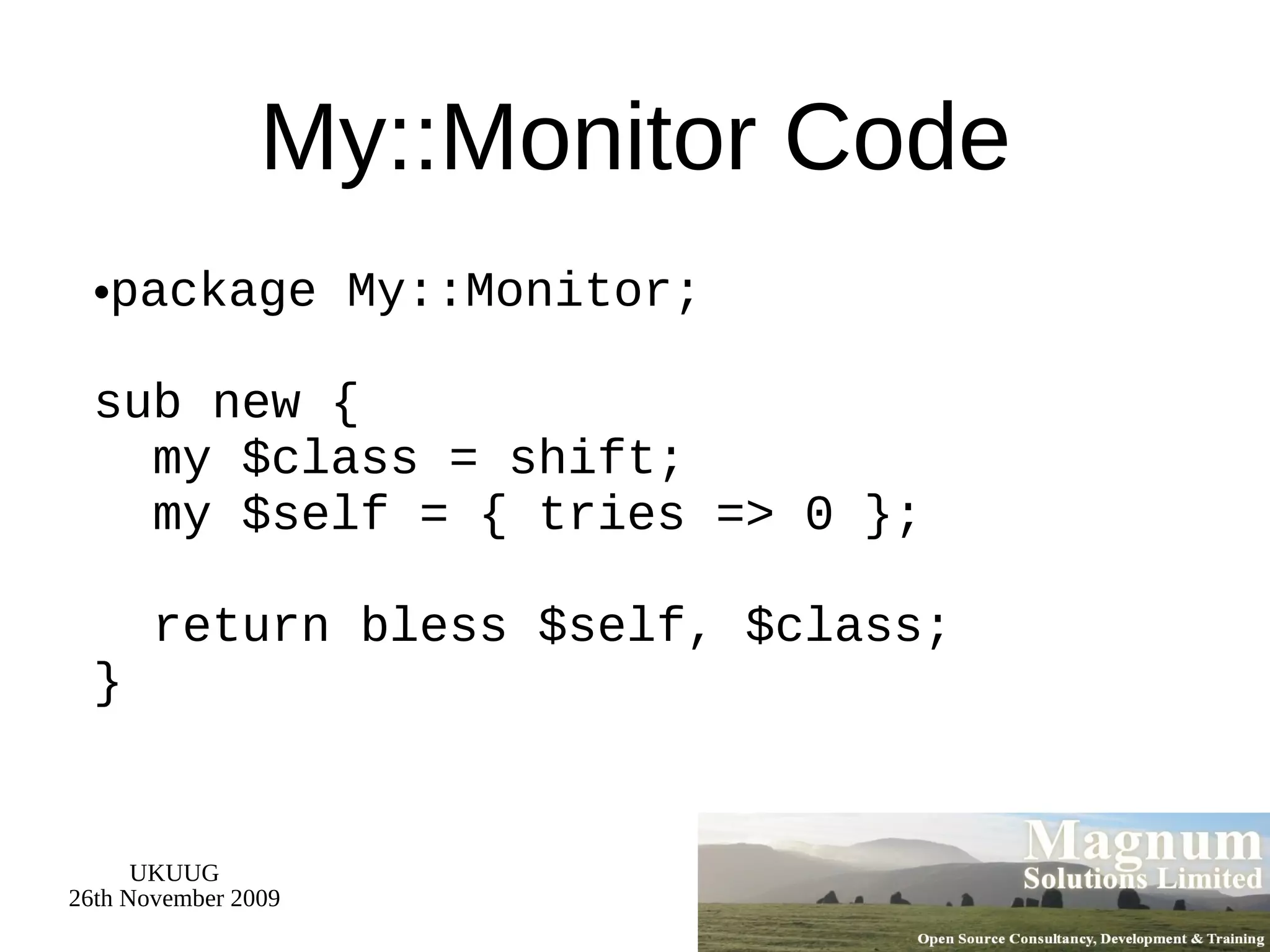
My::Monitor Code package My::Monitor; sub new {   my $class = shift;   my $self = { tries => 0 };   return bless $self, $class; }
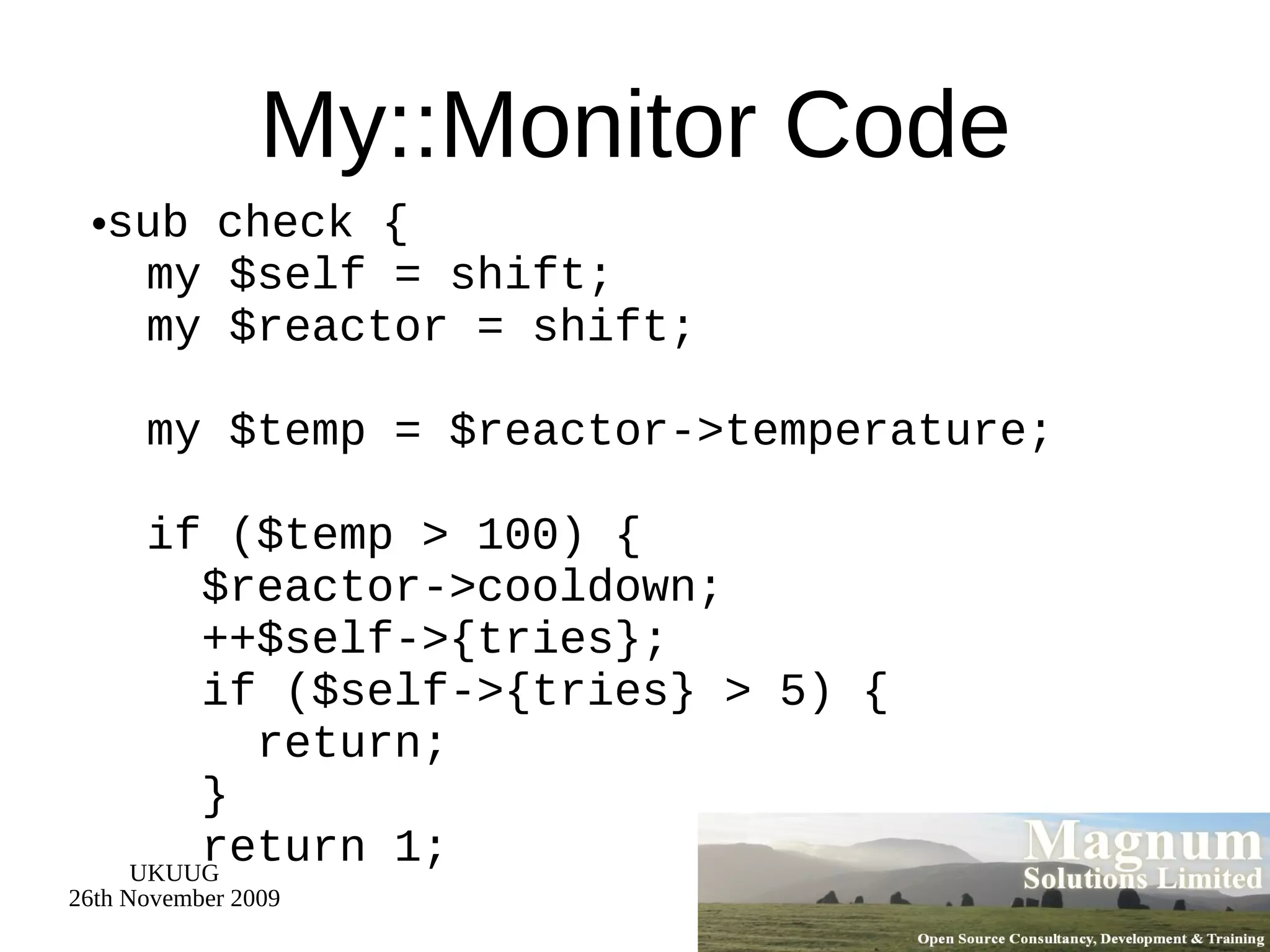
My::Monitor Code sub check {   my $self = shift;   my $reactor = shift;   my $temp = $reactor->temperature;   if ($temp > 100) {   $reactor->cooldown;   ++$self->{tries};   if ($self->{tries} > 5) {   return;   }   return 1;
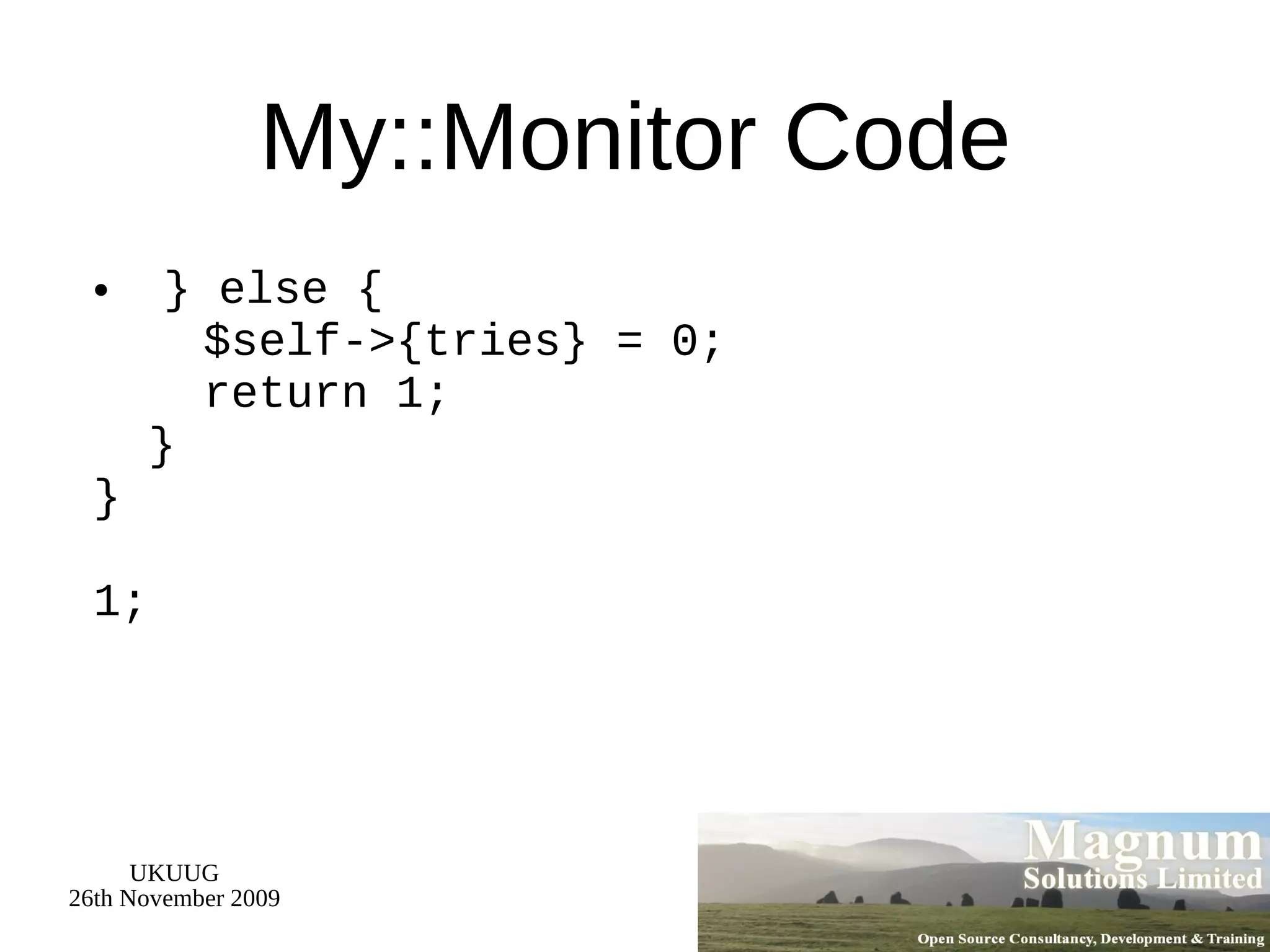
My::Monitor Code } else {   $self->{tries} = 0;   return 1;   } } 1;
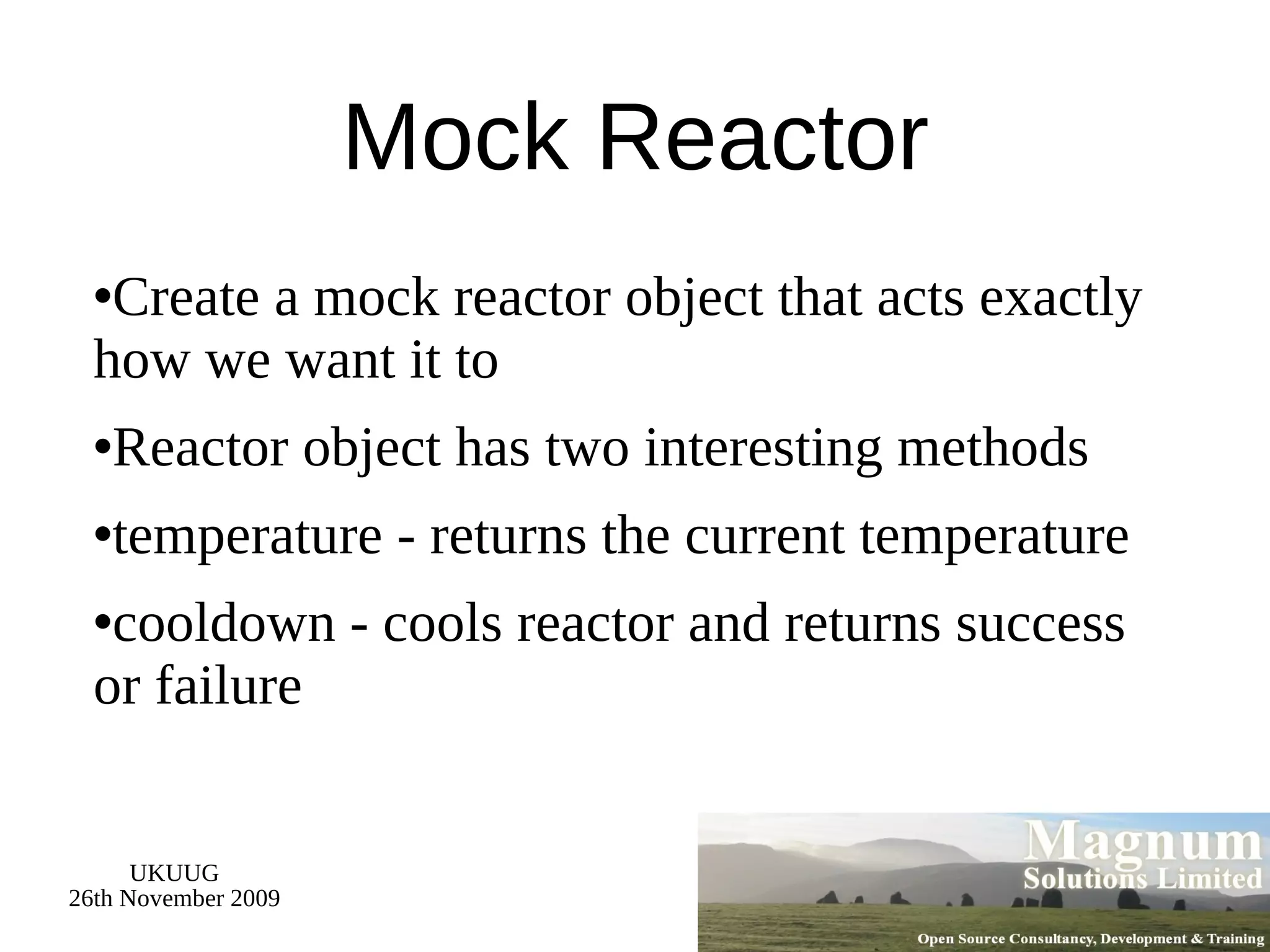
Mock Reactor Create a mock reactor object that acts exactly how we want it to Reactor object has two interesting methods temperature - returns the current temperature cooldown - cools reactor and returns success or failure
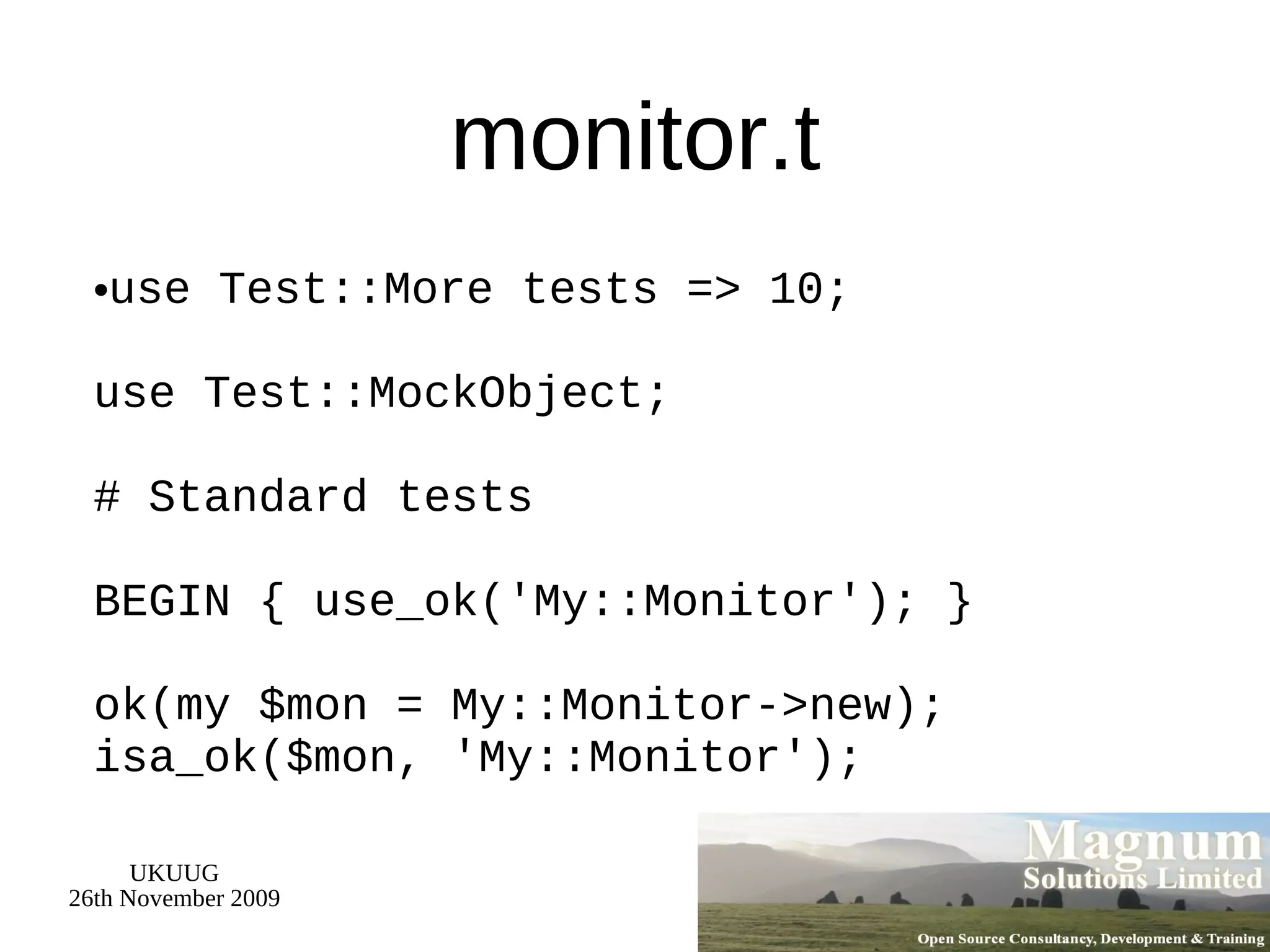
monitor.t use Test::More tests => 10; use Test::MockObject; # Standard tests BEGIN { use_ok('My::Monitor'); } ok(my $mon = My::Monitor->new); isa_ok($mon, 'My::Monitor');
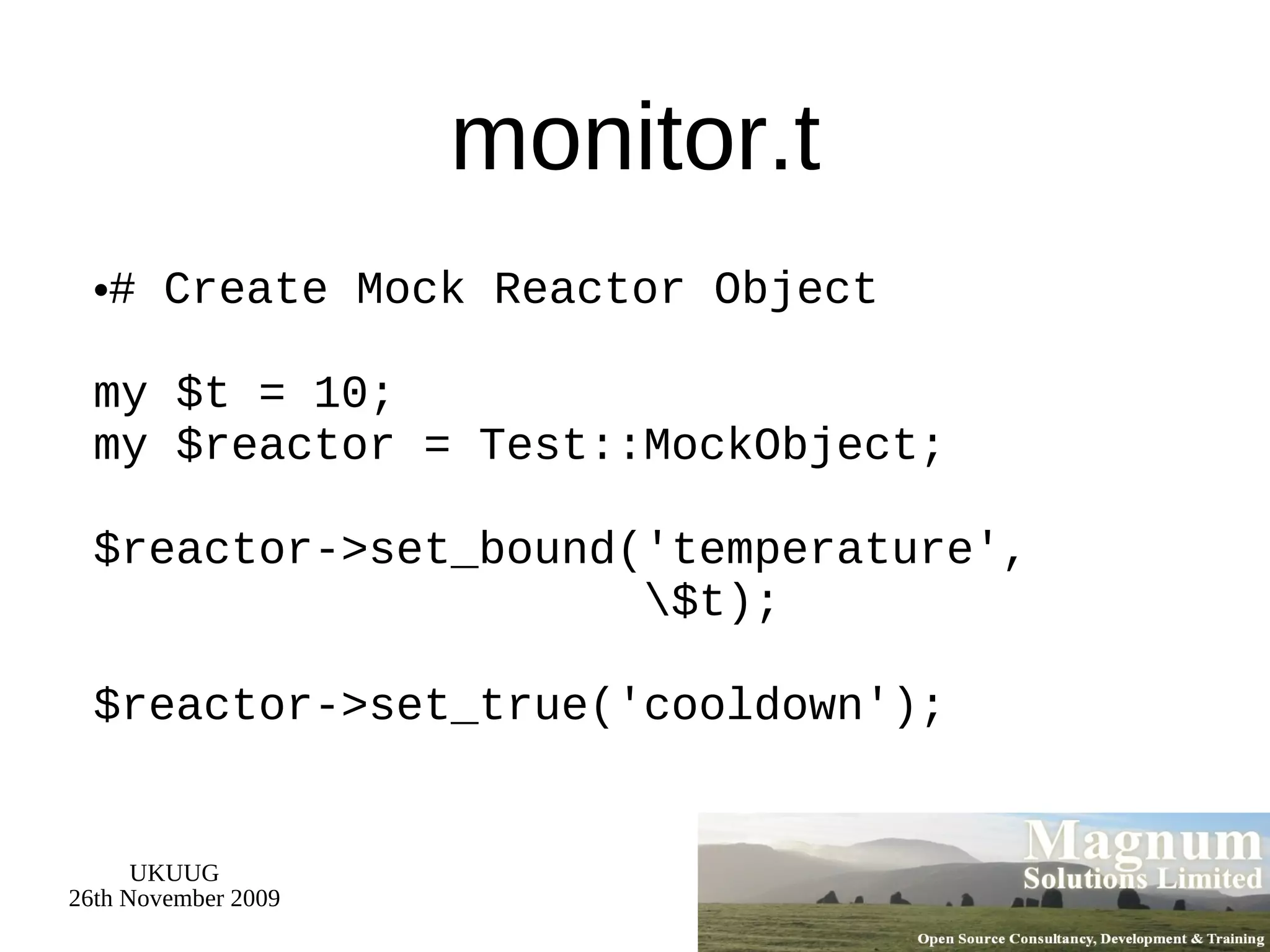
monitor.t # Create Mock Reactor Object my $t = 10; my $reactor = Test::MockObject; $reactor->set_bound('temperature',   \$t); $reactor->set_true('cooldown');
monitor.t # Test reactor ok($mon->check($reactor)); $t = 120; ok($mon->check($reactor)) for 1 .. 5; ok(!$mon->check($reactor));
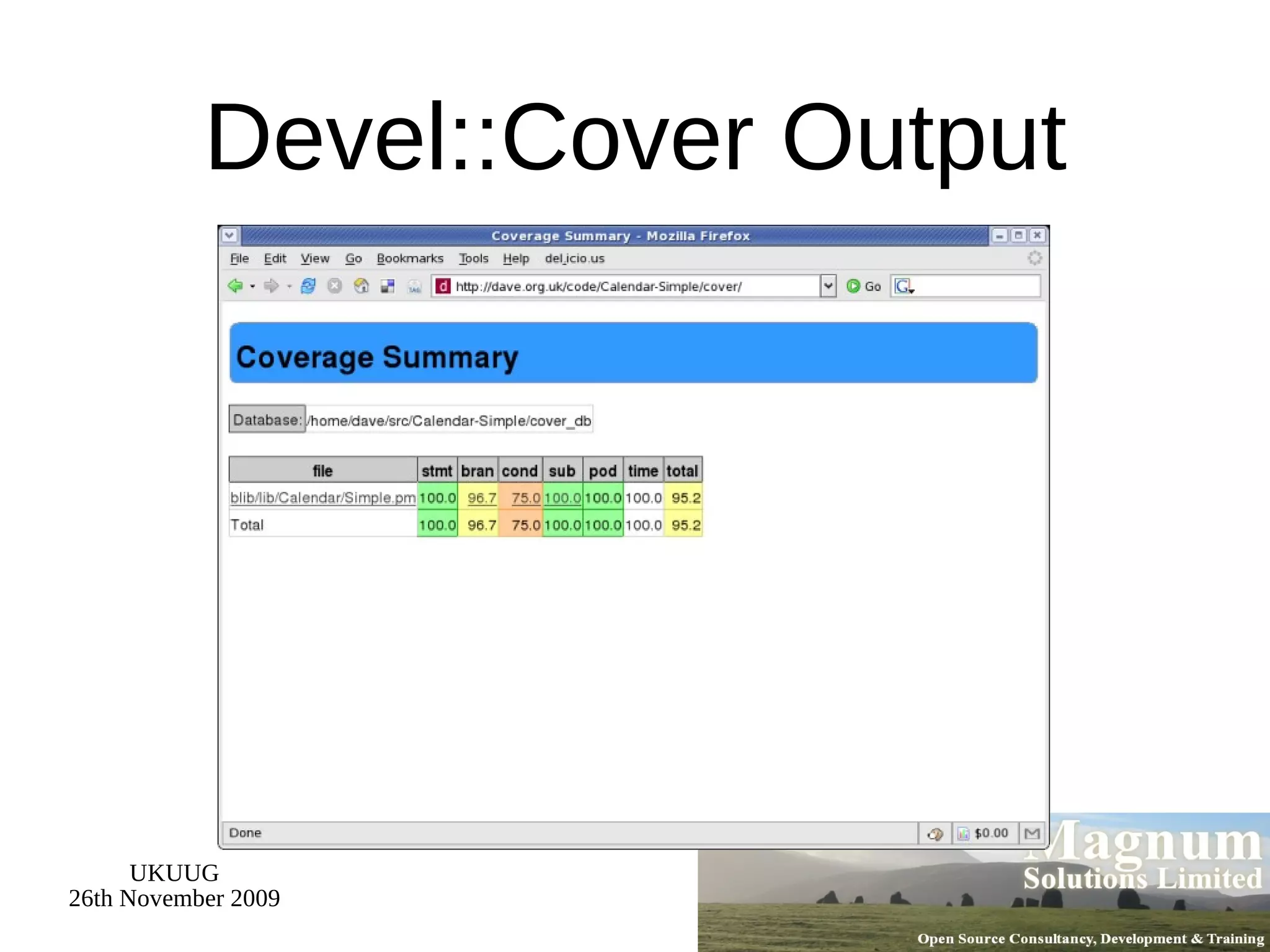
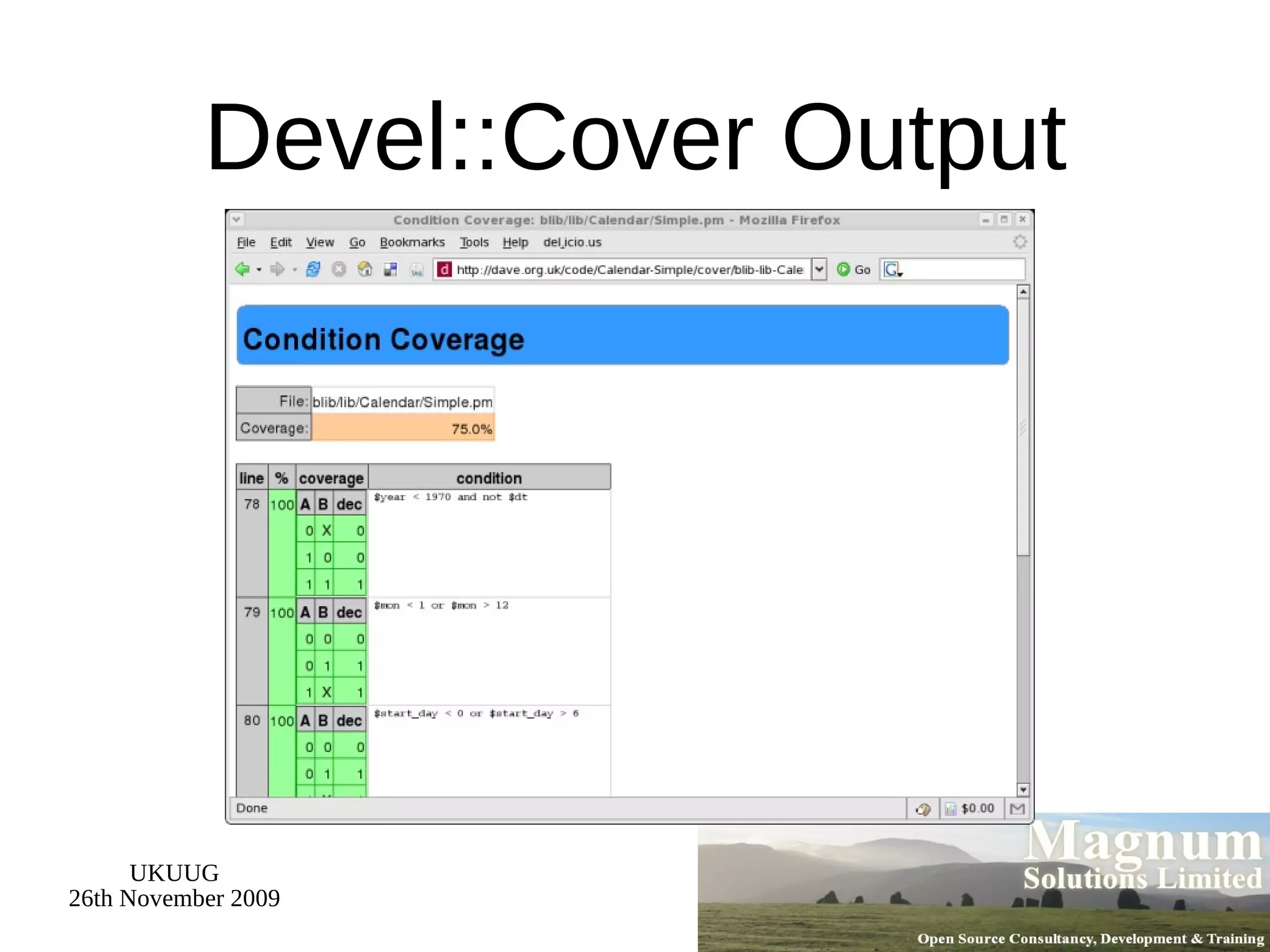
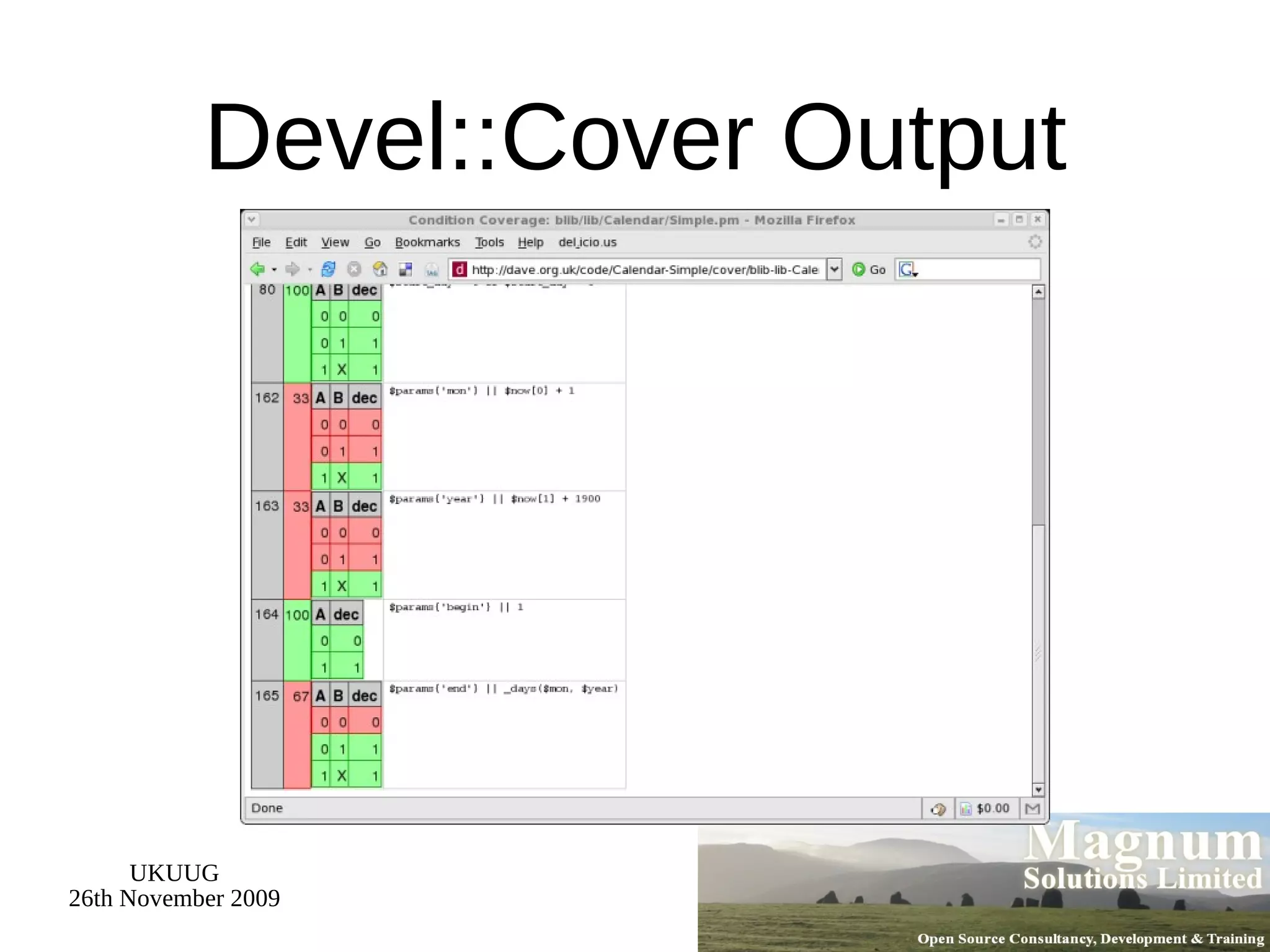
How Good Are Your Tests? How much of your code is exercised by your tests? Devel::Cover can help you to find out Deep internal magic Draws pretty charts HARNESS_PERL_SWITCHES= -MDevel::Cover make test cover
Devel::Cover Output
Devel::Cover Output
Devel::Cover Output
Alternative Test Paradigms Not everyone likes the Perl testing framework Other frameworks are available Test::Class xUnit style framework Test::FIT Framework for Interactive Testing http://fit.c2.com
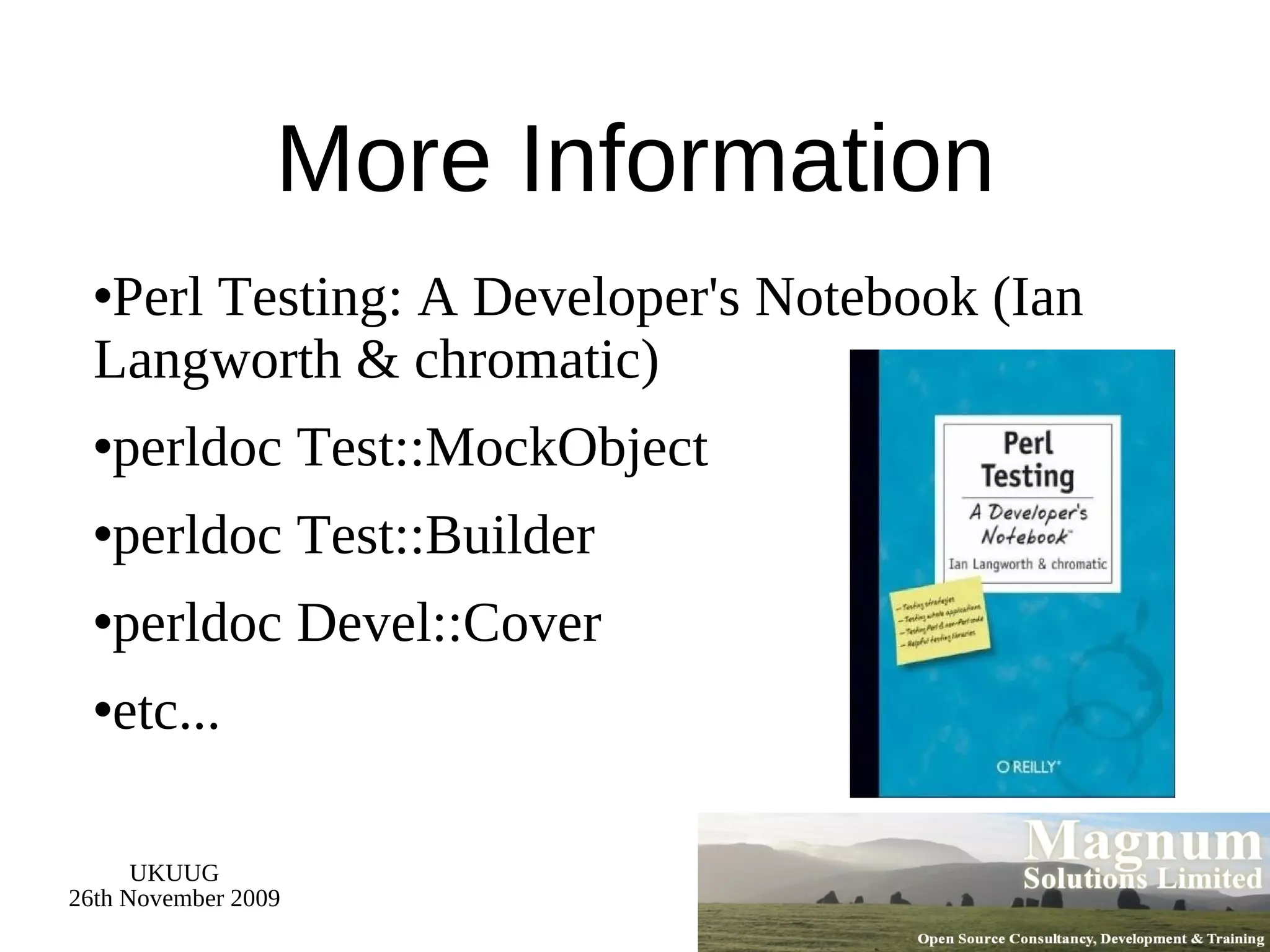
More Information Perl Testing: A Developer's Notebook (Ian Langworth & chromatic) perldoc Test::MockObject perldoc Test::Builder perldoc Devel::Cover etc...
Benchmarking
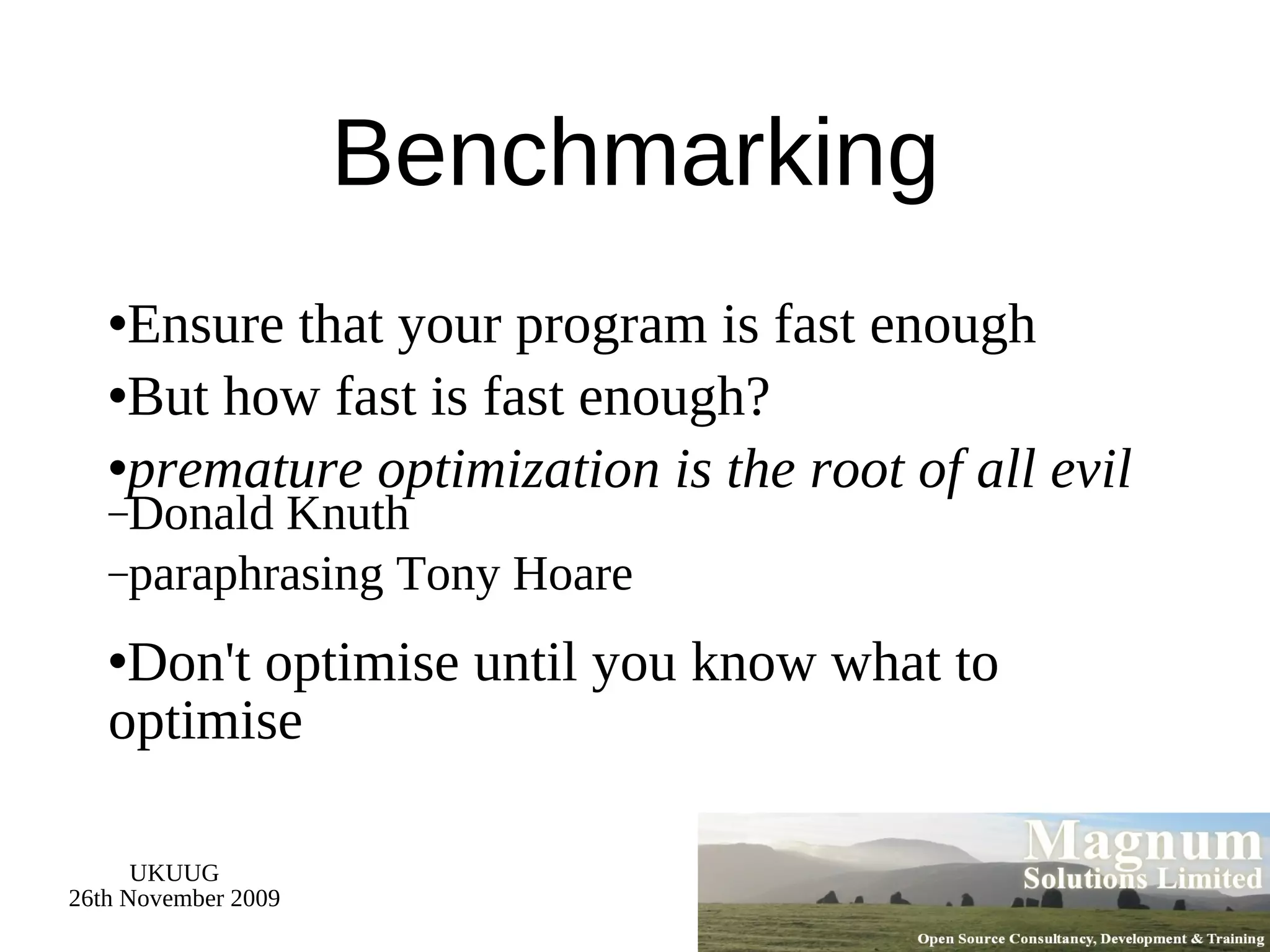
Benchmarking Ensure that your program is fast enough But how fast is fast enough? premature optimization is the root of all evil Donald Knuth paraphrasing Tony Hoare Don't optimise until you know what to optimise
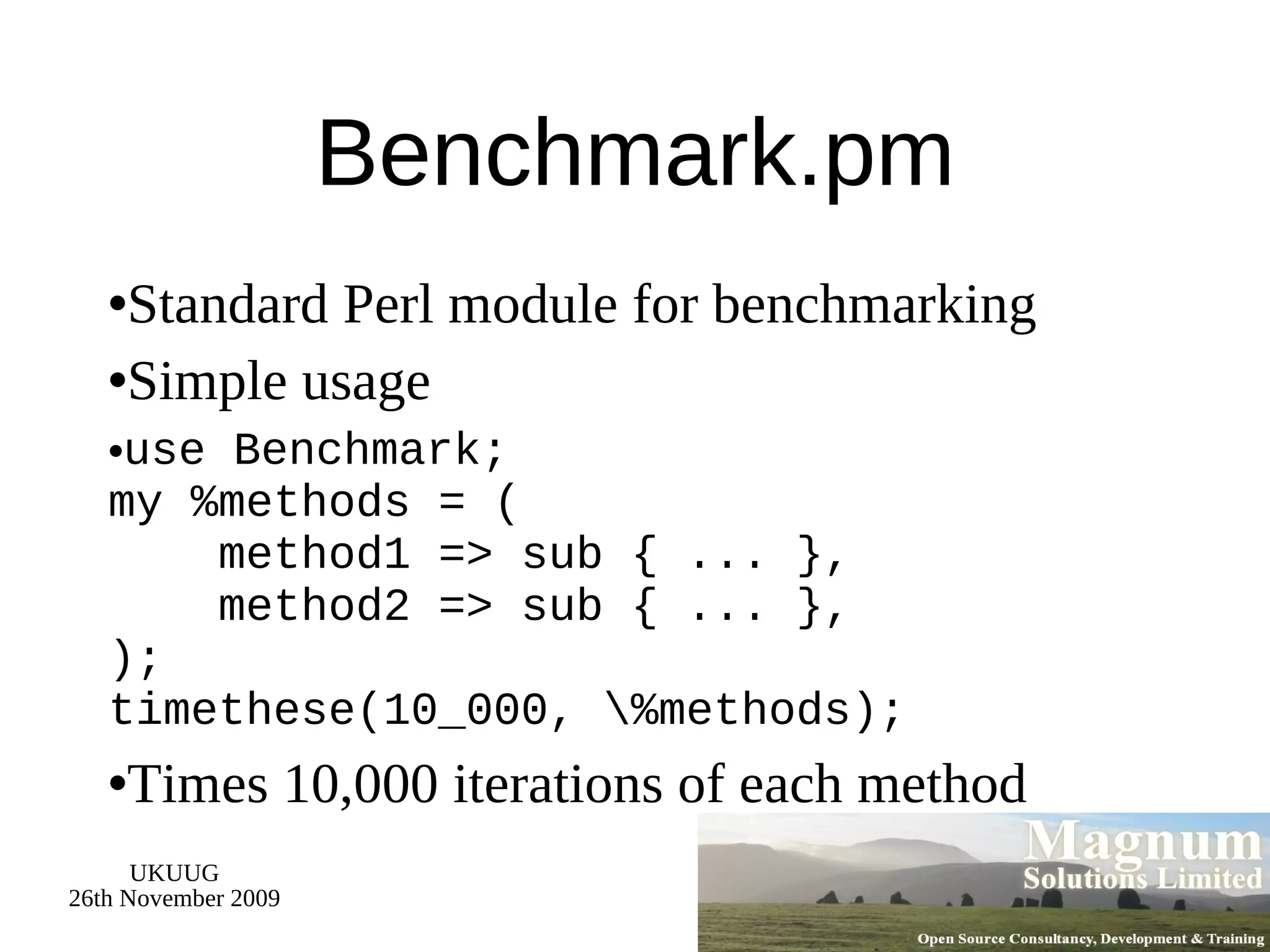
Benchmark.pm Standard Perl module for benchmarking Simple usage use Benchmark; my %methods = (   method1 => sub { ... },   method2 => sub { ... }, ); timethese(10_000, \%methods); Times 10,000 iterations of each method
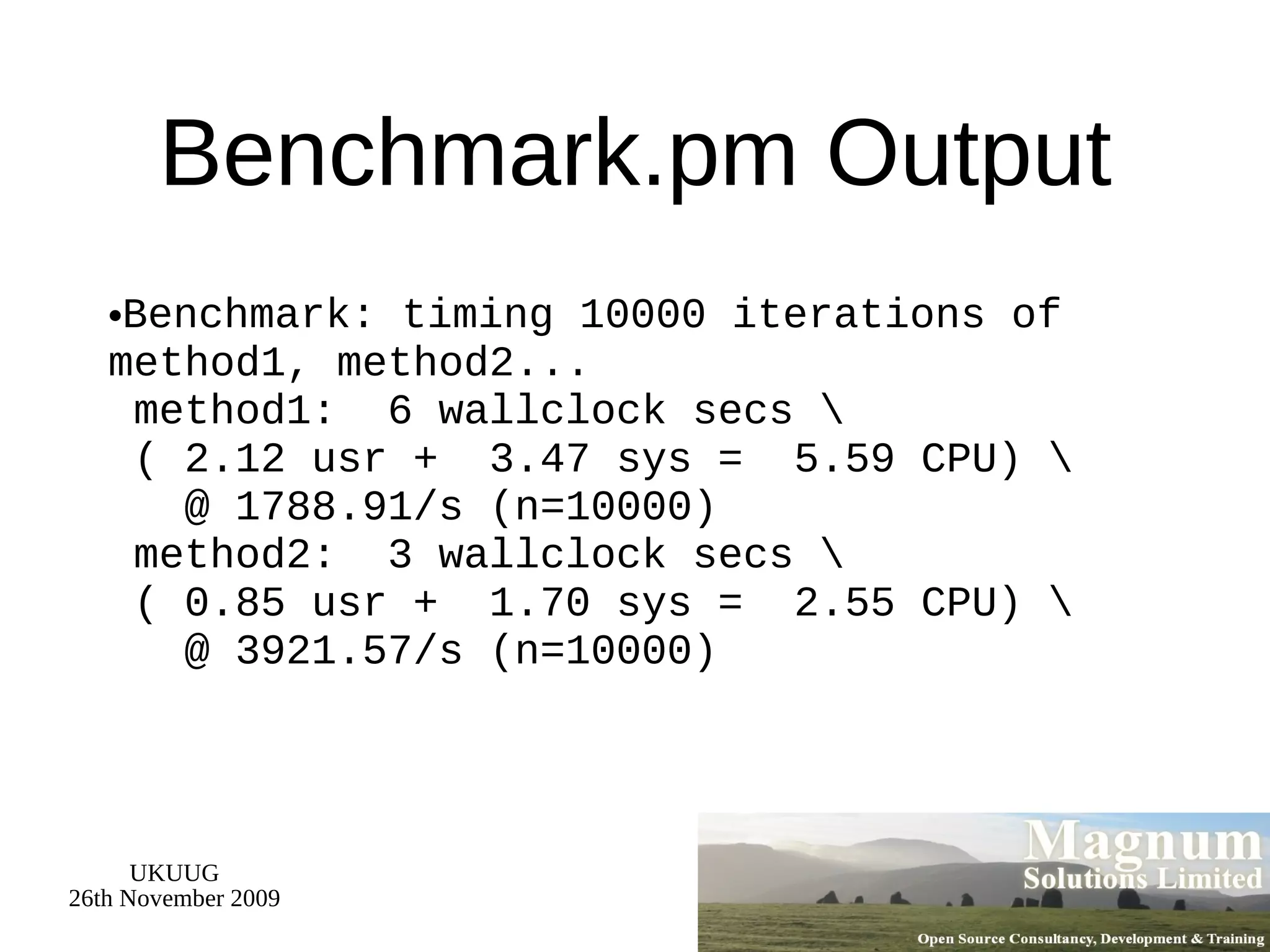
Benchmark.pm Output Benchmark: timing 10000 iterations of method1, method2...  method1:  6 wallclock secs \  ( 2.12 usr +  3.47 sys =  5.59 CPU) \   @ 1788.91/s (n=10000)  method2:  3 wallclock secs \  ( 0.85 usr +  1.70 sys =  2.55 CPU) \   @ 3921.57/s (n=10000)
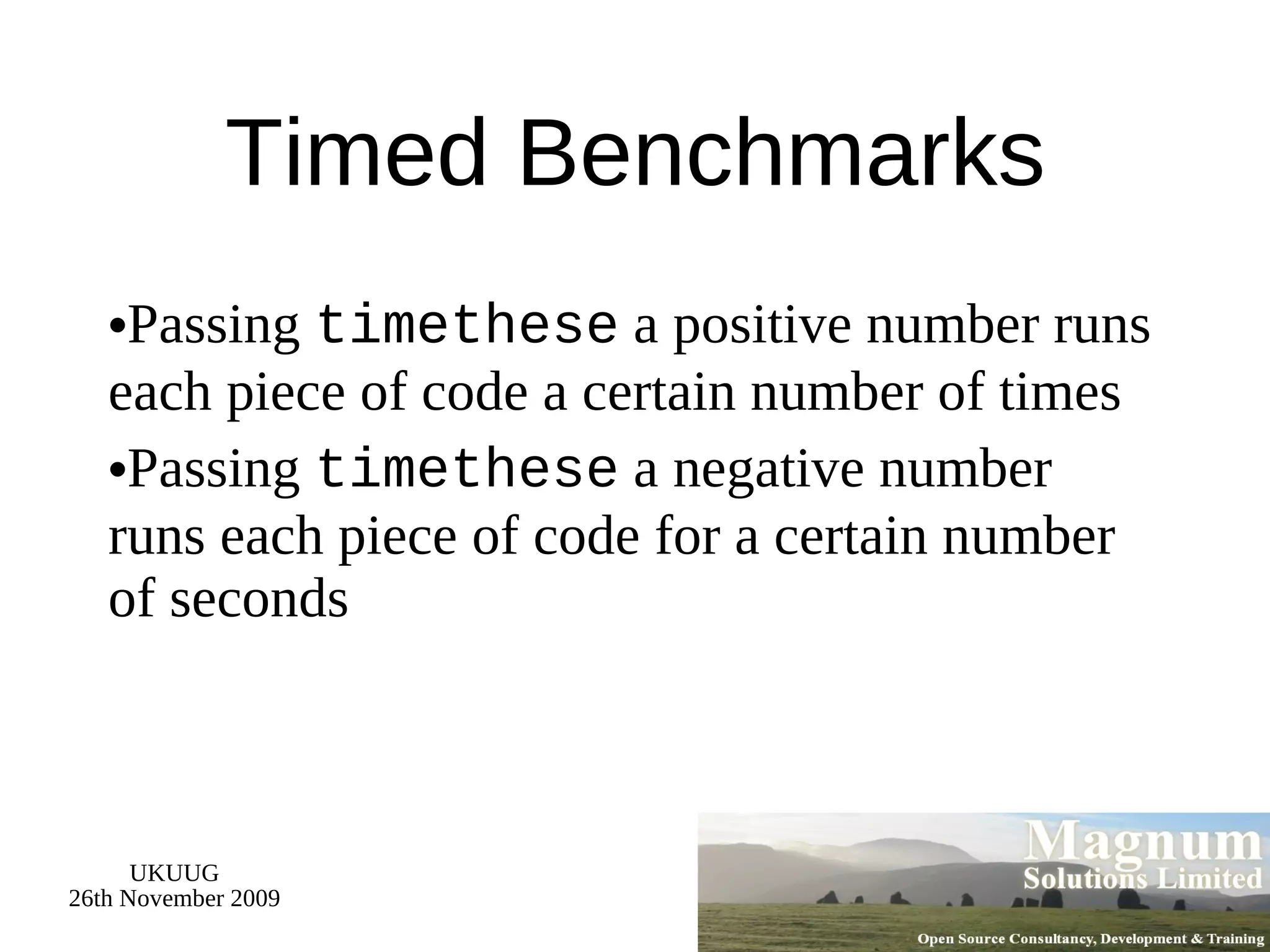
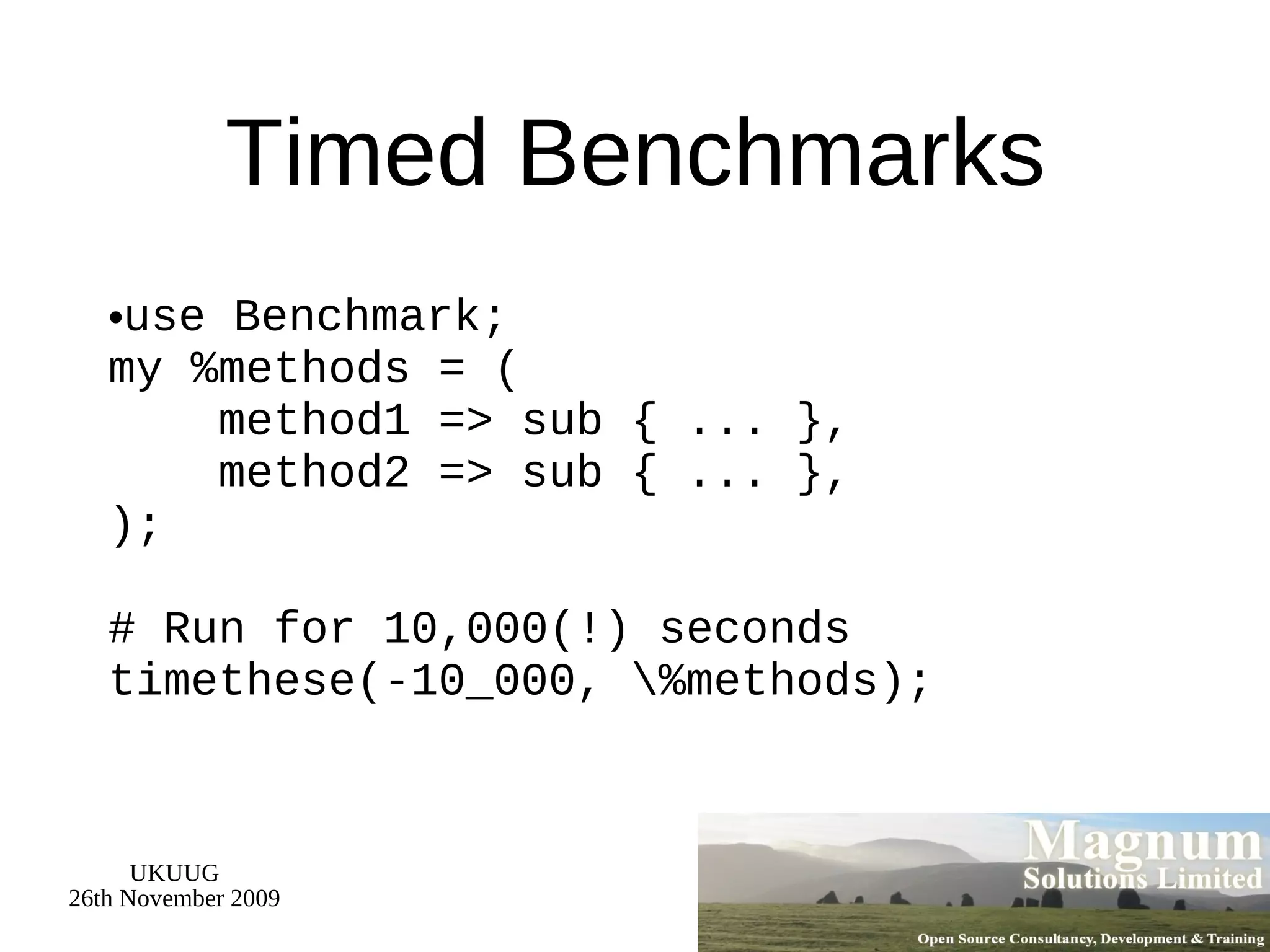
Timed Benchmarks Passing  timethese  a positive number runs each piece of code a certain number of times Passing  timethese  a negative number runs each piece of code for a certain number of seconds
Timed Benchmarks use Benchmark; my %methods = (   method1 => sub { ... },   method2 => sub { ... }, ); # Run for 10,000(!) seconds timethese(-10_000, \%methods);
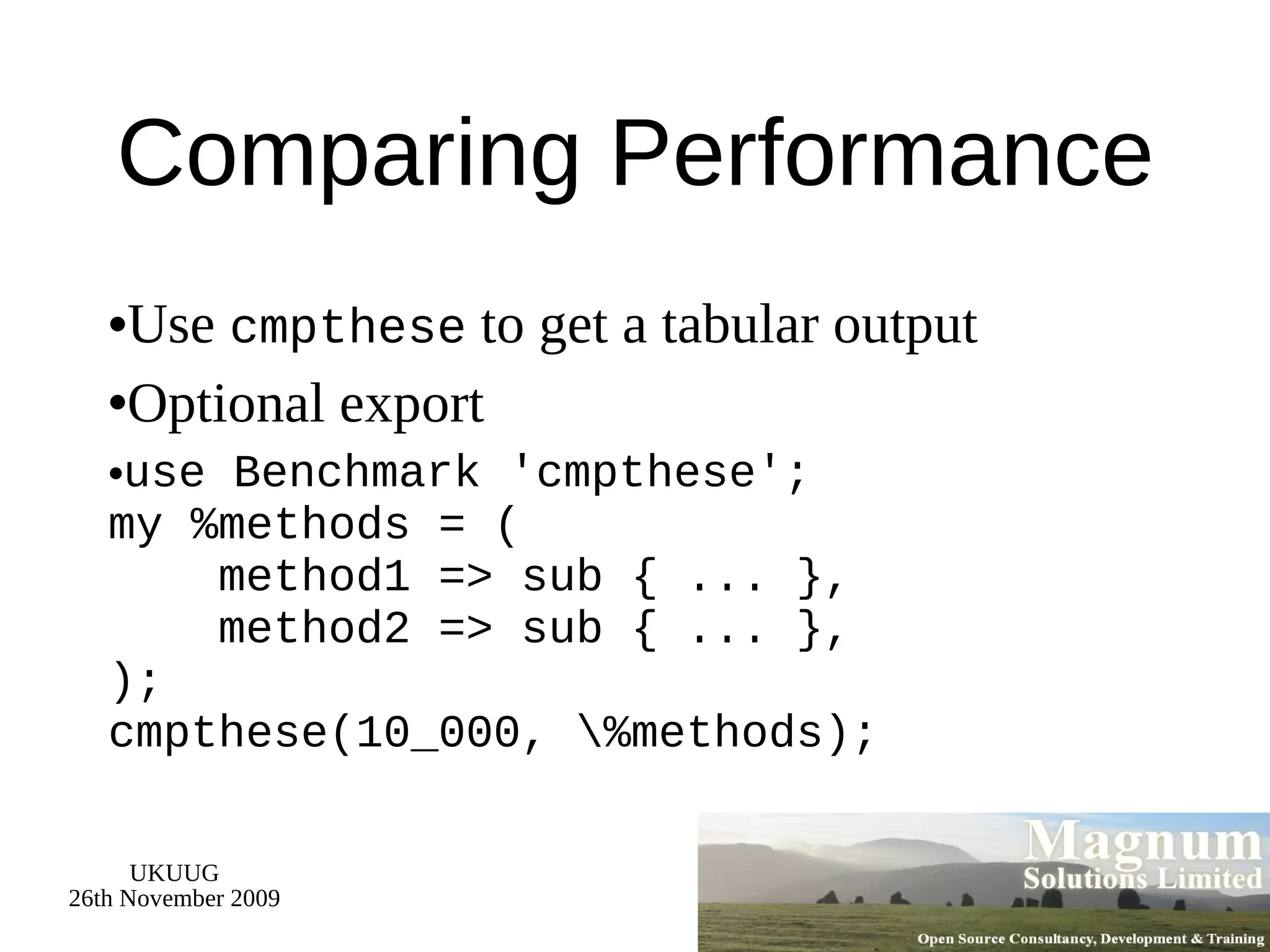
Comparing Performance Use  cmpthese  to get a tabular output Optional export use Benchmark 'cmpthese'; my %methods = (   method1 => sub { ... },   method2 => sub { ... }, ); cmpthese(10_000, \%methods);
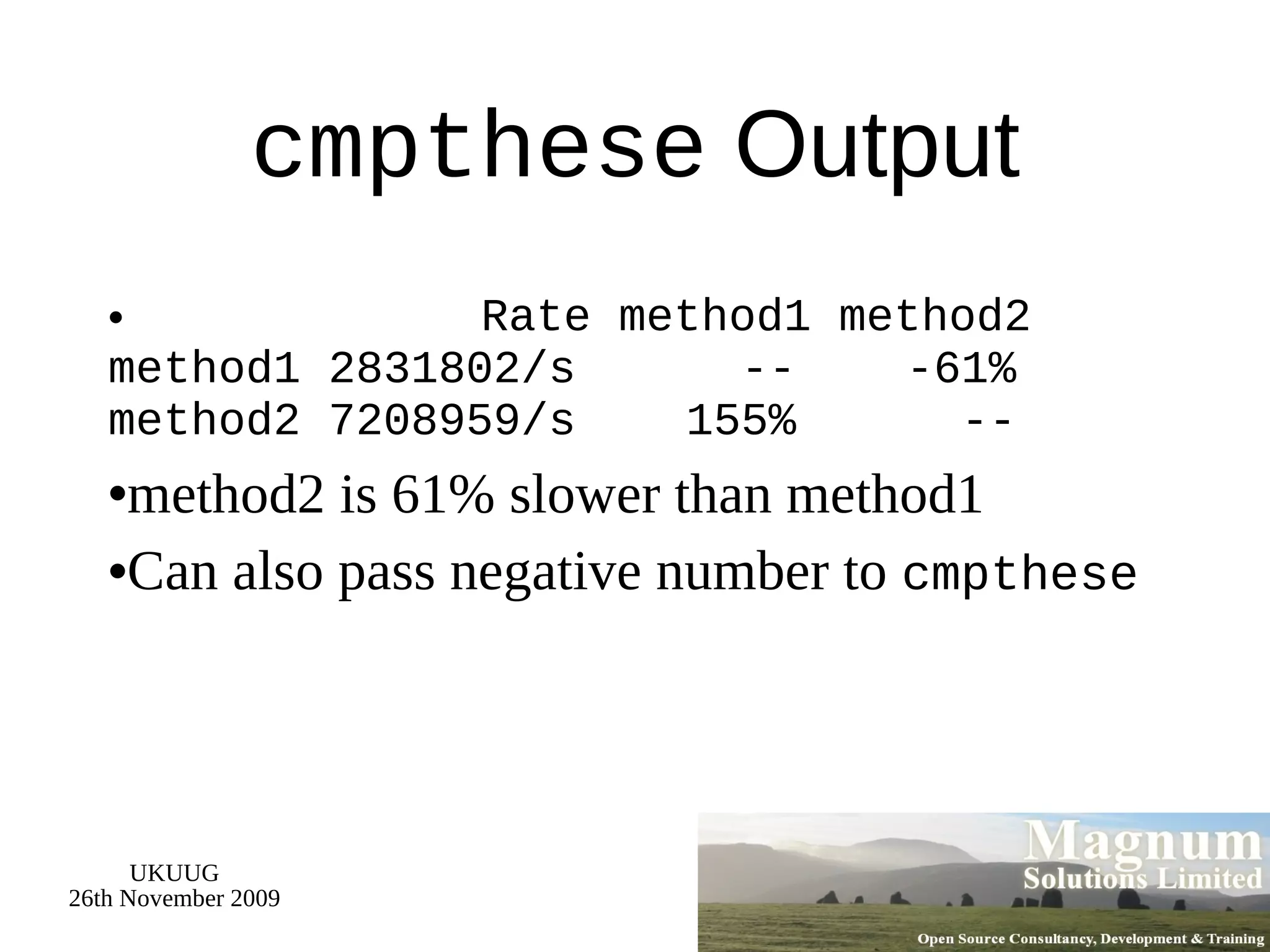
cmpthese  Output Rate method1 method2 method1 2831802/s  --  -61% method2 7208959/s  155%  --  method2 is 61% slower than method1 Can also pass negative number to  cmpthese
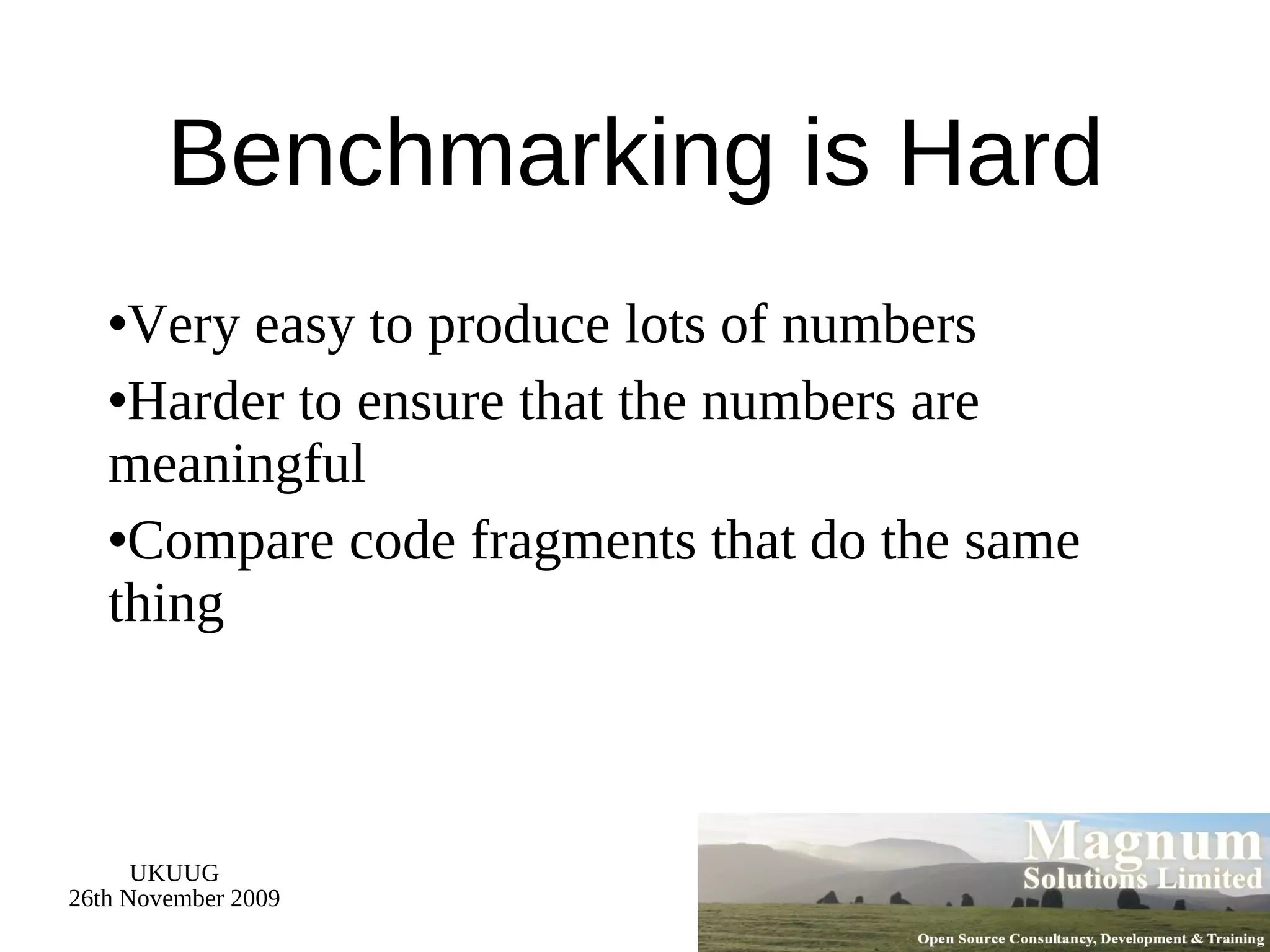
Benchmarking is Hard Very easy to produce lots of numbers Harder to ensure that the numbers are meaningful Compare code fragments that do the same thing
Bad Benchmarking use Benchmark qw{ timethese }; timethese( 1_000, {   Ordinary  => sub {   my @results = sort { -M $a <=> -M $b }  glob &quot;/bin/*&quot;; },   Schwartzian => sub {   map $_->[0],   sort { $a->[1] <=> $b->[1] }   map [$_, -M], glob &quot;/bin/*&quot;;   }, });
What to Benchmark Profile your code See which parts it is worth working on Look for code that Takes a long time to run, or Is called many times, or Both
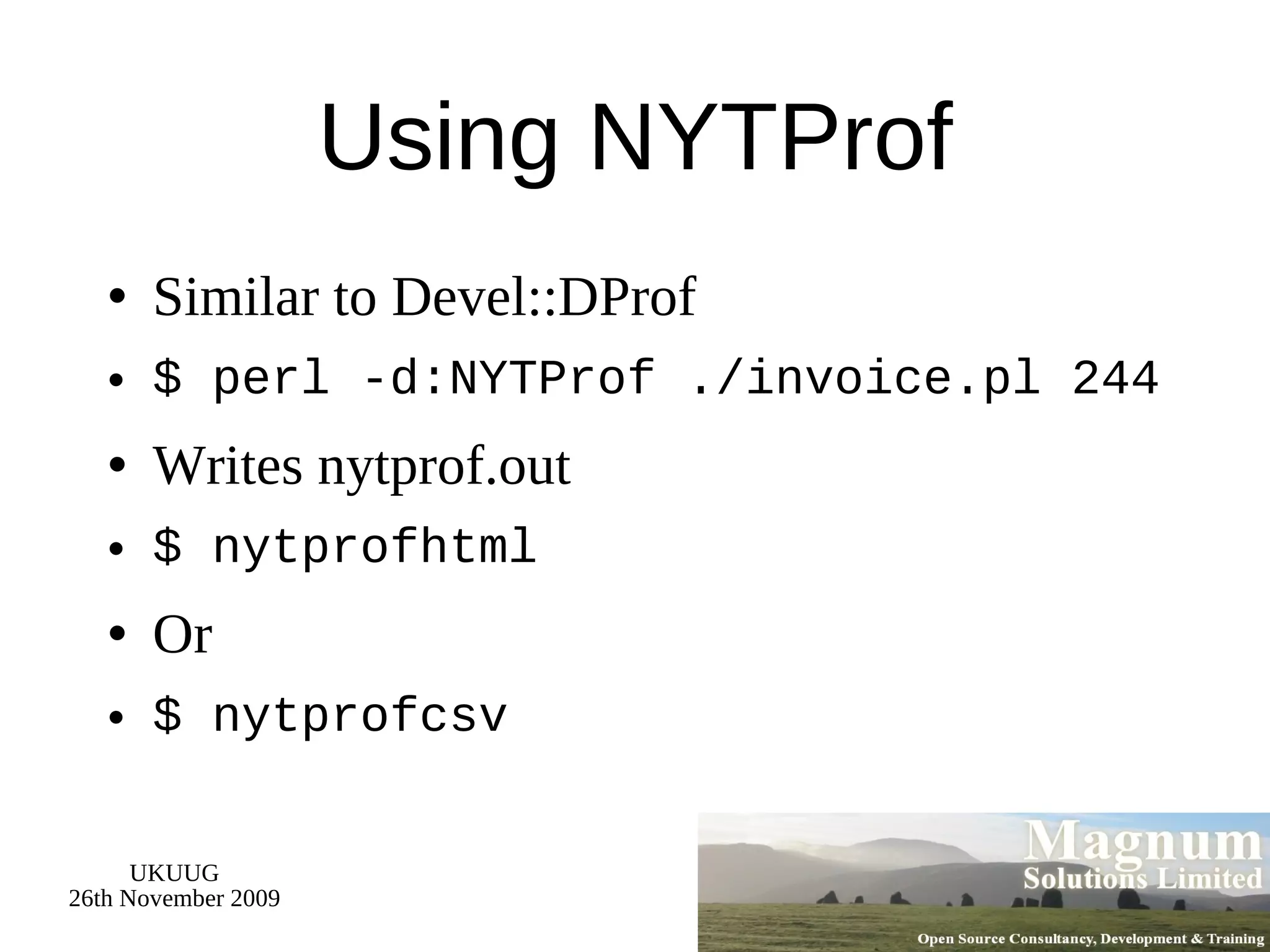
Devel::DProf Devel::DProf is the standard Perl profiling tool Included with Perl distribution Uses Perl debugger hooks perl -d:DProf your_program Produces a data file called  tmon.out Command line program  dprofpp  to view results
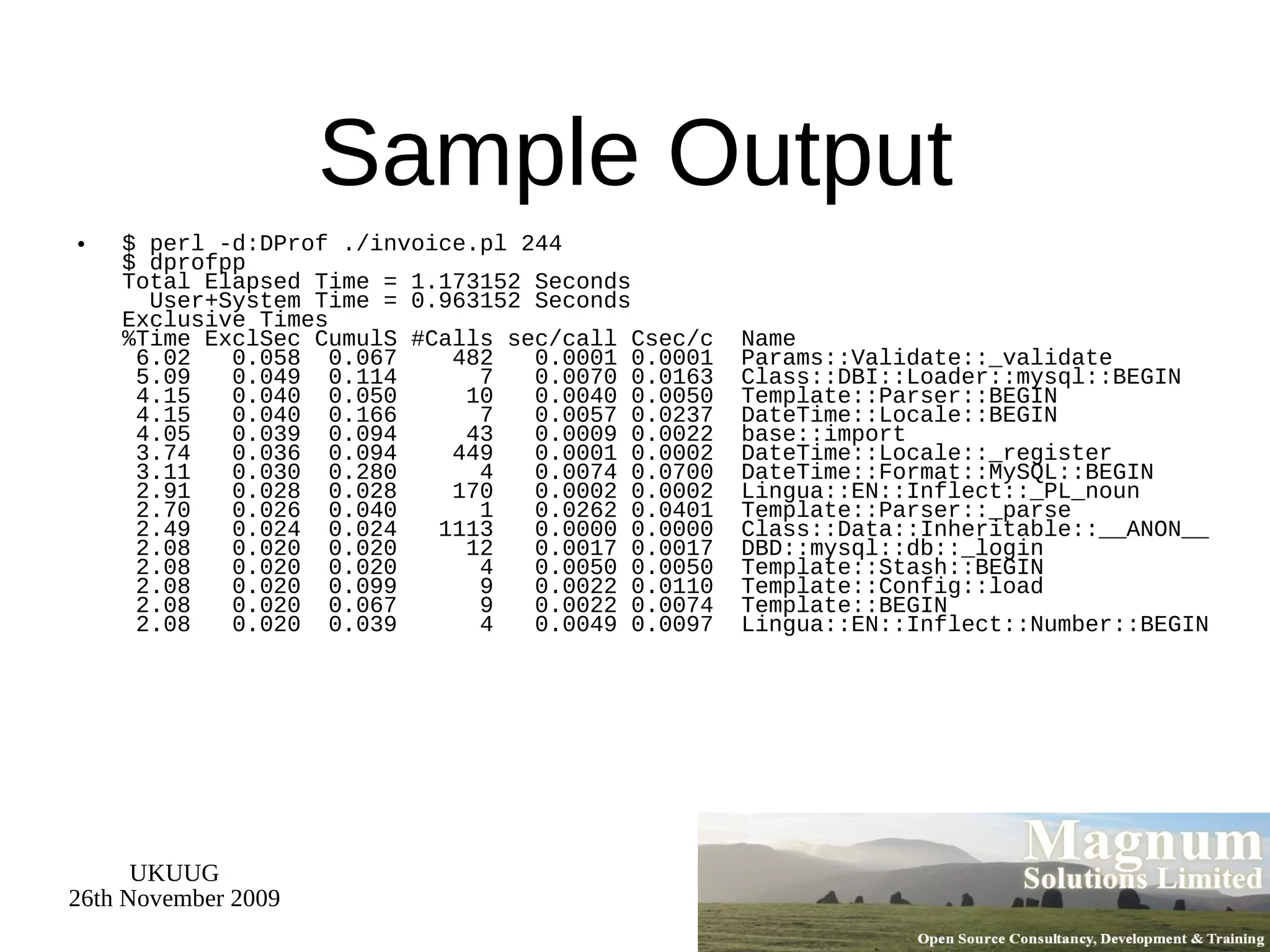
Sample Output $ perl -d:DProf ./invoice.pl 244 $ dprofpp  Total Elapsed Time = 1.173152 Seconds   User+System Time = 0.963152 Seconds Exclusive Times %Time ExclSec CumulS #Calls sec/call Csec/c  Name  6.02  0.058  0.067  482  0.0001 0.0001  Params::Validate::_validate  5.09  0.049  0.114  7  0.0070 0.0163  Class::DBI::Loader::mysql::BEGIN  4.15  0.040  0.050  10  0.0040 0.0050  Template::Parser::BEGIN  4.15  0.040  0.166  7  0.0057 0.0237  DateTime::Locale::BEGIN  4.05  0.039  0.094  43  0.0009 0.0022  base::import  3.74  0.036  0.094  449  0.0001 0.0002  DateTime::Locale::_register  3.11  0.030  0.280  4  0.0074 0.0700  DateTime::Format::MySQL::BEGIN  2.91  0.028  0.028  170  0.0002 0.0002  Lingua::EN::Inflect::_PL_noun  2.70  0.026  0.040  1  0.0262 0.0401  Template::Parser::_parse  2.49  0.024  0.024  1113  0.0000 0.0000  Class::Data::Inheritable::__ANON__  2.08  0.020  0.020  12  0.0017 0.0017  DBD::mysql::db::_login  2.08  0.020  0.020  4  0.0050 0.0050  Template::Stash::BEGIN  2.08  0.020  0.099  9  0.0022 0.0110  Template::Config::load  2.08  0.020  0.067  9  0.0022 0.0074  Template::BEGIN  2.08  0.020  0.039  4  0.0049 0.0097  Lingua::EN::Inflect::Number::BEGIN
Devel::NYTProf New profiling module Based on work from the New York Times Enhanced by Tim Bunce Pretty HTML output “borrowed” from Devel::Cover Far more flexible Far more powerful
Using NYTProf Similar to Devel::DProf $ perl -d:NYTProf ./invoice.pl 244 Writes nytprof.out $ nytprofhtml Or $ nytprofcsv
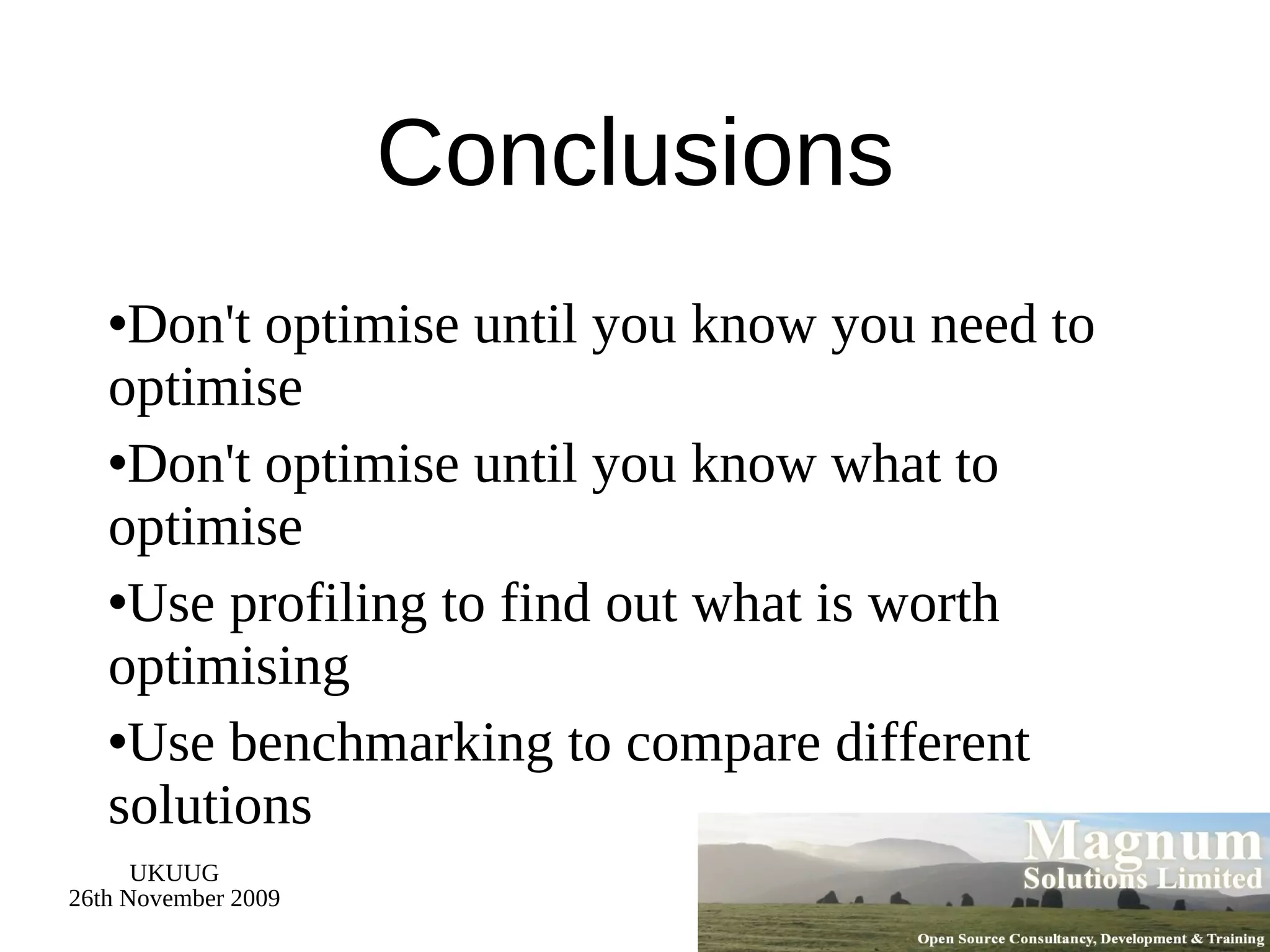
Conclusions Don't optimise until you know you need to optimise Don't optimise until you know what to optimise Use profiling to find out what is worth optimising Use benchmarking to compare different solutions
More Information perldoc Benchmark perldoc Devel::DProf perldoc Devel::NYTProf Chapters 5 and 6 of  Mastering Perl
Object Relational Mapping
ORM Mapping database relations into objects Tables (relations) map onto classes Rows (tuples) map onto objects Columns (attributes) map onto attributes Don't write SQL
SQL Is Tedious Select the id and name from this table Select all the details of this row Select something about related tables Update this row with these values Insert a new record with these values Delete this record
Replacing SQL Instead of SELECT * FROM  my_table WHERE  my_id = 10 and then dealing with the prepare/execute/fetch code
Replacing SQL We can write use My::Object; # warning! not a real orm my $obj = My::Object->retrieve(10) Or something similar
Writing An ORM Layer Not actually that hard to do yourself Each class needs an associated table Each class needs a list of columns Create simple SQL for basic CRUD operations Don't do that
Perl ORM Options Plenty of choices on CPAN Tangram SPOPS (Simple Perl Object Persistence with Security) Alzabo Class::DBI DBIx::Class The current favourite
DBIx::Class Standing on the shoulders of giants Learning from problems in Class::DBI More flexible More powerful
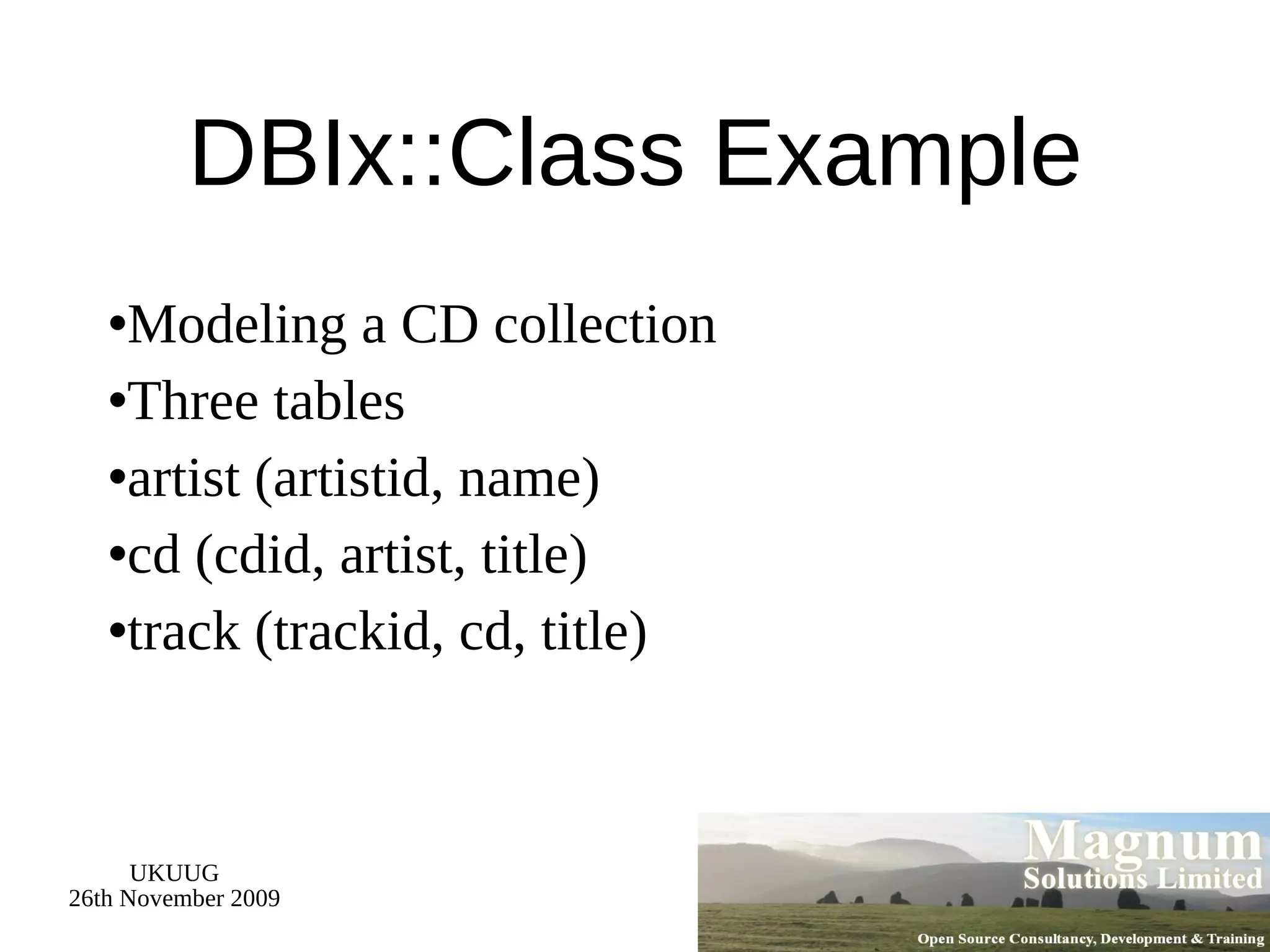
DBIx::Class Example Modeling a CD collection Three tables artist (artistid, name) cd (cdid, artist, title) track (trackid, cd, title)
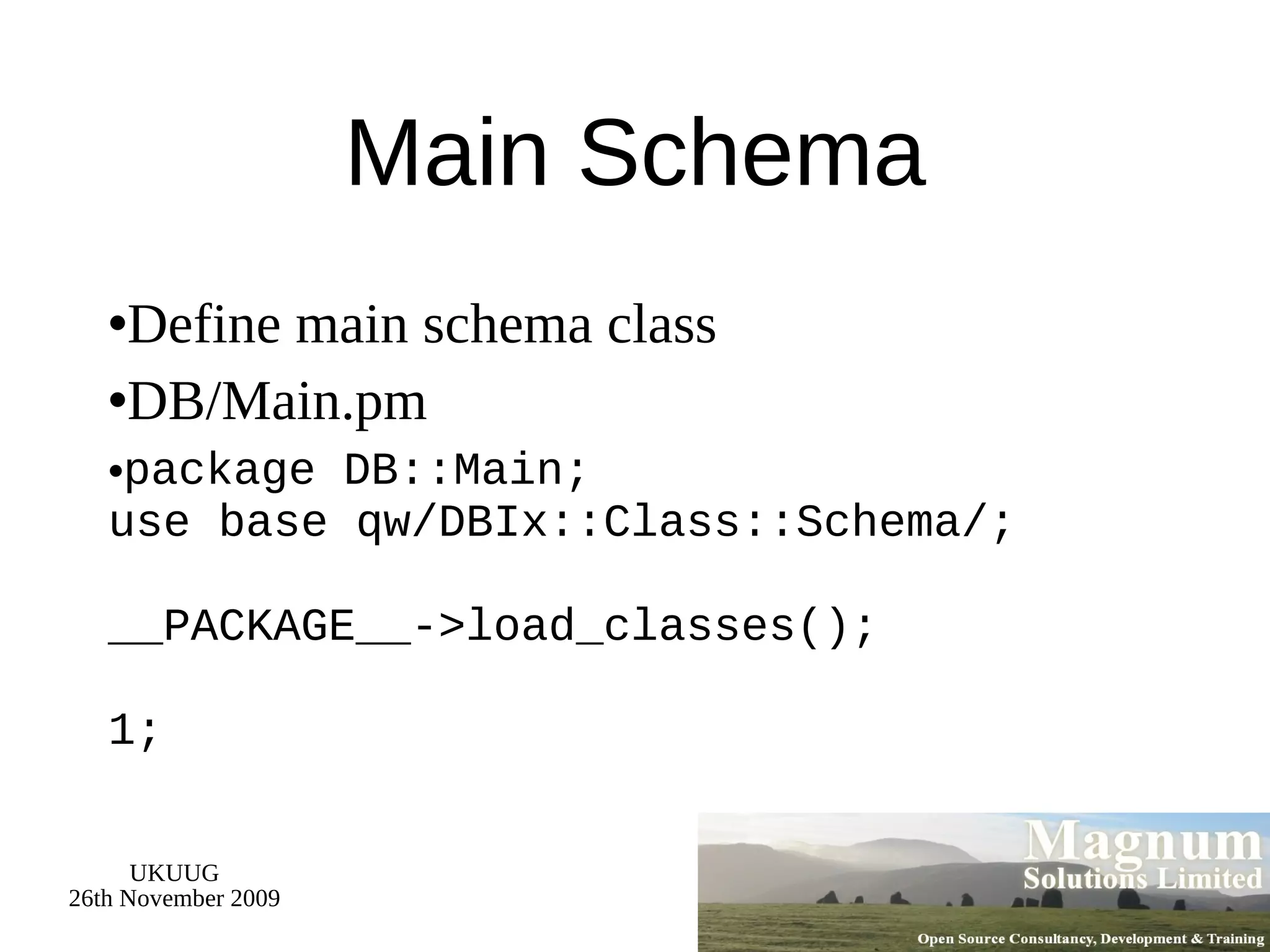
Main Schema Define main schema class DB/Main.pm package DB::Main; use base qw/DBIx::Class::Schema/; __PACKAGE__->load_classes(); 1;
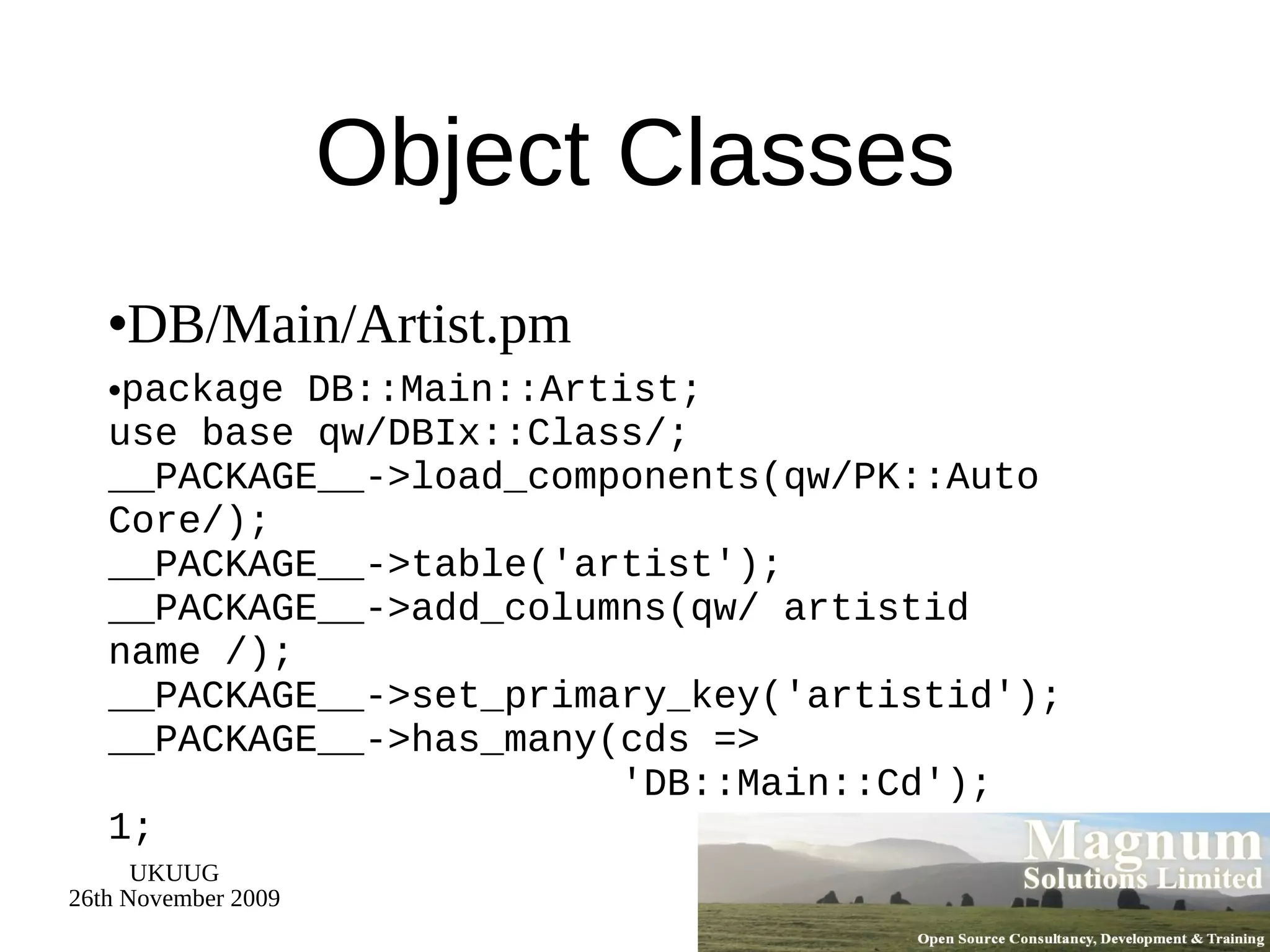
Object Classes DB/Main/Artist.pm package DB::Main::Artist; use base qw/DBIx::Class/; __PACKAGE__->load_components(qw/PK::Auto Core/); __PACKAGE__->table('artist'); __PACKAGE__->add_columns(qw/ artistid name /); __PACKAGE__->set_primary_key('artistid'); __PACKAGE__->has_many(cds =>   'DB::Main::Cd'); 1;
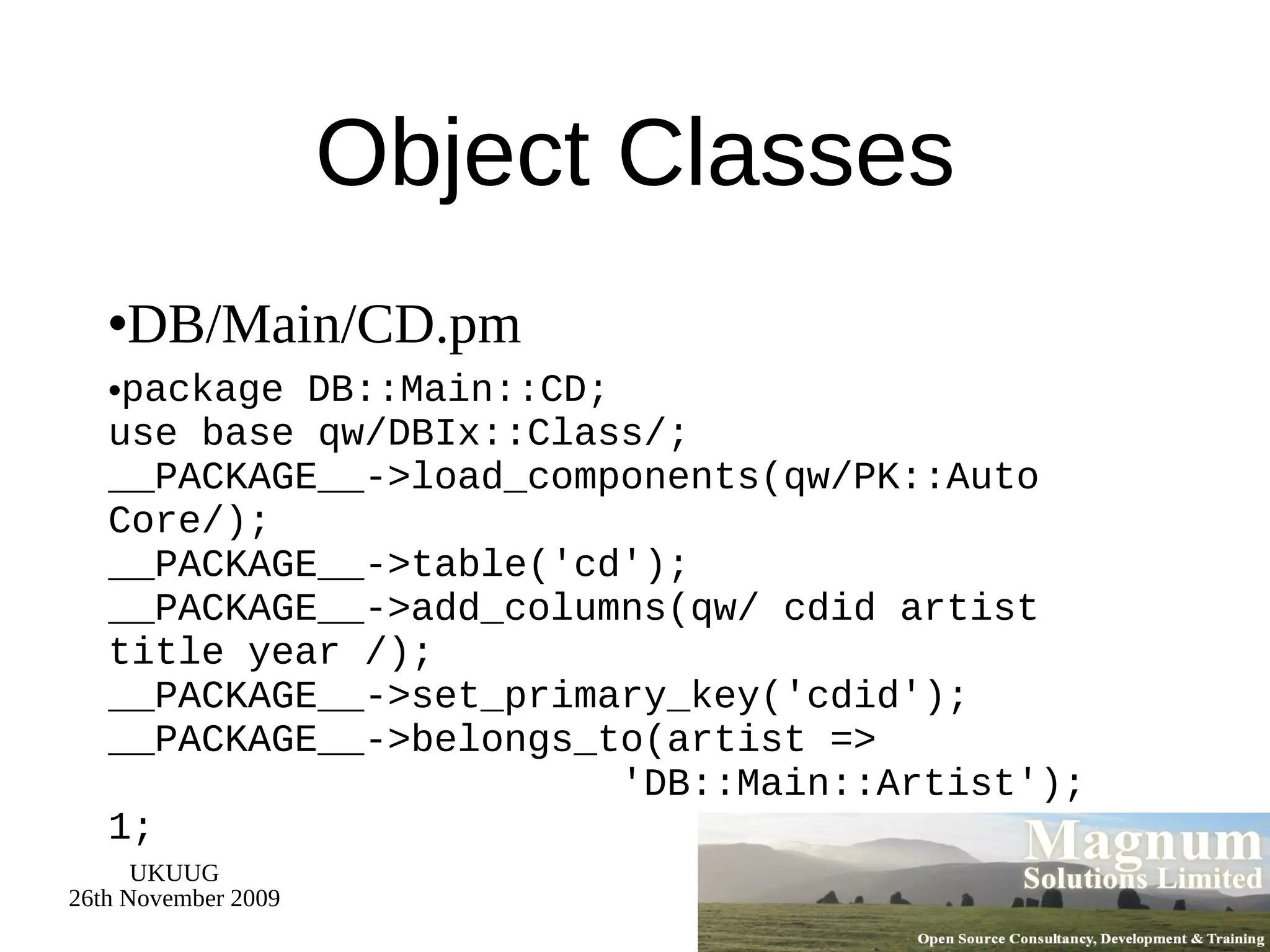
Object Classes DB/Main/CD.pm package DB::Main::CD; use base qw/DBIx::Class/; __PACKAGE__->load_components(qw/PK::Auto Core/); __PACKAGE__->table('cd'); __PACKAGE__->add_columns(qw/ cdid artist title year /); __PACKAGE__->set_primary_key('cdid'); __PACKAGE__->belongs_to(artist =>   'DB::Main::Artist'); 1;
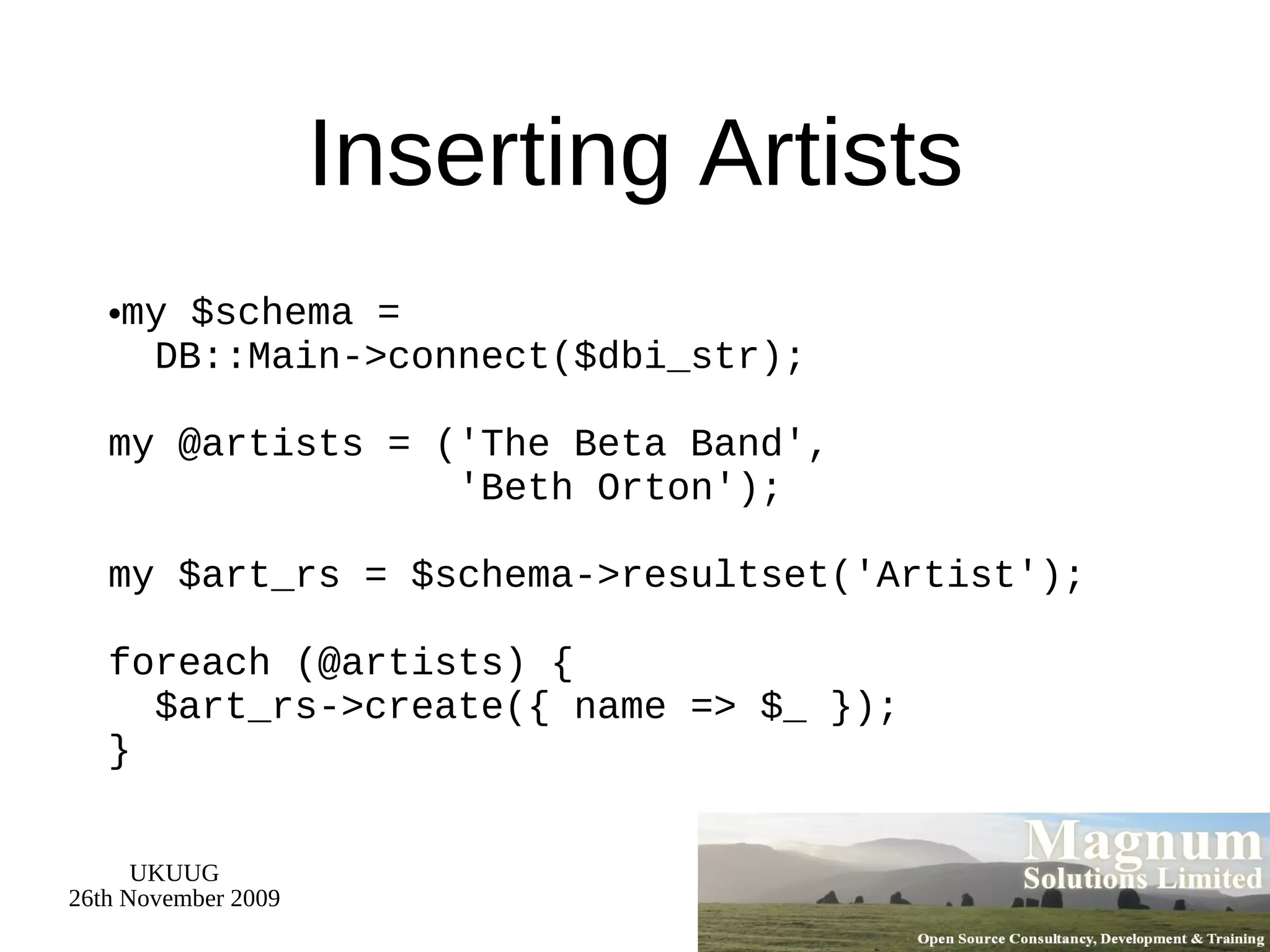
Inserting Artists my $schema =   DB::Main->connect($dbi_str); my @artists = ('The Beta Band',   'Beth Orton'); my $art_rs = $schema->resultset('Artist'); foreach (@artists) {   $art_rs->create({ name => $_ }); }
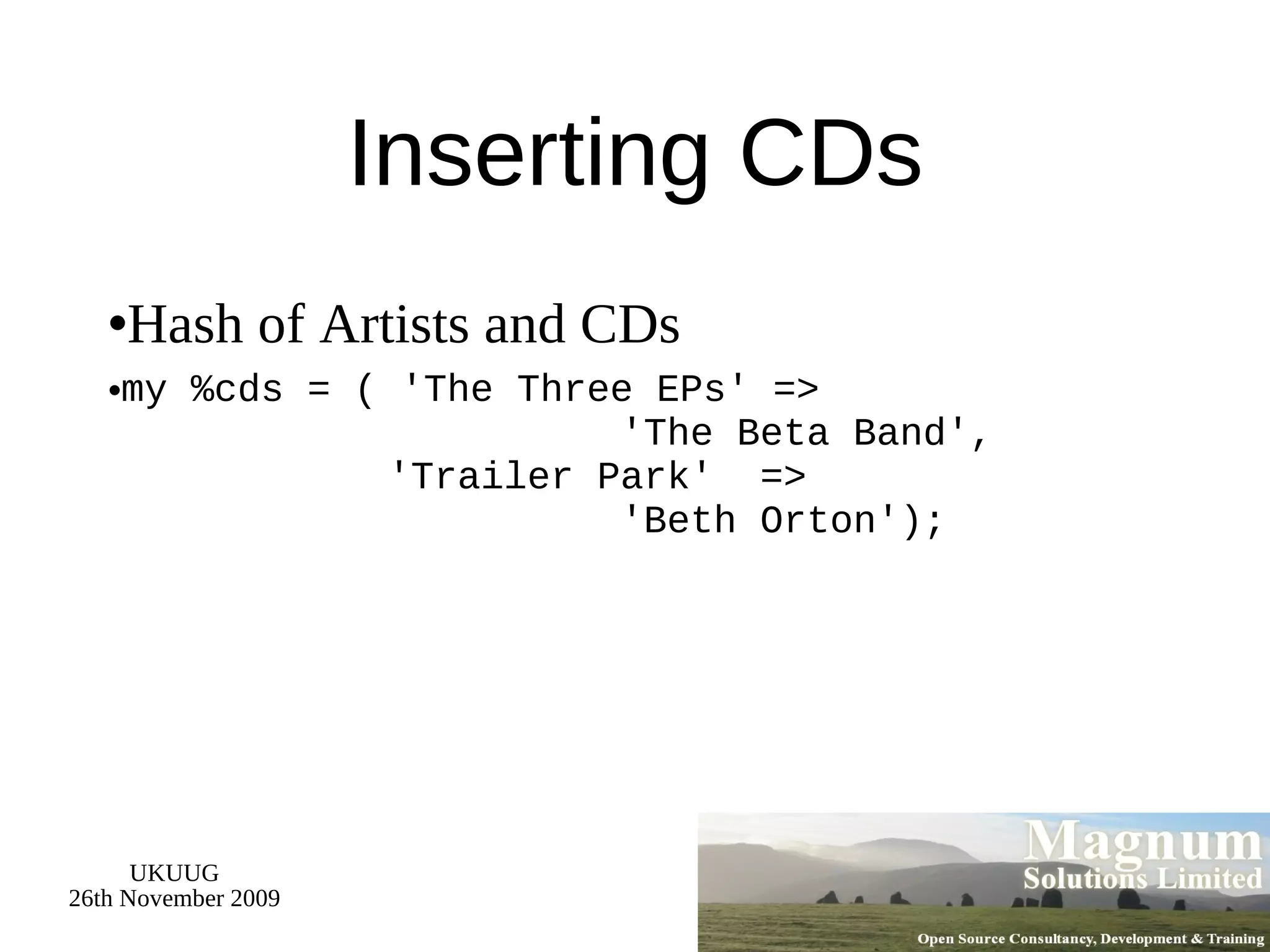
Inserting CDs Hash of Artists and CDs my %cds = ( 'The Three EPs' =>   'The Beta Band',   'Trailer Park'  =>   'Beth Orton');
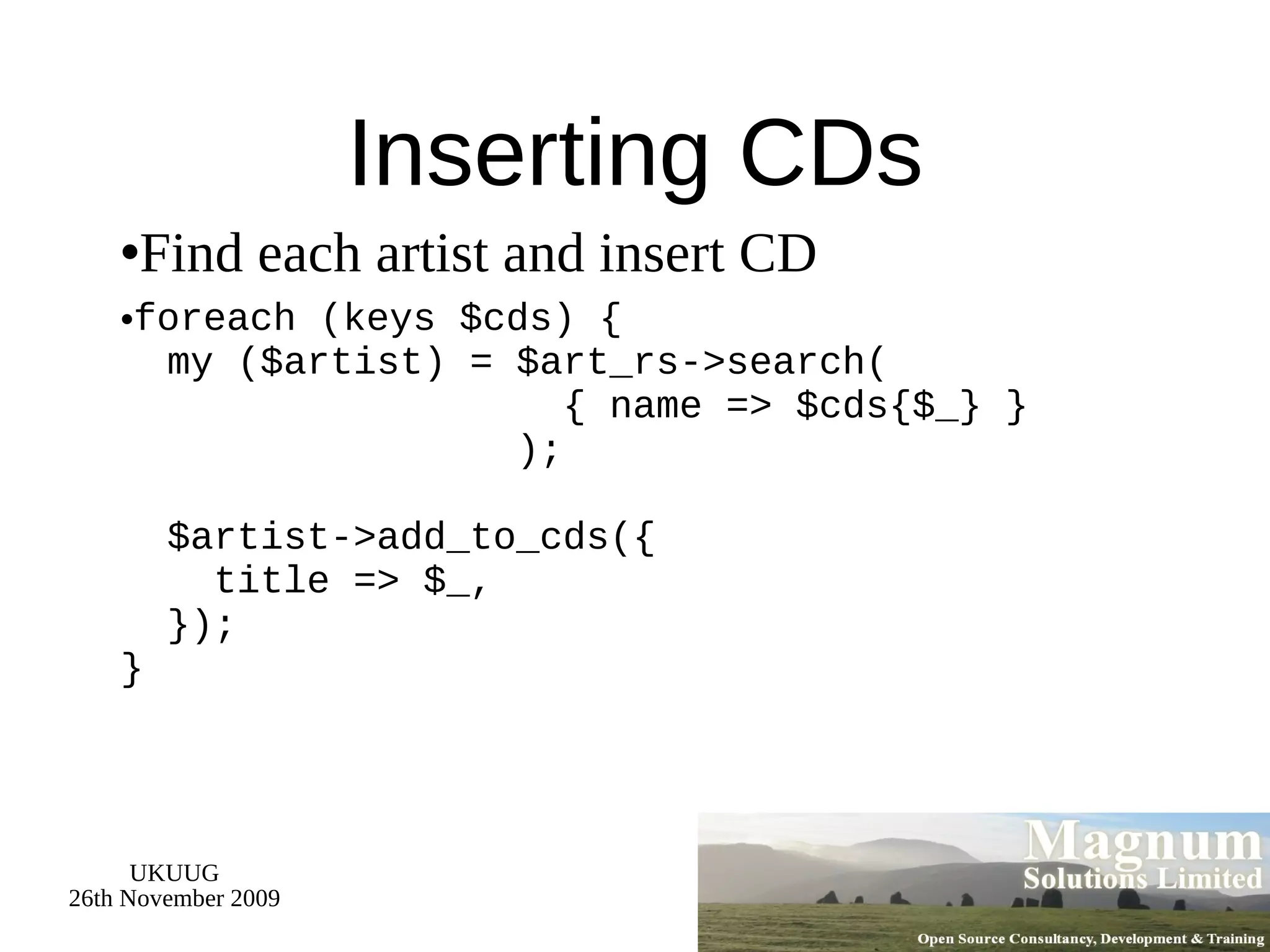
Inserting CDs Find each artist  and insert CD foreach (keys $cds) {   my ($artist) = $art_rs->search(   { name => $cds{$_} }   );   $artist->add_to_cds({   title => $_,   }); }
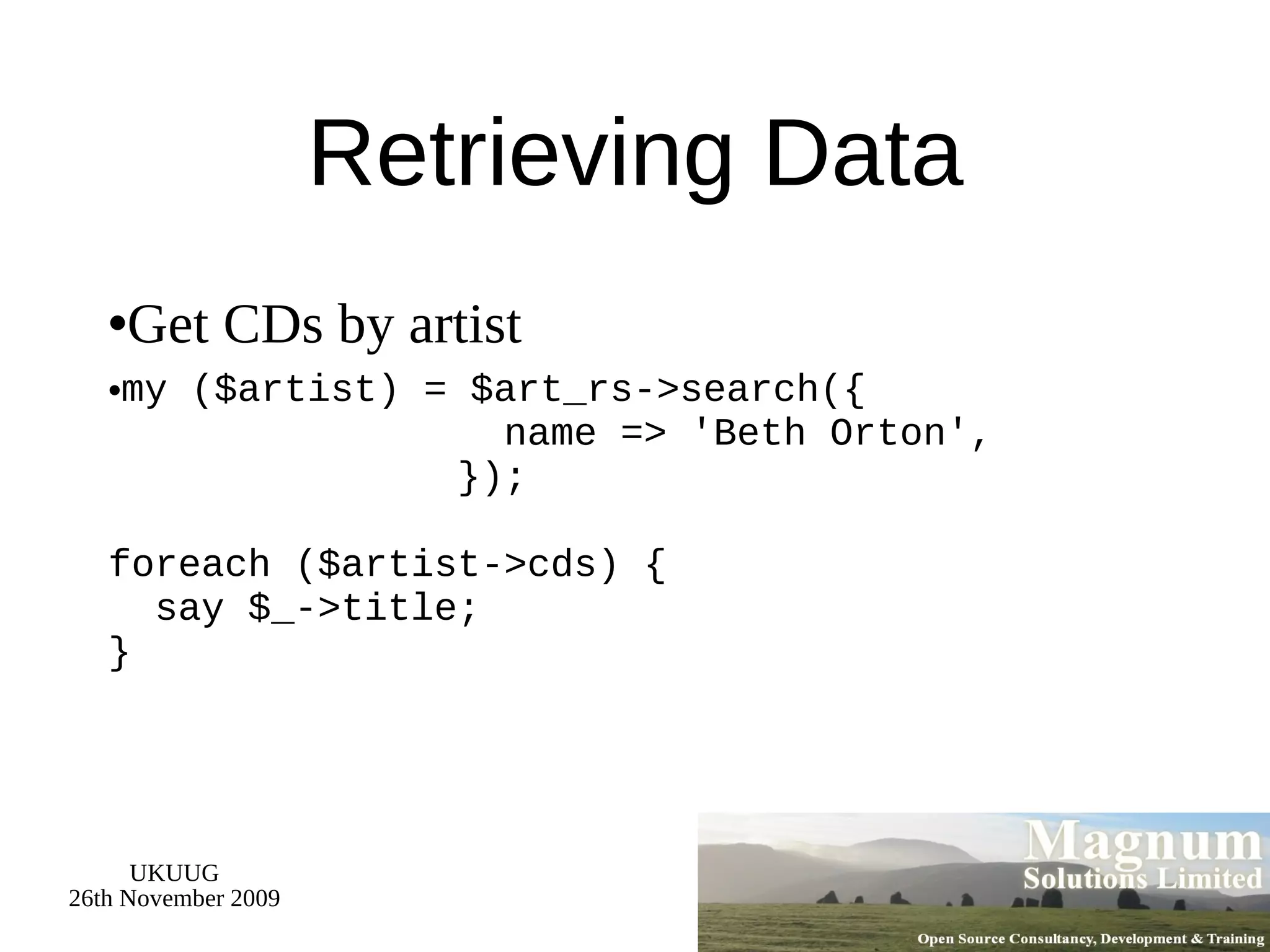
Retrieving Data Get CDs by artist my ($artist) = $art_rs->search({   name => 'Beth Orton',   }); foreach ($artist->cds) {   say $_->title; }
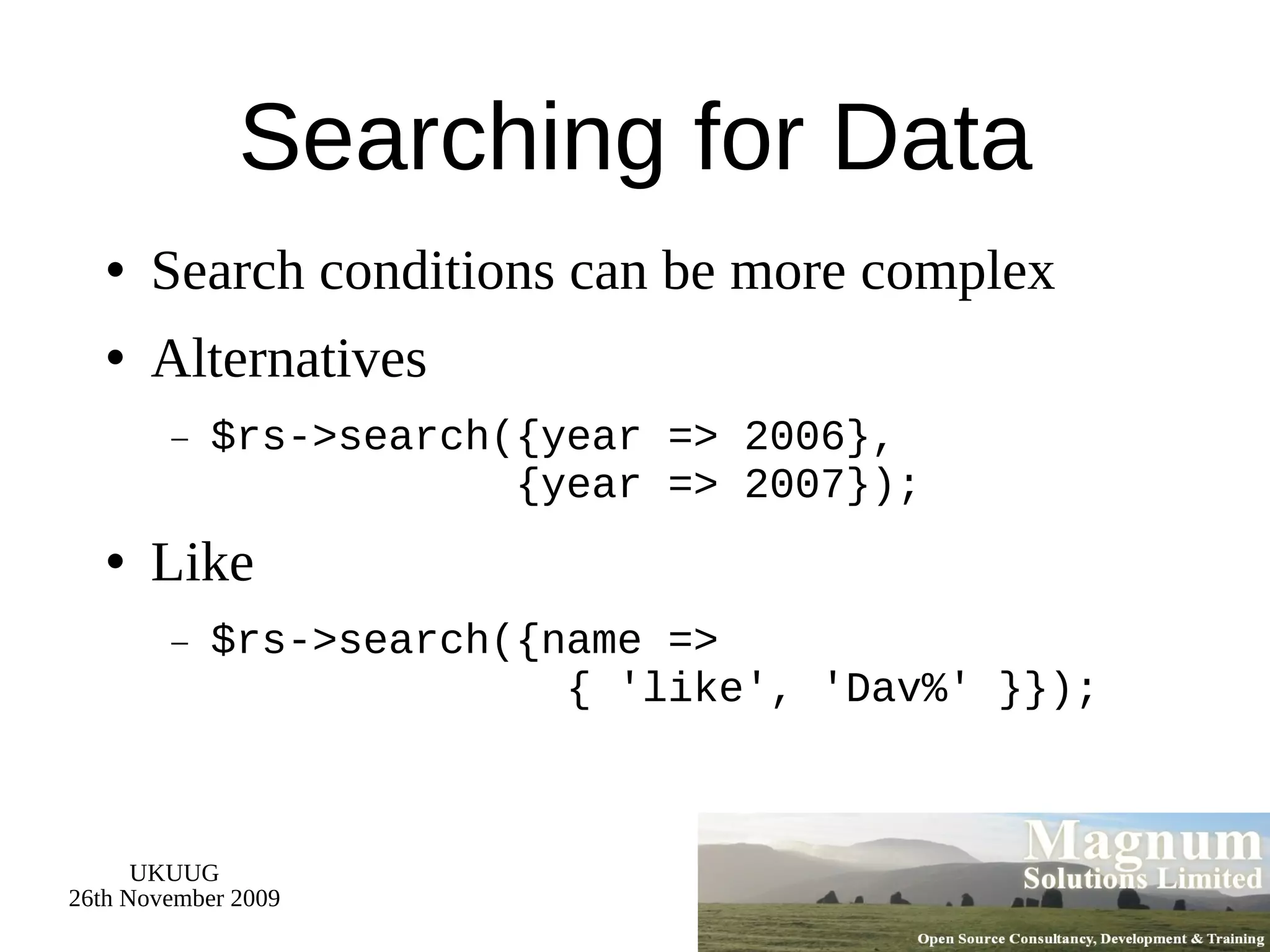
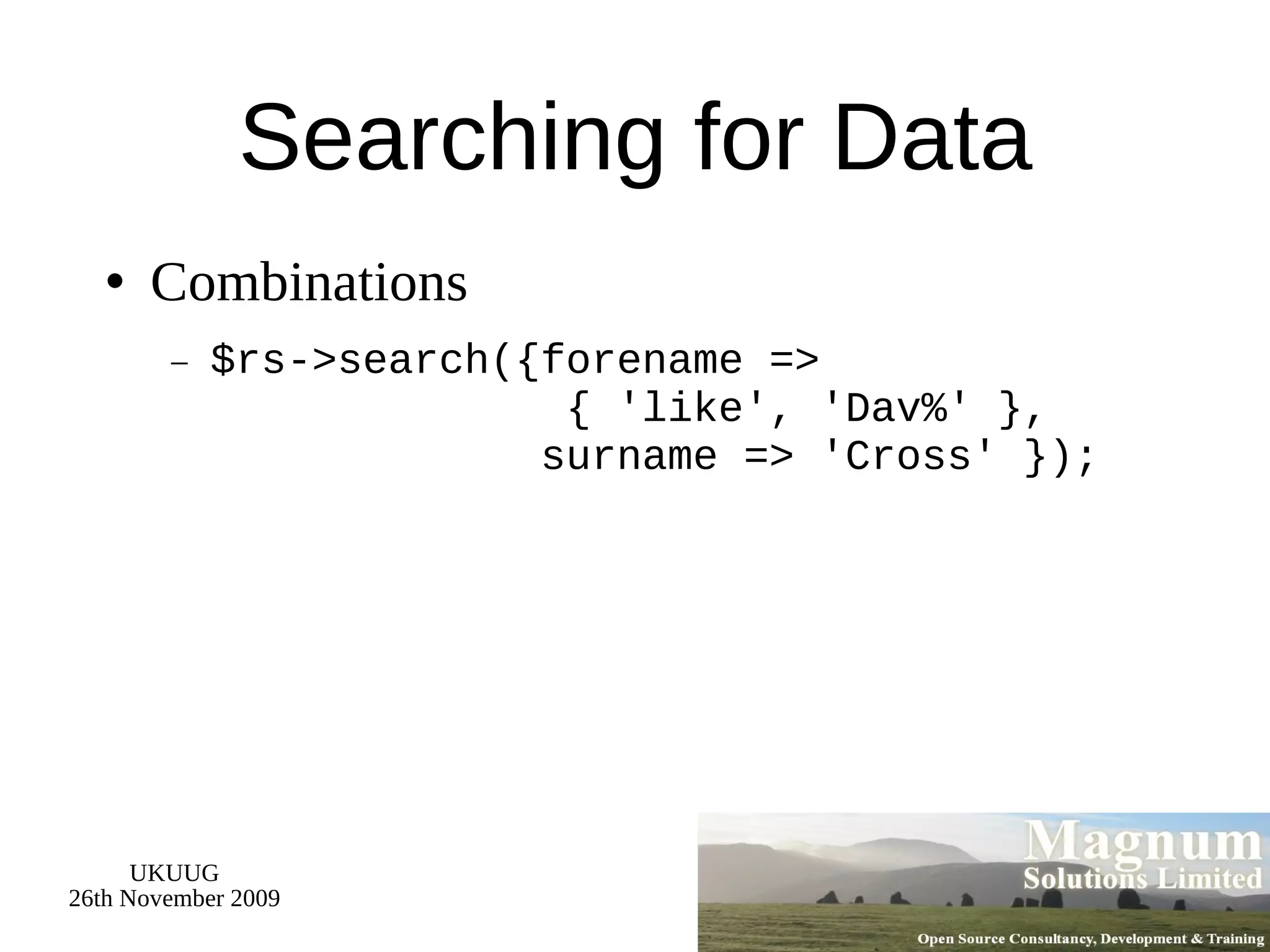
Searching for Data Search conditions can be more complex Alternatives $rs->search({year => 2006},   {year => 2007}); Like $rs->search({name =>   { 'like', 'Dav%' }});
Searching for Data Combinations $rs->search({forename =>   { 'like', 'Dav%' },   surname => 'Cross' });
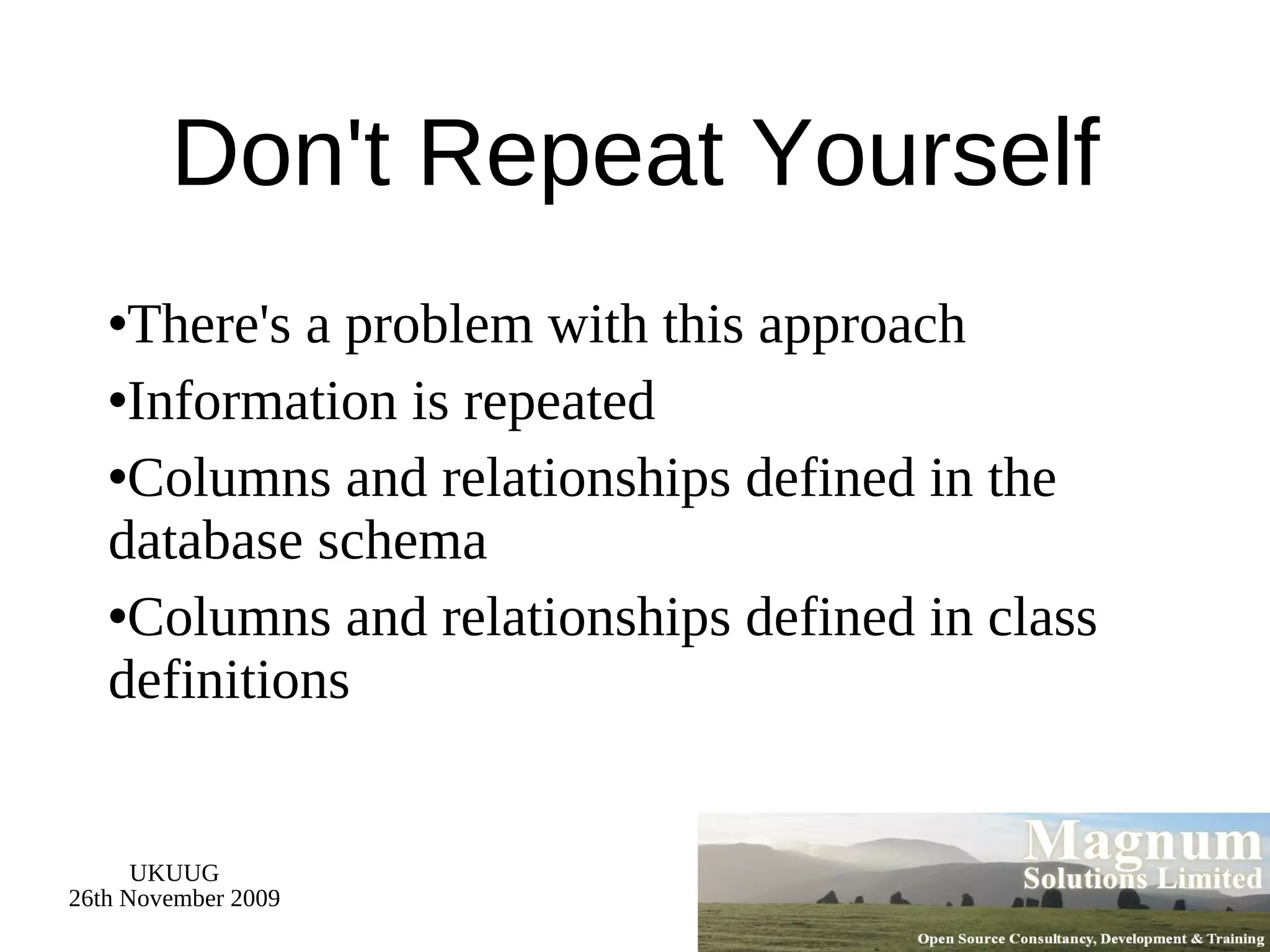
Don't Repeat Yourself There's a problem with this approach Information is repeated Columns and relationships defined in the database schema Columns and relationships defined in class definitions
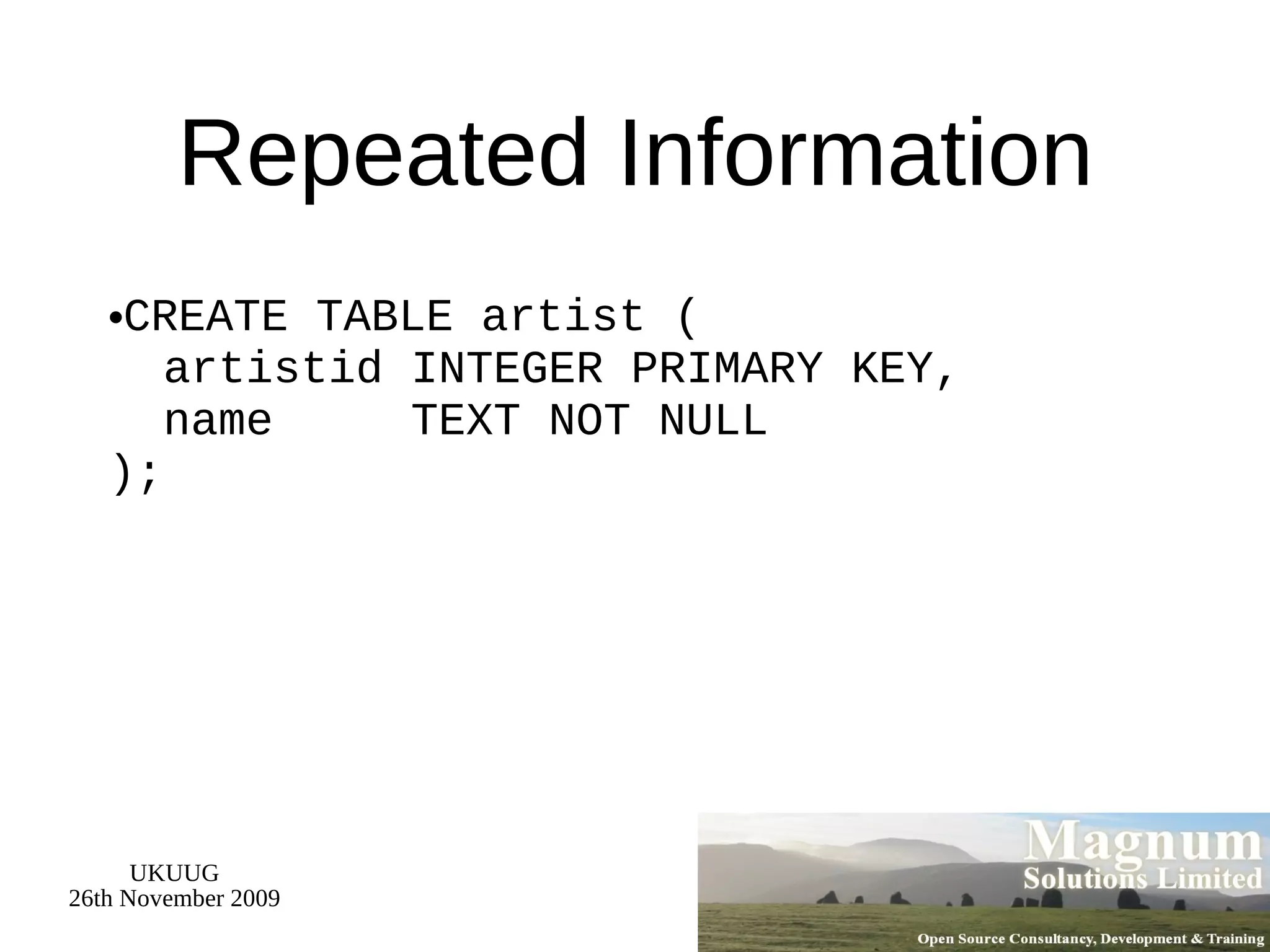
Repeated Information CREATE TABLE artist (   artistid INTEGER PRIMARY KEY,   name  TEXT NOT NULL  );
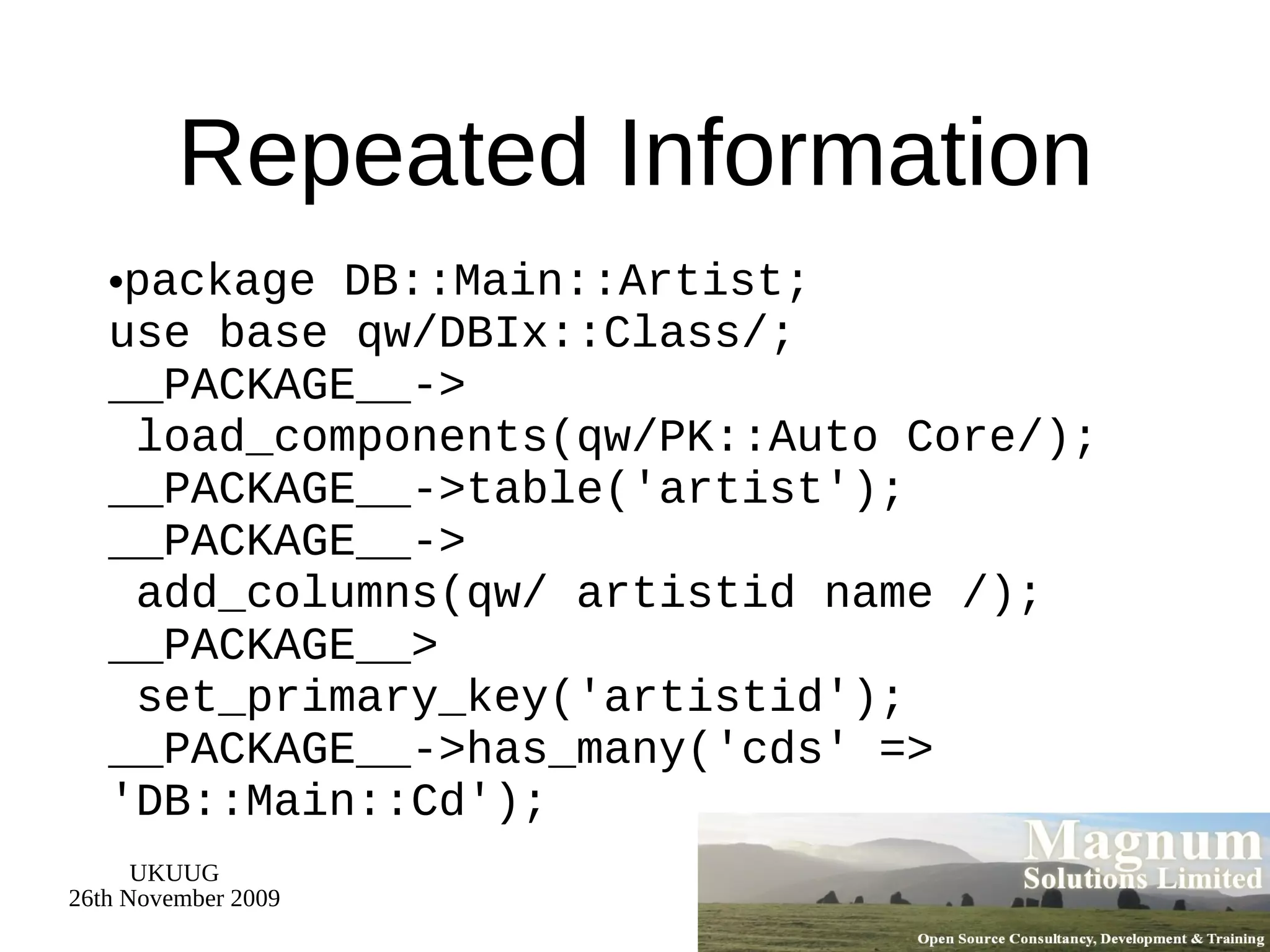
Repeated Information package DB::Main::Artist; use base qw/DBIx::Class/; __PACKAGE__->  load_components(qw/PK::Auto Core/); __PACKAGE__->table('artist'); __PACKAGE__->  add_columns(qw/ artistid name /); __PACKAGE__>  set_primary_key('artistid'); __PACKAGE__->has_many('cds' => 'DB::Main::Cd');
Database Metadata Some people don't put enough metadata in their databases Just tables and columns No relationships. No constraints You may as well make each column VARCHAR(255)
Database Metadata Describe your data in your database It's what your database is for It's what your database does best
No Metadata (Excuse 1) &quot;This is the only application that will ever access this database&quot; Bollocks All data will be shared eventually People will update your database using other applications Can you guarantee that someone won't use mysql to update your database?
No Metadata (Excuse 2) &quot;Database doesn't support those features&quot; Bollocks MySQL 3.x is not a database It's a set of data files with a vaguely SQL-like query syntax MySQL 4.x is a lot better MySQL 5.x is most of the way there Don't be constrained by using inferior tools
DBIC::Schema::Loader Creates classes by querying your database metadata No more repeated data We are now DRY Schema definitions in one place But... Performance problems
Performance Problems You don't really want to generate all your class definitions each time your program is run Need to generate the classes in advance dump_to_dir  method Regenerate classes each time schema changes
Alternative Approach Need one canonical definition of the data tables Doesn't need to be SQL DDL Could be in Perl code Write DBIx::Class definitions Generate DDL from those Harder approach Might need to generate ALTER TABLE
Conclusions ORM is a bridge between relational objects and program objects Avoid writing SQL in common cases DBIx::Class is the currently fashionable module Lots of plugins Caveat: ORM may be overkill for simple programs
More Information Manual pages (on CPAN) DBIx::Class DBIx::Class::Manual::* DBIx::Class::Schema::Loader Mailing list (Google for it)
Moose
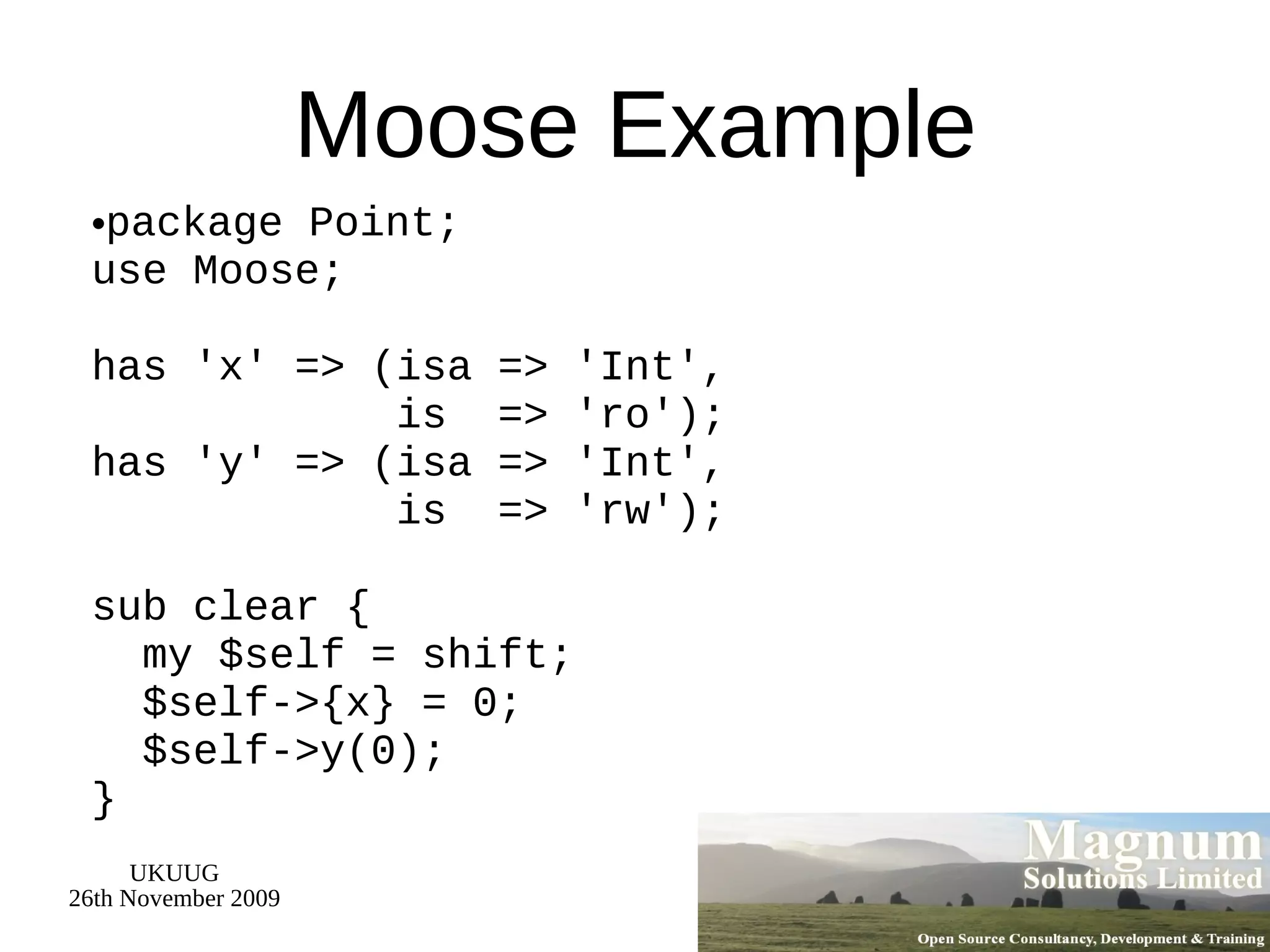
Moose A complete modern object system for Perl 5 Based on experiments with Perl 6 object model Built on top of Class::MOP MOP - Meta Object Protocol Set of abstractions for components of an object system Classes, Objects, Methods, Attributes An example might help
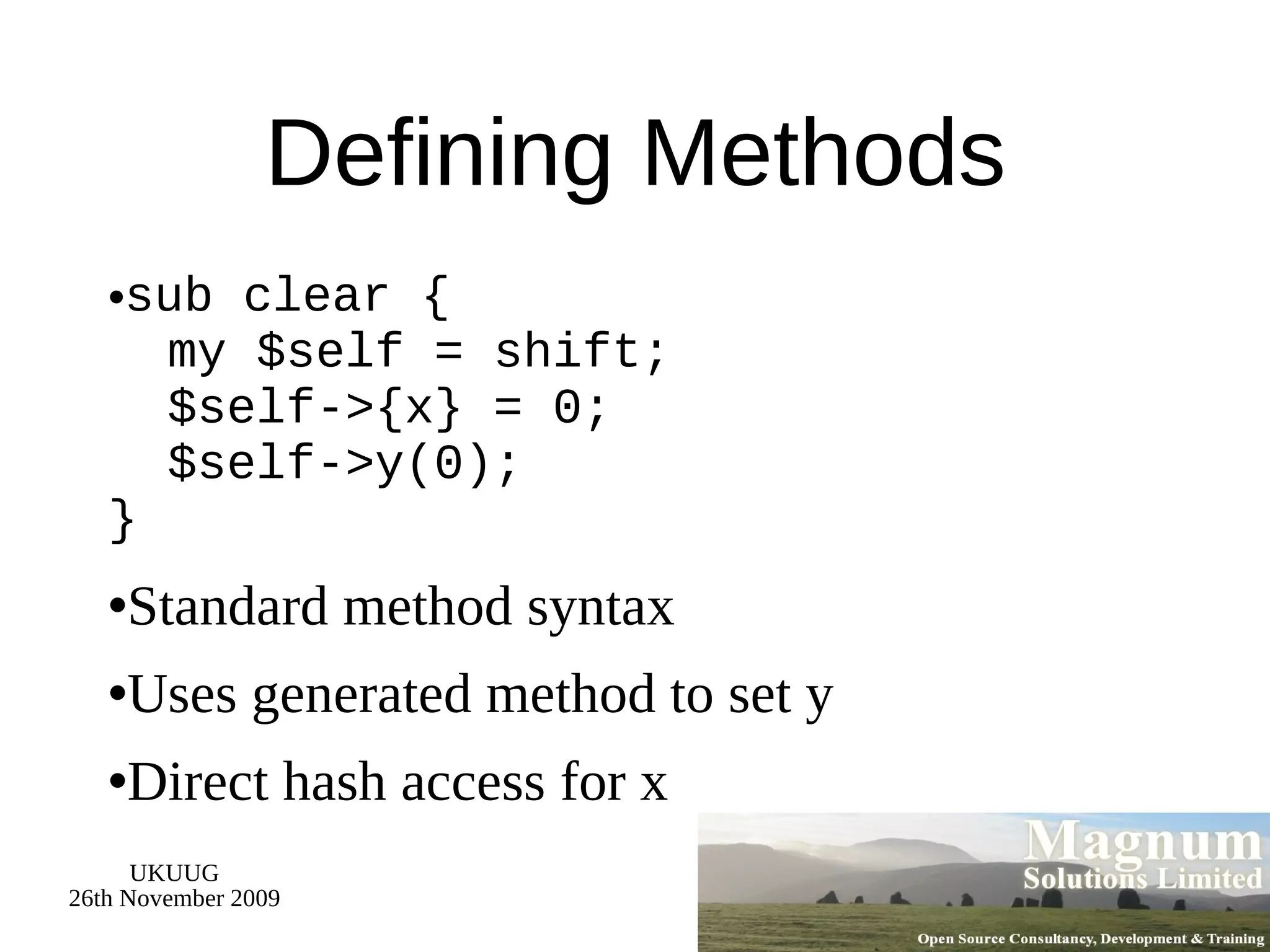
Moose Example package Point; use Moose; has 'x' => (isa => 'Int',   is  => 'ro'); has 'y' => (isa => 'Int',   is  => 'rw'); sub clear {   my $self = shift;   $self->{x} = 0;   $self->y(0); }
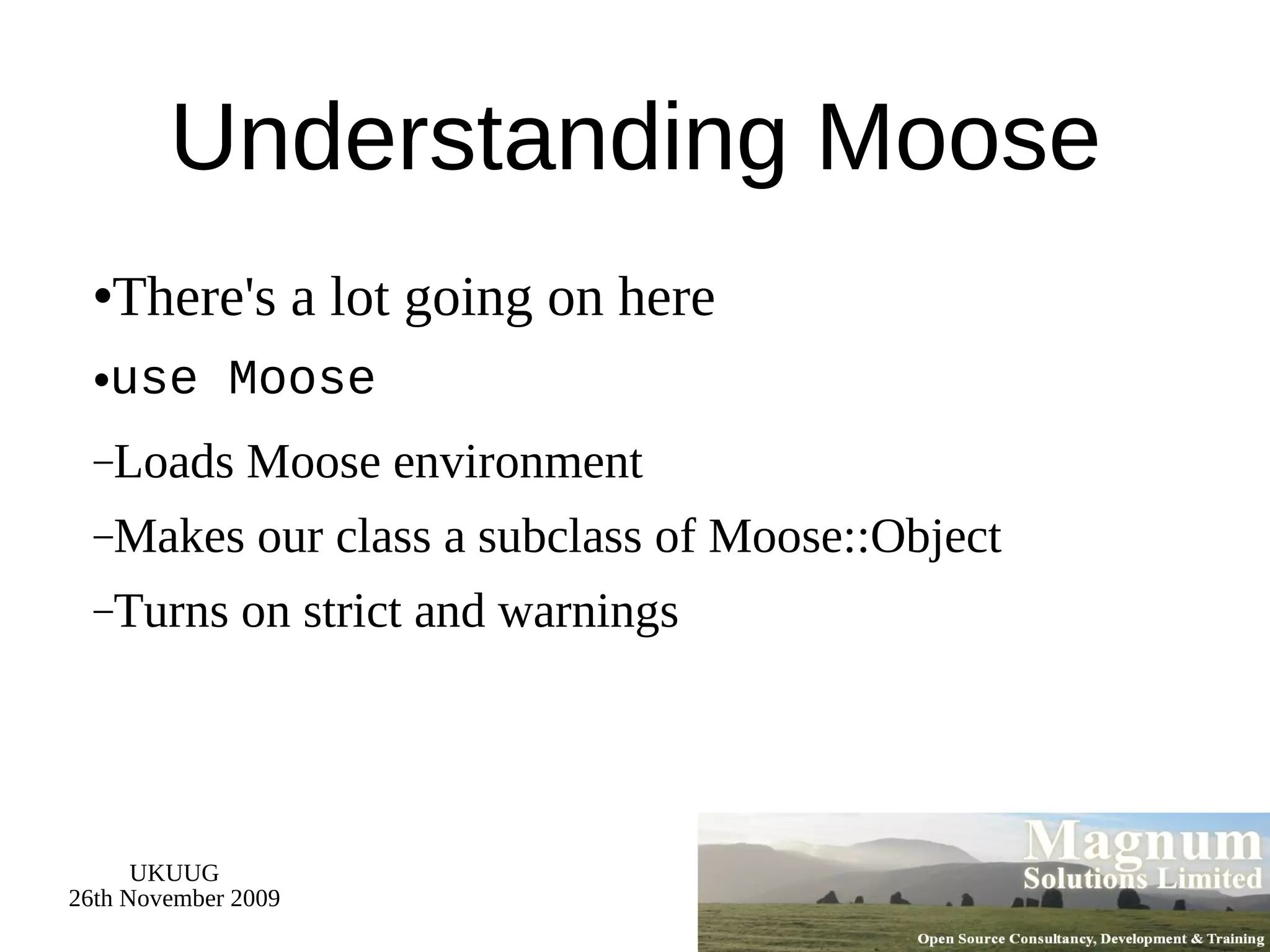
Understanding Moose There's a lot going on here use Moose Loads Moose environment Makes our class a subclass of Moose::Object Turns on strict and warnings
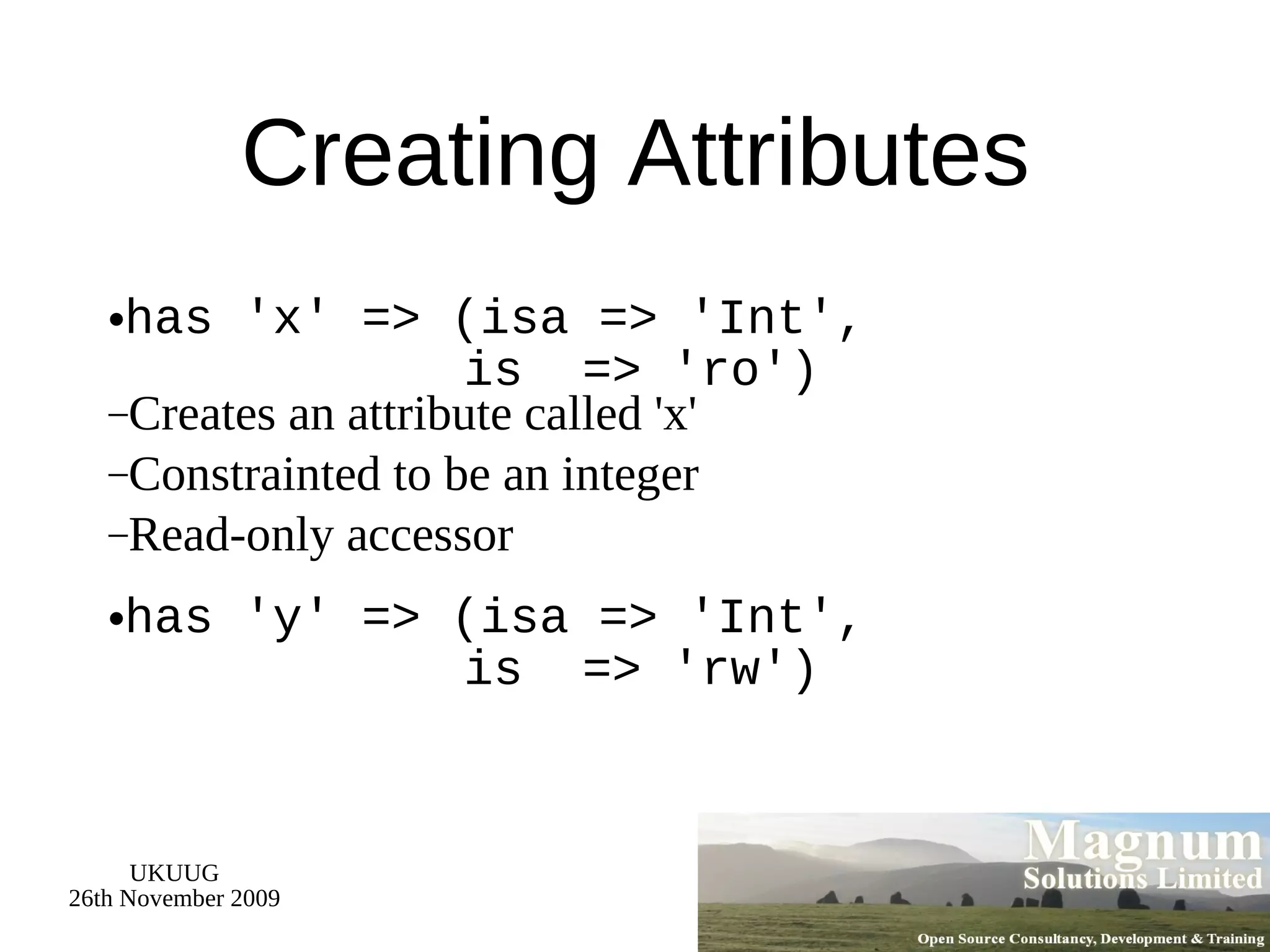
Creating Attributes has 'x' => (isa => 'Int',   is  => 'ro') Creates an attribute called 'x' Constrainted to be an integer Read-only accessor has 'y' => (isa => 'Int',   is  => 'rw')
Defining Methods sub clear {   my $self = shift;   $self->{x} = 0;   $self->y(0); } Standard method syntax Uses generated method to set y Direct hash access for x
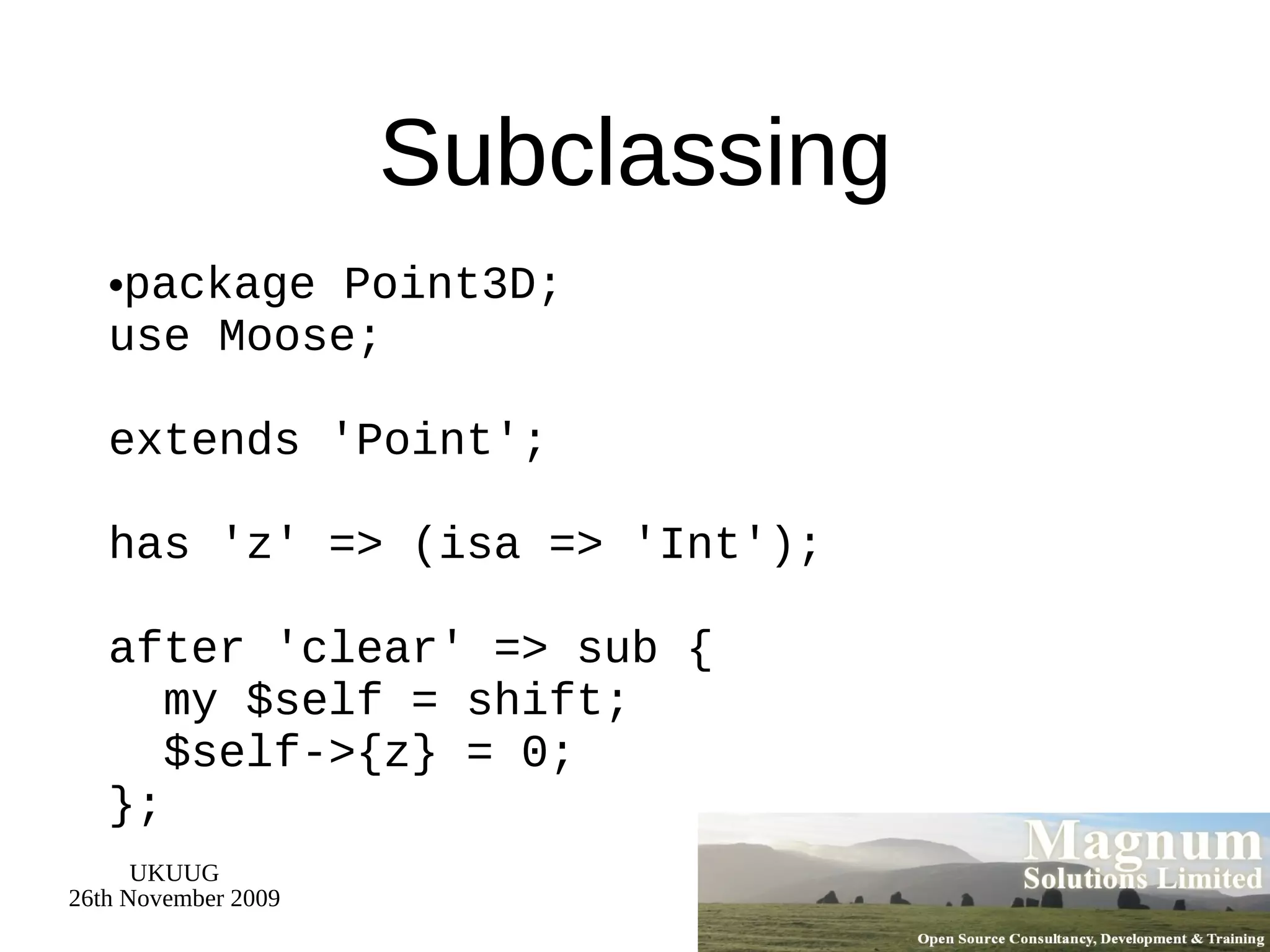
Subclassing package Point3D; use Moose; extends 'Point'; has 'z' => (isa => 'Int'); after 'clear' => sub {   my $self = shift;   $self->{z} = 0; };
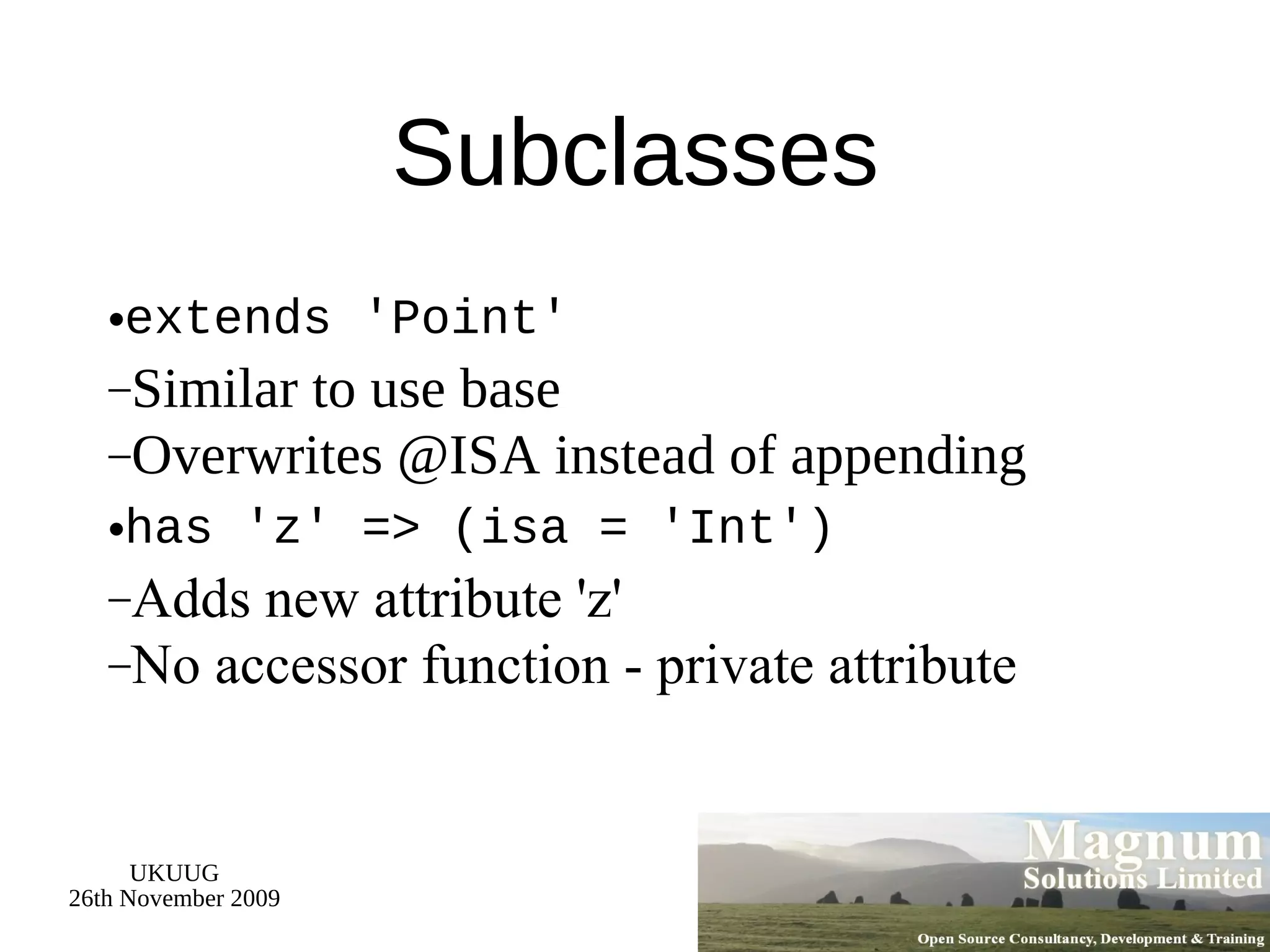
Subclasses extends 'Point' Similar to use base Overwrites @ISA instead of appending has 'z' => (isa = 'Int') Adds new attribute 'z' No accessor function - private attribute
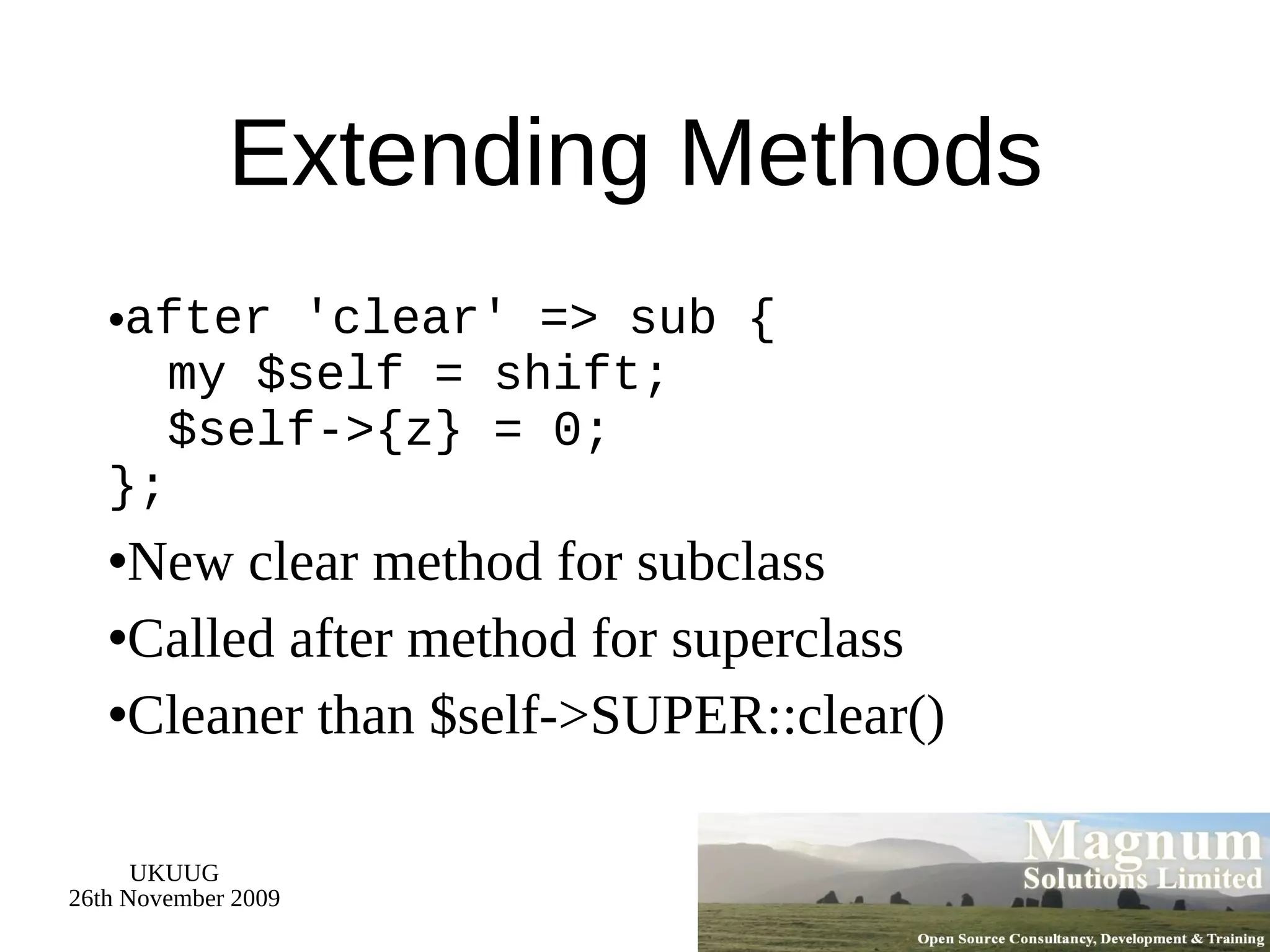
Extending Methods after 'clear' => sub {   my $self = shift;   $self->{z} = 0; }; New clear method for subclass Called after method for superclass Cleaner than $self->SUPER::clear()
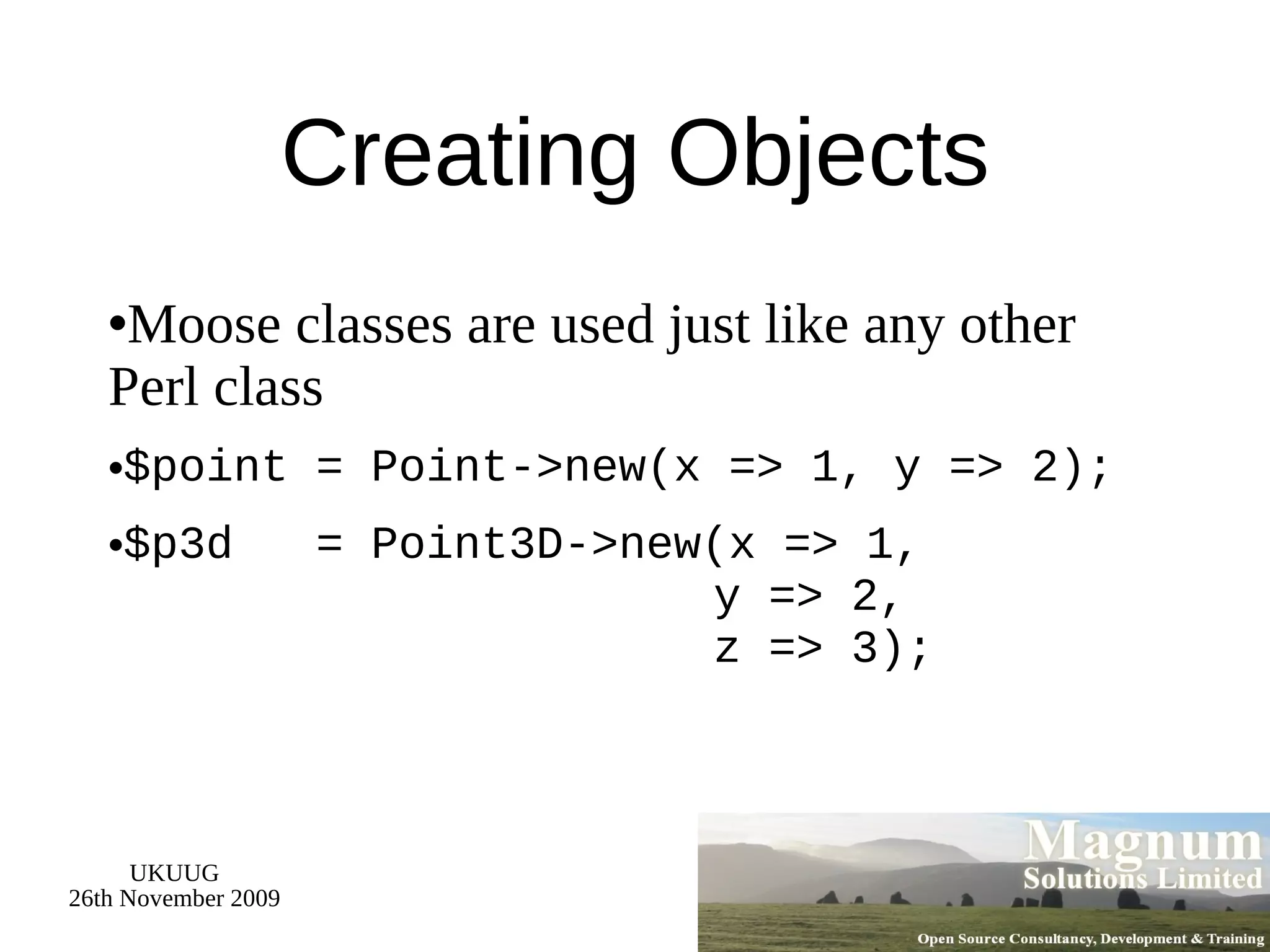
Creating Objects Moose classes are used just like any other Perl class $point = Point->new(x => 1, y => 2); $p3d  = Point3D->new(x => 1,   y => 2,   z => 3);
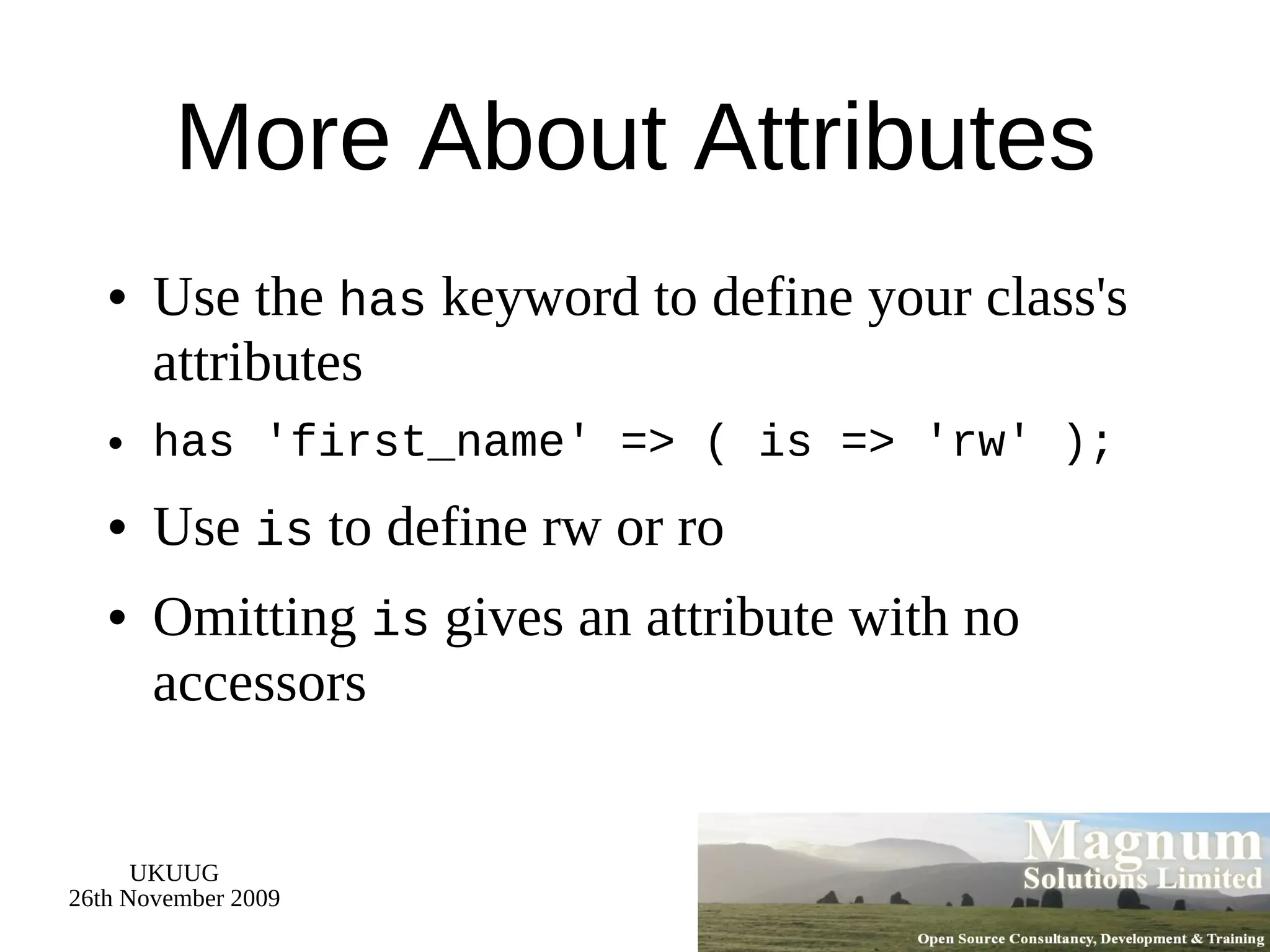
More About Attributes Use the  has  keyword to define your class's attributes has 'first_name' => ( is => 'rw' ); Use  is  to define rw or ro Omitting  is  gives an attribute with no accessors
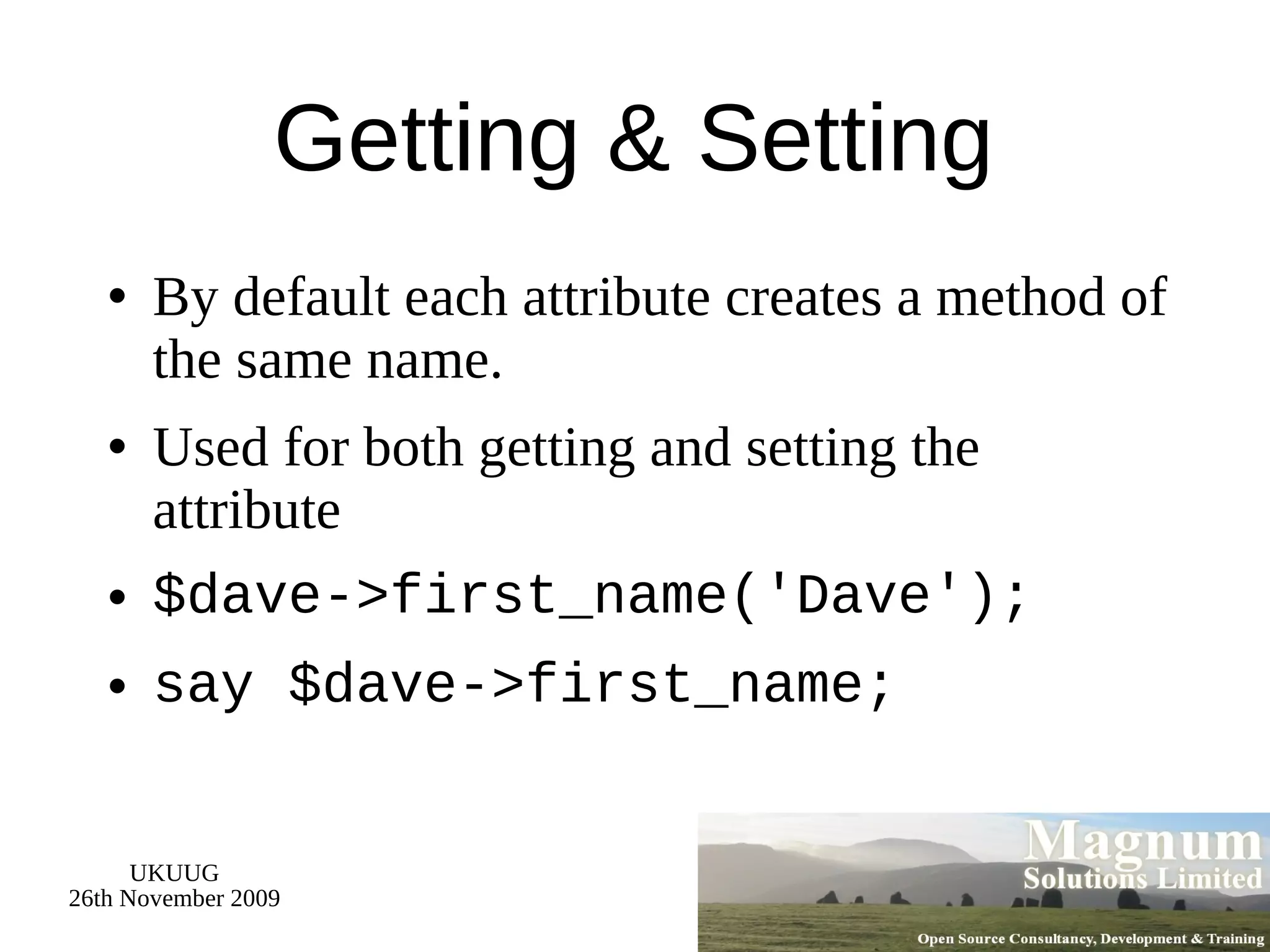
Getting & Setting By default each attribute creates a method of the same name. Used for both getting and setting the attribute $dave->first_name('Dave'); say $dave->first_name;
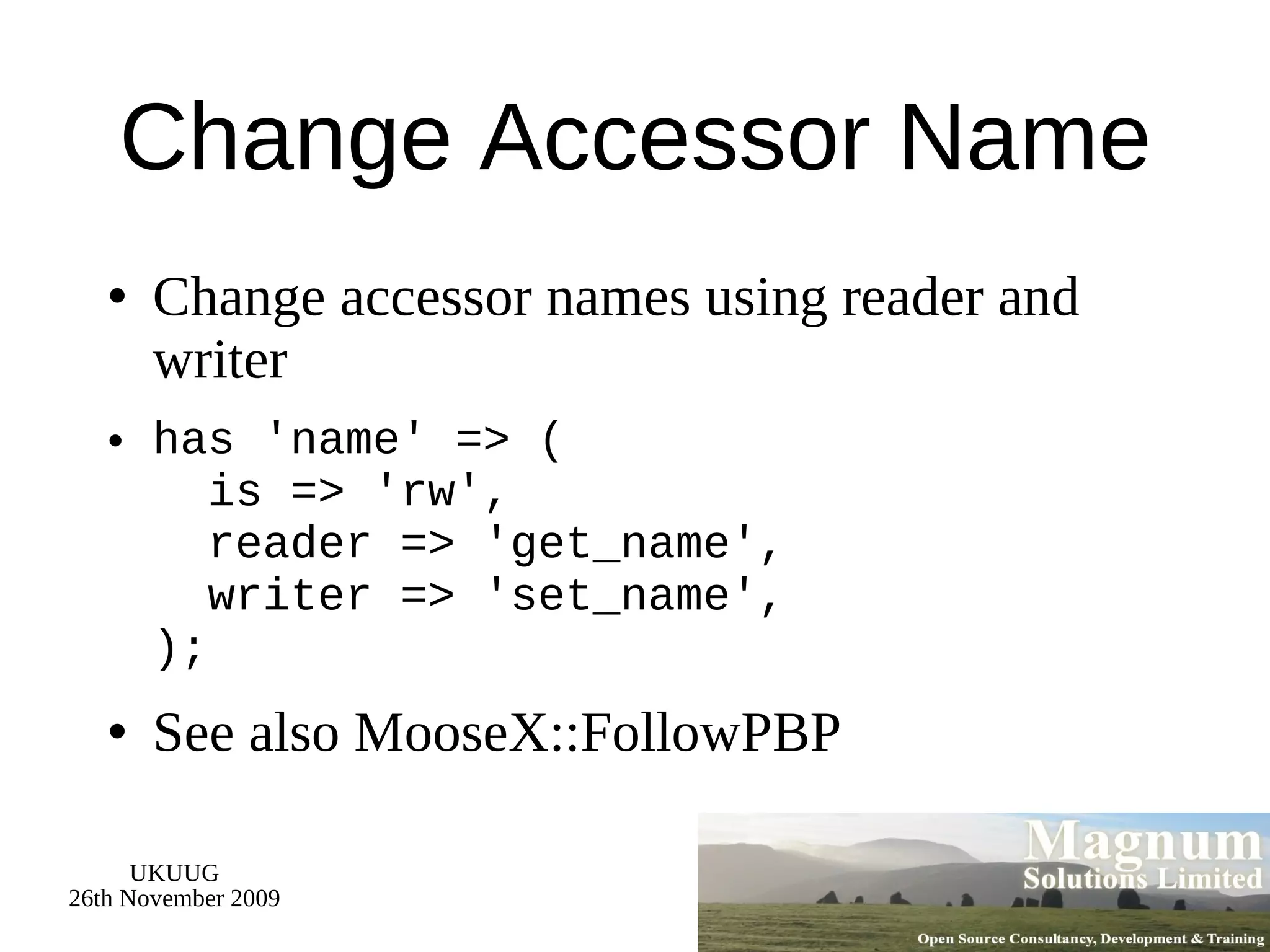
Change Accessor Name Change accessor names using reader and writer has 'name' => (   is => 'rw',   reader => 'get_name',   writer => 'set_name', ); See also MooseX::FollowPBP
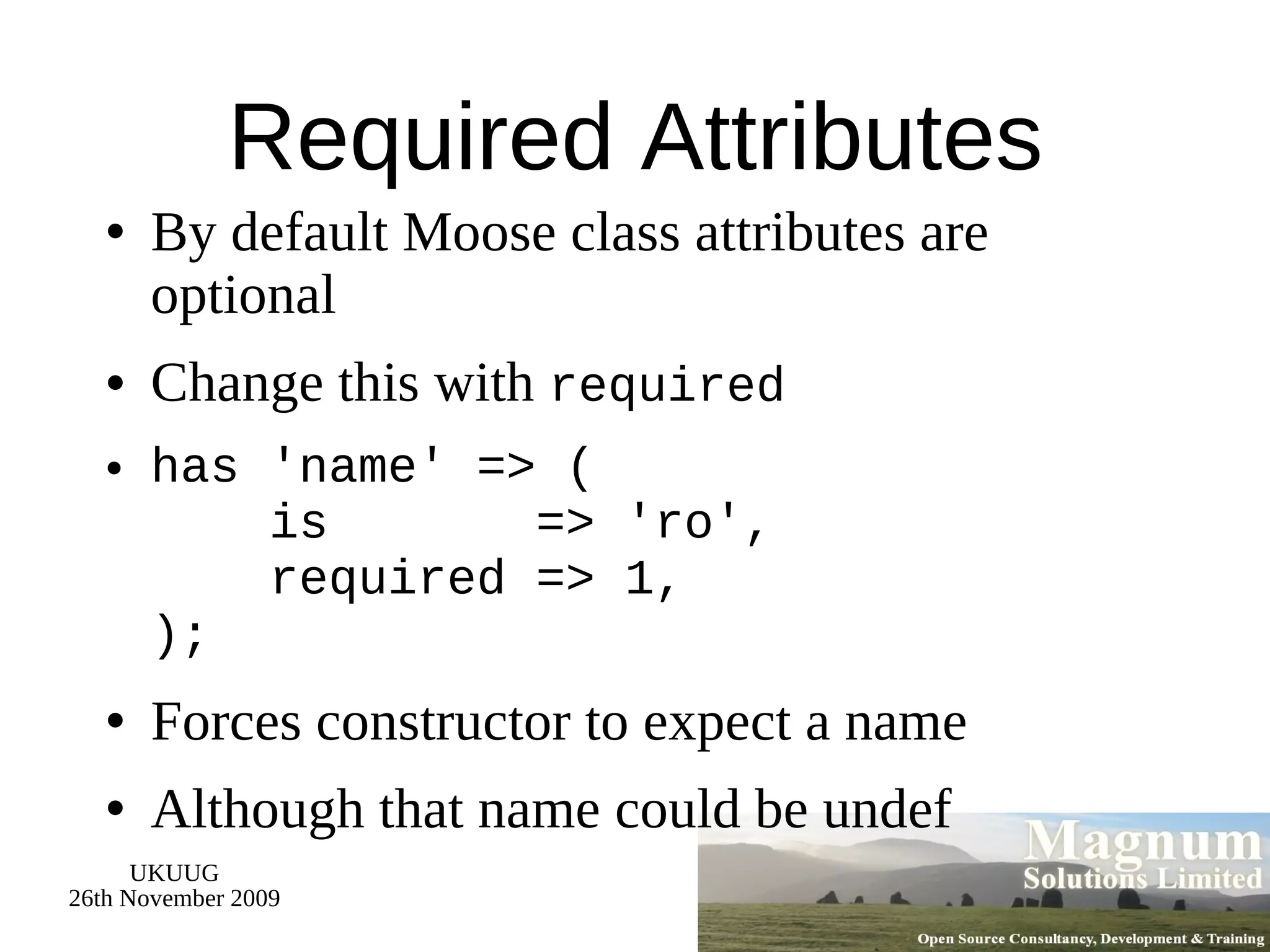
Required Attributes By default Moose class attributes are optional Change this with  required has 'name' => (   is  => 'ro',   required => 1, ); Forces constructor to expect a name Although that name could be undef
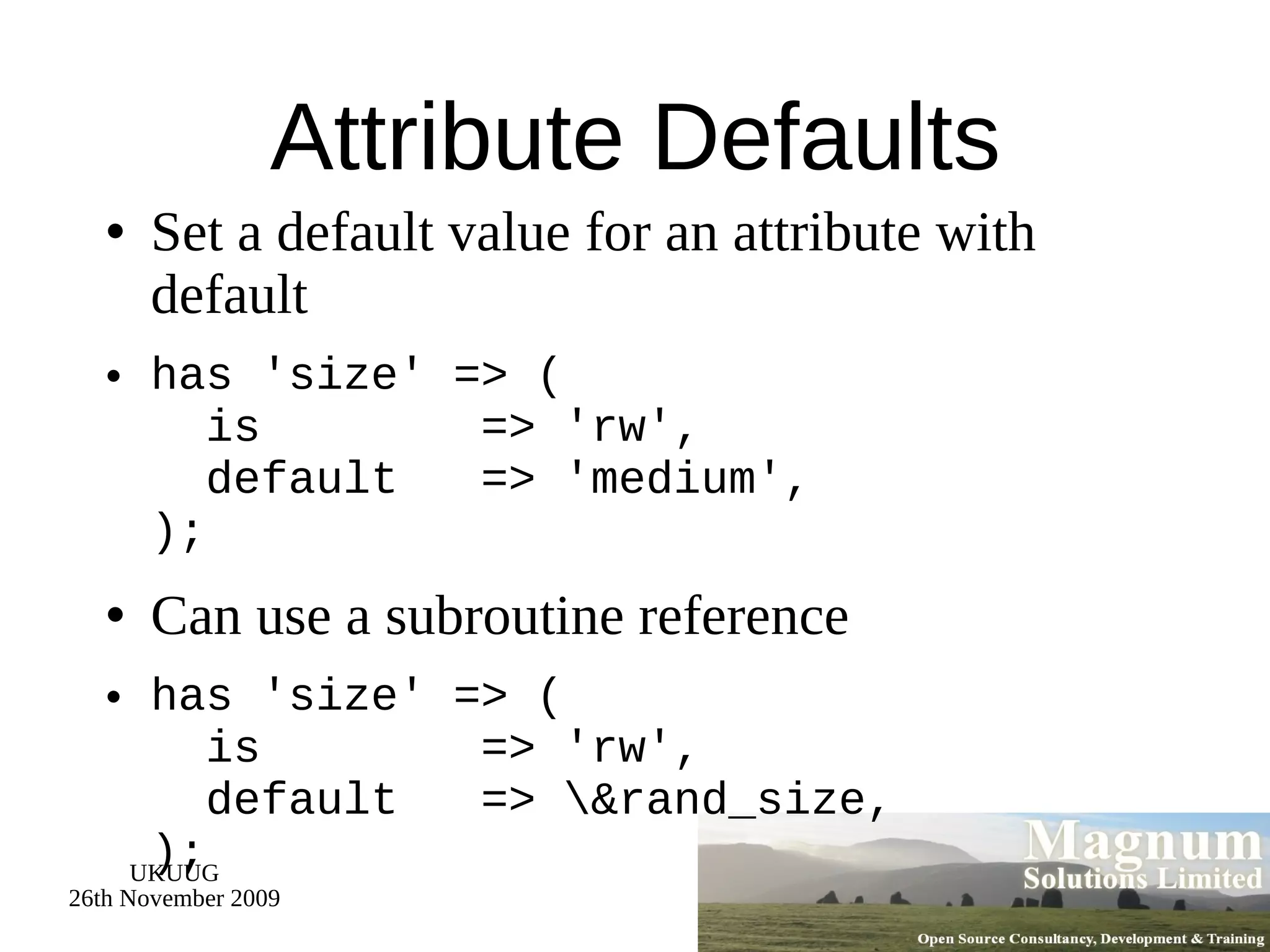
Attribute Defaults Set a default value for an attribute with default has 'size' => (   is  => 'rw',   default  => 'medium', ); Can use a subroutine reference has 'size' => (   is  => 'rw',   default  => \&rand_size, );
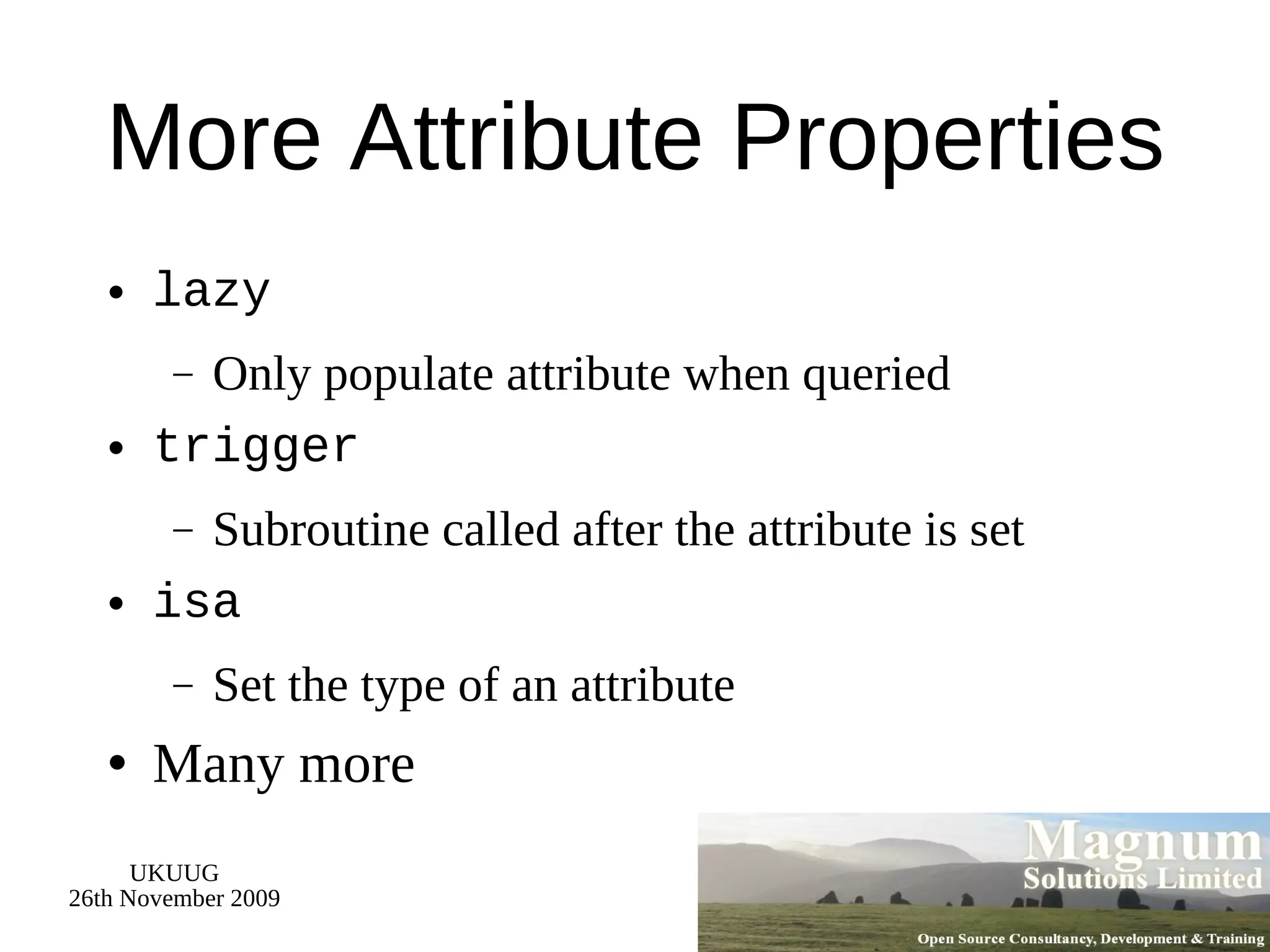
More Attribute Properties lazy Only populate attribute when queried trigger Subroutine called after the attribute is set isa Set the type of an attribute Many more
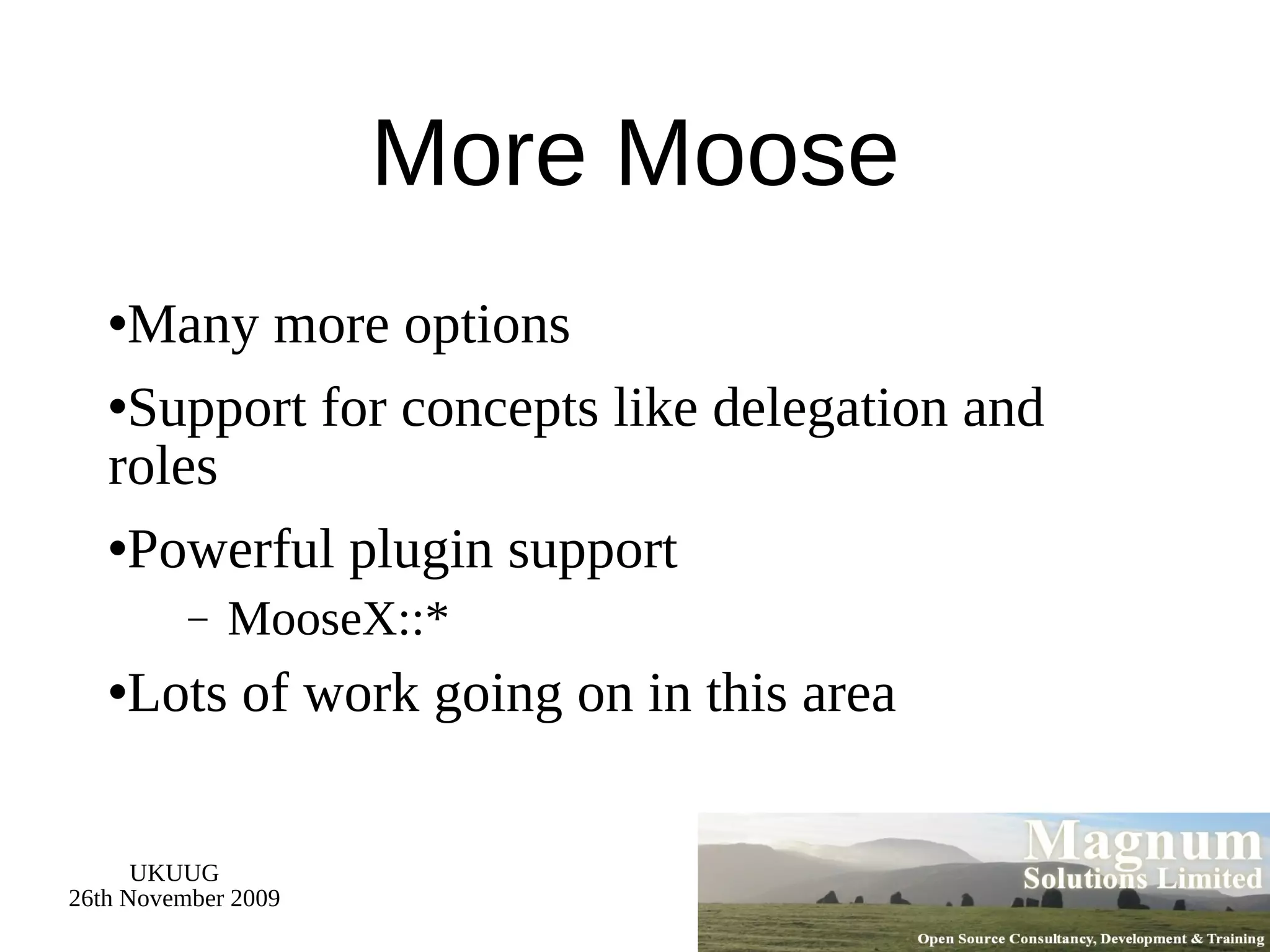
More Moose Many more options Support for concepts like delegation and roles Powerful plugin support MooseX::* Lots of work going on in this area
Catalyst
MVC Frameworks MVC frameworks are a popular way to write applications Particularly web applications
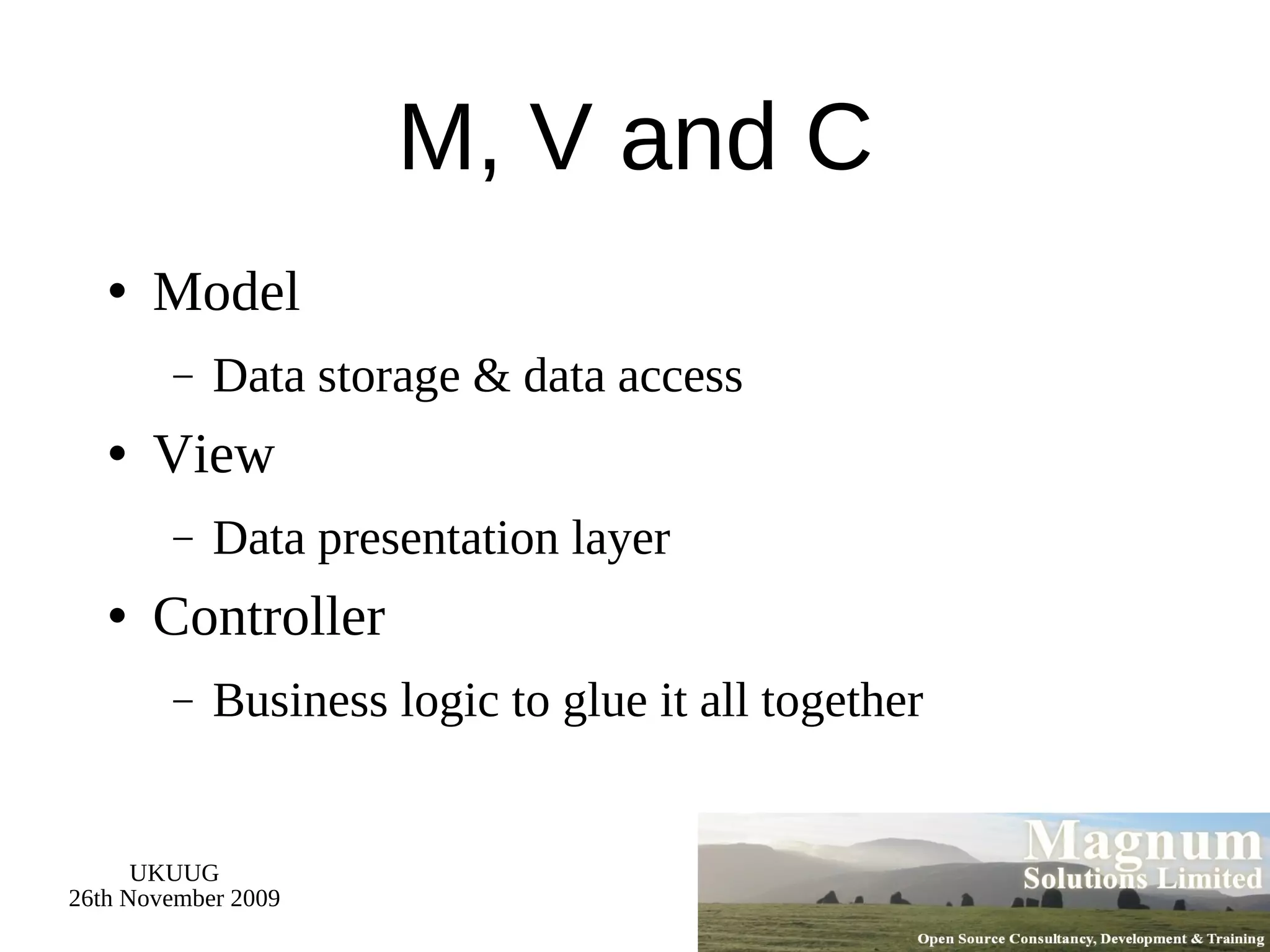
M, V and C Model Data storage & data access View Data presentation layer Controller Business logic to glue it all together
MVC Examples Ruby on Rails Django (Python) Struts (Java) CakePHP Many examples in most languages Perl has many options
MVC in Perl Maypole The original Perl MVC framework CGI::Application Simple MVC for CGI programming Jifty Developed and used by Best Practical Catalyst Currently the popular choice
Catalyst MVC framework in Perl Building on other heavily-used tools Model uses DBIx::Class View uses Template Toolkit These are just defaults Can use anything you want
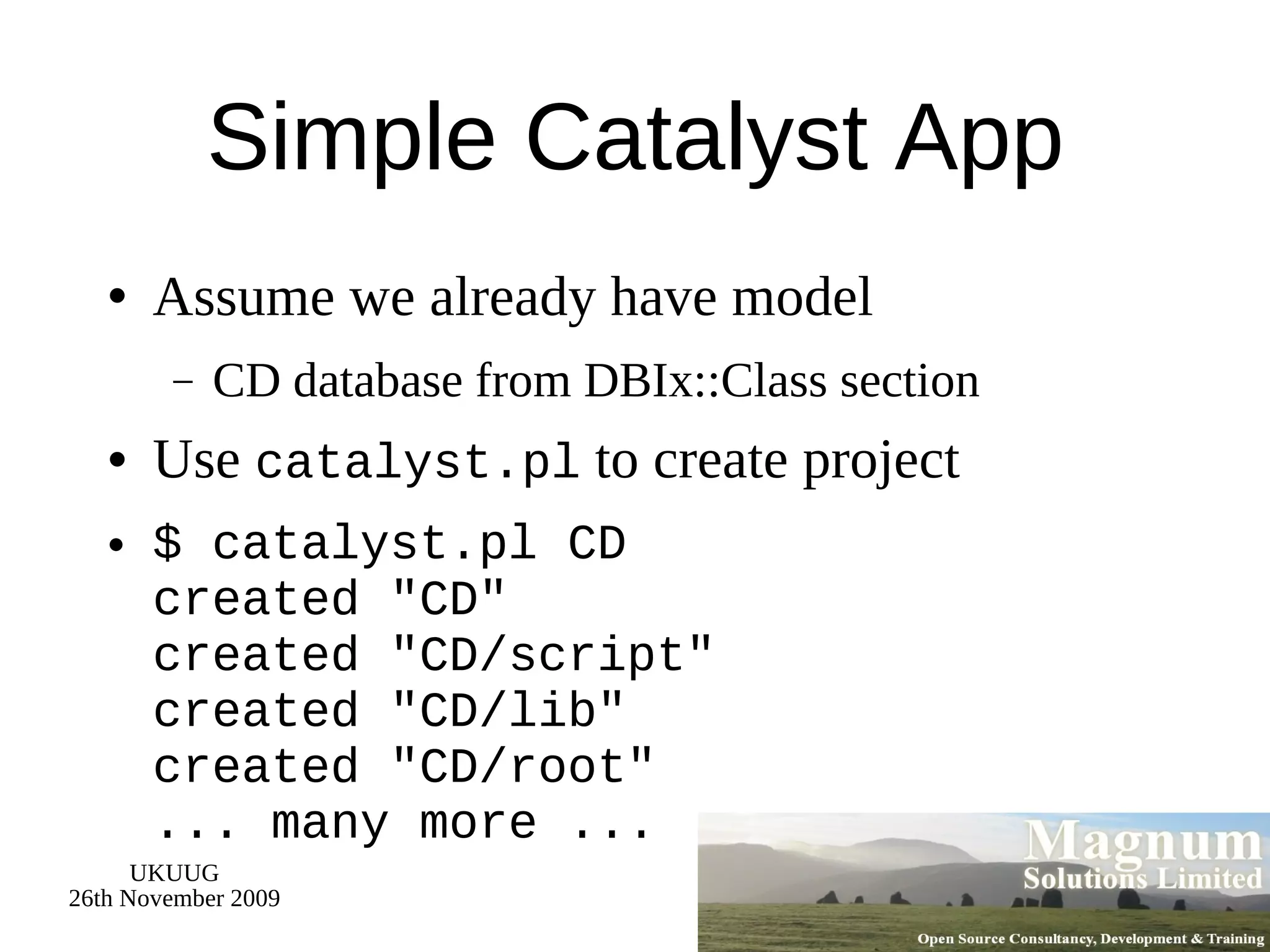
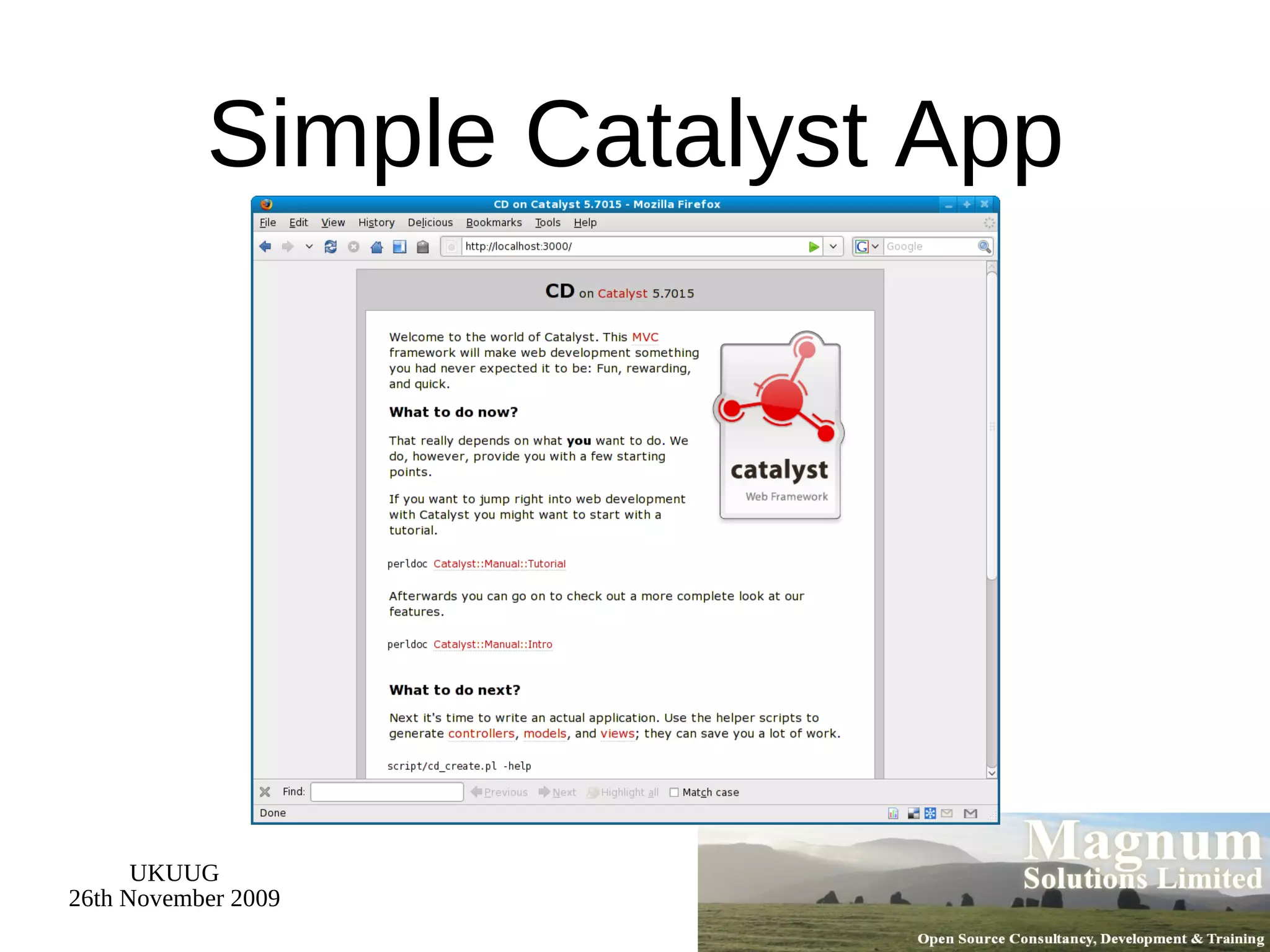
Simple Catalyst App Assume we already have model CD database from DBIx::Class section Use  catalyst.pl  to create project $ catalyst.pl CD created &quot;CD&quot; created &quot;CD/script&quot; created &quot;CD/lib&quot; created &quot;CD/root&quot; ... many more ...
What Just Happened? Catalyst just generated a lot of useful stuff for us Test web servers Standalone and FastCGI Configuration files Test stubs Helpers for creating models, views and controllers
A Working Application We already have a working application $ CD/script/cd_server.pl ... lots of output [info] CD powered by Catalyst 5.7015 You can connect to your server at http://localhost:3000 Of course, it doesn't do much yet
Simple Catalyst App
Next Steps Use various helper programs to create models and views for your application Write controller code to tie it all together Many plugins to handle various parts of the process Authentication URL resolution Session handling etc...
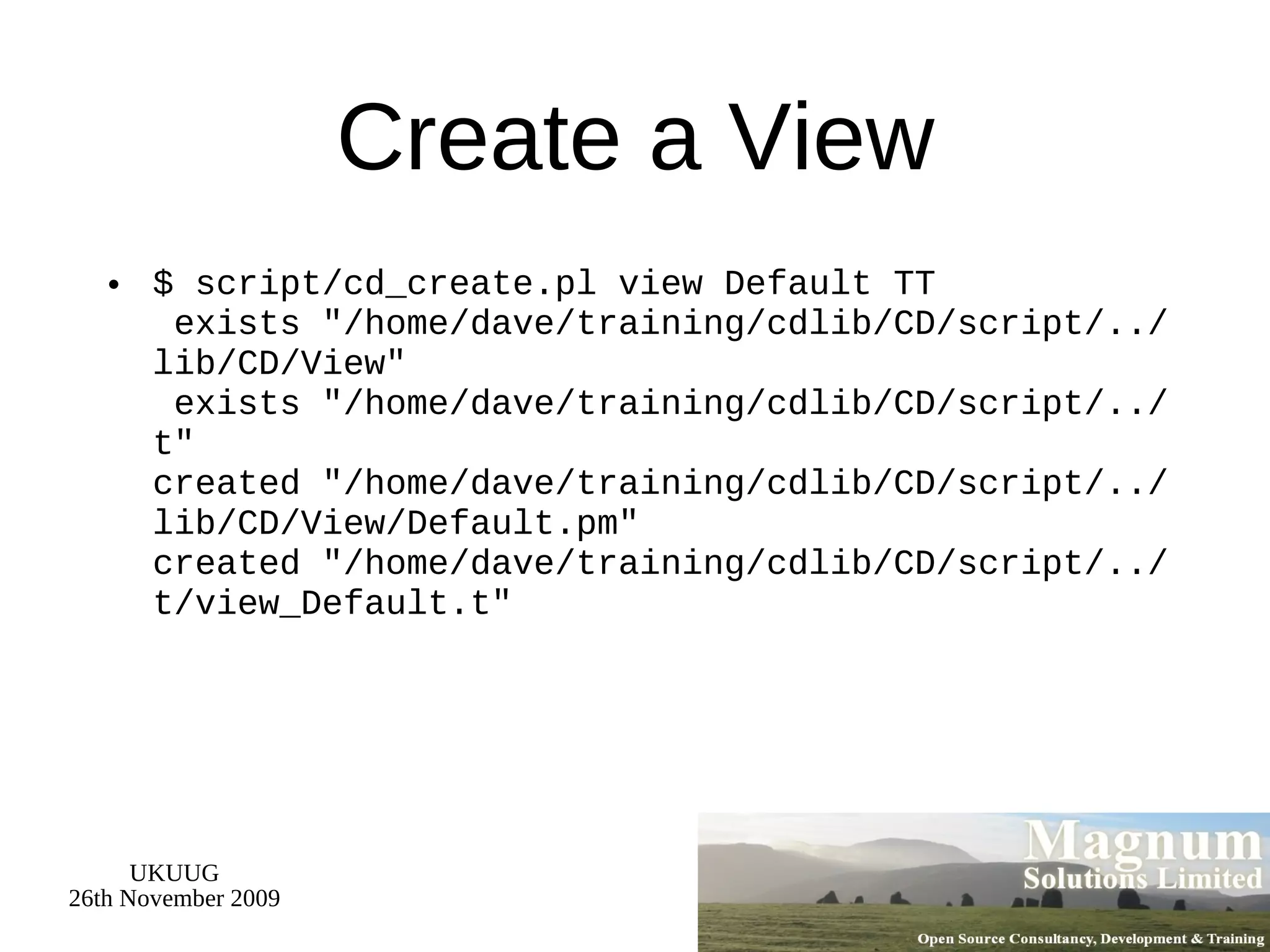
Create a View $ script/cd_create.pl view Default TT  exists &quot;/home/dave/training/cdlib/CD/script/../lib/CD/View&quot;  exists &quot;/home/dave/training/cdlib/CD/script/../t&quot; created &quot;/home/dave/training/cdlib/CD/script/../lib/CD/View/Default.pm&quot; created &quot;/home/dave/training/cdlib/CD/script/../t/view_Default.t&quot;
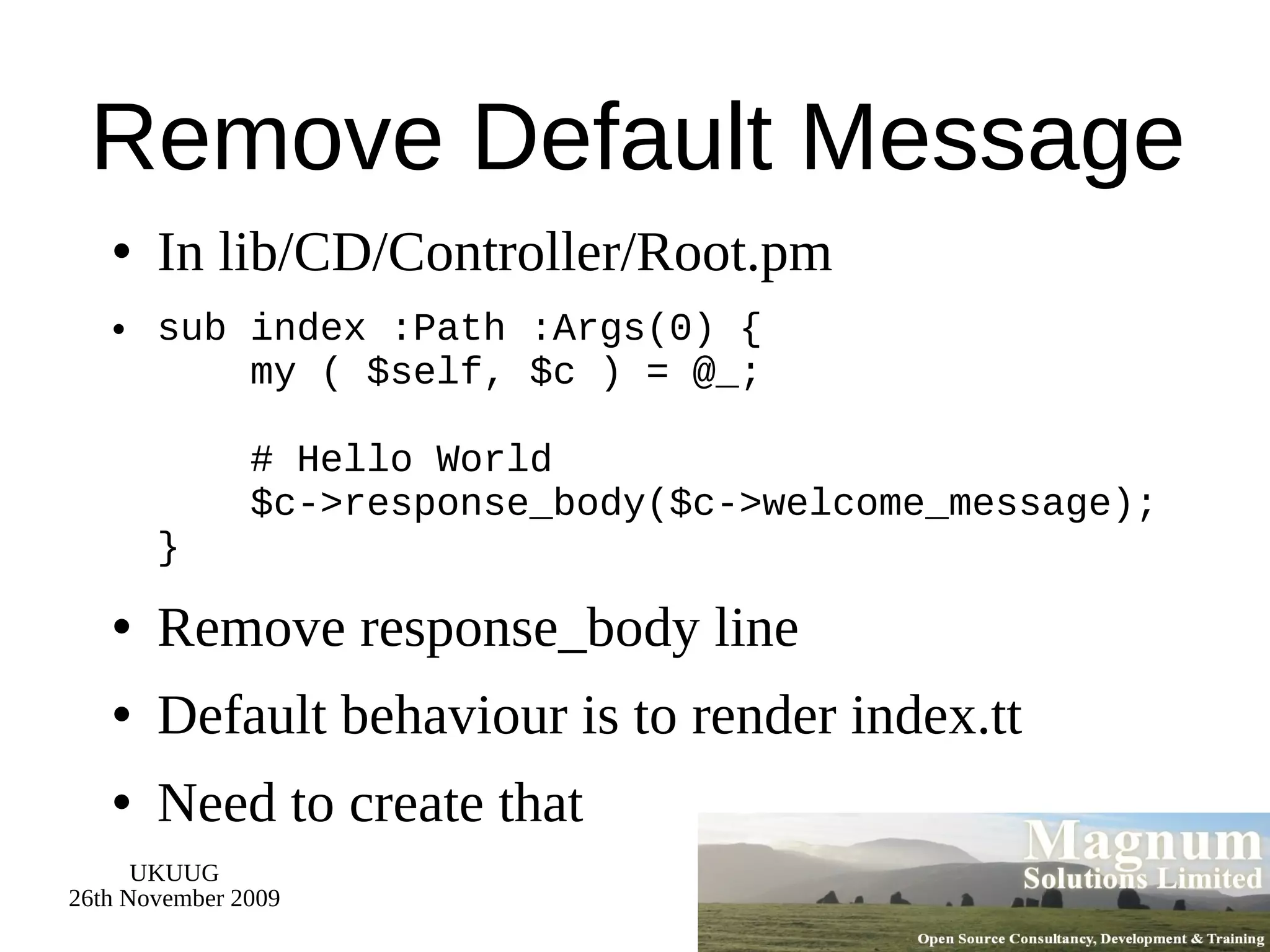
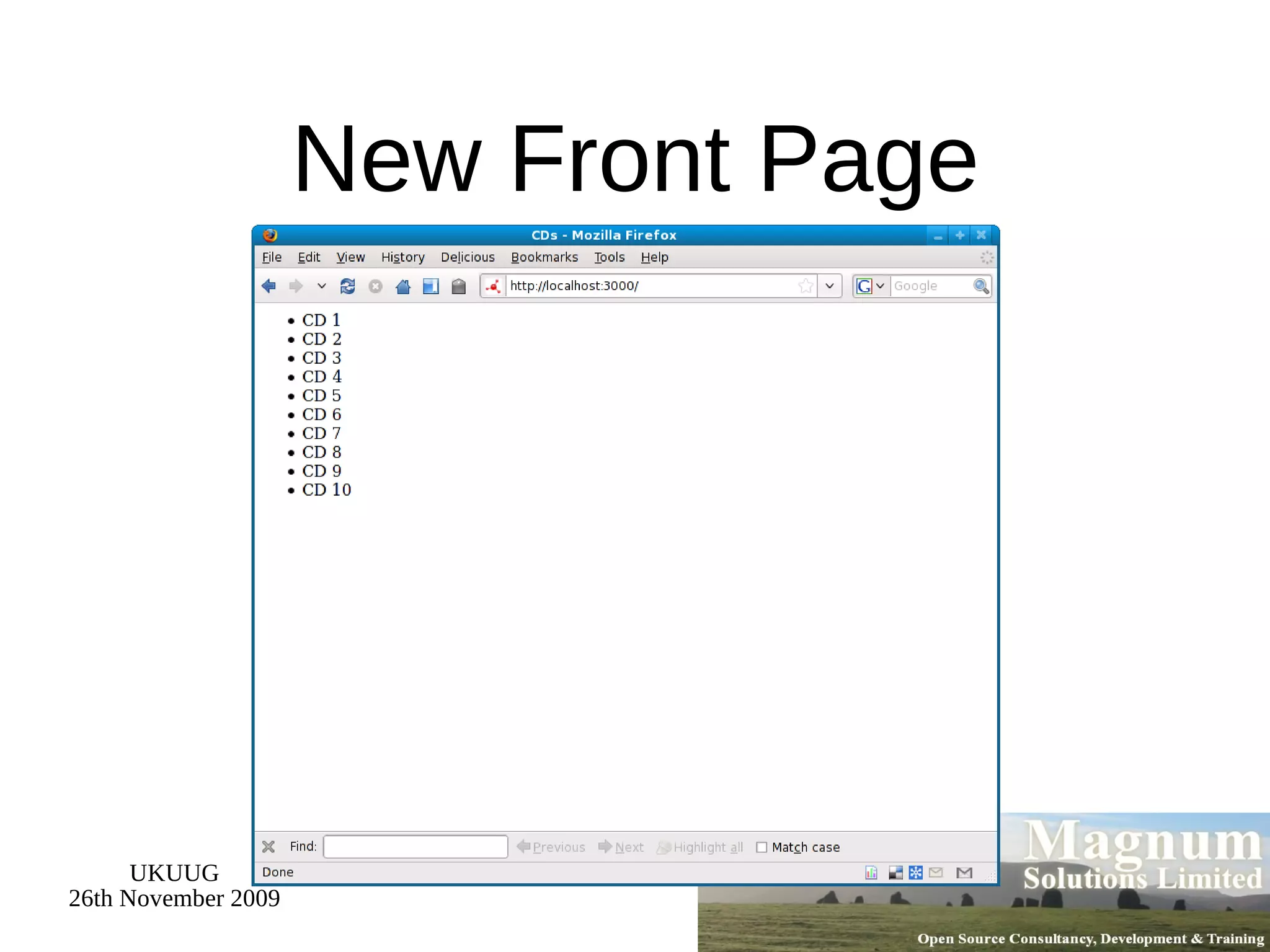
Remove Default Message In lib/CD/Controller/Root.pm sub index :Path :Args(0) {   my ( $self, $c ) = @_;   # Hello World   $c->response_body($c->welcome_message); } Remove response_body line Default behaviour is to render index.tt Need to create that
index.tt root/index.tt <html>   <head>   <title>CDs</title>   </head>   <body>   <ul> [% FOREACH cd IN [ 1 .. 10 ] %]   <li>CD [% cd %]</li> [% END %]   </ul>   </body> </html>
New Front Page
Adding Data Of course that's hard-coded data Need to add a model class And then more views And some controllers There's a lot to do I recommend working through a tutorial
Easier Catalyst A lot of web applications do similar things Given a database Produce screens to edit the data Surely most of this can be automated It's called Catalyst::Plugin::AutoCRUD (Demo)
Cat::Plugin::AutoCRUD Does a lot of work On the fly For every request No security on table updates So it's not right for every project Very impressive though
Conclusions There's a lot to bear in mind when writing a web app Using the right framework can help Catalyst is the most popular Perl framework As powerful as any other framework In any language Lots of work still going on Large team, active development
Recommended Book The Definitive Guide to Catalyst Kieren Diment Matt S Trout
Further Information
Further Information Some suggestions for places to go for further information Web sites Books Magazines Mailing lists Conferences
London Perl Mongers http://london.pm.org/ Mailing list Regular meetings Both social and technical London Perl Workshop 5 th  December 2009 Many other local Perl Monger groups http://pm.org/
Web Sites The Perl directory http://perl.org/ Lists of many Perl-related sites use Perl; Perl news site Also journals
Web Sites Perl Monks Best web site for Perl questions Many Perl experts
Perl Blogs Perl Iron Man http://ironman.enlightenedperl.org/ Planet Perl http://planet.perl.org/ Perlsphere http://perlsphere.net/ blogs.perl.org http://blogs.perl.org/
Books Some recent Perl books Perl Best Practices  - Damian Conway Advanced Perl Programming  - Simon Cozens Perl Hacks  - chromatic, Conway & Poe Intermediate Perl  - Schwartz, foy & Phoenix Mastering Perl  - brian d foy
More Books Higher Order Perl  - Mark-Jason Dominus Minimal Perl  - Tim Maher Pro Perl Debugging  - Richard Foley & Joe McMahon Perl & LWP  - Sean M Burke Updated online edition http://lwp.interglacial.com/ See http://books.perl.org/
Mailing Lists Many mailing lists devoted to Perl topics See http://lists.cpan.org/
Conferences The Open Source Convention Portland, Oregon 19-23 July 2010 YAPC Columbus, Ohio 2010 Pisa, Italy 2010 Brazil, Asia, Israel, Australia One-Day Perl Workshops See http://yapc.org/
That's all folks Any questions?

Advanced Perl Techniques

  • 1.
    Advanced Perl TechniquesDave Cross Magnum Solutions Ltd [email_address]
  • 2.
    Advanced Perl TechniquesAdvanced level training for Perl programmers Turn intermediate programmers into advanced programmers “ Modern” Perl Perl is not dying
  • 3.
    Advanced Perl TechniquesOne day isn't enough time We'll be moving fairly fast Lots of pointers to other information Feel free to ask questions
  • 4.
    What We WillCover What's new in Perl 5.10 Testing including coverage analysis Database access DBIx::Class
  • 5.
    What We WillCover Profiling & Benchmarking Object oriented programming with Moose MVC Frameworks Catalyst
  • 6.
    Schedule 09:45 –Begin 11:15 – Coffee break 13:00 – Lunch 14:00 – Begin 15:30 – Coffee break 17:00 – End
  • 7.
    Resources Slides availableon-line http://mag-sol.com/train/public/2009-11/adv Also see Slideshare http://www.slideshare.net/davorg/slideshows Get Satisfaction http://getsatisfaction.com/magnum
  • 8.
  • 9.
    Perl 5.10 Released18 th Dec 2007 Perl's 20 th birthday Many new features Well worth upgrading
  • 10.
    New Features Defined-oroperator Switch operator Smart matching say() Lexical $_
  • 11.
    New Features Statevariables Stacked file tests Regex improvements Many more
  • 12.
    Defined Or Booleanexpressions “short-circuit” $val = $val || $default; $val ||= $default; What if 0 is a valid value? Need to check “definedness” $val = defined $val ? $val : $default; $val = $default unless defined $val;
  • 13.
    Defined Or Thedefined or operator makes this easier $val = $val // $default; A different slant on truth Checks definedness Shortcircuit version too $val //= $value;
  • 14.
    Switch Statement Switch.pmwas added with Perl 5.8 Source filter Parser limitations Regular expressions eval 5.10 introduces a build-in switch statement
  • 15.
    Given ... WhenSwitch is spelled “given” Case is spelled “when” Powerful matching syntax
  • 16.
    Given Example given($foo) { when (/^abc/) { $abc = 1; } when (/^def/) { $def = 1; } when (/^xyz/) { $xyz = 1; } default { $nothing = 1; } }
  • 17.
    New Keywords Fournew keywords given when default continue
  • 18.
    given given(EXPR) Assignsthe result of EXPR to $_ within the following block Similar to do { my $_ = EXPR; ... }
  • 19.
    when when (EXPR)Uses smart matching to compare $_ with EXPR Equivalent to if ($_ ~~ EXPR) ~~ is the new smart match operator Compares two values and “does the right thing”
  • 20.
    default default defines a block that is executed if no when blocks match default block is optional
  • 21.
    continue continue keyword falls through to the next when block Normal behaviour is to break out of given block once the first when condition is matched
  • 22.
    continue given($foo) { when (/x/) { say '$foo contains an x'; continue } when (/y/) { say '$foo contains a y' } default { say '$foo contains no x or y' } }
  • 23.
    Smart Matching ~~is the new Smart Match operator Different kinds of matches Dependent on the types of the operands See “perldoc perlsyn” for the full details
  • 24.
    Smart Match Examples$foo ~~ $bar; # == or cmp @foo ~~ $bar; # array contains value %foo ~~ $bar; # hash key exists $foo ~~ qr{$bar}; # regex match @foo ~~ @bar; # arrays are identical %foo ~~ %bar; # hash keys match Many more alternatives
  • 25.
    say() say() is a new alternative to print() Adds a new line at the end of each call say($foo); # print $foo, “\n”; Two characters shorter than print Less typing
  • 26.
    Lexical $_ $_ is a package variable Always exists in main package Can lead to subtle bugs when not localised correctly Can now use my $_ to create a lexically scoped variable called $_
  • 27.
    State Variables Lexicalvariables disappear when their scope is destroyed sub variables { my $x; say ++$x; } variables() for 1 .. 3;
  • 28.
    State Variables Statevariables retain their value when their scope is destroyed sub variables { state $x; say ++$x; } variables() for 1 .. 3; Like static variables in C
  • 29.
    Stacked File TestsPeople often think you can do this -f -w -x $file Previously you couldn't Now you can Equivalent to -x $file && -w _ && -f _
  • 30.
    Regex Improvements Plentyof regular expression improvements Named capture buffers Possessive quantifiers Relative backreferences New escape sequences Many more
  • 31.
    Named Capture BuffersVariables $1, $2, etc change if the regex is altered Named captures retain their names (?<name> ... ) to define Use new %+ hash to access them
  • 32.
    Named Capture Examplewhile (<DATA>) { if (/(?<header>[\w\s]+) :\s+(?<value>.+)/x) { print &quot;$+{header} -> &quot;; print &quot;$+{value}\n&quot;; } }
  • 33.
    Possessive Quantifiers ?+, *+ , ++ Grab as much as they can Never give it back Finer control over backtracking 'aaaa' =~ /a++a/ Never matches
  • 34.
    Relative Backreferences \g{N}More powerful version of \1 , \2 , etc \g{1} is the same as \1 \g{-1} is the last capture buffer \g{-2} is the one before that
  • 35.
    New Escape Sequences\h – Horizontal white space \v – Vertical white space Also \H and \V
  • 36.
    Accessing New FeaturesSome new features would break backwards compatibility They are therefore turned off by default Turn them on with the feature pragma use feature 'say'; use feature 'switch'; use feature 'state'; use feature ':5.10';
  • 37.
    Implicit Loading Twoways to automatically turn on 5.10 features Require a high enough version of Perl use 5.10.0; # Or higher -E command line option perl -e 'say “hello”' perl -E 'say “hello”'
  • 38.
  • 39.
    Writing Test ModulesStandard test modules all work together Built using Test::Builder Ensures that test modules all use the same framework Use it as the basis of your own Test::* modules Test your Test::Builder test modules with Test::Builder::Tester
  • 40.
    Test::Between package Test::Between;use strict; use warnings; use base 'Exporter'; our @EXPORT = qw(is_between); use Test::Builder; my $test = Test::Builder->new;
  • 41.
    Test::Between sub is_between{ my ($item, $lower, $upper, $desc) = @_; return ( $test->ok($lower le $item && $item le $upper, $desc) || $test->diag(&quot;$item is not between $lower and $upper&quot;) ); } 1;
  • 42.
    Using Test::Between #!/usr/bin/perluse strict; use warnings; use Test::More tests => 3; use Test::Between; is_between('b', 'a', 'c', 'alpha'); is_between( 2, 1, 3, 'numeric'); is_between('two',1, 3, 'wrong');
  • 43.
    Test::Between Output $prove -v test.pl test.pl .. 1..3 ok 1 – alpha ok 2 – numeric not ok 3 – wrong # Failed test 'wrong' # at test.pl line 11. # two is not between 1 and 3 # Looks like you failed 1 test of 3. Dubious, test returned 1 (wstat 256, 0x100) Failed 1/3 subtests
  • 44.
    Test::Between Output TestSummary Report ------------------- test.pl (Wstat: 256 Tests: 3 Failed: 1) Failed test: 3 Non-zero exit status: 1 Files=1, Tests=3, 1 wallclock secs ( 0.07 usr 0.01 sys + 0.05 cusr 0.01 csys = 0.14 CPU) Result: FAIL
  • 45.
    Mocking Objects Sometimesit's hard to test external interfaces Fake them Test::MockObject pretends to be other objects Gives you complete control over what they return
  • 46.
    Testing Reactors You'rewriting code that monitors a nuclear reactor It's important that your code reacts correctly when the reactor overheats You don't have a reactor in the test environment
  • 47.
    Testing Reactors Evenif you did, you wouldn't want to make it overheat every time you run the tests Especially if you're not 100% sure of your code Of if you're running unattended smoke tests Fake it with a mock object
  • 48.
    My::Monitor Spec Ifthe temperature of a reactor is over 100 then try to cool it down If you have tried cooling a reactor down 5 times and the temperature is still over 100 then return an error
  • 49.
    My::Monitor Code packageMy::Monitor; sub new { my $class = shift; my $self = { tries => 0 }; return bless $self, $class; }
  • 50.
    My::Monitor Code subcheck { my $self = shift; my $reactor = shift; my $temp = $reactor->temperature; if ($temp > 100) { $reactor->cooldown; ++$self->{tries}; if ($self->{tries} > 5) { return; } return 1;
  • 51.
    My::Monitor Code }else { $self->{tries} = 0; return 1; } } 1;
  • 52.
    Mock Reactor Createa mock reactor object that acts exactly how we want it to Reactor object has two interesting methods temperature - returns the current temperature cooldown - cools reactor and returns success or failure
  • 53.
    monitor.t use Test::Moretests => 10; use Test::MockObject; # Standard tests BEGIN { use_ok('My::Monitor'); } ok(my $mon = My::Monitor->new); isa_ok($mon, 'My::Monitor');
  • 54.
    monitor.t # CreateMock Reactor Object my $t = 10; my $reactor = Test::MockObject; $reactor->set_bound('temperature', \$t); $reactor->set_true('cooldown');
  • 55.
    monitor.t # Testreactor ok($mon->check($reactor)); $t = 120; ok($mon->check($reactor)) for 1 .. 5; ok(!$mon->check($reactor));
  • 56.
    How Good AreYour Tests? How much of your code is exercised by your tests? Devel::Cover can help you to find out Deep internal magic Draws pretty charts HARNESS_PERL_SWITCHES= -MDevel::Cover make test cover
  • 57.
  • 58.
  • 59.
  • 60.
    Alternative Test ParadigmsNot everyone likes the Perl testing framework Other frameworks are available Test::Class xUnit style framework Test::FIT Framework for Interactive Testing http://fit.c2.com
  • 61.
    More Information PerlTesting: A Developer's Notebook (Ian Langworth & chromatic) perldoc Test::MockObject perldoc Test::Builder perldoc Devel::Cover etc...
  • 62.
  • 63.
    Benchmarking Ensure thatyour program is fast enough But how fast is fast enough? premature optimization is the root of all evil Donald Knuth paraphrasing Tony Hoare Don't optimise until you know what to optimise
  • 64.
    Benchmark.pm Standard Perlmodule for benchmarking Simple usage use Benchmark; my %methods = ( method1 => sub { ... }, method2 => sub { ... }, ); timethese(10_000, \%methods); Times 10,000 iterations of each method
  • 65.
    Benchmark.pm Output Benchmark:timing 10000 iterations of method1, method2... method1: 6 wallclock secs \ ( 2.12 usr + 3.47 sys = 5.59 CPU) \ @ 1788.91/s (n=10000) method2: 3 wallclock secs \ ( 0.85 usr + 1.70 sys = 2.55 CPU) \ @ 3921.57/s (n=10000)
  • 66.
    Timed Benchmarks Passing timethese a positive number runs each piece of code a certain number of times Passing timethese a negative number runs each piece of code for a certain number of seconds
  • 67.
    Timed Benchmarks useBenchmark; my %methods = ( method1 => sub { ... }, method2 => sub { ... }, ); # Run for 10,000(!) seconds timethese(-10_000, \%methods);
  • 68.
    Comparing Performance Use cmpthese to get a tabular output Optional export use Benchmark 'cmpthese'; my %methods = ( method1 => sub { ... }, method2 => sub { ... }, ); cmpthese(10_000, \%methods);
  • 69.
    cmpthese OutputRate method1 method2 method1 2831802/s -- -61% method2 7208959/s 155% -- method2 is 61% slower than method1 Can also pass negative number to cmpthese
  • 70.
    Benchmarking is HardVery easy to produce lots of numbers Harder to ensure that the numbers are meaningful Compare code fragments that do the same thing
  • 71.
    Bad Benchmarking useBenchmark qw{ timethese }; timethese( 1_000, { Ordinary => sub { my @results = sort { -M $a <=> -M $b } glob &quot;/bin/*&quot;; }, Schwartzian => sub { map $_->[0], sort { $a->[1] <=> $b->[1] } map [$_, -M], glob &quot;/bin/*&quot;; }, });
  • 72.
    What to BenchmarkProfile your code See which parts it is worth working on Look for code that Takes a long time to run, or Is called many times, or Both
  • 73.
    Devel::DProf Devel::DProf isthe standard Perl profiling tool Included with Perl distribution Uses Perl debugger hooks perl -d:DProf your_program Produces a data file called tmon.out Command line program dprofpp to view results
  • 74.
    Sample Output $perl -d:DProf ./invoice.pl 244 $ dprofpp Total Elapsed Time = 1.173152 Seconds User+System Time = 0.963152 Seconds Exclusive Times %Time ExclSec CumulS #Calls sec/call Csec/c Name 6.02 0.058 0.067 482 0.0001 0.0001 Params::Validate::_validate 5.09 0.049 0.114 7 0.0070 0.0163 Class::DBI::Loader::mysql::BEGIN 4.15 0.040 0.050 10 0.0040 0.0050 Template::Parser::BEGIN 4.15 0.040 0.166 7 0.0057 0.0237 DateTime::Locale::BEGIN 4.05 0.039 0.094 43 0.0009 0.0022 base::import 3.74 0.036 0.094 449 0.0001 0.0002 DateTime::Locale::_register 3.11 0.030 0.280 4 0.0074 0.0700 DateTime::Format::MySQL::BEGIN 2.91 0.028 0.028 170 0.0002 0.0002 Lingua::EN::Inflect::_PL_noun 2.70 0.026 0.040 1 0.0262 0.0401 Template::Parser::_parse 2.49 0.024 0.024 1113 0.0000 0.0000 Class::Data::Inheritable::__ANON__ 2.08 0.020 0.020 12 0.0017 0.0017 DBD::mysql::db::_login 2.08 0.020 0.020 4 0.0050 0.0050 Template::Stash::BEGIN 2.08 0.020 0.099 9 0.0022 0.0110 Template::Config::load 2.08 0.020 0.067 9 0.0022 0.0074 Template::BEGIN 2.08 0.020 0.039 4 0.0049 0.0097 Lingua::EN::Inflect::Number::BEGIN
  • 75.
    Devel::NYTProf New profilingmodule Based on work from the New York Times Enhanced by Tim Bunce Pretty HTML output “borrowed” from Devel::Cover Far more flexible Far more powerful
  • 76.
    Using NYTProf Similarto Devel::DProf $ perl -d:NYTProf ./invoice.pl 244 Writes nytprof.out $ nytprofhtml Or $ nytprofcsv
  • 77.
    Conclusions Don't optimiseuntil you know you need to optimise Don't optimise until you know what to optimise Use profiling to find out what is worth optimising Use benchmarking to compare different solutions
  • 78.
    More Information perldocBenchmark perldoc Devel::DProf perldoc Devel::NYTProf Chapters 5 and 6 of Mastering Perl
  • 79.
  • 80.
    ORM Mapping databaserelations into objects Tables (relations) map onto classes Rows (tuples) map onto objects Columns (attributes) map onto attributes Don't write SQL
  • 81.
    SQL Is TediousSelect the id and name from this table Select all the details of this row Select something about related tables Update this row with these values Insert a new record with these values Delete this record
  • 82.
    Replacing SQL Insteadof SELECT * FROM my_table WHERE my_id = 10 and then dealing with the prepare/execute/fetch code
  • 83.
    Replacing SQL Wecan write use My::Object; # warning! not a real orm my $obj = My::Object->retrieve(10) Or something similar
  • 84.
    Writing An ORMLayer Not actually that hard to do yourself Each class needs an associated table Each class needs a list of columns Create simple SQL for basic CRUD operations Don't do that
  • 85.
    Perl ORM OptionsPlenty of choices on CPAN Tangram SPOPS (Simple Perl Object Persistence with Security) Alzabo Class::DBI DBIx::Class The current favourite
  • 86.
    DBIx::Class Standing onthe shoulders of giants Learning from problems in Class::DBI More flexible More powerful
  • 87.
    DBIx::Class Example Modelinga CD collection Three tables artist (artistid, name) cd (cdid, artist, title) track (trackid, cd, title)
  • 88.
    Main Schema Definemain schema class DB/Main.pm package DB::Main; use base qw/DBIx::Class::Schema/; __PACKAGE__->load_classes(); 1;
  • 89.
    Object Classes DB/Main/Artist.pmpackage DB::Main::Artist; use base qw/DBIx::Class/; __PACKAGE__->load_components(qw/PK::Auto Core/); __PACKAGE__->table('artist'); __PACKAGE__->add_columns(qw/ artistid name /); __PACKAGE__->set_primary_key('artistid'); __PACKAGE__->has_many(cds => 'DB::Main::Cd'); 1;
  • 90.
    Object Classes DB/Main/CD.pmpackage DB::Main::CD; use base qw/DBIx::Class/; __PACKAGE__->load_components(qw/PK::Auto Core/); __PACKAGE__->table('cd'); __PACKAGE__->add_columns(qw/ cdid artist title year /); __PACKAGE__->set_primary_key('cdid'); __PACKAGE__->belongs_to(artist => 'DB::Main::Artist'); 1;
  • 91.
    Inserting Artists my$schema = DB::Main->connect($dbi_str); my @artists = ('The Beta Band', 'Beth Orton'); my $art_rs = $schema->resultset('Artist'); foreach (@artists) { $art_rs->create({ name => $_ }); }
  • 92.
    Inserting CDs Hashof Artists and CDs my %cds = ( 'The Three EPs' => 'The Beta Band', 'Trailer Park' => 'Beth Orton');
  • 93.
    Inserting CDs Findeach artist and insert CD foreach (keys $cds) { my ($artist) = $art_rs->search( { name => $cds{$_} } ); $artist->add_to_cds({ title => $_, }); }
  • 94.
    Retrieving Data GetCDs by artist my ($artist) = $art_rs->search({ name => 'Beth Orton', }); foreach ($artist->cds) { say $_->title; }
  • 95.
    Searching for DataSearch conditions can be more complex Alternatives $rs->search({year => 2006}, {year => 2007}); Like $rs->search({name => { 'like', 'Dav%' }});
  • 96.
    Searching for DataCombinations $rs->search({forename => { 'like', 'Dav%' }, surname => 'Cross' });
  • 97.
    Don't Repeat YourselfThere's a problem with this approach Information is repeated Columns and relationships defined in the database schema Columns and relationships defined in class definitions
  • 98.
    Repeated Information CREATETABLE artist ( artistid INTEGER PRIMARY KEY, name TEXT NOT NULL );
  • 99.
    Repeated Information packageDB::Main::Artist; use base qw/DBIx::Class/; __PACKAGE__-> load_components(qw/PK::Auto Core/); __PACKAGE__->table('artist'); __PACKAGE__-> add_columns(qw/ artistid name /); __PACKAGE__> set_primary_key('artistid'); __PACKAGE__->has_many('cds' => 'DB::Main::Cd');
  • 100.
    Database Metadata Somepeople don't put enough metadata in their databases Just tables and columns No relationships. No constraints You may as well make each column VARCHAR(255)
  • 101.
    Database Metadata Describeyour data in your database It's what your database is for It's what your database does best
  • 102.
    No Metadata (Excuse1) &quot;This is the only application that will ever access this database&quot; Bollocks All data will be shared eventually People will update your database using other applications Can you guarantee that someone won't use mysql to update your database?
  • 103.
    No Metadata (Excuse2) &quot;Database doesn't support those features&quot; Bollocks MySQL 3.x is not a database It's a set of data files with a vaguely SQL-like query syntax MySQL 4.x is a lot better MySQL 5.x is most of the way there Don't be constrained by using inferior tools
  • 104.
    DBIC::Schema::Loader Creates classesby querying your database metadata No more repeated data We are now DRY Schema definitions in one place But... Performance problems
  • 105.
    Performance Problems Youdon't really want to generate all your class definitions each time your program is run Need to generate the classes in advance dump_to_dir method Regenerate classes each time schema changes
  • 106.
    Alternative Approach Needone canonical definition of the data tables Doesn't need to be SQL DDL Could be in Perl code Write DBIx::Class definitions Generate DDL from those Harder approach Might need to generate ALTER TABLE
  • 107.
    Conclusions ORM isa bridge between relational objects and program objects Avoid writing SQL in common cases DBIx::Class is the currently fashionable module Lots of plugins Caveat: ORM may be overkill for simple programs
  • 108.
    More Information Manualpages (on CPAN) DBIx::Class DBIx::Class::Manual::* DBIx::Class::Schema::Loader Mailing list (Google for it)
  • 109.
  • 110.
    Moose A completemodern object system for Perl 5 Based on experiments with Perl 6 object model Built on top of Class::MOP MOP - Meta Object Protocol Set of abstractions for components of an object system Classes, Objects, Methods, Attributes An example might help
  • 111.
    Moose Example packagePoint; use Moose; has 'x' => (isa => 'Int', is => 'ro'); has 'y' => (isa => 'Int', is => 'rw'); sub clear { my $self = shift; $self->{x} = 0; $self->y(0); }
  • 112.
    Understanding Moose There'sa lot going on here use Moose Loads Moose environment Makes our class a subclass of Moose::Object Turns on strict and warnings
  • 113.
    Creating Attributes has'x' => (isa => 'Int', is => 'ro') Creates an attribute called 'x' Constrainted to be an integer Read-only accessor has 'y' => (isa => 'Int', is => 'rw')
  • 114.
    Defining Methods subclear { my $self = shift; $self->{x} = 0; $self->y(0); } Standard method syntax Uses generated method to set y Direct hash access for x
  • 115.
    Subclassing package Point3D;use Moose; extends 'Point'; has 'z' => (isa => 'Int'); after 'clear' => sub { my $self = shift; $self->{z} = 0; };
  • 116.
    Subclasses extends 'Point'Similar to use base Overwrites @ISA instead of appending has 'z' => (isa = 'Int') Adds new attribute 'z' No accessor function - private attribute
  • 117.
    Extending Methods after'clear' => sub { my $self = shift; $self->{z} = 0; }; New clear method for subclass Called after method for superclass Cleaner than $self->SUPER::clear()
  • 118.
    Creating Objects Mooseclasses are used just like any other Perl class $point = Point->new(x => 1, y => 2); $p3d = Point3D->new(x => 1, y => 2, z => 3);
  • 119.
    More About AttributesUse the has keyword to define your class's attributes has 'first_name' => ( is => 'rw' ); Use is to define rw or ro Omitting is gives an attribute with no accessors
  • 120.
    Getting & SettingBy default each attribute creates a method of the same name. Used for both getting and setting the attribute $dave->first_name('Dave'); say $dave->first_name;
  • 121.
    Change Accessor NameChange accessor names using reader and writer has 'name' => ( is => 'rw', reader => 'get_name', writer => 'set_name', ); See also MooseX::FollowPBP
  • 122.
    Required Attributes Bydefault Moose class attributes are optional Change this with required has 'name' => ( is => 'ro', required => 1, ); Forces constructor to expect a name Although that name could be undef
  • 123.
    Attribute Defaults Seta default value for an attribute with default has 'size' => ( is => 'rw', default => 'medium', ); Can use a subroutine reference has 'size' => ( is => 'rw', default => \&rand_size, );
  • 124.
    More Attribute Propertieslazy Only populate attribute when queried trigger Subroutine called after the attribute is set isa Set the type of an attribute Many more
  • 125.
    More Moose Manymore options Support for concepts like delegation and roles Powerful plugin support MooseX::* Lots of work going on in this area
  • 126.
  • 127.
    MVC Frameworks MVCframeworks are a popular way to write applications Particularly web applications
  • 128.
    M, V andC Model Data storage & data access View Data presentation layer Controller Business logic to glue it all together
  • 129.
    MVC Examples Rubyon Rails Django (Python) Struts (Java) CakePHP Many examples in most languages Perl has many options
  • 130.
    MVC in PerlMaypole The original Perl MVC framework CGI::Application Simple MVC for CGI programming Jifty Developed and used by Best Practical Catalyst Currently the popular choice
  • 131.
    Catalyst MVC frameworkin Perl Building on other heavily-used tools Model uses DBIx::Class View uses Template Toolkit These are just defaults Can use anything you want
  • 132.
    Simple Catalyst AppAssume we already have model CD database from DBIx::Class section Use catalyst.pl to create project $ catalyst.pl CD created &quot;CD&quot; created &quot;CD/script&quot; created &quot;CD/lib&quot; created &quot;CD/root&quot; ... many more ...
  • 133.
    What Just Happened?Catalyst just generated a lot of useful stuff for us Test web servers Standalone and FastCGI Configuration files Test stubs Helpers for creating models, views and controllers
  • 134.
    A Working ApplicationWe already have a working application $ CD/script/cd_server.pl ... lots of output [info] CD powered by Catalyst 5.7015 You can connect to your server at http://localhost:3000 Of course, it doesn't do much yet
  • 135.
  • 136.
    Next Steps Usevarious helper programs to create models and views for your application Write controller code to tie it all together Many plugins to handle various parts of the process Authentication URL resolution Session handling etc...
  • 137.
    Create a View$ script/cd_create.pl view Default TT exists &quot;/home/dave/training/cdlib/CD/script/../lib/CD/View&quot; exists &quot;/home/dave/training/cdlib/CD/script/../t&quot; created &quot;/home/dave/training/cdlib/CD/script/../lib/CD/View/Default.pm&quot; created &quot;/home/dave/training/cdlib/CD/script/../t/view_Default.t&quot;
  • 138.
    Remove Default MessageIn lib/CD/Controller/Root.pm sub index :Path :Args(0) { my ( $self, $c ) = @_; # Hello World $c->response_body($c->welcome_message); } Remove response_body line Default behaviour is to render index.tt Need to create that
  • 139.
    index.tt root/index.tt <html> <head> <title>CDs</title> </head> <body> <ul> [% FOREACH cd IN [ 1 .. 10 ] %] <li>CD [% cd %]</li> [% END %] </ul> </body> </html>
  • 140.
  • 141.
    Adding Data Ofcourse that's hard-coded data Need to add a model class And then more views And some controllers There's a lot to do I recommend working through a tutorial
  • 142.
    Easier Catalyst Alot of web applications do similar things Given a database Produce screens to edit the data Surely most of this can be automated It's called Catalyst::Plugin::AutoCRUD (Demo)
  • 143.
    Cat::Plugin::AutoCRUD Does alot of work On the fly For every request No security on table updates So it's not right for every project Very impressive though
  • 144.
    Conclusions There's alot to bear in mind when writing a web app Using the right framework can help Catalyst is the most popular Perl framework As powerful as any other framework In any language Lots of work still going on Large team, active development
  • 145.
    Recommended Book TheDefinitive Guide to Catalyst Kieren Diment Matt S Trout
  • 146.
  • 147.
    Further Information Somesuggestions for places to go for further information Web sites Books Magazines Mailing lists Conferences
  • 148.
    London Perl Mongershttp://london.pm.org/ Mailing list Regular meetings Both social and technical London Perl Workshop 5 th December 2009 Many other local Perl Monger groups http://pm.org/
  • 149.
    Web Sites ThePerl directory http://perl.org/ Lists of many Perl-related sites use Perl; Perl news site Also journals
  • 150.
    Web Sites PerlMonks Best web site for Perl questions Many Perl experts
  • 151.
    Perl Blogs PerlIron Man http://ironman.enlightenedperl.org/ Planet Perl http://planet.perl.org/ Perlsphere http://perlsphere.net/ blogs.perl.org http://blogs.perl.org/
  • 152.
    Books Some recentPerl books Perl Best Practices - Damian Conway Advanced Perl Programming - Simon Cozens Perl Hacks - chromatic, Conway & Poe Intermediate Perl - Schwartz, foy & Phoenix Mastering Perl - brian d foy
  • 153.
    More Books HigherOrder Perl - Mark-Jason Dominus Minimal Perl - Tim Maher Pro Perl Debugging - Richard Foley & Joe McMahon Perl & LWP - Sean M Burke Updated online edition http://lwp.interglacial.com/ See http://books.perl.org/
  • 154.
    Mailing Lists Manymailing lists devoted to Perl topics See http://lists.cpan.org/
  • 155.
    Conferences The OpenSource Convention Portland, Oregon 19-23 July 2010 YAPC Columbus, Ohio 2010 Pisa, Italy 2010 Brazil, Asia, Israel, Australia One-Day Perl Workshops See http://yapc.org/
  • 156.
    That's all folksAny questions?