






CLI,	
  the	
  other	
  SAPI
                                        Confoo
                                        Thursday	
  March	
  10th	
  2011
                                        Montreal,	
  Canada


                                  php


Thijs	
  Feryn
Evangelist
+32	
  (0)9	
  218	
  79	
  06
thijs@combellgroup.com
About	
  me


 I’m	
  an	
  Evangelist	
  at	
  Combell
About	
  me


 I’m	
  a	
  board	
  member	
  at	
  PHPBenelux
I	
  live	
  in	
  the	
  wonderful	
  city	
  of	
  Bruges
      MPBecker	
  -­‐	
  Bruges	
  by	
  Night	
  hWp://www.flickr.com/photos/galverson2/3715965933
Follow	
  me	
  on	
  Twi+er:	
  @ThijsFeryn

Give	
  me	
  feedback:	
  h+p://joind.in/2852

  Read	
  my	
  blog:	
  h+p://blog.feryn.eu
SAPI	
  according	
  to	
  Wikipedia


“The	
  Server	
  Applica^on	
  Programming	
  
Interface	
  (SAPI)	
  is	
  the	
  generic	
  term	
  used	
  to	
  
designate	
  direct	
  module	
  interfaces	
  to	
  web	
  
server	
  applica^ons”
SAPI	
  according	
  to	
  Wikipedia


          The	
  way	
  you	
  interact	
  with	
  PHP
Common	
  SAPIs


           •   Apache/Apache	
  2
           •   CGI
           •   FastCGI
           •   ISAPI
           •   CLI
           •   GTK
The	
  CLI	
  SAPI	
  according	
  to	
  php.net


   As	
  of	
  version	
  4.3.0,	
  PHP	
  supports	
  a	
  new	
  SAPI	
  
   type	
  (Server	
  Applica^on	
  Programming	
  
   Interface)	
  named	
  CLI	
  which	
  means	
  Command	
  
   Line	
  Interface.	
  As	
  the	
  name	
  implies,	
  this	
  SAPI	
  
   type	
  main	
  focus	
  is	
  on	
  developing	
  shell	
  (or	
  
   desktop	
  as	
  well)	
  applica^ons	
  with	
  PHP
The	
  CLI	
  SAPI	
  according	
  to	
  php.net


PHP	
  script	
  execu^on	
  via	
  the	
  command	
  line	
  interface
When	
  to	
  use


•   In	
  crons
•   For	
  batch	
  tasks
•   For	
  worker	
  processes
•   Daemons
•   Process	
  control
•   Interac^on	
  with	
  other	
  binaries
CLI 101
CLI 101
The PHP binary
Passing arguments
Reading from STDIN
I/O with pipes
CLI 101
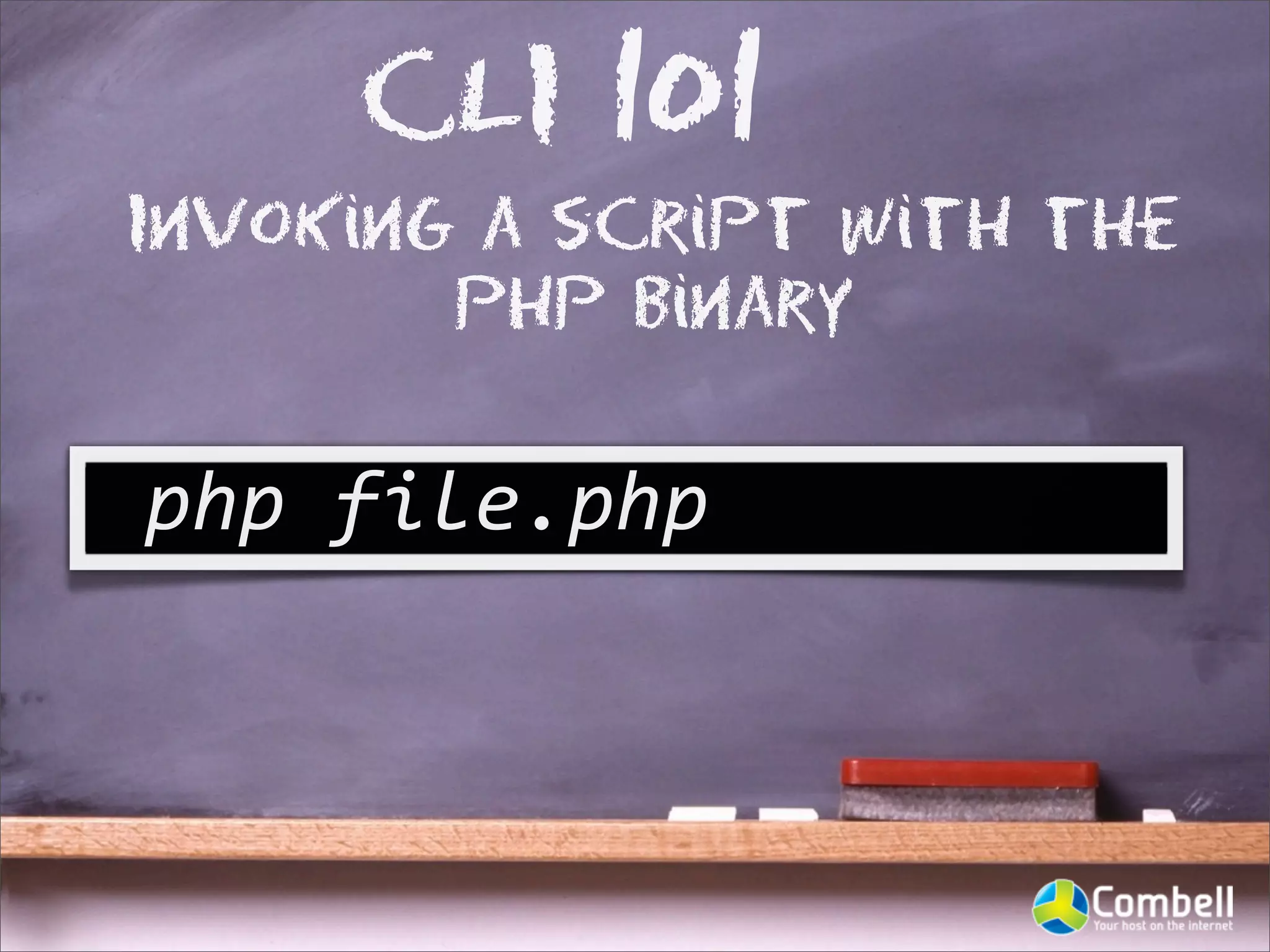
Invoking a script with the
        PHP binary

php	
  file.php
CLI 101
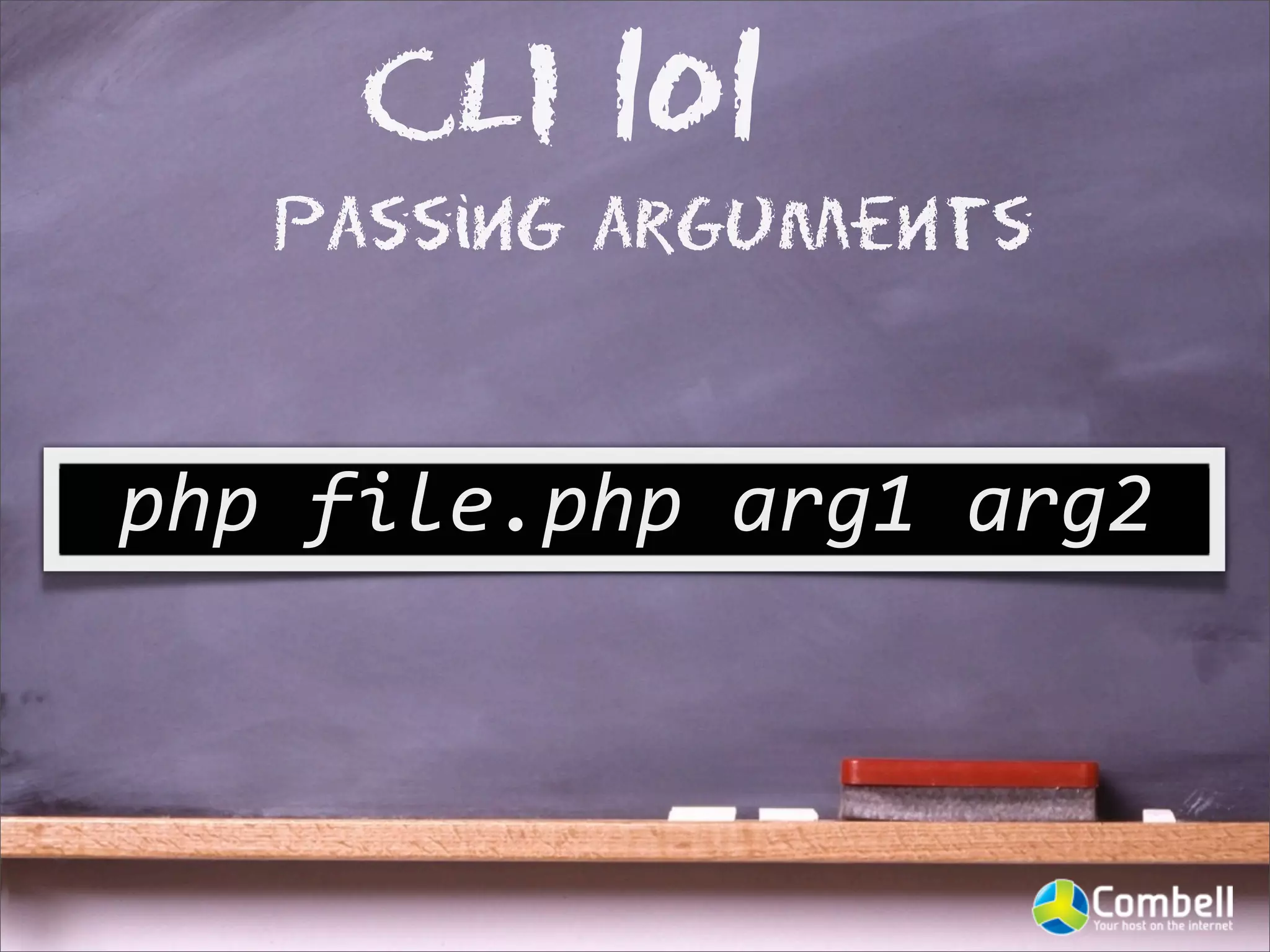
    Passing arguments


php	
  file.php	
  arg1	
  arg2
CLI 101
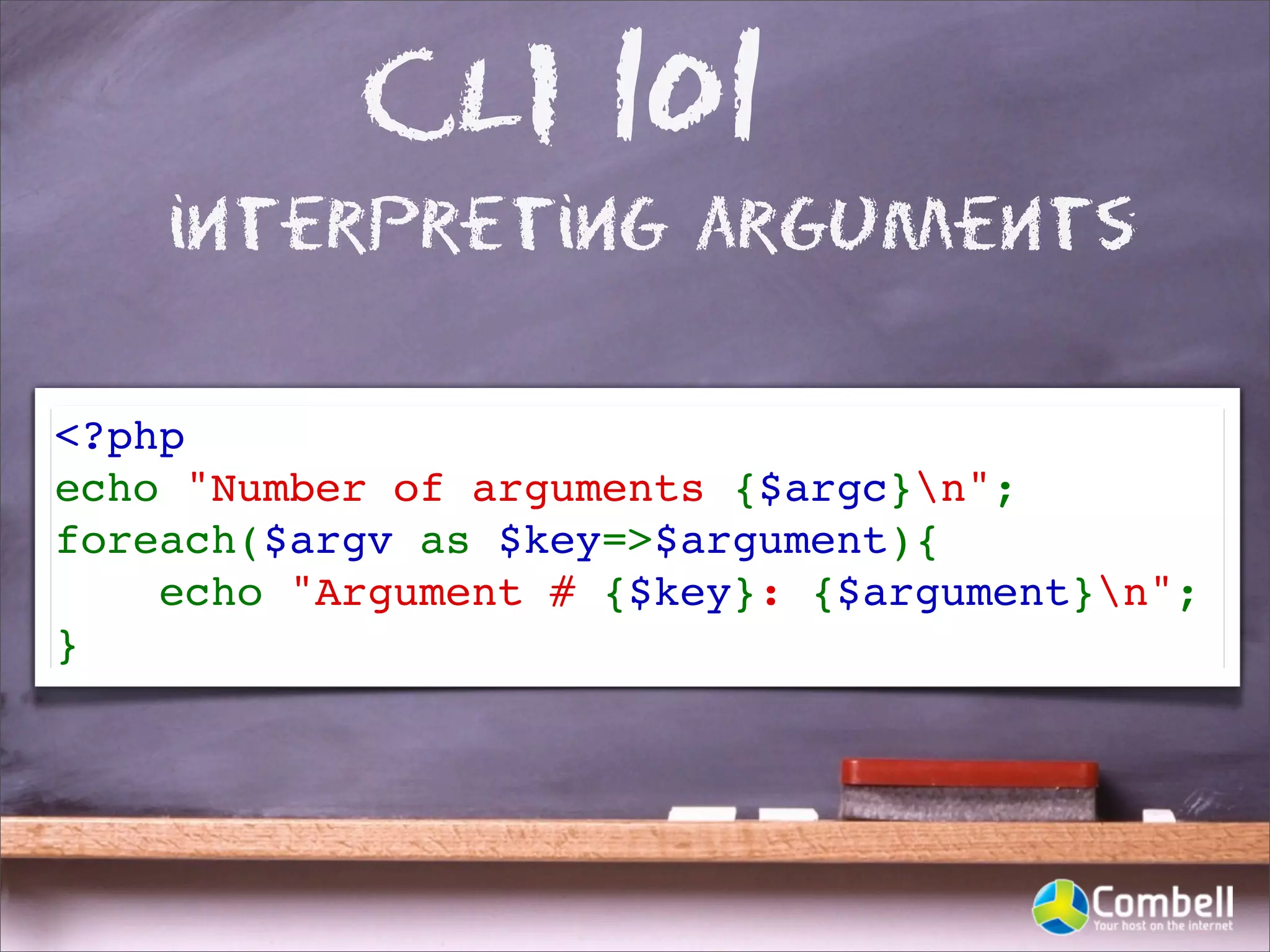
    interpreting arguments

<?php
echo "Number of arguments {$argc}n";
foreach($argv as $key=>$argument){
    echo "Argument # {$key}: {$argument}n"; 
}
CLI 101
    interpreting arguments
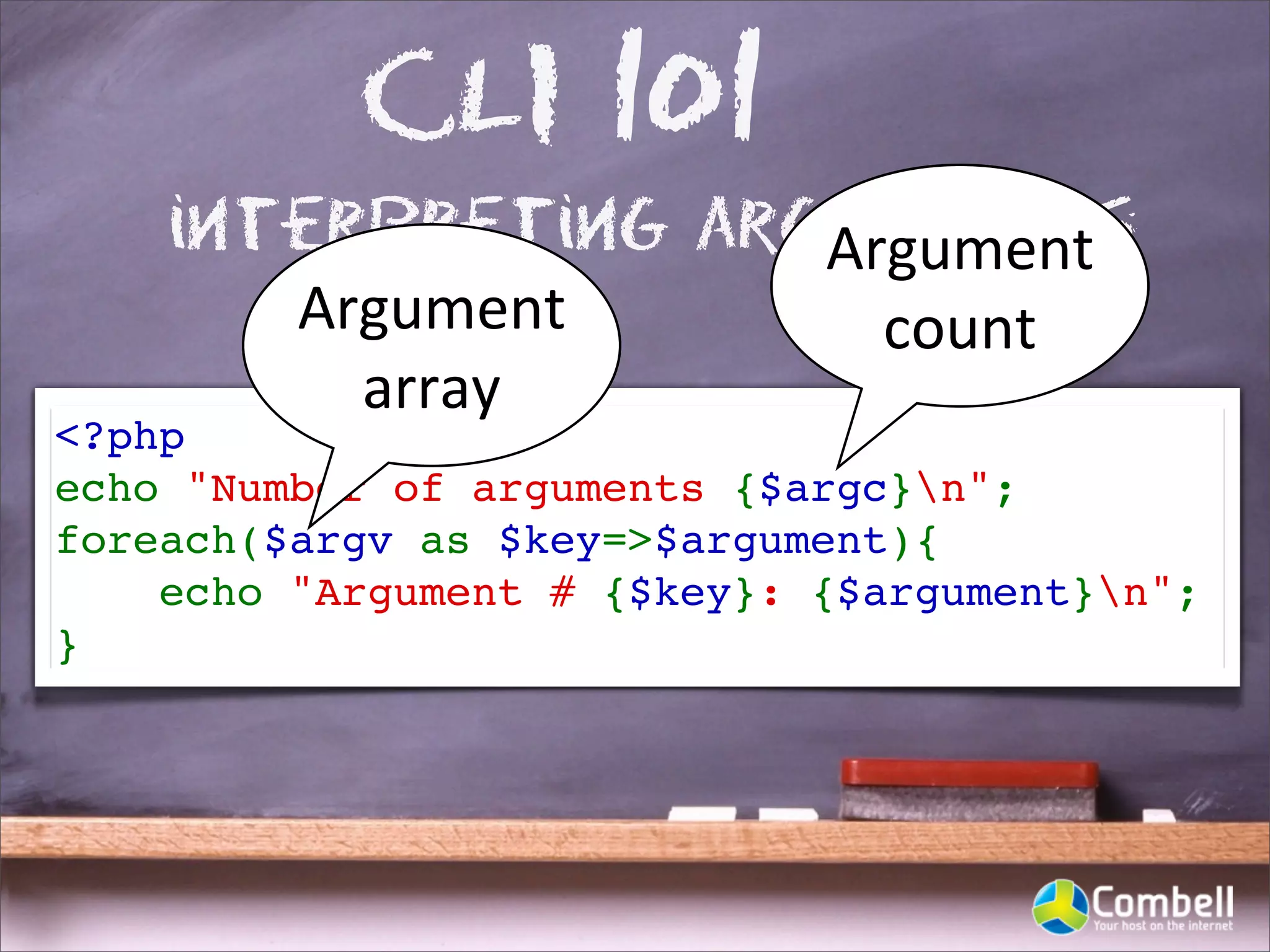
                    Argument	
  
       Argument	
     count
         array
<?php
echo "Number of arguments {$argc}n";
foreach($argv as $key=>$argument){
    echo "Argument # {$key}: {$argument}n"; 
}
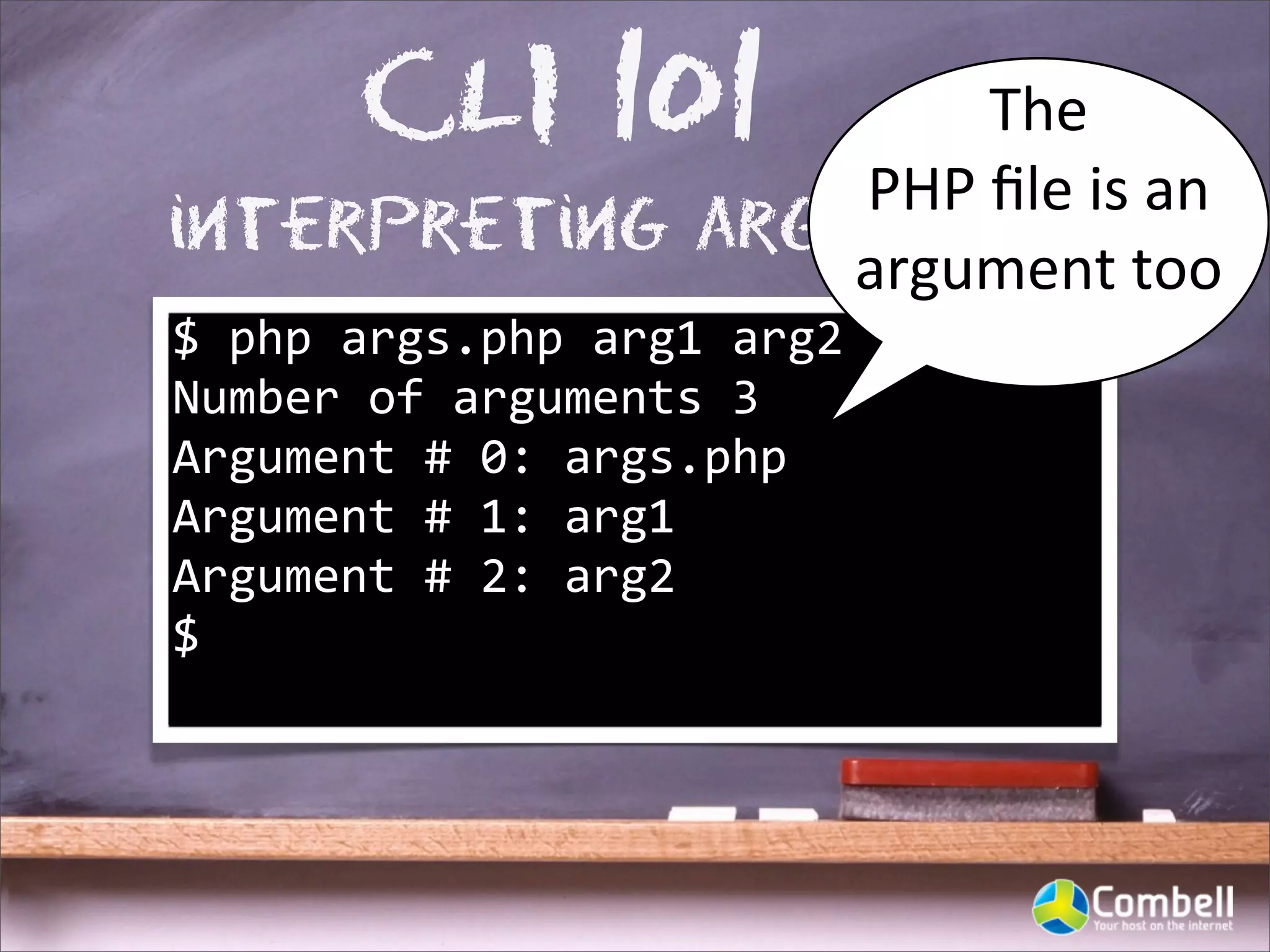
CLI 101      The	
  
                 PHP	
  file	
  is	
  an	
  
interpreting arguments
                 argument	
  too
$	
  php	
  args.php	
  arg1	
  arg2
Number	
  of	
  arguments	
  3
Argument	
  #	
  0:	
  args.php
Argument	
  #	
  1:	
  arg1
Argument	
  #	
  2:	
  arg2
$
CLI 101
   interpreting arguments
$_SERVER[‘argc’]      $argc

$_SERVER[‘argv’]      $argv

   !!! register_argc_argv !!!
CLI 101
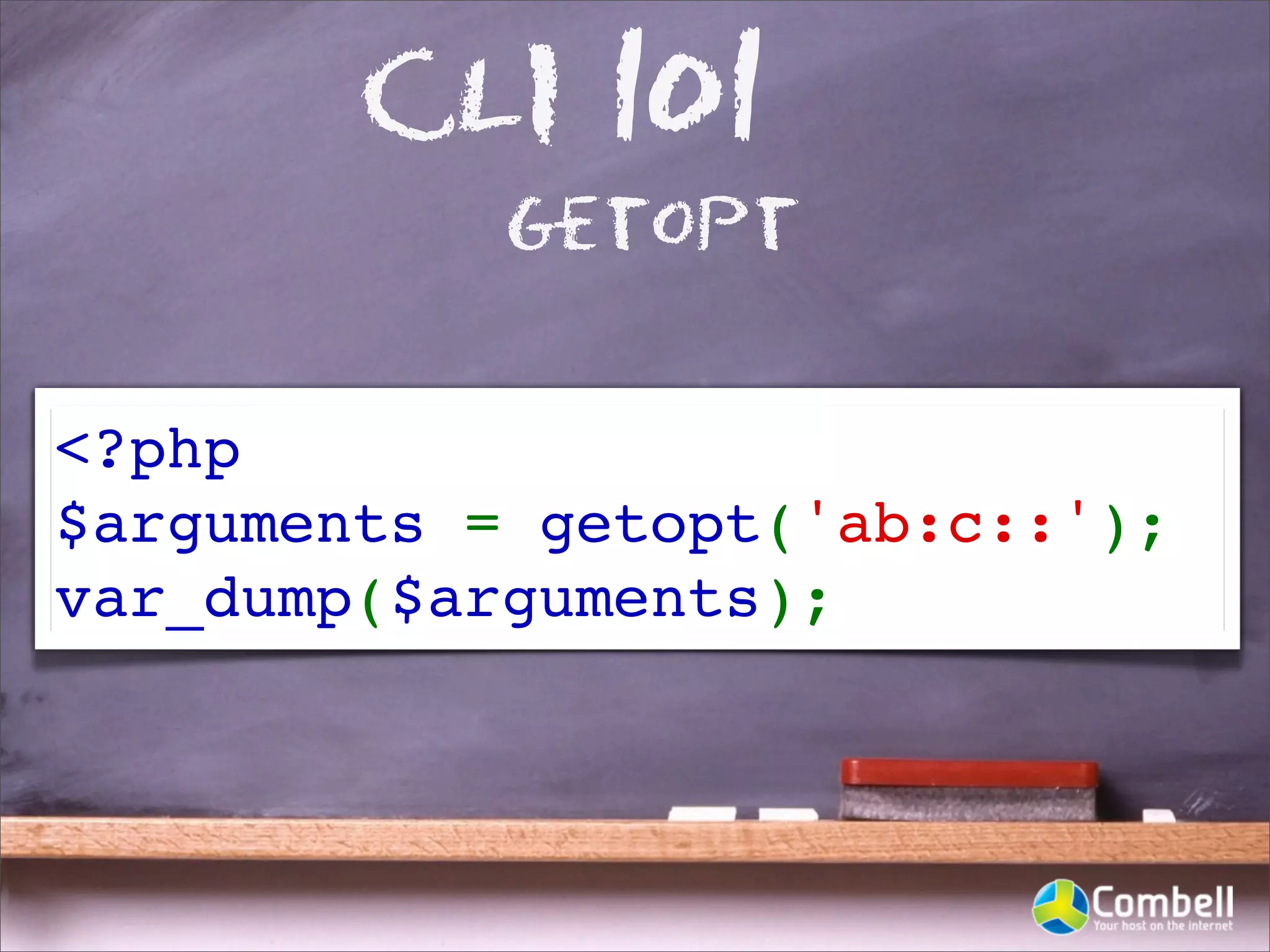
            getopt


<?php
$arguments = getopt('ab:c::');
var_dump($arguments);
CLI 101
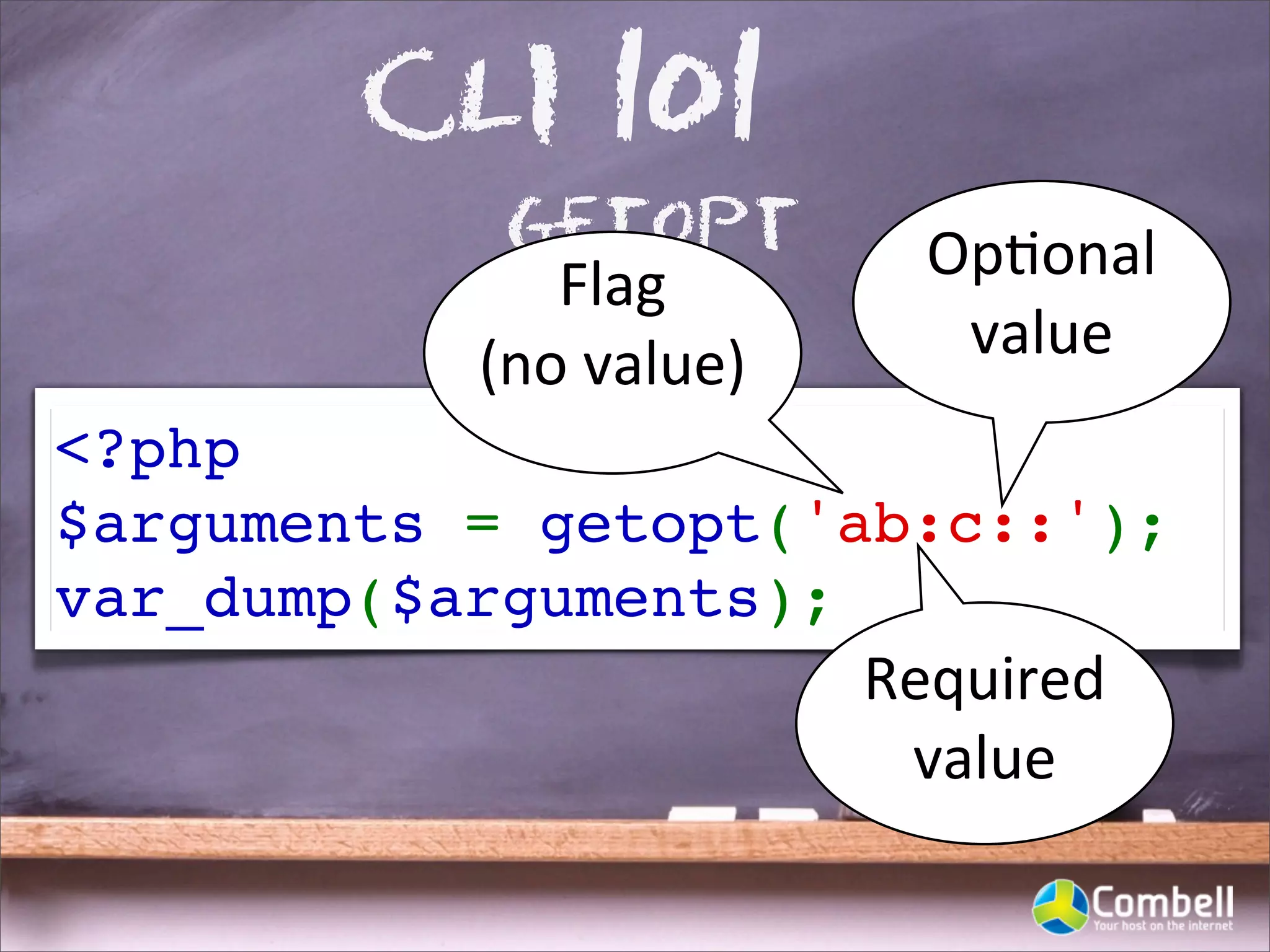
            getopt           Op^onal	
  
              Flag	
  
           (no	
  value)      value
<?php
$arguments = getopt('ab:c::');
var_dump($arguments);
                           Required	
  
                            value
CLI 101
php	
  getopt.php	
  -­‐a	
  -­‐b	
  2	
  -­‐c3
array(3)	
  {
	
  	
  ["a"]=>                                  No	


  bool(false)
	
  	
  ["b"]=>                              spacing	
  for	


  string(1)	
  "2"                      op^onal	


  ["c"]=>                              arguments
	
  	
  string(1)	
  "3"
}
CLI 101
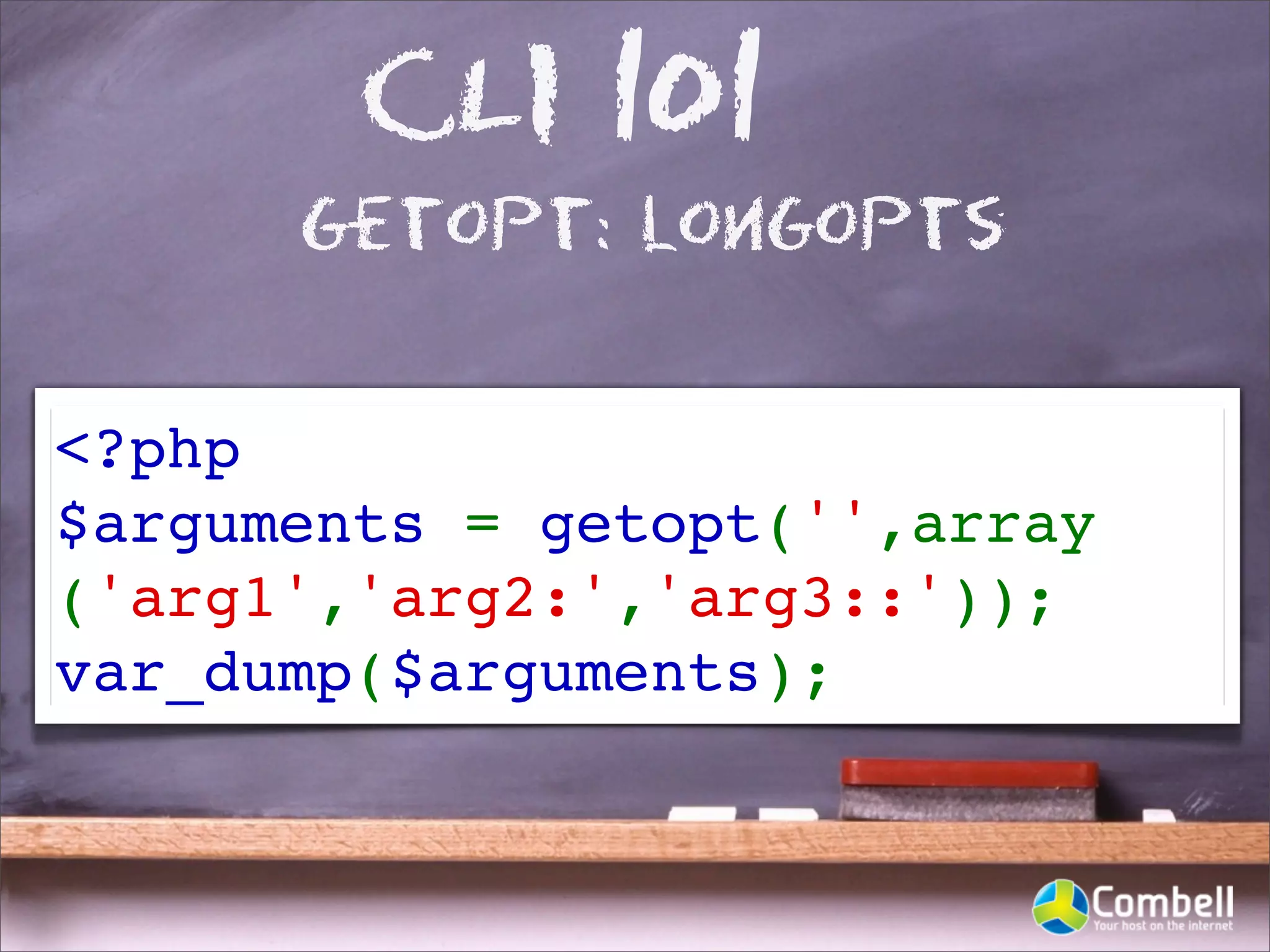
      getopt: longopts


<?php
$arguments = getopt('',array
('arg1','arg2:','arg3::'));
var_dump($arguments);
CLI 101
php	
  getopt2.php	
  -­‐-­‐arg1	
  -­‐-­‐arg2	
  123	
  -­‐-­‐arg3=x
array(3)	
  {
	
  	
  ["arg1"]=>
	
  	
  bool(false)                                 Mind	


  ["arg2"]=>                           the	
  “=”	
  sign
	
  	
  string(3)	
  "123"
	
  	
  ["arg3"]=>
	
  	
  string(1)	
  "x"
}
CLI 101
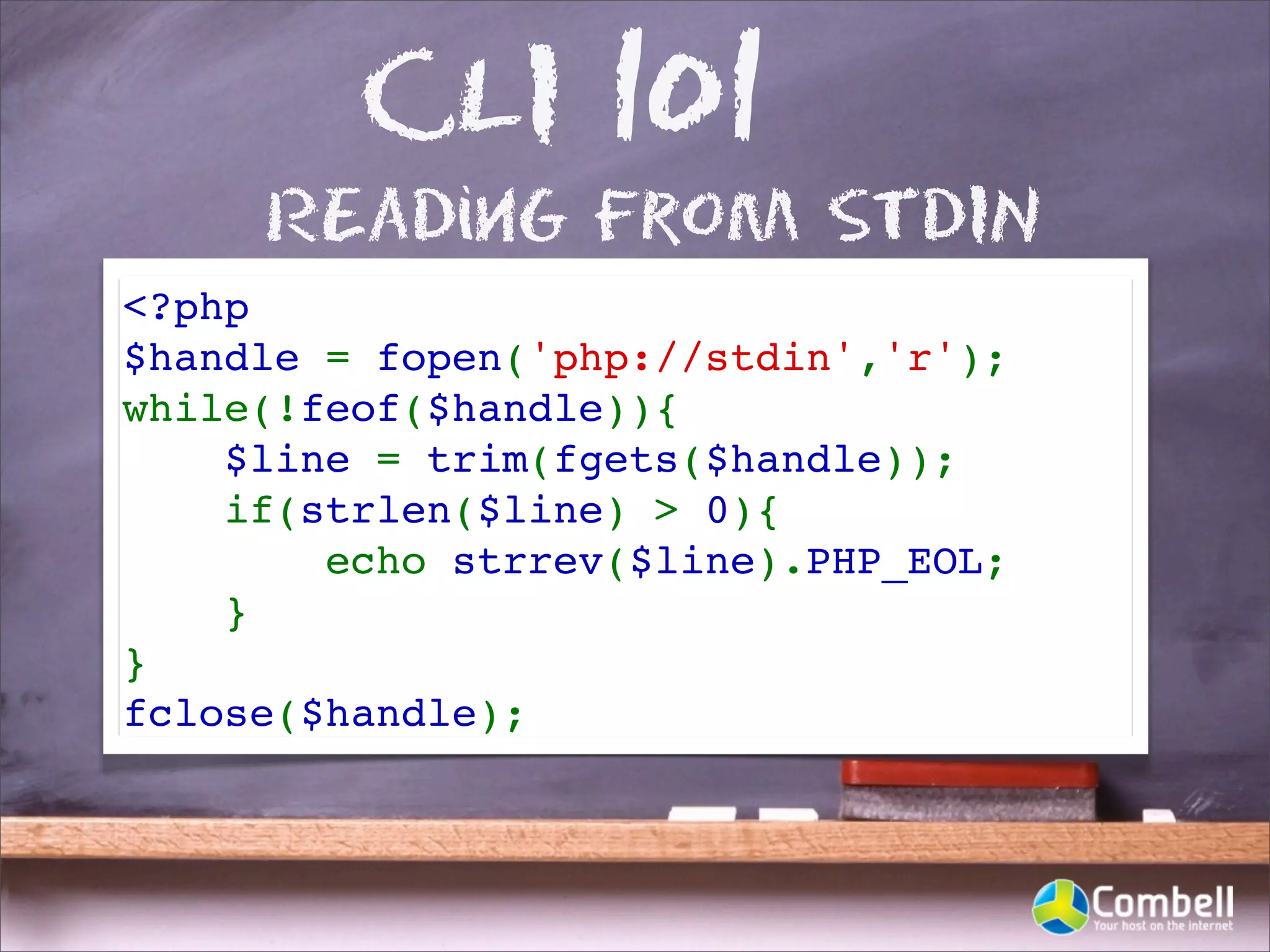
     REading From STDIN
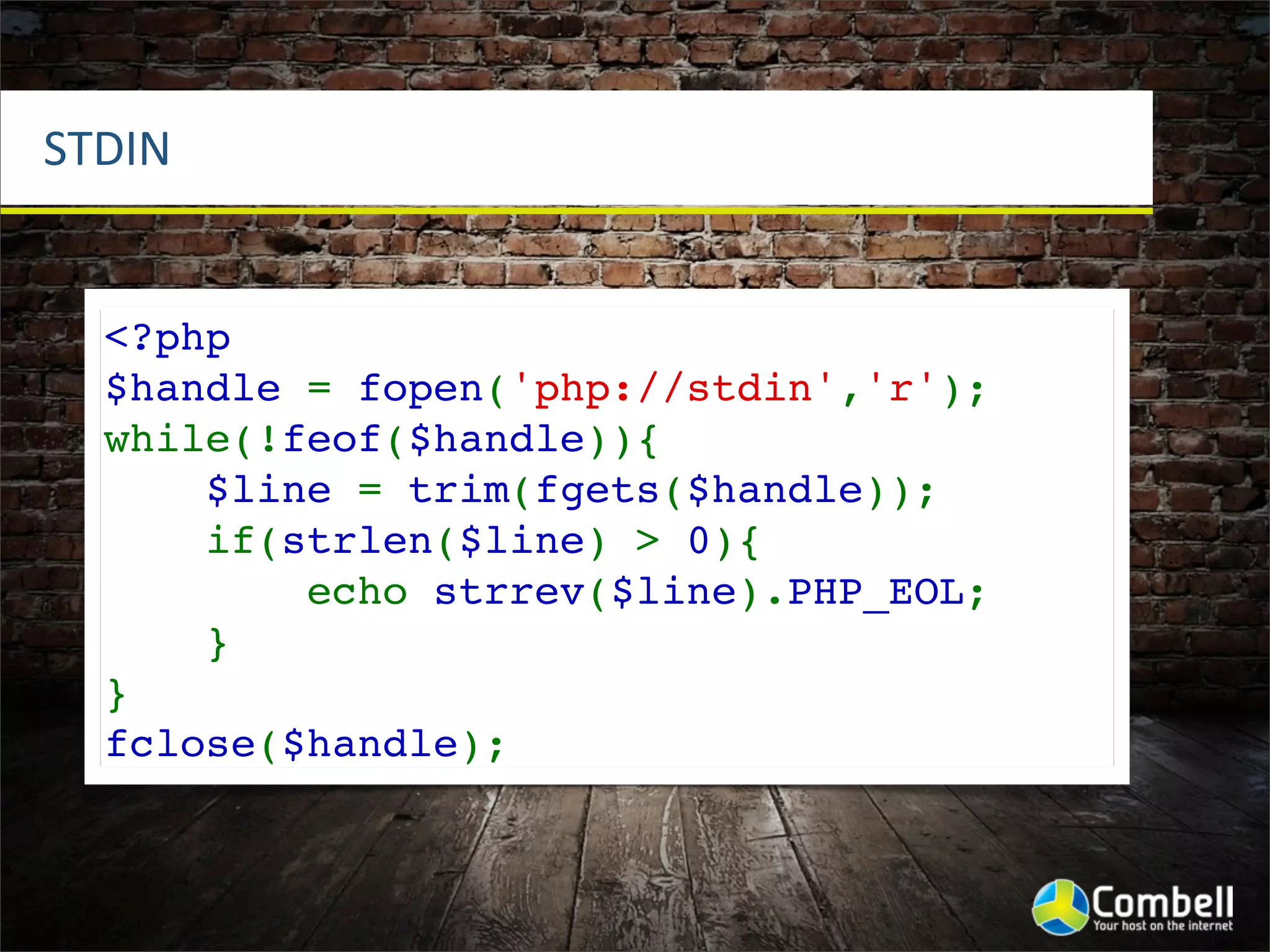
<?php
$handle = fopen('php://stdin','r');
while(!feof($handle)){
    $line = trim(fgets($handle));
    if(strlen($line) > 0){
        echo strrev($line).PHP_EOL;
    }
}
fclose($handle);
CLI 101
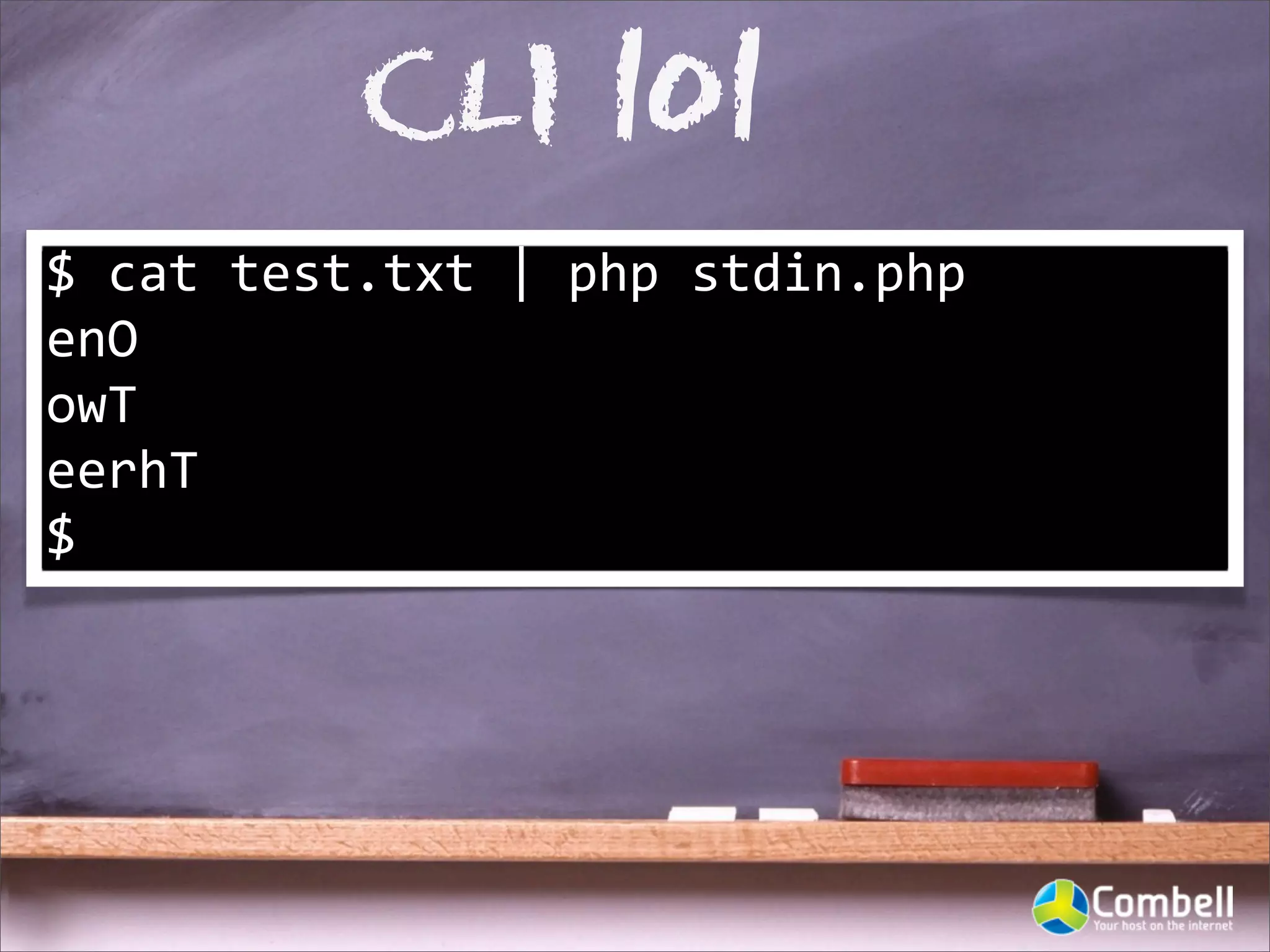
$	
  cat	
  test.txt	
  |	
  php	
  stdin.php	
  
enO
owT
eerhT
$
CLI 101
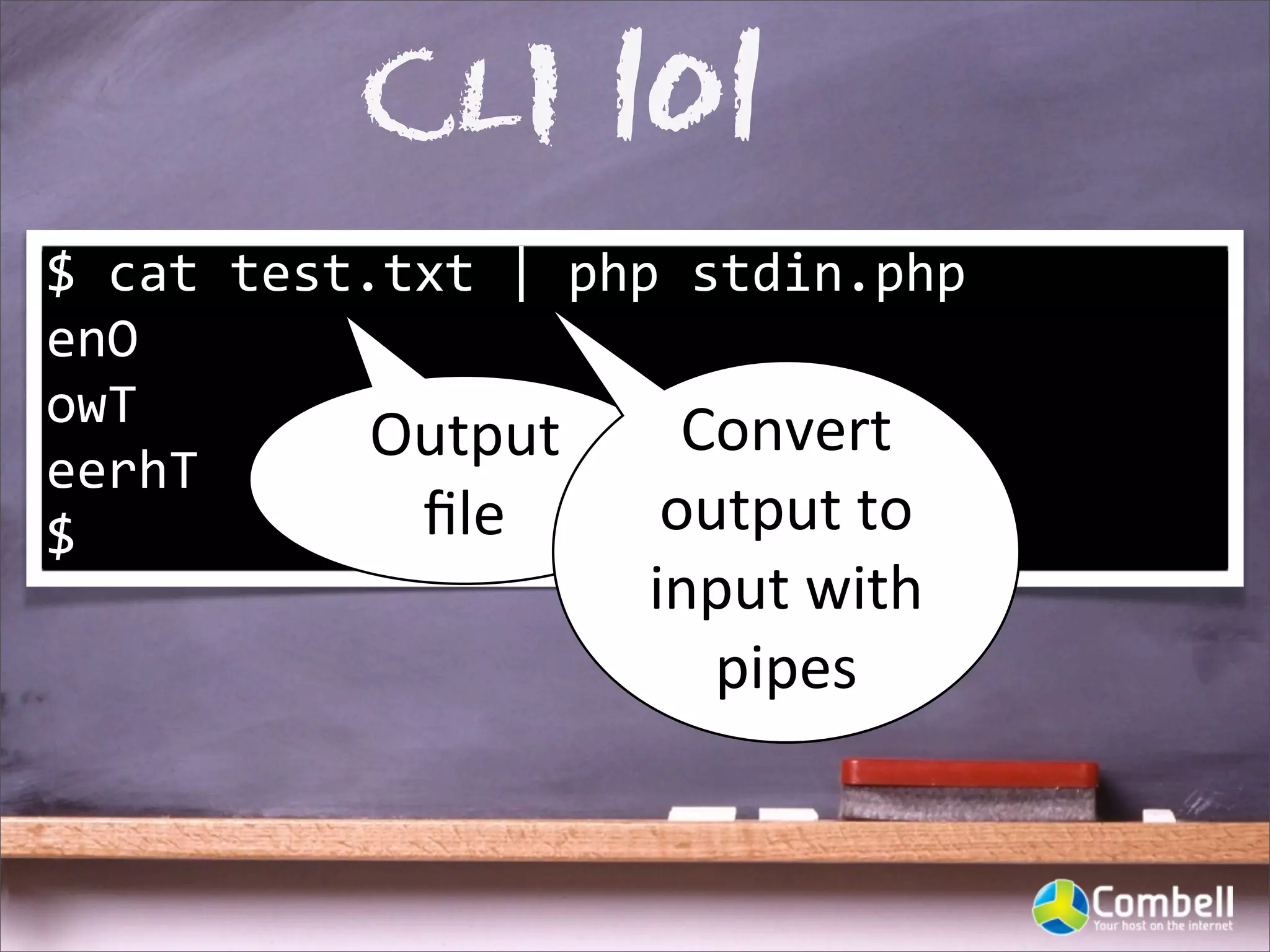
$	
  cat	
  test.txt	
  |	
  php	
  stdin.php	
  
enO
owT
                 Output	
          Convert	
  
eerhT
$                 file           output	
  to	
  
                               input	
  with	
  
                                 pipes
Comparing	
  the	
  Apache	
  &	
  CLI	
  SAPI
Comparing	
  the	
  Apache	
  &	
  CLI	
  SAPI

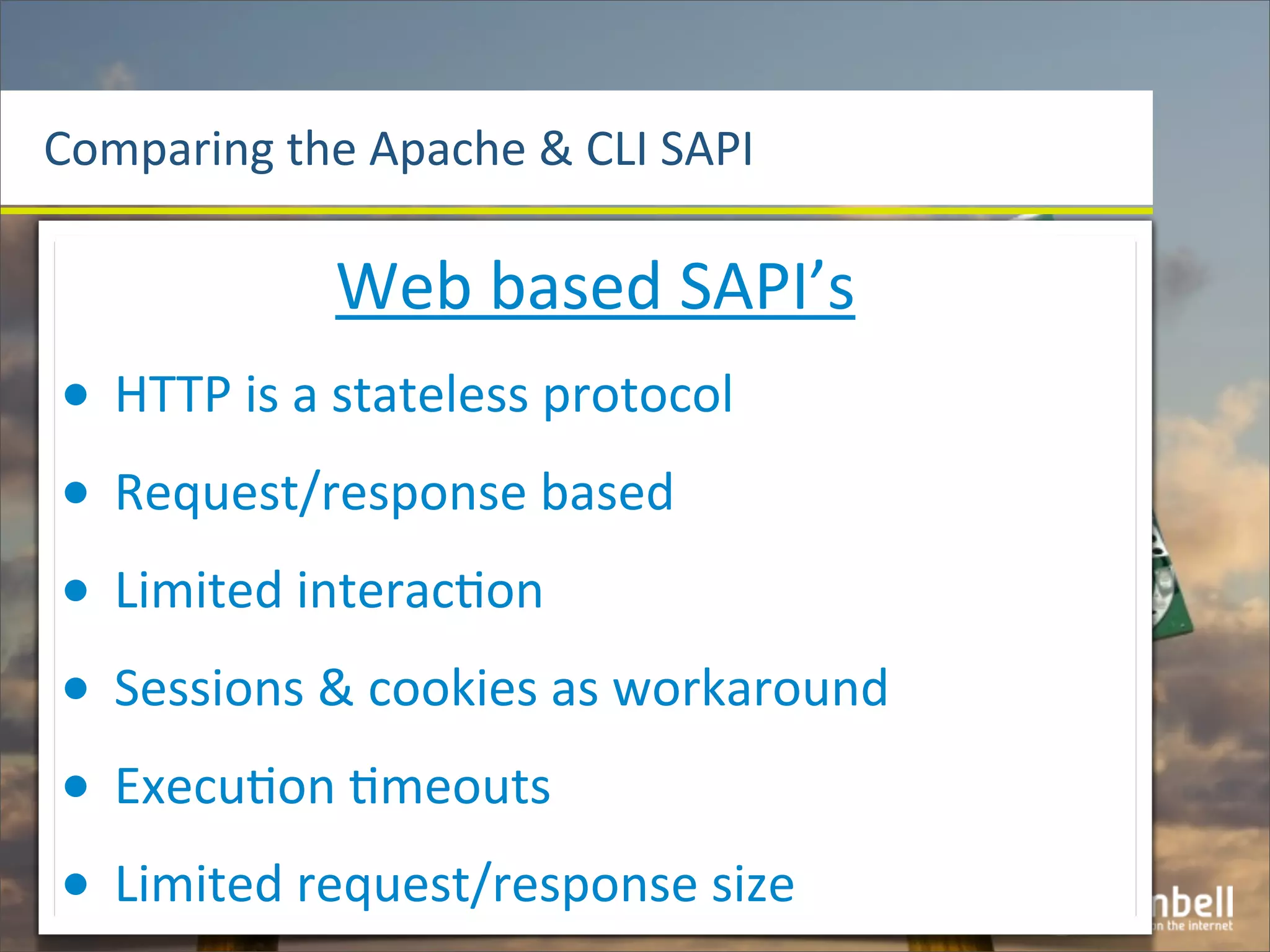
                  Web	
  based	
  SAPI’s
•   HTTP	
  is	
  a	
  stateless	
  protocol
•   Request/response	
  based
•   Limited	
  interac^on
•   Sessions	
  &	
  cookies	
  as	
  workaround
•   Execu^on	
  ^meouts
•   Limited	
  request/response	
  size
Comparing	
  the	
  Apache	
  &	
  CLI	
  SAPI


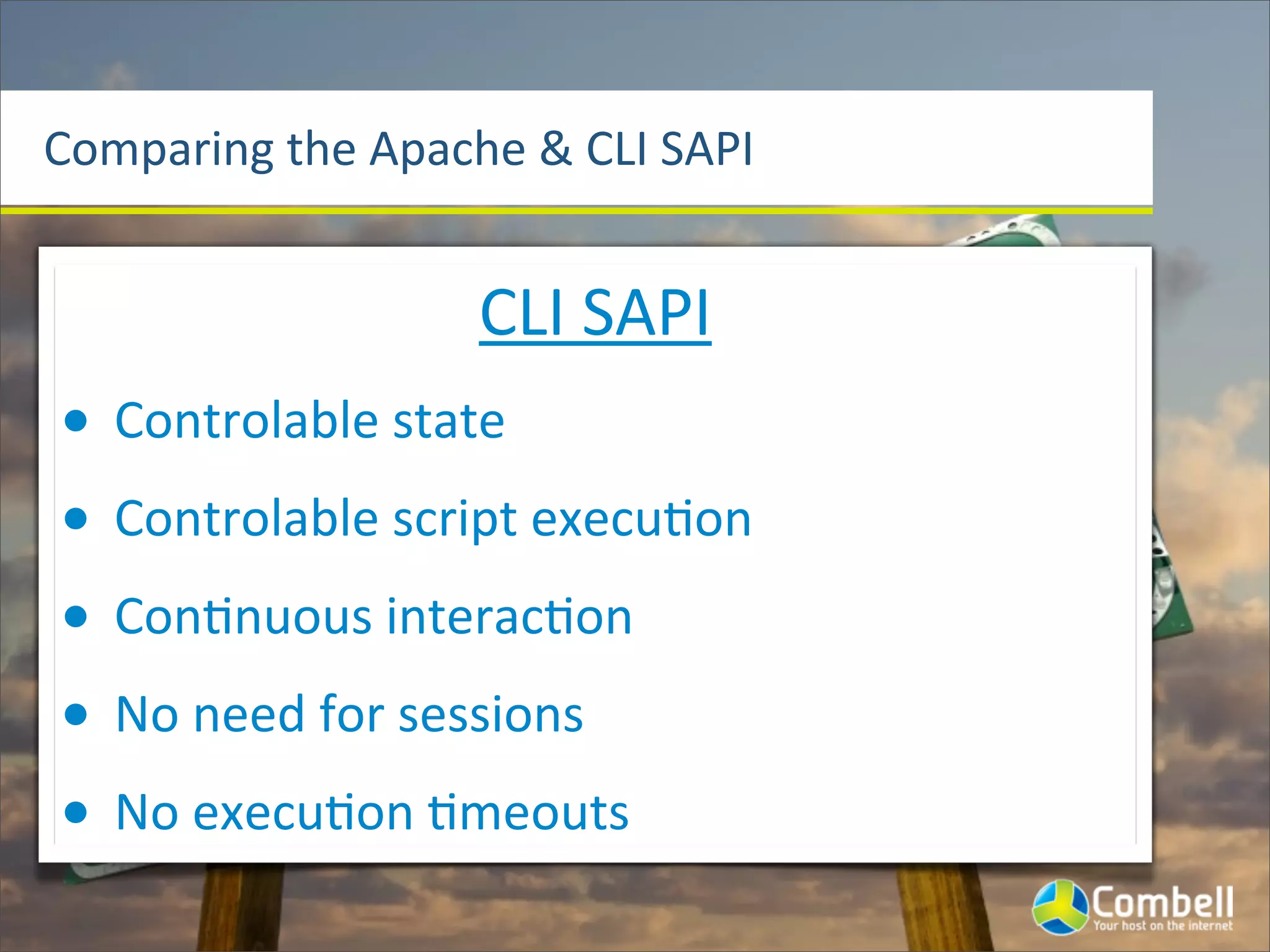
                            CLI	
  SAPI
•   Controlable	
  state
•   Controlable	
  script	
  execu^on
•   Con^nuous	
  interac^on
•   No	
  need	
  for	
  sessions
•   No	
  execu^on	
  ^meouts
Measuring	
  the	
  state
Input	
  &	
  output
Input	
  &	
  output


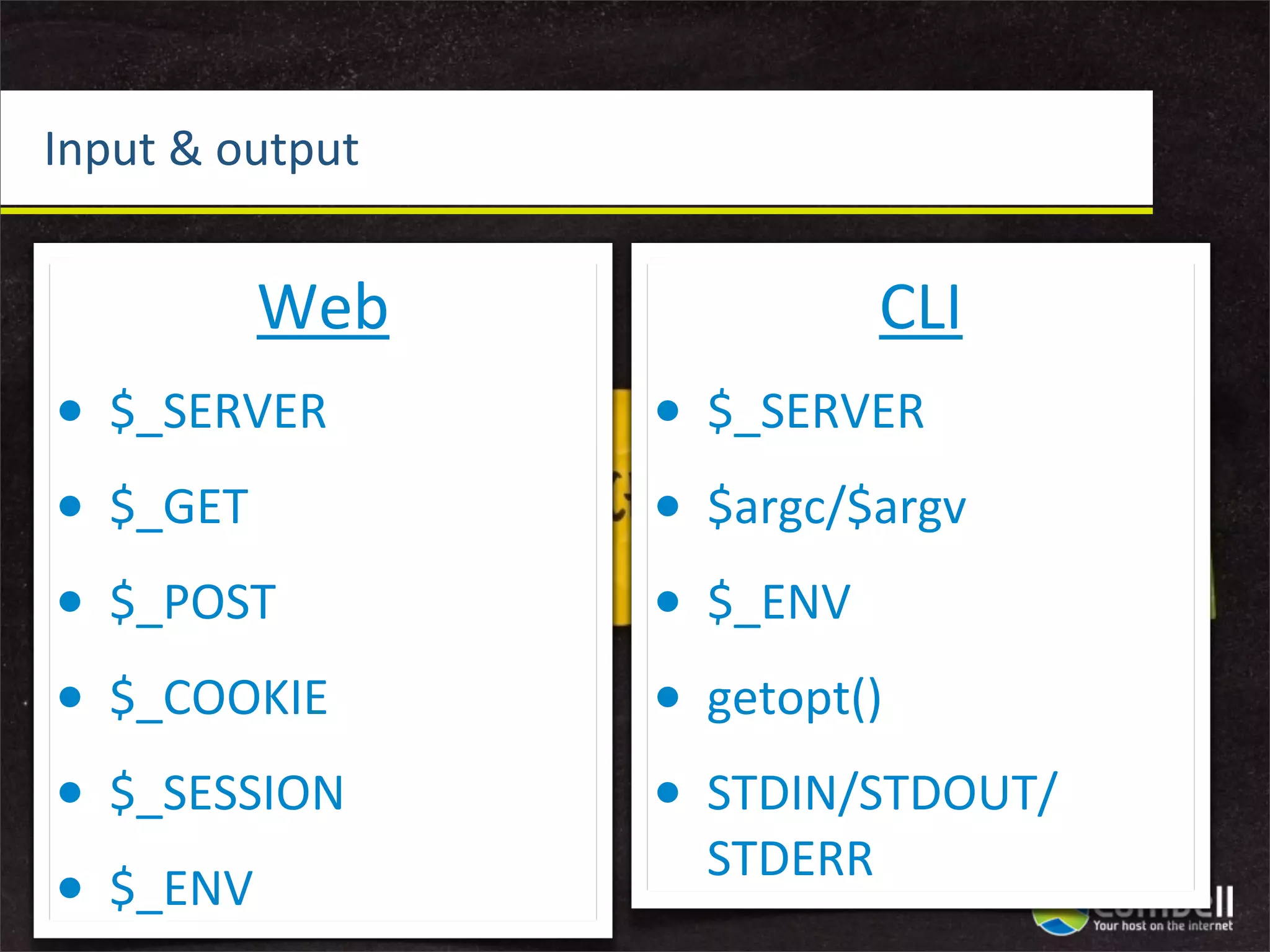
             Web                   CLI
•   $_SERVER           •   $_SERVER
•   $_GET              •   $argc/$argv
•   $_POST             •   $_ENV
•   $_COOKIE           •   getopt()
•   $_SESSION          •   STDIN/STDOUT/
                           STDERR
•   $_ENV
Change	
  your	
  mindset
Change	
  your	
  mindset


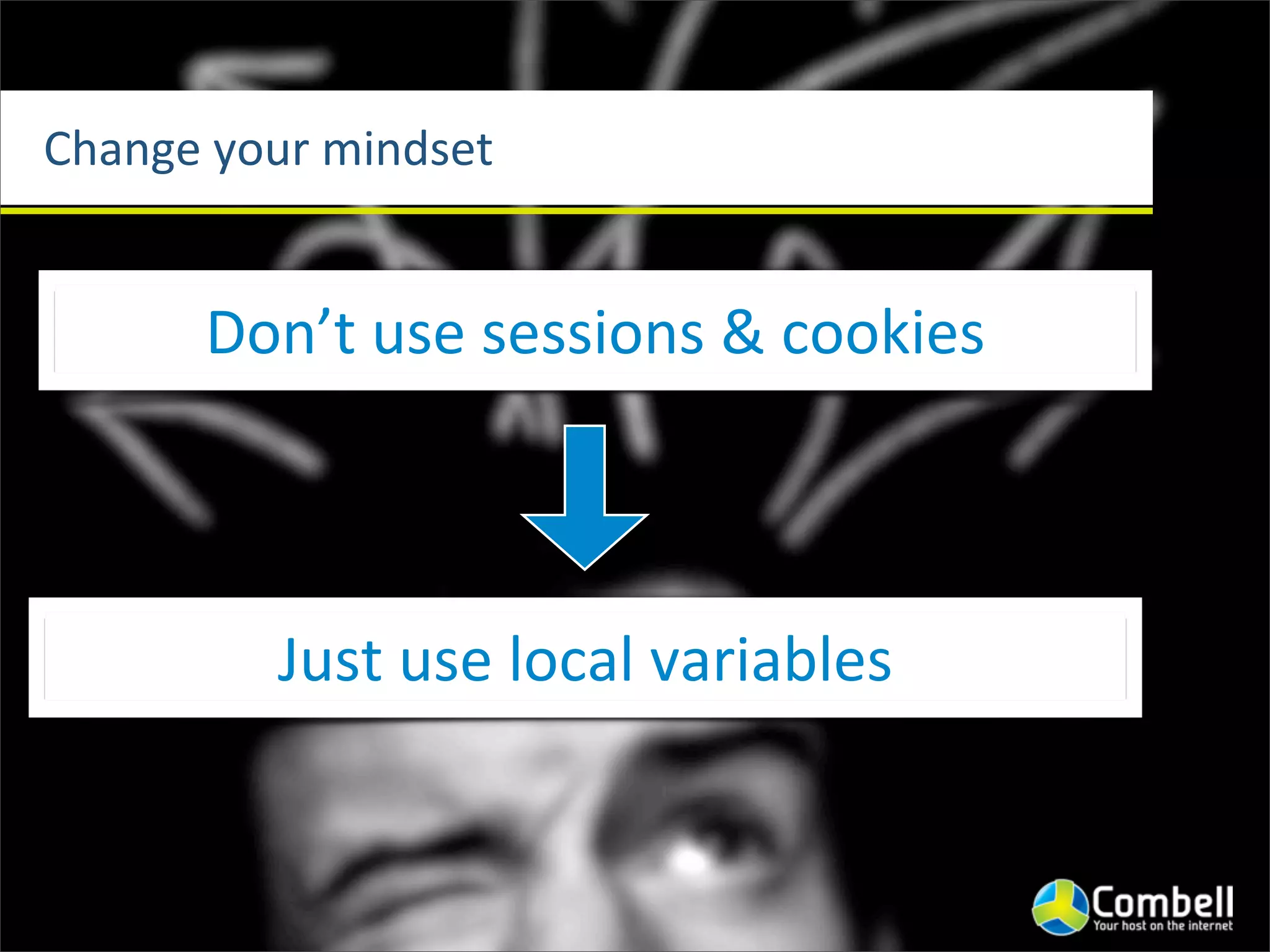
        Don’t	
  use	
  sessions	
  &	
  cookies


             Just	
  use	
  local	
  variables
Change	
  your	
  mindset


             Don’t	
  “get”	
  your	
  input


                    Just	
  “read”	
  it
Change	
  your	
  mindset


           Don’t	
  bundle	
  your	
  output


      You	
  can	
  use	
  distributed	
  output
Change	
  your	
  mindset


       If	
  you	
  don’t	
  need	
  HTTP,	
  use	
  CLI

                                                    E.g.	
  
                                                  cronjobs
                  Avoid	
  overhead
Change	
  your	
  mindset


        Current	
  directory	
  !=	
  webroot

                                          CLI	
  
                                      scripts	
  are	
  
➡Use	
  dirname(__FILE__)            executable	
  
                                     everywhere
➡Use	
  chdir()
➡Use	
  getcwd()
The	
  PHP	
  binary


                       php
The	
  PHP	
  binary


Usage:	
  php	
  [options]	
  [-­‐f]	
  <file>	
  [-­‐-­‐]	
  [args...]


  php	
  [options]	
  -­‐r	
  <code>	
  [-­‐-­‐]	
  [args...]


  php	
  [options]	
  [-­‐B	
  <begin_code>]	
  -­‐R	
  <code>	
  
[-­‐E	
  <end_code>]	
  [-­‐-­‐]	
  [args...]


  php	
  [options]	
  [-­‐B	
  <begin_code>]	
  -­‐F	
  <file>	
  
[-­‐E	
  <end_code>]	
  [-­‐-­‐]	
  [args...]


  php	
  [options]	
  -­‐-­‐	
  [args...]


  php	
  [options]	
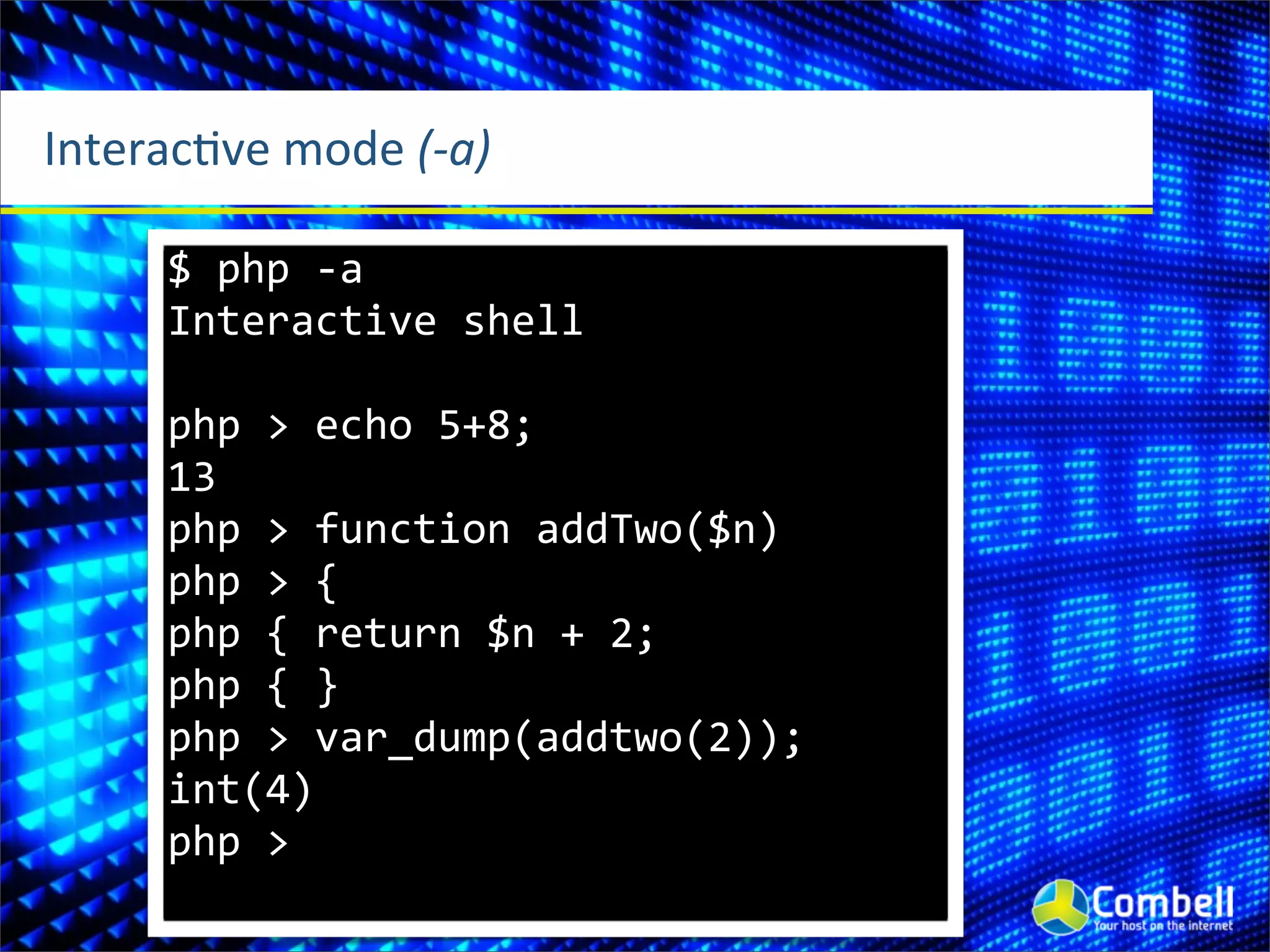
  -­‐a
InteracOve	
  mode	
  (-­‐a)

       $	
  php	
  -­‐a
       Interactive	
  shell

       php	
  >	
  echo	
  5+8;
       13
       php	
  >	
  function	
  addTwo($n)
       php	
  >	
  {
       php	
  {	
  return	
  $n	
  +	
  2;
       php	
  {	
  }
       php	
  >	
  var_dump(addtwo(2));
       int(4)
       php	
  >
InteracOve	
  mode	
  (-­‐a)


       $	
  php	
  -­‐a                                   Tab	
  
       Interactive	
  shell                            comple^on
       php	
  >	
  stri[TAB][TAB]
       strip_tags	


  stripcslashes	
  	
  
       stripslashes	
  	
  	
  stristr	


       stripos	


       php	
  >	
  stri
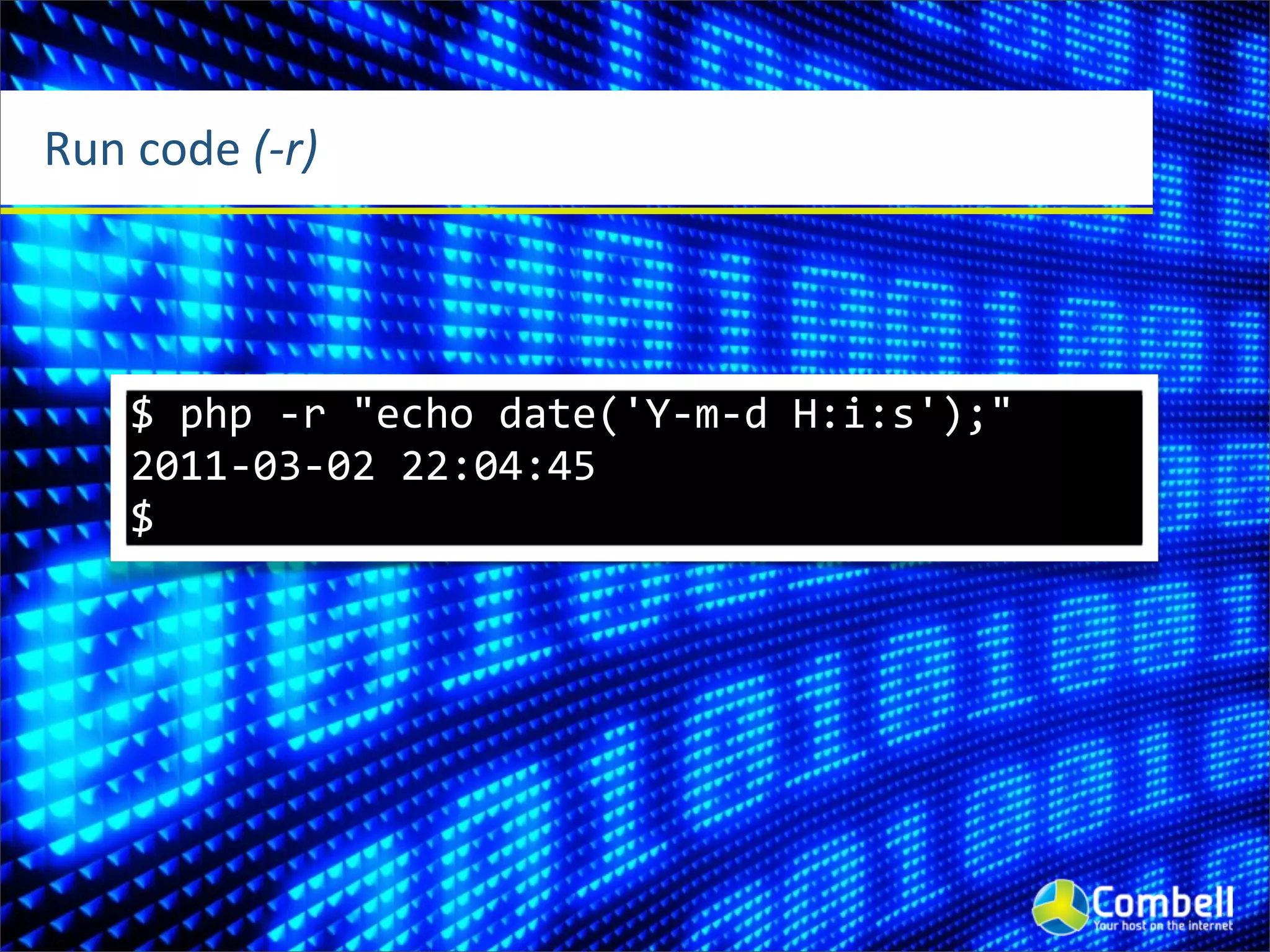
Run	
  code	
  (-­‐r)


      $	
  php	
  -­‐r	
  "echo	
  date('Y-­‐m-­‐d	
  H:i:s');"
      2011-­‐03-­‐02	
  22:04:45
      $
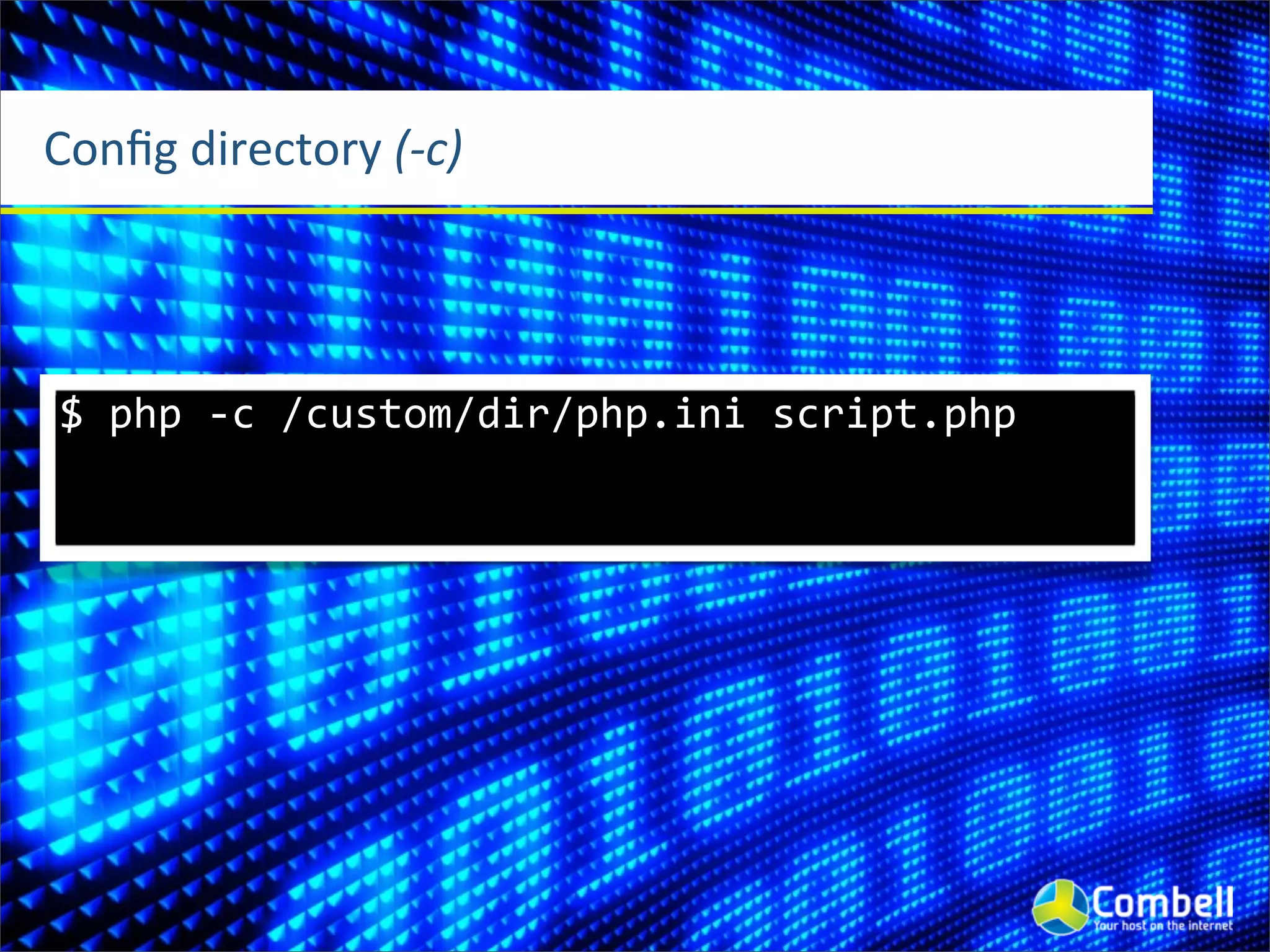
Config	
  directory	
  (-­‐c)


 $	
  php	
  -­‐c	
  /custom/dir/php.ini	
  script.php
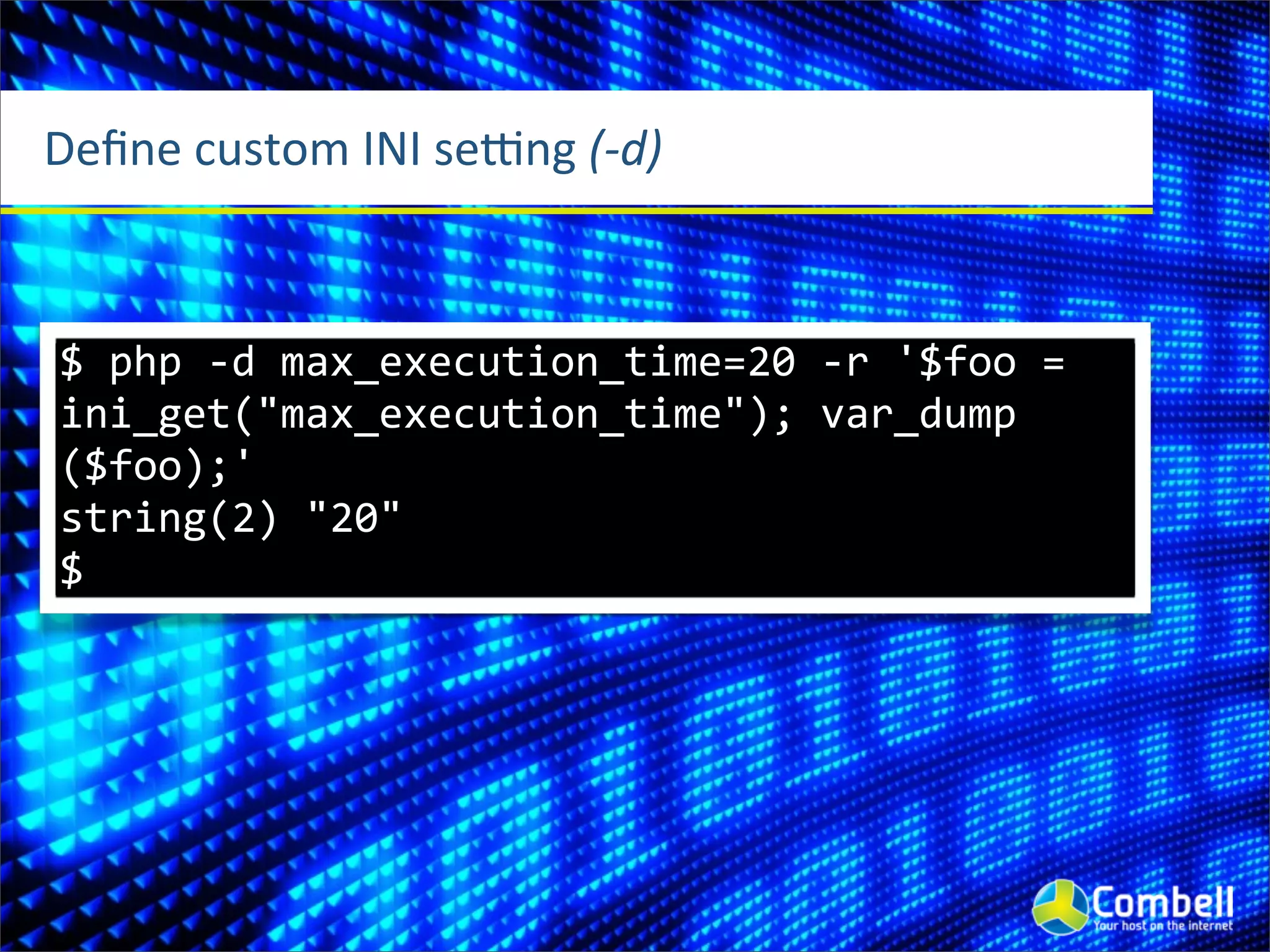
Define	
  custom	
  INI	
  seSng	
  (-­‐d)


 $	
  php	
  -­‐d	
  max_execution_time=20	
  -­‐r	
  '$foo	
  =	
  
 ini_get("max_execution_time");	
  var_dump
 ($foo);'
 string(2)	
  "20"
 $
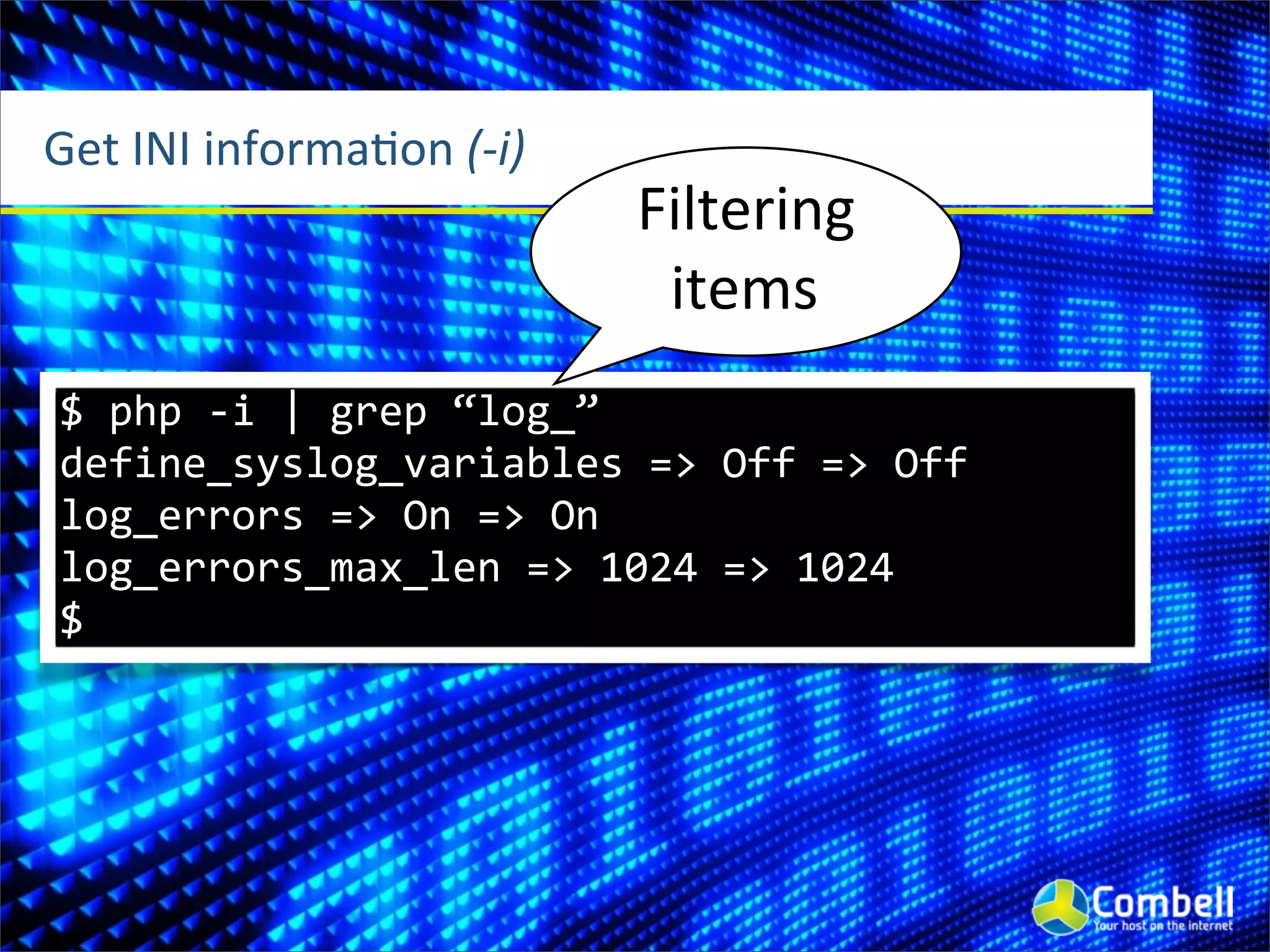
Get	
  INI	
  informaOon	
  (-­‐i)
                                     Filtering	
  
                                      items
 $	
  php	
  -­‐i	
  |	
  grep	
  “log_”
 define_syslog_variables	
  =>	
  Off	
  =>	
  Off
 log_errors	
  =>	
  On	
  =>	
  On
 log_errors_max_len	
  =>	
  1024	
  =>	
  1024
 $
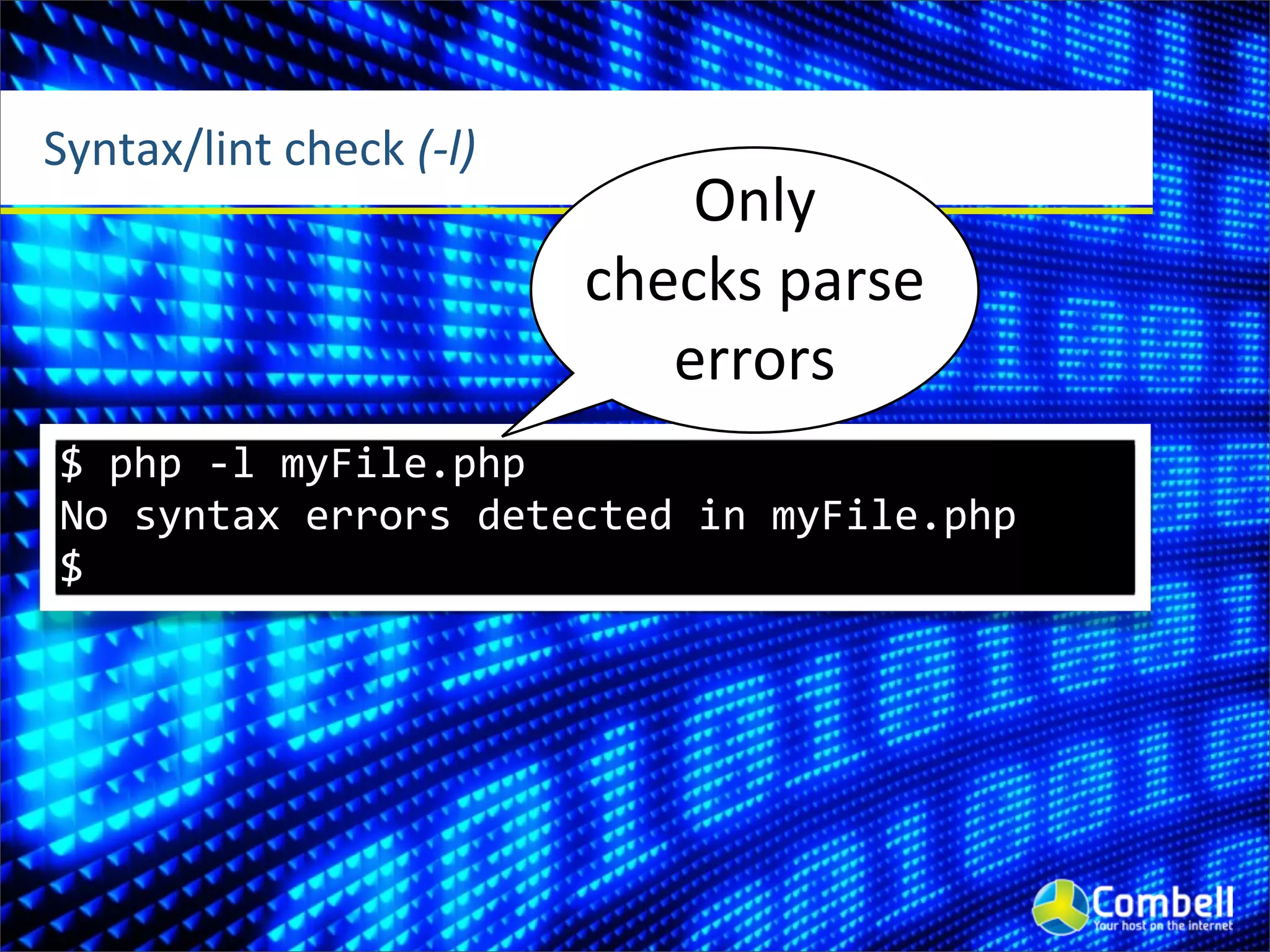
Syntax/lint	
  check	
  (-­‐l)
                                     Only	
  
                                 checks	
  parse	
  
                                    errors
 $	
  php	
  -­‐l	
  myFile.php
 No	
  syntax	
  errors	
  detected	
  in	
  myFile.php
 $
Module	
  list	
  (-­‐m)

 $	
  php	
  -­‐m
 [PHP	
  Modules]
 bcmath
 bz2
 calendar
 Core
 ctype
 curl
 date
 dba
 $
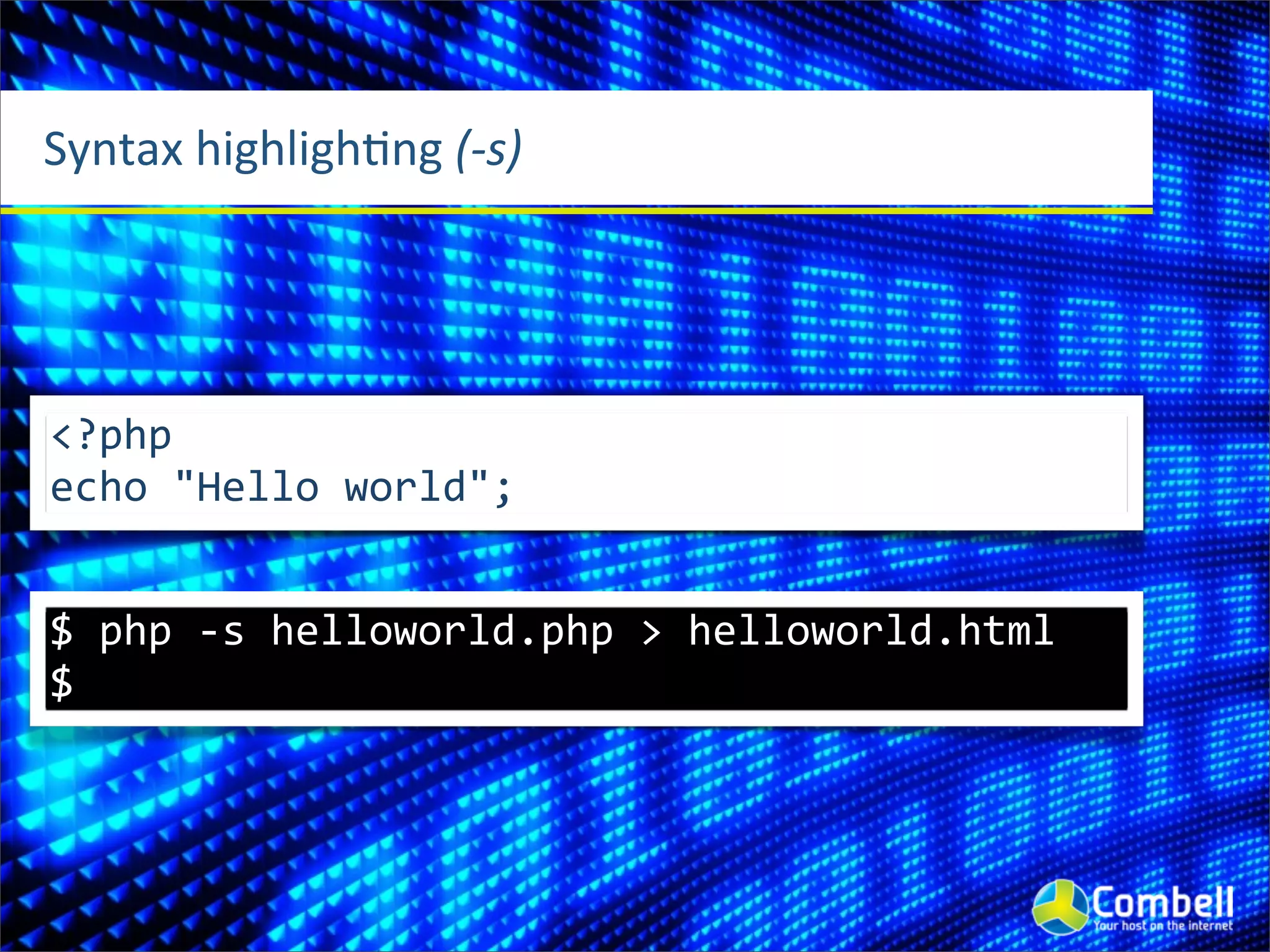
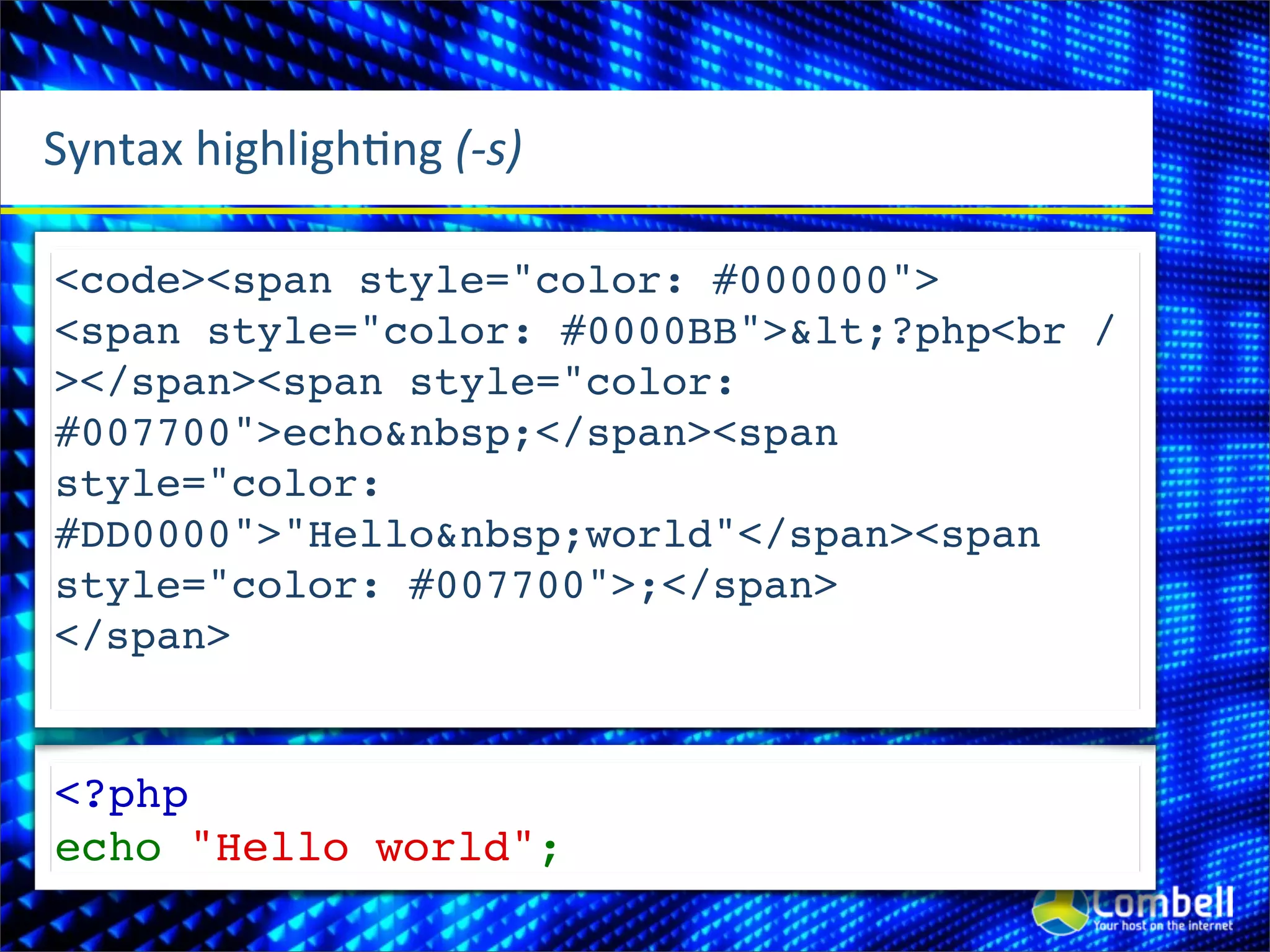
Syntax	
  highlighOng	
  (-­‐s)


<?php
echo	
  "Hello	
  world";


$	
  php	
  -­‐s	
  helloworld.php	
  >	
  helloworld.html
$
Syntax	
  highlighOng	
  (-­‐s)

<code><span style="color: #000000">
<span style="color: #0000BB">&lt;?php<br /
></span><span style="color:
#007700">echo&nbsp;</span><span
style="color:
#DD0000">"Hello&nbsp;world"</span><span
style="color: #007700">;</span>
</span>


<?php
echo "Hello world";
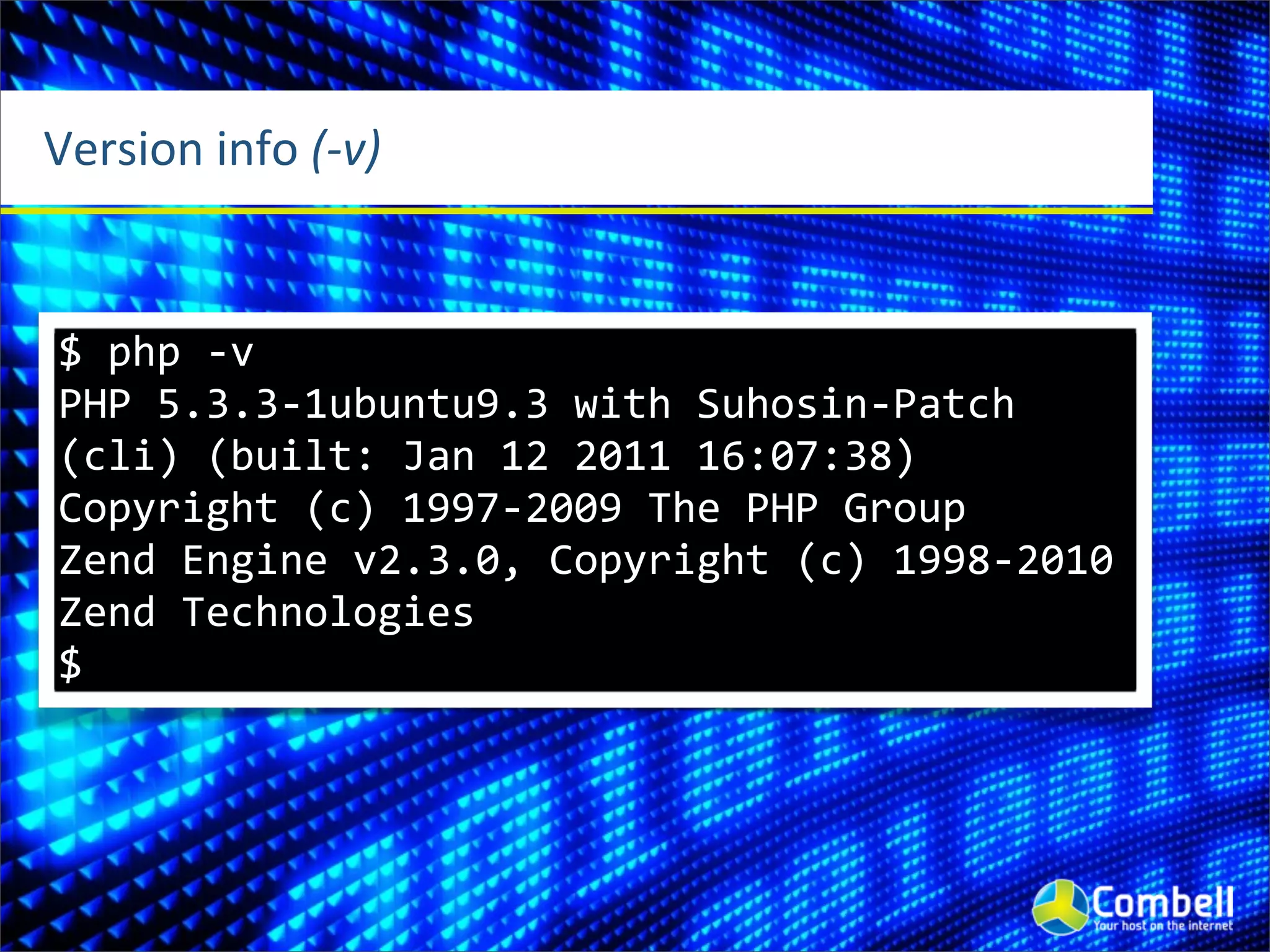
Version	
  info	
  (-­‐v)


 $	
  php	
  -­‐v
 PHP	
  5.3.3-­‐1ubuntu9.3	
  with	
  Suhosin-­‐Patch	
  
 (cli)	
  (built:	
  Jan	
  12	
  2011	
  16:07:38)	
  
 Copyright	
  (c)	
  1997-­‐2009	
  The	
  PHP	
  Group
 Zend	
  Engine	
  v2.3.0,	
  Copyright	
  (c)	
  1998-­‐2010	
  
 Zend	
  Technologies
 $
FuncOon	
  reflecOon	
  (-­‐-­‐rf)

$	
  php	
  -­‐-­‐rf	
  json_encode
Function	
  [	
  <internal:json>	
  function	
  
json_encode	
  ]	
  {


  -­‐	
  Parameters	
  [2]	
  {


  Parameter	
  #0	
  [	
  <required>	
  $value	
  ]


  Parameter	
  #1	
  [	
  <optional>	
  $options	
  ]
	
  	
  }
}
$
Class	
  reflecOon	
  (-­‐-­‐rf)
 $	
  php	
  -­‐-­‐rc	
  stdclass
 Class	
  [	
  <internal:Core>	
  class	
  stdClass	
  ]	
  {
 	
  	
  -­‐	
  Constants	
  [0]	
  {
 	
  	
  }
 	
  	
  -­‐	
  Static	
  properties	
  [0]	
  {
 	
  	
  }
 	
  	
  -­‐	
  Static	
  methods	
  [0]	
  {
 	
  	
  }
 	
  	
  -­‐	
  Properties	
  [0]	
  {
 	
  	
  }
 	
  	
  -­‐	
  Methods	
  [0]	
  {
 	
  	
  }
 }
 $
Extension	
  reflecOon	
  (-­‐-­‐re)

$	
  php	
  -­‐-­‐re	
  json
Extension	
  [	
  <persistent>	
  extension	
  #20	
  json	
  version	
  1.2.1	
  ]	
  {
...
	
  	
  -­‐	
  Functions	
  {


  Function	
  [	
  <internal:json>	
  function	
  json_encode	
  ]	
  {


  -­‐	
  Parameters	
  [2]	
  {


  Parameter	
  #0	
  [	
  <required>	
  $value	
  ]


  Parameter	
  #1	
  [	
  <optional>	
  $options	
  ]


  }


  }
...
}
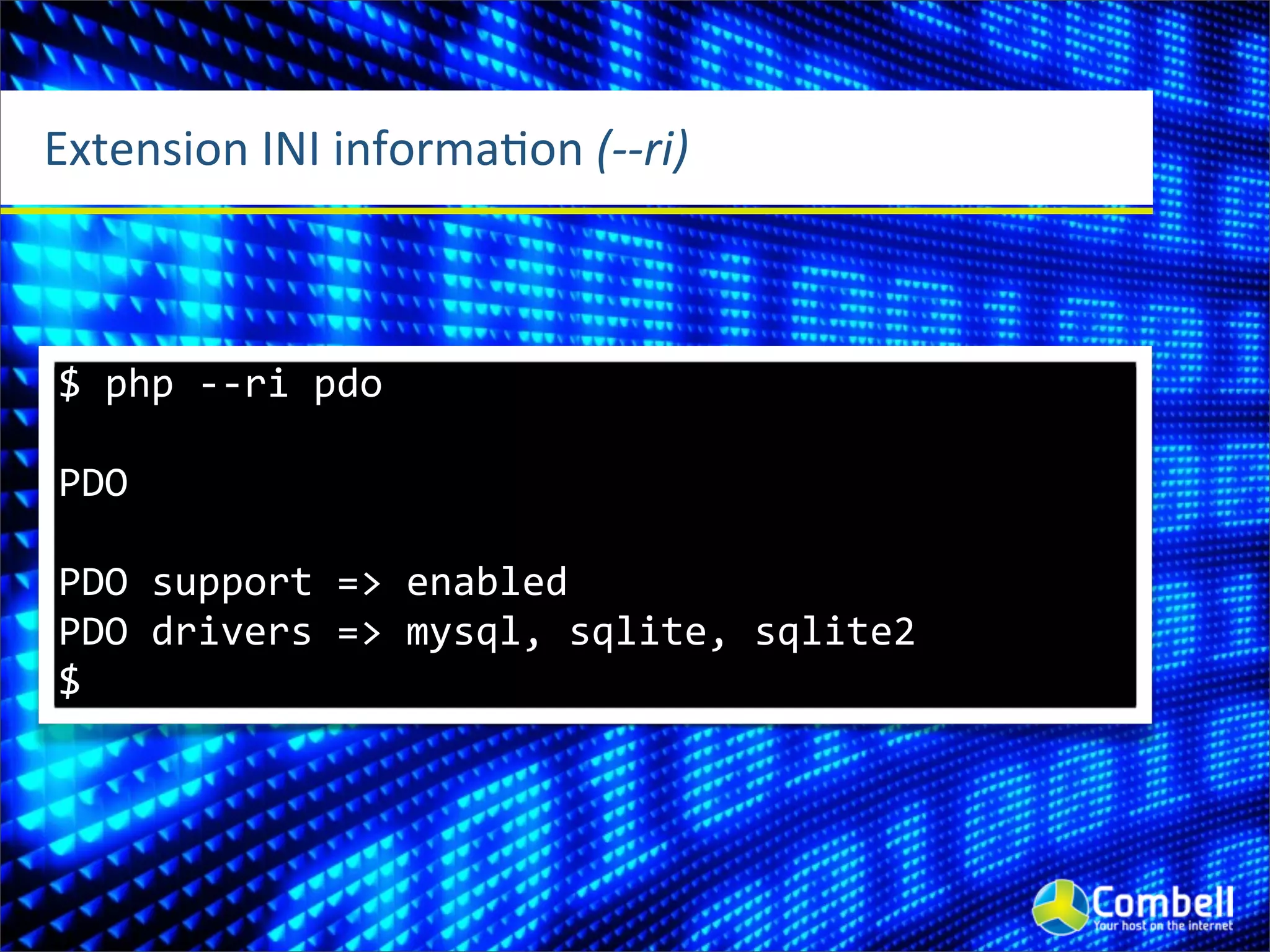
Extension	
  INI	
  informaOon	
  (-­‐-­‐ri)


 $	
  php	
  -­‐-­‐ri	
  pdo

 PDO

 PDO	
  support	
  =>	
  enabled
 PDO	
  drivers	
  =>	
  mysql,	
  sqlite,	
  sqlite2
 $
Back	
  on	
  track
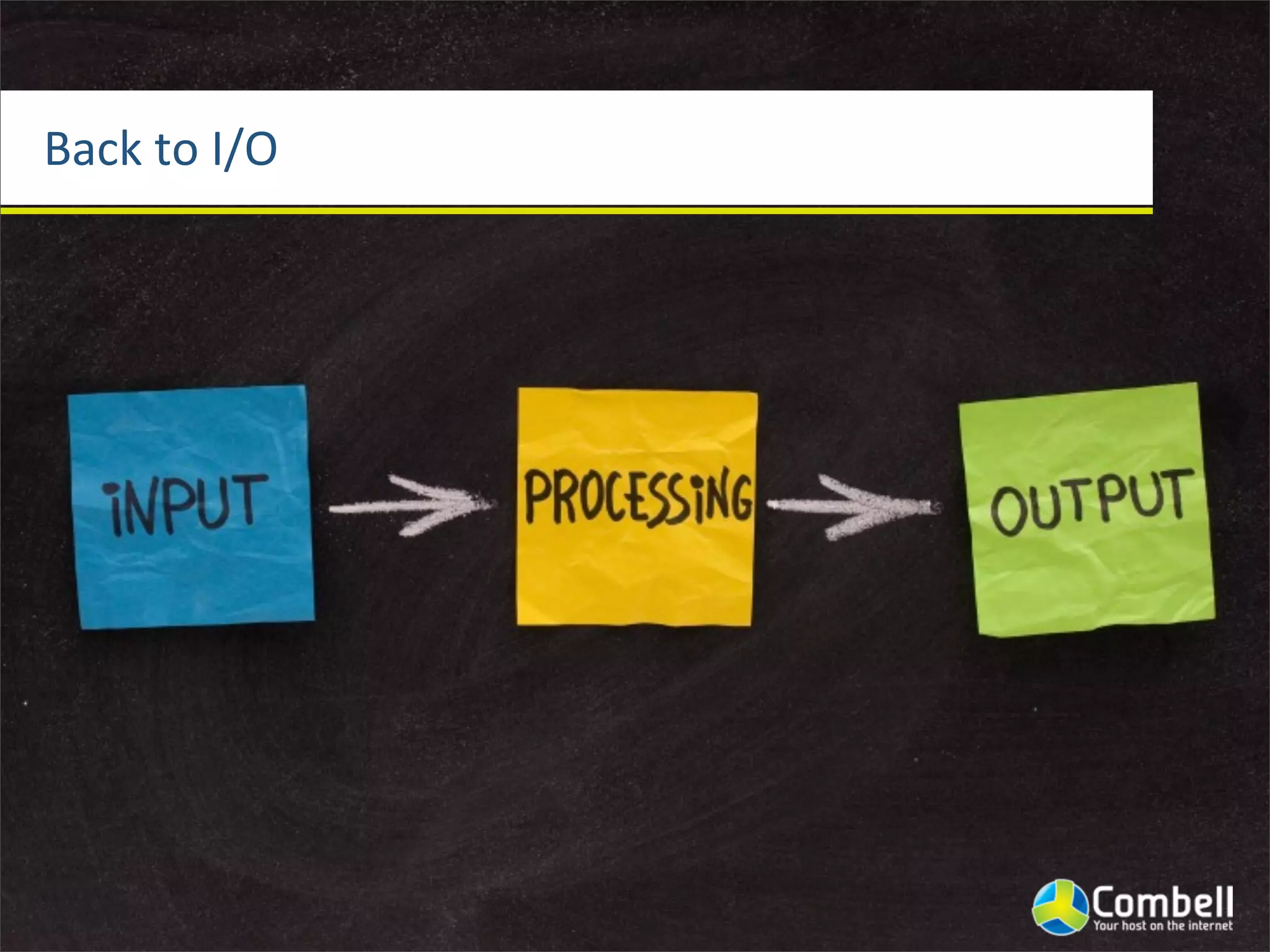
Back	
  to	
  I/O
STDIN


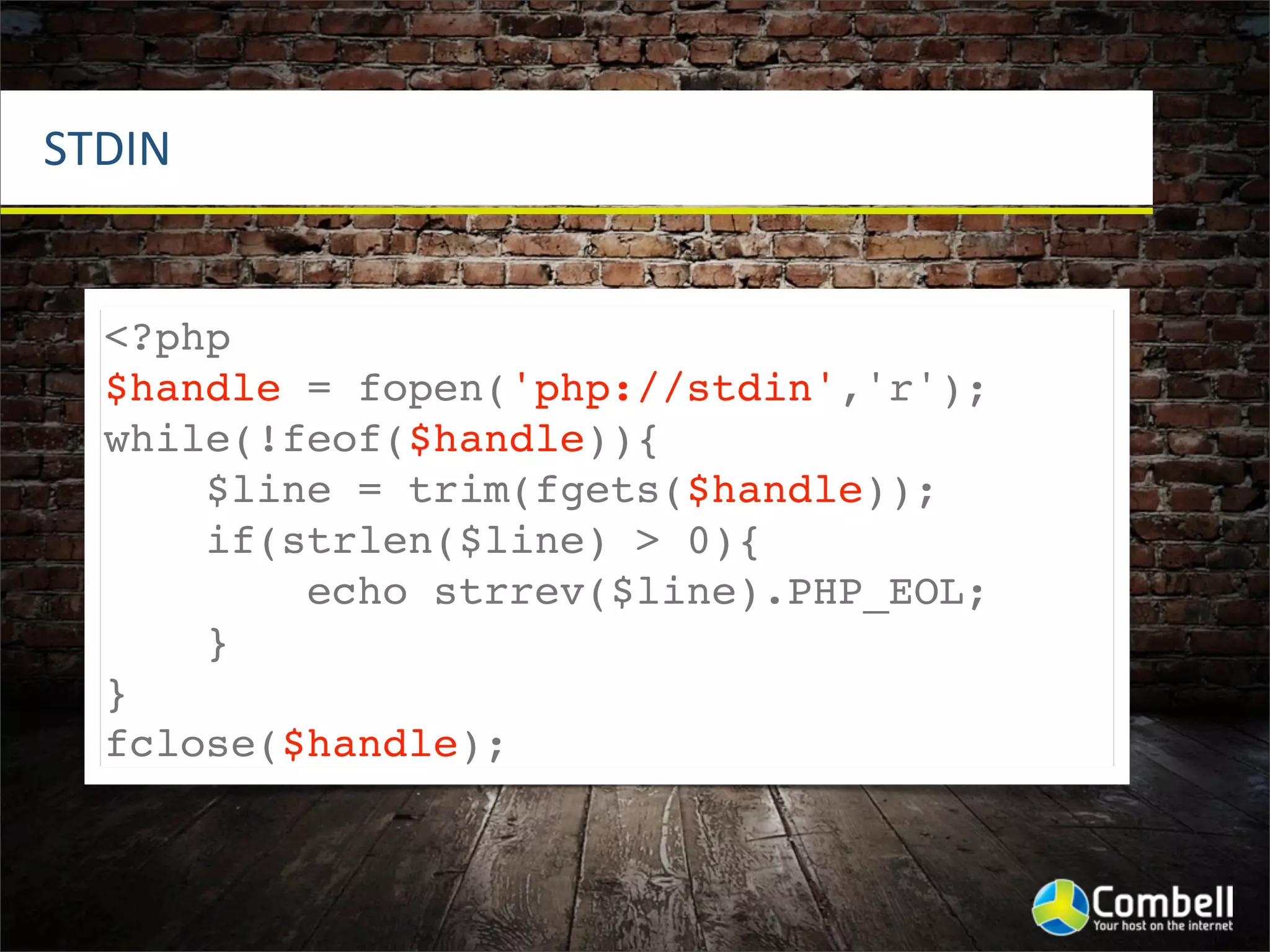
  <?php
  $handle = fopen('php://stdin','r');
  while(!feof($handle)){
      $line = trim(fgets($handle));
      if(strlen($line) > 0){
          echo strrev($line).PHP_EOL;
      }
  }
  fclose($handle);
STDIN


  <?php
  $handle = fopen('php://stdin','r');
  while(!feof($handle)){
      $line = trim(fgets($handle));
      if(strlen($line) > 0){
          echo strrev($line).PHP_EOL;
      }
  }
  fclose($handle);
STDIN


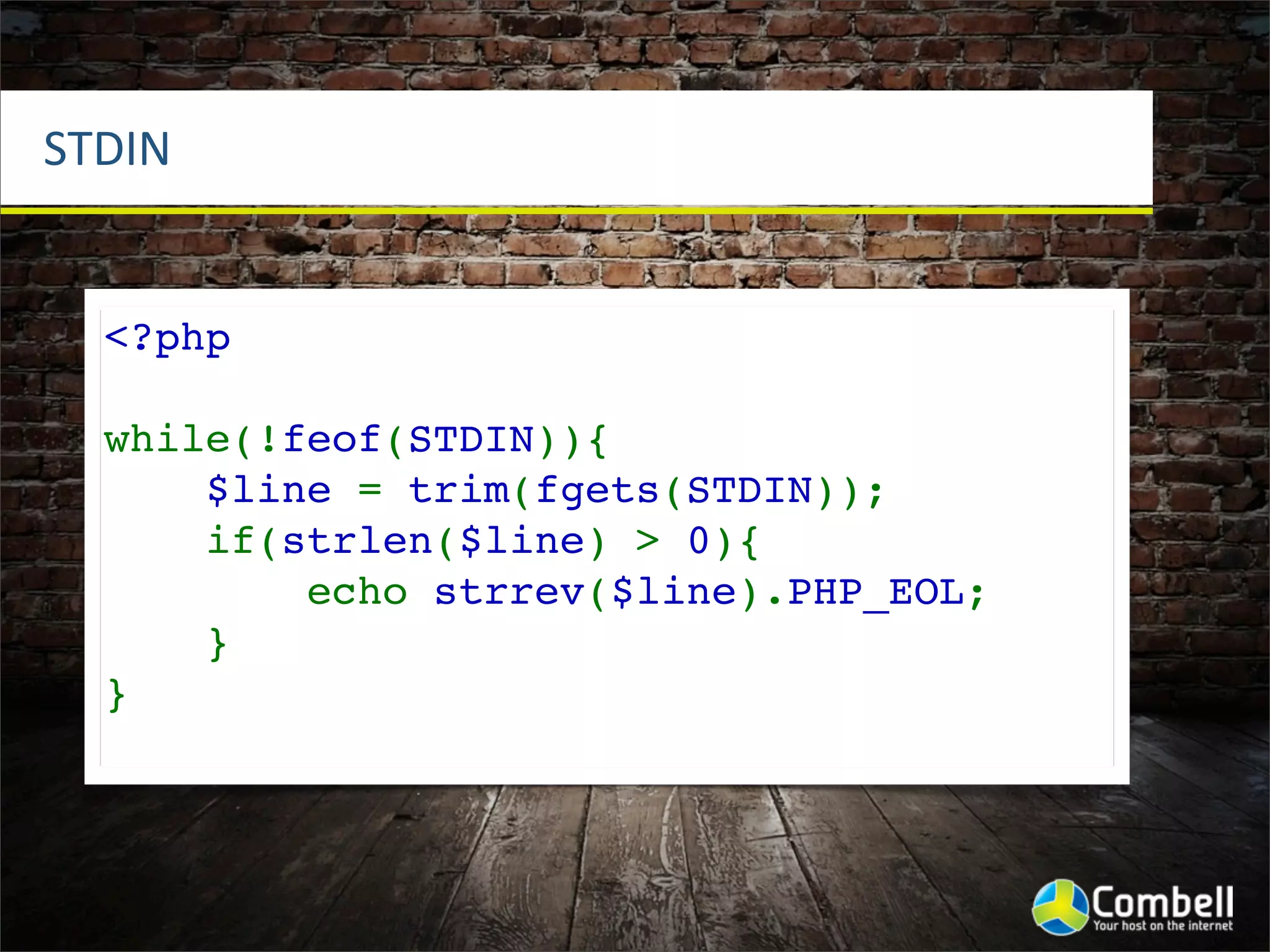
  <?php

  while(!feof(STDIN)){
      $line = trim(fgets(STDIN));
      if(strlen($line) > 0){
          echo strrev($line).PHP_EOL;
      }
  }
STDIN
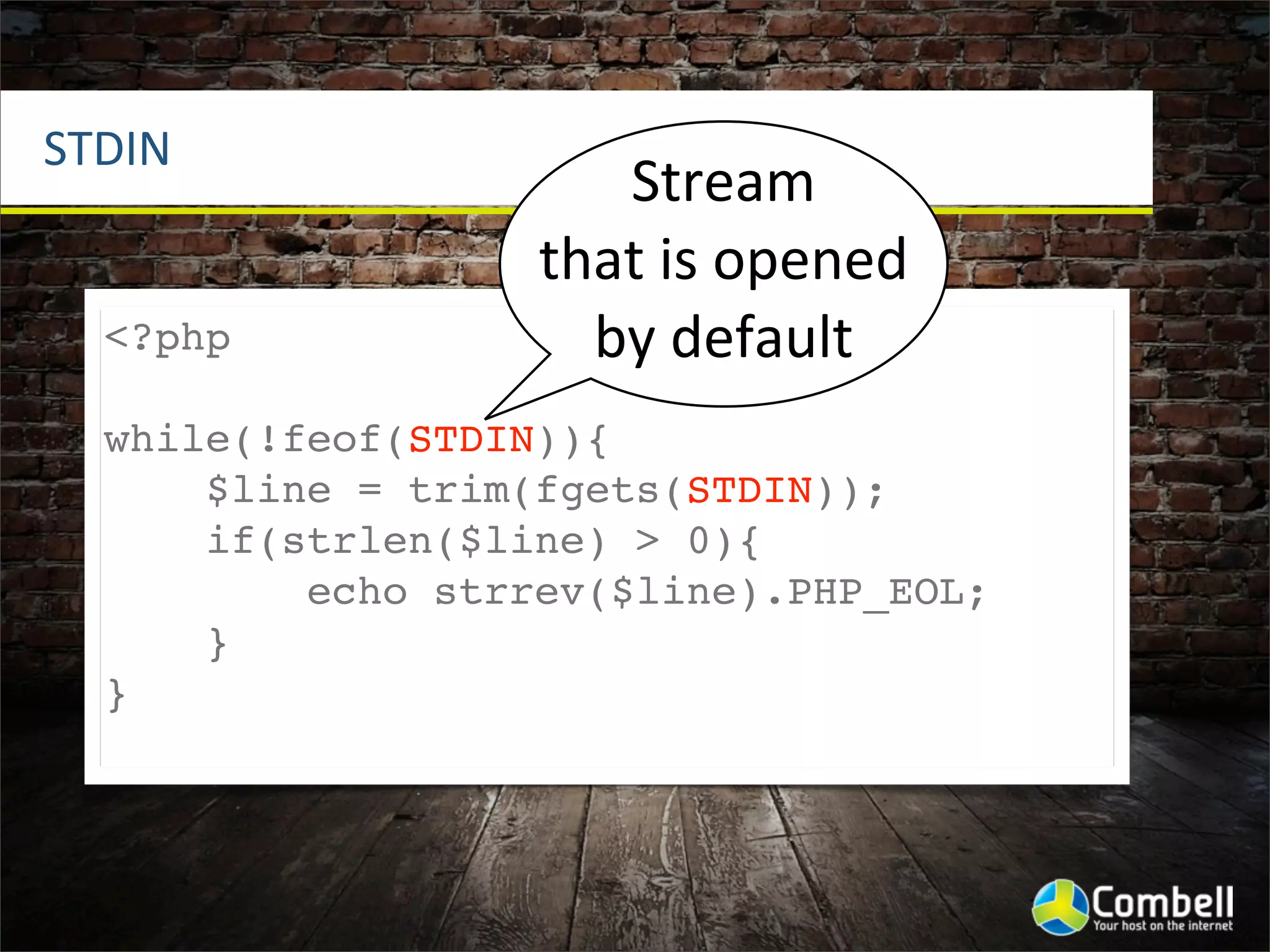
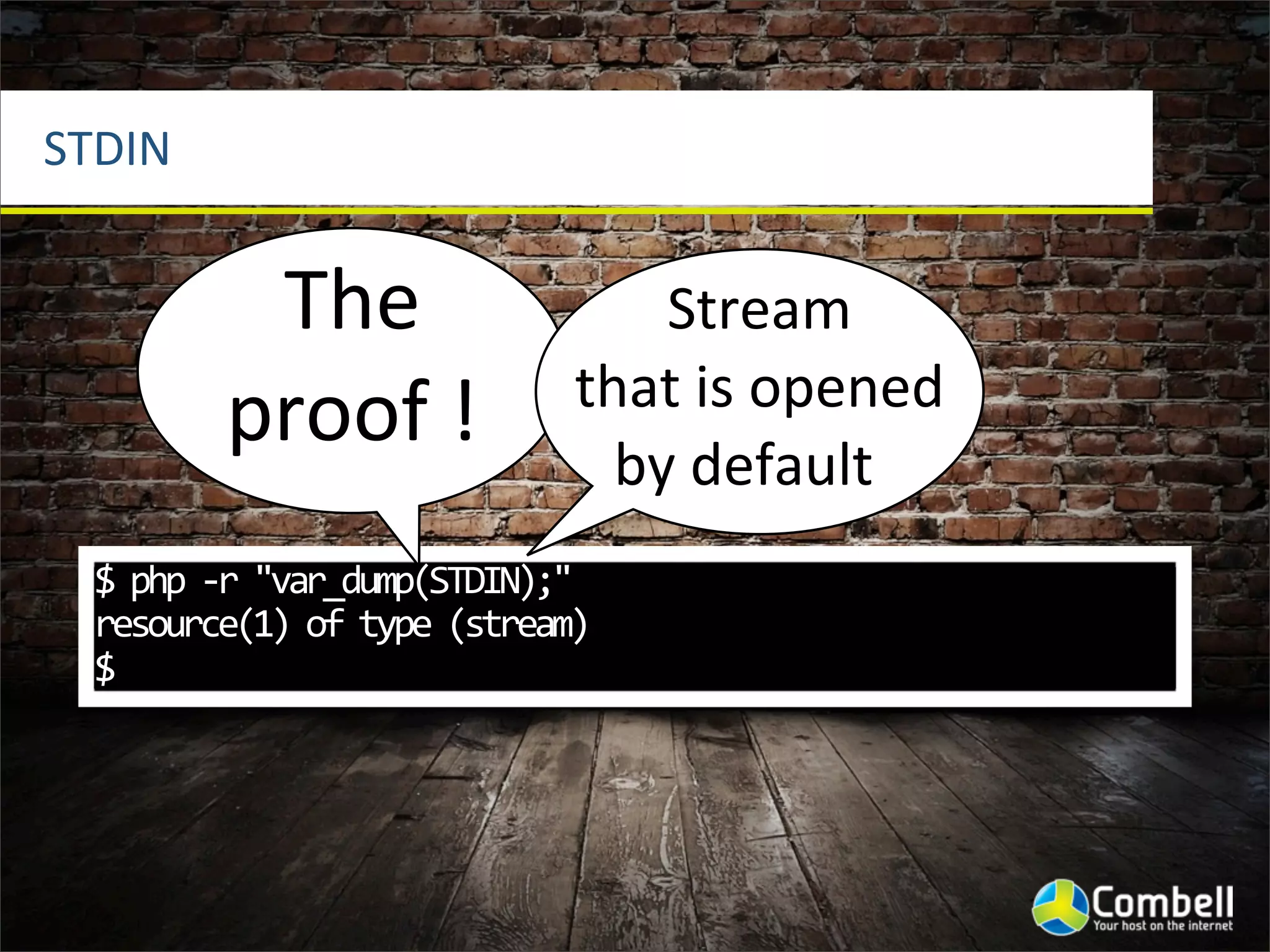
                      Stream	
  
                   that	
  is	
  opened	
  
  <?php              by	
  default
  while(!feof(STDIN)){
      $line = trim(fgets(STDIN));
      if(strlen($line) > 0){
          echo strrev($line).PHP_EOL;
      }
  }
STDIN


            The	
                        Stream	
  
                                     that	
  is	
  opened	
  
           proof	
  !                  by	
  default
 $	
  php	
  -­‐r	
  "var_dump(STDIN);"
 resource(1)	
  of	
  type	
  (stream)
 $
Wordcount	
  example

<?php
$wordArray = array();
while(!feof(STDIN)){
    $line = trim(fgets(STDIN));
    if(strlen($line) > 0){
        foreach(preg_split('/[s]+/',$line) as $word){
            if(!array_key_exists($word,$wordArray)){
                $wordArray[$word] = 0;
            }
            $wordArray[$word]++;
        }
    }
}
ksort($wordArray);
foreach($wordArray as $word=>$count){
    echo "$word: $count".PHP_EOL;
}
Wordcount	
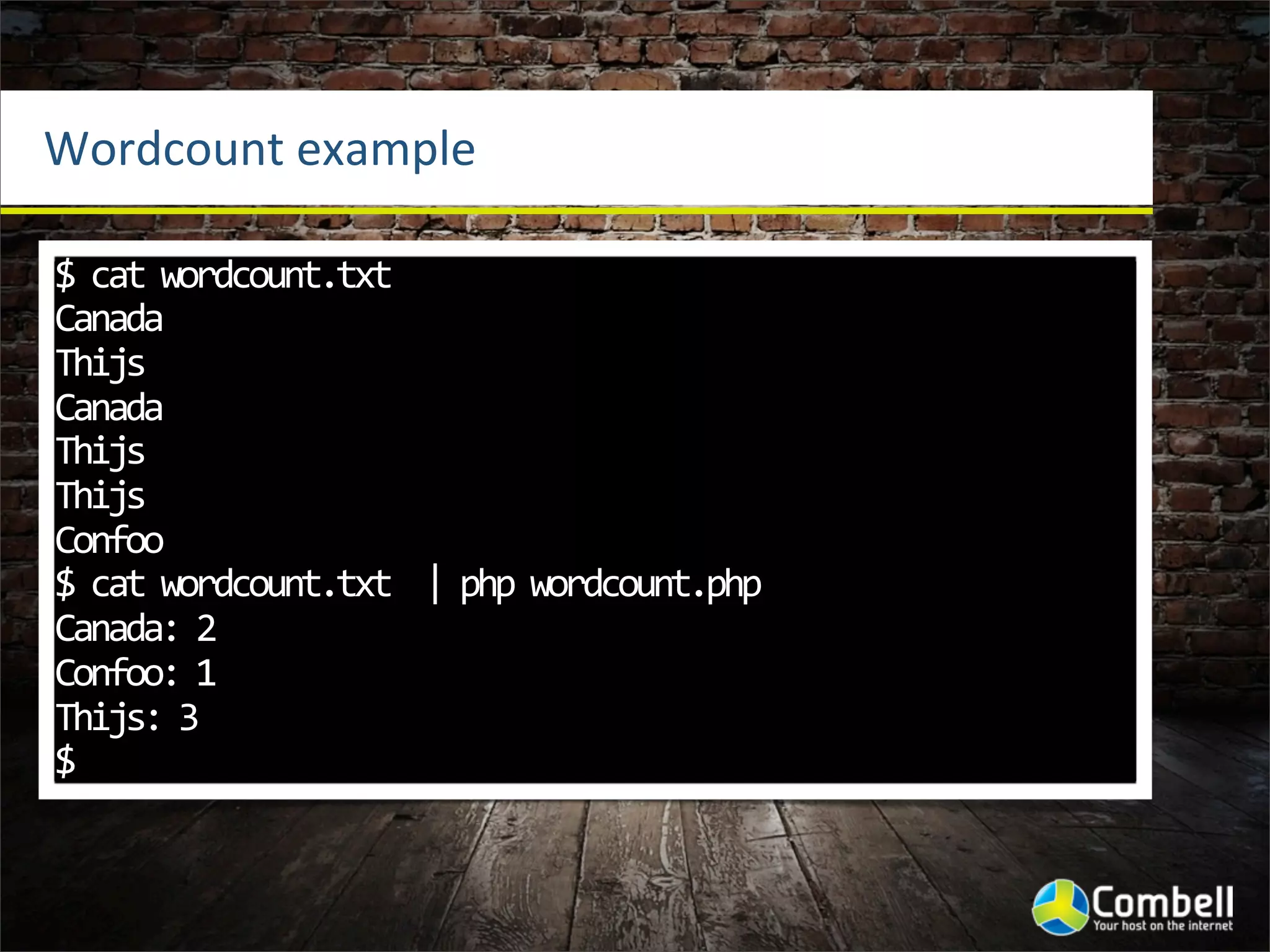
  example

$	
  cat	
  wordcount.txt	
  
Canada
Thijs
Canada
Thijs
Thijs
Confoo
$	
  cat	
  wordcount.txt	
  	
  |	
  php	
  wordcount.php	
  
Canada:	
  2
Confoo:	
  1
Thijs:	
  3
$
STDOUT
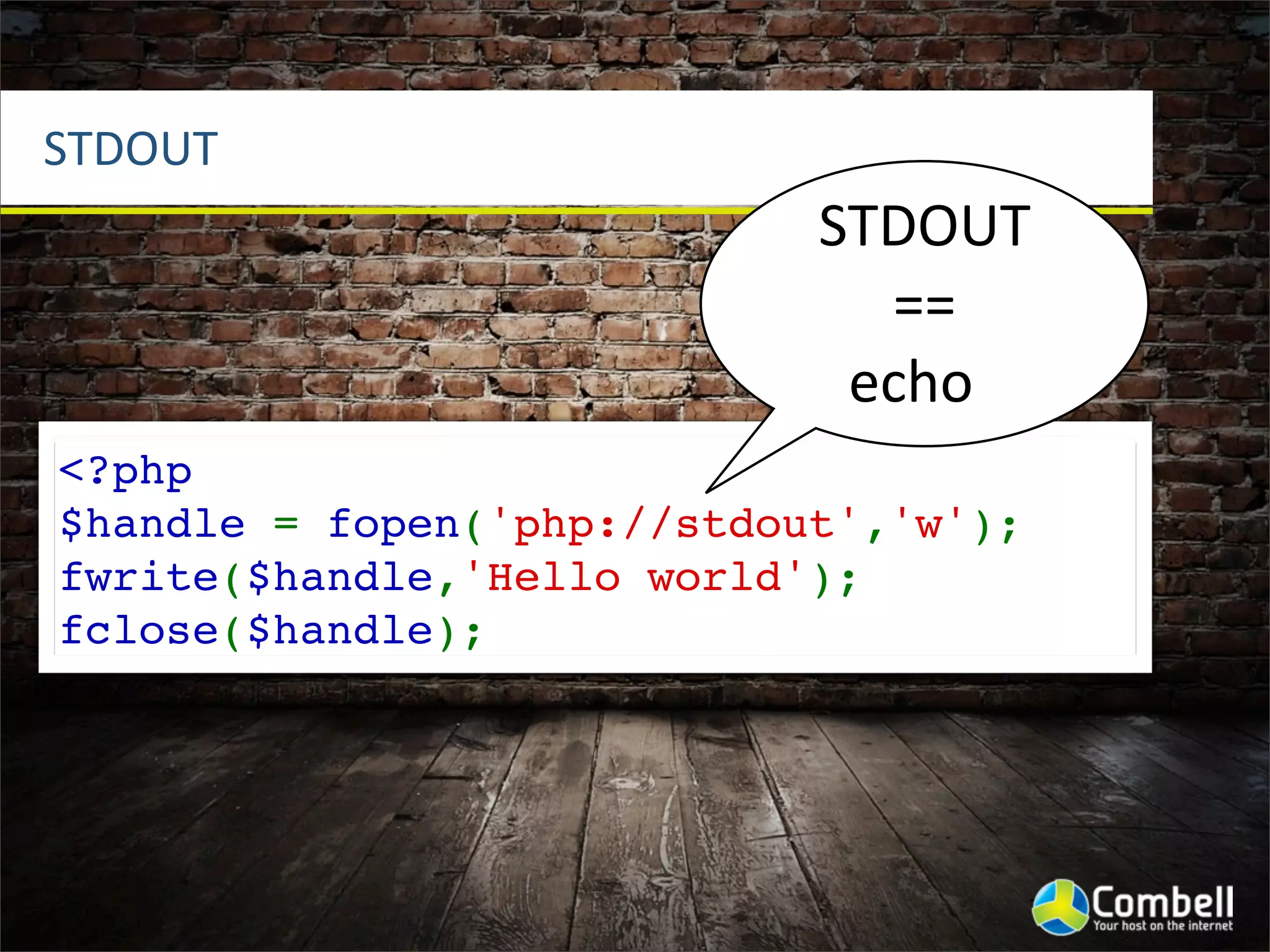
                            STDOUT	
  
                              ==	
  
                             echo
<?php
$handle = fopen('php://stdout','w');
fwrite($handle,'Hello world');
fclose($handle);
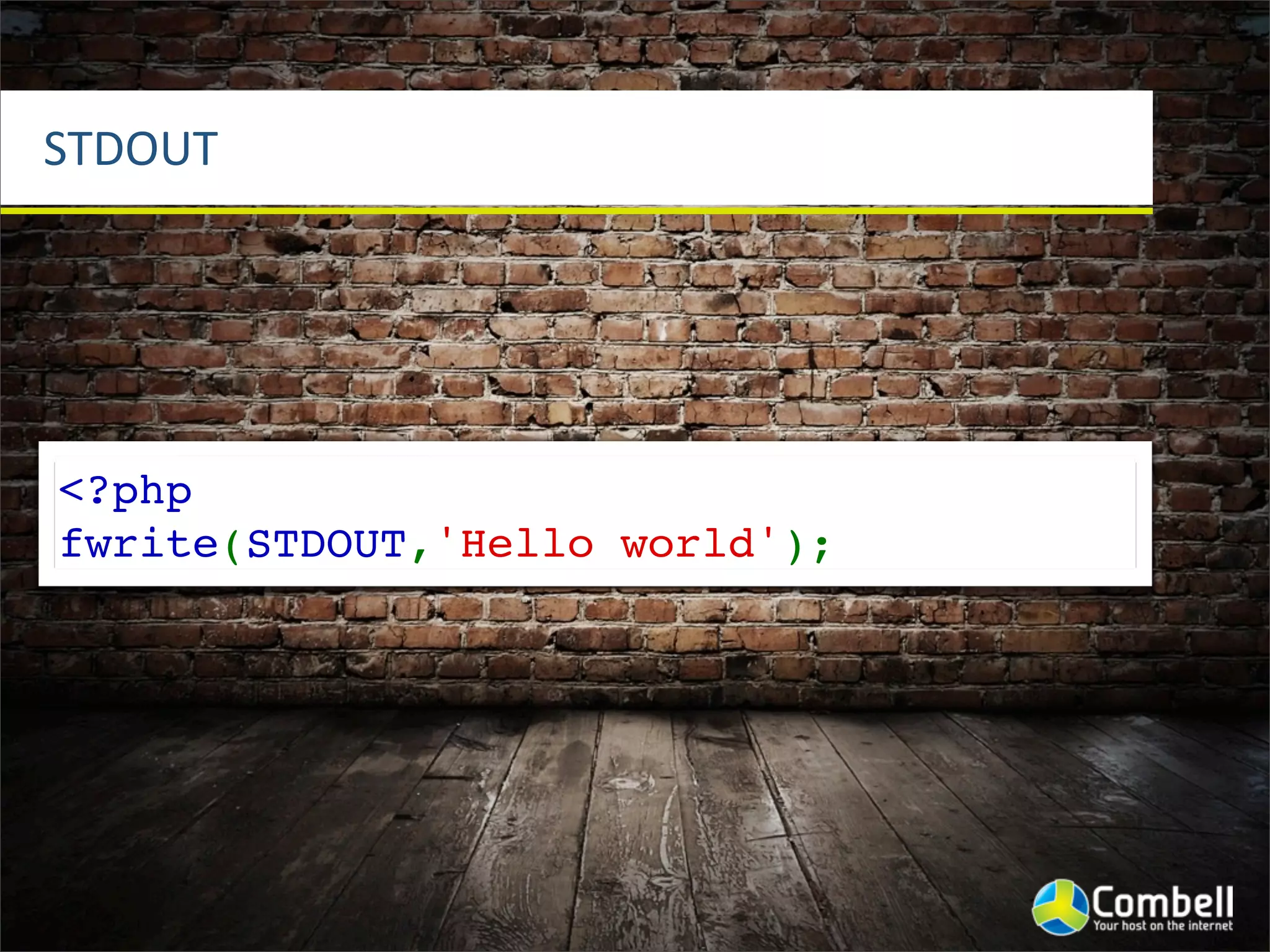
STDOUT


<?php
fwrite(STDOUT,'Hello world');
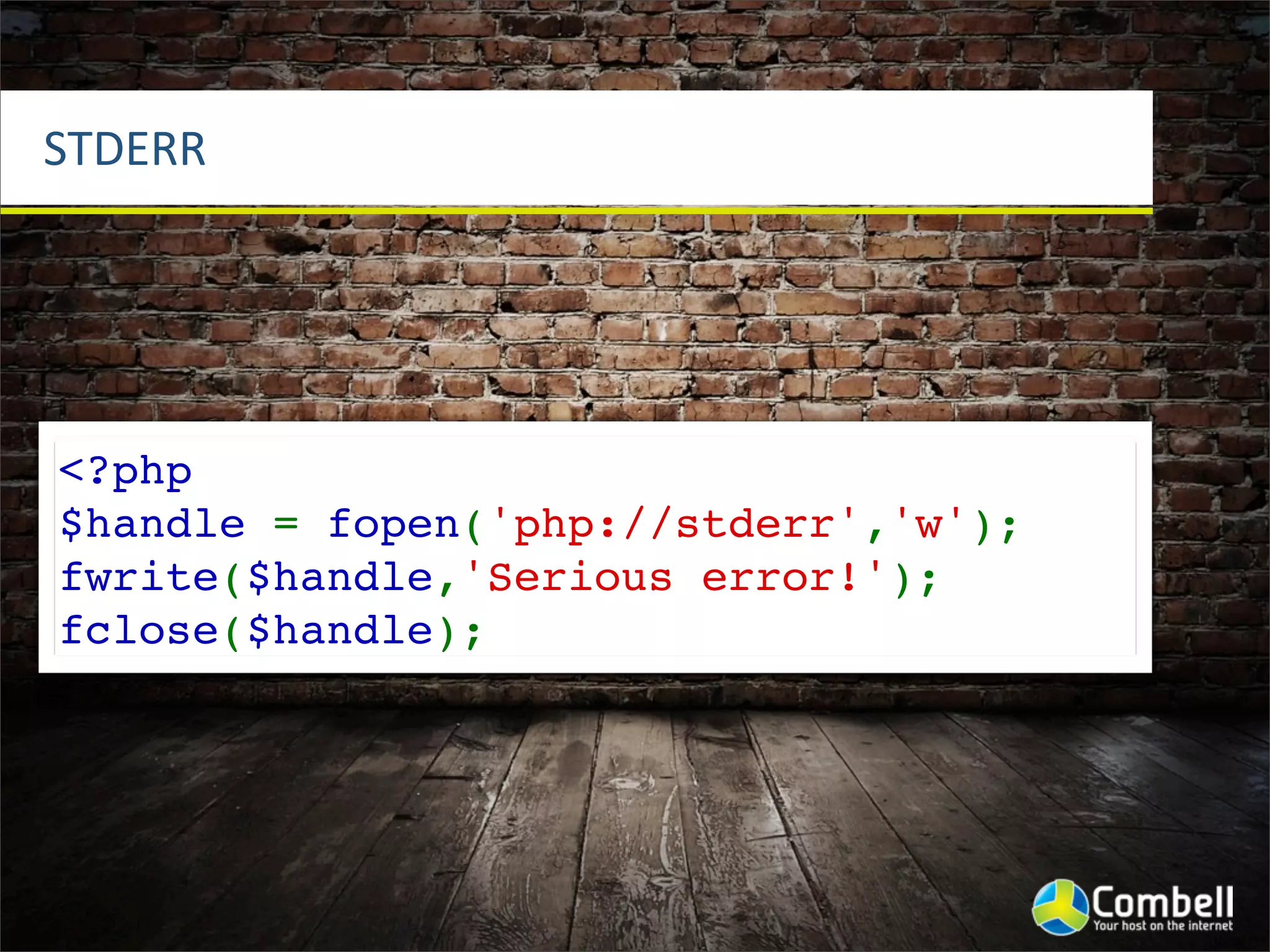
STDERR


<?php
$handle = fopen('php://stderr','w');
fwrite($handle,'Serious error!');
fclose($handle);
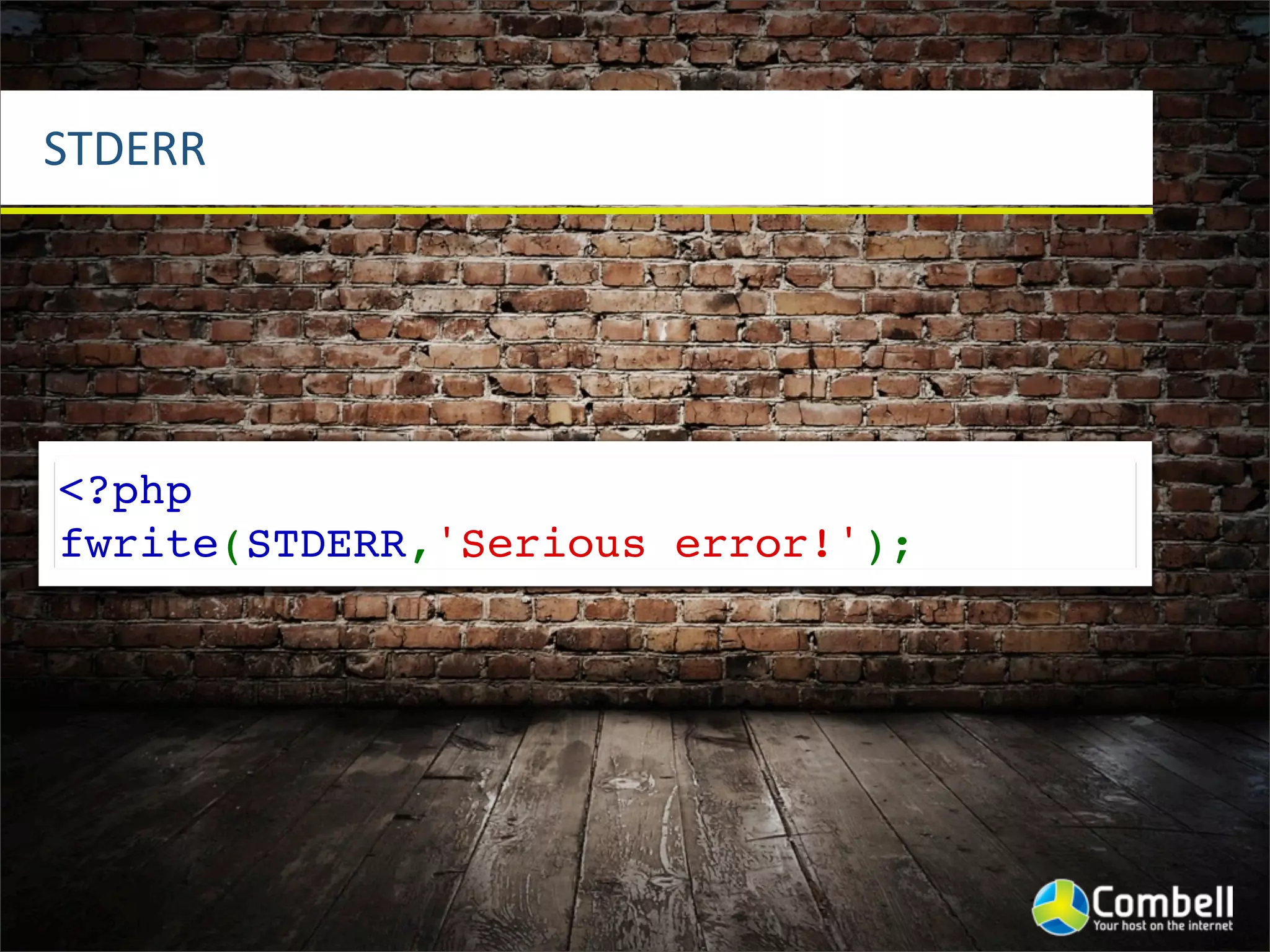
STDERR


<?php
fwrite(STDERR,'Serious error!');
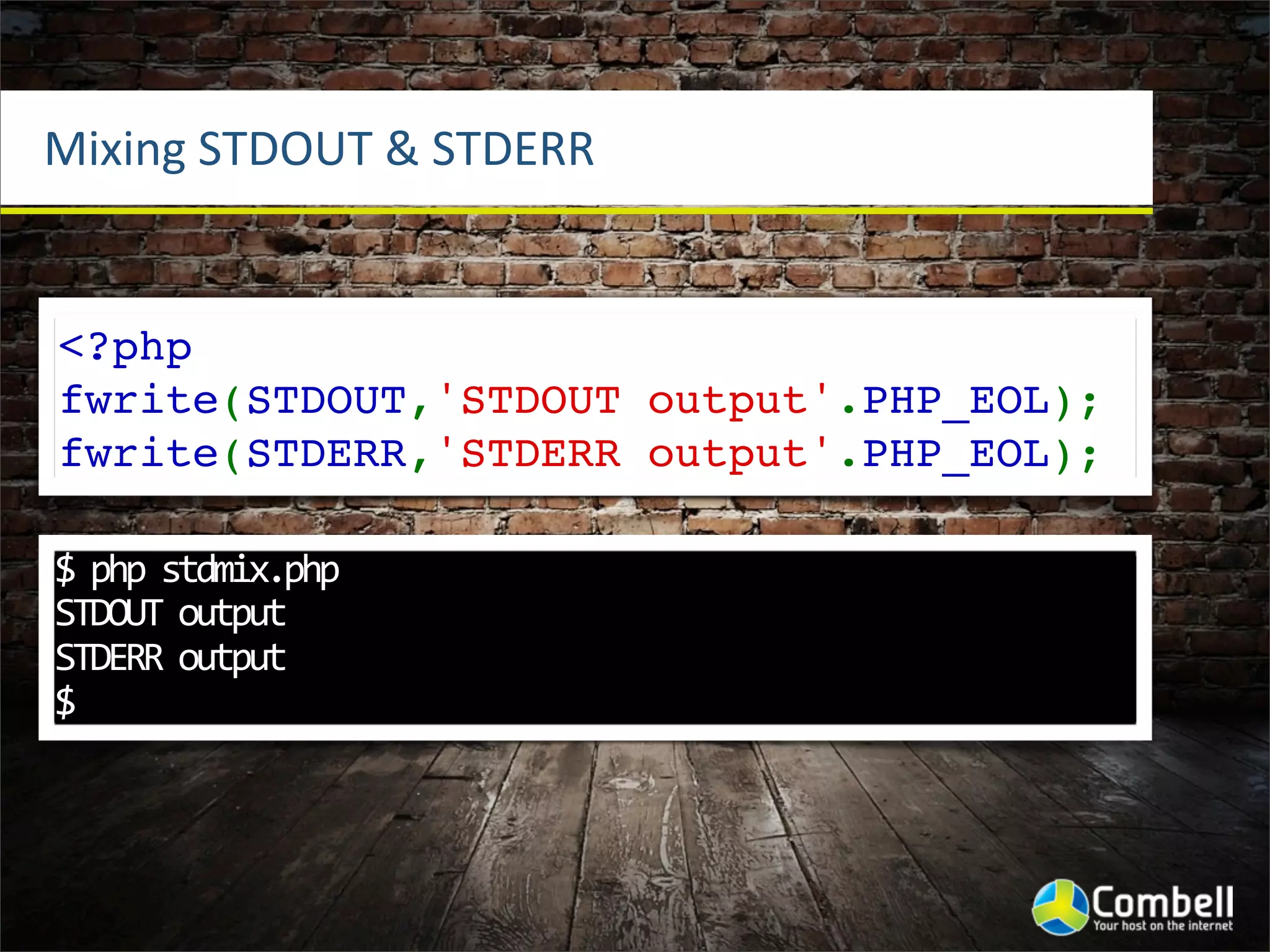
Mixing	
  STDOUT	
  &	
  STDERR


<?php
fwrite(STDOUT,'STDOUT output'.PHP_EOL);
fwrite(STDERR,'STDERR output'.PHP_EOL);

$	
  php	
  stdmix.php	
  
STDOUT	
  output
STDERR	
  output
$
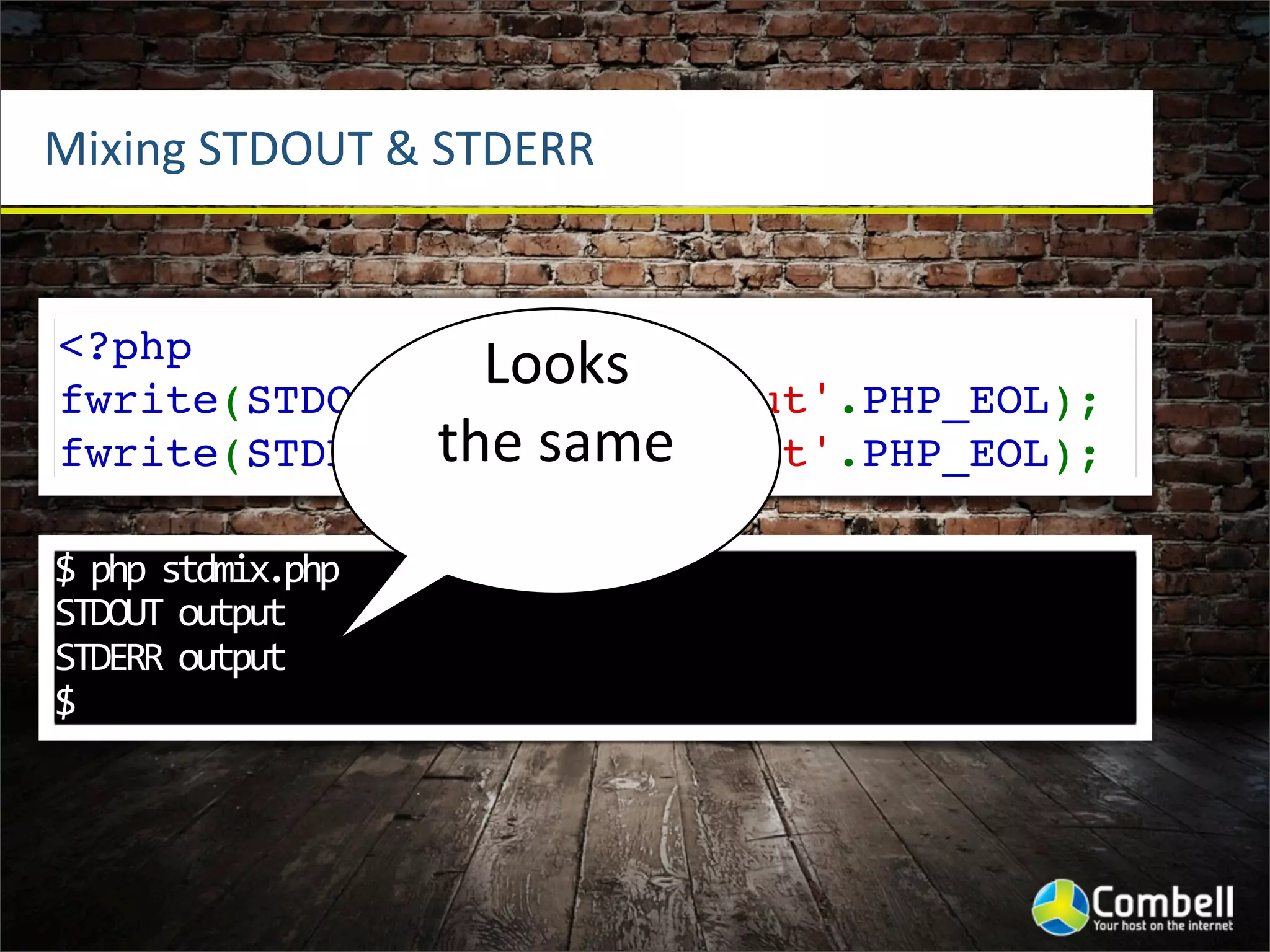
Mixing	
  STDOUT	
  &	
  STDERR


<?php
                Looks	
  
fwrite(STDOUT,'STDOUT output'.PHP_EOL);
              the	
  same
fwrite(STDERR,'STDERR output'.PHP_EOL);

$	
  php	
  stdmix.php	
  
STDOUT	
  output
STDERR	
  output
$
Mixing	
  STDOUT	
  &	
  STDERR


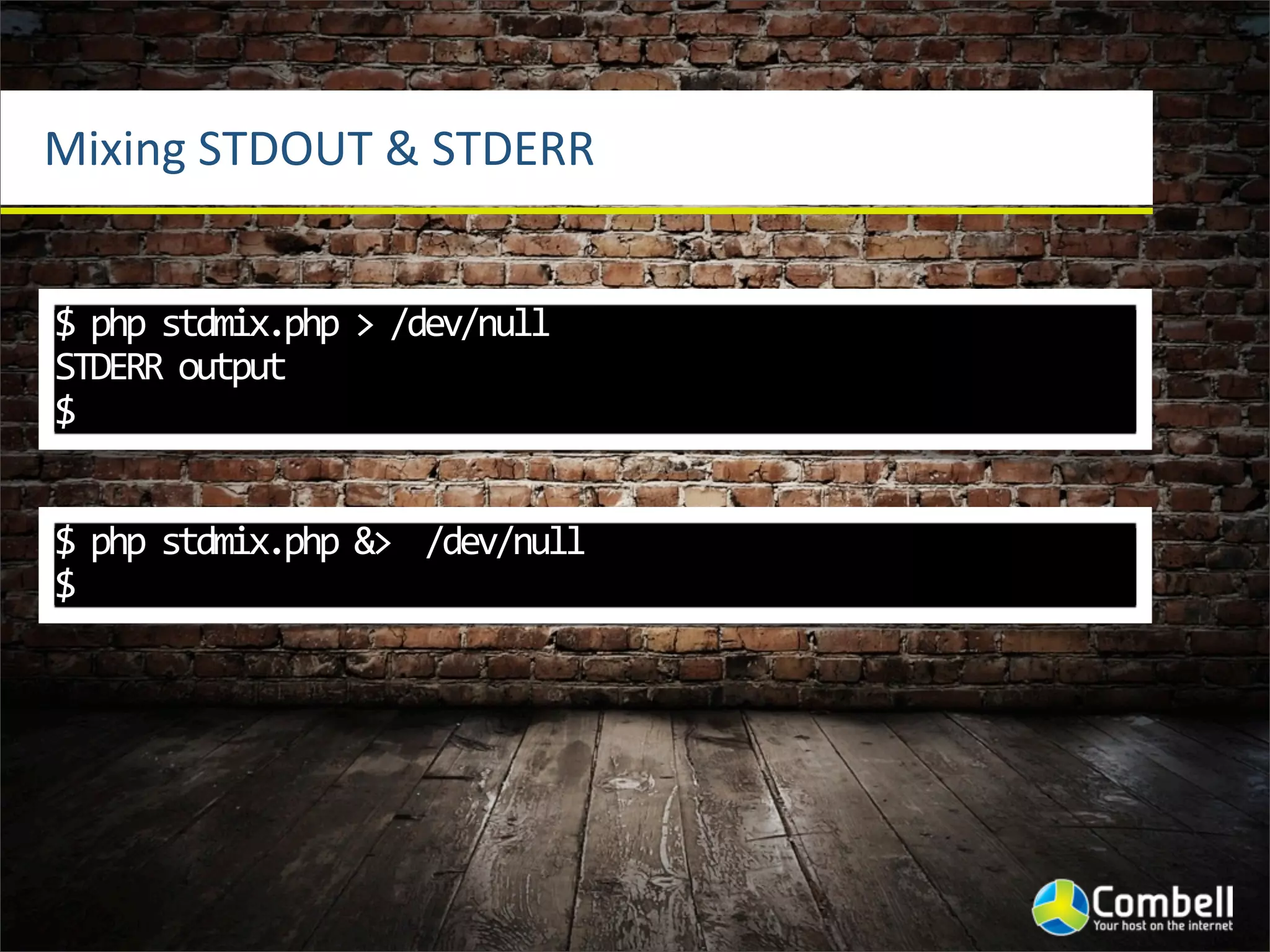
$	
  php	
  stdmix.php	
  >	
  /dev/null	
  
STDERR	
  output
$


$	
  php	
  stdmix.php	
  &>	
  	
  /dev/null
$
Mixing	
  STDOUT	
  &	
  STDERR
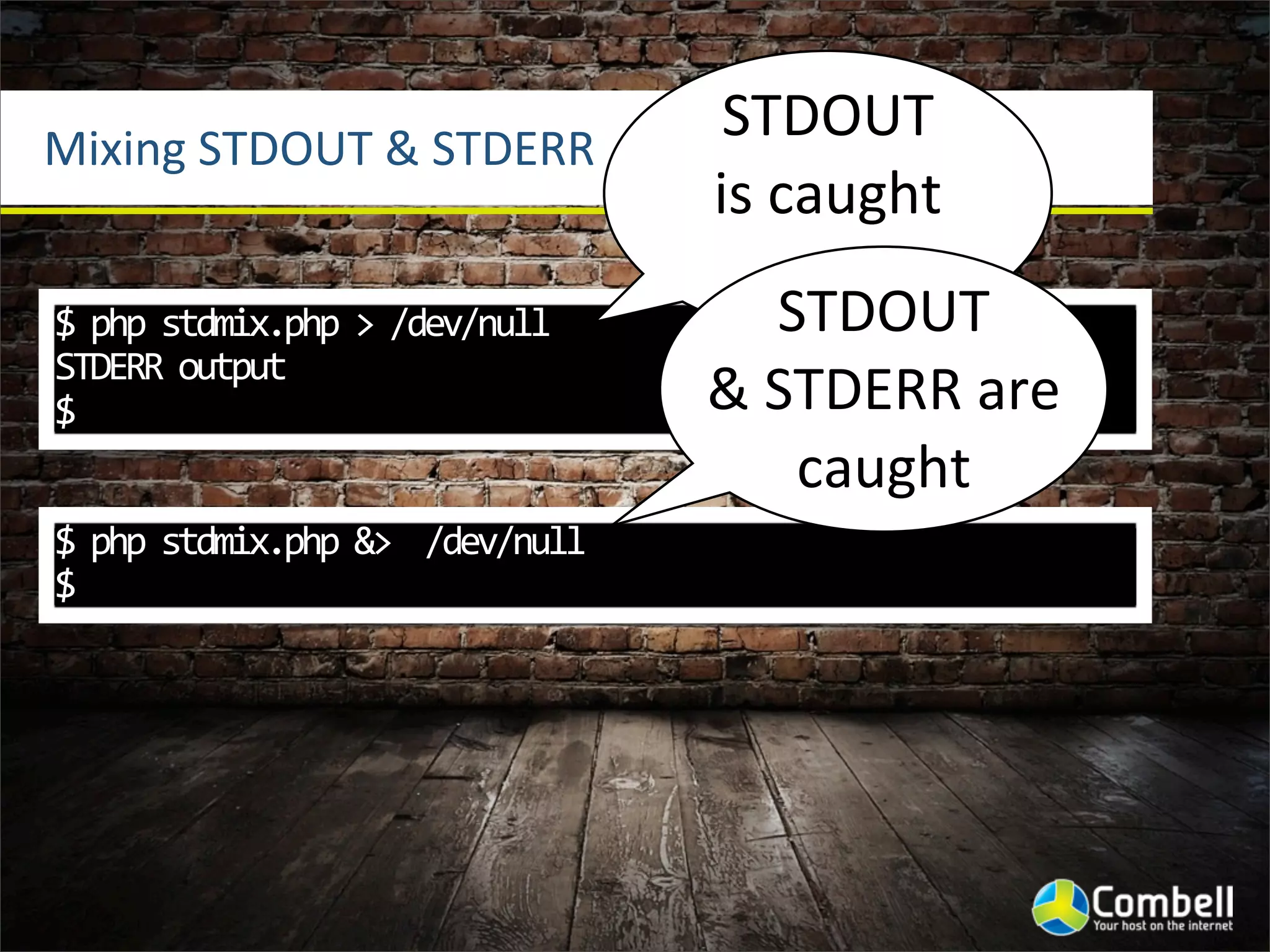
                                                 STDOUT	
  
                                                is	
  caught
$	
  php	
  stdmix.php	
  >	
  /dev/null	
           STDOUT	
  
STDERR	
  output
$                                               &	
  STDERR	
  are	
  
                                                      caught
$	
  php	
  stdmix.php	
  &>	
  	
  /dev/null
$
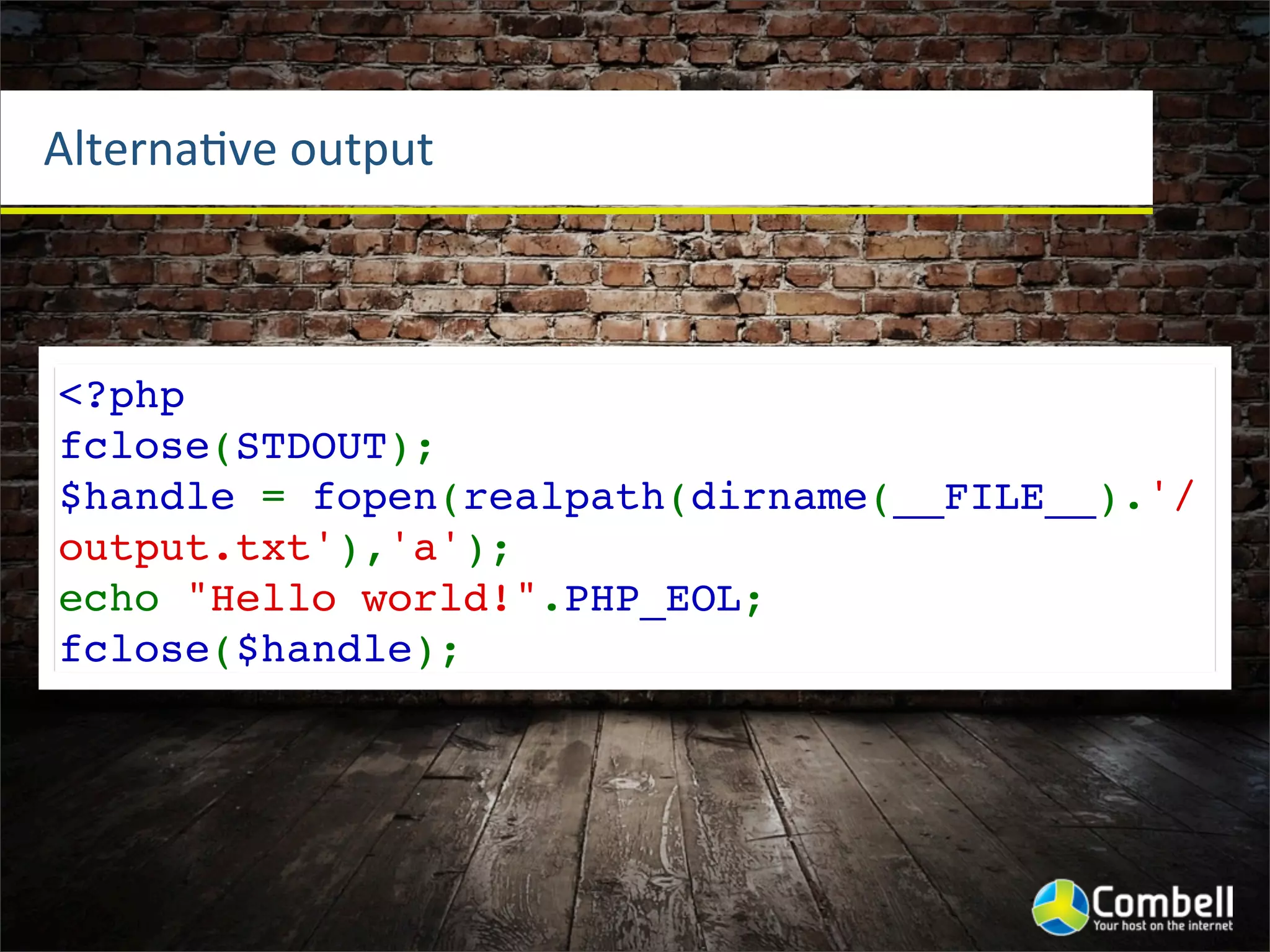
AlternaOve	
  output


<?php
fclose(STDOUT);
$handle = fopen(realpath(dirname(__FILE__).'/
output.txt'),'a');
echo "Hello world!".PHP_EOL;
fclose($handle);
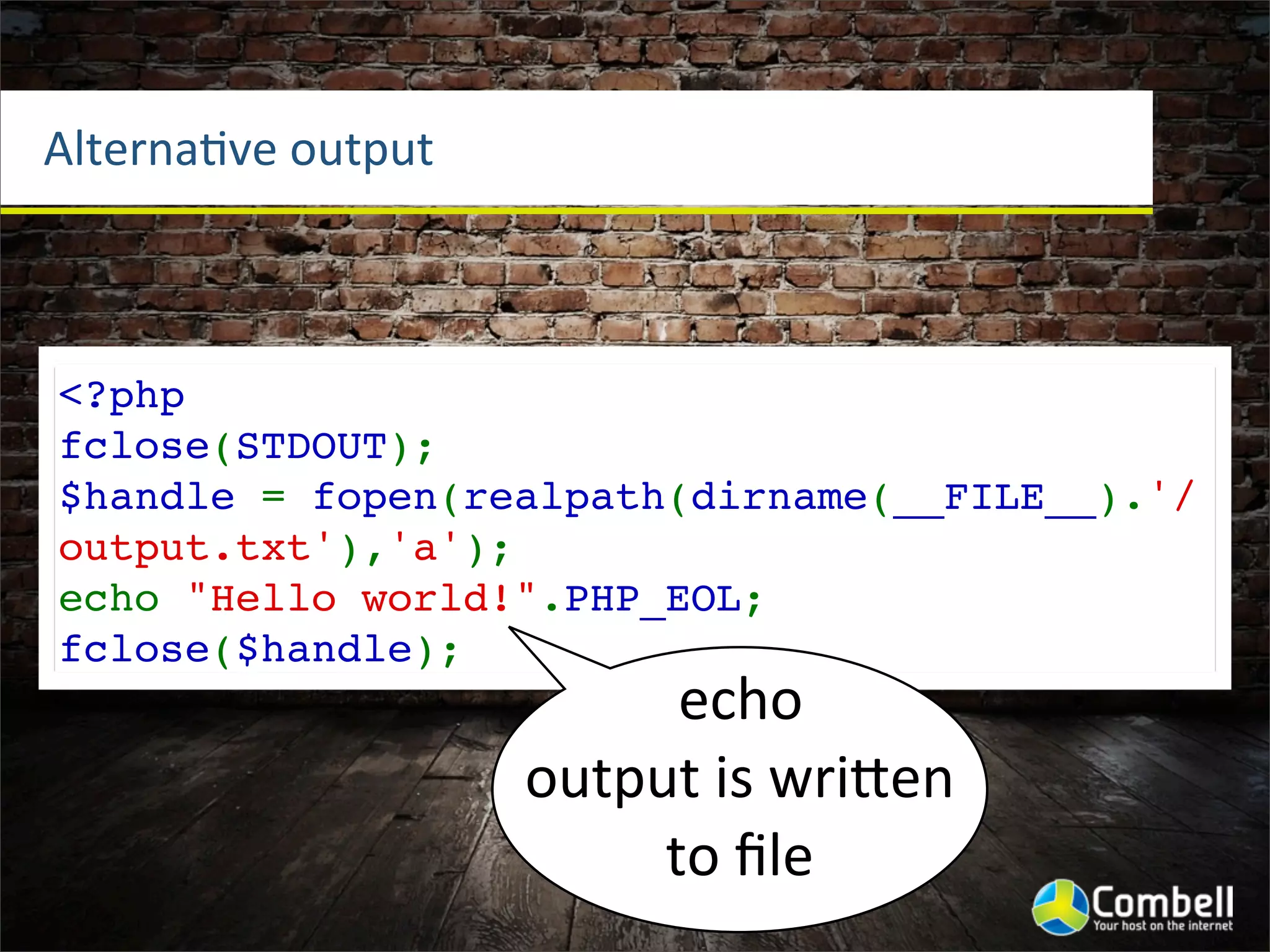
AlternaOve	
  output


<?php
fclose(STDOUT);
$handle = fopen(realpath(dirname(__FILE__).'/
output.txt'),'a');
echo "Hello world!".PHP_EOL;
fclose($handle);
                             echo	
  
                       output	
  is	
  wriWen	
  
                            to	
  file
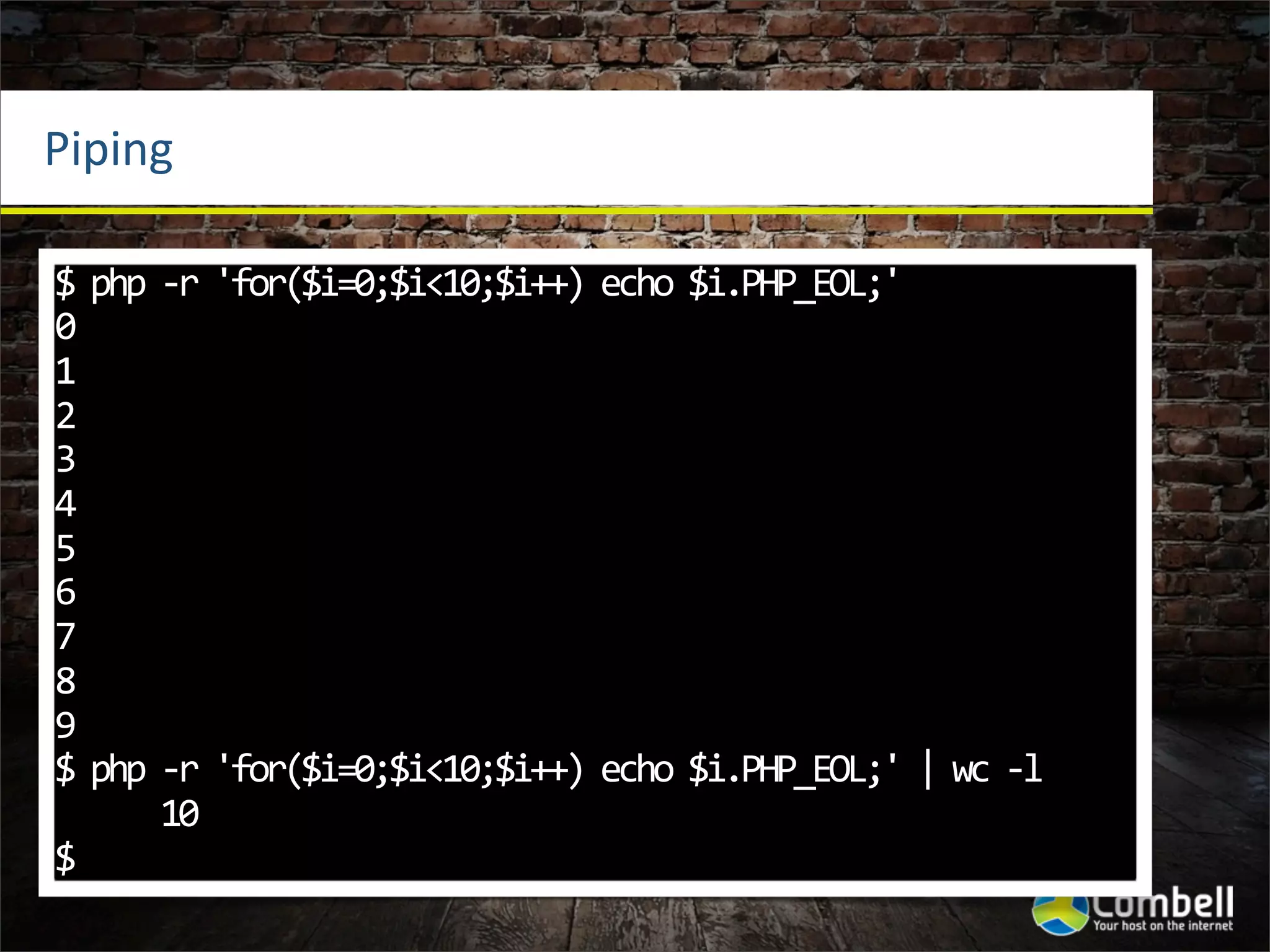
Piping

$	
  php	
  -­‐r	
  'for($i=0;$i<10;$i++)	
  echo	
  $i.PHP_EOL;'
0
1
2
3
4
5
6
7
8
9
$	
  php	
  -­‐r	
  'for($i=0;$i<10;$i++)	
  echo	
  $i.PHP_EOL;'	
  |	
  wc	
  -­‐l


  10
$
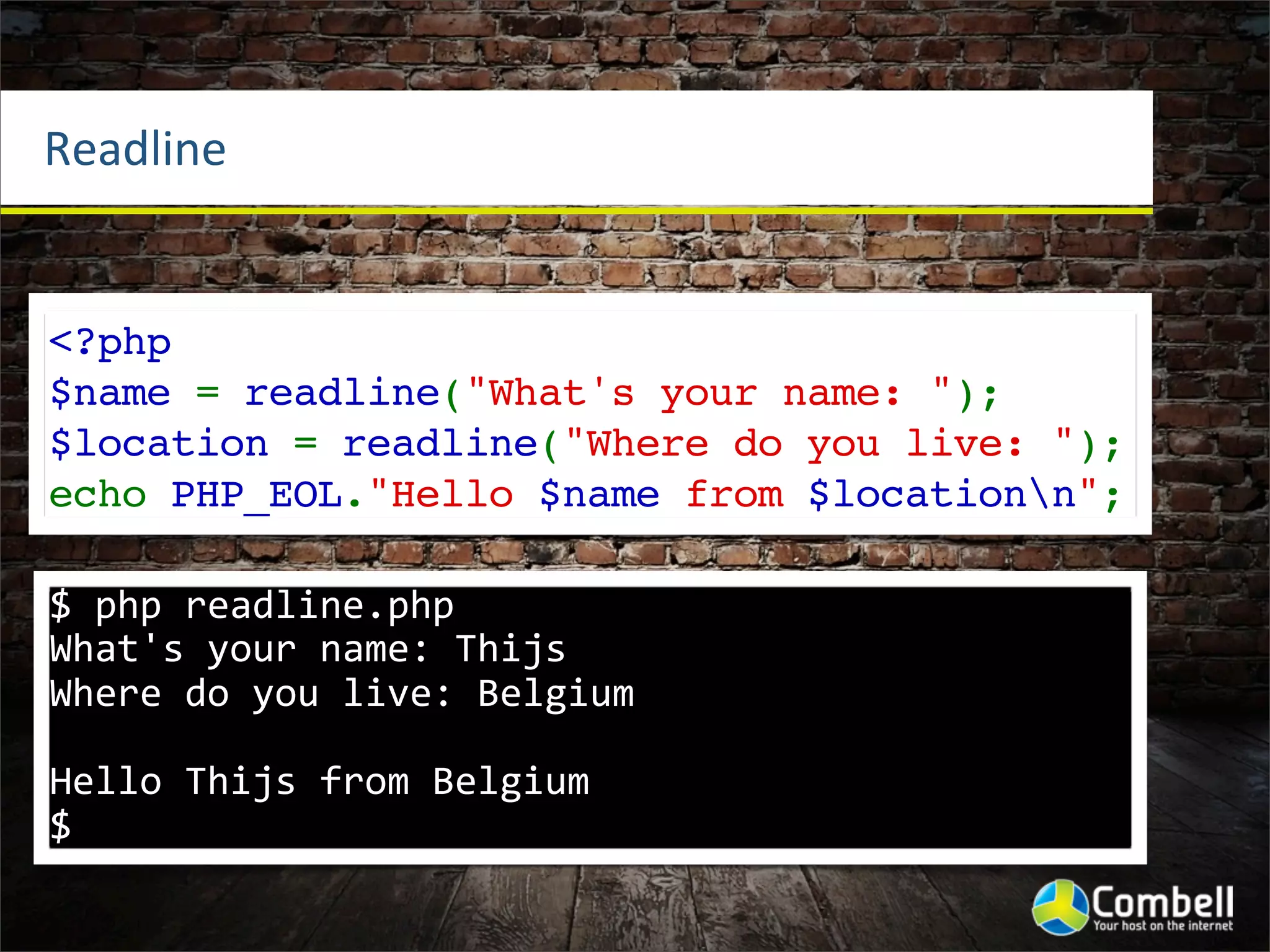
Readline


<?php
$name = readline("What's your name: ");
$location = readline("Where do you live: ");
echo PHP_EOL."Hello $name from $locationn";

$	
  php	
  readline.php	
  
What's	
  your	
  name:	
  Thijs
Where	
  do	
  you	
  live:	
  Belgium

Hello	
  Thijs	
  from	
  Belgium
$
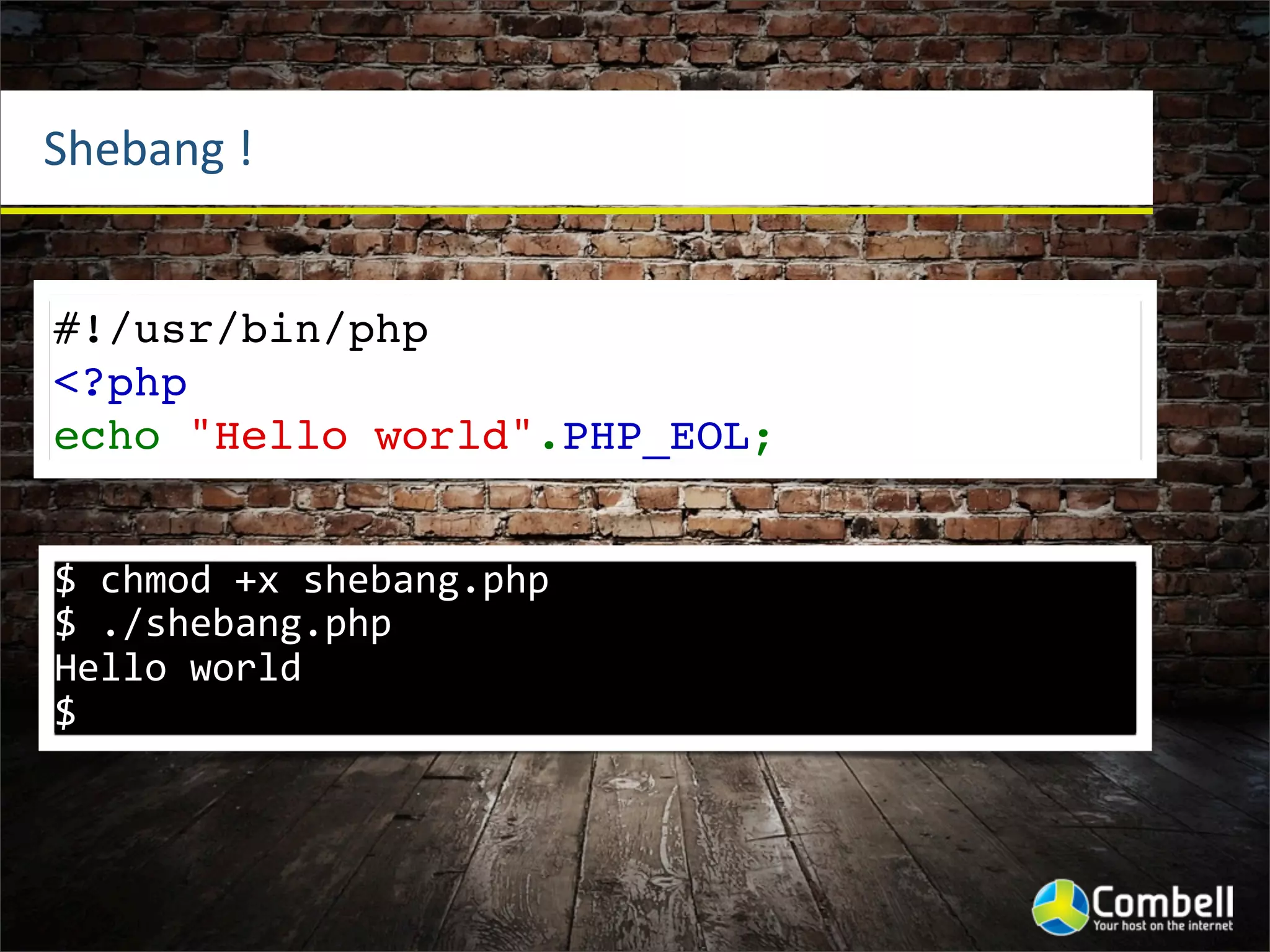
Shebang	
  !


#!/usr/bin/php
<?php
echo "Hello world".PHP_EOL;


$	
  chmod	
  +x	
  shebang.php
$	
  ./shebang.php
Hello	
  world
$
Encore
PCNTL	
  according	
  to	
  php.net


      Process	
  Control	
  support	
  in	
  PHP	
  
   implements	
  the	
  Unix	
  style	
  of	
  process	
  
    crea^on,	
  program	
  execu^on,	
  signal	
  
     handling	
  and	
  process	
  termina^on.
Process	
  Control	
  should	
  not	
  be	
  enabled	
  
  within	
  a	
  web	
  server	
  environment	
  and	
  
  unexpected	
  results	
  may	
  happen	
  if	
  any	
  
Process	
  Control	
  func^ons	
  are	
  used	
  within	
  
       a	
  web	
  server	
  environment.
Forking	
  according	
  to	
  Wikipedia


  In	
  compu^ng,	
  when	
  a	
  process	
  forks,	
  it	
  
            creates	
  a	
  copy	
  of	
  itself
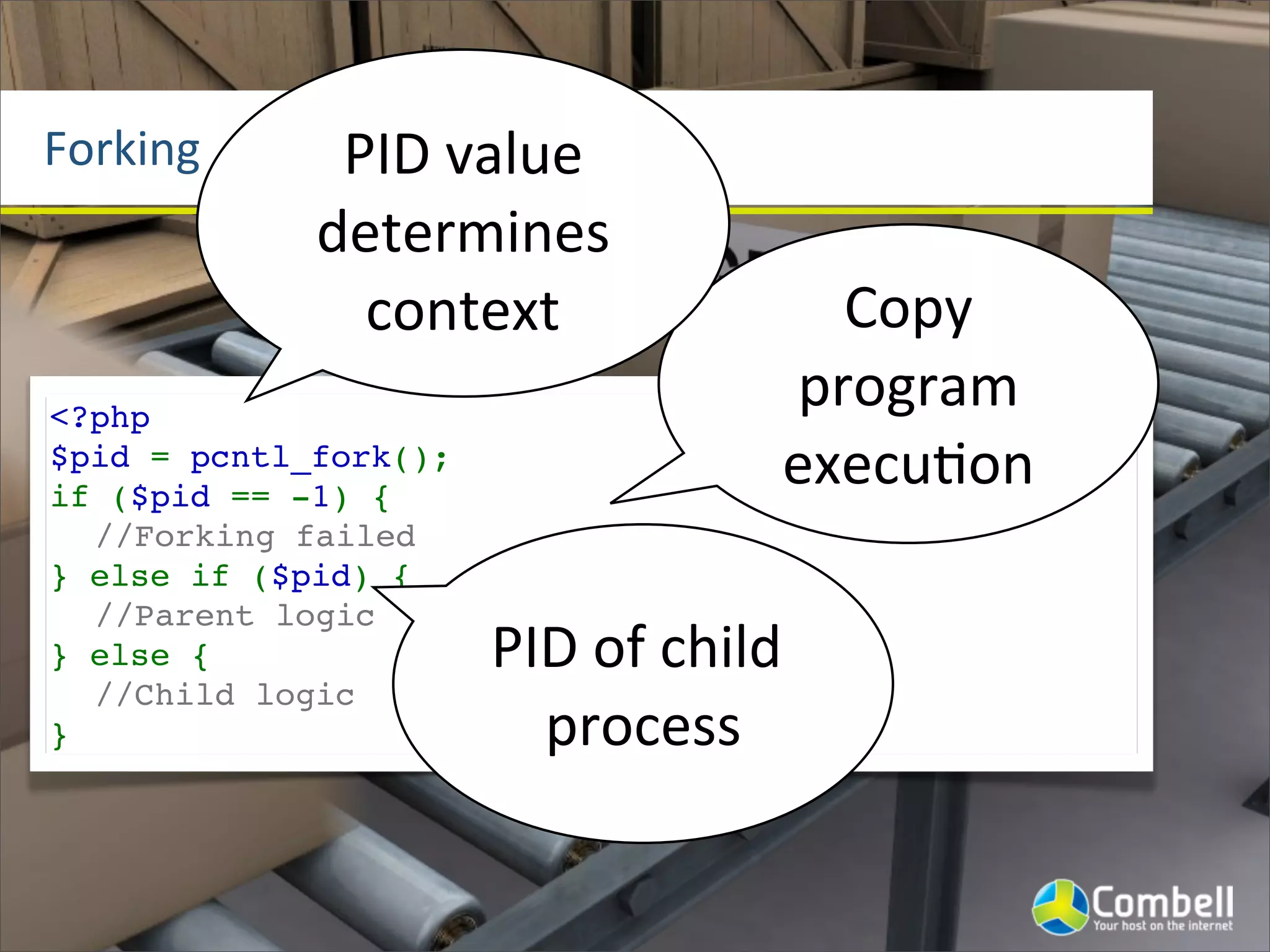
Forking       PID	
  value	
  
             determines	
  
               context                        Copy	
  
<?php
                                            program	
  
$pid = pcntl_fork();
if ($pid == -1) {
                                            execu^on
  //Forking failed
} else if ($pid) {
  //Parent logic
} else {               PID	
  of	
  child	
  
  //Child logic
}                        process
Forking
<?php
$pid = pcntl_fork();
if ($pid == -1) {
     die('could not fork');
} else if ($pid) {
     echo "[parent] Starting".PHP_EOL;
     pcntl_wait($status);
     echo "[parent] Exiting".PHP_EOL;
} else {
        echo "[child] Starting".PHP_EOL;
    for($i=0;$i<3;$i++){
        echo "[child] Loop $i".PHP_EOL;
        sleep(1);
    }
    echo "[child] Exiting".PHP_EOL;
    exit;
}
Forking                     Perform	
  
                            forking
<?php
$pid = pcntl_fork();
if ($pid == -1) {
     die('could not fork');
                                Wait	
  for	
  child	
  
} else if ($pid) {              termina^on
     echo "[parent] Starting".PHP_EOL;
     pcntl_wait($status);
     echo "[parent] Exiting".PHP_EOL;
} else {
        echo "[child] Starting".PHP_EOL;
    for($i=0;$i<3;$i++){
        echo "[child] Loop $i".PHP_EOL;
        sleep(1);
    }
    echo "[child] Exiting".PHP_EOL;
    exit;
}
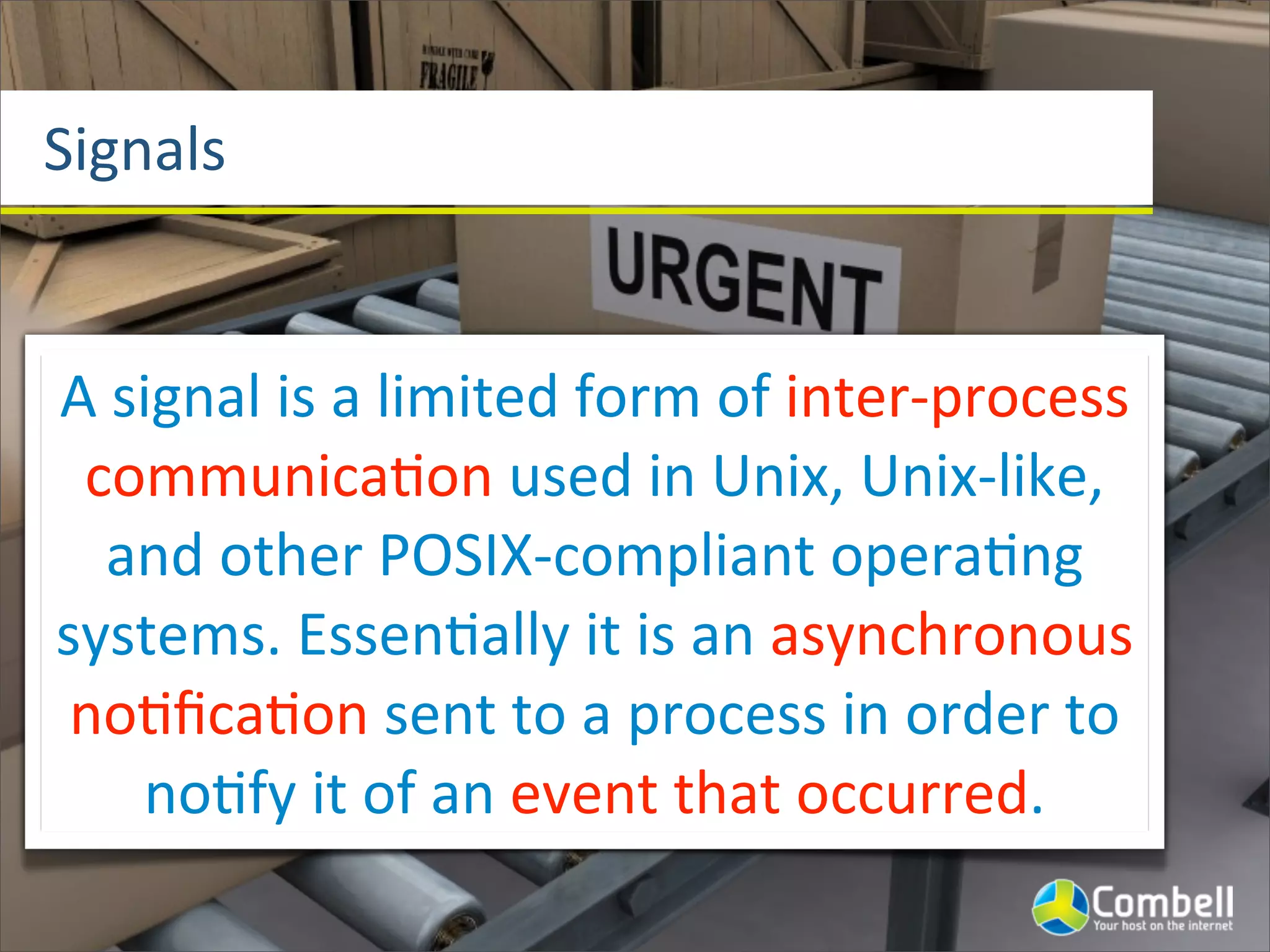
Signals


A	
  signal	
  is	
  a	
  limited	
  form	
  of	
  inter-­‐process	
  
 communica^on	
  used	
  in	
  Unix,	
  Unix-­‐like,	
  
   and	
  other	
  POSIX-­‐compliant	
  opera^ng	
  
systems.	
  Essen^ally	
  it	
  is	
  an	
  asynchronous	
  
 no^fica^on	
  sent	
  to	
  a	
  process	
  in	
  order	
  to	
  
      no^fy	
  it	
  of	
  an	
  event	
  that	
  occurred.
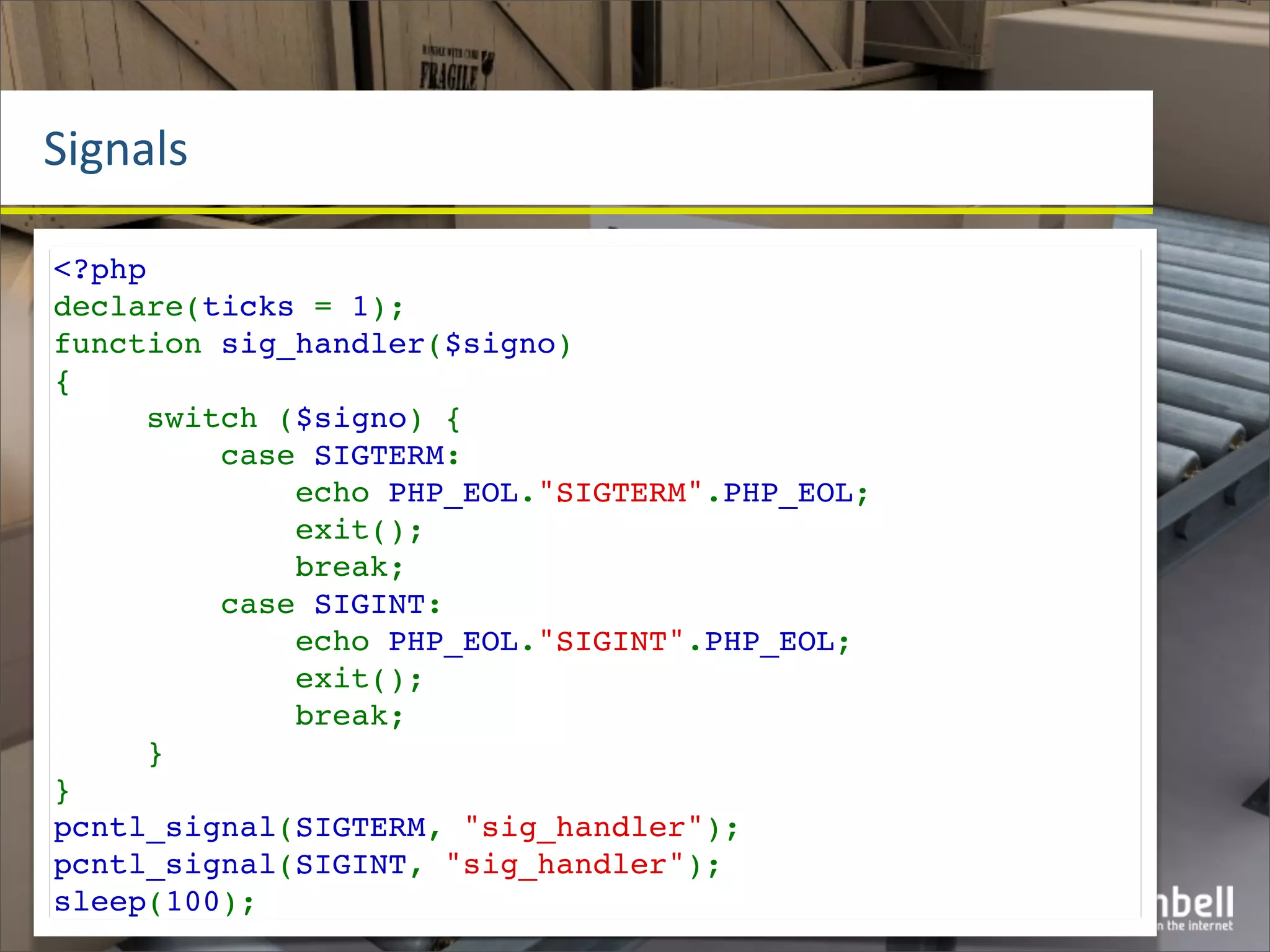
Signals

<?php
declare(ticks = 1);
function sig_handler($signo)
{
     switch ($signo) {
         case SIGTERM:
             echo PHP_EOL."SIGTERM".PHP_EOL;
             exit();
             break;
         case SIGINT:
             echo PHP_EOL."SIGINT".PHP_EOL;
             exit();
             break;
     }
}
pcntl_signal(SIGTERM, "sig_handler");
pcntl_signal(SIGINT, "sig_handler");
sleep(100);
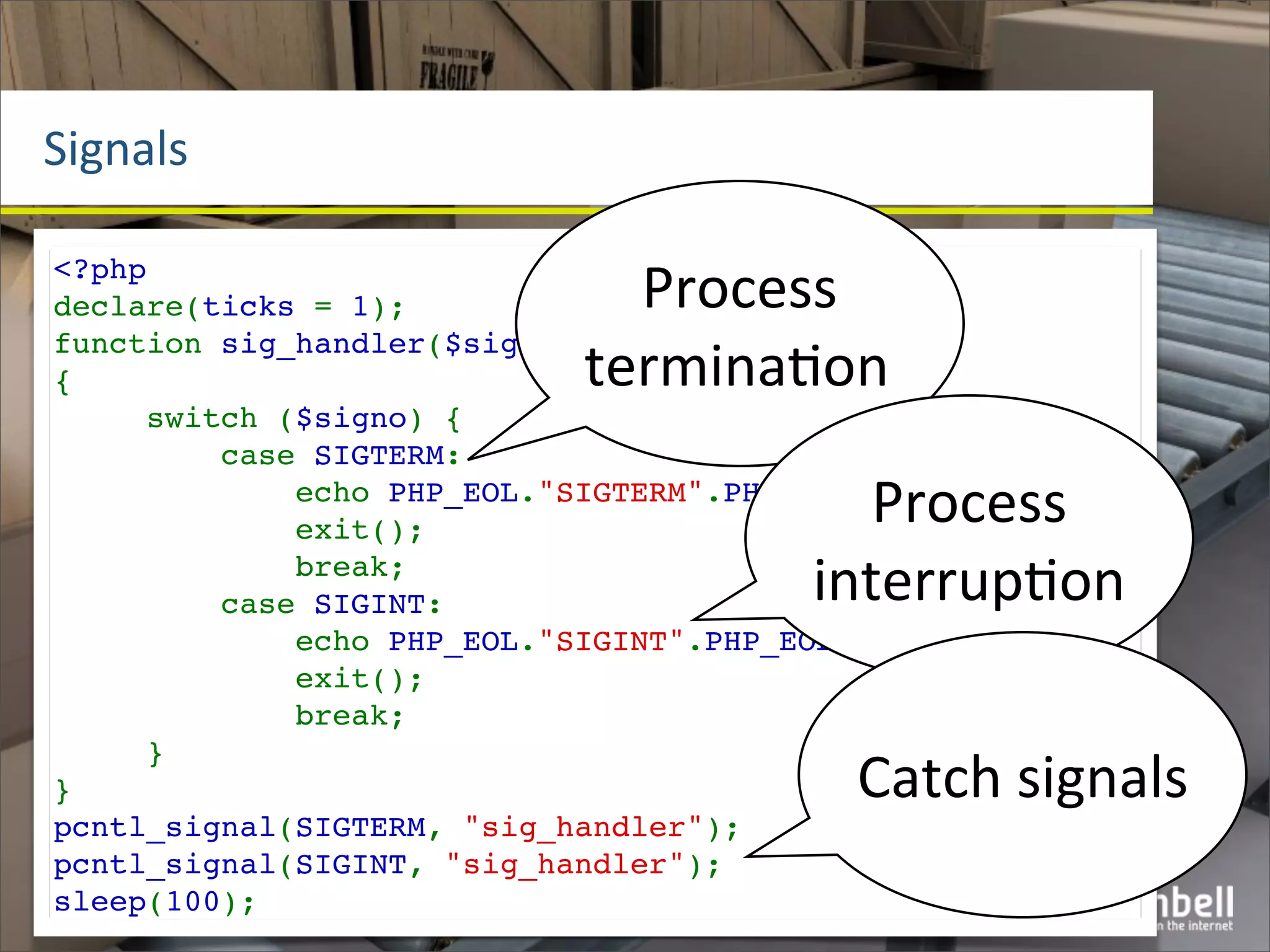
Signals

<?php
declare(ticks = 1);           Process	
  
                            termina^on
function sig_handler($signo)
{
     switch ($signo) {
         case SIGTERM:
                                           Process	
  
             echo PHP_EOL."SIGTERM".PHP_EOL;
             exit();
             break;
         case SIGINT:                   interrup^on
             echo PHP_EOL."SIGINT".PHP_EOL;
             exit();
             break;

                                           Catch	
  signals
     }
}
pcntl_signal(SIGTERM, "sig_handler");
pcntl_signal(SIGINT, "sig_handler");
sleep(100);
POSIX	
  process	
  control	
  funcOons

<?php
echo "[prefork] PID: ".posix_getpid
().", parent PID: ".posix_getppid().PHP_EOL;
$pid = pcntl_fork();
if ($pid == -1) {
  die('could not fork');
} else if ($pid == 0) {
  echo "[child] PID: ".posix_getpid
().", parent PID: ".posix_getppid().PHP_EOL;
  exit;
} else {
  echo "[parent] PID: ".posix_getpid
().", parent PID: ".posix_getppid().PHP_EOL;
  pcntl_wait($status);
}
Parent	
  PID	
                  Prefork	
  PID	
  
POSIX	
  process	
  c==	
   funcOons
    of	
  parent	
   ontrol	
              ==	
  
<?php
     session	
  PID                    parent	
  PID
echo "[prefork] PID: ".posix_getpid
().", parent PID: ".posix_getppid().PHP_EOL;
$pid = pcntl_fork();
if ($pid == -1) {
     die('could not fork');                  child	
  PID
} else if ($pid == 0) {
   child	
  PID
        echo "[child] PID: ".posix_getpid
().", parent PID: ".posix_getppid().PHP_EOL;
        exit;                                   parent	
  
} else {                                         PID
        echo "[parent] PID: ".posix_getpid
().", parent PID: ".posix_getppid().PHP_EOL;
        pcntl_wait($status);
}
POSIX	
  process	
  control	
  funcOons

<?php
$pid=pcntl_fork();
if ($pid == -1) {
    die("could not fork");
} else if ($pid) {
    $exists = posix_kill($pid,0)?'still':'no longer';
    echo "[parent] Child process $pid $exists exists".PHP_EOL;
    echo "[parent] Killing child process $pid".PHP_EOL;
    posix_kill($pid,SIGTERM);
    echo "[parent] Child process $pid killed".PHP_EOL;
    pcntl_wait($status);
    $exists = posix_kill($pid,0)?'still':'no longer';
    echo "[parent] Child process $pid $exists exists".PHP_EOL;
} else {
    while(true){
        sleep(100);
    }
    exit;
}
POSIX	
  process	
  control	
  funcOons
                           “KILL	
  0”	
  checks	
  
<?php
$pid=pcntl_fork();            existence
if ($pid == -1) {
    die("could not fork");
} else if ($pid) {
                                       Send	
  SIGTERM	
  
    $exists = posix_kill($pid,0)?'still':'no longer';
    echo "[parent] Child process $pid $exists exists".PHP_EOL;
                                           signal
    echo "[parent] Killing child process $pid".PHP_EOL;
    posix_kill($pid,SIGTERM);
    echo "[parent] Child process $pid killed".PHP_EOL;
    pcntl_wait($status);
    $exists = posix_kill($pid,0)?'still':'no longer';
    echo "[parent] Child process $pid $exists exists".PHP_EOL;
} else {
    while(true){
                                             Child	
  process	
  
        sleep(100);
    }
                                                is	
  dead
    exit;
}
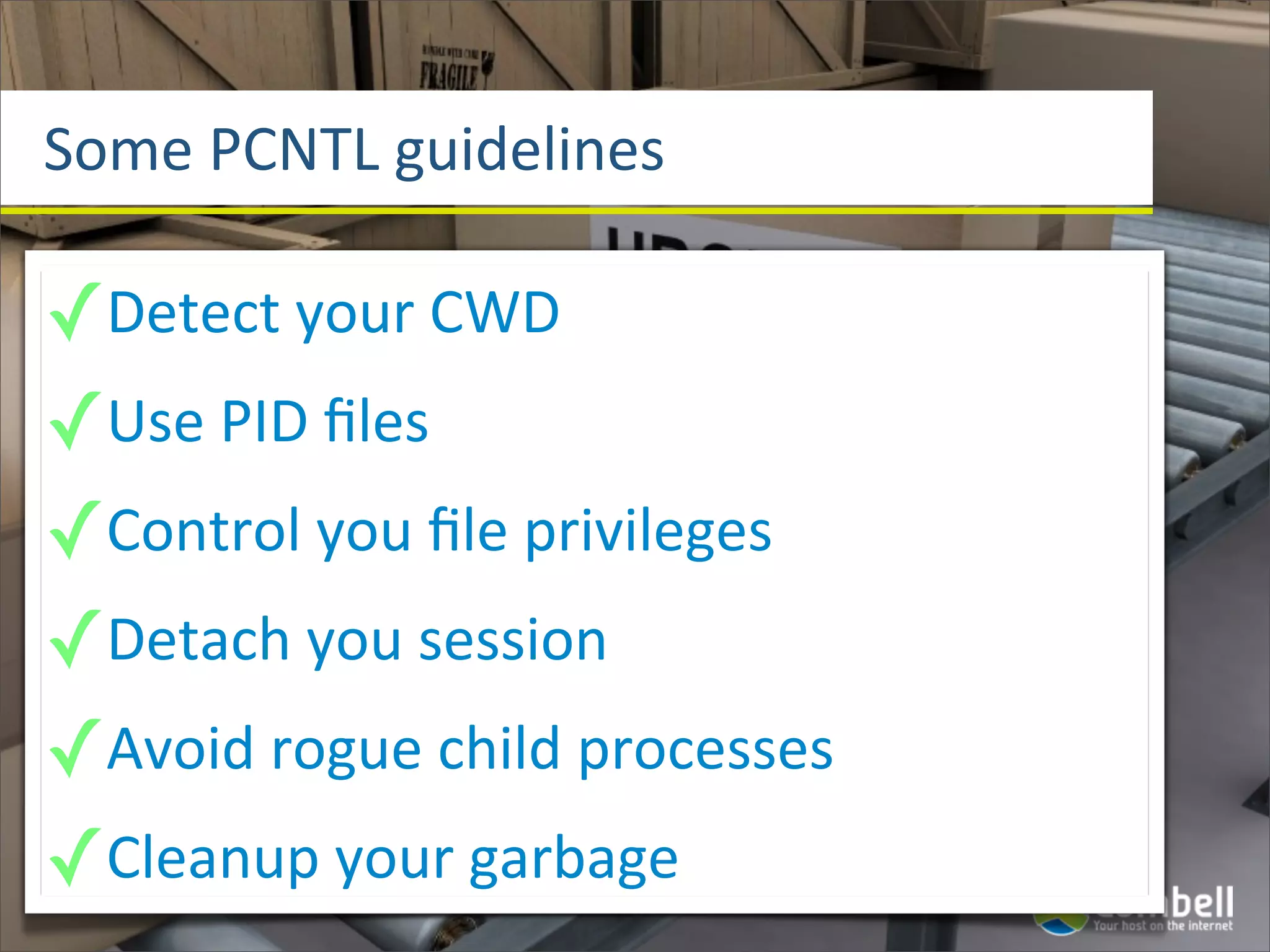
Some	
  PCNTL	
  guidelines

✓Detect	
  your	
  CWD
✓Use	
  PID	
  files
✓Control	
  you	
  file	
  privileges
✓Detach	
  you	
  session
✓Avoid	
  rogue	
  child	
  processes
✓Cleanup	
  your	
  garbage
Talk	
  
                                                            dedicated	
  to	
  
                                                           process	
  control	
  
Check	
  this	
  
guy	
  out	
  !                                                in	
  PHP
                     Jeroen	
  Keppens:	
  @jkeppens
                http://www.slideshare.net/jkeppens/php-­‐in-­‐the-­‐dark
Q&A
Thanks	
  !

Cli the other SAPI confoo11