Introducing Modern Perl Dave Cross Magnum Solutions Ltd [email_address]
Modern Perl Perl has been around for a long time
Achieved great popularity in the 1990s
“The duct tape of the internet”
Perl has moved on a lot since then
Many people's perceptions of Perl haven't
Modern Perl Keeping up to date with Perl
Surveying modern modules and techniques
A lot to cover
Only an overview
Plenty of pointers to more information
What We Will Cover Modern Core Perl
Template Toolkit
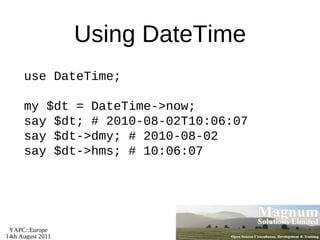
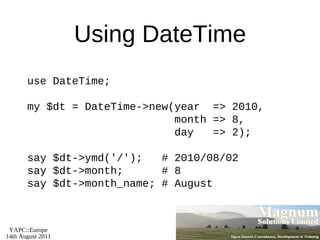
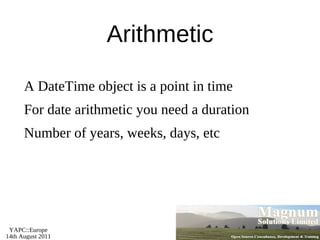
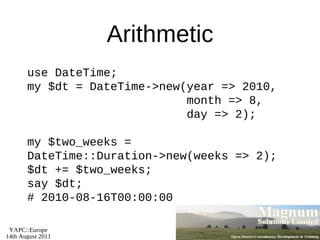
DateTime
DBIx::Class
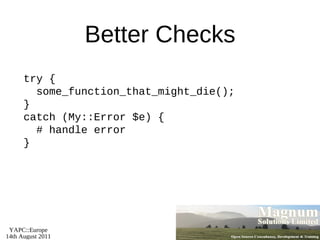
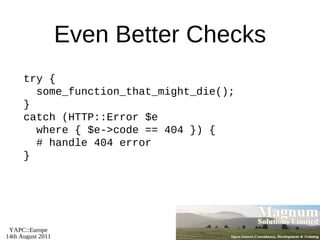
TryCatch
What We Will Cover Moose
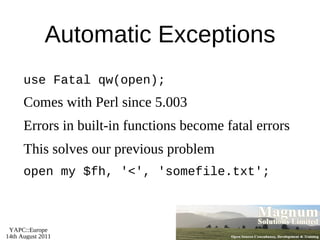
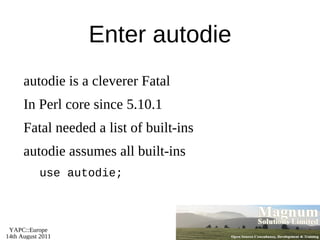
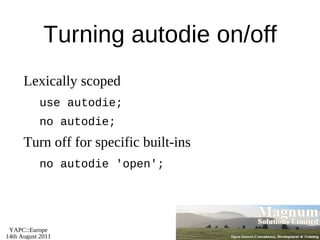
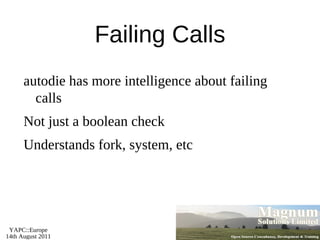
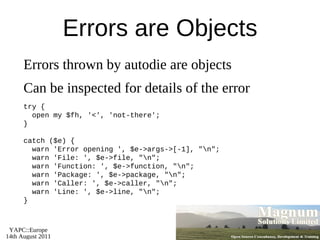
autodie
Catalyst
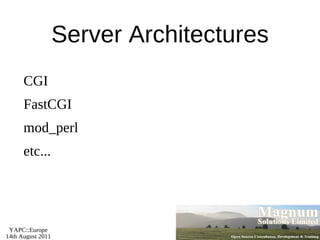
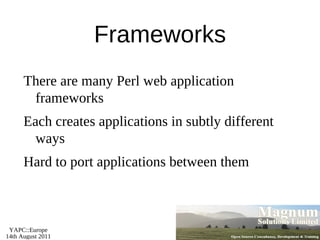
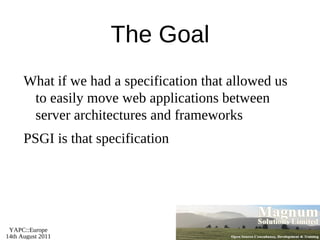
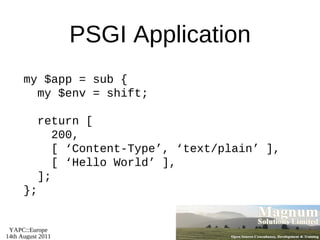
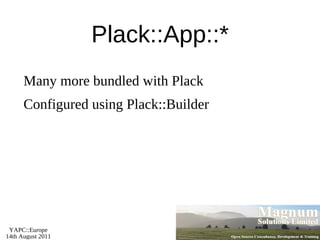
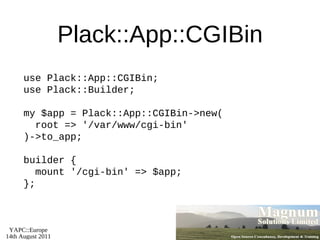
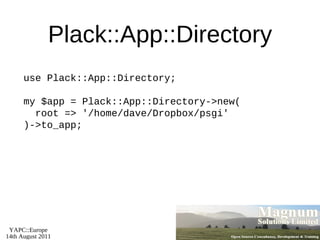
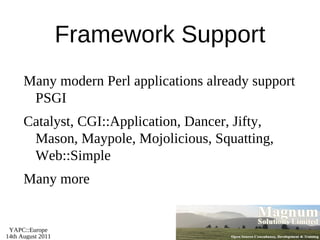
PSGI/Plack
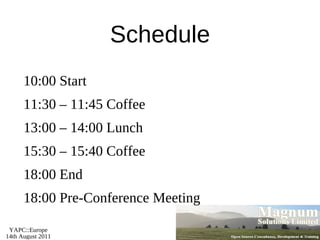
Schedule 10:00 Start
11:30 – 11:45 Coffee
13:00 – 14:00 Lunch
15:30 – 15:40 Coffee
18:00 End
18:00 Pre-Conference Meeting
Resources Slides available on-line http://mag-sol.com/train/yapc/2011 Also see Slideshare http://www.slideshare.net/davorg/slideshows Get Satisfaction http://getsatisfaction.com/magnum
Modern Core Perl
Perl Releases Perl 5 has moved to a regular release cycle
Major release every year
Minor releases when required
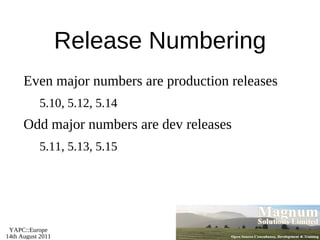
Release Numbering Even major numbers are production releases 5.10, 5.12, 5.14 Odd major numbers are dev releases 5.11, 5.13, 5.15
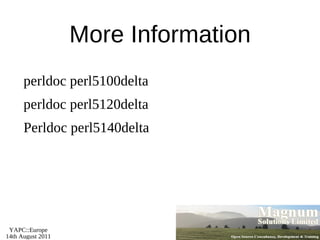
Perl 5.10 Released 18 th  Dec 2007 Perl's 20 th  birthday Many new features
Well worth upgrading
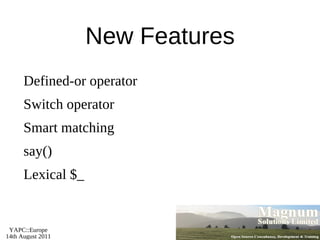
New Features Defined-or operator
Switch operator
Smart matching
say()
Lexical $_
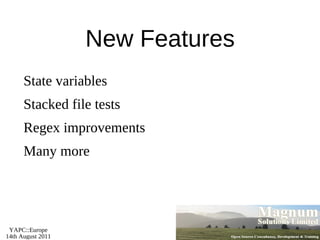
New Features State variables
Stacked file tests
Regex improvements
Many more
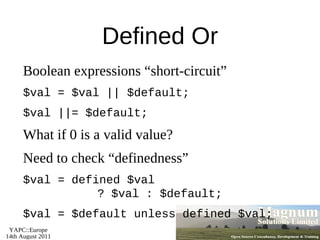
Defined Or Boolean expressions “short-circuit”
$val = $val || $default;
$val ||= $default;
What if 0 is a valid value?
Need to check “definedness”
$val = defined $val   ? $val : $default;
$val = $default unless defined $val;
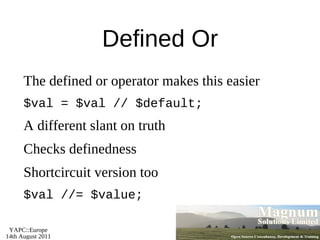
Defined Or The defined or operator makes this easier
$val = $val // $default;
A different slant on truth
Checks definedness
Shortcircuit version too
$val //= $value;
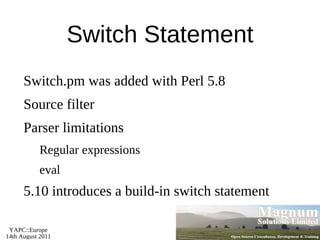
Switch Statement Switch.pm was added with Perl 5.8
Source filter
Parser limitations Regular expressions
eval 5.10 introduces a build-in switch statement
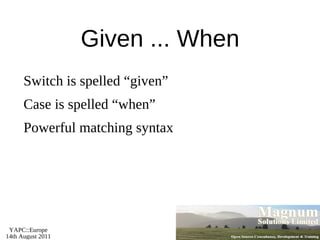
Given ... When Switch is spelled “given”
Case is spelled “when”
Powerful matching syntax
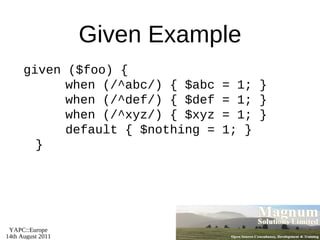
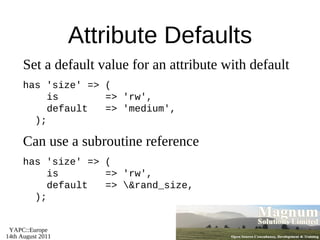
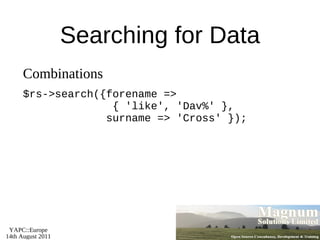
Given Example given ($foo) {   when (/^abc/) { $abc = 1; }   when (/^def/) { $def = 1; }   when (/^xyz/) { $xyz = 1; }   default { $nothing = 1; } }
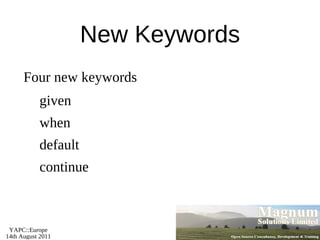
New Keywords Four new keywords given
when
default
continue
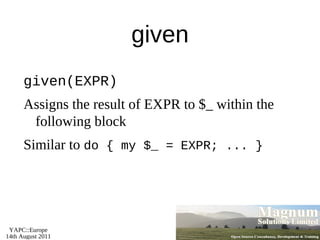
given given(EXPR)
Assigns the result of EXPR to $_ within the following block
Similar to  do { my $_ = EXPR; ... }
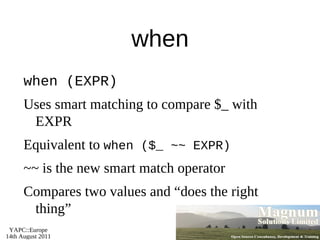
when when (EXPR)
Uses smart matching to compare $_ with EXPR
Equivalent to  when ($_ ~~ EXPR)
~~ is the new smart match operator
Compares two values and “does the right thing”
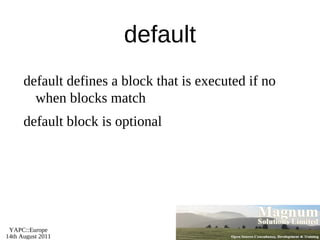
default default defines a block that is executed if no when blocks match
default block is optional
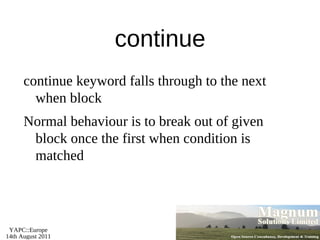
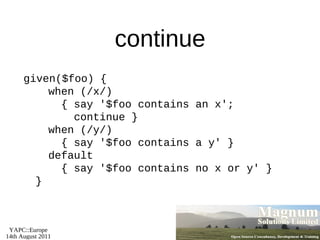
continue continue keyword falls through to the next when block
Normal behaviour is to break out of given block once the first when condition is matched
continue given($foo) {   when (/x/)   { say '$foo contains an x';   continue }   when (/y/)   { say '$foo contains a y' }   default   { say '$foo contains no x or y' } }
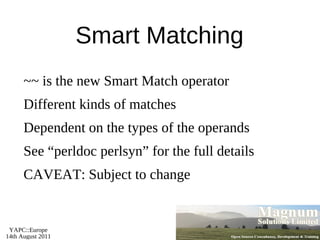
Smart Matching ~~ is the new Smart Match operator
Different kinds of matches
Dependent on the types of the operands
See “perldoc perlsyn” for the full details
CAVEAT: Subject to change
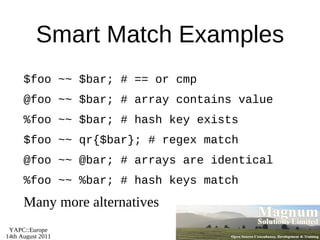
Smart Match Examples $foo ~~ $bar; # == or cmp
@foo ~~ $bar; # array contains value
%foo ~~ $bar; # hash key exists
$foo ~~ qr{$bar}; # regex match
@foo ~~ @bar; # arrays are identical
%foo ~~ %bar; # hash keys match
Many more alternatives
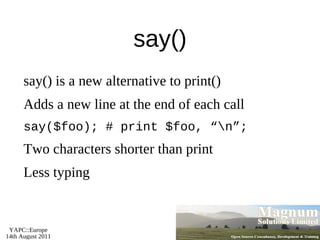
say() say() is a new alternative to print()
Adds a new line at the end of each call
say($foo); # print $foo, “\n”;
Two characters shorter than print
Less typing
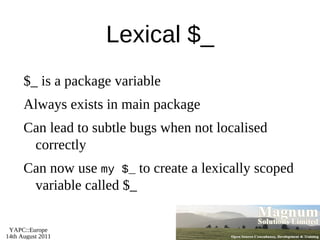
Lexical $_ $_ is a package variable
Always exists in main package
Can lead to subtle bugs when not localised correctly
Can now use  my $_  to create a lexically scoped variable called $_
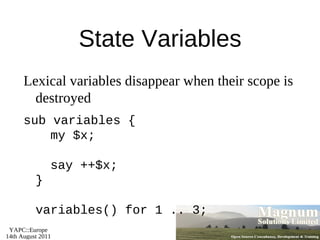
State Variables Lexical variables disappear when their scope is destroyed
sub variables {   my $x;   say ++$x; } variables() for 1 .. 3;
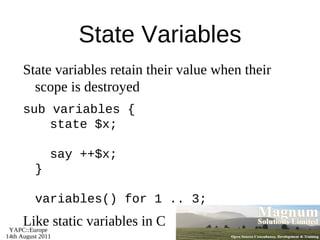
State Variables State variables retain their value when their scope is destroyed
sub variables {   state $x;   say ++$x; } variables() for 1 .. 3;
Like static variables in C
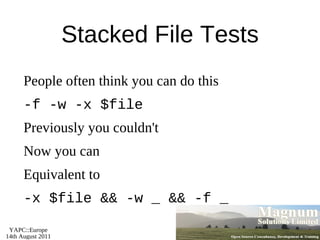
Stacked File Tests People often think you can do this
-f -w -x $file
Previously you couldn't
Now you can
Equivalent to
-x $file && -w _ && -f _
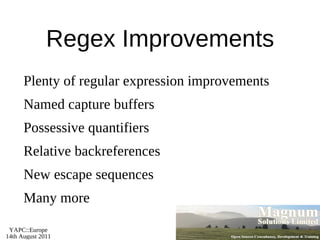
Regex Improvements Plenty of regular expression improvements
Named capture buffers
Possessive quantifiers
Relative backreferences
New escape sequences
Many more
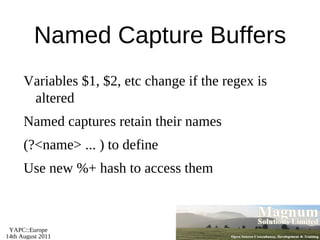
Named Capture Buffers Variables $1, $2, etc change if the regex is altered
Named captures retain their names
(?<name> ... ) to define
Use new %+ hash to access them
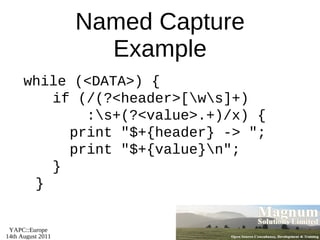
Named Capture Example while (<DATA>) {   if (/(?<header>[\w\s]+)   :\s+(?<value>.+)/x) {   print &quot;$+{header} -> &quot;;   print &quot;$+{value}\n&quot;;   } }
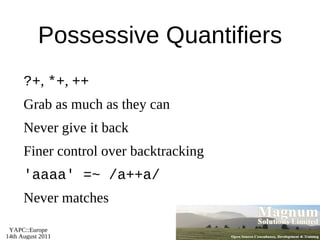
Possessive Quantifiers ?+ ,  *+ ,  ++
Grab as much as they can
Never give it back
Finer control over backtracking
'aaaa' =~ /a++a/
Never matches
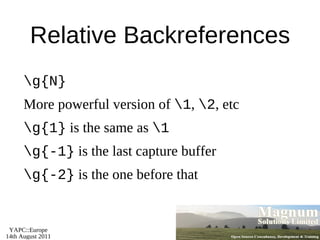
Relative Backreferences \g{N}
More powerful version of  \1 ,  \2 , etc
\g{1}  is the same as  \1
\g{-1}  is the last capture buffer
\g{-2}  is the one before that
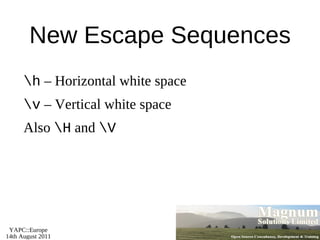
New Escape Sequences \h  – Horizontal white space
\v  – Vertical white space
Also  \H  and  \V
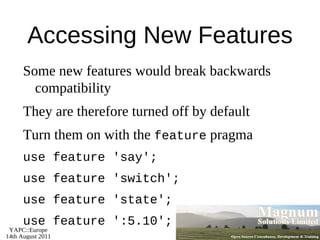
Accessing New Features Some new features would break backwards compatibility
They are therefore turned off by default
Turn them on with the  feature  pragma
use feature 'say';
use feature 'switch';
use feature 'state';
use feature ':5.10';
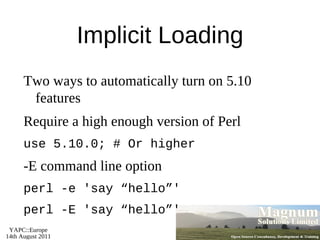
Implicit Loading Two ways to automatically turn on 5.10 features
Require a high enough version of Perl
use 5.10.0; # Or higher
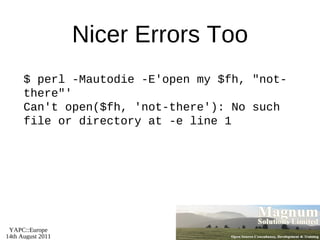
-E command line option
perl -e 'say “hello”'
perl -E 'say “hello”'
Perl 5.12 Released 12 April 2010 5.12.4 20 June 2011 Many new enhancements
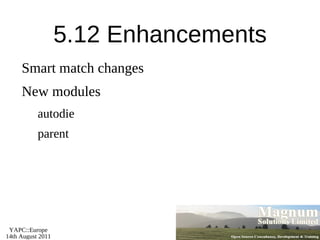
5.12 Enhancements Smart match changes
New modules autodie
parent
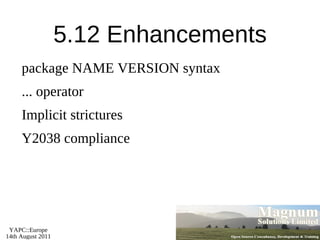
5.12 Enhancements package NAME VERSION syntax
... operator
Implicit strictures
Y2038 compliance
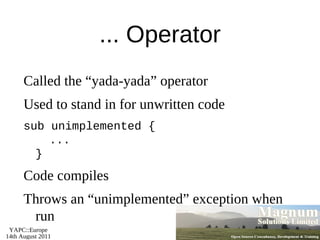
... Operator Called the “yada-yada” operator
Used to stand in for unwritten code
sub unimplemented {   ... }
Code compiles
Throws an “unimplemented” exception when run
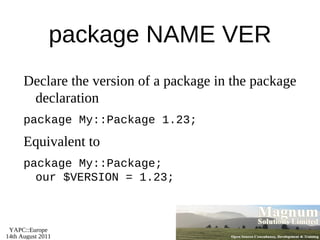
package NAME VER Declare the version of a package in the package declaration
package My::Package 1.23;
Equivalent to
package My::Package; our $VERSION = 1.23;
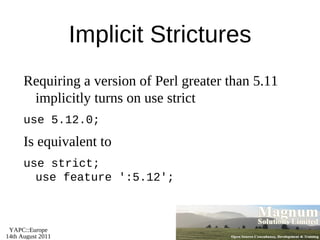
Implicit Strictures Requiring a version of Perl greater than 5.11 implicitly turns on use strict
use 5.12.0;
Is equivalent to
use strict; use feature ':5.12';
Y2038 Compliance Core time functions are now Y2038 compliant
Smart Match Changes Some changes to Smart Match operator
No longer commutative
See new table in perlsyn
CAVEAT: More changes coming
New Modules Some new modules in the standard distribution
autodie
parent Better version of base.
Perl 5.14 Released 14 May 2011 5.14.1 16 June 2011 Many new enhancements
5.16 due spring 2012
5.14 Enhancements Non-destructive substitution
Container functions accept references
Package block
New modules
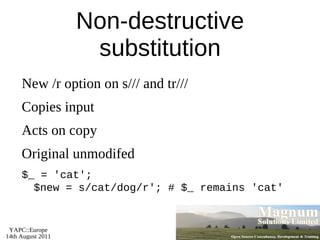
Non-destructive substitution New /r option on s/// and tr///
Copies input
Acts on copy
Original unmodifed
$_ = 'cat'; $new = s/cat/dog/r'; # $_ remains 'cat'
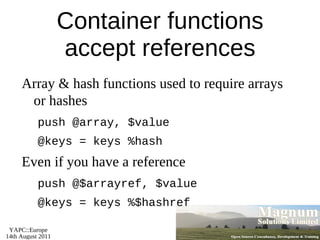
Container functions accept references Array & hash functions used to require arrays or hashes push @array, $value
@keys = keys %hash Even if you have a reference push @$arrayref, $value
@keys = keys %$hashref
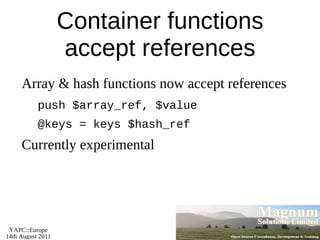
Container functions accept references Array & hash functions now accept references push $array_ref, $value
@keys = keys $hash_ref Currently experimental
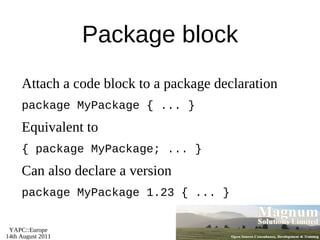
Package block Attach a code block to a package declaration
package MyPackage { ... }
Equivalent to
{ package MyPackage; ... }
Can also declare a version
package MyPackage 1.23 { ... }
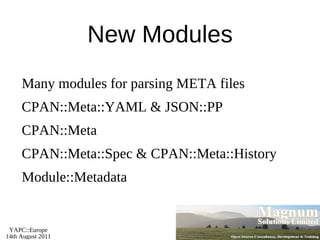
New Modules Many modules for parsing META files
CPAN::Meta::YAML & JSON::PP
CPAN::Meta
CPAN::Meta::Spec & CPAN::Meta::History
Module::Metadata
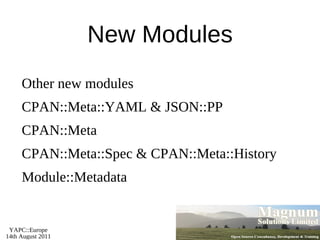
New Modules Other new modules
CPAN::Meta::YAML & JSON::PP
CPAN::Meta
CPAN::Meta::Spec & CPAN::Meta::History

Introduction to Modern Perl