Non Traditional
Machining Processes
1
Objectives 2
At the end of this presentation, we will be aware of merits of Non
conventional machining processes over their traditional counter-
parts. The traditional machining processes rely on harder tool or
abrasive material to remove the softer material whereas non-
traditional machining processes such as EDM uses electrical spark
or thermal energy to erode unwanted material in order to create
desired shape.
CHIPS FORMATION IN CONVENTIONAL
MACHINING PROCESS
3
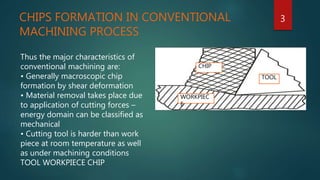
Thus the major characteristics of
conventional machining are:
• Generally macroscopic chip
formation by shear deformation
• Material removal takes place due
to application of cutting forces –
energy domain can be classified as
mechanical
• Cutting tool is harder than work
piece at room temperature as well
as under machining conditions
TOOL WORKPIECE CHIP
TOOL
WORKPIEC
E
CHIP
4Classification Of Non Traditional Machining Process
1. Thermal
a. Electric Discharge machining (EDM)
b. wire cut edm (WEDM)
c. Laser Beam Machining (LBM)
d. Ion Beam Machining (IBM)
e. Electron Beam machining (EBM)
f. Electric discharge grinding (EDG)
g. Plasma arc Machining (PAM)
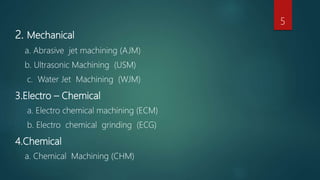
2. Mechanical
a. Abrasive jet machining (AJM)
b. Ultrasonic Machining (USM)
c. Water Jet Machining (WJM)
3.Electro – Chemical
a. Electro chemical machining (ECM)
b. Electro chemical grinding (ECG)
4.Chemical
a. Chemical Machining (CHM)
5
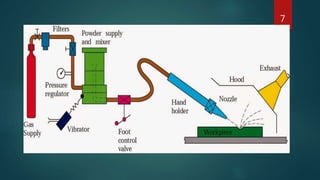
Abrasive jet machining (AJM), also known
as abrasivemicro-blasting, pencil blasting and micro-
abrasive blasting, is
an abrasive blasting machining process that
usesabrasives propelled by a high velocity gas to erode
material from the workpiece.
ABRASIVE JET MACHINING 6
7
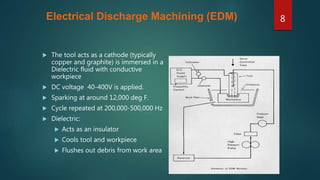
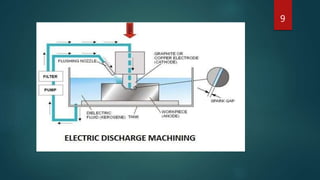
Electrical Discharge Machining (EDM)
 The tool acts as a cathode (typically
copper and graphite) is immersed in a
Dielectric fluid with conductive
workpiece
 DC voltage 40-400V is applied.
 Sparking at around 12,000 deg F.
 Cycle repeated at 200,000-500,000 Hz
 Dielectric:
 Acts as an insulator
 Cools tool and workpiece
 Flushes out debris from work area
8
9
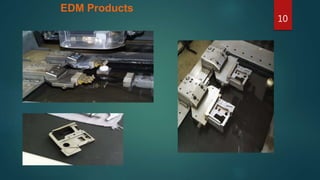
EDM Products
10
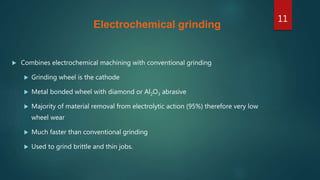
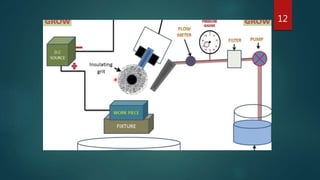
Electrochemical grinding
 Combines electrochemical machining with conventional grinding
 Grinding wheel is the cathode
 Metal bonded wheel with diamond or Al2O3 abrasive
 Majority of material removal from electrolytic action (95%) therefore very low
wheel wear
 Much faster than conventional grinding
 Used to grind brittle and thin jobs.
11
12
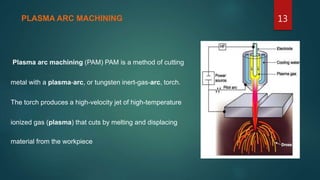
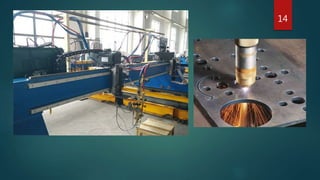
Plasma arc machining (PAM) PAM is a method of cutting
metal with a plasma-arc, or tungsten inert-gas-arc, torch.
The torch produces a high-velocity jet of high-temperature
ionized gas (plasma) that cuts by melting and displacing
material from the workpiece
PLASMA ARC MACHINING 13
14
Electron Beam Machining (EBM) 15
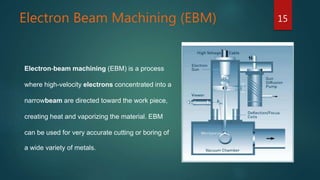
Electron-beam machining (EBM) is a process
where high-velocity electrons concentrated into a
narrowbeam are directed toward the work piece,
creating heat and vaporizing the material. EBM
can be used for very accurate cutting or boring of
a wide variety of metals.
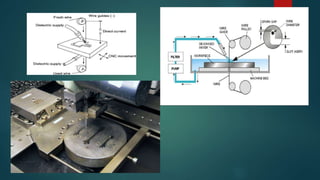
Wire electrical discharge machining (EDM) is a non-traditional machining process
that uses electricity to cut any conductive material precisely and accurately with a
thin, electrically charged copper or brass wire as an electrode.During the wire EDM
process, the wire carries one side of an electrical charge and the workpiece carries
the other side of the charge. When the wire gets close to the part, the attraction of
electrical charges creates a controlled spark, melting and vaporizing microscopic
particles of material.
Wire Electrical Discharge Machining
16
17
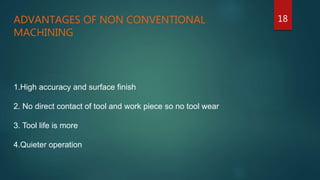
18ADVANTAGES OF NON CONVENTIONAL
MACHINING
1.High accuracy and surface finish
2. No direct contact of tool and work piece so no tool wear
3. Tool life is more
4.Quieter operation
19
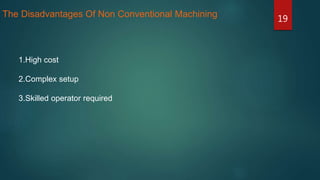
The Disadvantages Of Non Conventional Machining
1.High cost
2.Complex setup
3.Skilled operator required
20
THANK
YOU

Non traditional machining processes amp[ file

  • 1.
  • 2.
    Objectives 2 At theend of this presentation, we will be aware of merits of Non conventional machining processes over their traditional counter- parts. The traditional machining processes rely on harder tool or abrasive material to remove the softer material whereas non- traditional machining processes such as EDM uses electrical spark or thermal energy to erode unwanted material in order to create desired shape.
  • 3.
    CHIPS FORMATION INCONVENTIONAL MACHINING PROCESS 3 Thus the major characteristics of conventional machining are: • Generally macroscopic chip formation by shear deformation • Material removal takes place due to application of cutting forces – energy domain can be classified as mechanical • Cutting tool is harder than work piece at room temperature as well as under machining conditions TOOL WORKPIECE CHIP TOOL WORKPIEC E CHIP
  • 4.
    4Classification Of NonTraditional Machining Process 1. Thermal a. Electric Discharge machining (EDM) b. wire cut edm (WEDM) c. Laser Beam Machining (LBM) d. Ion Beam Machining (IBM) e. Electron Beam machining (EBM) f. Electric discharge grinding (EDG) g. Plasma arc Machining (PAM)
  • 5.
    2. Mechanical a. Abrasivejet machining (AJM) b. Ultrasonic Machining (USM) c. Water Jet Machining (WJM) 3.Electro – Chemical a. Electro chemical machining (ECM) b. Electro chemical grinding (ECG) 4.Chemical a. Chemical Machining (CHM) 5
  • 6.
    Abrasive jet machining(AJM), also known as abrasivemicro-blasting, pencil blasting and micro- abrasive blasting, is an abrasive blasting machining process that usesabrasives propelled by a high velocity gas to erode material from the workpiece. ABRASIVE JET MACHINING 6
  • 7.
  • 8.
    Electrical Discharge Machining(EDM)  The tool acts as a cathode (typically copper and graphite) is immersed in a Dielectric fluid with conductive workpiece  DC voltage 40-400V is applied.  Sparking at around 12,000 deg F.  Cycle repeated at 200,000-500,000 Hz  Dielectric:  Acts as an insulator  Cools tool and workpiece  Flushes out debris from work area 8
  • 9.
  • 10.
  • 11.
    Electrochemical grinding  Combineselectrochemical machining with conventional grinding  Grinding wheel is the cathode  Metal bonded wheel with diamond or Al2O3 abrasive  Majority of material removal from electrolytic action (95%) therefore very low wheel wear  Much faster than conventional grinding  Used to grind brittle and thin jobs. 11
  • 12.
  • 13.
    Plasma arc machining(PAM) PAM is a method of cutting metal with a plasma-arc, or tungsten inert-gas-arc, torch. The torch produces a high-velocity jet of high-temperature ionized gas (plasma) that cuts by melting and displacing material from the workpiece PLASMA ARC MACHINING 13
  • 14.
  • 15.
    Electron Beam Machining(EBM) 15 Electron-beam machining (EBM) is a process where high-velocity electrons concentrated into a narrowbeam are directed toward the work piece, creating heat and vaporizing the material. EBM can be used for very accurate cutting or boring of a wide variety of metals.
  • 16.
    Wire electrical dischargemachining (EDM) is a non-traditional machining process that uses electricity to cut any conductive material precisely and accurately with a thin, electrically charged copper or brass wire as an electrode.During the wire EDM process, the wire carries one side of an electrical charge and the workpiece carries the other side of the charge. When the wire gets close to the part, the attraction of electrical charges creates a controlled spark, melting and vaporizing microscopic particles of material. Wire Electrical Discharge Machining 16
  • 17.
  • 18.
    18ADVANTAGES OF NONCONVENTIONAL MACHINING 1.High accuracy and surface finish 2. No direct contact of tool and work piece so no tool wear 3. Tool life is more 4.Quieter operation
  • 19.
    19 The Disadvantages OfNon Conventional Machining 1.High cost 2.Complex setup 3.Skilled operator required
  • 20.