28th March 2015
by Adrian Land
SEO	
  –	
  the	
  future	
  is	
  content.	
  Again!	
  
Presents	
  at	
  
WHY CAN I TALK ABOUT SEO?
I	
  have	
  been	
  doing	
  online	
  marke>ng	
  &	
  SEO	
  since	
  the	
  late	
  90’s.	
  	
  
I	
  learnt	
  my	
  trade	
  &	
  survived	
  the	
  dot-­‐com	
  bubble	
  before	
  driving	
  ROI	
  
from	
  natural	
  search	
  and	
  other	
  channels	
  for	
  compe>>ve	
  companies	
  in	
  
challenging	
  ver>cals.	


In	
  2013,	
  founded	
  my	
  own	
  agency	
  SESOME.	


•  Head	
  of	
  Inbound	
  Marke>ng	
  at	
  My	
  Des>na>on.com	
  
•  Head	
  of	
  SEO,	
  for	
  Thomas	
  Cook	
  Group	
  
•  Global	
  Director	
  of	
  SEO	
  for	
  Hotels.com	
  
•  Head	
  of	
  Search	
  for	
  HomeAway	
  Group	
  Europe	
  
Previous	
  roles	
  held	
  
	
  Find	
  me	
  >	
  
@adrianland	
  	
  |	
  adrianland.uk	
  |	
  sesome.co.uk	
  
THE NEXT HOUR
What is SEO? Explained and myth busting.
Recent changes and what it means for you.
IF, the future is content (again)!, So, what is
optimised content?
Then some practical. Tips and discussion
around content planning & production.
Then some practical!
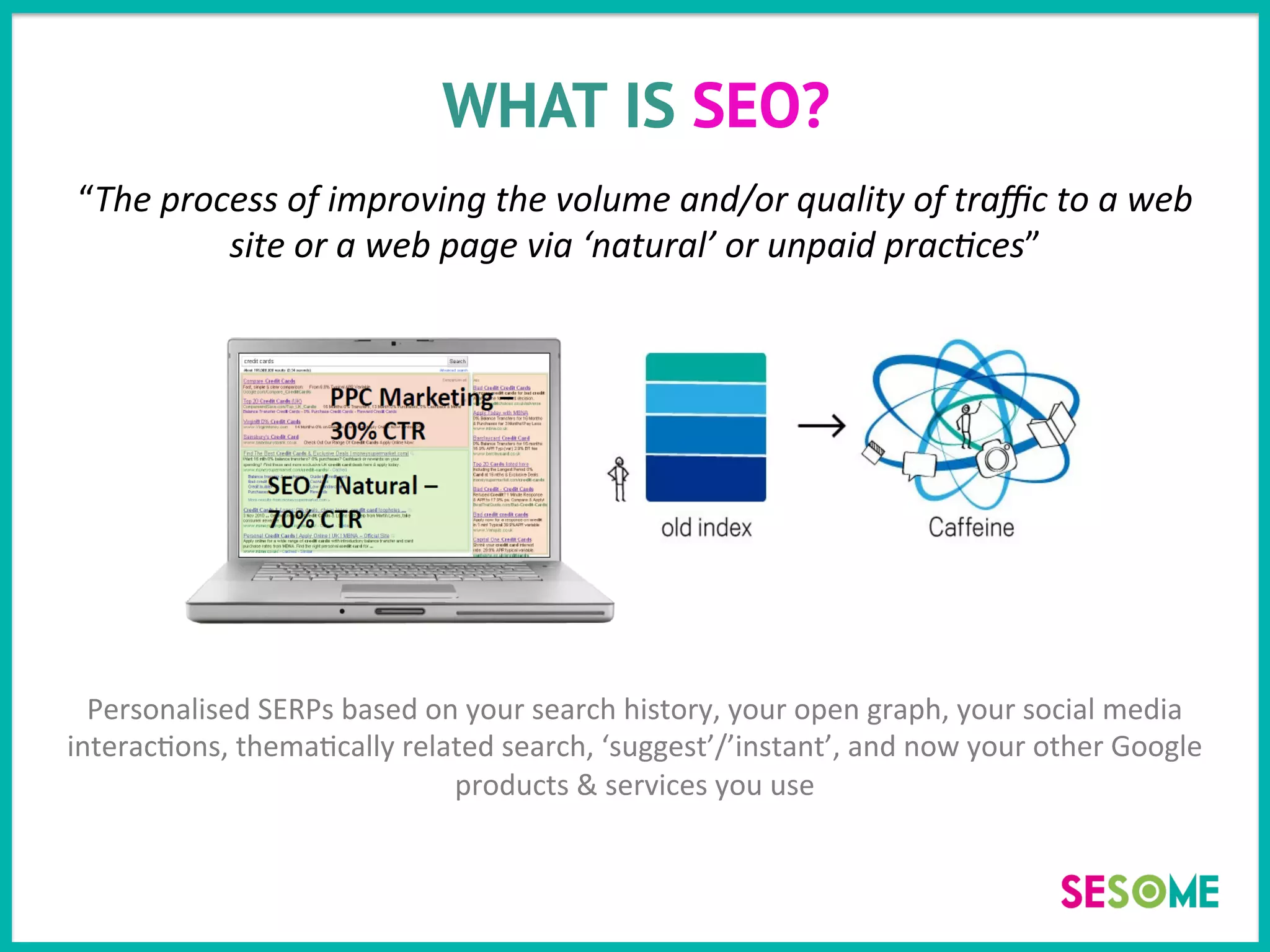
WHAT IS SEO?
“The	
  process	
  of	
  improving	
  the	
  volume	
  and/or	
  quality	
  of	
  traffic	
  to	
  a	
  web	
  
site	
  or	
  a	
  web	
  page	
  via	
  ‘natural’	
  or	
  unpaid	
  prac=ces”	
  	
  
Personalised	
  SERPs	
  based	
  on	
  your	
  search	
  history,	
  your	
  open	
  graph,	
  your	
  social	
  media	
  
interac>ons,	
  thema>cally	
  related	
  search,	
  ‘suggest’/’instant’,	
  and	
  now	
  your	
  other	
  Google	
  
products	
  &	
  services	
  you	
  use	


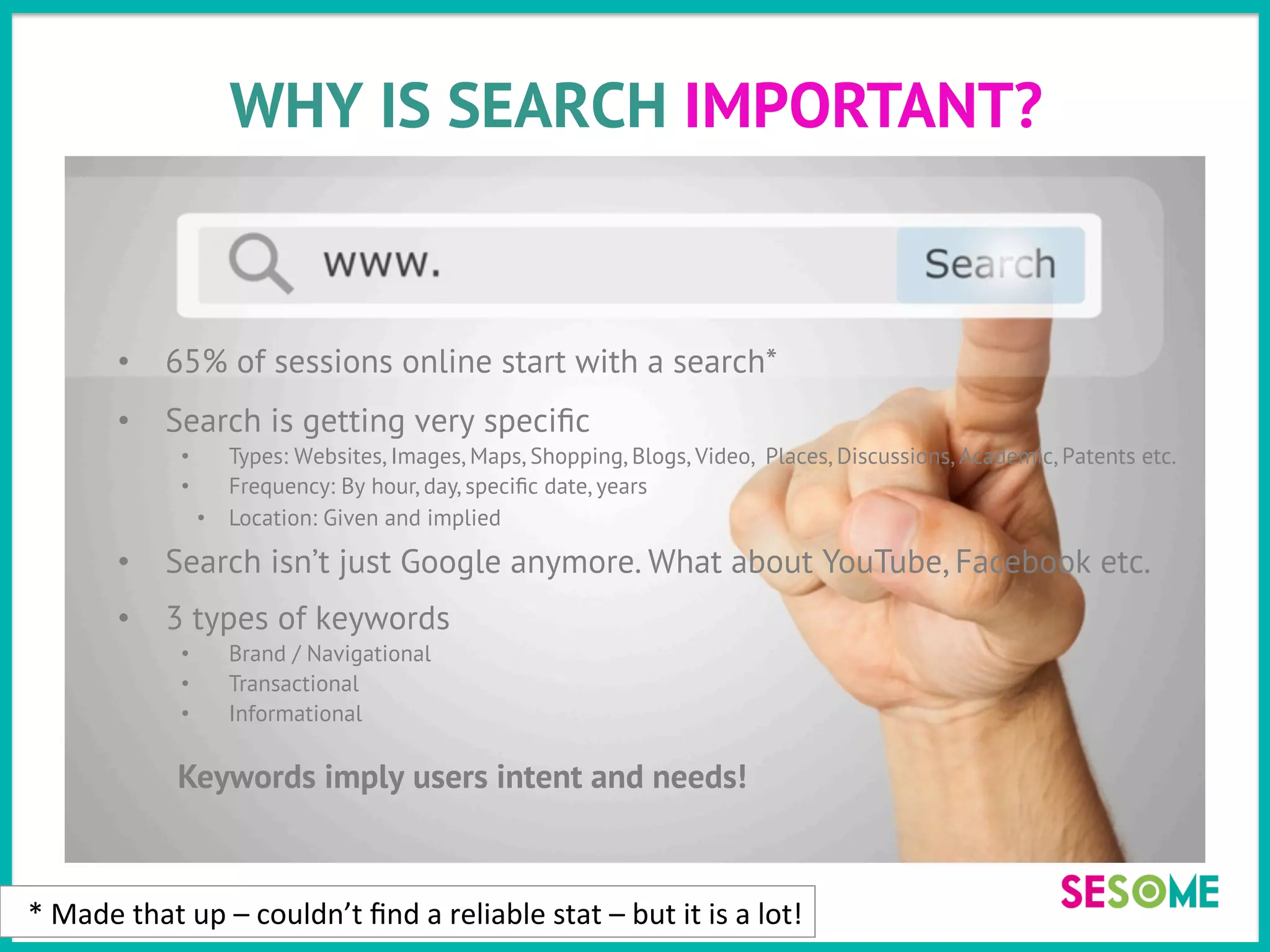
•  65% of sessions online start with a search*
•  Search is getting very specific
•  Types: Websites, Images, Maps, Shopping, Blogs, Video, Places, Discussions, Academic, Patents etc.
•  Frequency: By hour, day, specific date, years
•  Location: Given and implied
•  Search isn’t just Google anymore. What about YouTube, Facebook etc.
•  3 types of keywords
•  Brand / Navigational
•  Transactional
•  Informational
Keywords imply users intent and needs!
WHY IS SEARCH IMPORTANT?
*	
  Made	
  that	
  up	
  –	
  couldn’t	
  find	
  a	
  reliable	
  stat	
  –	
  but	
  it	
  is	
  a	
  lot!	
  
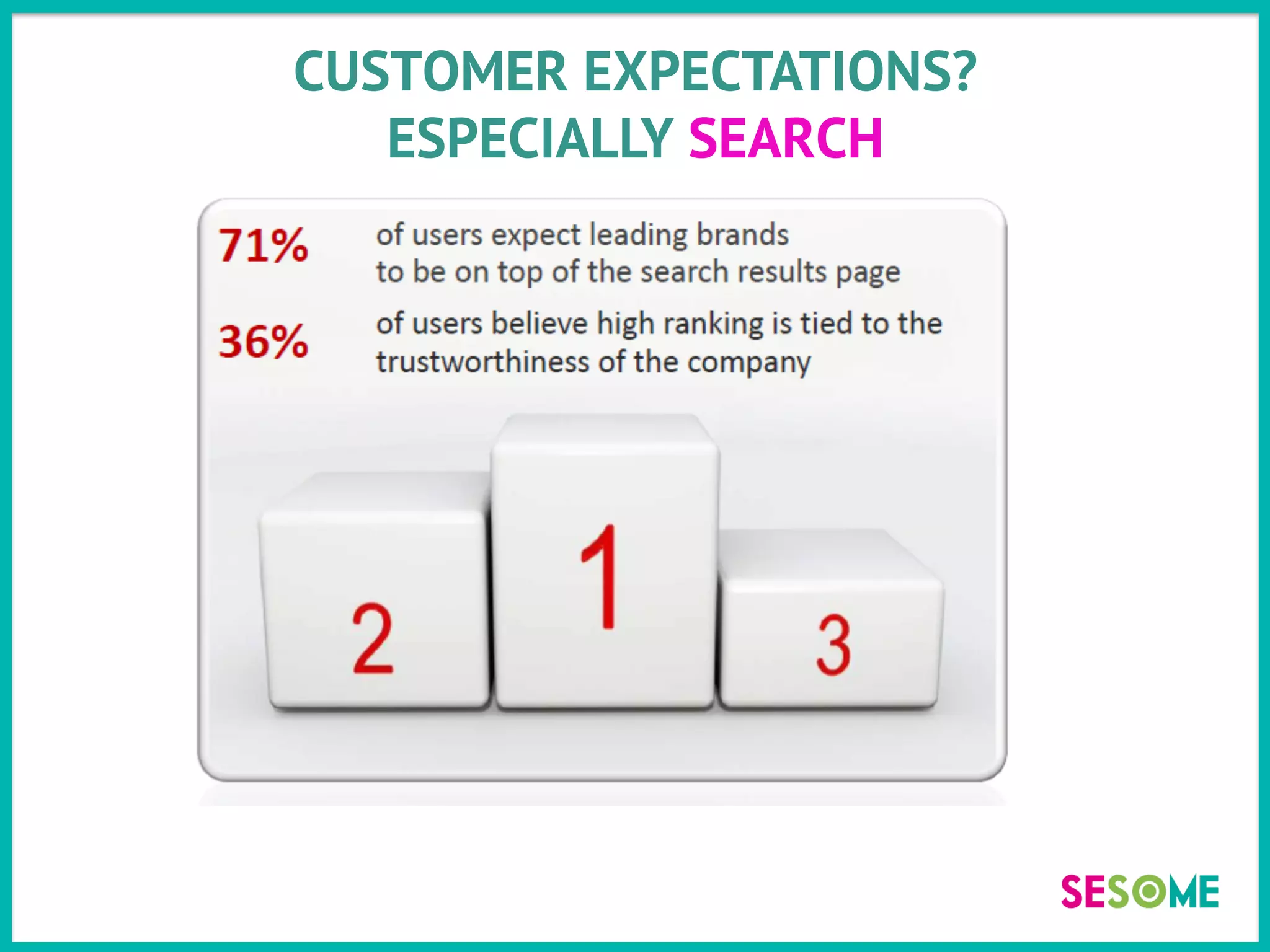
CUSTOMER EXPECTATIONS?
ESPECIALLY SEARCH
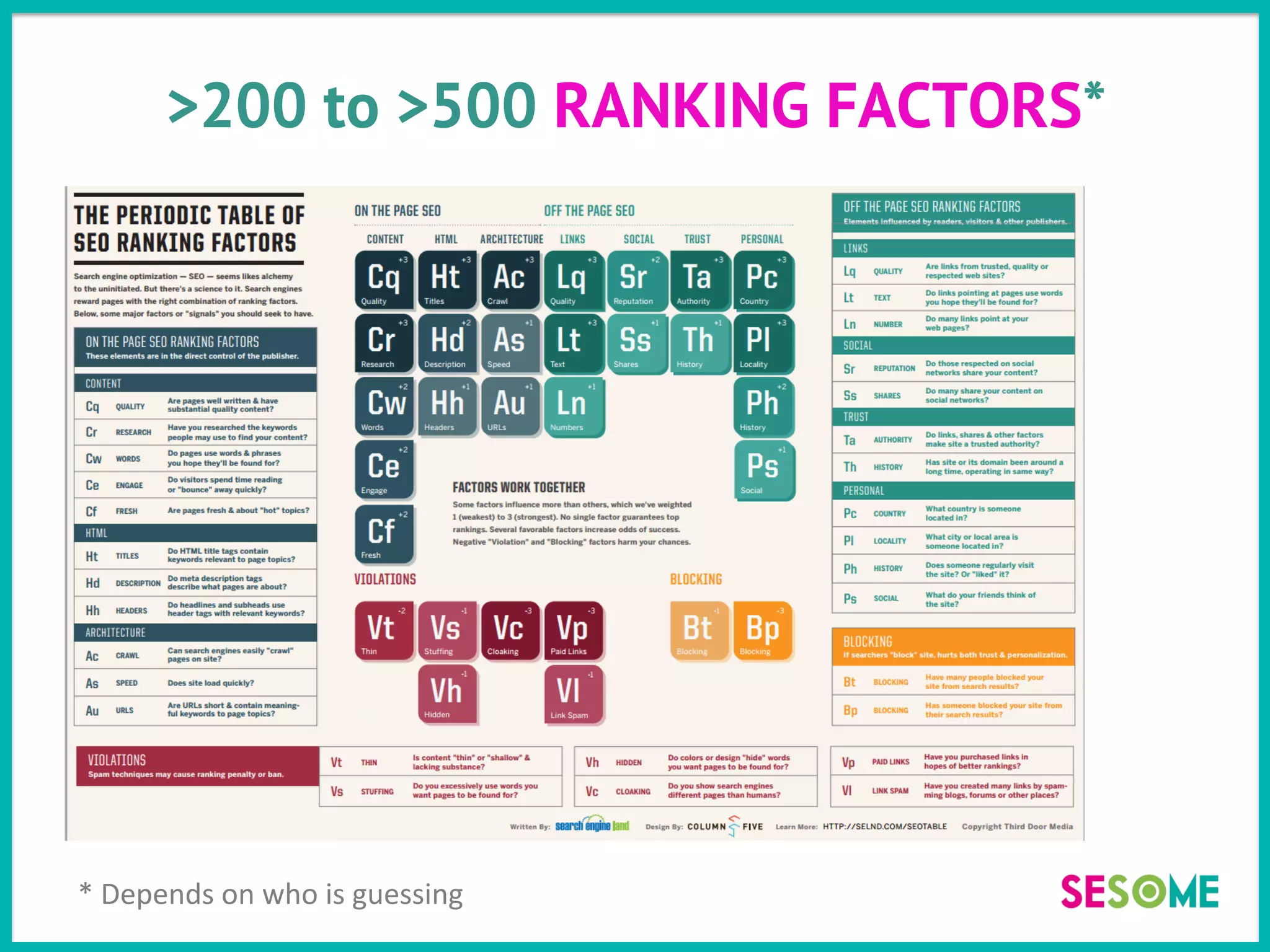
>200 to >500 RANKING FACTORS*
*	
  Depends	
  on	
  who	
  is	
  guessing	
  
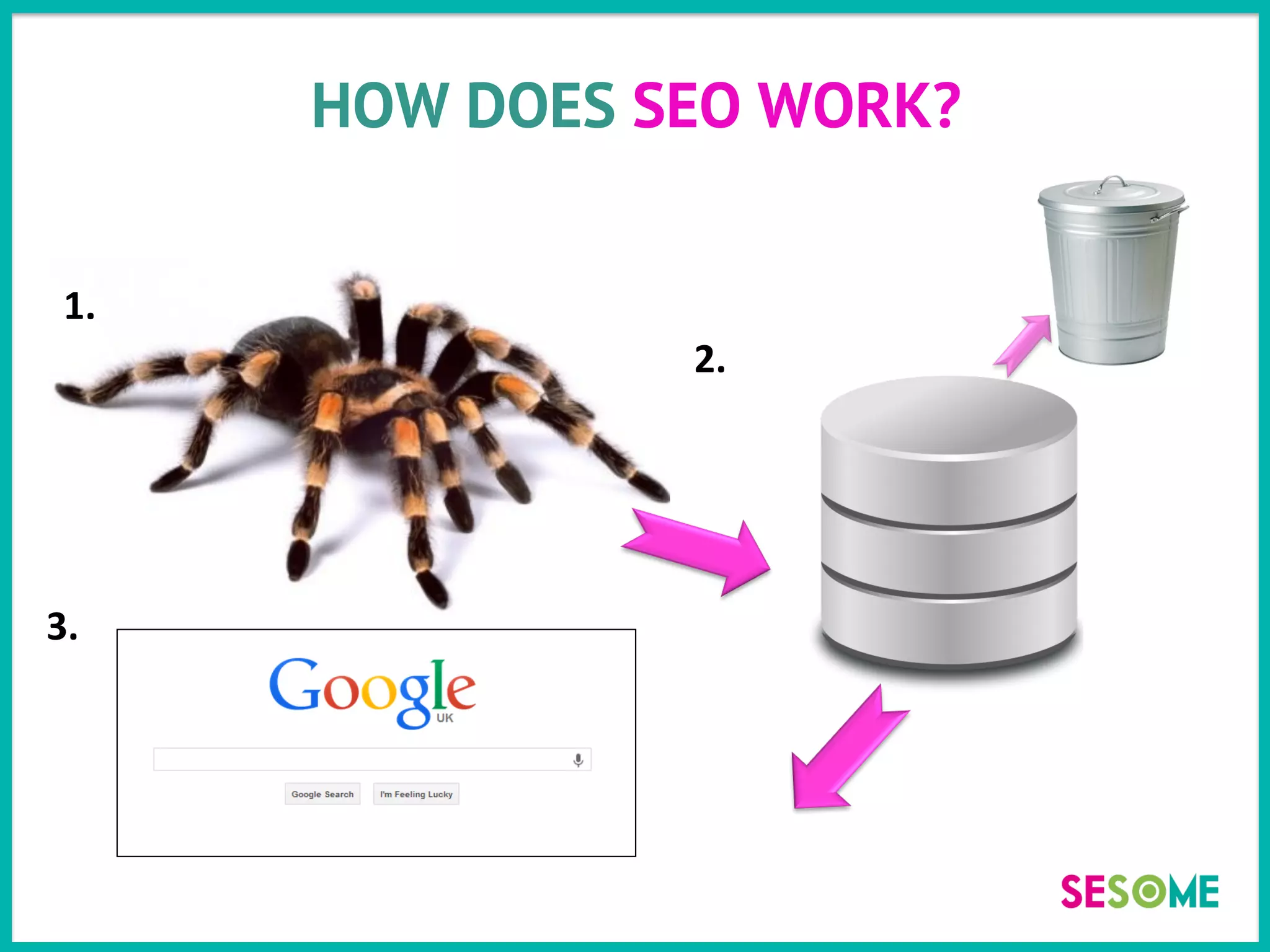
HOW DOES SEO WORK?
1.	
  
2.	
  
3.	
  
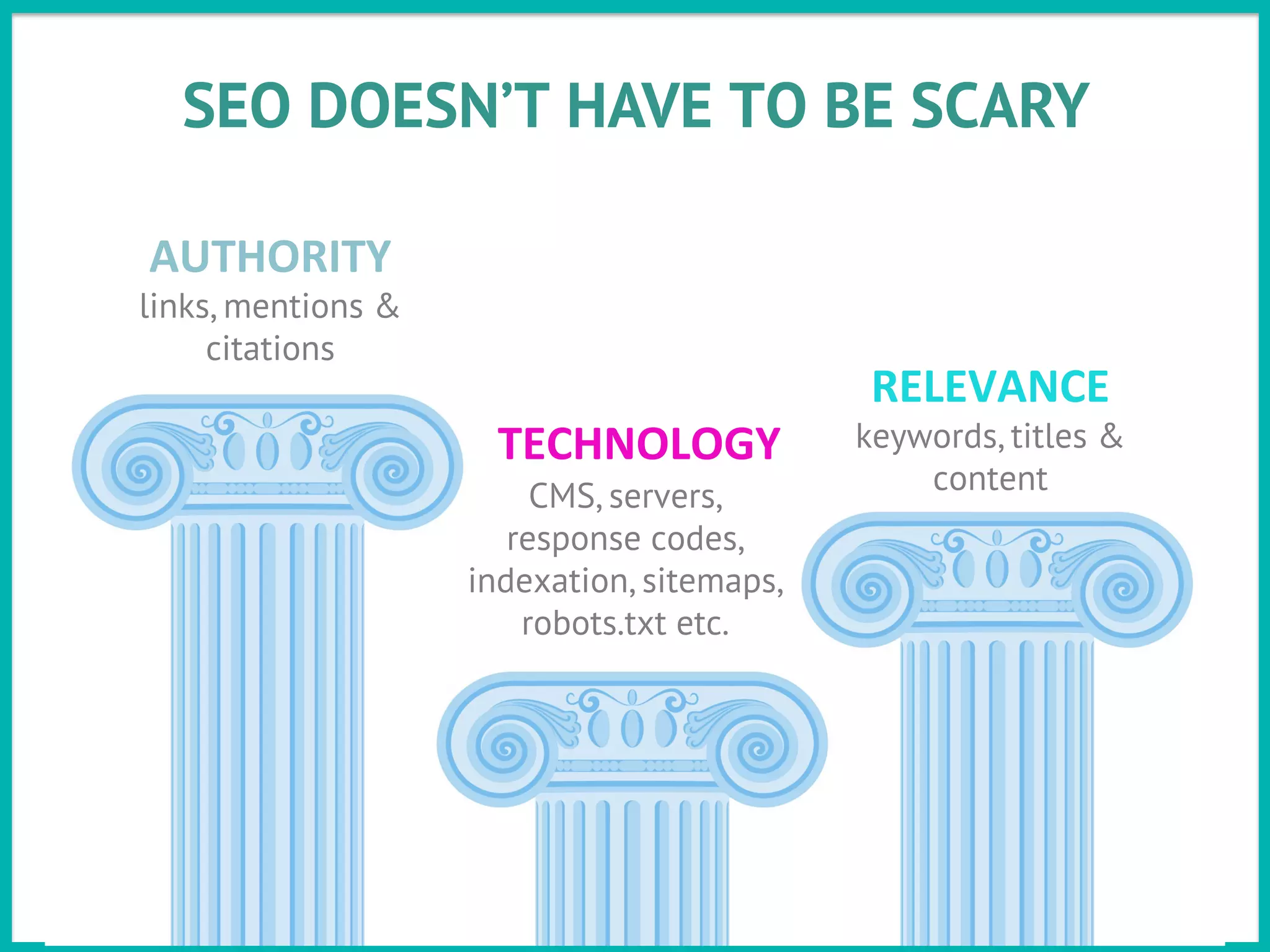
SEO DOESN’T HAVE TO BE SCARY
links, mentions &
citations
CMS, servers,
response codes,
indexation, sitemaps,
robots.txt etc.
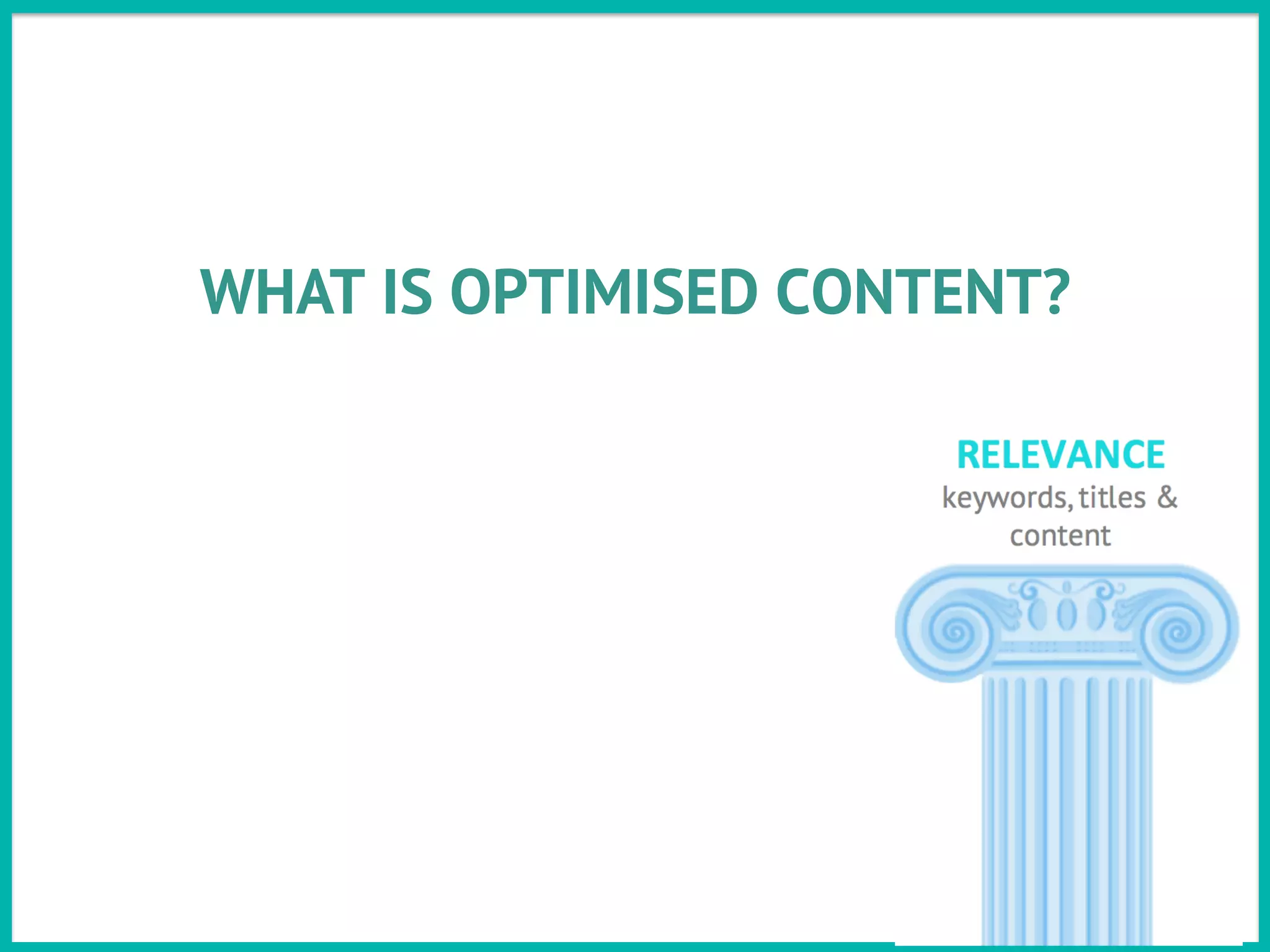
keywords, titles &
content
TECHNOLOGY	
  
RELEVANCE	
  
AUTHORITY	
  
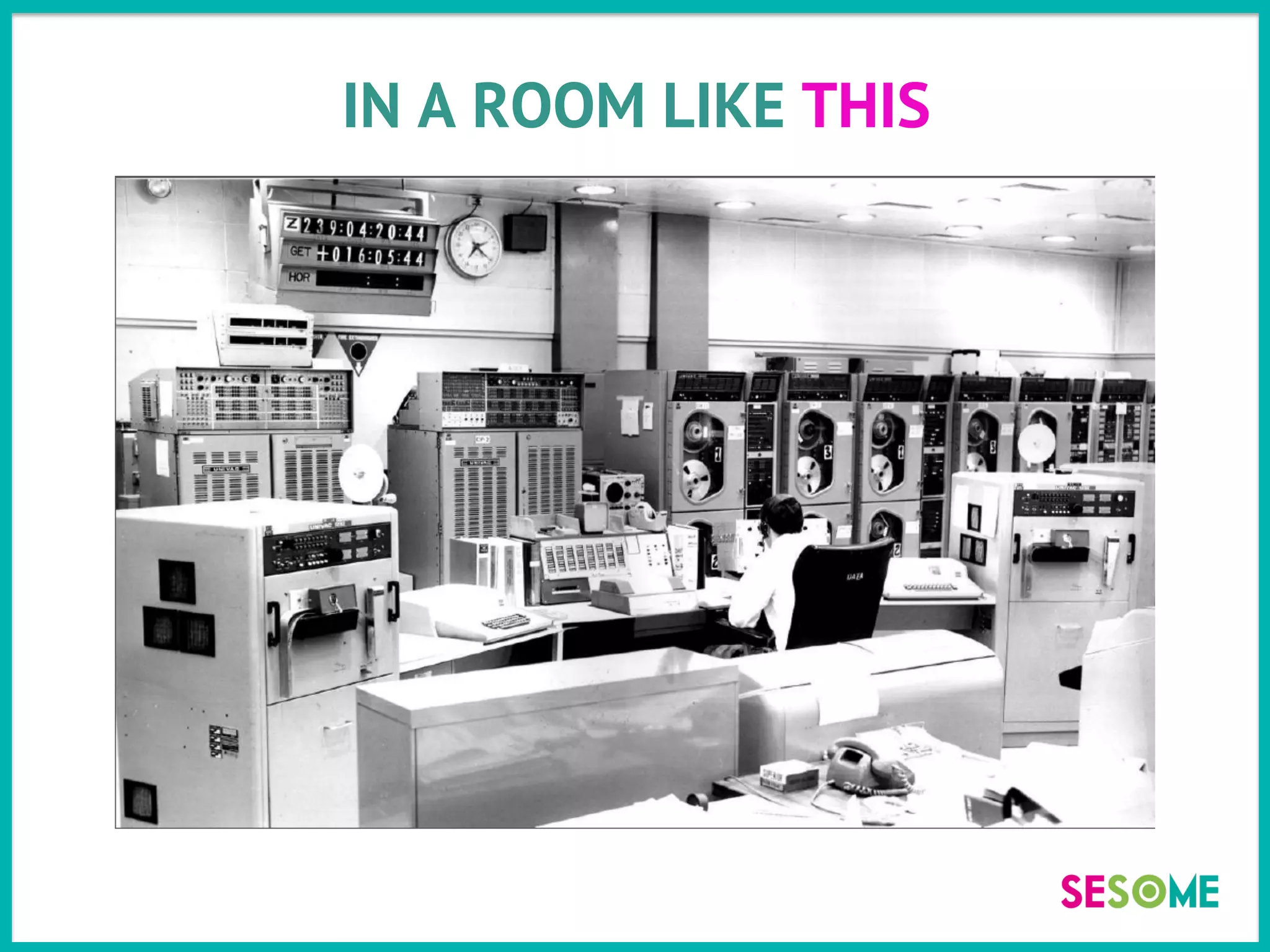
IN A ROOM LIKE THIS
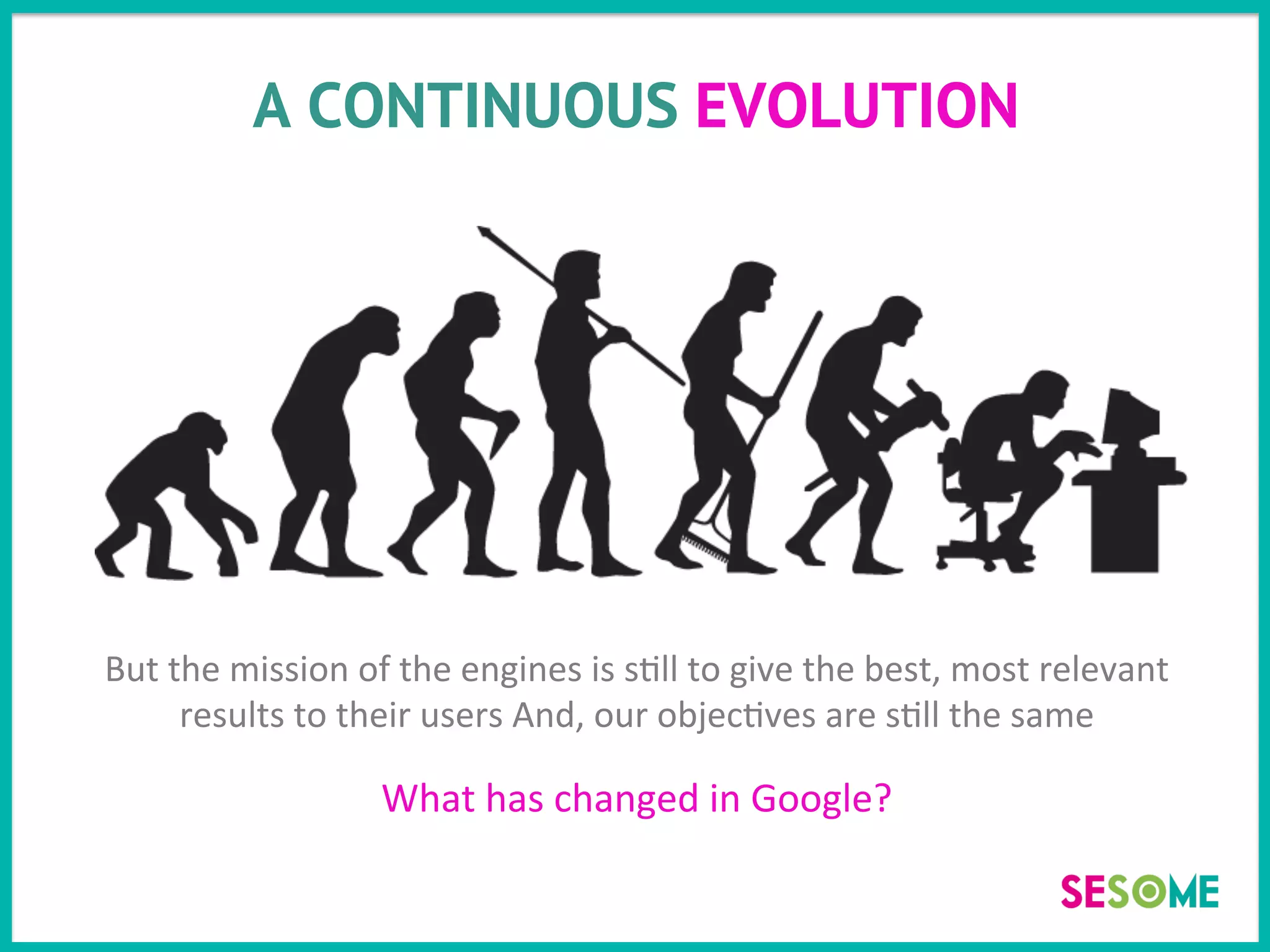
A CONTINUOUS EVOLUTION
But	
  the	
  mission	
  of	
  the	
  engines	
  is	
  s>ll	
  to	
  give	
  the	
  best,	
  most	
  relevant	
  
results	
  to	
  their	
  users	
  And,	
  our	
  objec>ves	
  are	
  s>ll	
  the	
  same	


What	
  has	
  changed	
  in	
  Google?	
  
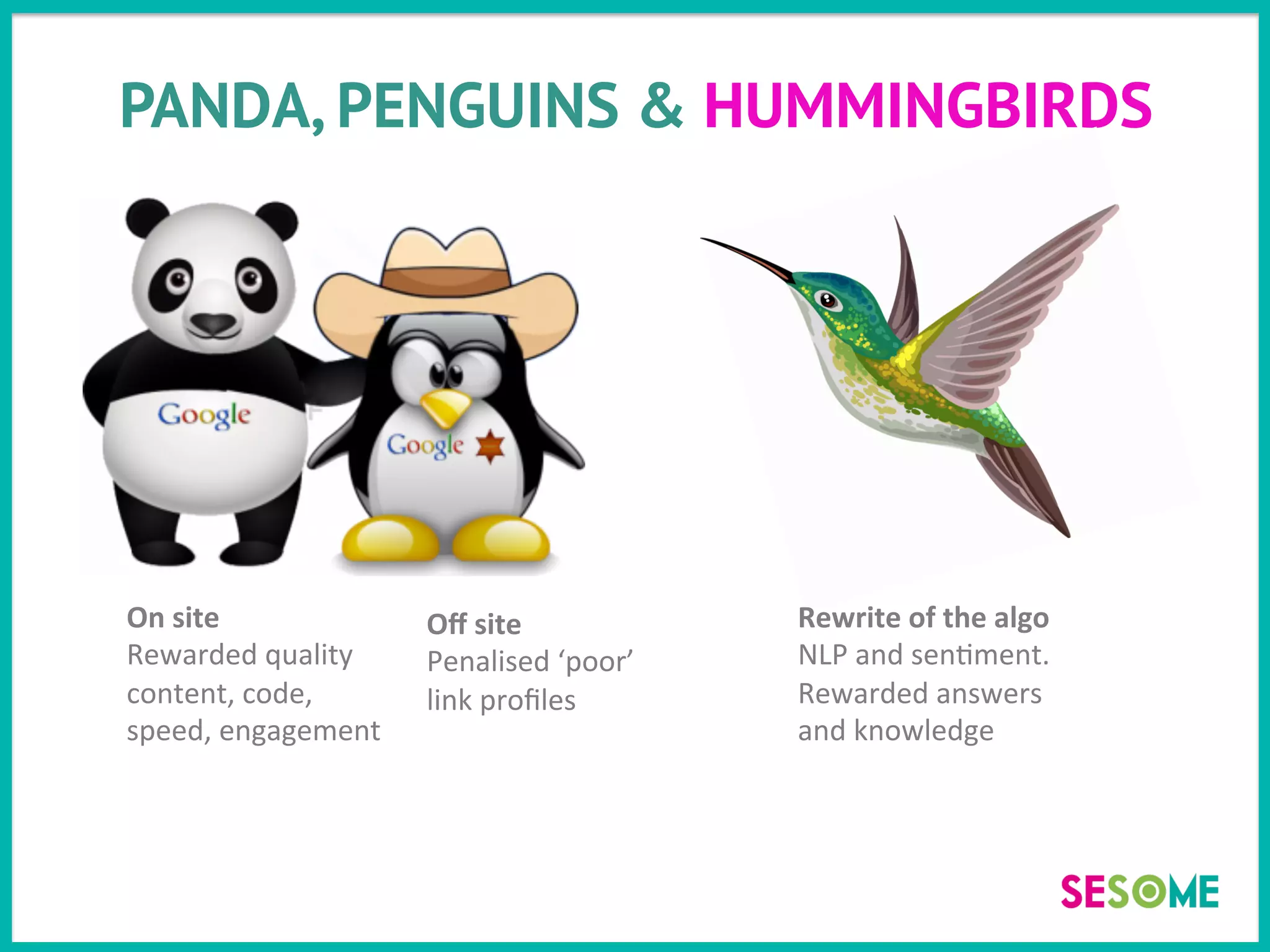
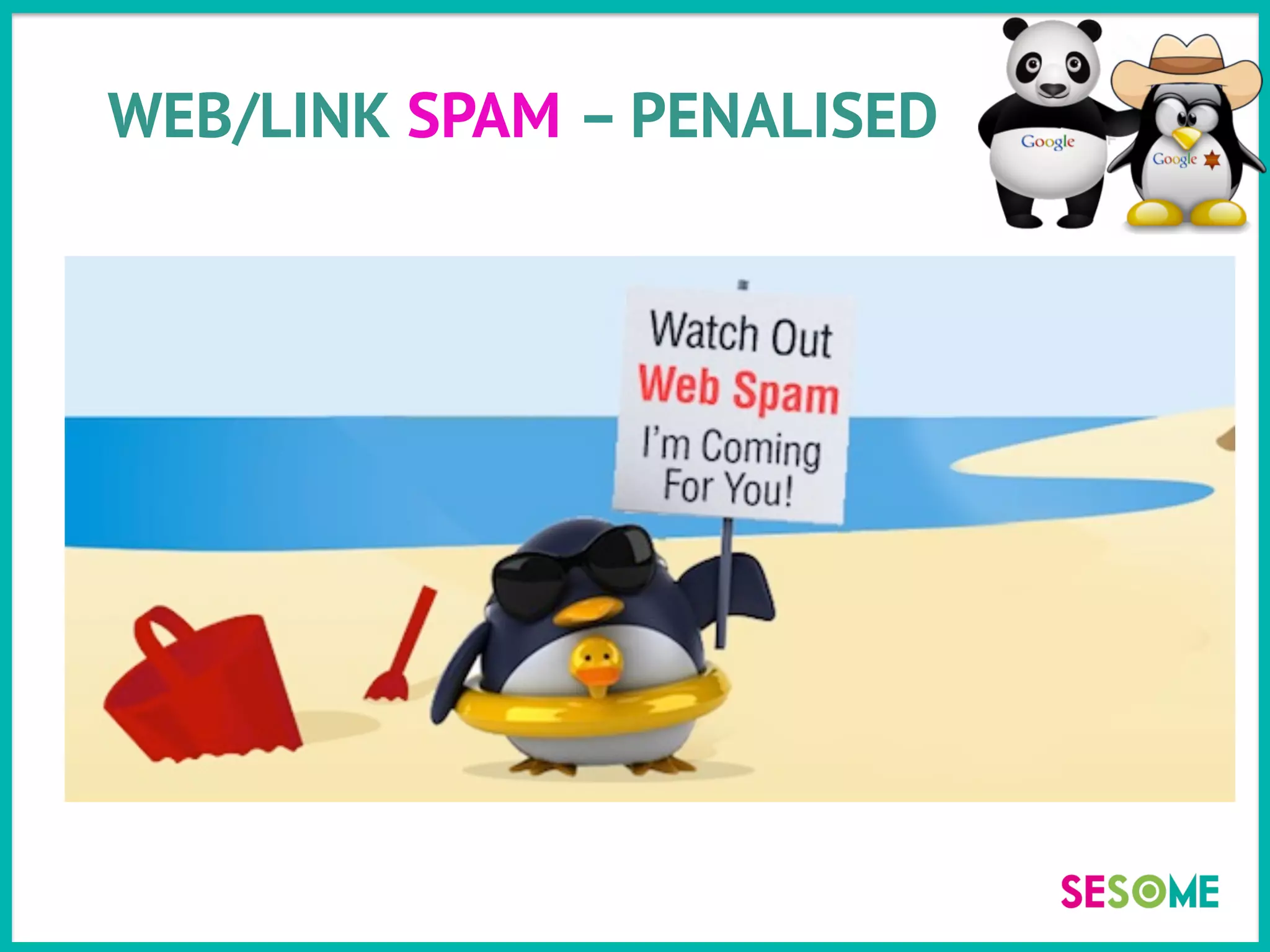
PANDA, PENGUINS & HUMMINGBIRDS
On	
  site	
  	
  
Rewarded	
  quality	
  
content,	
  code,	
  
speed,	
  engagement	
  
Off	
  site	
  	
  
Penalised	
  ‘poor’	
  
link	
  profiles	
  
Rewrite	
  of	
  the	
  algo	
  
NLP	
  and	
  sen>ment.	
  
Rewarded	
  answers	
  
and	
  knowledge	
  
WEB/LINK SPAM – PENALISED
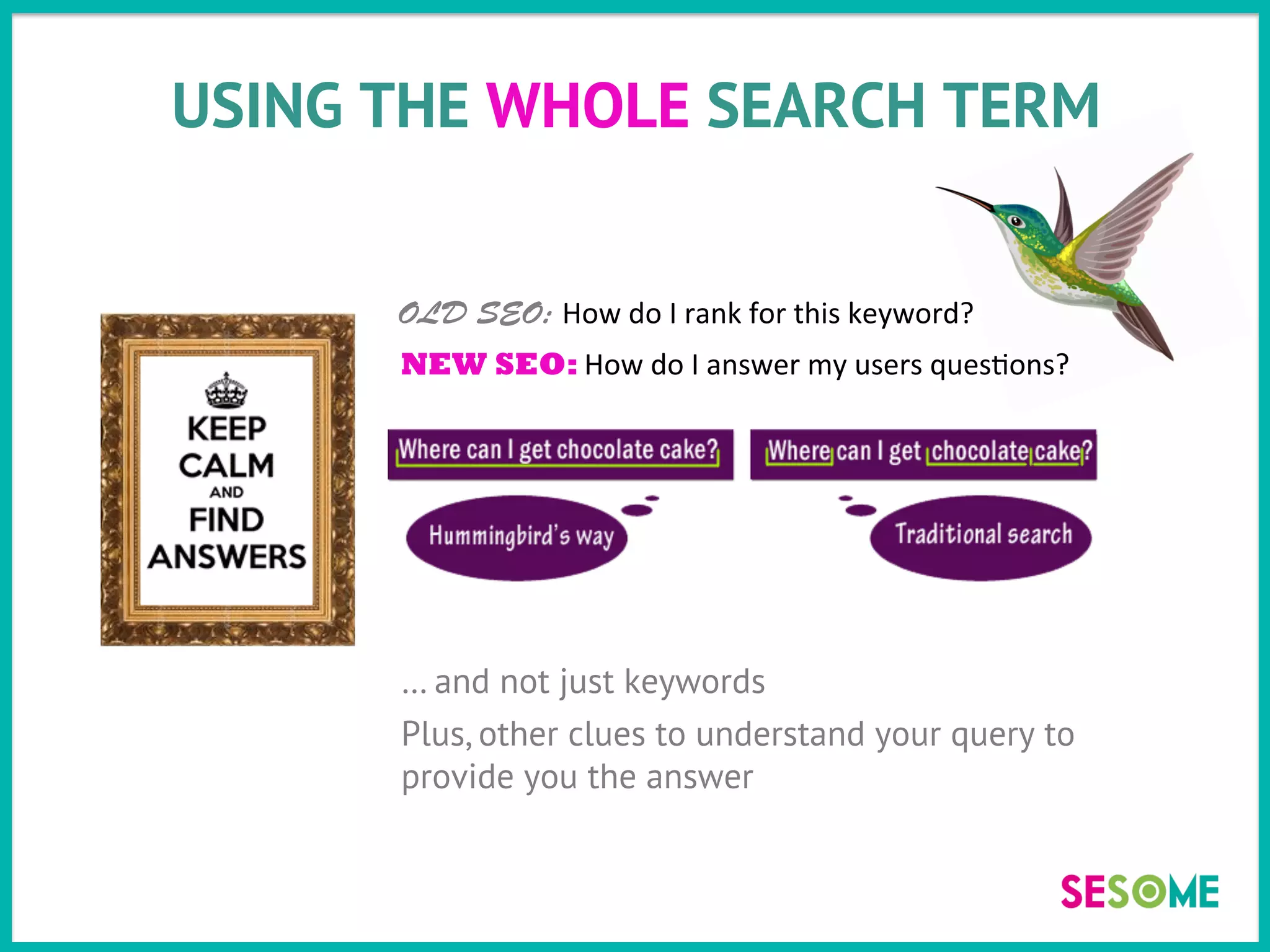
USING THE WHOLE SEARCH TERM
… and not just keywords
Plus, other clues to understand your query to
provide you the answer
OLD SEO: How	
  do	
  I	
  rank	
  for	
  this	
  keyword?	
  
NEW SEO: How	
  do	
  I	
  answer	
  my	
  users	
  ques>ons?	


Other changes
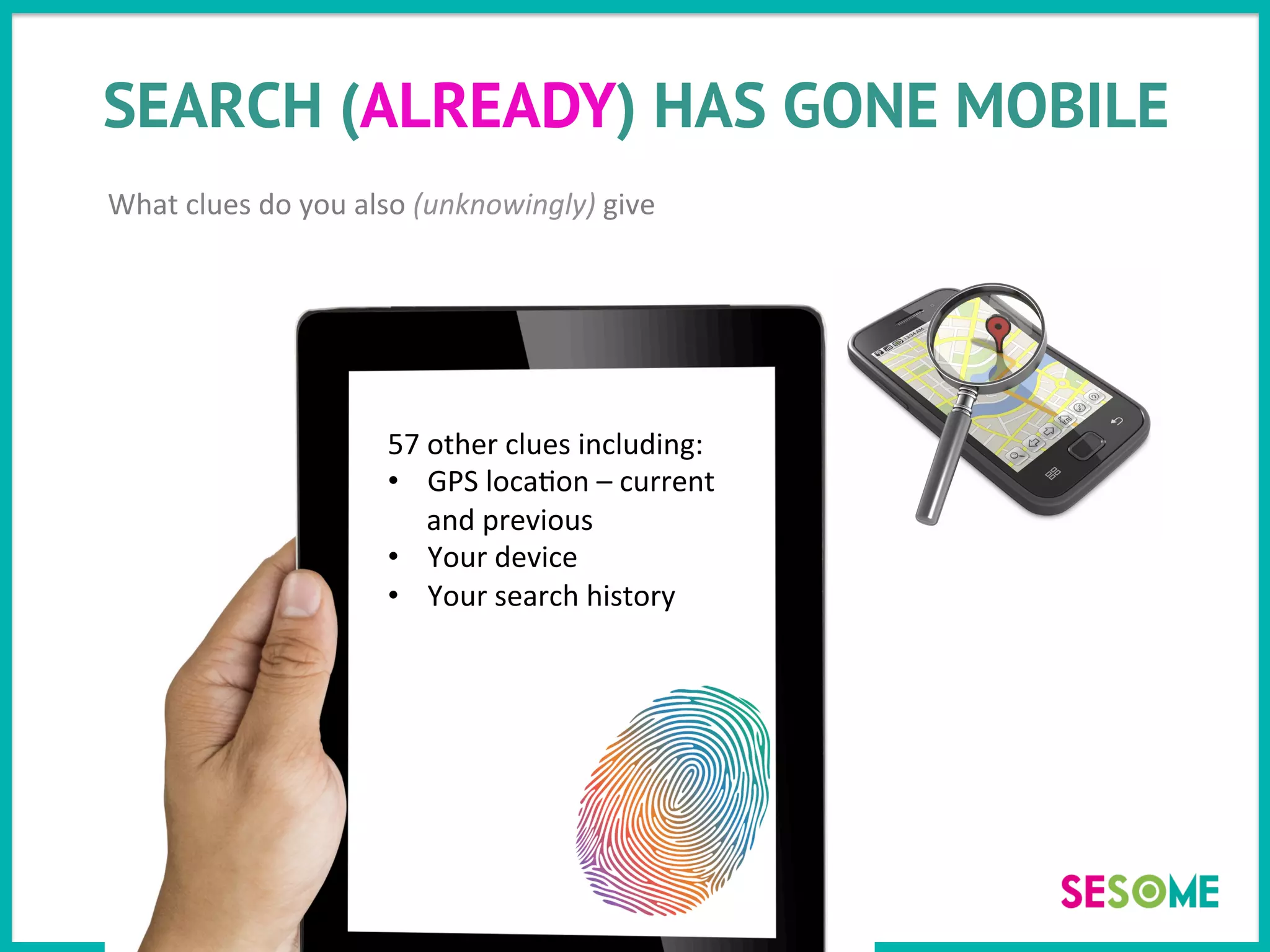
SEARCH (ALREADY) HAS GONE MOBILE
What	
  clues	
  do	
  you	
  also	
  (unknowingly)	
  give	
  
57	
  other	
  clues	
  including:	
  
•  GPS	
  loca>on	
  –	
  current	
  
and	
  previous	
  
•  Your	
  device	
  
•  Your	
  search	
  history	


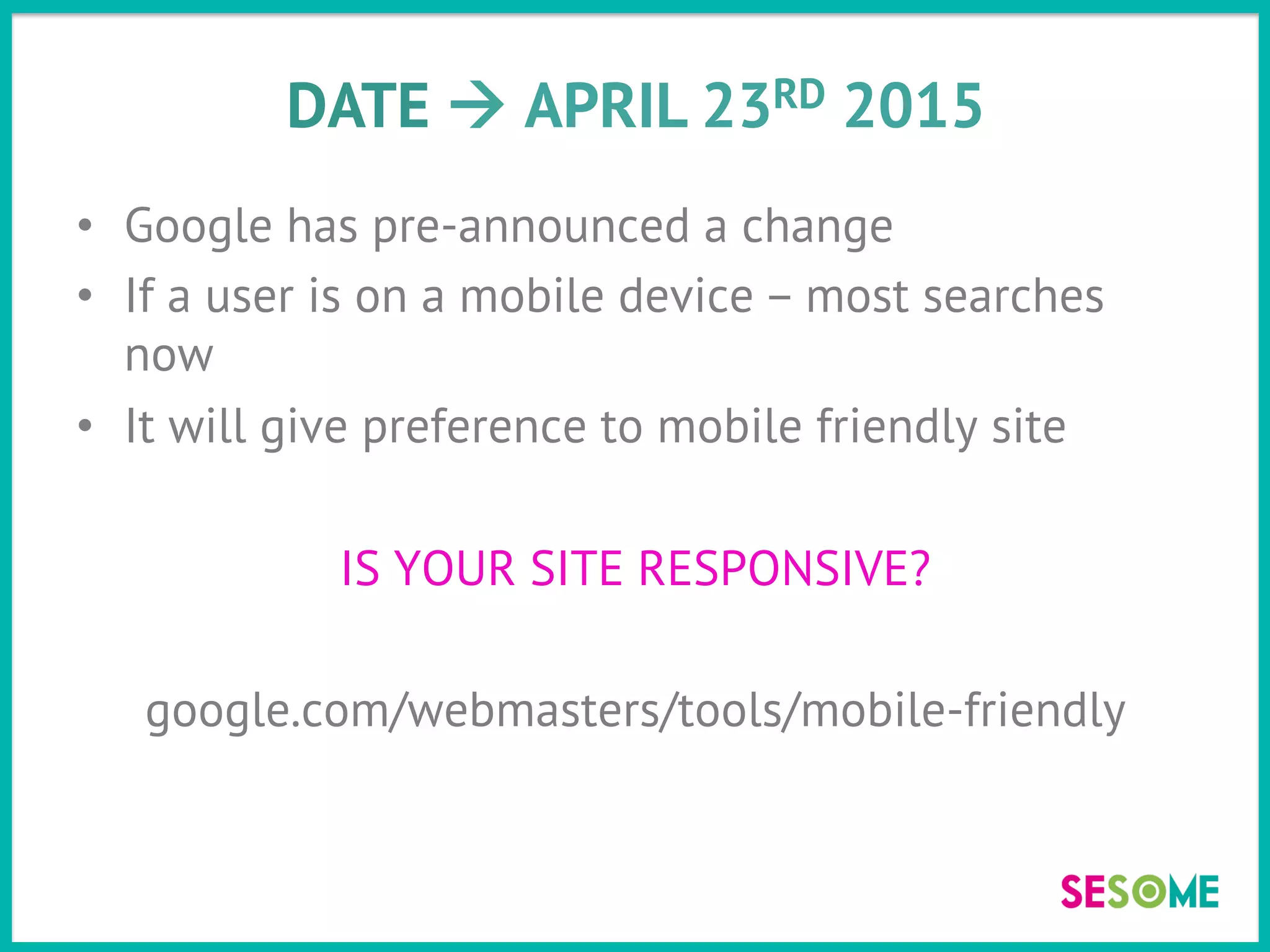
DATE à APRIL 21st 2015
•  Google has pre-announced a change
•  If a user is on a mobile device – most searches
now
•  It will give preference to mobile friendly site
IS YOUR SITE RESPONSIVE?
google.com/webmasters/tools/mobile-friendly
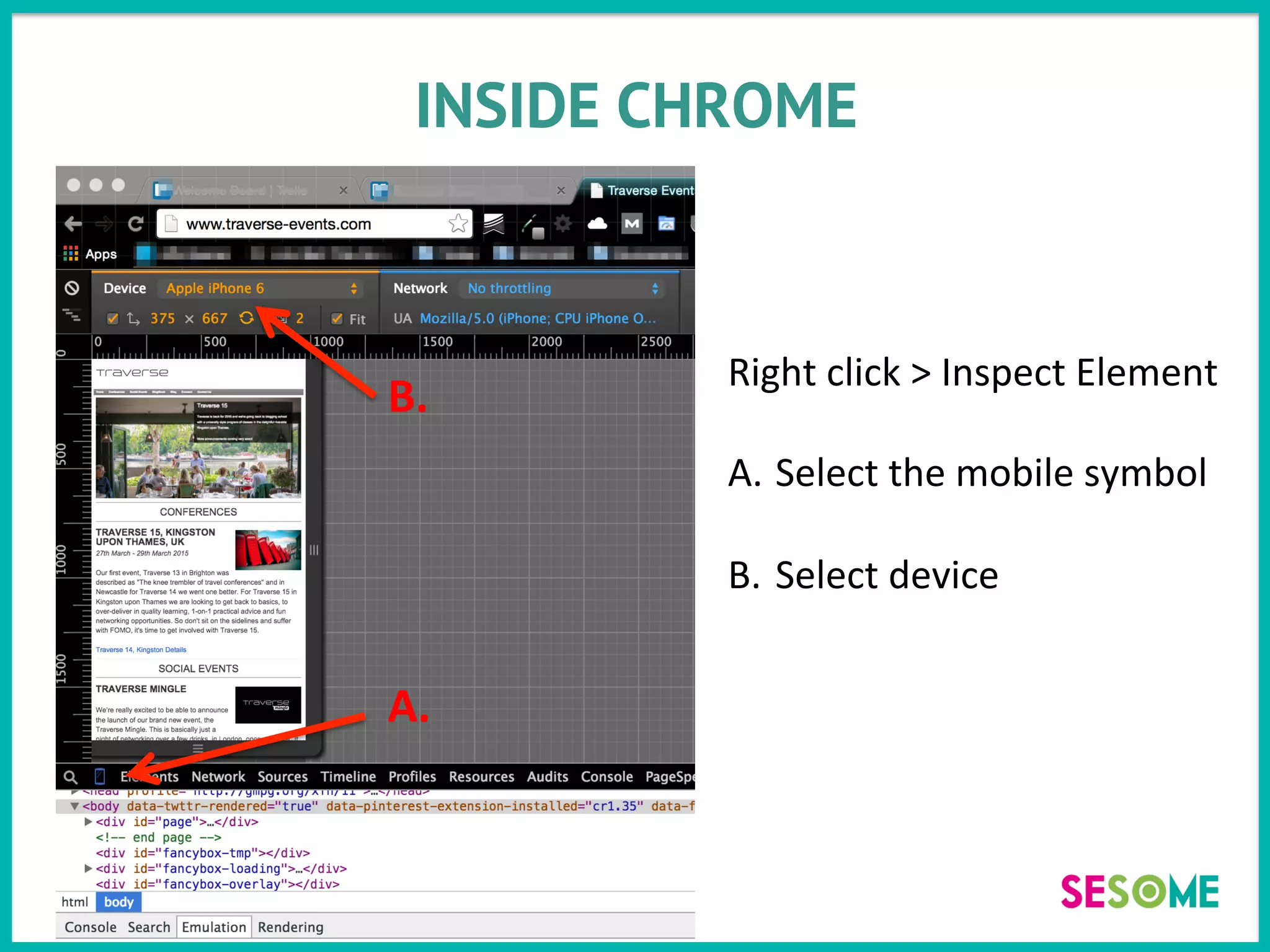
INSIDE CHROME
Right	
  click	
  >	
  Inspect	
  Element	


A.  Select	
  the	
  mobile	
  symbol	
  
B.  Select	
  device	
  
A.	
  
B.	
  
WHAT IS OPTIMISED CONTENT?
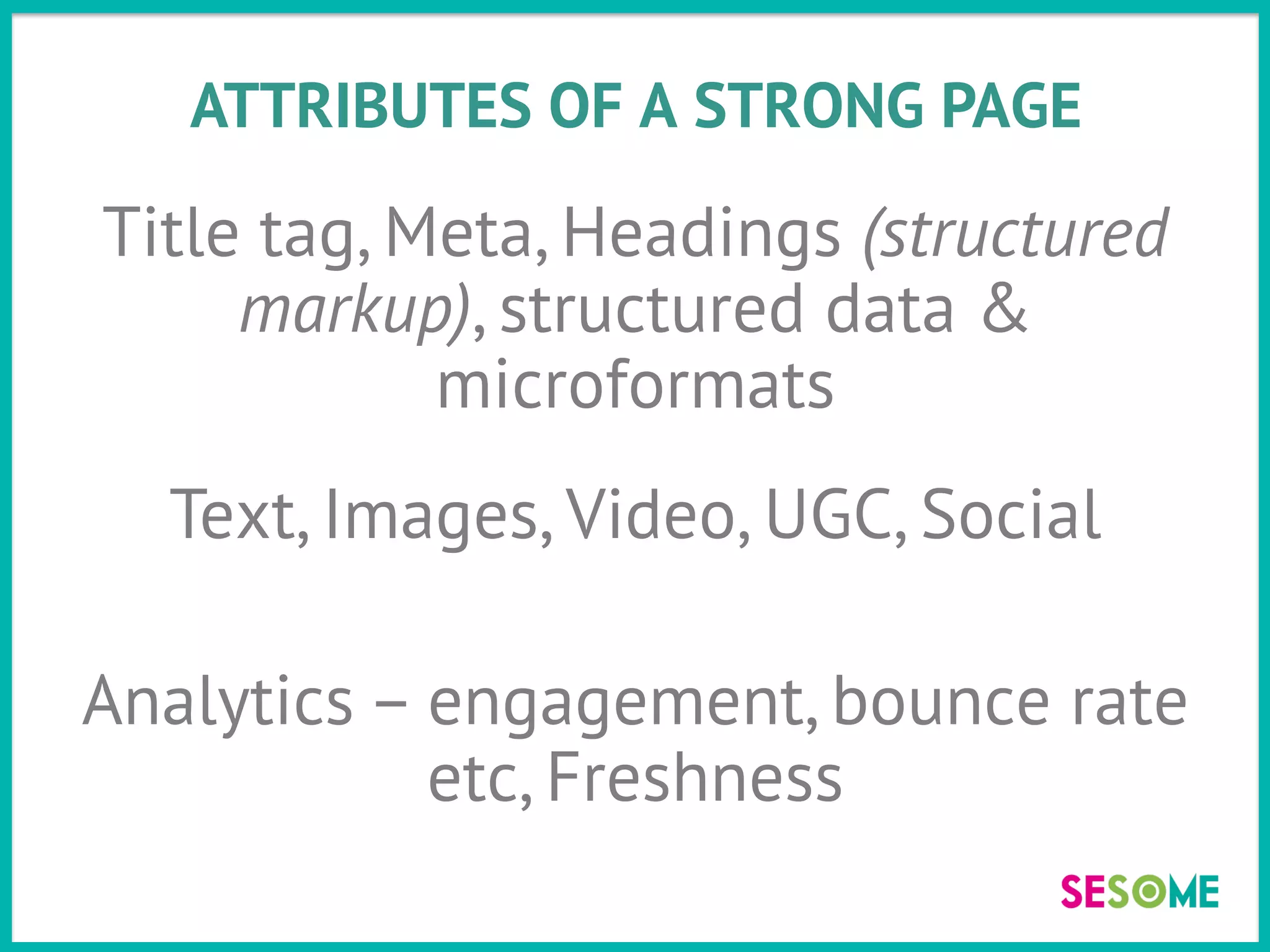
ATTRIBUTES OF A STRONG PAGE
Title tag, Meta, Headings (structured
markup), structured data &
microformats
Text, Images, Video, UGC, Social
Analytics – engagement, bounce rate
etc, Freshness
57 TYPES OF CONTENT
101 lists, A day in the life, About me!, About you, Admit faults,
Advice, Best buys, Blueprints and plans, Bucket lists, Case
studies, Collate trending news, Common mistakes,
Comparisons, Complaints & rants, Conference takeaways,
Data, Dear future self…, E-Books, Events & Sponsorship, FAQs,
Funnies, Gifs, Good / nice things!, Guest posts, Hold a
competition, How to blog, How To…, In 5 years time &
predictions, Infographics, Interviews, Lessons learned, Life
hacking tips, Make a game, Market analysis & commentary,
Music & Performances, Myths & busting them, News
commentary, Photos, Q & A, Rants, Reaction posts, Regulations
& compliance, Research & analysis, Resources for readers,
Review a Book/Movie/Product, Round ups and compilations,
Seasonal posts, Share your challenges & issues, Strange facts,
Tell a story, This history of…, Top XX, Training materials,
Webinars, What if…?, Write a story, Your vision and opinions,
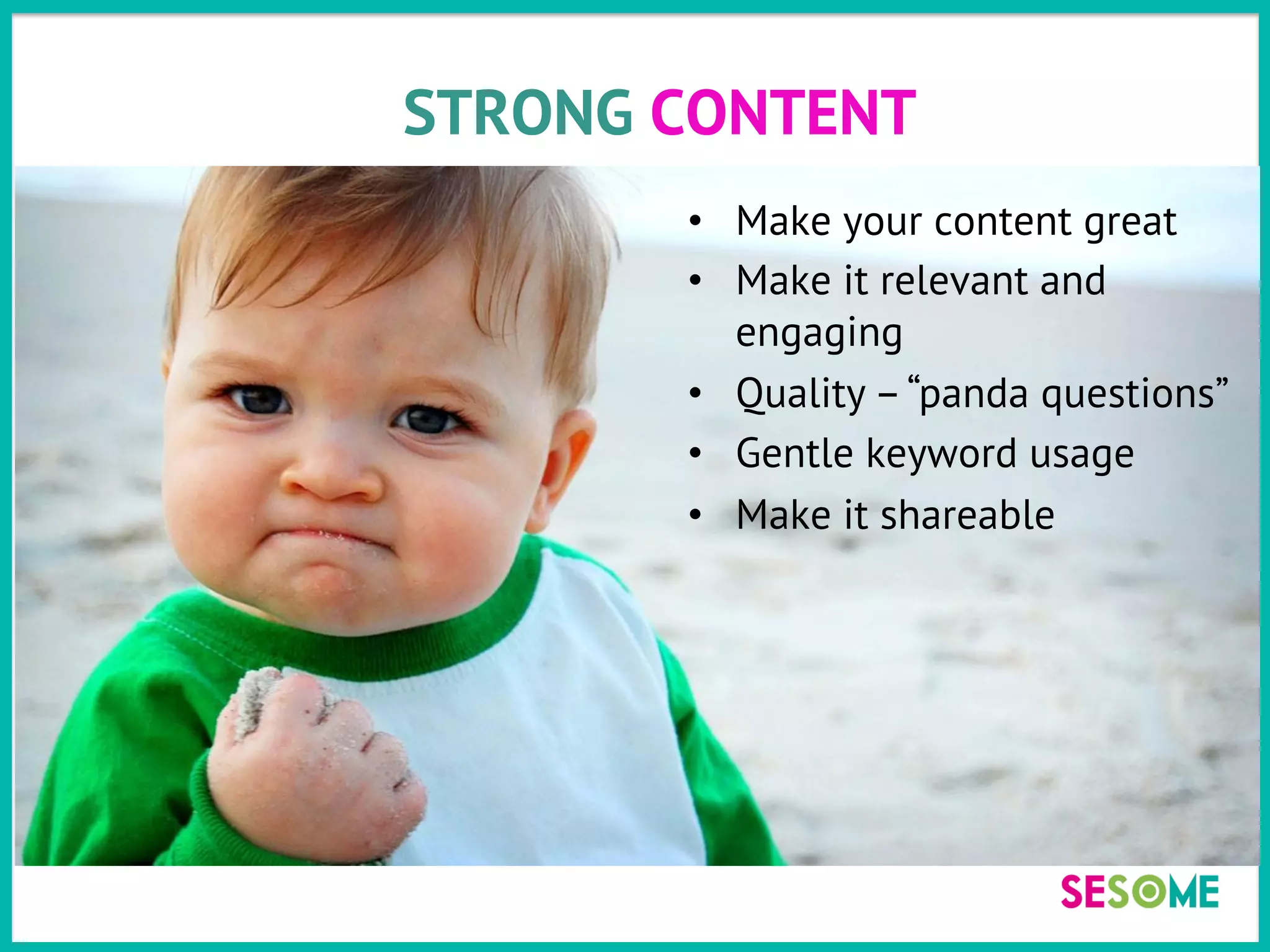
STRONG CONTENT
•  Make your content great
•  Make it relevant and
engaging
•  Quality –“panda questions”
•  Gentle keyword usage
•  Make it shareable
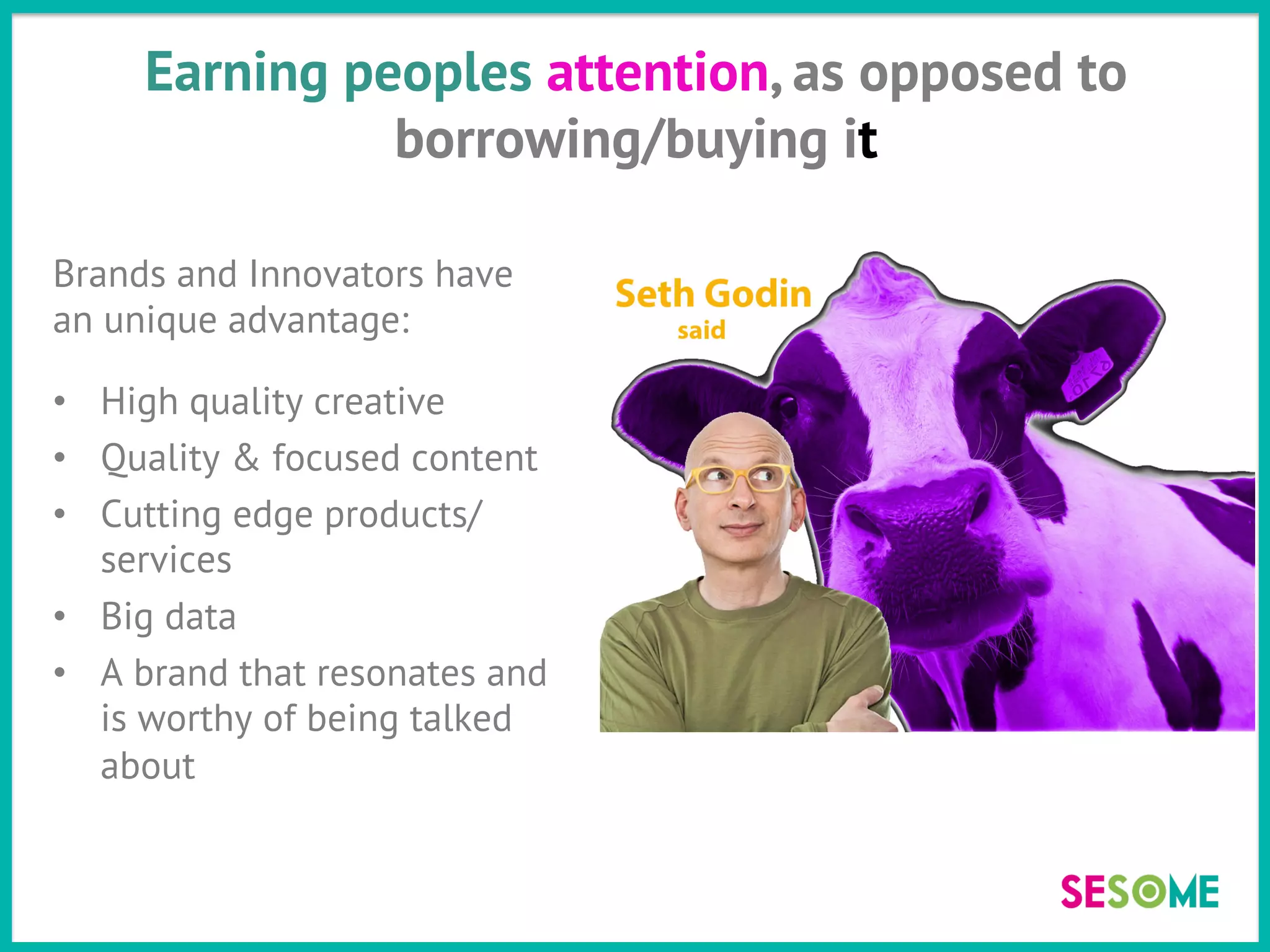
Earning peoples attention, as opposed to
borrowing/buying it
Brands and Innovators have
an unique advantage:
•  High quality creative
•  Quality & focused content
•  Cutting edge products/
services
•  Big data
•  A brand that resonates and
is worthy of being talked
about
RECAP – SEO -> What do people get wrong?
•  User experience & engagement
•  Search and Social isn’t built in from the ground up
•  In-accessibility!
•  Not designed for mobile (responsive design)
•  Lack unique content
•  Little or no consumer engagement or delight
•  Slow and error prone sites
•  Non-joined up marketing channels, and siloed
reporting that reinforces what they think they know
•  Assume that if you build a website customer will just
come!
A QUICK
TIME CHECK
TIME FOR YOU TO DO SOMETHING
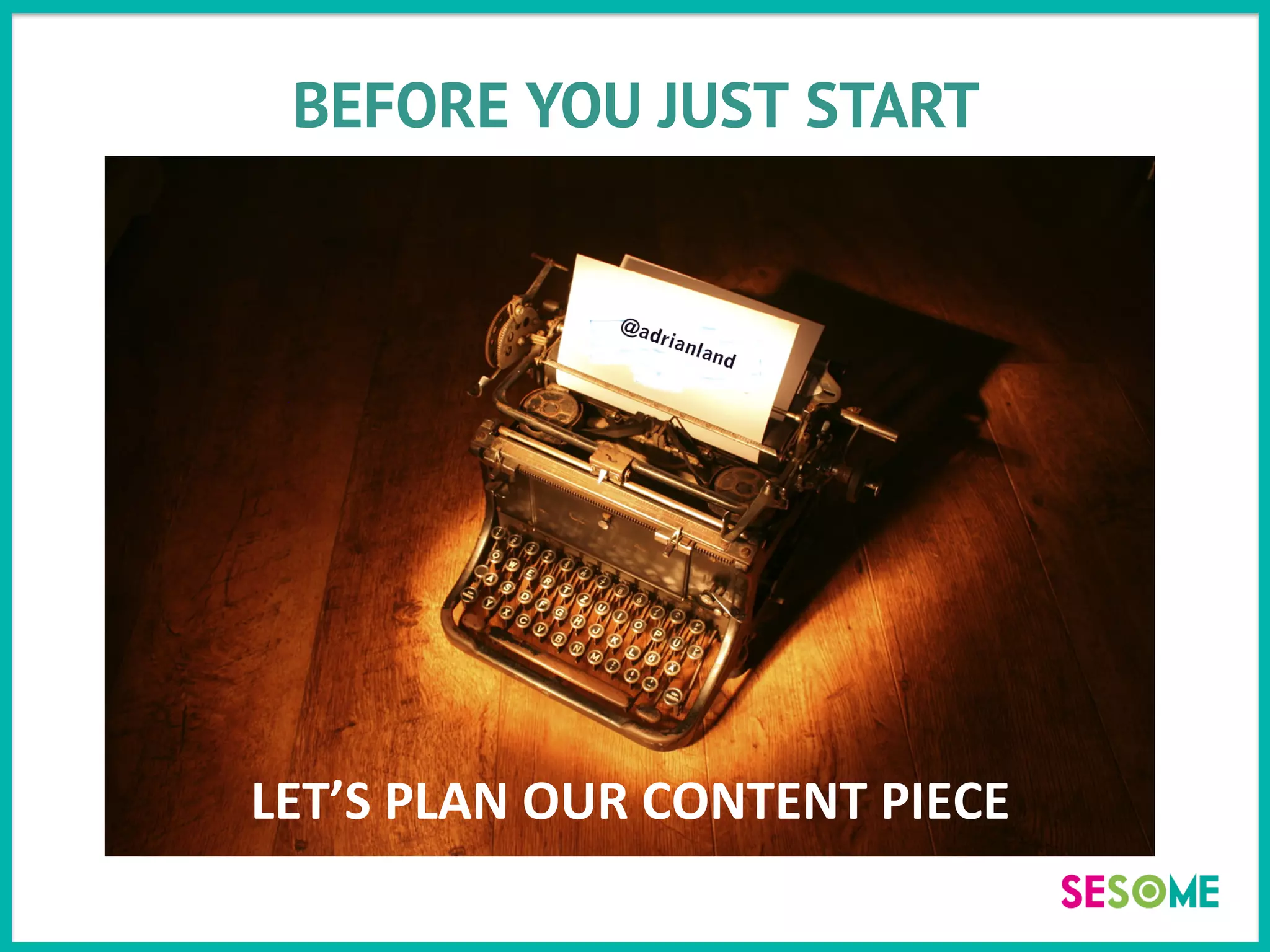
BEFORE YOU JUST START
LET’S	
  PLAN	
  OUR	
  CONTENT	
  PIECE	
  
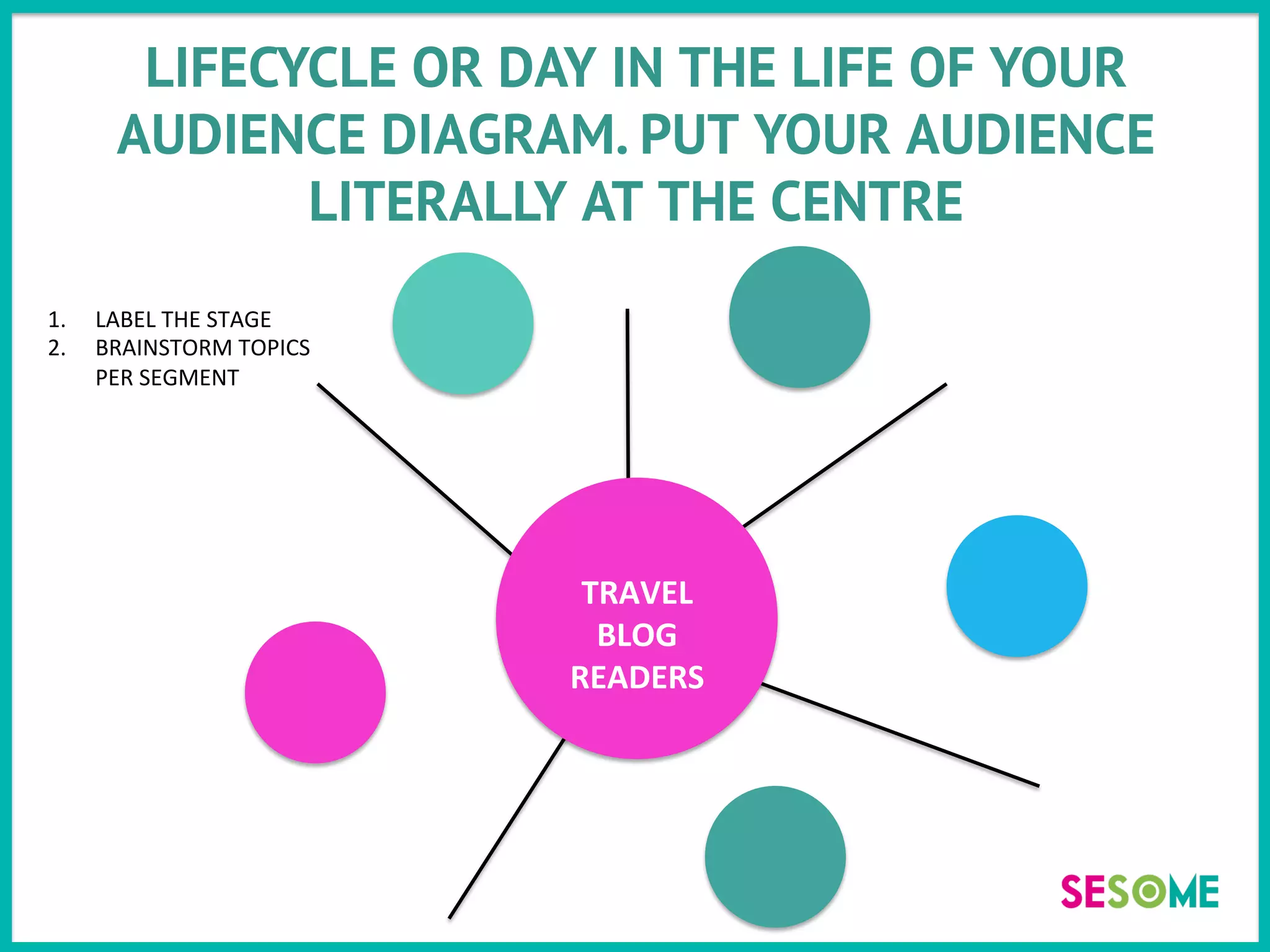
TRAVEL	
  
BLOG	
  
READERS	
  
LIFECYCLE OR DAY IN THE LIFE OF YOUR
AUDIENCE DIAGRAM. PUT YOUR AUDIENCE
LITERALLY AT THE CENTRE
1.  LABEL	
  THE	
  STAGE	
  
2.  BRAINSTORM	
  TOPICS	
  
PER	
  SEGMENT	
  
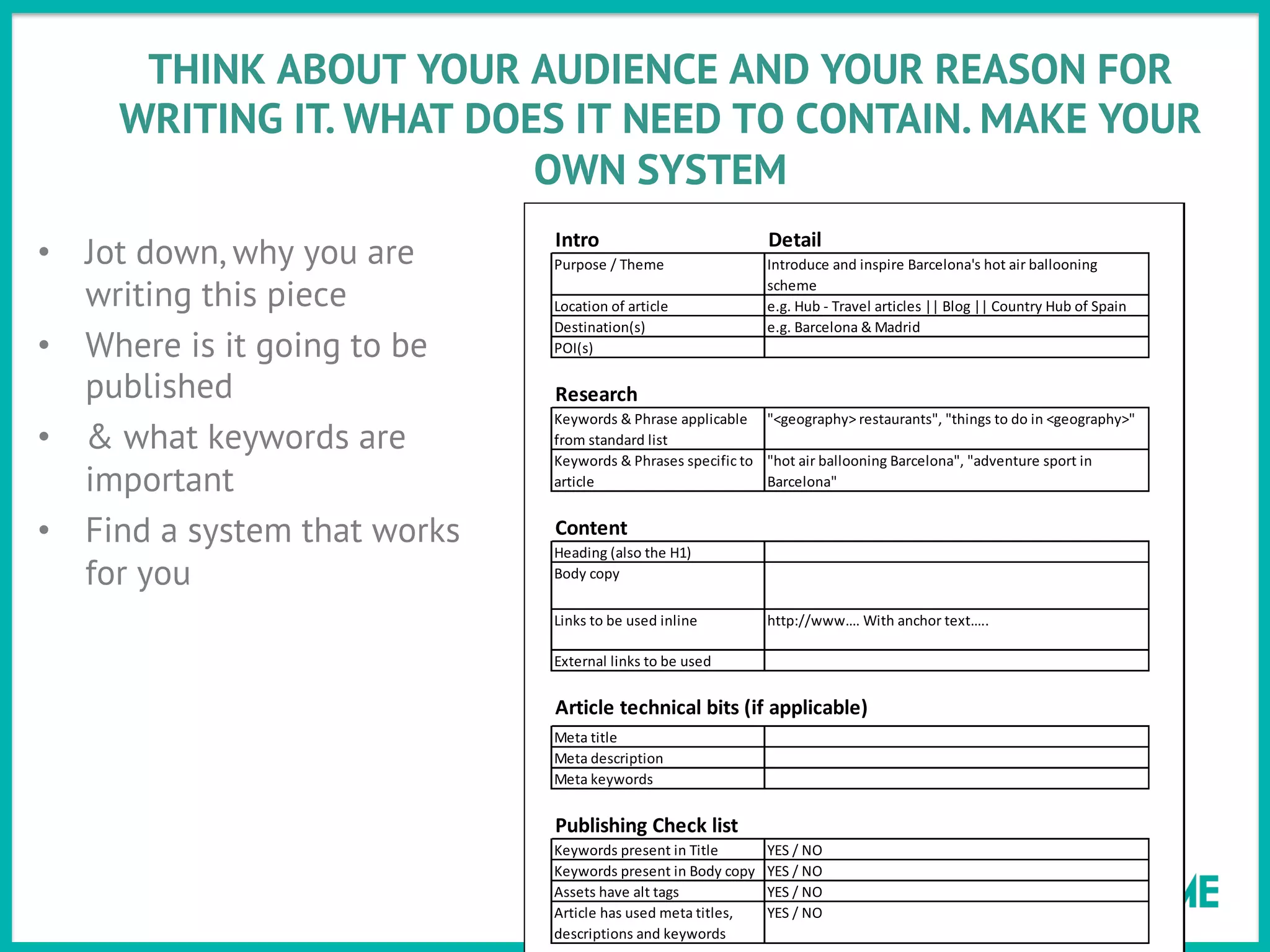
THINK ABOUT YOUR AUDIENCE AND YOUR REASON FOR
WRITING IT. WHAT DOES IT NEED TO CONTAIN. MAKE YOUR
OWN SYSTEM
•  Jot down, why you are
writing this piece
•  Where is it going to be
published
•  & what keywords are
important
•  Find a system that works
for you
Intro Detail
Purpose	
  /	
  Theme Introduce	
  and	
  inspire	
  Barcelona's	
  hot	
  air	
  ballooning	
  
scheme
Location	
  of	
  article e.g.	
  Hub	
  -­‐	
  Travel	
  articles	
  ||	
  Blog	
  ||	
  Country	
  Hub	
  of	
  Spain
Destination(s) e.g.	
  Barcelona	
  &	
  Madrid
POI(s)
Research
Keywords	
  &	
  Phrase	
  applicable	
  
from	
  standard	
  list
"<geography>	
  restaurants",	
  "things	
  to	
  do	
  in	
  <geography>"
Keywords	
  &	
  Phrases	
  specific	
  to	
  
article
"hot	
  air	
  ballooning	
  Barcelona",	
  "adventure	
  sport	
  in	
  
Barcelona"
Content
Heading	
  (also	
  the	
  H1)
Body	
  copy
Links	
  to	
  be	
  used	
  inline http://www….	
  With	
  anchor	
  text…..
External	
  links	
  to	
  be	
  used
Meta	
  title
Meta	
  description
Meta	
  keywords
Publishing	
  Check	
  list
Keywords	
  present	
  in	
  Title YES	
  /	
  NO
Keywords	
  present	
  in	
  Body	
  copy YES	
  /	
  NO
Assets	
  have	
  alt	
  tags YES	
  /	
  NO
Article	
  has	
  used	
  meta	
  titles,	
  
descriptions	
  and	
  keywords
YES	
  /	
  NO
Article	
  technical	
  bits	
  (if	
  applicable)
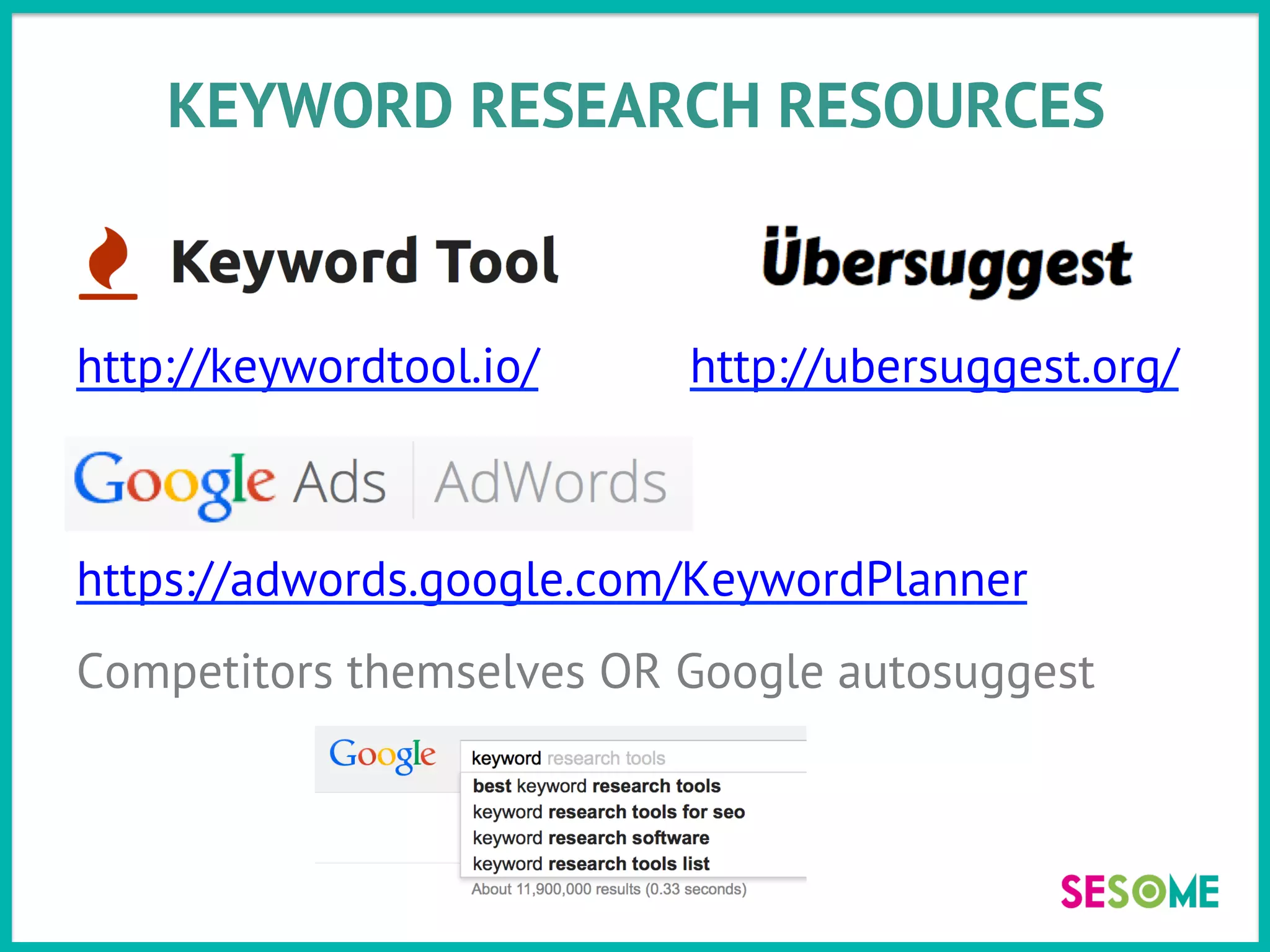
KEYWORD RESEARCH RESOURCES
http://keywordtool.io/ http://ubersuggest.org/
https://adwords.google.com/KeywordPlanner
Competitors themselves OR Google autosuggest
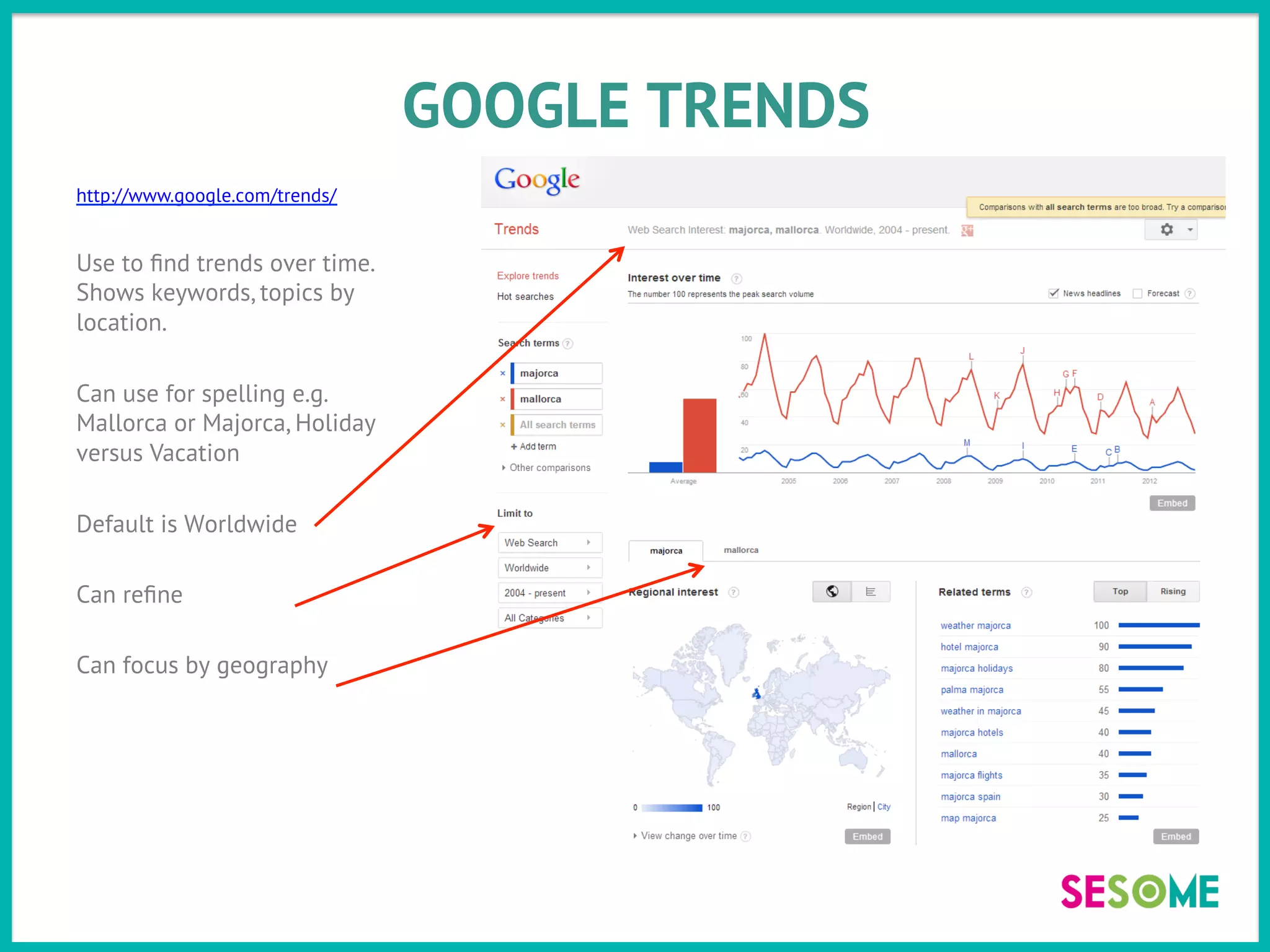
GOOGLE TRENDS
http://www.google.com/trends/
Use to find trends over time.
Shows keywords, topics by
location.
Can use for spelling e.g.
Mallorca or Majorca, Holiday
versus Vacation
Default is Worldwide
Can refine
Can focus by geography
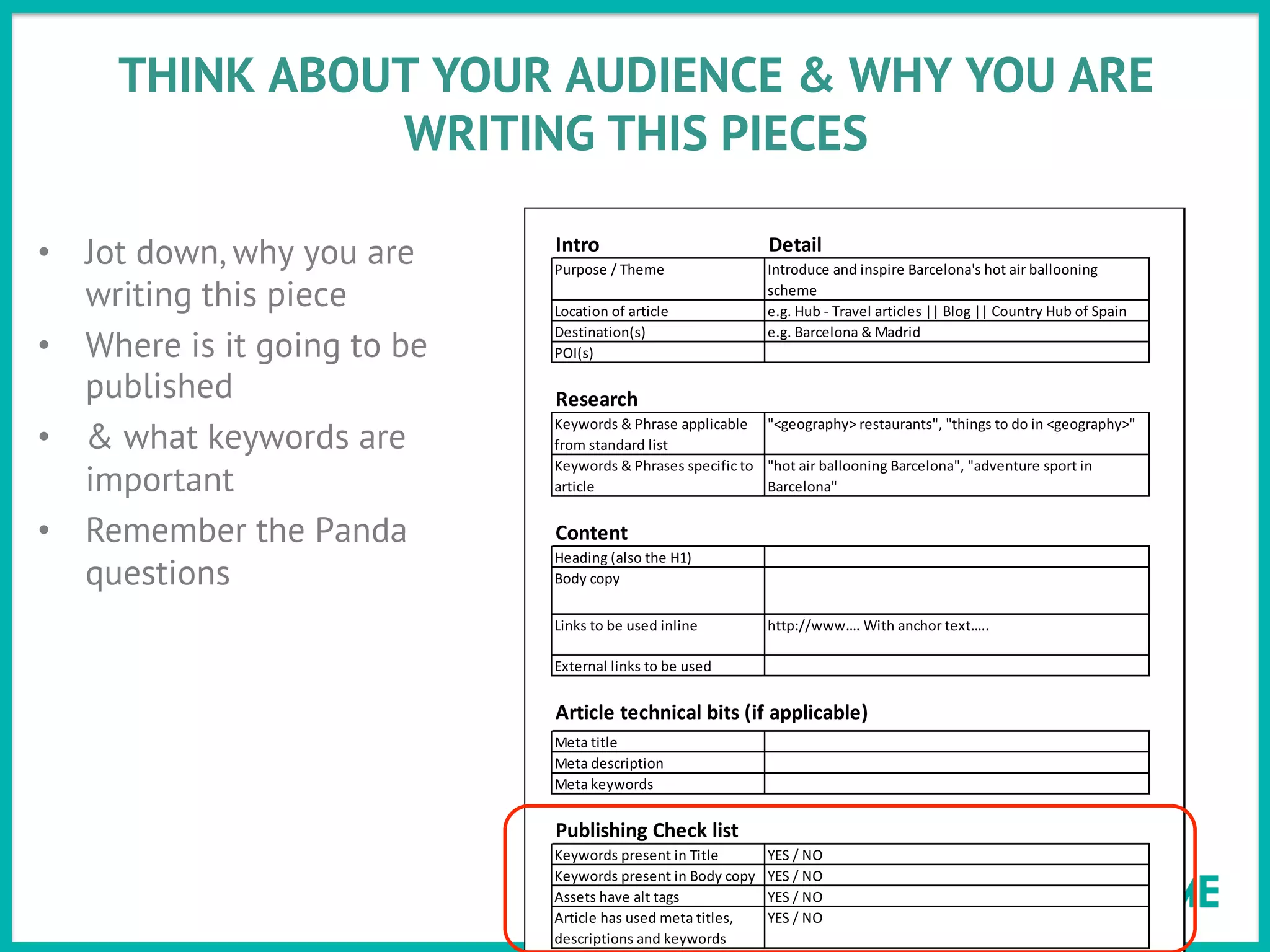
THINK ABOUT YOUR AUDIENCE & WHY YOU ARE
WRITING THIS PIECES
•  Jot down, why you are
writing this piece
•  Where is it going to be
published
•  & what keywords are
important
•  Remember the Panda
questions
Intro Detail
Purpose	
  /	
  Theme Introduce	
  and	
  inspire	
  Barcelona's	
  hot	
  air	
  ballooning	
  
scheme
Location	
  of	
  article e.g.	
  Hub	
  -­‐	
  Travel	
  articles	
  ||	
  Blog	
  ||	
  Country	
  Hub	
  of	
  Spain
Destination(s) e.g.	
  Barcelona	
  &	
  Madrid
POI(s)
Research
Keywords	
  &	
  Phrase	
  applicable	
  
from	
  standard	
  list
"<geography>	
  restaurants",	
  "things	
  to	
  do	
  in	
  <geography>"
Keywords	
  &	
  Phrases	
  specific	
  to	
  
article
"hot	
  air	
  ballooning	
  Barcelona",	
  "adventure	
  sport	
  in	
  
Barcelona"
Content
Heading	
  (also	
  the	
  H1)
Body	
  copy
Links	
  to	
  be	
  used	
  inline http://www….	
  With	
  anchor	
  text…..
External	
  links	
  to	
  be	
  used
Meta	
  title
Meta	
  description
Meta	
  keywords
Publishing	
  Check	
  list
Keywords	
  present	
  in	
  Title YES	
  /	
  NO
Keywords	
  present	
  in	
  Body	
  copy YES	
  /	
  NO
Assets	
  have	
  alt	
  tags YES	
  /	
  NO
Article	
  has	
  used	
  meta	
  titles,	
  
descriptions	
  and	
  keywords
YES	
  /	
  NO
Article	
  technical	
  bits	
  (if	
  applicable)
THE ‘PANDA’ QUESTIONS FROM GOOGLE
We, and the bots want quality content – real content, not automated, not duplicate nor “thin” content. Here
are some questions from Google to think about when planning your content. Our content team use this
too
•  Would you trust the information presented in this article?
•  Is this article written by an expert or enthusiast who knows the topic well, or is it more shallow in
nature?
•  Does the site have duplicate, overlapping, or redundant articles on the same or similar topics with
slightly different keyword variations?
•  Would you be comfortable giving your credit card information to this site?
•  Does this article have spelling, stylistic, or factual errors?
•  Are the topics driven by genuine interests of readers of the site, or does the site generate content by
attempting to guess what might rank well in search engines?
•  Does the article provide original content or information, original reporting, original research, or
original analysis?
•  Does the page provide substantial value when compared to other pages in search results?
Source:	
  hJp://googlewebmastercentral.blogspot.co.uk/2011/05/more-­‐guidance-­‐on-­‐building-­‐high-­‐quality.html	
  
CONTINUED…
•  How much quality control is done on content?
•  Does the article describe both sides of a story?
•  Is the site a recognized authority on its topic?
•  Is the content mass-produced by or outsourced to a large number of creators, or spread across a large network of
sites, so that individual pages or sites don’t get as much attention or care?
•  Was the article edited well, or does it appear sloppy or hastily produced?
•  For a health related query, would you trust information from this site?
•  Would you recognize this site as an authoritative source when mentioned by name?
•  Does this article provide a complete or comprehensive description of the topic?
•  Does this article contain insightful analysis or interesting information that is beyond obvious?
•  Is this the sort of page you’d want to bookmark, share with a friend, or recommend?
•  Does this article have an excessive amount of ads that distract from or interfere with the main content?
•  Would you expect to see this article in a printed magazine, encyclopedia or book?
•  Are the articles short, unsubstantial, or otherwise lacking in helpful specifics?
•  Are the pages produced with great care and attention to detail vs. less attention to detail?
•  Would users complain when they see pages from this site?
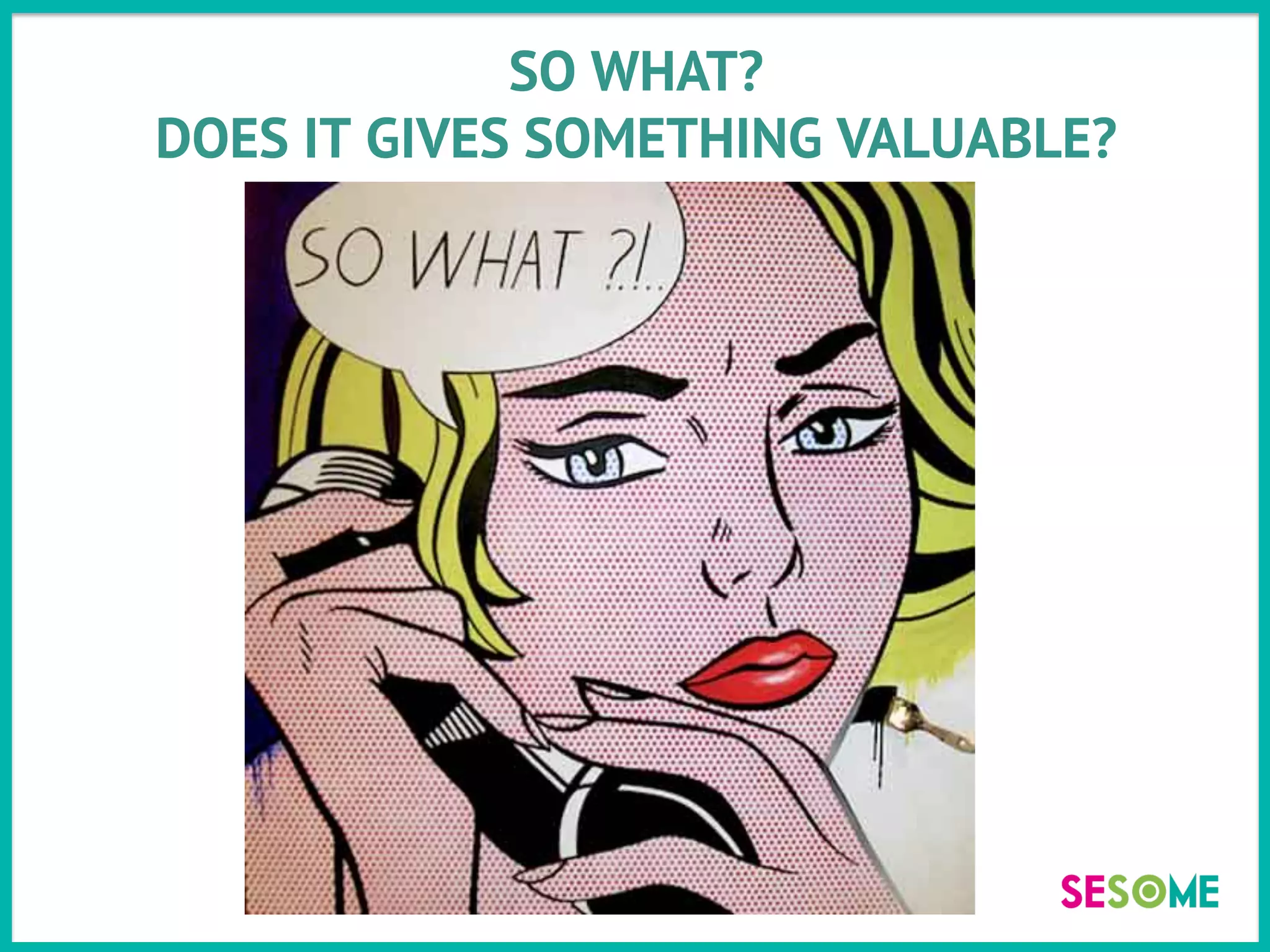
SO WHAT?
DOES IT GIVES SOMETHING VALUABLE?
QUESTIONS
THANK YOU
Adrian Land
adrian@sesome.co.uk
@adrianland

SEO - the future is content. Again. Workshop & Exercise. Traverse 15.

  • 1.
    28th March 2015 byAdrian Land SEO  –  the  future  is  content.  Again!   Presents  at  
  • 2.
    WHY CAN ITALK ABOUT SEO? I  have  been  doing  online  marke>ng  &  SEO  since  the  late  90’s.     I  learnt  my  trade  &  survived  the  dot-­‐com  bubble  before  driving  ROI   from  natural  search  and  other  channels  for  compe>>ve  companies  in   challenging  ver>cals.       In  2013,  founded  my  own  agency  SESOME.             •  Head  of  Inbound  Marke>ng  at  My  Des>na>on.com   •  Head  of  SEO,  for  Thomas  Cook  Group   •  Global  Director  of  SEO  for  Hotels.com   •  Head  of  Search  for  HomeAway  Group  Europe   Previous  roles  held    Find  me  >   @adrianland    |  adrianland.uk  |  sesome.co.uk  
  • 3.
    THE NEXT HOUR Whatis SEO? Explained and myth busting. Recent changes and what it means for you. IF, the future is content (again)!, So, what is optimised content? Then some practical. Tips and discussion around content planning & production. Then some practical!
  • 4.
    WHAT IS SEO? “The  process  of  improving  the  volume  and/or  quality  of  traffic  to  a  web   site  or  a  web  page  via  ‘natural’  or  unpaid  prac=ces”     Personalised  SERPs  based  on  your  search  history,  your  open  graph,  your  social  media   interac>ons,  thema>cally  related  search,  ‘suggest’/’instant’,  and  now  your  other  Google   products  &  services  you  use        
  • 5.
    •  65% ofsessions online start with a search* •  Search is getting very specific •  Types: Websites, Images, Maps, Shopping, Blogs, Video, Places, Discussions, Academic, Patents etc. •  Frequency: By hour, day, specific date, years •  Location: Given and implied •  Search isn’t just Google anymore. What about YouTube, Facebook etc. •  3 types of keywords •  Brand / Navigational •  Transactional •  Informational Keywords imply users intent and needs! WHY IS SEARCH IMPORTANT? *  Made  that  up  –  couldn’t  find  a  reliable  stat  –  but  it  is  a  lot!  
  • 6.
  • 7.
    >200 to >500RANKING FACTORS* *  Depends  on  who  is  guessing  
  • 8.
    HOW DOES SEOWORK? 1.   2.   3.  
  • 9.
    SEO DOESN’T HAVETO BE SCARY links, mentions & citations CMS, servers, response codes, indexation, sitemaps, robots.txt etc. keywords, titles & content TECHNOLOGY   RELEVANCE   AUTHORITY  
  • 11.
    IN A ROOMLIKE THIS
  • 12.
    A CONTINUOUS EVOLUTION But  the  mission  of  the  engines  is  s>ll  to  give  the  best,  most  relevant   results  to  their  users  And,  our  objec>ves  are  s>ll  the  same       What  has  changed  in  Google?  
  • 13.
    PANDA, PENGUINS &HUMMINGBIRDS On  site     Rewarded  quality   content,  code,   speed,  engagement   Off  site     Penalised  ‘poor’   link  profiles   Rewrite  of  the  algo   NLP  and  sen>ment.   Rewarded  answers   and  knowledge  
  • 14.
  • 15.
    USING THE WHOLESEARCH TERM … and not just keywords Plus, other clues to understand your query to provide you the answer OLD SEO: How  do  I  rank  for  this  keyword?   NEW SEO: How  do  I  answer  my  users  ques>ons?    
  • 16.
  • 17.
    SEARCH (ALREADY) HASGONE MOBILE What  clues  do  you  also  (unknowingly)  give   57  other  clues  including:   •  GPS  loca>on  –  current   and  previous   •  Your  device   •  Your  search  history    
  • 18.
    DATE à APRIL21st 2015 •  Google has pre-announced a change •  If a user is on a mobile device – most searches now •  It will give preference to mobile friendly site IS YOUR SITE RESPONSIVE? google.com/webmasters/tools/mobile-friendly
  • 19.
    INSIDE CHROME Right  click  >  Inspect  Element     A.  Select  the  mobile  symbol   B.  Select  device   A.   B.  
  • 20.
  • 21.
    ATTRIBUTES OF ASTRONG PAGE Title tag, Meta, Headings (structured markup), structured data & microformats Text, Images, Video, UGC, Social Analytics – engagement, bounce rate etc, Freshness
  • 22.
    57 TYPES OFCONTENT 101 lists, A day in the life, About me!, About you, Admit faults, Advice, Best buys, Blueprints and plans, Bucket lists, Case studies, Collate trending news, Common mistakes, Comparisons, Complaints & rants, Conference takeaways, Data, Dear future self…, E-Books, Events & Sponsorship, FAQs, Funnies, Gifs, Good / nice things!, Guest posts, Hold a competition, How to blog, How To…, In 5 years time & predictions, Infographics, Interviews, Lessons learned, Life hacking tips, Make a game, Market analysis & commentary, Music & Performances, Myths & busting them, News commentary, Photos, Q & A, Rants, Reaction posts, Regulations & compliance, Research & analysis, Resources for readers, Review a Book/Movie/Product, Round ups and compilations, Seasonal posts, Share your challenges & issues, Strange facts, Tell a story, This history of…, Top XX, Training materials, Webinars, What if…?, Write a story, Your vision and opinions,
  • 23.
    STRONG CONTENT •  Makeyour content great •  Make it relevant and engaging •  Quality –“panda questions” •  Gentle keyword usage •  Make it shareable
  • 24.
    Earning peoples attention,as opposed to borrowing/buying it Brands and Innovators have an unique advantage: •  High quality creative •  Quality & focused content •  Cutting edge products/ services •  Big data •  A brand that resonates and is worthy of being talked about
  • 25.
    RECAP – SEO-> What do people get wrong? •  User experience & engagement •  Search and Social isn’t built in from the ground up •  In-accessibility! •  Not designed for mobile (responsive design) •  Lack unique content •  Little or no consumer engagement or delight •  Slow and error prone sites •  Non-joined up marketing channels, and siloed reporting that reinforces what they think they know •  Assume that if you build a website customer will just come!
  • 26.
  • 27.
    TIME FOR YOUTO DO SOMETHING
  • 28.
    BEFORE YOU JUSTSTART LET’S  PLAN  OUR  CONTENT  PIECE  
  • 29.
    TRAVEL   BLOG   READERS   LIFECYCLE OR DAY IN THE LIFE OF YOUR AUDIENCE DIAGRAM. PUT YOUR AUDIENCE LITERALLY AT THE CENTRE 1.  LABEL  THE  STAGE   2.  BRAINSTORM  TOPICS   PER  SEGMENT  
  • 30.
    THINK ABOUT YOURAUDIENCE AND YOUR REASON FOR WRITING IT. WHAT DOES IT NEED TO CONTAIN. MAKE YOUR OWN SYSTEM •  Jot down, why you are writing this piece •  Where is it going to be published •  & what keywords are important •  Find a system that works for you Intro Detail Purpose  /  Theme Introduce  and  inspire  Barcelona's  hot  air  ballooning   scheme Location  of  article e.g.  Hub  -­‐  Travel  articles  ||  Blog  ||  Country  Hub  of  Spain Destination(s) e.g.  Barcelona  &  Madrid POI(s) Research Keywords  &  Phrase  applicable   from  standard  list "<geography>  restaurants",  "things  to  do  in  <geography>" Keywords  &  Phrases  specific  to   article "hot  air  ballooning  Barcelona",  "adventure  sport  in   Barcelona" Content Heading  (also  the  H1) Body  copy Links  to  be  used  inline http://www….  With  anchor  text….. External  links  to  be  used Meta  title Meta  description Meta  keywords Publishing  Check  list Keywords  present  in  Title YES  /  NO Keywords  present  in  Body  copy YES  /  NO Assets  have  alt  tags YES  /  NO Article  has  used  meta  titles,   descriptions  and  keywords YES  /  NO Article  technical  bits  (if  applicable)
  • 31.
    KEYWORD RESEARCH RESOURCES http://keywordtool.io/http://ubersuggest.org/ https://adwords.google.com/KeywordPlanner Competitors themselves OR Google autosuggest
  • 32.
    GOOGLE TRENDS http://www.google.com/trends/ Use tofind trends over time. Shows keywords, topics by location. Can use for spelling e.g. Mallorca or Majorca, Holiday versus Vacation Default is Worldwide Can refine Can focus by geography
  • 33.
    THINK ABOUT YOURAUDIENCE & WHY YOU ARE WRITING THIS PIECES •  Jot down, why you are writing this piece •  Where is it going to be published •  & what keywords are important •  Remember the Panda questions Intro Detail Purpose  /  Theme Introduce  and  inspire  Barcelona's  hot  air  ballooning   scheme Location  of  article e.g.  Hub  -­‐  Travel  articles  ||  Blog  ||  Country  Hub  of  Spain Destination(s) e.g.  Barcelona  &  Madrid POI(s) Research Keywords  &  Phrase  applicable   from  standard  list "<geography>  restaurants",  "things  to  do  in  <geography>" Keywords  &  Phrases  specific  to   article "hot  air  ballooning  Barcelona",  "adventure  sport  in   Barcelona" Content Heading  (also  the  H1) Body  copy Links  to  be  used  inline http://www….  With  anchor  text….. External  links  to  be  used Meta  title Meta  description Meta  keywords Publishing  Check  list Keywords  present  in  Title YES  /  NO Keywords  present  in  Body  copy YES  /  NO Assets  have  alt  tags YES  /  NO Article  has  used  meta  titles,   descriptions  and  keywords YES  /  NO Article  technical  bits  (if  applicable)
  • 34.
    THE ‘PANDA’ QUESTIONSFROM GOOGLE We, and the bots want quality content – real content, not automated, not duplicate nor “thin” content. Here are some questions from Google to think about when planning your content. Our content team use this too •  Would you trust the information presented in this article? •  Is this article written by an expert or enthusiast who knows the topic well, or is it more shallow in nature? •  Does the site have duplicate, overlapping, or redundant articles on the same or similar topics with slightly different keyword variations? •  Would you be comfortable giving your credit card information to this site? •  Does this article have spelling, stylistic, or factual errors? •  Are the topics driven by genuine interests of readers of the site, or does the site generate content by attempting to guess what might rank well in search engines? •  Does the article provide original content or information, original reporting, original research, or original analysis? •  Does the page provide substantial value when compared to other pages in search results? Source:  hJp://googlewebmastercentral.blogspot.co.uk/2011/05/more-­‐guidance-­‐on-­‐building-­‐high-­‐quality.html  
  • 35.
    CONTINUED… •  How muchquality control is done on content? •  Does the article describe both sides of a story? •  Is the site a recognized authority on its topic? •  Is the content mass-produced by or outsourced to a large number of creators, or spread across a large network of sites, so that individual pages or sites don’t get as much attention or care? •  Was the article edited well, or does it appear sloppy or hastily produced? •  For a health related query, would you trust information from this site? •  Would you recognize this site as an authoritative source when mentioned by name? •  Does this article provide a complete or comprehensive description of the topic? •  Does this article contain insightful analysis or interesting information that is beyond obvious? •  Is this the sort of page you’d want to bookmark, share with a friend, or recommend? •  Does this article have an excessive amount of ads that distract from or interfere with the main content? •  Would you expect to see this article in a printed magazine, encyclopedia or book? •  Are the articles short, unsubstantial, or otherwise lacking in helpful specifics? •  Are the pages produced with great care and attention to detail vs. less attention to detail? •  Would users complain when they see pages from this site?
  • 36.
    SO WHAT? DOES ITGIVES SOMETHING VALUABLE?
  • 37.
  • 38.