Editorial
SEO Strategy
www.ravelrumba.com
November 18, 2010
SEO Basics for Editorial Teams
Rob Flaherty / @ravelrumba
What does Search Engine
Optimization really mean?
It means structuring and formatting our
websites in a way that makes it easy for
search engines and users to find our
content.
3 Main Goals
• Make it easy for Google to find our
content
• Make it easy for Google to understand
our content
• Make it easy for users to find our
content
A lot goes into a
comprehensive SEO
strategy.
It requires participation
from Marketing,
Technology, and Editorial.
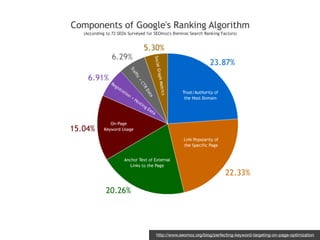
http://www.seomoz.org/blog/perfecting-keyword-targeting-on-page-optimization
Today we’re going to
focus on just two parts:
Keywords &
Article Titles
Keywords
What are Keywords?
Keywords are the words that users type
when they search for things on the
internet.
Keywords represent the specific language
and terminology that users use when they
search for things.
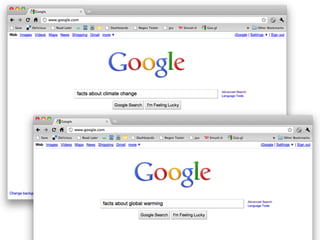
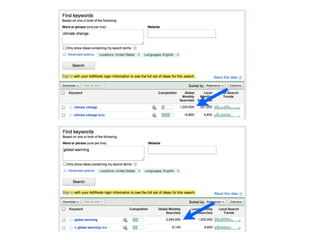
Do we write about
Climate Change
or
GlobalWarming ?
Multiple Factors
• Accuracy (just because terms are often
used synonymously doesn’t mean
they’re synonymous)
• Style, Usage
• Context
• And... SEO!
Multiple Factors
• Competing factors will need to be
weighed on a case-by-case basis.
• Editorial integrity should come first.
• The goal is to reinforce our content
with what we know about how users
search for things.
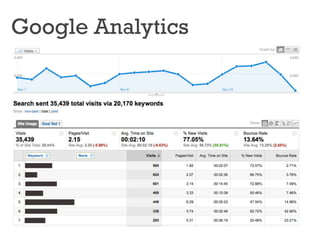
How do we know what
terms users search for?
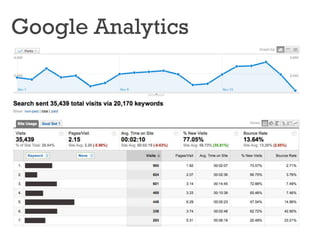
Google Analytics
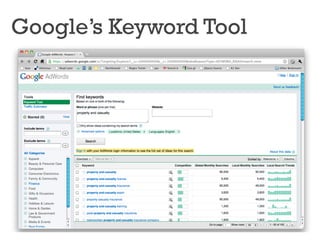
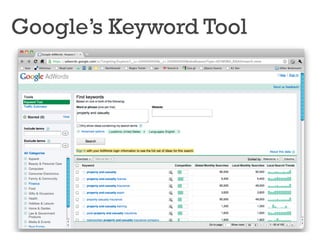
Google’s Keyword Tool
The goal is to optimize
content by aligning our
language with the language
that our readers use.
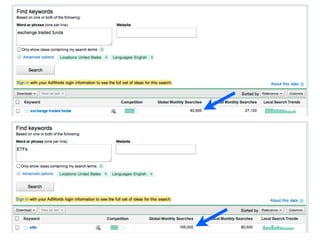
Another Example
“ETFs”
vs.
“Exchange Traded Funds”
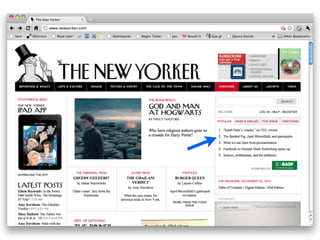
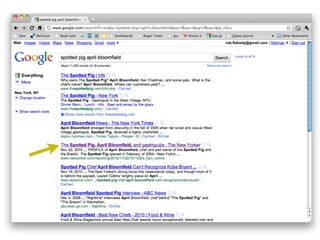
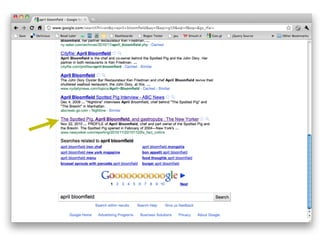
How Users Search
for Stuff
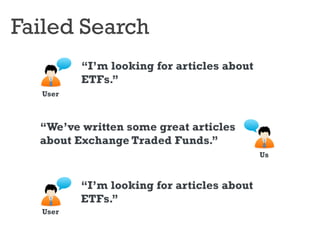
Failed Search
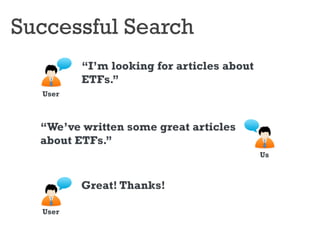
Successful Search
Two places where
keywords are most
effective:
In the first
paragraph of a story.
And in...
Titles
The biggest opportunity
Editorial has to optimize
content: article titles.
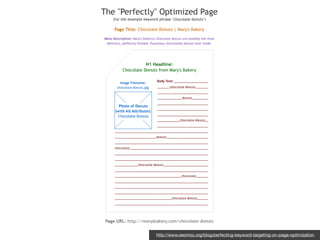
A well optimized page is
made up of many different
things.
http://www.seomoz.org/blog/perfecting-keyword-targeting-on-page-optimization
But the thing that has the
most weight is the article
title.
What makes an article title
SEO-friendly?
What constitutes a good
title on the web is different
from what constitutes a
good title in print.
The main difference has to
do with context.
The print experience is
immersed in context.
On the web, a story title
has to stand on its own.
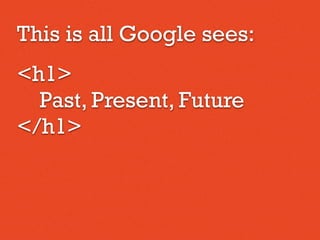
This is all Google sees:
<h1>
Past, Present, Future
</h1>
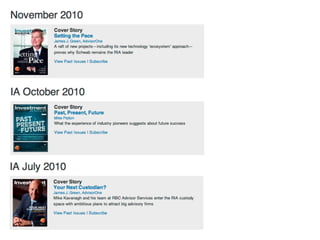
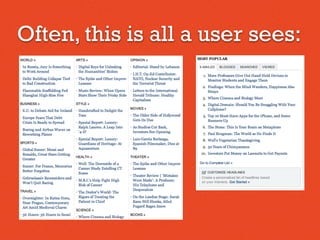
Often, this is all a user sees:
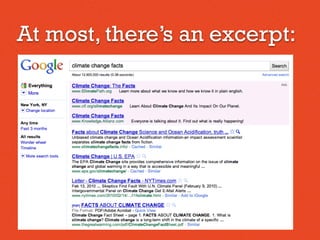
At most, there’s an excerpt:
Titles on the web have
to do more work.
This concept is often
referred to as
microcontent.
Microcontent
“Microcontent needs to be pearls of
clarity: you get 40-60 characters to
explain your macrocontent. Unless the
title or subject make it absolutely clear
what the page or email is about, users
will never open it.”
-Jakob Nielsen
http://www.useit.com/alertbox/980906.html
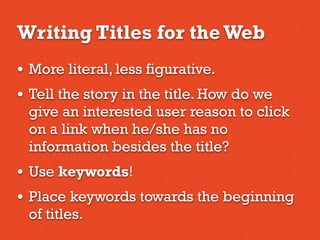
Writing Titles for the Web
• More literal, less figurative.
• Tell the story in the title. How do we
give an interested user reason to click
on a link when he/she has no
information besides the title?
• Use keywords!
• Place keywords towards the beginning
of titles.
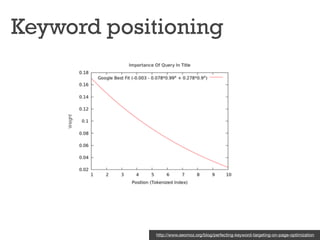
Keywords have the most
oomph! when placed at the
start of a title.
http://www.seomoz.org/blog/perfecting-keyword-targeting-on-page-optimization
Keyword positioning
Bad
The New Roller Coaster
Better
The New Roller Coaster:Volatility and
Leveraged ETFs
Superstar
Volatility and Leveraged ETFs:The
New Roller Coaster
Example
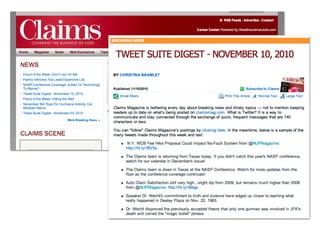
• Tweet Suite Digest - November 03, 2010
• Tweet Suite Digest - November 10, 2010
Instead of this:
We could do this:
• OII, iPhone Apps, and Fantasy Football
Insurance - Tweet Suite Digest
• NASP,WCB, and Dr.Wecht - This Week
on Twitter
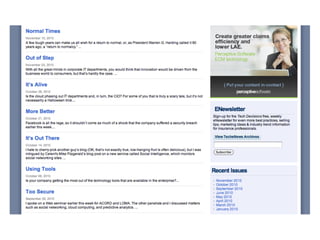
Sometimes it’s easy
(e.g., news articles).
Sometimes it’s harder
(e.g., blog posts).
Workflow
and Tools
The Workflow
1.What is this story about?
2.What is the language readers use
when searching for this content?
3. How can we fine-tune the content to
match what users are searching for?
Magazine Articles
Magazine stories published on the web
can use different titles than those used in
the print edition.
Two different titles for two different roles.
Tools
Google Analytics
Google’s Keyword Tool
Summary &
Final Thoughts
Summary
• Editorial SEO should focus primarily on
two things: Keywords and Titles.
• Keyword strategy is about getting in
tune with our users.
• Article titles are paramount.
• Position powerful keywords at the
beginning of titles and within the first
paragraph of an article.
Summary
• Whenever possible, infuse titles with
description (using keywords).
• Think of titles as “microcontent”. Aim
for titles that can stand on their own.
• Use Google Analytics and Google’s
Keyword Tool.
The point of all this is to
make our content more
accessible, to extend our
reach, and to increase
our readership.
These ideas must be
balanced with other
editorial needs.
There’s more to editorial
SEO than what we’ve talked
about, but keywords and
titles form the foundation.
One last thought:
We want to make our
content robot-friendly.
But remember what the
robots are trying to do...
...they’re trying to figure
out what humans value.
The robots are just the
middlemen. At the end of
the day we’re still writing
for humans.
Great content is the best
SEO strategy.
Questions, maybe?
More questions still?
Rob Flaherty
www.ravelrumba.com
Email: rob@ravelrumba.com
Twitter: @ravelrumba

Editorial SEO Strategy