► Familiarize students with the terms, key
  concepts and basic principles associated with
  the climate of India.
► Provide them idea about the mechanism of
  Indian      monsoon.
► Study the climate of India through the
  understanding and analysis of local climate.
► Explore the causative factor of the spatial
  variations in the climate of the country.
► Understand and analyze the variation of climatic
  phenomenon in the cycle of seasons.
► Make students aware of the change in climate
  (global warming) at local level to understand it
  at national and global level.
Variations In Climate
       Varied land forms features
FACTORS AFFECTING INDIAN CLIMATE

              •The Himalayan Mt.


                  •Surrounding Seas

                 •Relief Features

                 •Distance from Sea
Factors Affecting Climate of India
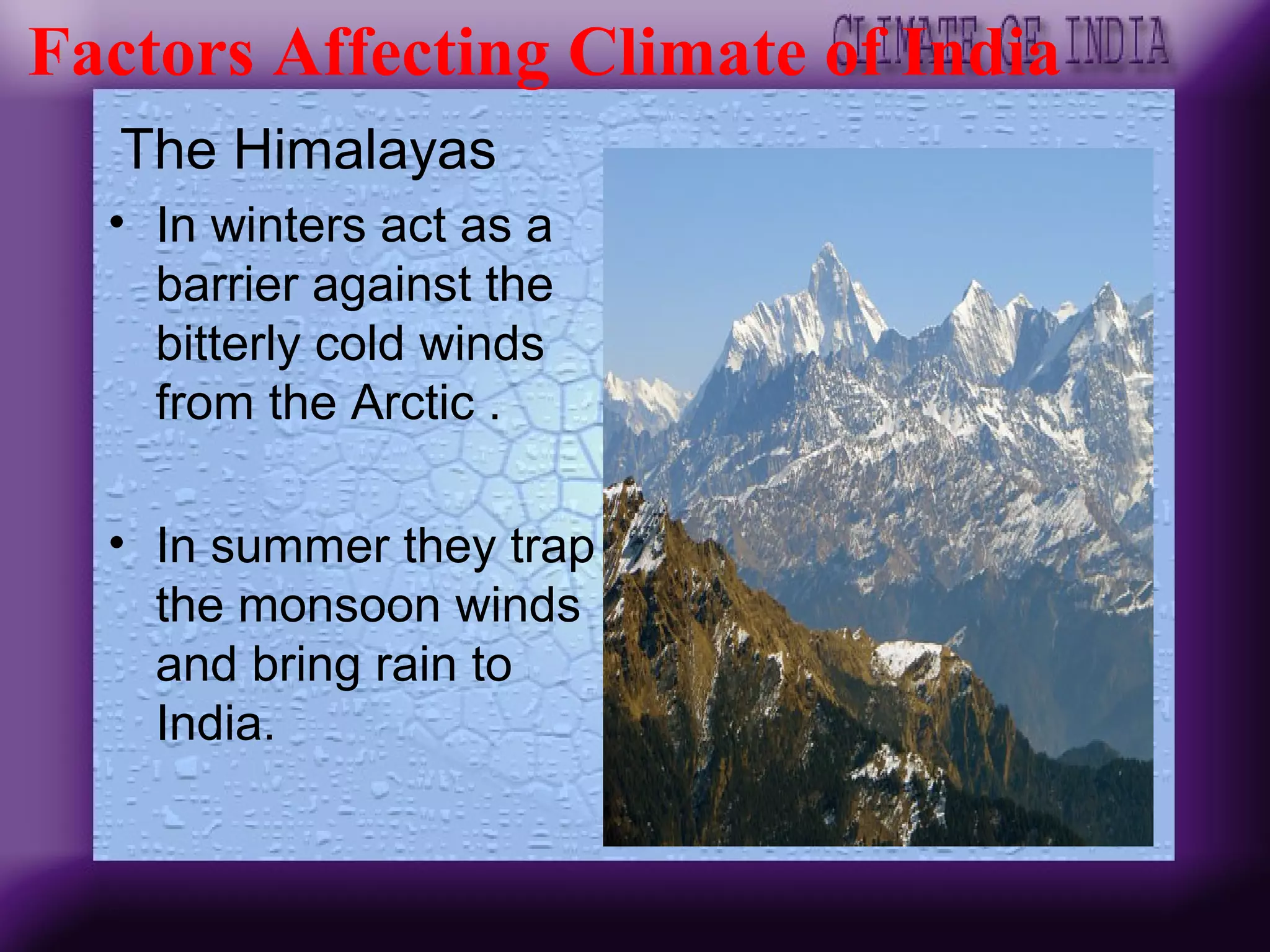
   The Himalayas
  • In winters act as a
    barrier against the
    bitterly cold winds
    from the Arctic .

  • In summer they trap
    the monsoon winds
    and bring rain to
    India.
Cold
                              Wav
                          e
                                Cold
                               Wav
                                    e
                          Cold
                                           THE HIMALAYAS- CLIMATIC BARRIER


                               Wav
                                   e
                         Cold
                              Wav
                                  e
                d
             Win
       oon
M   ons             d
       n         Win
   soo
Mon                 d
                 Win
            on
         nso
    Mo               d
                  Win
            on
         nso
    Mo
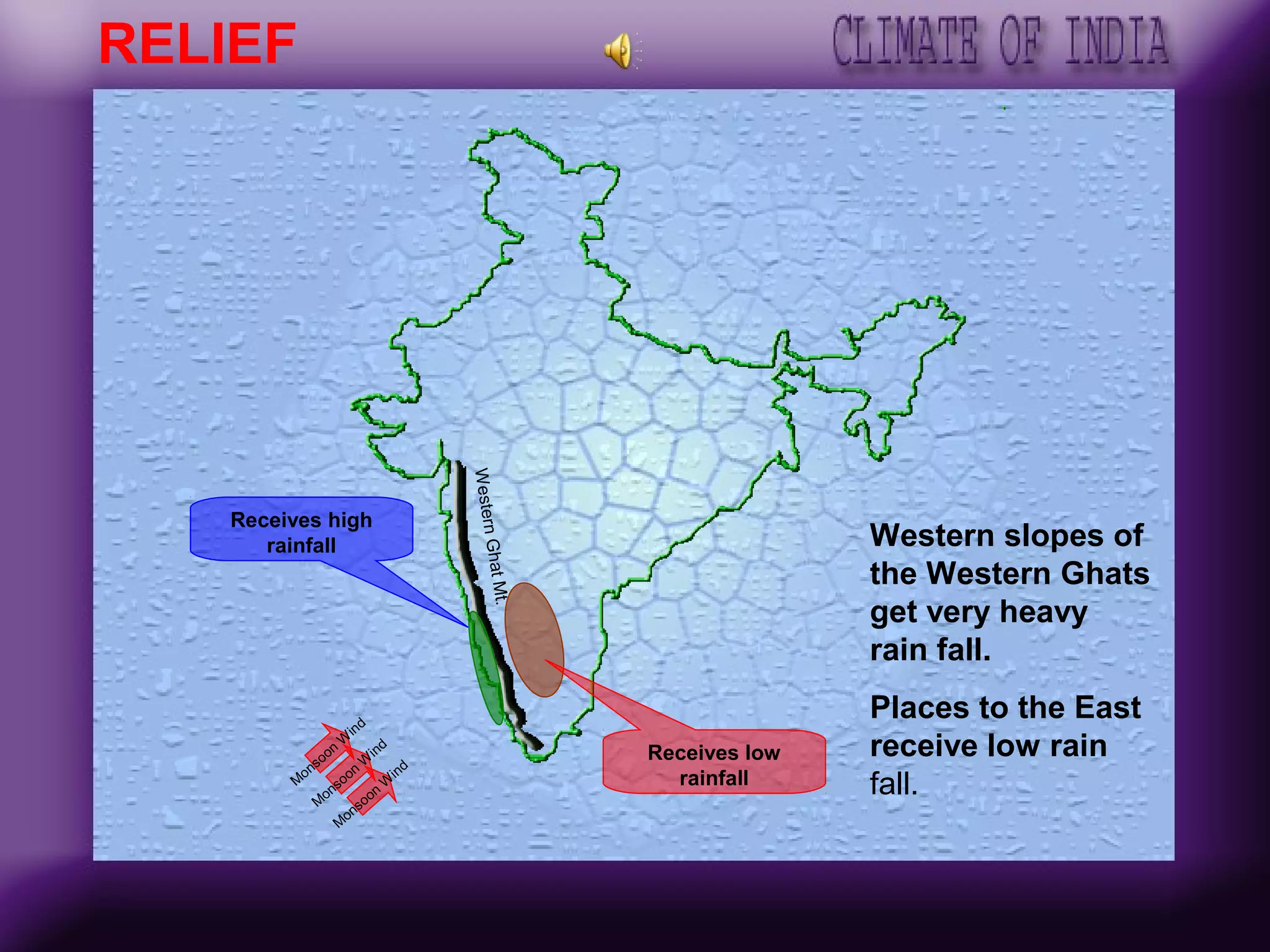
RELIEF


                                     W estern

   Receives high
      rainfall                                                    Western slopes of
                                        Ghat M


                                                                  the Western Ghats
                                                                  get very heavy
                                              t.


                                                                  rain fall.

                        d
                                                                  Places to the East
                     in

            so
               on
                  W
                       W
                          in
                             d
                                 d
                                                   Receives low   receive low rain
           n         n         in
        M
         o
              o ns
                   oo
                         o n
                             W                       rainfall     fall.
             M        so
                    on
                 M
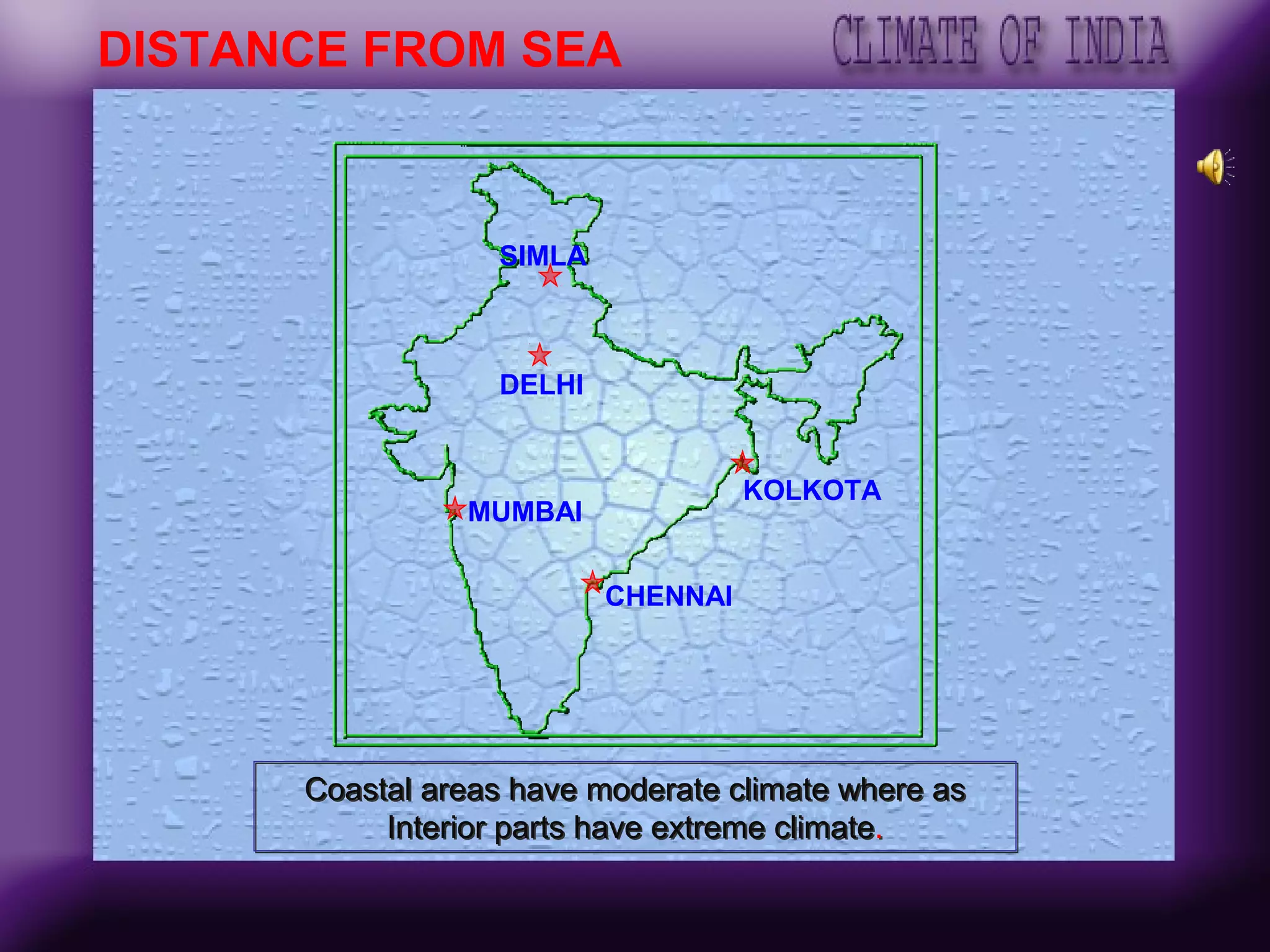
DISTANCE FROM SEA


                  SIMLA


                  DELHI


                                    KOLKOTA
                MUMBAI

                          CHENNAI


      Coastal areas have moderate climate where as
           Interior parts have extreme climate.
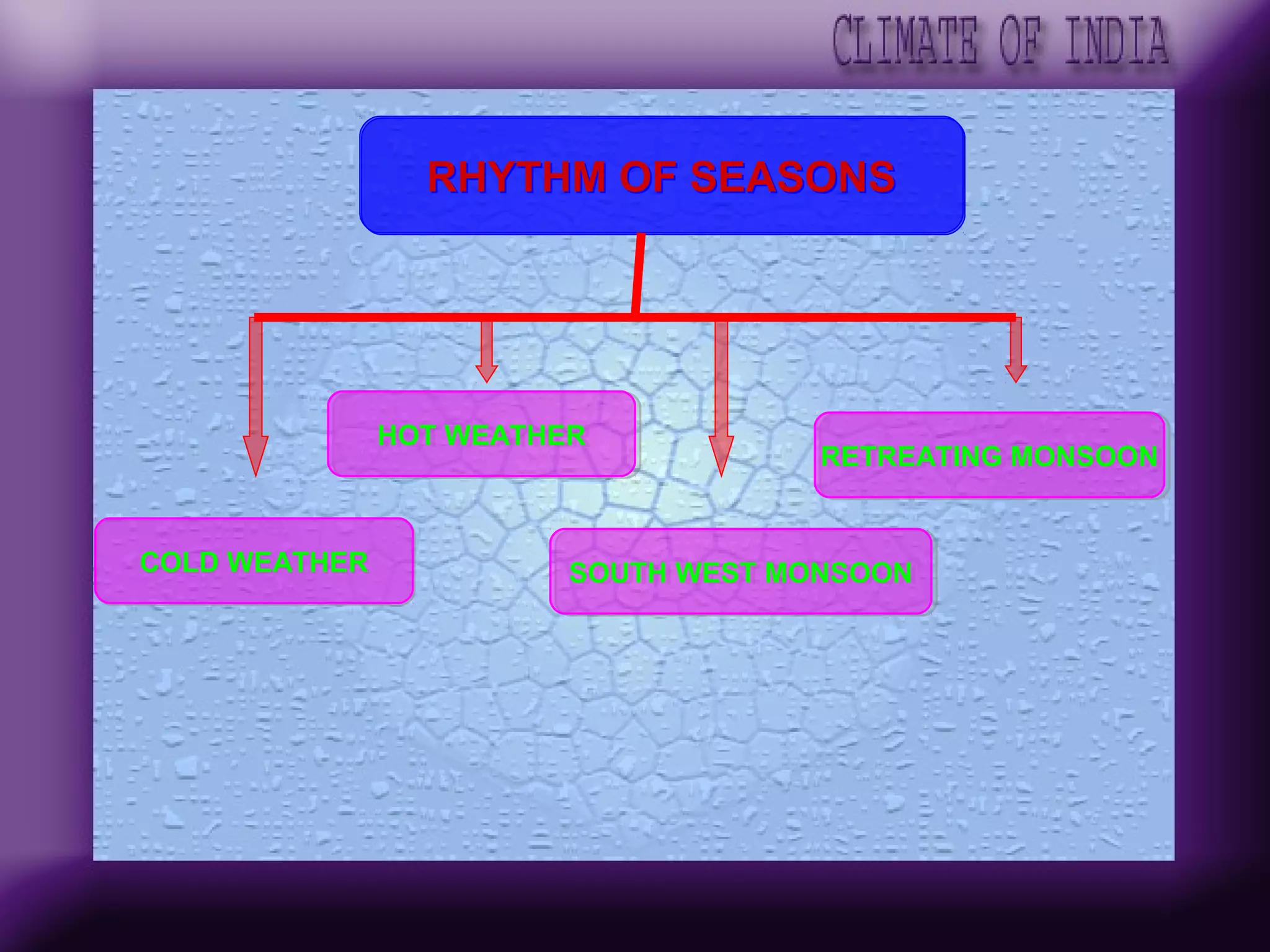
RHYTHM OF SEASONS


               HOT WEATHER
               HOT WEATHER
                                    RETREATING MONSOON
                                    RETREATING MONSOON


COLD WEATHER            SOUTH WEST MONSOON
                        SOUTH WEST MONSOON
Winter Season
  ► It extends from December to
    February.
  ► Average temperature in the
    Northern Plains is between 10° C
    and 15°C
  ► North India experiences intense
    cold.
  ► .There is light rainfall during
    winter.
  ► This is caused by Cyclonic
    storms which originate from the
    Mediterranean sea and Travel
    towards India These winds are
    WESTERN DISTURBANCE
  ► Occasional tropical cyclone visit
    eastern coast in this season.
   •   They cause heavy snowfall in
       the Himalayas and rain in the
       plains.
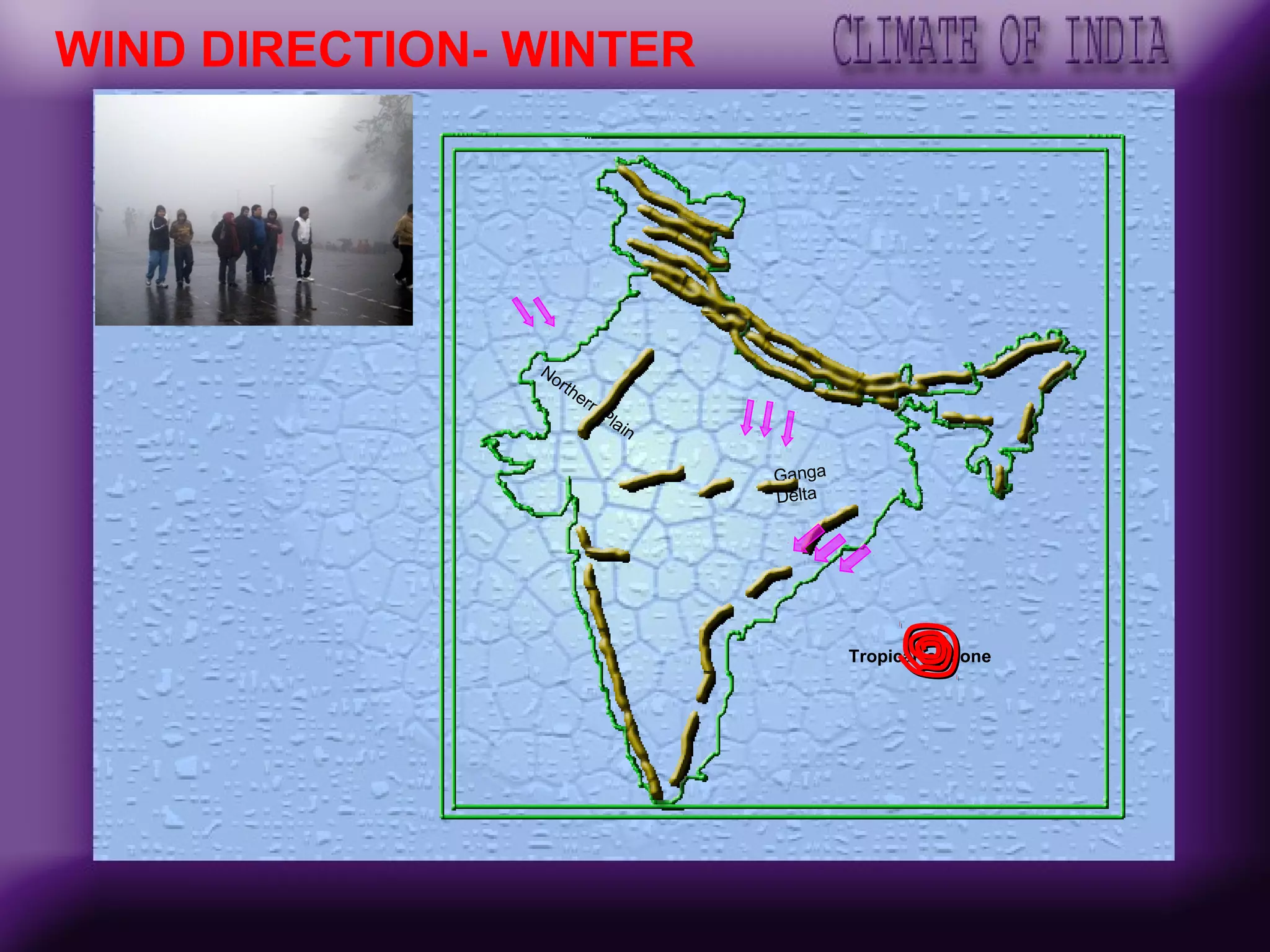
WIND DIRECTION- WINTER


                No
                   r   the
                          rn
                               Pl
                                 ain


                                       Ganga
                                       Delta


                                               Tropical cyclone
WINTER RAINFALL

                  RAINFALL DUE
                   TO WESTERN
                  DISTURBANCES


                    RAINFALL DUE
                   TO NORTH EAST
                        WIND
The Summer Season
 Summmer starts from April and
lasts till June.

Northern Plains record highest
temperature.

Deccan is comparatively cooler

The hot dry wind LOO blows
over Northern Plains.

Kalbaisakhi Occurs in West
Bengal and Assam.

Mango showers occur in
Karnataka and Kerala
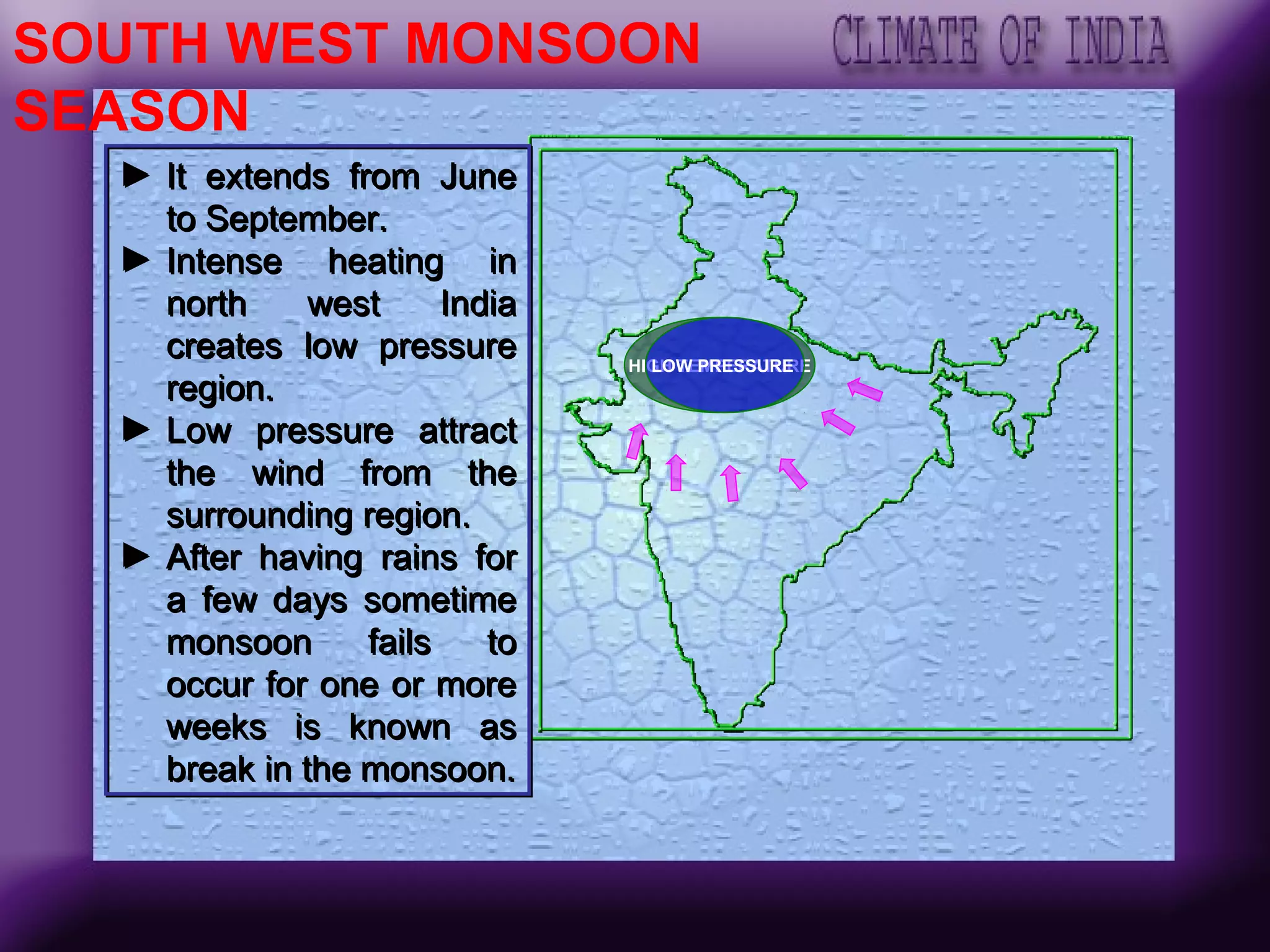
SOUTH WEST MONSOON
SEASON
  ► It extends from June
    to September.
  ► Intense heating in
    north     west     India
    creates low pressure       HIGH TEMPERATURE
                                 LOW PRESSURE
    region.
  ► Low pressure attract
    the wind from the
    surrounding region.
  ► After having rains for
    a few days sometime
    monsoon      fails    to
    occur for one or more
    weeks is known as
    break in the monsoon.
MONSOON WIND


     Arabian sea
                                      Bay of Bengal
       Branch                            Branch

                   EQUATOR


                                                   e
                                                 ad
                        e


                                  e


                                          e
                      ad


                                        ad
                               ad


                                               Tr
                    Tr


                             Tr


                                      Tr


                                                   SE
                        SE


                                 SE


                                          SE
ONSET OF SW MONSOON


                                                     e
                                                 Jun
                                             15 th
                          y
                       Jul


                                 y
                  th


                              Jul
                 15
                          1 st


                   e
               Jun
       th
      10
                   ne
            th   Ju                         ne
           5                         st   Ju
                                     1
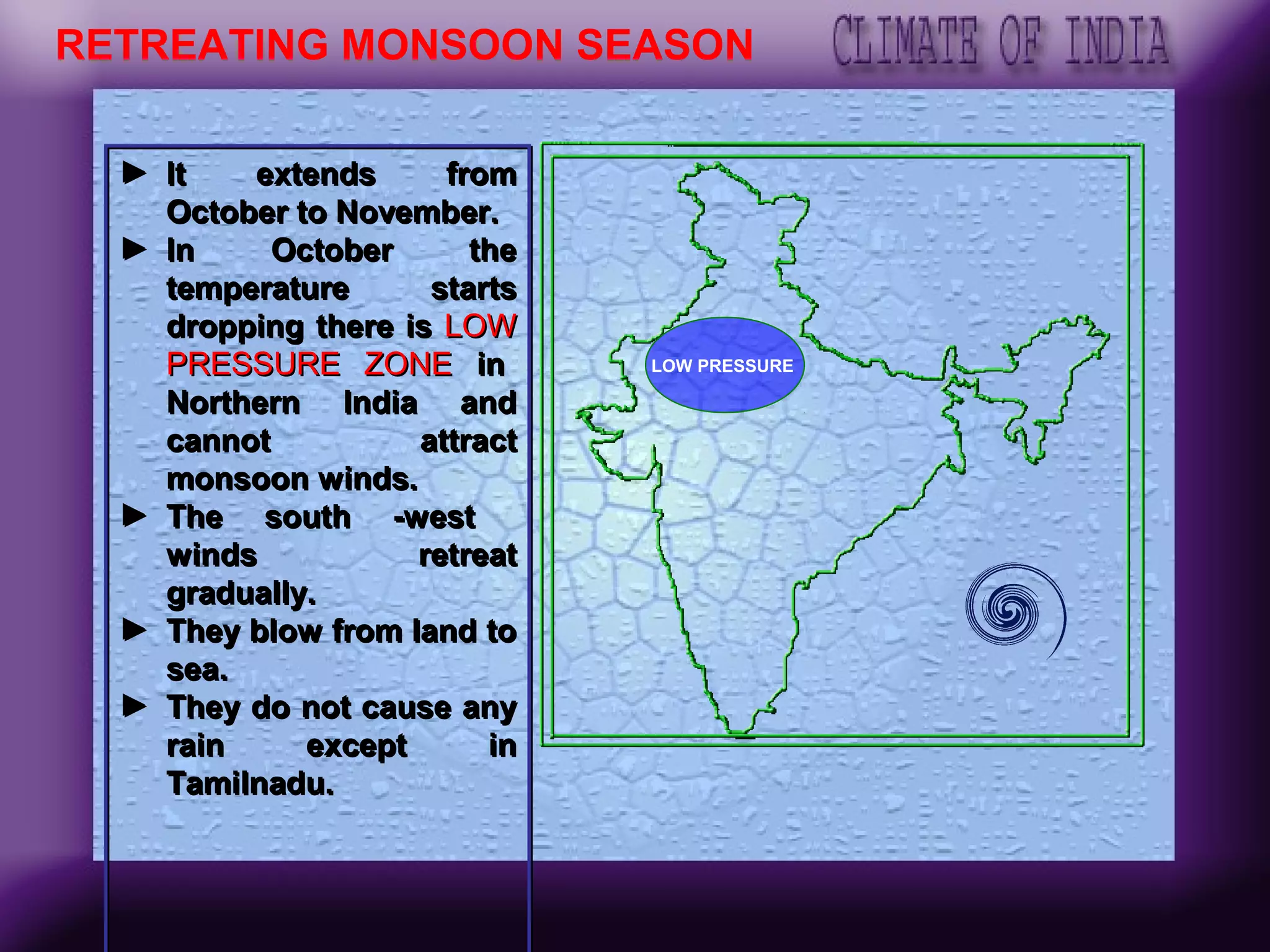
RETREATING MONSOON SEASON

  ► It   extends      from
    October to November.
  ► In     October      the
    temperature      starts
    dropping there is LOW
    PRESSURE ZONE in          LOW PRESSURE

    Northern India and
    cannot          attract
    monsoon winds.
  ► The south -west
    winds           retreat
    gradually.
  ► They blow from land to
    sea.
  ► They do not cause any
    rain     except      in
    Tamilnadu.
DISTRIBUTION OF RAINFALL

 ► Broadly    ,India
   can be divided
   into Four rainfall
   regions

 ► Very            heavy
   rainfall

 ►    heavy rainfall       > 200cm

 ►              moderate
                           100-200cm
     rainfall

 ►    scanty rainfall       50-100 cm


                            < 50cm
Very heavy rainfall           Heavy rainfall regions
regions:more than 200cm       :between 100to 200cm
Of rain in a year.            of rain in a year.

• the Western Coastal        • The Ganga plains in
  Plains                       Bihar and West Bengal.
• The western slopes of      • The Himalayan region.
  theWestern Ghats.          • The Northwestern part of
• Most of the northeastern     the Peninsular Plateau
  states.                    • Parts of the Western
                               Ghats.
                             • The east coast and the
                               north east India
Moderate rainfall region:     Scanty rainfall region
Annual rainfall between 50—   lessthan 50 cm
100cm

• The upper Ganga plain       • Western Rajasthan
• Eastern Rajasthan             Southern Punjab and
  Punjab Haryana and            Northern Gujarat.
  Soutern Kashmir             • Eastern slopes of the
• Parts of the Deccan           Western Ghats.
  Plateau –Karnataka,         • Northern Parts of
  Andhra Pradesh&               Kashmir.
  Tamilnadu.
HOT WEATHER SEASON


                 May 480C


                      April 380C


                     March 300C
STORMS IN HOT WEATHER SEASON

                                                      FAQ


                                 BARDOLI
                                CHHEERHA

                        LOO


                              KALBAISAKHI


                MANGO
               SHOWER


                    BLOSSOM
                    SHOWER
                                  Rhythm of Seasons
TEMPERATURE- JULY


            250C


                               20 0C
     300C      25
                   0
                   C
               20
                   0
                   C


                               30
                                0
                                C


                       30 0C
CLIMATE CHANGE & INDIA


► India has long coast line
  and rise of sea level will
   and rise of sea level will
  submerge large area.
   submerge large area.
► A population of 7.1
  million living in coastal
   million living in coastal
  areas will be affected.
   areas will be affected.
► Production of crops like
  wheat, rice etc will
   wheat, rice etc will                            KOLKOTA
  decrease.
   decrease.                    MUMBAI
► The natural disasters
  like cyclone, floods and
   like cyclone, floods and              CHENNAI
  drought will increase in
   drought will increase in
  frequency as well as
   frequency as well as
  intensity.
   intensity.
Let’sEvaluate
•   Mention the Three factors which affect India’s climate.
•   Why are the Himalayas important in determinig India’s climate
•   Give the four Major seaons of India.
•   What are western disturbances in which area do they cause rain?
•   Which months are known for the retreating monsoon?
•   Which is the rain shadow area?
•   Name the four rainfall regions.
•   Which region receives the the least amount of rainfall.

Seasons of india

  • 3.
    ► Familiarize studentswith the terms, key concepts and basic principles associated with the climate of India. ► Provide them idea about the mechanism of Indian monsoon. ► Study the climate of India through the understanding and analysis of local climate. ► Explore the causative factor of the spatial variations in the climate of the country. ► Understand and analyze the variation of climatic phenomenon in the cycle of seasons. ► Make students aware of the change in climate (global warming) at local level to understand it at national and global level.
  • 4.
    Variations In Climate Varied land forms features
  • 5.
    FACTORS AFFECTING INDIANCLIMATE •The Himalayan Mt. •Surrounding Seas •Relief Features •Distance from Sea
  • 6.
    Factors Affecting Climateof India The Himalayas • In winters act as a barrier against the bitterly cold winds from the Arctic . • In summer they trap the monsoon winds and bring rain to India.
  • 7.
    Cold Wav e Cold Wav e Cold THE HIMALAYAS- CLIMATIC BARRIER Wav e Cold Wav e d Win oon M ons d n Win soo Mon d Win on nso Mo d Win on nso Mo
  • 8.
    RELIEF W estern Receives high rainfall Western slopes of Ghat M the Western Ghats get very heavy t. rain fall. d Places to the East in so on W W in d d Receives low receive low rain n n in M o o ns oo o n W rainfall fall. M so on M
  • 9.
    DISTANCE FROM SEA SIMLA DELHI KOLKOTA MUMBAI CHENNAI Coastal areas have moderate climate where as Interior parts have extreme climate.
  • 10.
    RHYTHM OF SEASONS HOT WEATHER HOT WEATHER RETREATING MONSOON RETREATING MONSOON COLD WEATHER SOUTH WEST MONSOON SOUTH WEST MONSOON
  • 11.
    Winter Season ► It extends from December to February. ► Average temperature in the Northern Plains is between 10° C and 15°C ► North India experiences intense cold. ► .There is light rainfall during winter. ► This is caused by Cyclonic storms which originate from the Mediterranean sea and Travel towards India These winds are WESTERN DISTURBANCE ► Occasional tropical cyclone visit eastern coast in this season. • They cause heavy snowfall in the Himalayas and rain in the plains.
  • 12.
    WIND DIRECTION- WINTER No r the rn Pl ain Ganga Delta Tropical cyclone
  • 13.
    WINTER RAINFALL RAINFALL DUE TO WESTERN DISTURBANCES RAINFALL DUE TO NORTH EAST WIND
  • 14.
    The Summer Season Summmer starts from April and lasts till June. Northern Plains record highest temperature. Deccan is comparatively cooler The hot dry wind LOO blows over Northern Plains. Kalbaisakhi Occurs in West Bengal and Assam. Mango showers occur in Karnataka and Kerala
  • 15.
    SOUTH WEST MONSOON SEASON ► It extends from June to September. ► Intense heating in north west India creates low pressure HIGH TEMPERATURE LOW PRESSURE region. ► Low pressure attract the wind from the surrounding region. ► After having rains for a few days sometime monsoon fails to occur for one or more weeks is known as break in the monsoon.
  • 16.
    MONSOON WIND Arabian sea Bay of Bengal Branch Branch EQUATOR e ad e e e ad ad ad Tr Tr Tr Tr SE SE SE SE
  • 17.
    ONSET OF SWMONSOON e Jun 15 th y Jul y th Jul 15 1 st e Jun th 10 ne th Ju ne 5 st Ju 1
  • 18.
    RETREATING MONSOON SEASON ► It extends from October to November. ► In October the temperature starts dropping there is LOW PRESSURE ZONE in LOW PRESSURE Northern India and cannot attract monsoon winds. ► The south -west winds retreat gradually. ► They blow from land to sea. ► They do not cause any rain except in Tamilnadu.
  • 19.
    DISTRIBUTION OF RAINFALL ► Broadly ,India can be divided into Four rainfall regions ► Very heavy rainfall ► heavy rainfall > 200cm ► moderate 100-200cm rainfall ► scanty rainfall 50-100 cm < 50cm
  • 20.
    Very heavy rainfall Heavy rainfall regions regions:more than 200cm :between 100to 200cm Of rain in a year. of rain in a year. • the Western Coastal • The Ganga plains in Plains Bihar and West Bengal. • The western slopes of • The Himalayan region. theWestern Ghats. • The Northwestern part of • Most of the northeastern the Peninsular Plateau states. • Parts of the Western Ghats. • The east coast and the north east India
  • 21.
    Moderate rainfall region: Scanty rainfall region Annual rainfall between 50— lessthan 50 cm 100cm • The upper Ganga plain • Western Rajasthan • Eastern Rajasthan Southern Punjab and Punjab Haryana and Northern Gujarat. Soutern Kashmir • Eastern slopes of the • Parts of the Deccan Western Ghats. Plateau –Karnataka, • Northern Parts of Andhra Pradesh& Kashmir. Tamilnadu.
  • 22.
    HOT WEATHER SEASON May 480C April 380C March 300C
  • 23.
    STORMS IN HOTWEATHER SEASON FAQ BARDOLI CHHEERHA LOO KALBAISAKHI MANGO SHOWER BLOSSOM SHOWER Rhythm of Seasons
  • 24.
    TEMPERATURE- JULY 250C 20 0C 300C 25 0 C 20 0 C 30 0 C 30 0C
  • 25.
    CLIMATE CHANGE &INDIA ► India has long coast line ► India has long coast line and rise of sea level will and rise of sea level will submerge large area. submerge large area. ► A population of 7.1 ► A population of 7.1 million living in coastal million living in coastal areas will be affected. areas will be affected. ► Production of crops like ► Production of crops like wheat, rice etc will wheat, rice etc will KOLKOTA decrease. decrease. MUMBAI ► The natural disasters ► The natural disasters like cyclone, floods and like cyclone, floods and CHENNAI drought will increase in drought will increase in frequency as well as frequency as well as intensity. intensity.
  • 32.
    Let’sEvaluate • Mention the Three factors which affect India’s climate. • Why are the Himalayas important in determinig India’s climate • Give the four Major seaons of India. • What are western disturbances in which area do they cause rain? • Which months are known for the retreating monsoon? • Which is the rain shadow area? • Name the four rainfall regions. • Which region receives the the least amount of rainfall.