A minimum 3 levels progress
            FOR ALL PUPILS


          We’ll get you there
What’s the issue?
   Not all pupils are making at least 3 levels progress.


   And most progress happens in Year 11.


   Some pupils make much slower progress in the other
    years, particularly at KS3!


   What should I do?
 Start by setting the Long Term Targets for all pupils by using
  our formula click on this link (SETTING TARGETS)

 The formula assumes at least 6 sub levels progress in KS3
  and a further level at KS4. At KS3, that translates to 2 sub
  levels in Yrs 7, 8 & 9
How do pupils know what progress they
are making against their targets?
 Read this then click here for the   PUPIL TRACKING SHEET.
These are available L1-L8

 The tracking sheet shows what level & sub level that Abigail
was assessed at the end of the previous year (ie 3A), & where
the teacher for the new academic year has to get her to by the
end of that year (ie 4B) as a minimum expectation.

 Underneath, is the APP criteria at the level that the pupil is
working at & will be formally assessed against once every half
term so that the pupil’s progress towards the target is measured
regularly

 How much progress is being made - and how quickly - can be
seen simply & clearly by both pupil and teacher.
How does the tracking sheet work?
 Use the Half Termly Tests provided (click here to
  see an example of one). There are 6 of these (one
  per half term) at every level (L1-8). Answer sheets
  are provided.

 Give each pupil the single level test at the level which
  you think that they are currently operating

 They take an hour for pupils to complete. Each
  question tests a specific criteria. ie Q1 tests APP
  criteria 1; Q2 tests APP criteria 2 etc….

 If a pupil gets the question completely right, you put a
  cross in the corresponding cell on the tracking sheet;
  a line if partially right and a dot if wrong.
How do I award a level from the test?
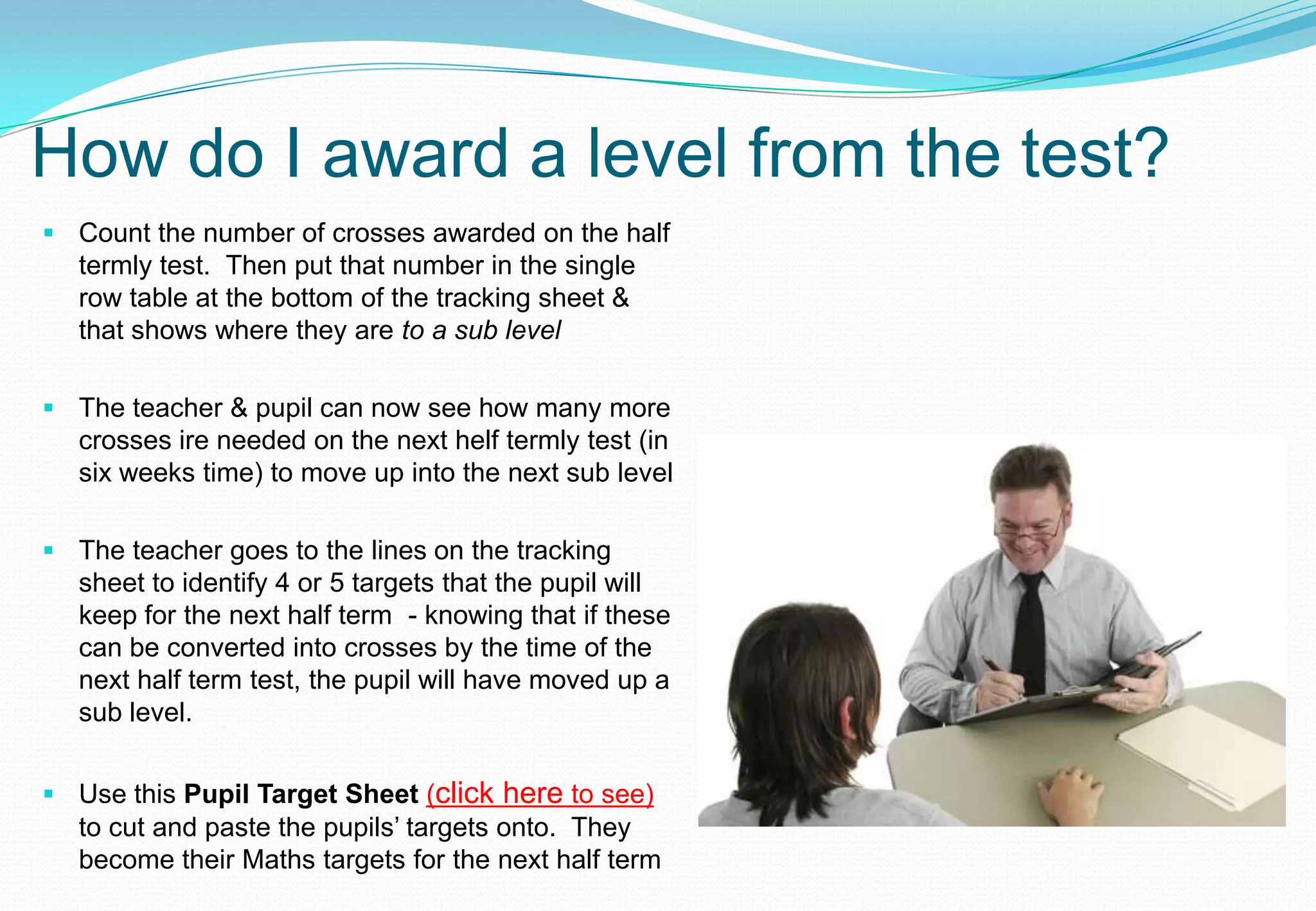
 Count the number of crosses awarded on the half
  termly test. Then put that number in the single
  row table at the bottom of the tracking sheet &
  that shows where they are to a sub level

 The teacher & pupil can now see how many more
  crosses ire needed on the next helf termly test (in
  six weeks time) to move up into the next sub level

 The teacher goes to the lines on the tracking
  sheet to identify 4 or 5 targets that the pupil will
  keep for the next half term - knowing that if these
  can be converted into crosses by the time of the
  next half term test, the pupil will have moved up a
  sub level.


 Use this Pupil Target Sheet (click here to see)
  to cut and paste the pupils’ targets onto. They
  become their Maths targets for the next half term
How are Maths targets achieved?
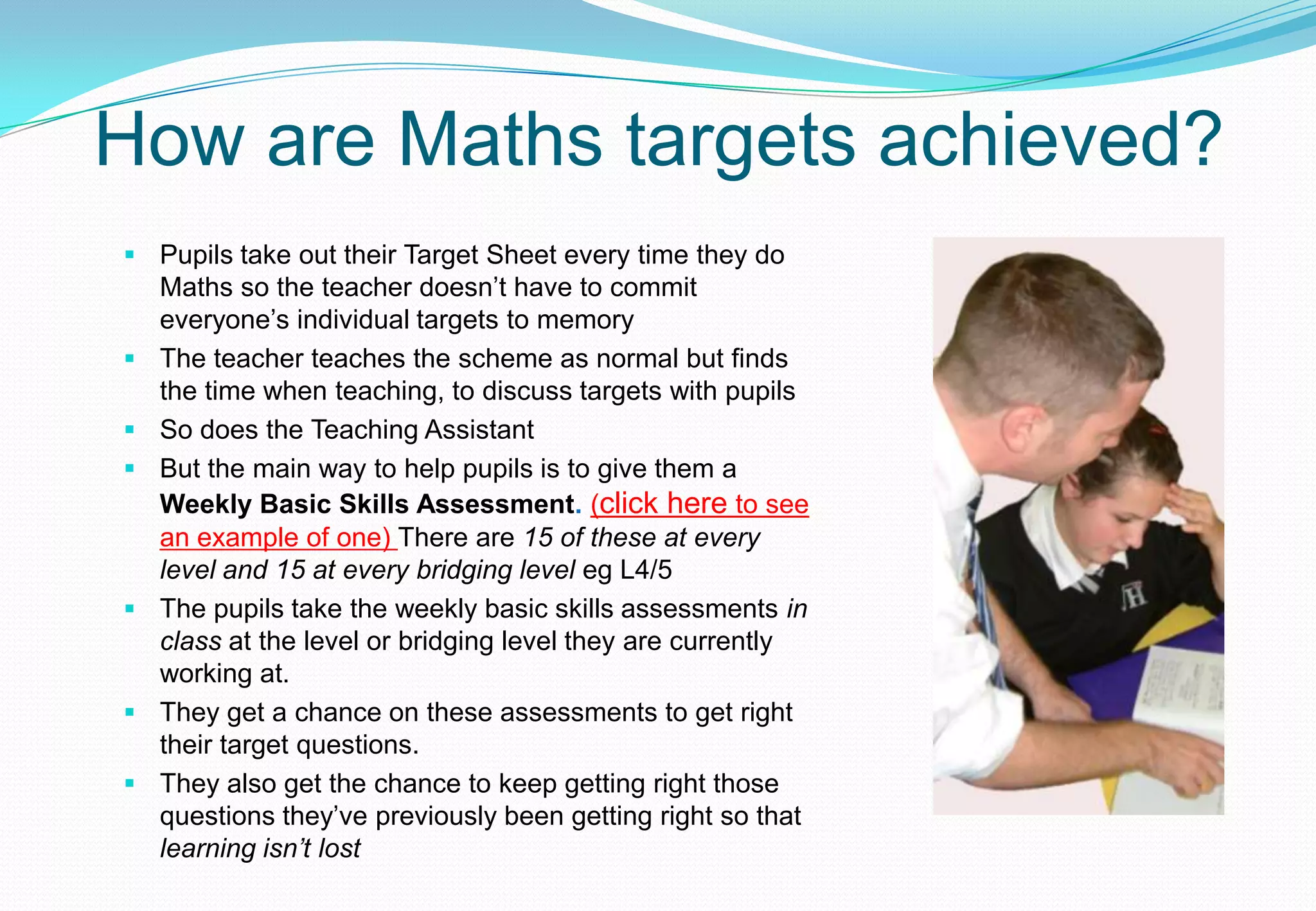
 Pupils take out their Target Sheet every time they do
  Maths so the teacher doesn’t have to commit
  everyone’s individual targets to memory
 The teacher teaches the scheme as normal but finds
  the time when teaching, to discuss targets with pupils
 So does the Teaching Assistant
 But the main way to help pupils is to give them a
  Weekly Basic Skills Assessment. (click here to see
  an example of one) There are 15 of these at every
  level and 15 at every bridging level eg L4/5
 The pupils take the weekly basic skills assessments in
  class at the level or bridging level they are currently
  working at.
 They get a chance on these assessments to get right
  their target questions.
 They also get the chance to keep getting right those
  questions they’ve previously been getting right so that
  learning isn’t lost
Are the weekly basic skills a test?
No - they are   assessments NOT tests.
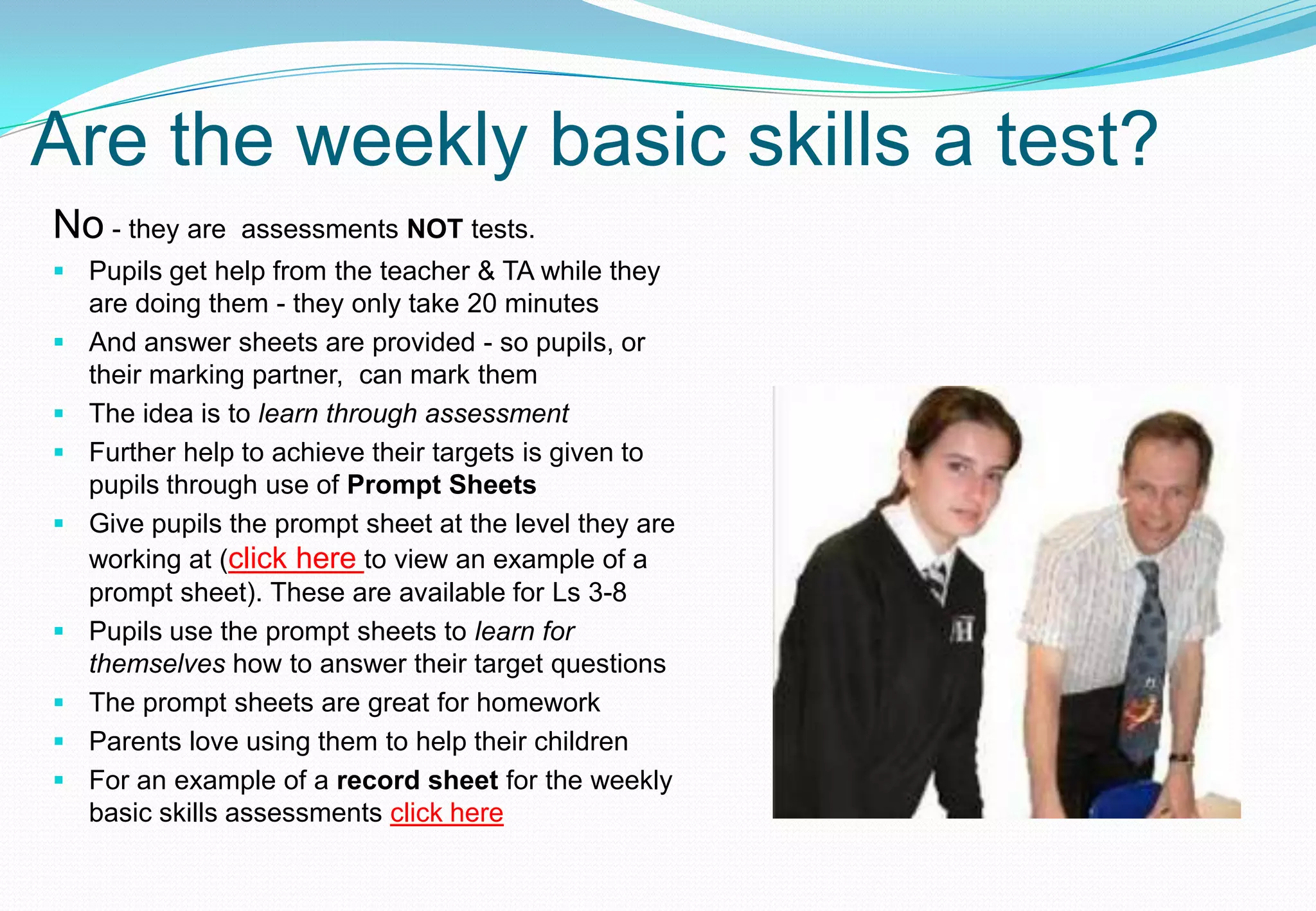
 Pupils get help from the teacher & TA while they
  are doing them - they only take 20 minutes
 And answer sheets are provided - so pupils, or
  their marking partner, can mark them
 The idea is to learn through assessment
 Further help to achieve their targets is given to
  pupils through use of Prompt Sheets
 Give pupils the prompt sheet at the level they are
  working at (click here to view an example of a
  prompt sheet). These are available for Ls 3-8
 Pupils use the prompt sheets to learn for
  themselves how to answer their target questions
 The prompt sheets are great for homework
 Parents love using them to help their children
 For an example of a record sheet for the weekly
  basic skills assessments click here
How do I identify gaps in pupils’ learning?
  Dot line & crosses from half termly tests are
   copied and pasted onto this Maths class record.
   (click here to view Maths Class Record)
  These are for the teacher to maintain an
   overview of class performance
  They identify gaps in T&L, which informs
   planning.
  Teachers use these assessments to change
   what was planned to teach. Now teaching to
   the gaps in learning identified by the
   assessments.
  The scheme isn’t abandoned, just modified to
   address gaps in pupils’ learning.

  We teach the pupils not the scheme!
  They also give an indication of ability groups to
   inform class organisation and differentiation and
   show the children requiring intervention and
   extension work.
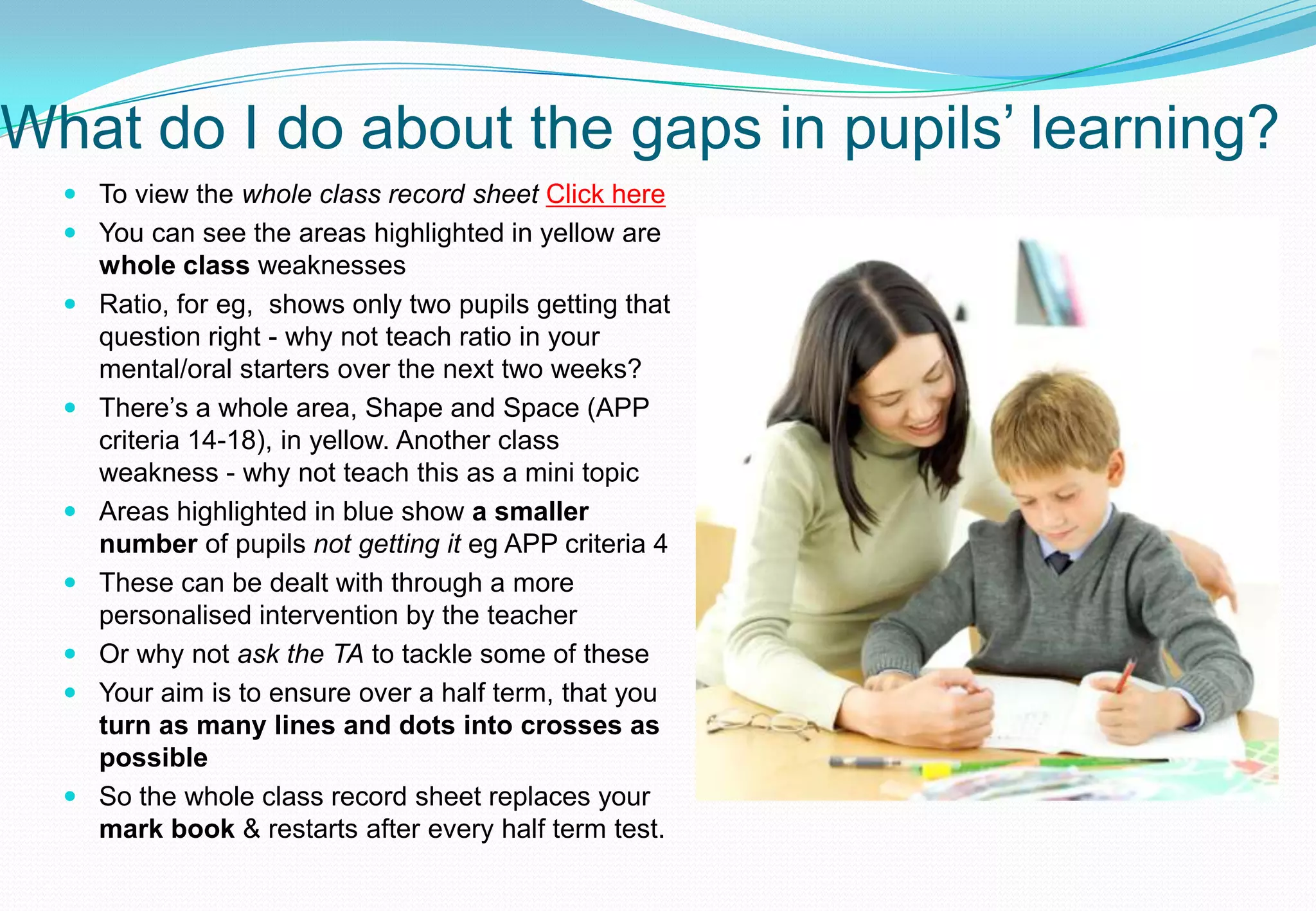
What do I do about the gaps in pupils’ learning?
   To view the whole class record sheet Click here
   You can see the areas highlighted in yellow are
    whole class weaknesses
   Ratio, for eg, shows only two pupils getting that
    question right - why not teach ratio in your
    mental/oral starters over the next two weeks?
   There’s a whole area, Shape and Space (APP
    criteria 14-18), in yellow. Another class
    weakness - why not teach this as a mini topic
   Areas highlighted in blue show a smaller
    number of pupils not getting it eg APP criteria 4
   These can be dealt with through a more
    personalised intervention by the teacher
   Or why not ask the TA to tackle some of these
   Your aim is to ensure over a half term, that you
    turn as many lines and dots into crosses as
    possible
   So the whole class record sheet replaces your
    mark book & restarts after every half term test.
What about Key Stage 4?
These resources are now available for
            KS4 as well.
How Can I Get the Resources?

                                      Click here to find out
                                      how I order these
          QuickTime™ and a
                                      Maths products for
            decompressor


                                      use in my own
    are needed to see this picture.


                                      school. Click here to
                                      view next training
                                      events.

SAM Maths

  • 1.
    A minimum 3levels progress FOR ALL PUPILS We’ll get you there
  • 2.
    What’s the issue?  Not all pupils are making at least 3 levels progress.  And most progress happens in Year 11.  Some pupils make much slower progress in the other years, particularly at KS3! What should I do?  Start by setting the Long Term Targets for all pupils by using our formula click on this link (SETTING TARGETS)  The formula assumes at least 6 sub levels progress in KS3 and a further level at KS4. At KS3, that translates to 2 sub levels in Yrs 7, 8 & 9
  • 3.
    How do pupilsknow what progress they are making against their targets?  Read this then click here for the PUPIL TRACKING SHEET. These are available L1-L8  The tracking sheet shows what level & sub level that Abigail was assessed at the end of the previous year (ie 3A), & where the teacher for the new academic year has to get her to by the end of that year (ie 4B) as a minimum expectation.  Underneath, is the APP criteria at the level that the pupil is working at & will be formally assessed against once every half term so that the pupil’s progress towards the target is measured regularly  How much progress is being made - and how quickly - can be seen simply & clearly by both pupil and teacher.
  • 4.
    How does thetracking sheet work?  Use the Half Termly Tests provided (click here to see an example of one). There are 6 of these (one per half term) at every level (L1-8). Answer sheets are provided.  Give each pupil the single level test at the level which you think that they are currently operating  They take an hour for pupils to complete. Each question tests a specific criteria. ie Q1 tests APP criteria 1; Q2 tests APP criteria 2 etc….  If a pupil gets the question completely right, you put a cross in the corresponding cell on the tracking sheet; a line if partially right and a dot if wrong.
  • 5.
    How do Iaward a level from the test?  Count the number of crosses awarded on the half termly test. Then put that number in the single row table at the bottom of the tracking sheet & that shows where they are to a sub level  The teacher & pupil can now see how many more crosses ire needed on the next helf termly test (in six weeks time) to move up into the next sub level  The teacher goes to the lines on the tracking sheet to identify 4 or 5 targets that the pupil will keep for the next half term - knowing that if these can be converted into crosses by the time of the next half term test, the pupil will have moved up a sub level.  Use this Pupil Target Sheet (click here to see) to cut and paste the pupils’ targets onto. They become their Maths targets for the next half term
  • 6.
    How are Mathstargets achieved?  Pupils take out their Target Sheet every time they do Maths so the teacher doesn’t have to commit everyone’s individual targets to memory  The teacher teaches the scheme as normal but finds the time when teaching, to discuss targets with pupils  So does the Teaching Assistant  But the main way to help pupils is to give them a Weekly Basic Skills Assessment. (click here to see an example of one) There are 15 of these at every level and 15 at every bridging level eg L4/5  The pupils take the weekly basic skills assessments in class at the level or bridging level they are currently working at.  They get a chance on these assessments to get right their target questions.  They also get the chance to keep getting right those questions they’ve previously been getting right so that learning isn’t lost
  • 7.
    Are the weeklybasic skills a test? No - they are assessments NOT tests.  Pupils get help from the teacher & TA while they are doing them - they only take 20 minutes  And answer sheets are provided - so pupils, or their marking partner, can mark them  The idea is to learn through assessment  Further help to achieve their targets is given to pupils through use of Prompt Sheets  Give pupils the prompt sheet at the level they are working at (click here to view an example of a prompt sheet). These are available for Ls 3-8  Pupils use the prompt sheets to learn for themselves how to answer their target questions  The prompt sheets are great for homework  Parents love using them to help their children  For an example of a record sheet for the weekly basic skills assessments click here
  • 8.
    How do Iidentify gaps in pupils’ learning?  Dot line & crosses from half termly tests are copied and pasted onto this Maths class record. (click here to view Maths Class Record)  These are for the teacher to maintain an overview of class performance  They identify gaps in T&L, which informs planning.  Teachers use these assessments to change what was planned to teach. Now teaching to the gaps in learning identified by the assessments.  The scheme isn’t abandoned, just modified to address gaps in pupils’ learning.  We teach the pupils not the scheme!  They also give an indication of ability groups to inform class organisation and differentiation and show the children requiring intervention and extension work.
  • 9.
    What do Ido about the gaps in pupils’ learning?  To view the whole class record sheet Click here  You can see the areas highlighted in yellow are whole class weaknesses  Ratio, for eg, shows only two pupils getting that question right - why not teach ratio in your mental/oral starters over the next two weeks?  There’s a whole area, Shape and Space (APP criteria 14-18), in yellow. Another class weakness - why not teach this as a mini topic  Areas highlighted in blue show a smaller number of pupils not getting it eg APP criteria 4  These can be dealt with through a more personalised intervention by the teacher  Or why not ask the TA to tackle some of these  Your aim is to ensure over a half term, that you turn as many lines and dots into crosses as possible  So the whole class record sheet replaces your mark book & restarts after every half term test.
  • 10.
    What about KeyStage 4? These resources are now available for KS4 as well.
  • 11.
    How Can IGet the Resources? Click here to find out how I order these QuickTime™ and a Maths products for decompressor use in my own are needed to see this picture. school. Click here to view next training events.

Editor's Notes

  • #5 There’s always something to look forward to in our job!If asked to describe your job in one adjective we would get everything from Rewarding, Exciting, Exhausting, Frustrating, Depressing but we would never get Boring.APP alone presents a huge challenge (have seen tears in staffrooms)New Ofsted 250 schools into special measures in first 3 monthsAM will address all and much more besides.