ADMISSION
&
DISCHARGE
Ms. Pompi Begum
Nursing tutor
Nemcare Institute of nursing science, mirza(assam)
INTRODUCTION
 Admission is the entry of a patient into a
hospital/ward for therapeutic/ diagnostic
purpose
 Admission means, allowing a client to stay
in the hospital for observation,
investigations, and treatment of the
disease he/she is suffering from.
TYPES OF ADMISSION
A. Based on the condition
1. Emergency
2. Routine
B. Based on the Purpose of the Admission
1.Therapeutic Admission
2. Diagnostic Admission
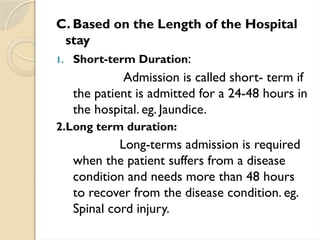
C. Based on the Length of the Hospital stay
1. Short-term Duration
2. Long term duration
A. Based on the condition
1. Emergency Admission:
Clients are admitted in acute conditions
requiring immediate treatment. E.g.: patient with
heart attack, poisoning, breathing difficulty,
RTA(Road traffic accident) etc
Patient should be admitted in casualty or
emergency department to save the life of the
patient
2. Routine / Elective Admission:
Clients are admitted for investigations and
planned treatment and surgeries. E.g.: patient with
diabetes, hypertension, appendicitis, jaundice etc
B. Based on the Purpose of the Admission
1. Therapeutic Admission-Therapeutic
admission means patient has already
diagnosed with medical condition and
now require medical care for the
improvement.
2. Diagnostic Admission -Admission called
is diagnostic admission when the patient
has to undergo some procedure and
require investigation like biopsy.
C. Based on the Length of the Hospital
stay
1. Short-term Duration:
Admission is called short- term if
the patient is admitted for a 24-48 hours in
the hospital. eg. Jaundice.
2.Long term duration:
Long-terms admission is required
when the patient suffers from a disease
condition and needs more than 48 hours
to recover from the disease condition. eg.
Spinal cord injury.
Purposes of admission
• To undergo evaluation & treatment
• To know what is really happening in
his/her body right oft it to be fixed
• To provide emotional security to the
newly admitted patient and his family
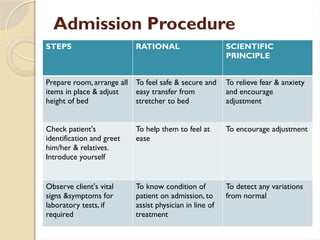
Admission Procedure
STEPS RATIONAL SCIENTIFIC
PRINCIPLE
Prepare room, arrange all
items in place & adjust
height of bed
To feel safe & secure and
easy transfer from
stretcher to bed
To relieve fear & anxiety
and encourage
adjustment
Check patient's
identification and greet
him/her & relatives.
Introduce yourself
To help them to feel at
ease
To encourage adjustment
Observe client's vital
signs &symptoms for
laboratory tests, if
required
To know condition of
patient on admission, to
assist physician in line of
treatment
To detect any variations
from normal
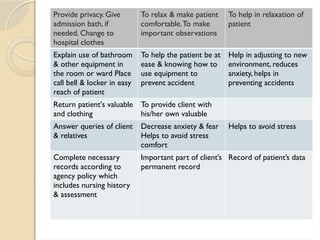
Provide privacy. Give
admission bath, if
needed. Change to
hospital clothes
To relax & make patient
comfortable.To make
important observations
To help in relaxation of
patient
Explain use of bathroom
& other equipment in
the room or ward Place
call bell & locker in easy
reach of patient
To help the patient be at
ease & knowing how to
use equipment to
prevent accident
Help in adjusting to new
environment, reduces
anxiety, helps in
preventing accidents
Return patient's valuable
and clothing
To provide client with
his/her own valuable
Answer queries of client
& relatives
Decrease anxiety & fear
Helps to avoid stress
comfort
Helps to avoid stress
Complete necessary
records according to
agency policy which
includes nursing history
& assessment
Important part of client’s
permanent record
Record of patient’s data
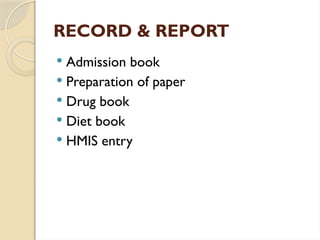
RECORD & REPORT
 Admission book
 Preparation of paper
 Drug book
 Diet book
 HMIS entry
MEDICO-LEGAL CASE
 A medico-legal case is one where besides the
medical treatment; investigations by law enforcing
agencies, are essential to fix the responsibility
regarding the present state / condition of the
patient
 Proper handling and accurate documentation of
these cases is of prime importance to avoid legal
complications.
EXAMPLE OF MLC
 Accidents like Road Traffic Accidents(RTA),
 Industrial accidents
 Poisoning
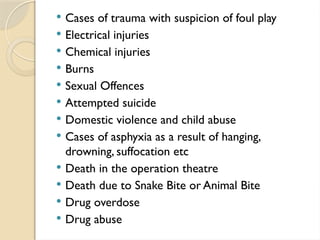
 Cases of trauma with suspicion of foul play
 Electrical injuries
 Chemical injuries
 Burns
 Sexual Offences
 Attempted suicide
 Domestic violence and child abuse
 Cases of asphyxia as a result of hanging,
drowning, suffocation etc
 Death in the operation theatre
 Death due to Snake Bite or Animal Bite
 Drug overdose
 Drug abuse
ROLE OF NURSE IN ADMISSION OF MLC
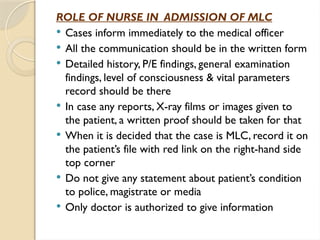
 Cases inform immediately to the medical officer
 All the communication should be in the written form
 Detailed history, P/E findings, general examination
findings, level of consciousness & vital parameters
record should be there
 In case any reports, X-ray films or images given to
the patient, a written proof should be taken for that
 When it is decided that the case is MLC, record it on
the patient’s file with red link on the right-hand side
top corner
 Do not give any statement about patient’s condition
to police, magistrate or media
 Only doctor is authorized to give information
DISCHARGE
 "Discharge of patient from the hospital
means, relieving a person from hospital
setting, who admitted as an inpatient in
that hospital“
 Discharge from the hospital is the point
at which the patient leaves the hospital
and either returns home or is transferred
to another facility such as one for
rehabilitation or to a nursing home."
PURPOSE OF DISCHARGE
 To be certain that the patient has the information on
his/her condition.
 To inform about the follow-up visits or referral to other
health agencies.
 To teach the Nursing procedure or care he/she needs at
home & to take re-demonstration
 To provide for a safe, efficient return of all patient's
valuables
 Provide continuity of care at home
 To assist the patient to manage successfully the change
from hospital environment to home environment
 To prevent any misunderstanding or difficulties for the
patient or hospital in relation to patient's discharge,
medicines, bills.
Types of Discharge
 1. Planned Discharge
 2.Abscond
 3. Parole
 4. LAMA/DAMA
 5.Transfer/Referral
 6. Death
 7. Discharge on Request
 Planned Discharge- Patient's treatment is over and the
attending physician has discharged the patient
 Abscond- Patient leaves the hospital without prior
information.
 Parole- a conditional release given to a psychiatric patient in a
hospital before discharge enabling the patient to visit freely
various designated areas on the hospital grounds
 LAMA/DAMA: patient chooses to leave the hospital before
the treating physician recommends discharge.
 Transfer/Referral- Patient is transferred to another health
care facility or within the same hospital from one ward to
another
 Death- after death of patient, the dead body is handed over to
the relatives after completing the discharge procedure.
 Discharge on Request- In this type of discharge, treatment is
not complete, but by taking the patient out of hospital, there is
no immediate danger to the life of the patient
ESSENTIAL OF PLANNED DISCHARGE
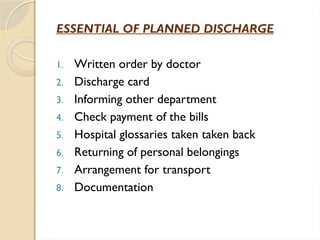
1. Written order by doctor
2. Discharge card
3. Informing other department
4. Check payment of the bills
5. Hospital glossaries taken taken back
6. Returning of personal belongings
7. Arrangement for transport
8. Documentation
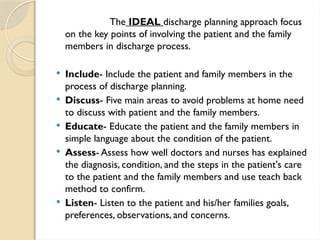
The IDEAL discharge planning approach focus
on the key points of involving the patient and the family
members in discharge process.
 Include- Include the patient and family members in the
process of discharge planning.
 Discuss- Five main areas to avoid problems at home need
to discuss with patient and the family members.
 Educate- Educate the patient and the family members in
simple language about the condition of the patient.
 Assess- Assess how well doctors and nurses has explained
the diagnosis, condition, and the steps in the patient's care
to the patient and the family members and use teach back
method to confirm.
 Listen- Listen to the patient and his/her families goals,
preferences, observations, and concerns.
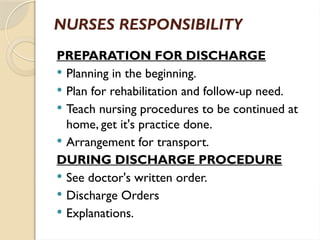
NURSES RESPONSIBILITY
PREPARATION FOR DISCHARGE
 Planning in the beginning.
 Plan for rehabilitation and follow-up need.
 Teach nursing procedures to be continued at
home, get it's practice done.
 Arrangement for transport.
DURING DISCHARGE PROCEDURE
 See doctor's written order.
 Discharge Orders
 Explanations.
 Hand over personal belongings.
 Check and receive any hospital property.
 Confirm bill paid.
 Inform other departments regarding
discharge
 Arrange transport.
 DAMA:- check consent
AFTER DISCHARGE:
 Documentation
 Care of patient’s room and article
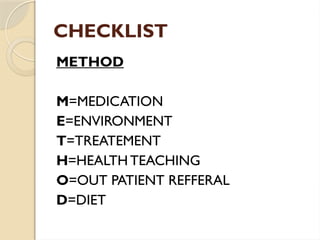
CHECKLIST
METHOD
M=MEDICATION
E=ENVIRONMENT
T=TREATEMENT
H=HEALTH TEACHING
O=OUT PATIENT REFFERAL
D=DIET
Hospital’s  admission and discharge.pptx