MULTIDISCIPLINARYMULTIDISCIPLINARY
FLIPPED LEARNING WITHFLIPPED LEARNING WITH
ICTICT
ERASMUS+ KA2 PROJECTERASMUS+ KA2 PROJECT
2015-20172015-2017
Daugavpils SaskaDaugavpils Saskannasas
School/LatviaSchool/Latvia
ADJECTIVESADJECTIVES
What is an adjective?What is an adjective?
Adjectives are descriptive words. Adjectives are used to
describe or give information about things, ideas and people.
We use adjectives to describe nouns.
The most common question an adjective might answer is
"What kind of ...?"
Adjectives have neither gender, number, nor case in English.
The ending of an adjective is always the same.
Examples:
• Robinson Crusoe is a good book.
• We have some good students.
• It is all for our good friends.
FORMATION OFFORMATION OF
ADJECTIVESADJECTIVES
The adjectives are formed from nouns and verbs by adding
suffixes.
Sometimes we have to make some spelling changes to the
word before adding the suffix.
We can form adjectives in the following ways:
break
harmful
vary
beautiful
variable
breakable
harm
beauty
angryanger
funnyfun
danger
hungry
child
courageous
childish
dangerous
hunger
courage
naturalnature
goldengold
USINGUSING
ADJECTIVES INADJECTIVES IN
SENTENCESSENTENCES
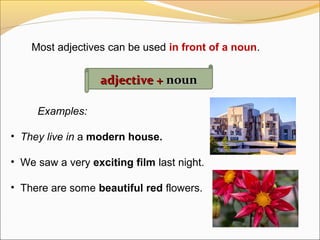
Most adjectives can be used in front of a noun.
Examples:
• They live in a modern house.
• We saw a very exciting film last night.
• There are some beautiful red flowers.
adjective +adjective + nounnoun
We can also use adjectives after a link verb like
be, look or feel:
Examples:
• Their house is beautiful.
• That film looks interesting.
• I feel really tired today.
be/look/feel/smell/taste/soundbe/look/feel/smell/taste/sound + adjective+ adjective
ORDER OFORDER OF
ADJECTIVESADJECTIVES
Sometimes we use more than one adjective in front of a
noun.
• She has a small round black wooden box.
Here is the most common order of adjectives in English:
1 2 3 4 5 6 7
opinion size shape age colour origin material
• She has a nice big round new yellow French glass bowl.
COMPARATIVECOMPARATIVE
ANDAND
SUPERLATIVESUPERLATIVE
ADJECTIVESADJECTIVES
Comparative adjectives are used to compare
differences between the two objects.
They are used in sentences where two nouns (people or
things) are compared.
Examples:
• My house is larger than yours.
• New York is much bigger than Boston.
• Your dog runs faster than Jim's dog.
Noun (subject) + verb +Noun (subject) + verb + comparative adjectivecomparative adjective ++ thanthan ++
noun (object).noun (object).
Comparison is expressed in the following sentence patterns:
• John is as old as Peter.
• John is not so old as Charles.
• Charles is older than John.
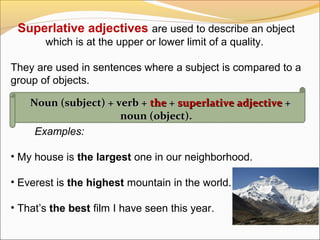
Superlative adjectives are used to describe an object
which is at the upper or lower limit of a quality.
They are used in sentences where a subject is compared to a
group of objects.
Examples:
• My house is the largest one in our neighborhood.
• Everest is the highest mountain in the world.
• That’s the best film I have seen this year.
Noun (subject) + verb +Noun (subject) + verb + thethe ++ superlativesuperlative adjectiveadjective ++
noun (object).noun (object).
FORMINGFORMING
COMPARATIVESCOMPARATIVES
ANDAND
SUPERLATIVESSUPERLATIVES
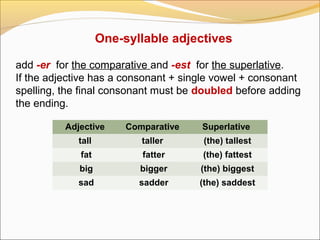
One-syllable adjectives
add -er for the comparative and -est for the superlative.
If the adjective has a consonant + single vowel + consonant
spelling, the final consonant must be doubled before adding
the ending.
Adjective Comparative Superlative
tall taller (the) tallest
fat fatter (the) fattest
big bigger (the) biggest
sad sadder (the) saddest
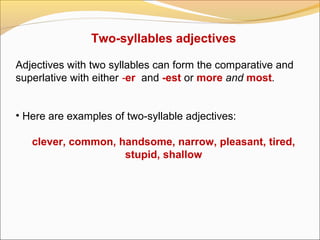
Two-syllables adjectives
Adjectives with two syllables can form the comparative and
superlative with either -er and -est or more and most.
• Here are examples of two-syllable adjectives:
clever, common, handsome, narrow, pleasant, tired,
stupid, shallow
Two-syllables adjectives ending in -y
form the comparative and superlative by changing
the -y into -i and adding -er and -est:
Adjective Comparative Superlative
angry angrier (the) angriest
busy busier (the) busiest
happy happier (the) happiest
Other two-syllables adjectives and adjectives with
more than two syllables
Most of these form the comparative and superlative
with more and most:
Adjective Comparative Superlative
careless more careless the most careless
expensive more expensive the most expensive
intelligent more intelligent the most intelligent
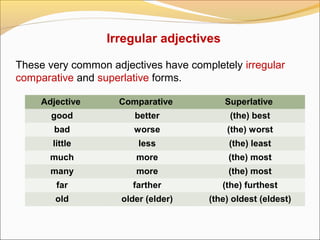
Irregular adjectives
These very common adjectives have completely irregular
comparative and superlative forms.
Adjective Comparative Superlative
good better (the) best
bad worse (the) worst
little less (the) least
much more (the) most
many more (the) most
far farther (the) furthest
old older (elder) (the) oldest (eldest)
Examples:
• Today is the worst day I've had in a long time.
• You play tennis better than I do.
• This is the least expensive sweater in the store.
• This sweater is less expensive than that one.
References:
•Raymond Murphy, Essential Grammar in Use
•www.freeimages.com
•https:// pixabay.com
•https://learnenglish.britishcouncil.org
Adjectives

Adjectives

  • 1.
    MULTIDISCIPLINARYMULTIDISCIPLINARY FLIPPED LEARNING WITHFLIPPEDLEARNING WITH ICTICT ERASMUS+ KA2 PROJECTERASMUS+ KA2 PROJECT 2015-20172015-2017 Daugavpils SaskaDaugavpils Saskannasas School/LatviaSchool/Latvia
  • 3.
  • 4.
    What is anadjective?What is an adjective? Adjectives are descriptive words. Adjectives are used to describe or give information about things, ideas and people. We use adjectives to describe nouns. The most common question an adjective might answer is "What kind of ...?"
  • 5.
    Adjectives have neithergender, number, nor case in English. The ending of an adjective is always the same. Examples: • Robinson Crusoe is a good book. • We have some good students. • It is all for our good friends.
  • 6.
  • 7.
    The adjectives areformed from nouns and verbs by adding suffixes. Sometimes we have to make some spelling changes to the word before adding the suffix.
  • 8.
    We can formadjectives in the following ways: break harmful vary beautiful variable breakable harm beauty angryanger funnyfun
  • 9.
  • 10.
  • 11.
    Most adjectives canbe used in front of a noun. Examples: • They live in a modern house. • We saw a very exciting film last night. • There are some beautiful red flowers. adjective +adjective + nounnoun
  • 12.
    We can alsouse adjectives after a link verb like be, look or feel: Examples: • Their house is beautiful. • That film looks interesting. • I feel really tired today. be/look/feel/smell/taste/soundbe/look/feel/smell/taste/sound + adjective+ adjective
  • 13.
  • 14.
    Sometimes we usemore than one adjective in front of a noun. • She has a small round black wooden box. Here is the most common order of adjectives in English: 1 2 3 4 5 6 7 opinion size shape age colour origin material • She has a nice big round new yellow French glass bowl.
  • 15.
  • 16.
    Comparative adjectives areused to compare differences between the two objects. They are used in sentences where two nouns (people or things) are compared. Examples: • My house is larger than yours. • New York is much bigger than Boston. • Your dog runs faster than Jim's dog. Noun (subject) + verb +Noun (subject) + verb + comparative adjectivecomparative adjective ++ thanthan ++ noun (object).noun (object).
  • 17.
    Comparison is expressedin the following sentence patterns: • John is as old as Peter. • John is not so old as Charles. • Charles is older than John.
  • 18.
    Superlative adjectives areused to describe an object which is at the upper or lower limit of a quality. They are used in sentences where a subject is compared to a group of objects. Examples: • My house is the largest one in our neighborhood. • Everest is the highest mountain in the world. • That’s the best film I have seen this year. Noun (subject) + verb +Noun (subject) + verb + thethe ++ superlativesuperlative adjectiveadjective ++ noun (object).noun (object).
  • 19.
  • 20.
    One-syllable adjectives add -erfor the comparative and -est for the superlative. If the adjective has a consonant + single vowel + consonant spelling, the final consonant must be doubled before adding the ending. Adjective Comparative Superlative tall taller (the) tallest fat fatter (the) fattest big bigger (the) biggest sad sadder (the) saddest
  • 21.
    Two-syllables adjectives Adjectives withtwo syllables can form the comparative and superlative with either -er and -est or more and most. • Here are examples of two-syllable adjectives: clever, common, handsome, narrow, pleasant, tired, stupid, shallow
  • 22.
    Two-syllables adjectives endingin -y form the comparative and superlative by changing the -y into -i and adding -er and -est: Adjective Comparative Superlative angry angrier (the) angriest busy busier (the) busiest happy happier (the) happiest
  • 23.
    Other two-syllables adjectivesand adjectives with more than two syllables Most of these form the comparative and superlative with more and most: Adjective Comparative Superlative careless more careless the most careless expensive more expensive the most expensive intelligent more intelligent the most intelligent
  • 24.
    Irregular adjectives These verycommon adjectives have completely irregular comparative and superlative forms. Adjective Comparative Superlative good better (the) best bad worse (the) worst little less (the) least much more (the) most many more (the) most far farther (the) furthest old older (elder) (the) oldest (eldest)
  • 25.
    Examples: • Today isthe worst day I've had in a long time. • You play tennis better than I do. • This is the least expensive sweater in the store. • This sweater is less expensive than that one.
  • 26.
    References: •Raymond Murphy, EssentialGrammar in Use •www.freeimages.com •https:// pixabay.com •https://learnenglish.britishcouncil.org