Sandra  Algarín Flor Cosme 2007
What is the difference  between adjective and adverb?  Adjective  : is a word that modifies a noun or pronoun. Adverb  : is a word that modifies a verb, an adjective, or another adverb.(When it modifies a verb tells  how, when ,where , or to   what extent).
Basic rules: Adjectives  An  adjective  always follows a form of the verb  to be   when it modifies the noun before the verb. Examples: I   was  nervous . She   has been  sick   all week . My car is  black .
An  adjective  follows a  sense   verb   or a  verb of appearance  ( feel, taste, smell, sound, look, appear, and seem ) when it modifies the noun before the verb.  Examples: Castor oil tastes  awful . The images on the negative appeared  dark . The ocean air smells  fresh .
Adjectives usually answer one of a few different questions: “ What kind? ” or “ Which? ” or “ How many? ” Examples: The   tough   professor gave us the  final  exam.( Tough  tells us “ What kind of professor  ” we’re talking about and  final  “ Which ”  exam we’re talking about .) Fifteen  students passed the  midterm  exam.( Fifteen  tells us “ How many ” students and  midterm  tells us “ Which ” exam  the students passed.
Most of the time,  adjectives  come before nouns. Examples: I ate an  enormous  breakfast. Jean Reuben has a  new  typewriter. It was a  dangerous  lake to swim in.
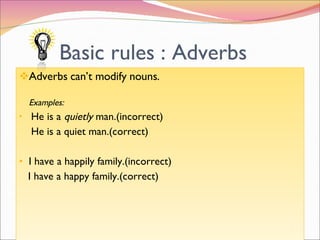
Basic rules : Adverbs Adverbs can’t modify nouns. Examples: He is a  quietly  man.(incorrect) He is a quiet man.(correct) I have a happily family.(incorrect) I have a happy family.(correct)

Adjectives

  • 1.
    Sandra AlgarínFlor Cosme 2007
  • 2.
    What is thedifference between adjective and adverb? Adjective : is a word that modifies a noun or pronoun. Adverb : is a word that modifies a verb, an adjective, or another adverb.(When it modifies a verb tells how, when ,where , or to what extent).
  • 3.
    Basic rules: Adjectives An adjective always follows a form of the verb to be when it modifies the noun before the verb. Examples: I was nervous . She has been sick all week . My car is black .
  • 4.
    An adjective follows a sense verb or a verb of appearance ( feel, taste, smell, sound, look, appear, and seem ) when it modifies the noun before the verb. Examples: Castor oil tastes awful . The images on the negative appeared dark . The ocean air smells fresh .
  • 5.
    Adjectives usually answerone of a few different questions: “ What kind? ” or “ Which? ” or “ How many? ” Examples: The tough professor gave us the final exam.( Tough tells us “ What kind of professor ” we’re talking about and final “ Which ” exam we’re talking about .) Fifteen students passed the midterm exam.( Fifteen tells us “ How many ” students and midterm tells us “ Which ” exam the students passed.
  • 6.
    Most of thetime, adjectives come before nouns. Examples: I ate an enormous breakfast. Jean Reuben has a new typewriter. It was a dangerous lake to swim in.
  • 7.
    Basic rules :Adverbs Adverbs can’t modify nouns. Examples: He is a quietly man.(incorrect) He is a quiet man.(correct) I have a happily family.(incorrect) I have a happy family.(correct)