ADJECTIVES
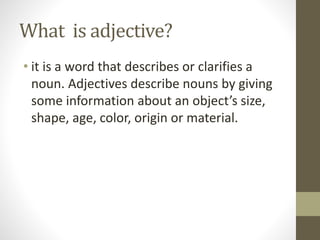
What is adjective?
• it is a word that describes or clarifies a
noun. Adjectives describe nouns by giving
some information about an object’s size,
shape, age, color, origin or material.
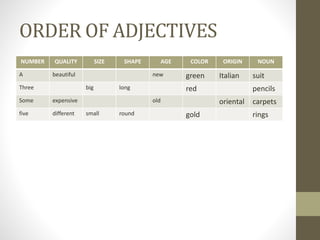
ORDER OF ADJECTIVES
NUMBER QUALITY SIZE SHAPE AGE COLOR ORIGIN NOUN
A beautiful new green Italian suit
Three big long red pencils
Some expensive old oriental carpets
five different small round gold rings
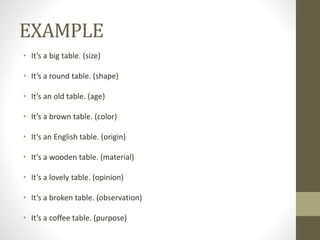
EXAMPLE
• It’s a big table. (size)
• It’s a round table. (shape)
• It’s an old table. (age)
• It’s a brown table. (color)
• It’s an English table. (origin)
• It’s a wooden table. (material)
• It’s a lovely table. (opinion)
• It’s a broken table. (observation)
• It’s a coffee table. (purpose)
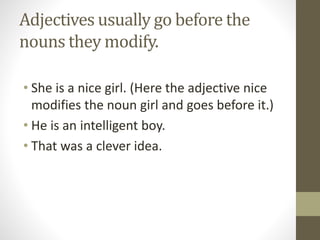
Adjectives usually go before the
nouns they modify.
• She is a nice girl. (Here the adjective nice
modifies the noun girl and goes before it.)
• He is an intelligent boy.
• That was a clever idea.
When two or more adjectivescomebeforea
noun, they are usually separatedby commas.
•A short, fair, pretty girl
•A large, round table
Whenthelasttwoareadjectivesofcolor,theyareusually
separated byand.
•A black and white cow (NOT black
white cow)
•Red and blue socks
Whentwoormoreadjectivescomeinthepredicative
position,weuseandbetweenthelasttwo.
•The boy was handsome, smart and
polite.
•The clouds looked white and fluffy.
Sometimeswe put an adjectiveafter the noun
for the sake of emphasis.
•There lived an old man strong and
wicked. (More emphatic than ‘There
lived a strong and wicked old man.’)
Inphrasessuchasthosegiven below,theadjective
alwayscomesafterthenoun.
• Time-immemorial
• Heir-apparent
• God Almighty
• President elect
In lines of poetry, too, the adjective is
sometimes put after the noun.
O men with sisters dear! (Instead of ‘O men with
dear sisters’)
Adjectives also act as complements.
Complements are words that complete the predicate
of a sentence when the verb is “be.”
EXAMPLE
• He is tall.
• We’ve been teachers for five years.
• You were my best friend.
• He was smart, handsome and rich.
What Do Adjectives Look Like?
• English grammar can be tricky, there are often
exceptions to the rules, so you need to be careful.
You'll find that English adjectives often end with these
suffixes:
• -able/-ible – adorable, invisible, responsible,
uncomfortable
• -al – educational, gradual, illegal, nocturnal, viral
• -an – American, Mexican, urban
• -ar – cellular, popular, spectacular, vulgar
• -ent – intelligent, potent, silent, violent
• -ful – harmful, powerful, tasteful, thoughtful
• -ic/-ical – athletic, energetic, magical, scientific
• -ine – bovine, canine, equine, feminine,
masculine
• -ile – agile, docile, fertile, virile
• -ive – informative, native, talkative
• -less – careless, endless, homeless, timeless
• -ous – cautious, dangerous, enormous,
malodorous
• -some – awesome, handsome, lonesome,
wholesome
Where Do Adjectives Go in a
Sentence?
• If you come across a word that ends in -
y, -ary or -ate (or any other suffix for
that matter), and you want to know if
it’s an adjective, just look at where it is
and what it’s doing in the sentence.
• If it comes immediately before a noun, and
especially if it comes between an article (a,
an, the),
• a possessive adjective (my, his, her, its, your,
our, their)
• a demonstrative (this, that, these, those) or
• an amount (some, most, all, a few) and a
noun, then it’s an adjective.
• he grassy field was wet with dew.
– “Grassy” comes between an article (the) and a
noun (field), so you know it’s an adjective.
• These are my old trophies.
– “Old” comes between a possessive adjective (my)
and a noun (trophies), making it an adjective.
• We had a few ordinary days.
– “Ordinary” comes between an amount (a few) and
a noun (days), so it’s definitely an adjective.
• Did you see that immaculate kitchen?
– “Immaculate” comes between a demonstrative
(that) and a noun (kitchen), so it must be an
adjective.
THANK YOU

Adjectives

  • 1.
  • 2.
    What is adjective? •it is a word that describes or clarifies a noun. Adjectives describe nouns by giving some information about an object’s size, shape, age, color, origin or material.
  • 3.
    ORDER OF ADJECTIVES NUMBERQUALITY SIZE SHAPE AGE COLOR ORIGIN NOUN A beautiful new green Italian suit Three big long red pencils Some expensive old oriental carpets five different small round gold rings
  • 4.
    EXAMPLE • It’s abig table. (size) • It’s a round table. (shape) • It’s an old table. (age) • It’s a brown table. (color) • It’s an English table. (origin) • It’s a wooden table. (material) • It’s a lovely table. (opinion) • It’s a broken table. (observation) • It’s a coffee table. (purpose)
  • 5.
    Adjectives usually gobefore the nouns they modify. • She is a nice girl. (Here the adjective nice modifies the noun girl and goes before it.) • He is an intelligent boy. • That was a clever idea.
  • 6.
    When two ormore adjectivescomebeforea noun, they are usually separatedby commas. •A short, fair, pretty girl •A large, round table
  • 7.
    Whenthelasttwoareadjectivesofcolor,theyareusually separated byand. •A blackand white cow (NOT black white cow) •Red and blue socks
  • 8.
    Whentwoormoreadjectivescomeinthepredicative position,weuseandbetweenthelasttwo. •The boy washandsome, smart and polite. •The clouds looked white and fluffy.
  • 9.
    Sometimeswe put anadjectiveafter the noun for the sake of emphasis. •There lived an old man strong and wicked. (More emphatic than ‘There lived a strong and wicked old man.’)
  • 10.
    Inphrasessuchasthosegiven below,theadjective alwayscomesafterthenoun. • Time-immemorial •Heir-apparent • God Almighty • President elect In lines of poetry, too, the adjective is sometimes put after the noun. O men with sisters dear! (Instead of ‘O men with dear sisters’)
  • 11.
    Adjectives also actas complements. Complements are words that complete the predicate of a sentence when the verb is “be.” EXAMPLE • He is tall. • We’ve been teachers for five years. • You were my best friend. • He was smart, handsome and rich.
  • 12.
    What Do AdjectivesLook Like? • English grammar can be tricky, there are often exceptions to the rules, so you need to be careful. You'll find that English adjectives often end with these suffixes: • -able/-ible – adorable, invisible, responsible, uncomfortable • -al – educational, gradual, illegal, nocturnal, viral • -an – American, Mexican, urban • -ar – cellular, popular, spectacular, vulgar • -ent – intelligent, potent, silent, violent • -ful – harmful, powerful, tasteful, thoughtful
  • 13.
    • -ic/-ical –athletic, energetic, magical, scientific • -ine – bovine, canine, equine, feminine, masculine • -ile – agile, docile, fertile, virile • -ive – informative, native, talkative • -less – careless, endless, homeless, timeless • -ous – cautious, dangerous, enormous, malodorous • -some – awesome, handsome, lonesome, wholesome
  • 14.
    Where Do AdjectivesGo in a Sentence? • If you come across a word that ends in - y, -ary or -ate (or any other suffix for that matter), and you want to know if it’s an adjective, just look at where it is and what it’s doing in the sentence.
  • 15.
    • If itcomes immediately before a noun, and especially if it comes between an article (a, an, the), • a possessive adjective (my, his, her, its, your, our, their) • a demonstrative (this, that, these, those) or • an amount (some, most, all, a few) and a noun, then it’s an adjective.
  • 16.
    • he grassyfield was wet with dew. – “Grassy” comes between an article (the) and a noun (field), so you know it’s an adjective. • These are my old trophies. – “Old” comes between a possessive adjective (my) and a noun (trophies), making it an adjective. • We had a few ordinary days. – “Ordinary” comes between an amount (a few) and a noun (days), so it’s definitely an adjective. • Did you see that immaculate kitchen? – “Immaculate” comes between a demonstrative (that) and a noun (kitchen), so it must be an adjective.
  • 18.