ADIABATIC PROCESS
FOR AN IDEAL GAS
Adiabatic process
The Adiabatic process is a thermodynamic process in which
there is no heat transfer from in or out of the system.
In an Ideal gas, this process is characterized in changes in
pressure, volume, and temperature that occur without the
transfer of thermal energy. Instead, any work done by or on
the gas results solely from changes in its internal energy.
The complete set of formulas relates pressure, volume, and
temperature. Taking account, the Adiabatic index γ, which is
the ratio of specific heat at constant pressure (Cp) to at
constant volume (Cv).
Using the first law of thermodynamics
The first law is expressed as:
ΔU=Q−W
where:
 ΔU is the change in internal energy of the system.
 Q is the heat added to the system.
 W is the work done by the system.
An adiabatic process is one in which there is no heat
exchange with the surroundings:
Q= 0
In an adiabatic process, since Q=0, the first law simplifies
to:
ΔU= −W
This means that any work done by the gas results in a
decrease in internal energy, while work done on the gas
increases its internal energy.
ADIABATIC RELATIONS
Pressure, Volume, and Temperature
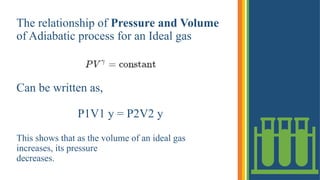
The relationship of Pressure and Volume
of Adiabatic process for an Ideal gas
Can be written as,
P1V1 y = P2V2 y
This shows that as the volume of an ideal gas
increases, its pressure
decreases.
Example:
A monatomic gas at an initial pressure of 10,000
Pa expands adiabatically from an initial volume
of 8.0m3, to a final volume of 64.0m3. What is
the new pressure?
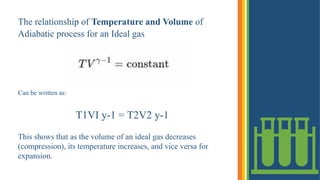
The relationship of Temperature and Volume of
Adiabatic process for an Ideal gas
Can be written as:
T1VI y-1 = T2V2 y-1
This shows that as the volume of an ideal gas decreases
(compression), its temperature increases, and vice versa for
expansion.
Example:
An ideal gas undergoes an adiabatic expansion. Initially,
the gas has a temperature of 500 K and occupies a
volume of 2.0 m3. After expansion, the volume
increases to 4.0 m3. If the gas has an adiabatic index
γ=1.4, find the final temperature after the expansion.
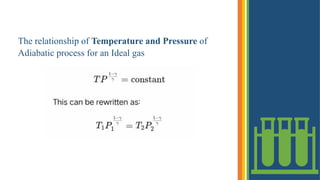
The relationship of Temperature and Pressure of
Adiabatic process for an Ideal gas
Example
An ideal gas undergoes an adiabatic expansion.
Initially, the gas has a pressure of 400 kPa and a
temperature of 350 K. After expansion, the
pressure drops to 150 kPa. If the gas has an
adiabatic index γ=1.4, find the final temperature​
after the expansion.
Work done in an
Adiabatic process
What is Adiabatic Expansion?
Adiabatic expansion is defined as the expansion
in which there is no heat interaction of the
system with the surroundings and work is done
by the system at the expense of its internal
energy. When the gas expands the temperature
decreases and the pressure decreases and the
work is positive.
What is Adiabatic Compression?
Adiabatic compression of the air is defined as
the compression in which no heat is added or
subtracted from the air, and the internal energy
of the air is increased, which is equal to the
external work done on the air. The pressure of
the air is more than the volume as the
temperature increases during compression. The
work is negative.
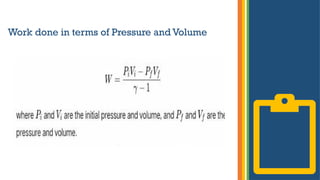
Work done in terms of Pressure and Volume
Example
An ideal gas expands adiabatically from an initial
volume of 1.0 m3 to a final volume of 3.0 m3. The initial
pressure of the gas is 300 kPa, and the adiabatic index
γ=1.4 (a) Calculate the final pressure. (b) Calculate the
work done by the gas during this adiabatic expansion.
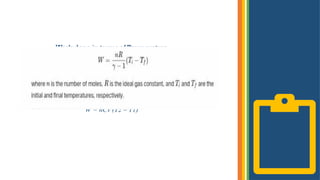
Work done in terms of Temperature
Or
W = nCv (T2 – T1)
The specific heat capacity at constant volume (Cv​
) is often used in the context of calculating work
done when the gas is compressed because it
directly relates to the energy changes at constant
volume.
Conversely, when considering the work done
during expansion, one might prefer the formula
involving R and gamma = γ because it connects
to the gas law relationships that define how
pressure and volume interact during the
expansion process.
Example
An ideal gas undergoes an adiabatic
expansion from an initial temperature
500 K to a final temperature 300 K. If
there are 2 moles of the gas and γ=1.4,
calculate the work done during the
expansion.
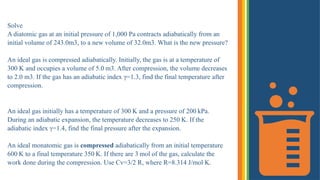
Solve
A diatomic gas at an initial pressure of 1,000 Pa contracts adiabatically from an
initial volume of 243.0m3, to a new volume of 32.0m3. What is the new pressure?
An ideal gas is compressed adiabatically. Initially, the gas is at a temperature of
300 K and occupies a volume of 5.0 m3. After compression, the volume decreases
to 2.0 m3. If the gas has an adiabatic index γ=1.3, find the final temperature​after
compression.
An ideal gas initially has a temperature of 300 K and a pressure of 200 kPa.
During an adiabatic expansion, the temperature decreases to 250 K. If the
adiabatic index γ=1.4, find the final pressure​after the expansion.
An ideal monatomic gas is compressed adiabatically from an initial temperature
600 K to a final temperature 350 K. If there are 3 mol of the gas, calculate the
work done during the compression. Use Cv=3/2 R, where R=8.314 J/mol·K.
THANKYOU !

ADIABATIC PROCESS FOR AN IDErrAL GAS.pptx

  • 1.
  • 2.
    Adiabatic process The Adiabaticprocess is a thermodynamic process in which there is no heat transfer from in or out of the system. In an Ideal gas, this process is characterized in changes in pressure, volume, and temperature that occur without the transfer of thermal energy. Instead, any work done by or on the gas results solely from changes in its internal energy. The complete set of formulas relates pressure, volume, and temperature. Taking account, the Adiabatic index γ, which is the ratio of specific heat at constant pressure (Cp) to at constant volume (Cv).
  • 3.
    Using the firstlaw of thermodynamics The first law is expressed as: ΔU=Q−W where:  ΔU is the change in internal energy of the system.  Q is the heat added to the system.  W is the work done by the system.
  • 4.
    An adiabatic processis one in which there is no heat exchange with the surroundings: Q= 0 In an adiabatic process, since Q=0, the first law simplifies to: ΔU= −W This means that any work done by the gas results in a decrease in internal energy, while work done on the gas increases its internal energy.
  • 5.
  • 6.
    The relationship ofPressure and Volume of Adiabatic process for an Ideal gas Can be written as, P1V1 y = P2V2 y This shows that as the volume of an ideal gas increases, its pressure decreases.
  • 7.
    Example: A monatomic gasat an initial pressure of 10,000 Pa expands adiabatically from an initial volume of 8.0m3, to a final volume of 64.0m3. What is the new pressure?
  • 8.
    The relationship ofTemperature and Volume of Adiabatic process for an Ideal gas Can be written as: T1VI y-1 = T2V2 y-1 This shows that as the volume of an ideal gas decreases (compression), its temperature increases, and vice versa for expansion.
  • 9.
    Example: An ideal gasundergoes an adiabatic expansion. Initially, the gas has a temperature of 500 K and occupies a volume of 2.0 m3. After expansion, the volume increases to 4.0 m3. If the gas has an adiabatic index γ=1.4, find the final temperature after the expansion.
  • 10.
    The relationship ofTemperature and Pressure of Adiabatic process for an Ideal gas
  • 11.
    Example An ideal gasundergoes an adiabatic expansion. Initially, the gas has a pressure of 400 kPa and a temperature of 350 K. After expansion, the pressure drops to 150 kPa. If the gas has an adiabatic index γ=1.4, find the final temperature​ after the expansion.
  • 12.
    Work done inan Adiabatic process
  • 13.
    What is AdiabaticExpansion? Adiabatic expansion is defined as the expansion in which there is no heat interaction of the system with the surroundings and work is done by the system at the expense of its internal energy. When the gas expands the temperature decreases and the pressure decreases and the work is positive.
  • 14.
    What is AdiabaticCompression? Adiabatic compression of the air is defined as the compression in which no heat is added or subtracted from the air, and the internal energy of the air is increased, which is equal to the external work done on the air. The pressure of the air is more than the volume as the temperature increases during compression. The work is negative.
  • 15.
    Work done interms of Pressure and Volume
  • 16.
    Example An ideal gasexpands adiabatically from an initial volume of 1.0 m3 to a final volume of 3.0 m3. The initial pressure of the gas is 300 kPa, and the adiabatic index γ=1.4 (a) Calculate the final pressure. (b) Calculate the work done by the gas during this adiabatic expansion.
  • 17.
    Work done interms of Temperature Or W = nCv (T2 – T1)
  • 18.
    The specific heatcapacity at constant volume (Cv​ ) is often used in the context of calculating work done when the gas is compressed because it directly relates to the energy changes at constant volume. Conversely, when considering the work done during expansion, one might prefer the formula involving R and gamma = γ because it connects to the gas law relationships that define how pressure and volume interact during the expansion process.
  • 19.
    Example An ideal gasundergoes an adiabatic expansion from an initial temperature 500 K to a final temperature 300 K. If there are 2 moles of the gas and γ=1.4, calculate the work done during the expansion.
  • 20.
    Solve A diatomic gasat an initial pressure of 1,000 Pa contracts adiabatically from an initial volume of 243.0m3, to a new volume of 32.0m3. What is the new pressure? An ideal gas is compressed adiabatically. Initially, the gas is at a temperature of 300 K and occupies a volume of 5.0 m3. After compression, the volume decreases to 2.0 m3. If the gas has an adiabatic index γ=1.3, find the final temperature​after compression. An ideal gas initially has a temperature of 300 K and a pressure of 200 kPa. During an adiabatic expansion, the temperature decreases to 250 K. If the adiabatic index γ=1.4, find the final pressure​after the expansion. An ideal monatomic gas is compressed adiabatically from an initial temperature 600 K to a final temperature 350 K. If there are 3 mol of the gas, calculate the work done during the compression. Use Cv=3/2 R, where R=8.314 J/mol·K.
  • 21.