4/11/2018
Department of Mechanical Engineering Confidential 1
PRESENTED BY:
J RAHUL RAO
ID NO: 172071022
M.TECH. (THERMAL ENGG.)
K L (Deemed to be) UNIVERSITY.
What’s Adiabatic Demagnetization.?
4/11/201
8
Department of Mechanical Engineering
Confi
dentia
l
2
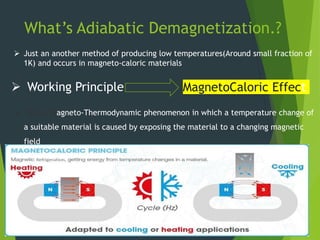
MagnetoCaloric Effect
 It’s a Magneto-Thermodynamic phenomenon in which a temperature change of
a suitable material is caused by exposing the material to a changing magnetic
field
 Working Principle
 Just an another method of producing low temperatures(Around small fraction of
1K) and occurs in magneto-caloric materials.
4/11/201
8
Department of Mechanical Engineering
Confidential
3
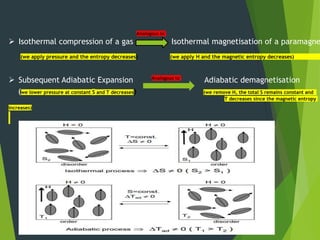
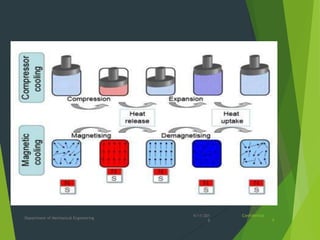
 Isothermal compression of a gas Isothermal magnetisation of a paramagne
(we apply pressure and the entropy decreases) (we apply H and the magnetic entropy decreases)
 Subsequent Adiabatic Expansion Adiabatic demagnetisation
(we lower pressure at constant S and T decreases) (we remove H, the total S remains constant and
T decreases since the magnetic entropy
increases)
Analogous to
Analogous to
4/11/201
8
Department of Mechanical Engineering
Confidential
5
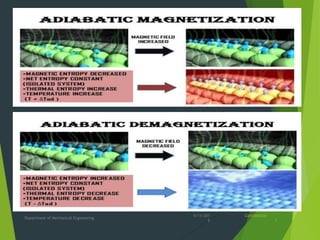
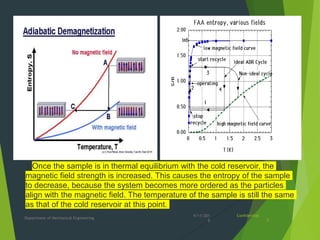
1.Once the sample is in thermal equilibrium with the cold reservoir, the
magnetic field strength is increased. This causes the entropy of the sample
to decrease, because the system becomes more ordered as the particles
align with the magnetic field. The temperature of the sample is still the same
as that of the cold reservoir at this point.
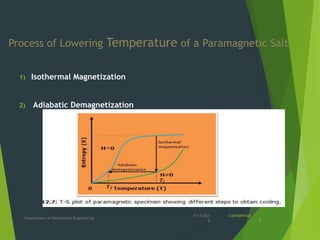
Process of Lowering Temperature of a Paramagnetic Salt
1) Isothermal Magnetization
2) Adiabatic Demagnetization
4/11/201
8
Department of Mechanical Engineering
Confidential
6
what exactly is the procedure
4/11/201
8
Department of Mechanical Engineering
Confidential
7
i. First, the sample to be cooled is allowed to touch a cold He reservoir (which has a
constant temperature of around 3-4 K), and a magnetic field is induced in the
region of the sample.
ii. Once the sample is in thermal equilibrium with the cold reservoir, the magnetic
field strength is increased. This causes the entropy of the sample to decrease,
because the system becomes more ordered as the particles align with the
magnetic field. The temperature of the sample is still the same as that of the cold
reservoir at this point.
iii. Then the sample is isolated from the cold reservoir, and the magnetic field
strength is reduced. The entropy of the sample remains the same, but its
temperature drops in reaction to the reduction in the magnetic field strength. If the
sample was already at a fairly low temperature, this temperature decrease can be
ten-fold or greater.
 Magnetic dipoles in a crystal of paramagnetic salt have this property of disorder. In them,
the dipoles are randomly oriented in space.
 When a magnetic field is applied, these levels become separated sharply. If the magnetic
field is applied while the paramagnetic salt is in contact with the liquid helium bath (an
isothermal process in which a constant temperature is maintained), many more dipoles will
become aligned, with a resultant transfer of thermal energy to the bath.
 If the magnetic field is decreased after removing it from that helium bath, no heat can flow
back into the sample (an adiabatic process), and thus it will cool.
Experimental Procedure
4/11/201
8
Department of Mechanical Engineering
Confidential
8
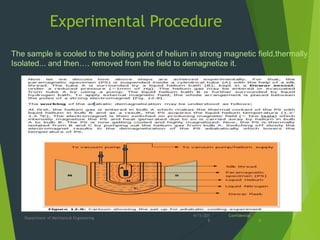
The sample is cooled to the boiling point of helium in strong magnetic field,thermally
Isolated... and then…. removed from the field to demagnetize it.
4/11/201
8
Department of Mechanical Engineering
Confidential
9
Adiabatic Nuclear
Demagnetization
 This process relies on aligning nuclear dipoles (arising
from nuclear spins), which are at least 1,000 times
smaller than those of atoms
 16 micro-degrees (0.000016 degree) absolute could
be reached!!
4/11/201
8
Department of Mechanical Engineering
Confidential
10
Thank
You

Adiabatic de magnetization

  • 1.
    4/11/2018 Department of MechanicalEngineering Confidential 1 PRESENTED BY: J RAHUL RAO ID NO: 172071022 M.TECH. (THERMAL ENGG.) K L (Deemed to be) UNIVERSITY.
  • 2.
    What’s Adiabatic Demagnetization.? 4/11/201 8 Departmentof Mechanical Engineering Confi dentia l 2 MagnetoCaloric Effect  It’s a Magneto-Thermodynamic phenomenon in which a temperature change of a suitable material is caused by exposing the material to a changing magnetic field  Working Principle  Just an another method of producing low temperatures(Around small fraction of 1K) and occurs in magneto-caloric materials.
  • 3.
    4/11/201 8 Department of MechanicalEngineering Confidential 3
  • 4.
     Isothermal compressionof a gas Isothermal magnetisation of a paramagne (we apply pressure and the entropy decreases) (we apply H and the magnetic entropy decreases)  Subsequent Adiabatic Expansion Adiabatic demagnetisation (we lower pressure at constant S and T decreases) (we remove H, the total S remains constant and T decreases since the magnetic entropy increases) Analogous to Analogous to
  • 5.
    4/11/201 8 Department of MechanicalEngineering Confidential 5 1.Once the sample is in thermal equilibrium with the cold reservoir, the magnetic field strength is increased. This causes the entropy of the sample to decrease, because the system becomes more ordered as the particles align with the magnetic field. The temperature of the sample is still the same as that of the cold reservoir at this point.
  • 6.
    Process of LoweringTemperature of a Paramagnetic Salt 1) Isothermal Magnetization 2) Adiabatic Demagnetization 4/11/201 8 Department of Mechanical Engineering Confidential 6
  • 7.
    what exactly isthe procedure 4/11/201 8 Department of Mechanical Engineering Confidential 7 i. First, the sample to be cooled is allowed to touch a cold He reservoir (which has a constant temperature of around 3-4 K), and a magnetic field is induced in the region of the sample. ii. Once the sample is in thermal equilibrium with the cold reservoir, the magnetic field strength is increased. This causes the entropy of the sample to decrease, because the system becomes more ordered as the particles align with the magnetic field. The temperature of the sample is still the same as that of the cold reservoir at this point. iii. Then the sample is isolated from the cold reservoir, and the magnetic field strength is reduced. The entropy of the sample remains the same, but its temperature drops in reaction to the reduction in the magnetic field strength. If the sample was already at a fairly low temperature, this temperature decrease can be ten-fold or greater.  Magnetic dipoles in a crystal of paramagnetic salt have this property of disorder. In them, the dipoles are randomly oriented in space.  When a magnetic field is applied, these levels become separated sharply. If the magnetic field is applied while the paramagnetic salt is in contact with the liquid helium bath (an isothermal process in which a constant temperature is maintained), many more dipoles will become aligned, with a resultant transfer of thermal energy to the bath.  If the magnetic field is decreased after removing it from that helium bath, no heat can flow back into the sample (an adiabatic process), and thus it will cool.
  • 8.
    Experimental Procedure 4/11/201 8 Department ofMechanical Engineering Confidential 8 The sample is cooled to the boiling point of helium in strong magnetic field,thermally Isolated... and then…. removed from the field to demagnetize it.
  • 9.
    4/11/201 8 Department of MechanicalEngineering Confidential 9
  • 10.
    Adiabatic Nuclear Demagnetization  Thisprocess relies on aligning nuclear dipoles (arising from nuclear spins), which are at least 1,000 times smaller than those of atoms  16 micro-degrees (0.000016 degree) absolute could be reached!! 4/11/201 8 Department of Mechanical Engineering Confidential 10 Thank You