ADIABATIC DEMAGNETIZATION
OF
PARAMAGENETIC SALTS
ATHUL RAJ T K
Mechanical Engineering
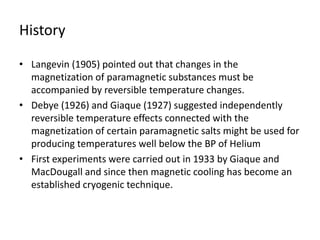
History
• Langevin (1905) pointed out that changes in the
magnetization of paramagnetic substances must be
accompanied by reversible temperature changes.
• Debye (1926) and Giaque (1927) suggested independently
reversible temperature effects connected with the
magnetization of certain paramagnetic salts might be used for
producing temperatures well below the BP of Helium
• First experiments were carried out in 1933 by Giaque and
MacDougall and since then magnetic cooling has become an
established cryogenic technique.
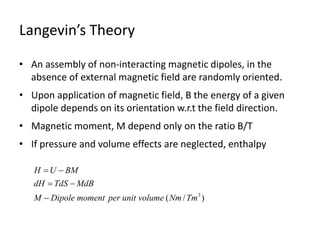
Langevin’s Theory
• An assembly of non-interacting magnetic dipoles, in the
absence of external magnetic field are randomly oriented.
• Upon application of magnetic field, B the energy of a given
dipole depends on its orientation w.r.t the field direction.
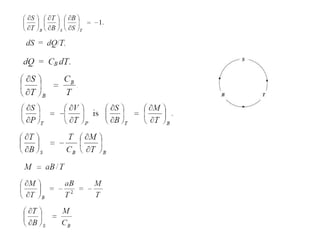
• Magnetic moment, M depend only on the ratio B/T
• If pressure and volume effects are neglected, enthalpy
)
/
( 3
Tm
Nm
volume
unit
per
moment
Dipole
M
MdB
TdS
dH
BM
U
H





Remarks
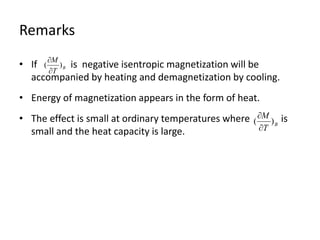
• If is negative isentropic magnetization will be
accompanied by heating and demagnetization by cooling.
• Energy of magnetization appears in the form of heat.
• The effect is small at ordinary temperatures where is
small and the heat capacity is large.
B
T
M
)
(


B
T
M
)
(


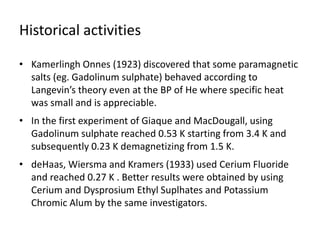
Historical activities
• Kamerlingh Onnes (1923) discovered that some paramagnetic
salts (eg. Gadolinum sulphate) behaved according to
Langevin’s theory even at the BP of He where specific heat
was small and is appreciable.
• In the first experiment of Giaque and MacDougall, using
Gadolinum sulphate reached 0.53 K starting from 3.4 K and
subsequently 0.23 K demagnetizing from 1.5 K.
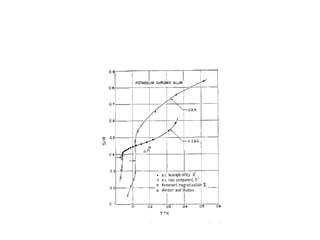
• deHaas, Wiersma and Kramers (1933) used Cerium Fluoride
and reached 0.27 K . Better results were obtained by using
Cerium and Dysprosium Ethyl Suplhates and Potassium
Chromic Alum by the same investigators.
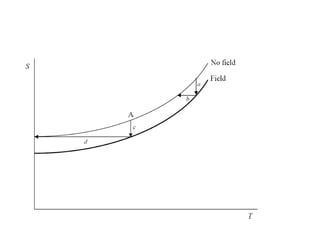
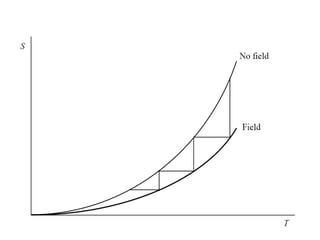
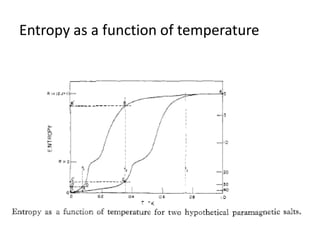
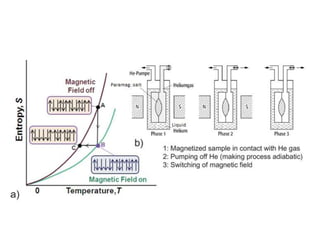
Entropy as a function of temperature
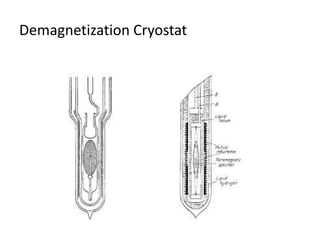
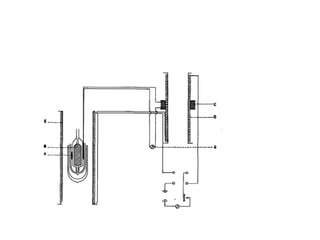
Demagnetization Cryostat
ADIABATIC DEMAGNETIZATION OFPARAMAGENETIC SALTS

ADIABATIC DEMAGNETIZATION OFPARAMAGENETIC SALTS

  • 1.
  • 2.
    History • Langevin (1905)pointed out that changes in the magnetization of paramagnetic substances must be accompanied by reversible temperature changes. • Debye (1926) and Giaque (1927) suggested independently reversible temperature effects connected with the magnetization of certain paramagnetic salts might be used for producing temperatures well below the BP of Helium • First experiments were carried out in 1933 by Giaque and MacDougall and since then magnetic cooling has become an established cryogenic technique.
  • 3.
    Langevin’s Theory • Anassembly of non-interacting magnetic dipoles, in the absence of external magnetic field are randomly oriented. • Upon application of magnetic field, B the energy of a given dipole depends on its orientation w.r.t the field direction. • Magnetic moment, M depend only on the ratio B/T • If pressure and volume effects are neglected, enthalpy ) / ( 3 Tm Nm volume unit per moment Dipole M MdB TdS dH BM U H     
  • 7.
    Remarks • If isnegative isentropic magnetization will be accompanied by heating and demagnetization by cooling. • Energy of magnetization appears in the form of heat. • The effect is small at ordinary temperatures where is small and the heat capacity is large. B T M ) (   B T M ) (  
  • 8.
    Historical activities • KamerlinghOnnes (1923) discovered that some paramagnetic salts (eg. Gadolinum sulphate) behaved according to Langevin’s theory even at the BP of He where specific heat was small and is appreciable. • In the first experiment of Giaque and MacDougall, using Gadolinum sulphate reached 0.53 K starting from 3.4 K and subsequently 0.23 K demagnetizing from 1.5 K. • deHaas, Wiersma and Kramers (1933) used Cerium Fluoride and reached 0.27 K . Better results were obtained by using Cerium and Dysprosium Ethyl Suplhates and Potassium Chromic Alum by the same investigators.
  • 9.
    Entropy as afunction of temperature
  • 10.