Lennard Funk
Addressing Bone Loss
The Pragmatic
Approach
lenfunk@shoulderdoc.co.uk
www.wrightington.com
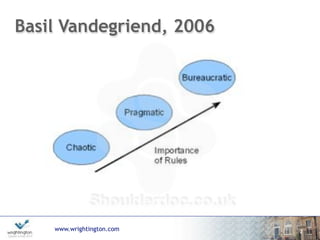
Basil Vandegriend, 2006
2
www.wrightington.com
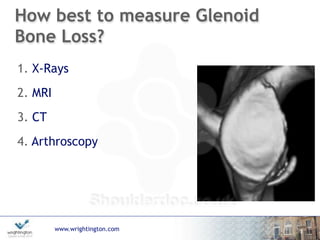
How best to measure Glenoid
Bone Loss?
1. X-Rays
2. MRI
3. CT
4. Arthroscopy
3
www.wrightington.com
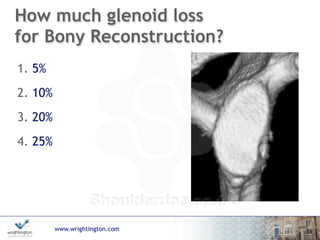
How much glenoid loss 

for Bony Reconstruction?
1. 5%
2. 10%
3. 20%
4. 25%
www.wrightington.com
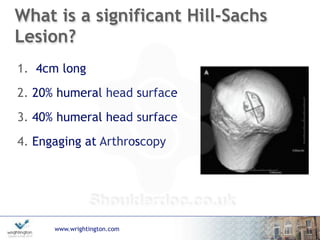
What is a significant Hill-Sachs
Lesion?
1. 4cm long
2. 20% humeral head surface
3. 40% humeral head surface
4. Engaging at Arthroscopy
GLENOID BONE LOSS
6
www.wrightington.com
Where does 20-25% come from?
Itoi Cadaveric Studies - JBJS, 2000:
Stability of repaired cadaveric shoulders
With no glenoid removed
With 21% anterior glenoid removed
ER and ABER
Yamamoto & Itoi - AJSM, 2009
Stability ratio mechanical test 8 cadavers
At 20% stability ration greatly decreased
Yamamoto - JBJS, 2010
Same study (with 5 more shoulders)!!
7
www.wrightington.com
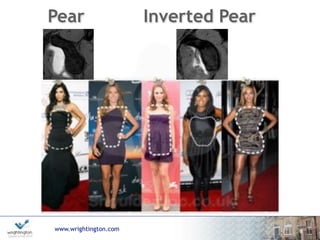
Pear
8
Inverted Pear
www.wrightington.com 9
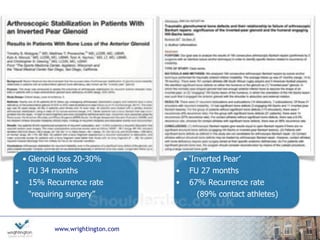
• Glenoid loss 20-30%
• FU 34 months
• 15% Recurrence rate
“requiring surgery”
• ‘Inverted Pear’
• FU 27 months
• 67% Recurrence rate

(89% contact athletes)
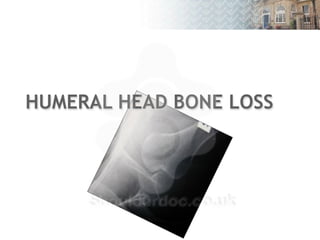
HUMERAL HEAD BONE LOSS
10
www.wrightington.com
What is a significant
Hill-sachs lesion?
Bigliani & Flatow (1996) 

[quoted in Cetik (2007)]:
Mild - <20%
Moderate - 20-45%
Severe - >45%
11
> 30% = Needs Treatment
www.wrightington.com
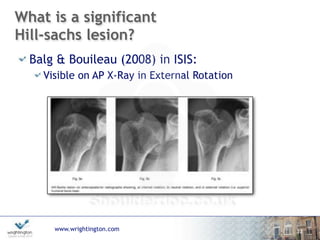
What is a significant
Hill-sachs lesion?
Balg & Bouileau (2008) in ISIS:
Visible on AP X-Ray in External Rotation
12
www.wrightington.com
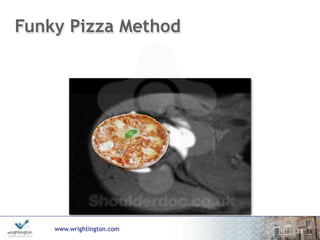
Funky Pizza Method
13
www.wrightington.com
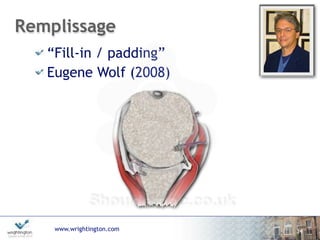
Remplissage
“Fill-in / padding”
Eugene Wolf (2008)
14
www.wrightington.com
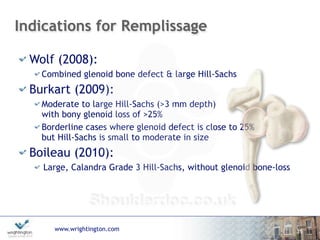
Indications for Remplissage
Wolf (2008):
Combined glenoid bone defect & large Hill-Sachs
Burkart (2009):
Moderate to large Hill-Sachs (>3 mm depth) 

with bony glenoid loss of >25%
Borderline cases where glenoid defect is close to 25% 

but Hill-Sachs is small to moderate in size
Boileau (2010):
Large, Calandra Grade 3 Hill-Sachs, without glenoid bone-loss
15
Assessing Bone Loss
16
www.wrightington.com
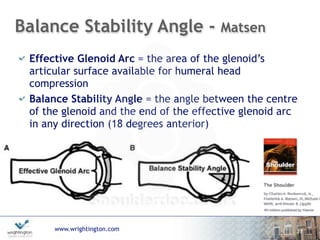
Balance Stability Angle - Matsen
Effective Glenoid Arc = the area of the glenoid’s
articular surface available for humeral head
compression
Balance Stability Angle = the angle between the centre
of the glenoid and the end of the effective glenoid arc
in any direction (18 degrees anterior)
17
www.wrightington.com
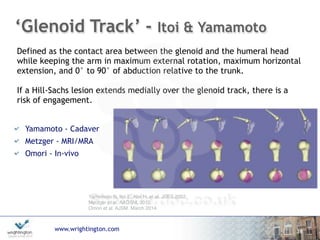
‘Glenoid Track’ - Itoi & Yamamoto
Yamamoto - Cadaver
Metzger - MRI/MRA
Omori - In-vivo
18
Yamamoto N, Itoi E, Abe H, et al. JSES 2007

Metzger et al. AAOSM, 2010

Omori et al. AJSM. March 2014.
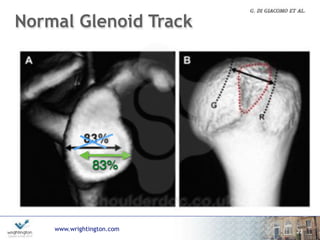
Defined as the contact area between the glenoid and the humeral head
while keeping the arm in maximum external rotation, maximum horizontal
extension, and 0° to 90° of abduction relative to the trunk.
"
If a Hill-Sachs lesion extends medially over the glenoid track, there is a
risk of engagement.
www.wrightington.com
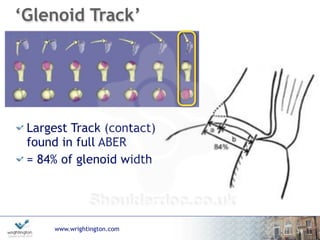
Largest Track (contact)
found in full ABER
= 84% of glenoid width
19
‘Glenoid Track’
www.wrightington.com 20
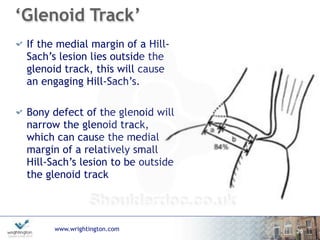
‘Glenoid Track’
If the medial margin of a Hill-
Sach’s lesion lies outside the
glenoid track, this will cause
an engaging Hill-Sach’s.
"
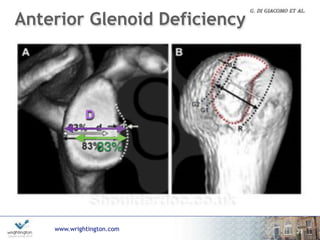
Bony defect of the glenoid will
narrow the glenoid track,
which can cause the medial
margin of a relatively small
Hill-Sach’s lesion to be outside
the glenoid track
www.wrightington.com
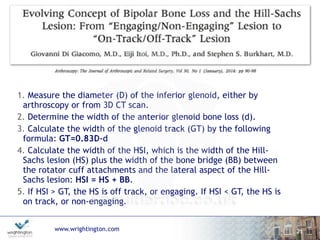
1. Measure the diameter (D) of the inferior glenoid, either by
arthroscopy or from 3D CT scan.
2. Determine the width of the anterior glenoid bone loss (d).
3. Calculate the width of the glenoid track (GT) by the following
formula: GT=0.83D-d
4. Calculate the width of the HSI, which is the width of the Hill-
Sachs lesion (HS) plus the width of the bone bridge (BB) between
the rotator cuff attachments and the lateral aspect of the Hill-
Sachs lesion: HSI = HS + BB.
5. If HSI > GT, the HS is off track, or engaging. If HSI < GT, the HS is
on track, or non-engaging.
21
www.wrightington.com
Normal Glenoid Track
22
83%
www.wrightington.com
Anterior Glenoid Deficiency
23
D
83%
www.wrightington.com
The Formula:
24
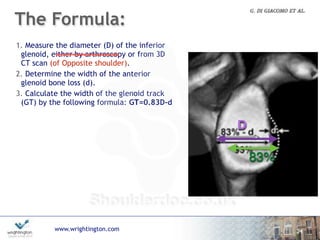
1. Measure the diameter (D) of the inferior
glenoid, either by arthroscopy or from 3D
CT scan (of Opposite shoulder).
2. Determine the width of the anterior
glenoid bone loss (d).
3. Calculate the width of the glenoid track
(GT) by the following formula: GT=0.83D-d
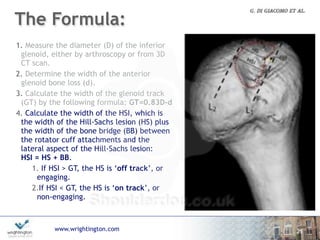
4. Calculate the width of the HSI, which is
the width of the Hill-Sachs lesion (HS) plus
the width of the bone bridge (BB) between
the rotator cuff attachments and the
lateral aspect of the Hill-Sachs lesion: 

HSI = HS + BB.
5. If HSI > GT, the HS is off track, or
engaging. If HSI < GT, the HS is on track, or
non-engaging.
D
83%
www.wrightington.com
The Formula:
25
1. Measure the diameter (D) of the inferior
glenoid, either by arthroscopy or from 3D
CT scan.
2. Determine the width of the anterior
glenoid bone loss (d).
3. Calculate the width of the glenoid track
(GT) by the following formula: GT=0.83D-d
4. Calculate the width of the HSI, which is
the width of the Hill-Sachs lesion (HS) plus
the width of the bone bridge (BB) between
the rotator cuff attachments and the
lateral aspect of the Hill-Sachs lesion: 

HSI = HS + BB.
1. If HSI > GT, the HS is ‘off track’, or
engaging.
2.If HSI < GT, the HS is ‘on track’, or
non-engaging.
www.wrightington.com
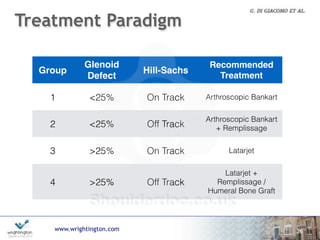
Treatment Paradigm
26
Group
Glenoid
Defect
Hill-Sachs
Recommended

Treatment
1 <25% On Track Arthroscopic Bankart
2 <25% Off Track
Arthroscopic Bankart
+ Remplissage
3 >25% On Track Latarjet
4 >25% Off Track
Latarjet +
Remplissage /
Humeral Bone Graft
Decision Making
27
www.wrightington.com
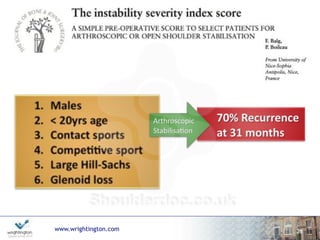
Balg & Bouileau, JBJSB, 2007:
Instability Severity Score!
28
www.wrightington.com
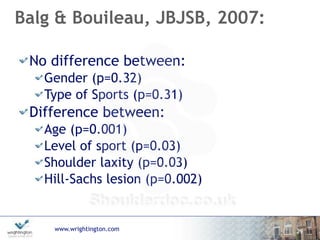
Balg & Bouileau, JBJSB, 2007:
No difference between:
Gender (p=0.32)
Type of Sports (p=0.31)
Difference between:
Age (p=0.001)
Level of sport (p=0.03)
Shoulder laxity (p=0.03)
Hill-Sachs lesion (p=0.002)
29
www.wrightington.com
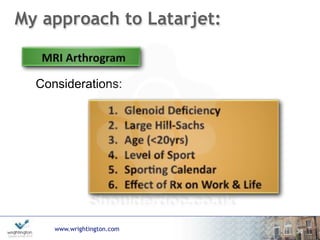
My approach to Latarjet:
30
Considerations:
www.wrightington.com
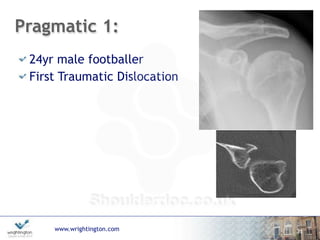
Pragmatic 1:
24yr male footballer
First Traumatic Dislocation
31
www.wrightington.com
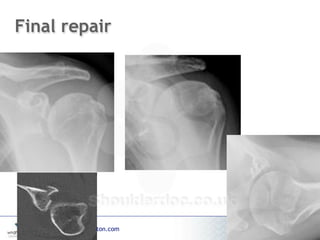
Final repair
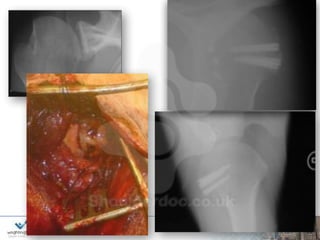
www.wrightington.com
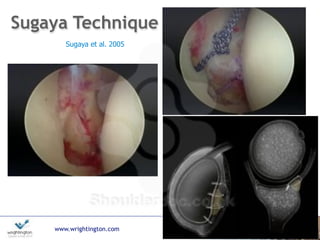
Sugaya Technique
Sugaya et al. 2005
www.wrightington.com
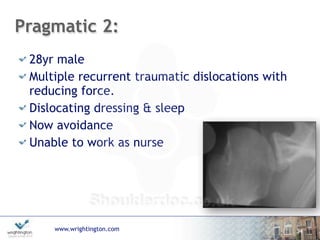
Pragmatic 2:
28yr male
Multiple recurrent traumatic dislocations with
reducing force.
Dislocating dressing & sleep
Now avoidance
Unable to work as nurse
34
www.wrightington.com
www.wrightington.com 36
“Soap and water 

and common sense are the
best disinfectants”
William Osler
www.wrightington.com
Thank You
37
www.wrightington.com
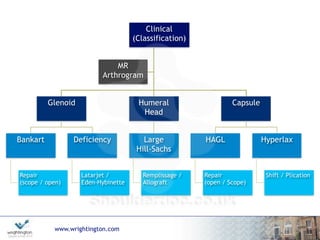
Clinical
(Classification)
MR
Arthrogram
Glenoid
Bankart
Repair

(scope / open)
Deficiency
Latarjet /

Eden-Hybinette
Humeral
Head
Large

Hill-Sachs
Remplissage /

Allograft
Capsule
HAGL
Repair

(open / Scope)
Hyperlax
Shift / Plication
www.wrightington.com

Addressing bone loss in shoulder instability lennard funk