MODELS
EVALUATION
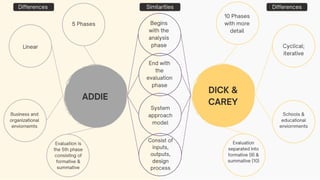
ADDIE vs Dick & Carey
USED TO DEFINE THE ACTIVITIES THAT
WILL GUIDE THE LEARNING
DEVELOPMENT PROCESS
Instructional Design Models
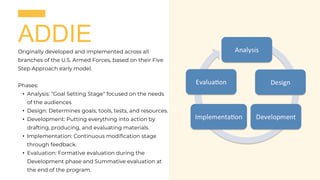
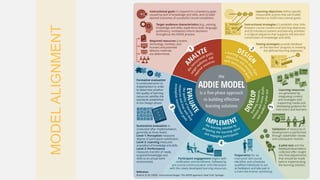
ADDIE
Originally developed and implemented across all
branches of the U.S. Armed Forces, based on their Five
Step Approach early model.
Phases:
• Analysis: "Goal Setting Stage" focused on the needs
of the audiences
• Design: Determines goals, tools, tests, and resources.
• Development: Putting everything into action by
drafting, producing, and evaluating materials.
• Implementation: Continuous modification stage
through feedback.
• Evaluation: Formative evaluation during the
Development phase and Summative evaluation at
the end of the program.
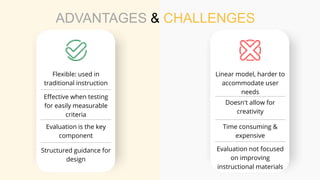
Flexible: used in
traditional instruction
Effective when testing
for easily measurable
criteria
Evaluation is the key
component
Structured guidance for
design
Linear model, harder to
accommodate user
needs
Time consuming &
expensive
Doesn't allow for
creativity
Evaluation not focused
on improving
instructional materials
ADVANTAGES & CHALLENGES
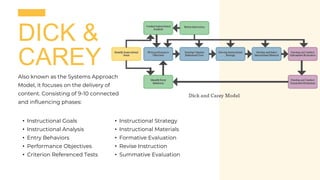
DICK &
CAREY
Also known as the Systems Approach
Model, it focuses on the delivery of
content. Consisting of 9-10 connected
and influencing phases:
• Instructional Goals
• Instructional Analysis
• Entry Behaviors
• Performance Objectives
• Criterion Referenced Tests
• Instructional Strategy
• Instructional Materials
• Formative Evaluation
• Revise Instruction
• Summative Evaluation
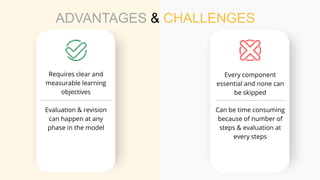
ADVANTAGES & CHALLENGES
Requires clear and
measurable learning
objectives
Every component
essential and none can
be skipped
Can be time consuming
because of number of
steps & evaluation at
every steps
Evaluation & revision
can happen at any
phase in the model
MODEL
ALIGNMENT
References:
Branch, R. M., & SpringerLink (Online service). (2009). Instructional design: The ADDIE
approach (1st.;1st; ed.). Boston, MA: Springer-Verlag US. doi:10.1007/978-0-387-09506-6
https://psu.pb.unizin.org/idhandbook/chapter/addie/
Kurt, S. (2018, December 16). ADDIE Model: Instructional Design. Educational
Technology. https://educationaltechnology.net/the-addie-model-instructional-
design/
Kurt, S. (2016, December 12). Dick and Carey Instructional Model. Educational
Technology. https://educationaltechnology.net/dick-and-carey-instructional-model/

ADDIE vs Dick & Carey ID Model.pptx

  • 1.
  • 2.
    USED TO DEFINETHE ACTIVITIES THAT WILL GUIDE THE LEARNING DEVELOPMENT PROCESS Instructional Design Models
  • 3.
    ADDIE Originally developed andimplemented across all branches of the U.S. Armed Forces, based on their Five Step Approach early model. Phases: • Analysis: "Goal Setting Stage" focused on the needs of the audiences • Design: Determines goals, tools, tests, and resources. • Development: Putting everything into action by drafting, producing, and evaluating materials. • Implementation: Continuous modification stage through feedback. • Evaluation: Formative evaluation during the Development phase and Summative evaluation at the end of the program.
  • 4.
    Flexible: used in traditionalinstruction Effective when testing for easily measurable criteria Evaluation is the key component Structured guidance for design Linear model, harder to accommodate user needs Time consuming & expensive Doesn't allow for creativity Evaluation not focused on improving instructional materials ADVANTAGES & CHALLENGES
  • 5.
    DICK & CAREY Also knownas the Systems Approach Model, it focuses on the delivery of content. Consisting of 9-10 connected and influencing phases: • Instructional Goals • Instructional Analysis • Entry Behaviors • Performance Objectives • Criterion Referenced Tests • Instructional Strategy • Instructional Materials • Formative Evaluation • Revise Instruction • Summative Evaluation
  • 6.
    ADVANTAGES & CHALLENGES Requiresclear and measurable learning objectives Every component essential and none can be skipped Can be time consuming because of number of steps & evaluation at every steps Evaluation & revision can happen at any phase in the model
  • 8.
  • 9.
    References: Branch, R. M.,& SpringerLink (Online service). (2009). Instructional design: The ADDIE approach (1st.;1st; ed.). Boston, MA: Springer-Verlag US. doi:10.1007/978-0-387-09506-6 https://psu.pb.unizin.org/idhandbook/chapter/addie/ Kurt, S. (2018, December 16). ADDIE Model: Instructional Design. Educational Technology. https://educationaltechnology.net/the-addie-model-instructional- design/ Kurt, S. (2016, December 12). Dick and Carey Instructional Model. Educational Technology. https://educationaltechnology.net/dick-and-carey-instructional-model/