Advance Database Management Systems :27
Parallel Database Distribution Architecture
Prof Neeraj Bhargava
Vaibhav Khanna
Department of Computer Science
School of Engineering and Systems Sciences
Maharshi Dayanand Saraswati University Ajmer
Parallel Databases
• In a parallel database architecture, there are multiple
processors that control multiple disk units containing
the database.
• The database may be partitioned on the disks, or
possibly replicated.
• If fault tolerance is a high priority, the system can be
set up so that each component can serve as a backup
for the other components of the same type, taking
over the functions of any similar component that fails.
• Parallel database system architectures can be shared
memory, shared-disk, shared-nothing, or hierarchical,
which is also called cluster.
Parallel Databases
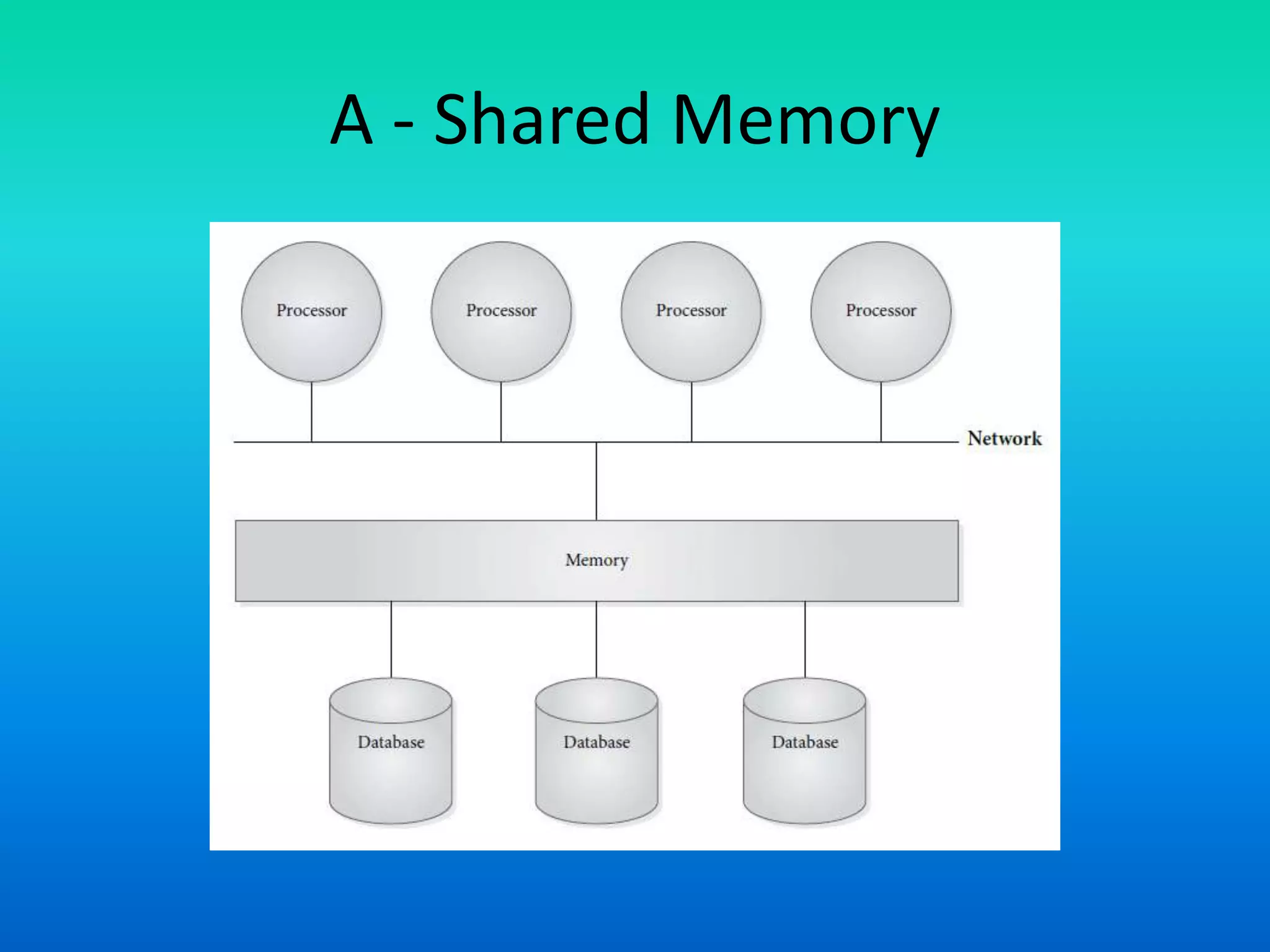
• In a shared-memory system, all processors have
access to the same memory and to shared disks, as
shown in FIGURE (A) .
• The database resides on the disks, either replicated on
them or partitioned across them.
• When a processor makes a data request, the data can
be fetched from any of the disks to memory buffers that
are shared by all processors.
• The DBMS informs the processor what page in memory
contains the requested data page.
Parallel Databases
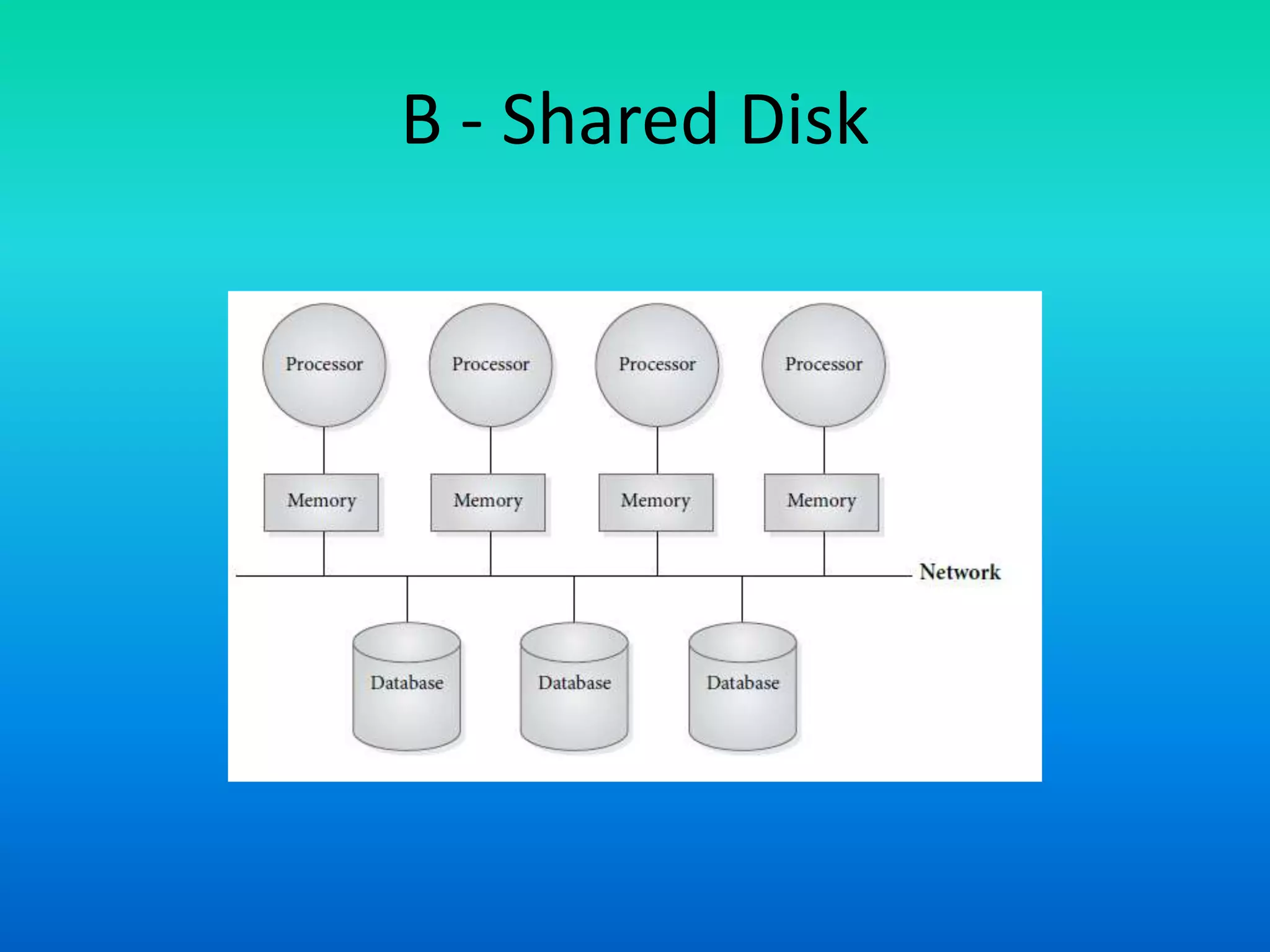
• In the shared-disk design, shown in FIGURE
(B) , each processor has exclusive access to
its own memory, but all processors have
access to the shared disk units.
• When a processor requests data, database
pages are brought into that processor’s
memory.
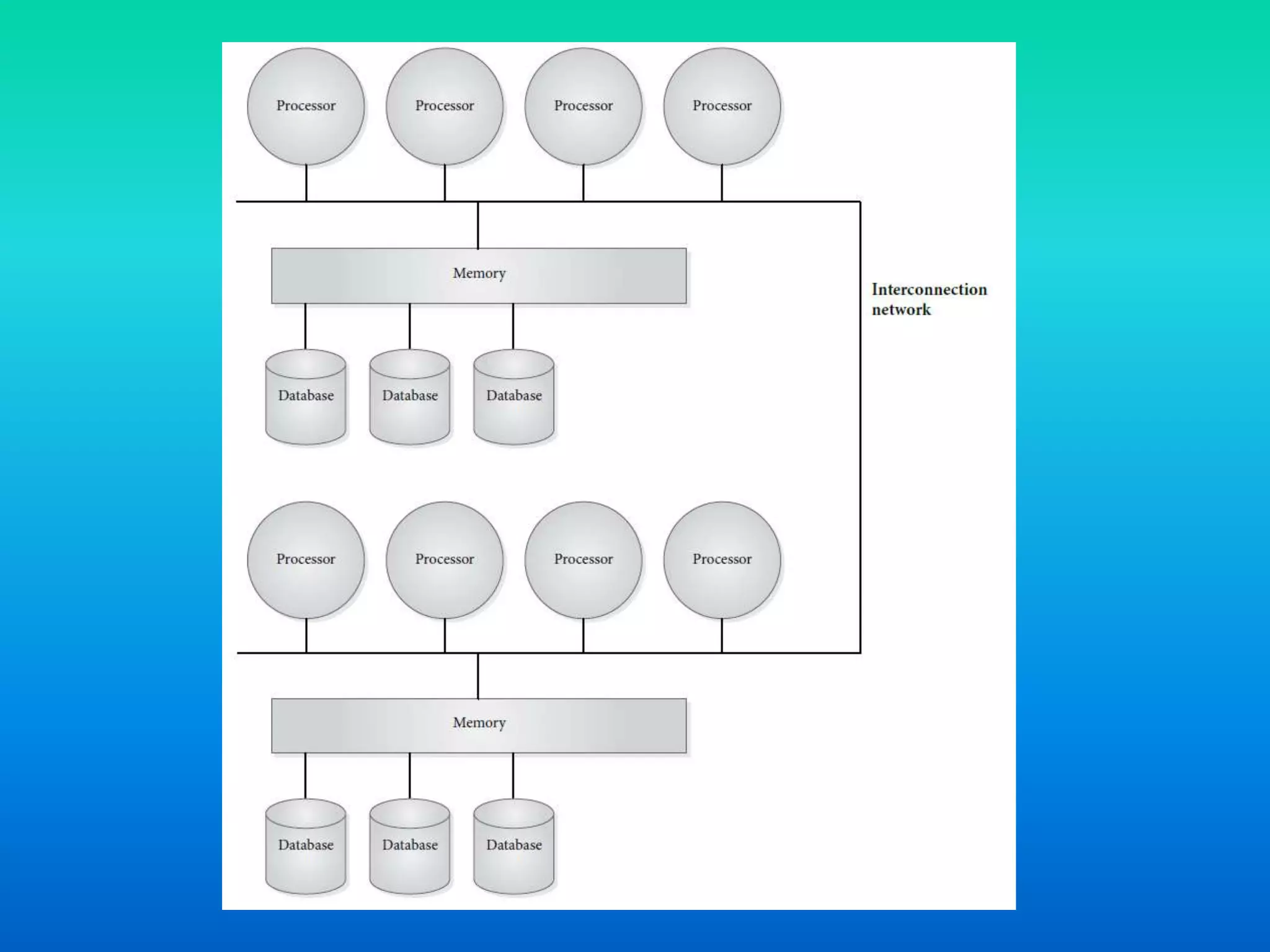
• In shared-nothing systems, each processor
has exclusive control of its own disk unit or
units and its own memory, as shown in
FIGURE (C) , but processors can
communicate with one another.
A - Shared Memory
B - Shared Disk
C - Shared Nothing
Partitioning for Preformance
• The purpose of parallel databases is to improve
performance by executing operations in a parallel
fashion on the various devices.
• Careful partitioning of data is essential so that parallel
evaluation of queries is possible.
• Data partitioning can be done by range partitioning,
which means placing records on designated disks
according to a range of values for a certain attribute.
• Other methods are by hashing on some attribute or by
placing new records on successive disks in round-robin
fashion.
Partitioning for Preformance
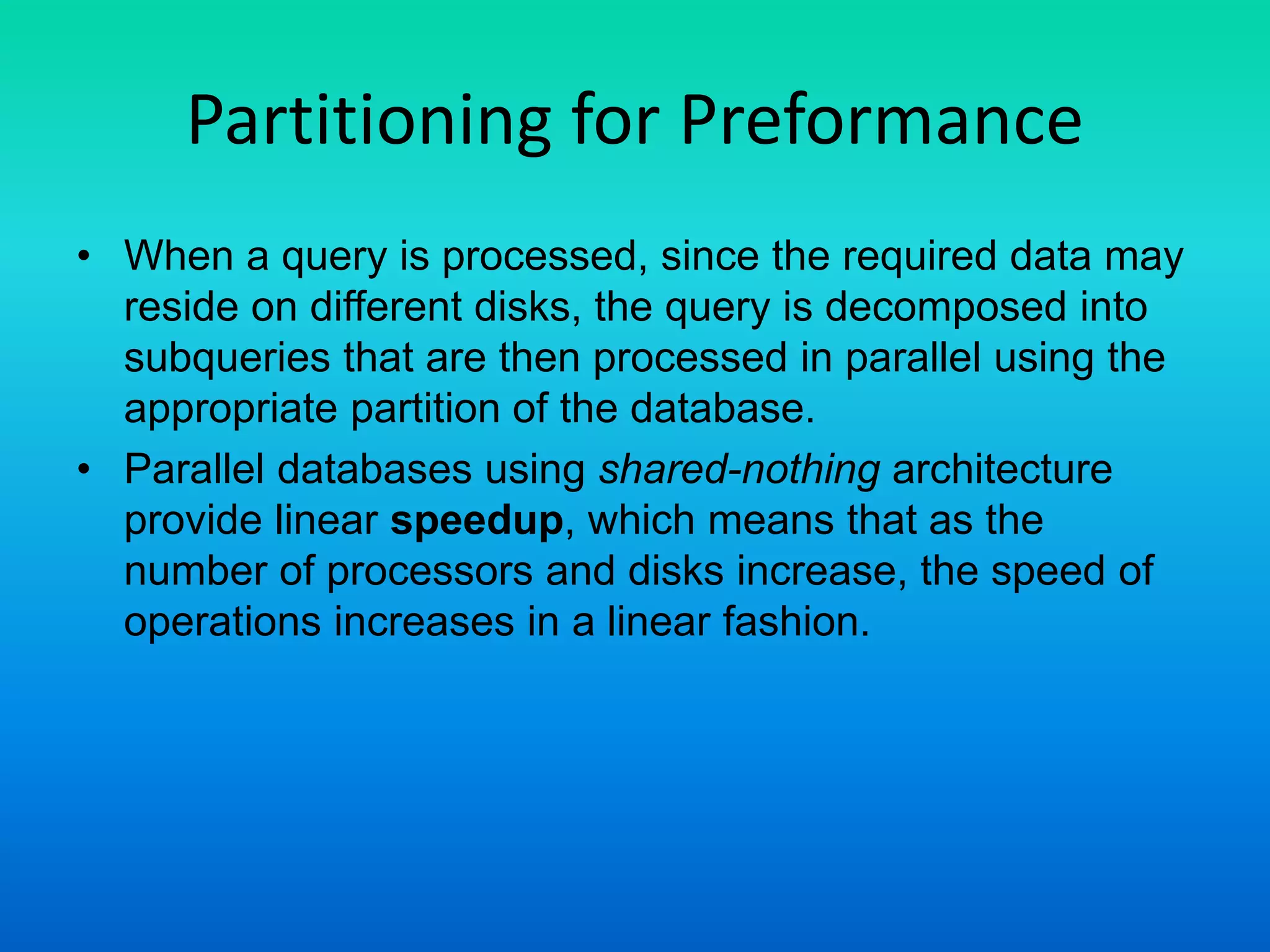
• When a query is processed, since the required data may
reside on different disks, the query is decomposed into
subqueries that are then processed in parallel using the
appropriate partition of the database.
• Parallel databases using shared-nothing architecture
provide linear speedup, which means that as the
number of processors and disks increase, the speed of
operations increases in a linear fashion.
Linear scale-up
• They also provide linear scale-up, which
means that they are scalable, so that if more
processors and disks are added, the
performance level is sustained.
• This allows us to increase the amount of data
stored and processed without sacrificing
performance.
• These characteristics of shared nothing have
made this the architecture of choice for Web
applications.
Assignment
• Explain the usage of Parallel Databases in
distributed DBMS
• What is Database Partitioning

Adbms 27 parallel database distribution architecture

  • 1.
    Advance Database ManagementSystems :27 Parallel Database Distribution Architecture Prof Neeraj Bhargava Vaibhav Khanna Department of Computer Science School of Engineering and Systems Sciences Maharshi Dayanand Saraswati University Ajmer
  • 2.
    Parallel Databases • Ina parallel database architecture, there are multiple processors that control multiple disk units containing the database. • The database may be partitioned on the disks, or possibly replicated. • If fault tolerance is a high priority, the system can be set up so that each component can serve as a backup for the other components of the same type, taking over the functions of any similar component that fails. • Parallel database system architectures can be shared memory, shared-disk, shared-nothing, or hierarchical, which is also called cluster.
  • 3.
    Parallel Databases • Ina shared-memory system, all processors have access to the same memory and to shared disks, as shown in FIGURE (A) . • The database resides on the disks, either replicated on them or partitioned across them. • When a processor makes a data request, the data can be fetched from any of the disks to memory buffers that are shared by all processors. • The DBMS informs the processor what page in memory contains the requested data page.
  • 4.
    Parallel Databases • Inthe shared-disk design, shown in FIGURE (B) , each processor has exclusive access to its own memory, but all processors have access to the shared disk units. • When a processor requests data, database pages are brought into that processor’s memory. • In shared-nothing systems, each processor has exclusive control of its own disk unit or units and its own memory, as shown in FIGURE (C) , but processors can communicate with one another.
  • 5.
    A - SharedMemory
  • 6.
  • 7.
    C - SharedNothing
  • 9.
    Partitioning for Preformance •The purpose of parallel databases is to improve performance by executing operations in a parallel fashion on the various devices. • Careful partitioning of data is essential so that parallel evaluation of queries is possible. • Data partitioning can be done by range partitioning, which means placing records on designated disks according to a range of values for a certain attribute. • Other methods are by hashing on some attribute or by placing new records on successive disks in round-robin fashion.
  • 10.
    Partitioning for Preformance •When a query is processed, since the required data may reside on different disks, the query is decomposed into subqueries that are then processed in parallel using the appropriate partition of the database. • Parallel databases using shared-nothing architecture provide linear speedup, which means that as the number of processors and disks increase, the speed of operations increases in a linear fashion.
  • 11.
    Linear scale-up • Theyalso provide linear scale-up, which means that they are scalable, so that if more processors and disks are added, the performance level is sustained. • This allows us to increase the amount of data stored and processed without sacrificing performance. • These characteristics of shared nothing have made this the architecture of choice for Web applications.
  • 12.
    Assignment • Explain theusage of Parallel Databases in distributed DBMS • What is Database Partitioning