Acquired Immunity
Acquired Immunity
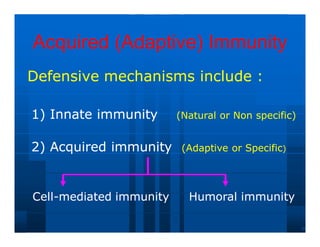
Acquired (Adaptive) Immunity
Defensive mechanisms include :
1) Innate immunity
1) Innate immunity (Natural or Non specific)
(Natural or Non specific)
2) Acquired immunity
2) Acquired immunity (Adaptive or Specific
(Adaptive or Specific)
)
Cell
Cell-
-mediated immunity Humoral immunity
mediated immunity Humoral immunity
Aquired (specific) immunity
* The
* The acquired
acquired immune response is
immune response is more
more specialized
specialized
than
than innate
innate immune response
immune response
* The acquired immune response involves a combination
of two mechanisms :
of two mechanisms :
1) Humoral immune response
2) cell mediated immune response
* They interact with one another to destroy foreign body
(microorganisms, infected cells, tumor cells)
Aquired (specific) immunity
Two mechanisms
Two mechanisms
1) Humoral immune response:
-
- Antibodies
Antibodies are produced by
are produced by B
B-
-lymphocytes
lymphocytes
-
- These have the ability to recognize and bind
These have the ability to recognize and bind
specifically to antigen that induced their formation
2) The cell mediated immune response (CMI)
-
- It is mediated by certain types of
It is mediated by certain types of T
T-
-lymphocytes
lymphocytes
-
- T
T-
-lymphocytes recognize foreign material by
lymphocytes recognize foreign material by
means of
means of surface receptors
surface receptors
-
- T
T-
-lymphocytes attack and destroy foreign material
lymphocytes attack and destroy foreign material
directly or through release of soluble mediators
i.e.
i.e. cytokines
cytokines
Characters Of Acquired Immune Response
1) Highly specific
1) Highly specific for the invading organism
for the invading organism
2) Discrimination between “self and “non self” molecules
The response only occurs to “non self” molecules
3) Diversity:
3) Diversity:
-
- It can respond to millions of different antigens
It can respond to millions of different antigens
-
- Lymphoctes population consists of many different
Lymphoctes population consists of many different
clones (one cell and its progny)
-
- Each clone express an antigen receptor and
Each clone express an antigen receptor and
responds only to one antigenic epitope
Characters Of Acquired Immune Response
4) Response amplified following repeated exposure to
the same pathogens
the same pathogens
5) Memory cells ( B and T cells) generated.
Mechanism Of Acquired Immune Response
Acquired immune response is initiated by:
* Recognition of the antigen by specific lymphocytes
* Activation of these specific lymphocytes
* Proliferation and differentiation into effector cells;
-
-The effector cells eliminate the antigen
The effector cells eliminate the antigen
-
-Return of homeostasis and development of memory cells
Return of homeostasis and development of memory cells
* Memory cells evoke a more rapid and long response on
re
re-
-exposure to same antigen
exposure to same antigen
Acquired Or Adaptive Immunity
I
I-
- Passive
Passive acquired
acquired immunity
immunity
a
a-
-Naturally
Naturally passive
passive acquired
acquired immunity
immunity
Antibodies
Antibodies are
are passed
passed through
through placenta
placenta
to
to the
the fetus
fetus
b
b-
- Artificially passive acquired immunity
Artificially passive acquired immunity
The injection of alredy prepared antibodies,
such as gamma globulin
(short
(short-
-term immunization)
term immunization)
II
II-
- Active acquired immunity
Active acquired immunity
a
a-
-Natural
Natural active
active acquired
acquired immunity
immunity :
:
-
- Following
Following clinical
clinical or
or subclinical
subclinical infections
infections
-
- measles
measles or
or mumps,
mumps, in
in which
which immunity
immunity is
is
long
long lasting
lasting
b
b-
- Artificial
Artificial active
active acquired
acquired immunity
immunity :
:
-
- Following
Following vaccination
vaccination with
with live
live or
or killed
killed
infectious
infectious agents
agents or
or their
their products
products
Mechanism of Humoral immunity
* Antibodies induce resistance through:
1) Antitoxin neutralize bacterial toxins (diphtheria,tetanus)
Antitoxin are developed actively as a result of:
a
a-
- Previous infection
Previous infection
b
b-
- Artificial immunization
Artificial immunization
c
c-
- Transferred passively as antiserum
Transferred passively as antiserum
* Neutralization of toxin with antitoxin prevents a
combination with tissue cells
Mechanism of Humoral immunity
2) Antibodies attach to the surface of bacteria and
a
a-
- act as opsonins and enhance phagocytosisd
act as opsonins and enhance phagocytosisd
b
b-
- prevent the adherence of microorganisms to
prevent the adherence of microorganisms to
their target cells, e.g. IgA in the gut
c
c-
- Activate the complement and lead to bacterial lysis
Activate the complement and lead to bacterial lysis
d
d-
- Clump bacteria (agglutination) leading to
Clump bacteria (agglutination) leading to
phagocytosis
phagocytosis

adaptive immunity.pdf immunology lecture

  • 1.
  • 2.
    Acquired (Adaptive) Immunity Acquired(Adaptive) Immunity Defensive mechanisms include : Defensive mechanisms include : 1) Innate immunity 1) Innate immunity (Natural or Non specific) (Natural or Non specific) 2) Acquired immunity 2) Acquired immunity (Adaptive or Specific (Adaptive or Specific) ) Cell Cell- -mediated immunity Humoral immunity mediated immunity Humoral immunity
  • 3.
    Aquired (specific) immunity Aquired(specific) immunity * The * The acquired acquired immune response is immune response is more more specialized specialized than than innate innate immune response immune response * The acquired immune response involves a combination * The acquired immune response involves a combination of two mechanisms : of two mechanisms : 1) Humoral immune response 1) Humoral immune response 2) cell mediated immune response 2) cell mediated immune response * They interact with one another to destroy foreign body * They interact with one another to destroy foreign body (microorganisms, infected cells, tumor cells) (microorganisms, infected cells, tumor cells)
  • 4.
    Aquired (specific) immunity Aquired(specific) immunity Two mechanisms Two mechanisms 1) Humoral immune response: 1) Humoral immune response: - - Antibodies Antibodies are produced by are produced by B B- -lymphocytes lymphocytes - - These have the ability to recognize and bind These have the ability to recognize and bind specifically to antigen that induced their formation specifically to antigen that induced their formation 2) The cell mediated immune response (CMI) 2) The cell mediated immune response (CMI) - - It is mediated by certain types of It is mediated by certain types of T T- -lymphocytes lymphocytes - - T T- -lymphocytes recognize foreign material by lymphocytes recognize foreign material by means of means of surface receptors surface receptors - - T T- -lymphocytes attack and destroy foreign material lymphocytes attack and destroy foreign material directly or through release of soluble mediators directly or through release of soluble mediators i.e. i.e. cytokines cytokines
  • 5.
    Characters Of AcquiredImmune Response Characters Of Acquired Immune Response 1) Highly specific 1) Highly specific for the invading organism for the invading organism 2) Discrimination between “self and “non self” molecules 2) Discrimination between “self and “non self” molecules The response only occurs to “non self” molecules The response only occurs to “non self” molecules 3) Diversity: 3) Diversity: - - It can respond to millions of different antigens It can respond to millions of different antigens - - Lymphoctes population consists of many different Lymphoctes population consists of many different clones (one cell and its progny) clones (one cell and its progny) - - Each clone express an antigen receptor and Each clone express an antigen receptor and responds only to one antigenic epitope responds only to one antigenic epitope
  • 6.
    Characters Of AcquiredImmune Response Characters Of Acquired Immune Response 4) Response amplified following repeated exposure to 4) Response amplified following repeated exposure to the same pathogens the same pathogens 5) Memory cells ( B and T cells) generated. 5) Memory cells ( B and T cells) generated.
  • 7.
    Mechanism Of AcquiredImmune Response Mechanism Of Acquired Immune Response Acquired immune response is initiated by: Acquired immune response is initiated by: * Recognition of the antigen by specific lymphocytes * Recognition of the antigen by specific lymphocytes * Activation of these specific lymphocytes * Activation of these specific lymphocytes * Proliferation and differentiation into effector cells; * Proliferation and differentiation into effector cells; - -The effector cells eliminate the antigen The effector cells eliminate the antigen - -Return of homeostasis and development of memory cells Return of homeostasis and development of memory cells * Memory cells evoke a more rapid and long response on * Memory cells evoke a more rapid and long response on re re- -exposure to same antigen exposure to same antigen
  • 8.
    Acquired Or AdaptiveImmunity Acquired Or Adaptive Immunity I I- - Passive Passive acquired acquired immunity immunity a a- -Naturally Naturally passive passive acquired acquired immunity immunity Antibodies Antibodies are are passed passed through through placenta placenta to to the the fetus fetus b b- - Artificially passive acquired immunity Artificially passive acquired immunity The injection of alredy prepared antibodies, The injection of alredy prepared antibodies, such as gamma globulin such as gamma globulin (short (short- -term immunization) term immunization)
  • 9.
    II II- - Active acquiredimmunity Active acquired immunity a a- -Natural Natural active active acquired acquired immunity immunity : : - - Following Following clinical clinical or or subclinical subclinical infections infections - - measles measles or or mumps, mumps, in in which which immunity immunity is is long long lasting lasting b b- - Artificial Artificial active active acquired acquired immunity immunity : : - - Following Following vaccination vaccination with with live live or or killed killed infectious infectious agents agents or or their their products products
  • 10.
    Mechanism of Humoralimmunity Mechanism of Humoral immunity * Antibodies induce resistance through: * Antibodies induce resistance through: 1) Antitoxin neutralize bacterial toxins (diphtheria,tetanus) 1) Antitoxin neutralize bacterial toxins (diphtheria,tetanus) Antitoxin are developed actively as a result of: Antitoxin are developed actively as a result of: a a- - Previous infection Previous infection b b- - Artificial immunization Artificial immunization c c- - Transferred passively as antiserum Transferred passively as antiserum * Neutralization of toxin with antitoxin prevents a * Neutralization of toxin with antitoxin prevents a combination with tissue cells combination with tissue cells
  • 11.
    Mechanism of Humoralimmunity Mechanism of Humoral immunity 2) Antibodies attach to the surface of bacteria and 2) Antibodies attach to the surface of bacteria and a a- - act as opsonins and enhance phagocytosisd act as opsonins and enhance phagocytosisd b b- - prevent the adherence of microorganisms to prevent the adherence of microorganisms to their target cells, e.g. IgA in the gut their target cells, e.g. IgA in the gut c c- - Activate the complement and lead to bacterial lysis Activate the complement and lead to bacterial lysis d d- - Clump bacteria (agglutination) leading to Clump bacteria (agglutination) leading to phagocytosis phagocytosis