P r e s e n t e r : A d a m O c h s
D a t e : D e c e m b e r 2 0 1 9
O ff i c e 3 6 5
@ O 3 6 5 A d a m
C o - P r e s e n t e r o f O ff i c e 3 6 5 P u l s e
The top 10 things I wish I
had known about Office
365 Groups
Before we get into our 10 reasons, lets talk about
why it matters!
Geographically Distributed
Need varied ways to connect across
locations and time-zones
Internal & External Team Members
Team members outside the firewall need
unfettered access
Multi-Generation Workforce
Different expectations and preferences
for tools
Employees work on nearly
2xthe number of teams,
compared to 5 years ago
Different groups have different needs
Co-Creating
Content
Mail &
Calendar
Voice, Video
& Meetings
Chat-based
Workspace
Sites & Content
Management
Enterprise
Social
Today’s
Challenges
Siloed Apps
Friction across applications – multiple logins, difficulty sharing and discovering information
Shadow IT
Incomplete toolset can lead to inconsistent security, compliance and risk
Wasted Time
Context switching between different apps drains attention and time
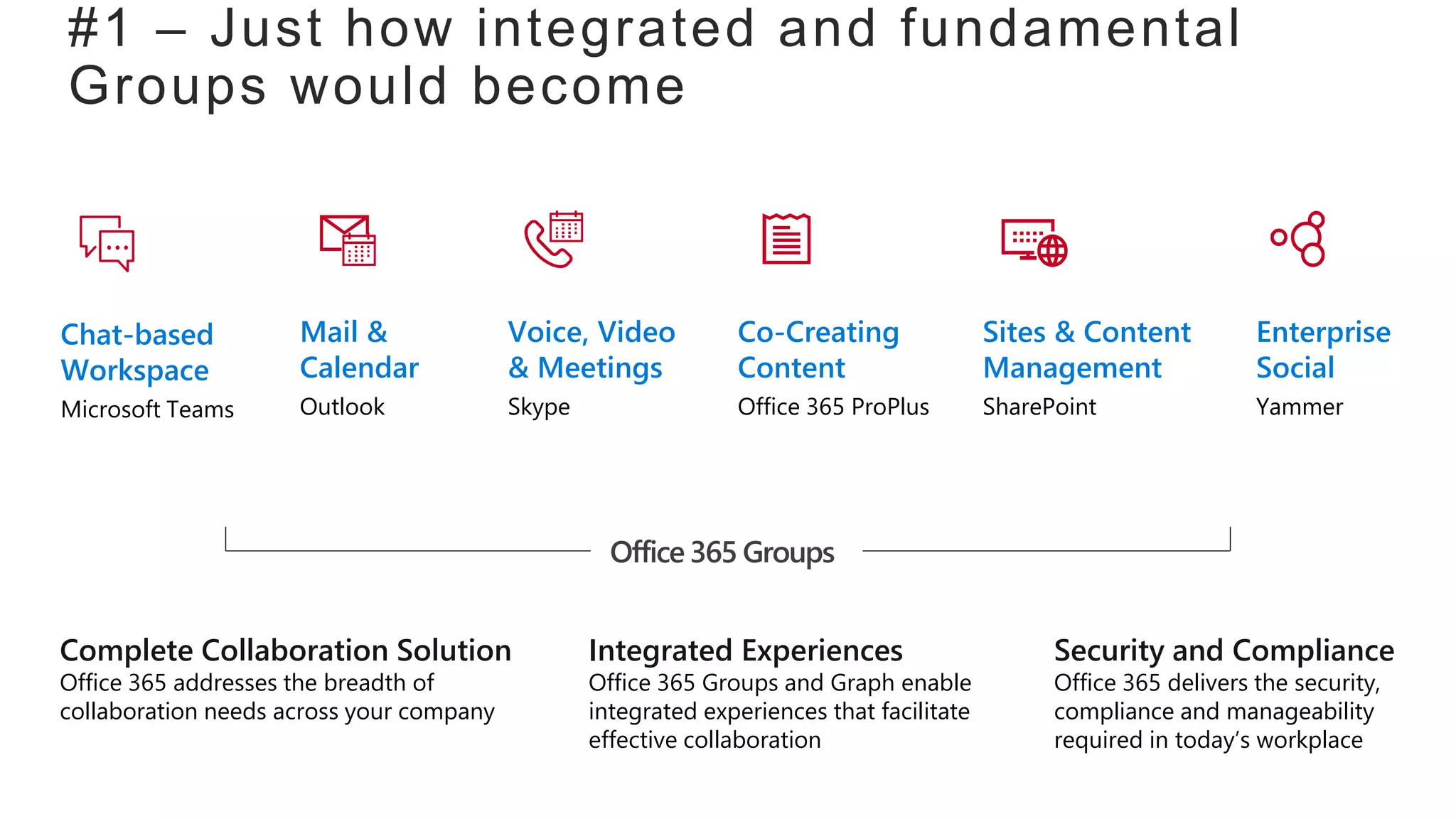
#1 – Just how integrated and fundamental
Groups would become
Complete Collaboration Solution
Office 365 addresses the breadth of
collaboration needs across your company
Integrated Experiences
Office 365 Groups and Graph enable
integrated experiences that facilitate
effective collaboration
Security and Compliance
Office 365 delivers the security,
compliance and manageability
required in today’s workplace
Co-Creating
Content
Office 365 ProPlus
Mail &
Calendar
Outlook
Voice, Video
& Meetings
Skype
Chat-based
Workspace
Microsoft Teams
Sites & Content
Management
SharePoint
Enterprise
Social
Yammer
Office 365 Groups
Office 365 Groups
Simplifies Collaboration
Today
Request DL for messaging
Get SharePoint Site for files
Create project plan
Manually manage permissions
on content
Ramp up new team members
based on previous group
discussions
Apply & manage policies on
content
Manually manage membership
and access on DL
Benefits for IT
Group identity & assets created in a
single step
Centrally managed as a single object
in Azure AD
Simplified permissions and
access structure
Benefits for end users
All group assets created in a
single step
Easy to manage independently
New members onboard quickly
Collaboration
In the Past
Generational Preferences at Work
Baby Boomer
(1946-1964)
Generation X
(1965-1979)
Millennial
(1980-1997)
Generation Z
(1998-2020)
In Person Meeting
Virtual Online Meeting (No
Video)
Virtual Online Meeting (Video)
Email
Team Workspaces
Instant Message (IM)
Enterprise Social Networking
Persistent Chat
Conversational User
Interfaces
Mostly preferAlways prefer Somewhat prefer Occasionally prefer Do not prefer
Avanade Research, Wired Magazine: The Next Generation of Working Practices, Herman Miller: Generations at Work, EY Study on Generational Shifts
For organizations with a multi-generation workforce, it is important to understand your demographics to know how to best find the balance of tools
across the generations. If you are an organization that heavily relies on email, what are you doing for your new workers? Are you giving them the tools
they need to be effective? Note: this is a generalization of observations, but any individual may cross multiple categories.
© Copyright Avanade 2016
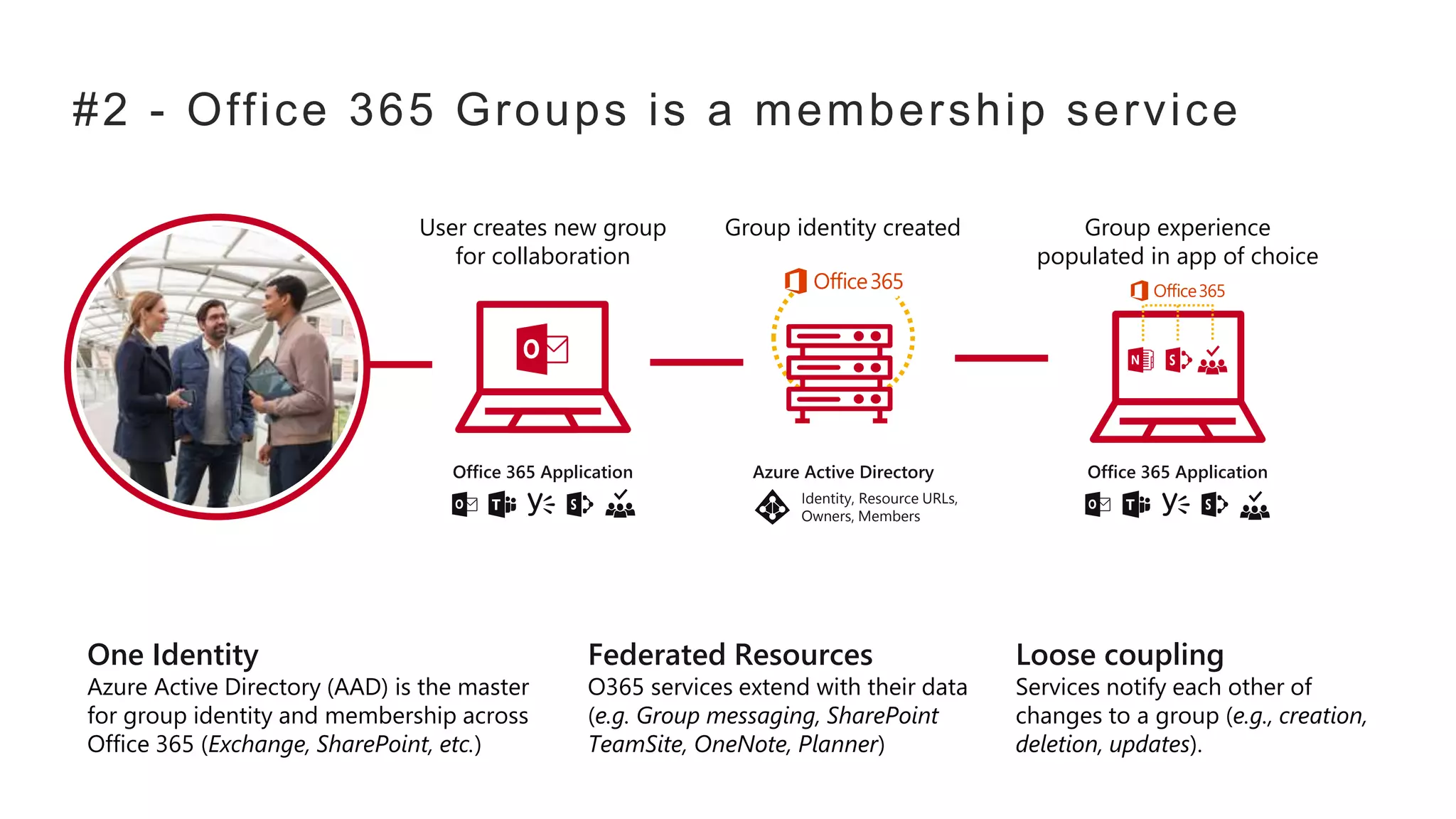
#2 - Office 365 Groups is a membership service
User creates new group
for collaboration
Office 365 Application
Group experience
populated in app of choice
Office 365 Application
One Identity
Azure Active Directory (AAD) is the master
for group identity and membership across
Office 365 (Exchange, SharePoint, etc.)
Federated Resources
O365 services extend with their data
(e.g. Group messaging, SharePoint
TeamSite, OneNote, Planner)
Loose coupling
Services notify each other of
changes to a group (e.g., creation,
deletion, updates).
Group identity created
Azure Active Directory
Identity, Resource URLs,
Owners, Members
Controlling groups – Admin Center
https://support.office.com/en-us/article/manage-who-can-create-office-365-groups-
4c46c8cb-17d0-44b5-9776-005fced8e618
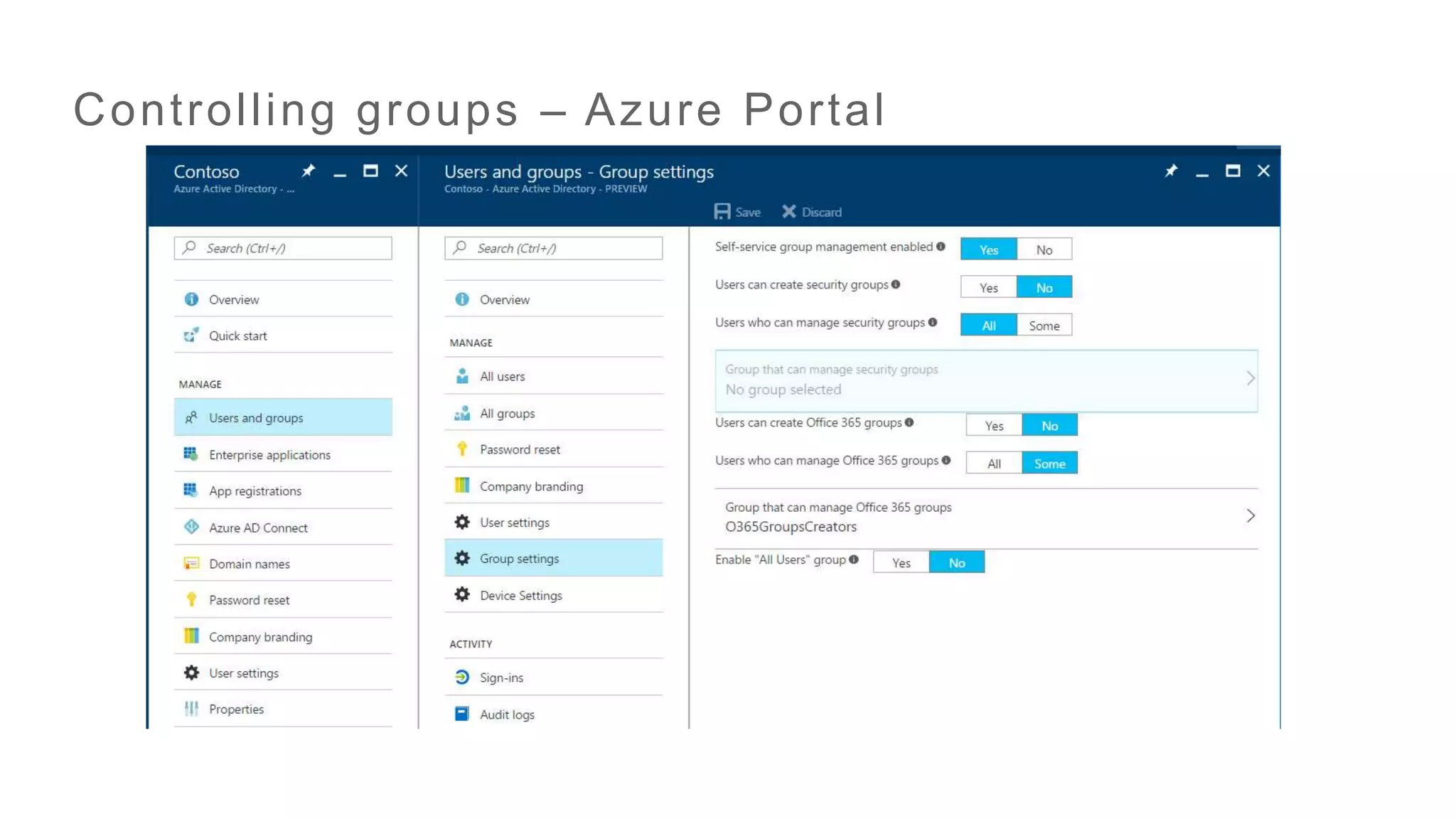
Controlling groups – Azure Portal
3 – Managing O365 groups is access by many,
mastered by none
https://docs.microsoft.com/en-us/azure/active-directory/active-directory-accessmanagement-groups-
settings-cmdlets
Cmdlet name Description
Get-UnifiedGroup Use this cmdlet to look up existing Office 365 groups, and to view
properties of the group object.
Set-UnifiedGroup Update the properties of a specific Office 365 group.
New-UnifiedGroup Create a new Office 365 group. This cmdlet provides a minimal
set of parameters, for setting values for extended properties use
Set-UnifiedGroup after creating the new group.
Remove-UnifiedGroup Delete an existing Office 365 group.
Get-UnifiedGroupLinks Retrieve membership and owner information for an Office 365
group.
Add-UnifiedGroupLinks Add members and owners to an existing Office 365 group.
Remove-UnifiedGroupLinks Remove owners and members from an existing Office 365 group.
Controlling site creation type and quota
Set-SPOSite –Identity https://contoso.sharepoint.com/sites/groupname -
StorageQuota 3000 -StorageQuotaWarningLevel 2000
Deletion recovery (soft-delete)
Expiring Groups
Preservation and deletion policies
Naming policy
Banned words and profanity checking
http://fasttrack.microsoft.com/roadmap
4 - What it
means to
delete!
What’s
Next?
You can now have multiple plans per group. Archiving old plans has been in conversations
for awhile, but I have yet to see it work properly.
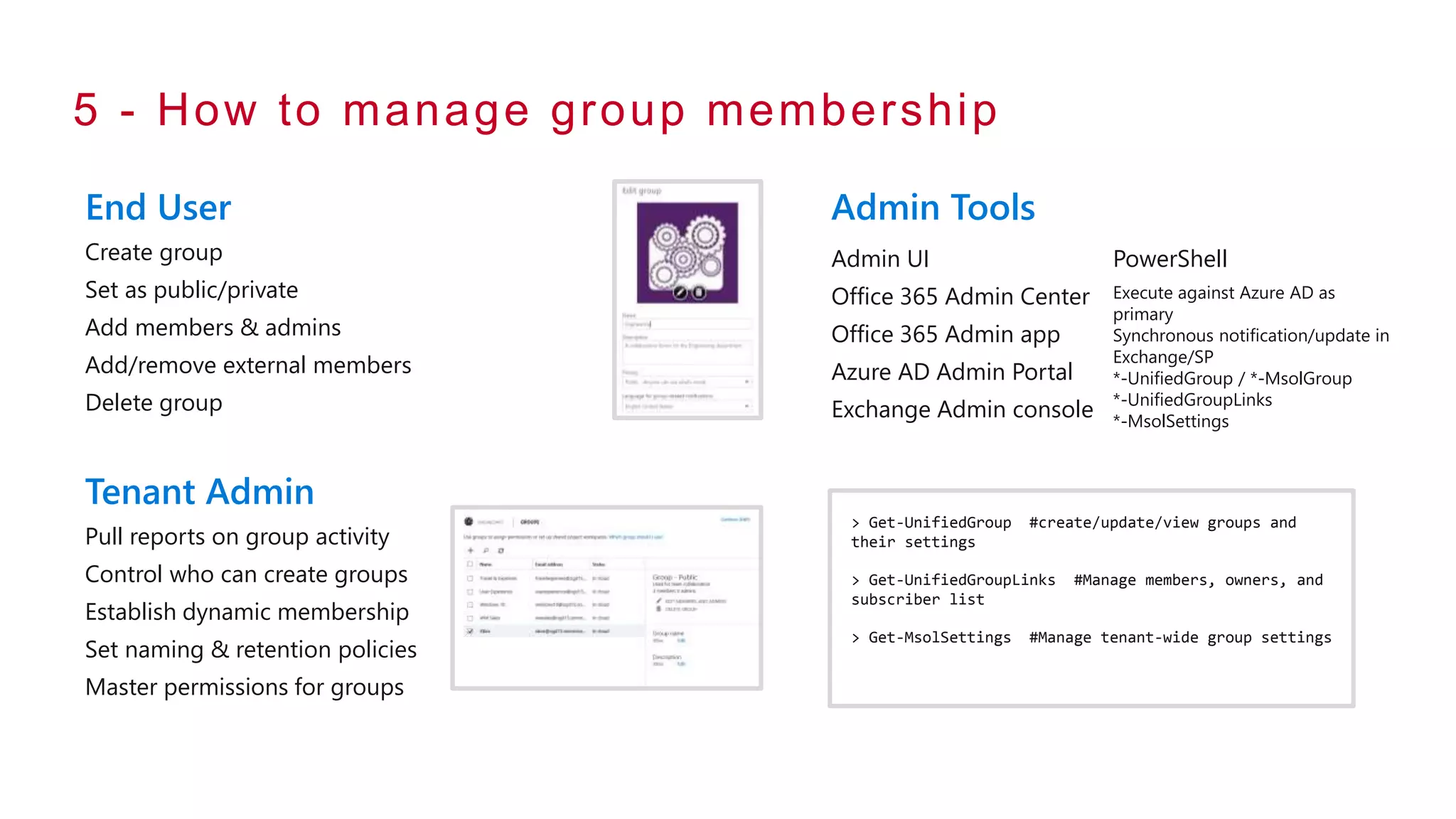
End User
Create group
Set as public/private
Add members & admins
Add/remove external members
Delete group
Tenant Admin
Pull reports on group activity
Control who can create groups
Establish dynamic membership
Set naming & retention policies
Master permissions for groups
Admin Tools
5 - How to manage group membership
> Get-UnifiedGroup #create/update/view groups and
their settings
> Get-UnifiedGroupLinks #Manage members, owners, and
subscriber list
> Get-MsolSettings #Manage tenant-wide group settings
Admin UI
Office 365 Admin Center
Office 365 Admin app
Azure AD Admin Portal
Exchange Admin console
PowerShell
Execute against Azure AD as
primary
Synchronous notification/update in
Exchange/SP
*-UnifiedGroup / *-MsolGroup
*-UnifiedGroupLinks
*-MsolSettings
6 – Ok! But what about external users?
How external guest access works
User adds
guest@gmail.com
Contoso Azure AD
manages guest ID,
maps to Office 365
Group
Guest ID synched to
Exchange Online,
SharePoint Online
Guest access in Office 365 groups | Guest access in Office 365 groups – Admin Help
Guest access to resources
governed by organization
policies
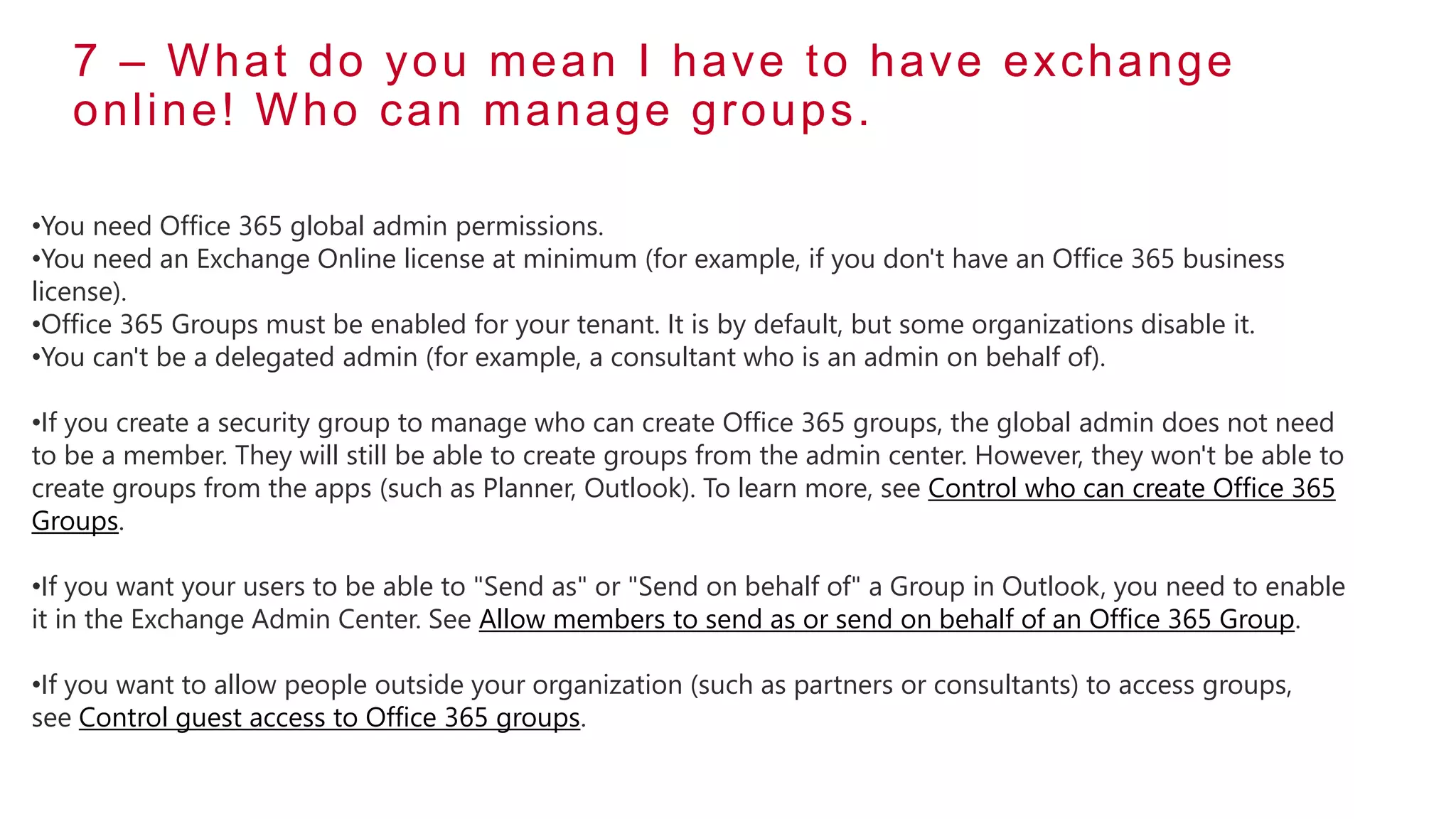
7 – What do you mean I have to have exchange
online! Who can manage groups.
•You need Office 365 global admin permissions.
•You need an Exchange Online license at minimum (for example, if you don't have an Office 365 business
license).
•Office 365 Groups must be enabled for your tenant. It is by default, but some organizations disable it.
•You can't be a delegated admin (for example, a consultant who is an admin on behalf of).
•If you create a security group to manage who can create Office 365 groups, the global admin does not need
to be a member. They will still be able to create groups from the admin center. However, they won't be able to
create groups from the apps (such as Planner, Outlook). To learn more, see Control who can create Office 365
Groups.
•If you want your users to be able to "Send as" or "Send on behalf of" a Group in Outlook, you need to enable
it in the Exchange Admin Center. See Allow members to send as or send on behalf of an Office 365 Group.
•If you want to allow people outside your organization (such as partners or consultants) to access groups,
see Control guest access to Office 365 groups.
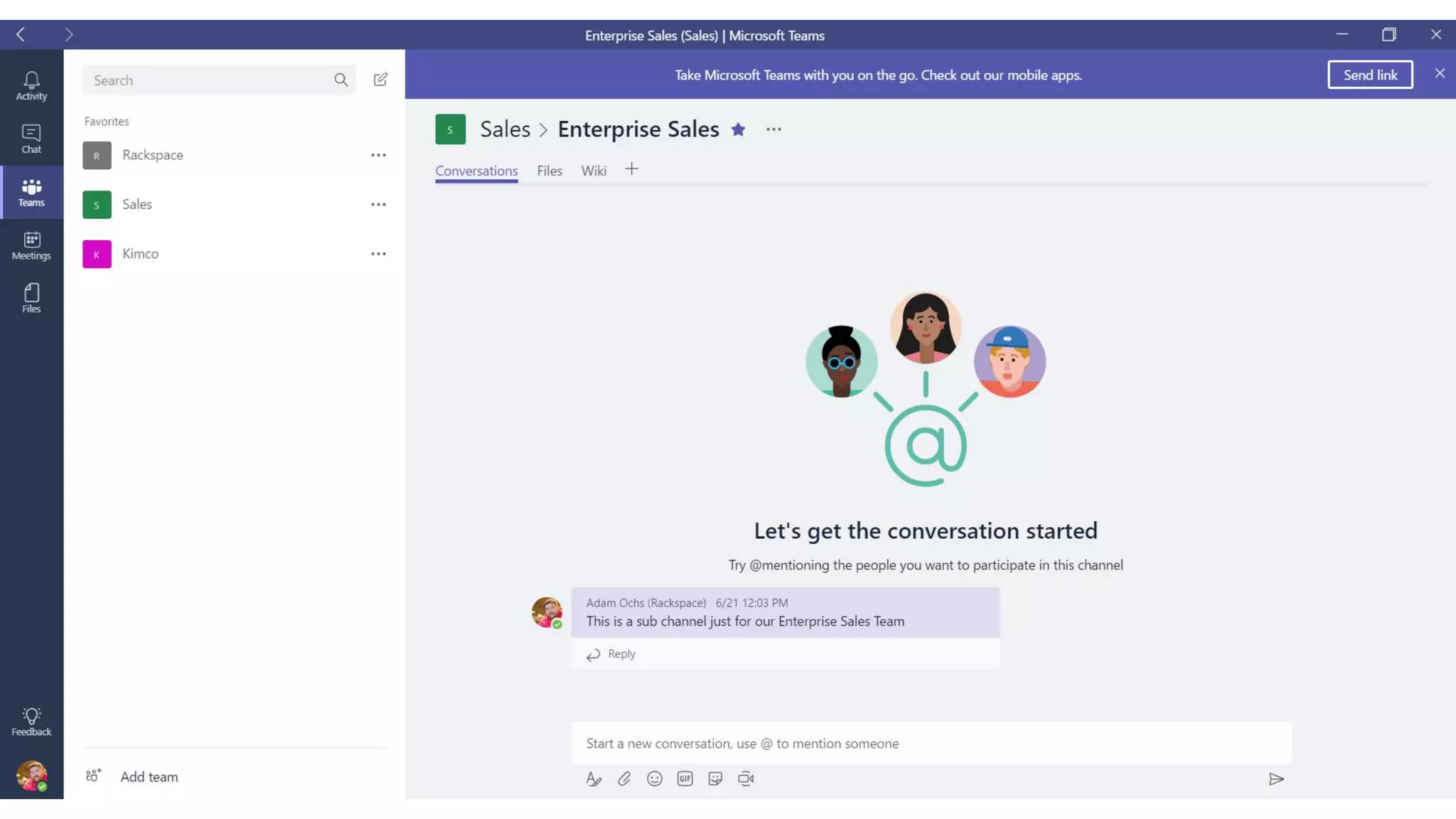
8 – Groups are CLOUD ONLY objects
- Teams have completely changed this conversation! The teams
app is the best way to consume O365 groups.
- Make your end users comfortable with OWA!
- The online applications are the place of choice for O365
groups if you are not using the teams app!
- Outlook is the next best thing, the rest is coming along!
9 – Converting your legacy DL’s into O365
groups
Why you should upgrade your DL to groups in
Outlook: https://aka.ms/whyupgradedls
Upgrade with one click via Exchange admin center
Upgrade via PowerShell scripts & more to come
Cross-premises DL upgrade possible using the
hummingbird tool
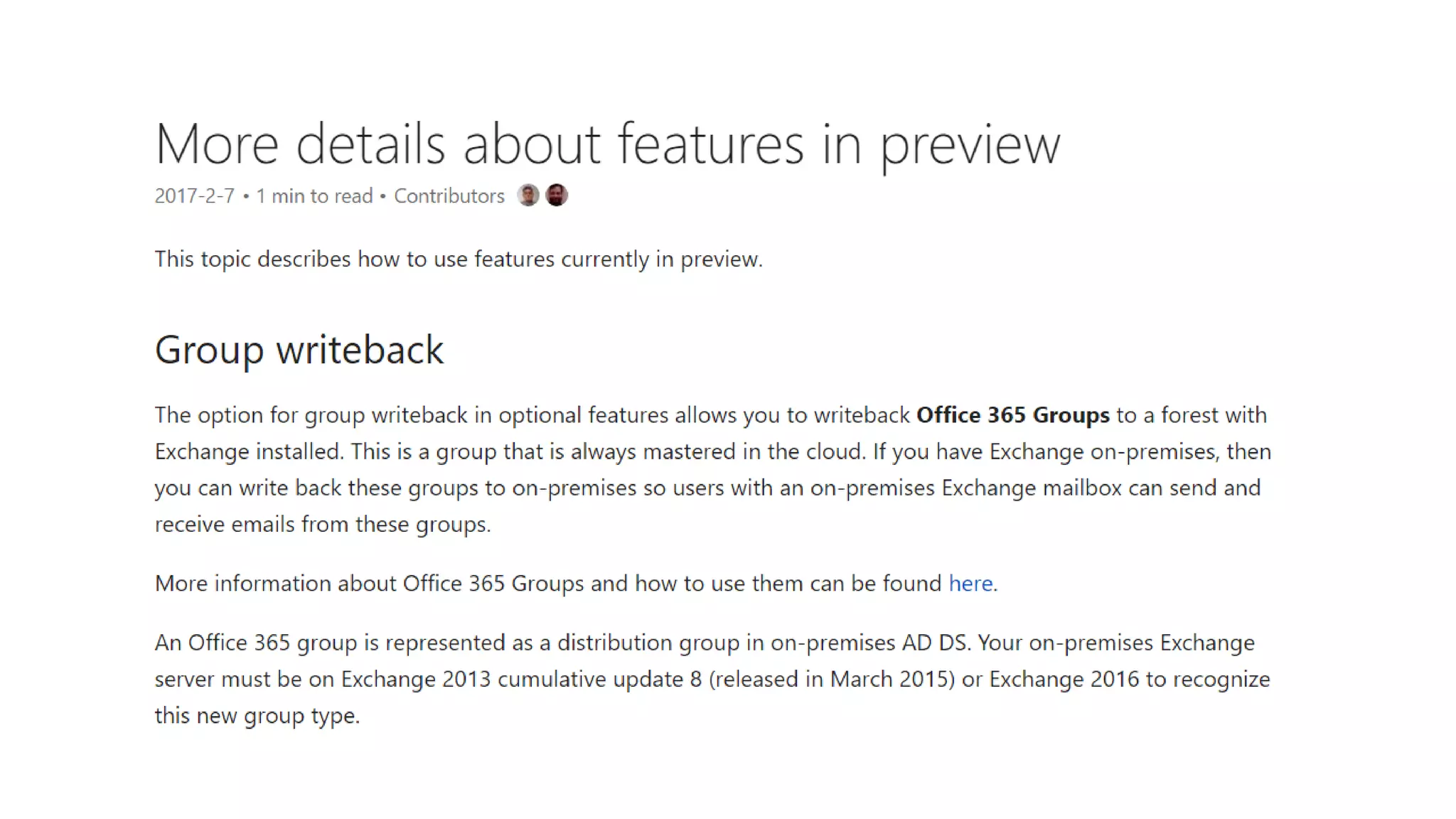
Configure Office 365 Groups with on-premises
Exchange
Migrate Public Folders to Office 365 Groups using
third party solutions from Binary Tree & Quadrotech
Microsoft Ignite recording: Migrate DL to groups in
Outlook
10 - The Greenest of Evergreen!
aka.ms/o365g
https://products.office.com/e
n-us/business/office-365-
roadmap

Adam ochs groups

  • 1.
    P r es e n t e r : A d a m O c h s D a t e : D e c e m b e r 2 0 1 9 O ff i c e 3 6 5 @ O 3 6 5 A d a m C o - P r e s e n t e r o f O ff i c e 3 6 5 P u l s e The top 10 things I wish I had known about Office 365 Groups
  • 2.
    Before we getinto our 10 reasons, lets talk about why it matters! Geographically Distributed Need varied ways to connect across locations and time-zones Internal & External Team Members Team members outside the firewall need unfettered access Multi-Generation Workforce Different expectations and preferences for tools Employees work on nearly 2xthe number of teams, compared to 5 years ago
  • 3.
    Different groups havedifferent needs Co-Creating Content Mail & Calendar Voice, Video & Meetings Chat-based Workspace Sites & Content Management Enterprise Social Today’s Challenges Siloed Apps Friction across applications – multiple logins, difficulty sharing and discovering information Shadow IT Incomplete toolset can lead to inconsistent security, compliance and risk Wasted Time Context switching between different apps drains attention and time
  • 4.
    #1 – Justhow integrated and fundamental Groups would become Complete Collaboration Solution Office 365 addresses the breadth of collaboration needs across your company Integrated Experiences Office 365 Groups and Graph enable integrated experiences that facilitate effective collaboration Security and Compliance Office 365 delivers the security, compliance and manageability required in today’s workplace Co-Creating Content Office 365 ProPlus Mail & Calendar Outlook Voice, Video & Meetings Skype Chat-based Workspace Microsoft Teams Sites & Content Management SharePoint Enterprise Social Yammer Office 365 Groups
  • 5.
    Office 365 Groups SimplifiesCollaboration Today Request DL for messaging Get SharePoint Site for files Create project plan Manually manage permissions on content Ramp up new team members based on previous group discussions Apply & manage policies on content Manually manage membership and access on DL Benefits for IT Group identity & assets created in a single step Centrally managed as a single object in Azure AD Simplified permissions and access structure Benefits for end users All group assets created in a single step Easy to manage independently New members onboard quickly Collaboration In the Past
  • 6.
    Generational Preferences atWork Baby Boomer (1946-1964) Generation X (1965-1979) Millennial (1980-1997) Generation Z (1998-2020) In Person Meeting Virtual Online Meeting (No Video) Virtual Online Meeting (Video) Email Team Workspaces Instant Message (IM) Enterprise Social Networking Persistent Chat Conversational User Interfaces Mostly preferAlways prefer Somewhat prefer Occasionally prefer Do not prefer Avanade Research, Wired Magazine: The Next Generation of Working Practices, Herman Miller: Generations at Work, EY Study on Generational Shifts For organizations with a multi-generation workforce, it is important to understand your demographics to know how to best find the balance of tools across the generations. If you are an organization that heavily relies on email, what are you doing for your new workers? Are you giving them the tools they need to be effective? Note: this is a generalization of observations, but any individual may cross multiple categories. © Copyright Avanade 2016
  • 8.
    #2 - Office365 Groups is a membership service User creates new group for collaboration Office 365 Application Group experience populated in app of choice Office 365 Application One Identity Azure Active Directory (AAD) is the master for group identity and membership across Office 365 (Exchange, SharePoint, etc.) Federated Resources O365 services extend with their data (e.g. Group messaging, SharePoint TeamSite, OneNote, Planner) Loose coupling Services notify each other of changes to a group (e.g., creation, deletion, updates). Group identity created Azure Active Directory Identity, Resource URLs, Owners, Members
  • 9.
    Controlling groups –Admin Center https://support.office.com/en-us/article/manage-who-can-create-office-365-groups- 4c46c8cb-17d0-44b5-9776-005fced8e618
  • 10.
  • 11.
    3 – ManagingO365 groups is access by many, mastered by none https://docs.microsoft.com/en-us/azure/active-directory/active-directory-accessmanagement-groups- settings-cmdlets Cmdlet name Description Get-UnifiedGroup Use this cmdlet to look up existing Office 365 groups, and to view properties of the group object. Set-UnifiedGroup Update the properties of a specific Office 365 group. New-UnifiedGroup Create a new Office 365 group. This cmdlet provides a minimal set of parameters, for setting values for extended properties use Set-UnifiedGroup after creating the new group. Remove-UnifiedGroup Delete an existing Office 365 group. Get-UnifiedGroupLinks Retrieve membership and owner information for an Office 365 group. Add-UnifiedGroupLinks Add members and owners to an existing Office 365 group. Remove-UnifiedGroupLinks Remove owners and members from an existing Office 365 group.
  • 12.
    Controlling site creationtype and quota Set-SPOSite –Identity https://contoso.sharepoint.com/sites/groupname - StorageQuota 3000 -StorageQuotaWarningLevel 2000
  • 13.
    Deletion recovery (soft-delete) ExpiringGroups Preservation and deletion policies Naming policy Banned words and profanity checking http://fasttrack.microsoft.com/roadmap 4 - What it means to delete! What’s Next?
  • 14.
    You can nowhave multiple plans per group. Archiving old plans has been in conversations for awhile, but I have yet to see it work properly.
  • 15.
    End User Create group Setas public/private Add members & admins Add/remove external members Delete group Tenant Admin Pull reports on group activity Control who can create groups Establish dynamic membership Set naming & retention policies Master permissions for groups Admin Tools 5 - How to manage group membership > Get-UnifiedGroup #create/update/view groups and their settings > Get-UnifiedGroupLinks #Manage members, owners, and subscriber list > Get-MsolSettings #Manage tenant-wide group settings Admin UI Office 365 Admin Center Office 365 Admin app Azure AD Admin Portal Exchange Admin console PowerShell Execute against Azure AD as primary Synchronous notification/update in Exchange/SP *-UnifiedGroup / *-MsolGroup *-UnifiedGroupLinks *-MsolSettings
  • 16.
    6 – Ok!But what about external users? How external guest access works User adds guest@gmail.com Contoso Azure AD manages guest ID, maps to Office 365 Group Guest ID synched to Exchange Online, SharePoint Online Guest access in Office 365 groups | Guest access in Office 365 groups – Admin Help Guest access to resources governed by organization policies
  • 17.
    7 – Whatdo you mean I have to have exchange online! Who can manage groups. •You need Office 365 global admin permissions. •You need an Exchange Online license at minimum (for example, if you don't have an Office 365 business license). •Office 365 Groups must be enabled for your tenant. It is by default, but some organizations disable it. •You can't be a delegated admin (for example, a consultant who is an admin on behalf of). •If you create a security group to manage who can create Office 365 groups, the global admin does not need to be a member. They will still be able to create groups from the admin center. However, they won't be able to create groups from the apps (such as Planner, Outlook). To learn more, see Control who can create Office 365 Groups. •If you want your users to be able to "Send as" or "Send on behalf of" a Group in Outlook, you need to enable it in the Exchange Admin Center. See Allow members to send as or send on behalf of an Office 365 Group. •If you want to allow people outside your organization (such as partners or consultants) to access groups, see Control guest access to Office 365 groups.
  • 18.
    8 – Groupsare CLOUD ONLY objects - Teams have completely changed this conversation! The teams app is the best way to consume O365 groups. - Make your end users comfortable with OWA! - The online applications are the place of choice for O365 groups if you are not using the teams app! - Outlook is the next best thing, the rest is coming along!
  • 22.
    9 – Convertingyour legacy DL’s into O365 groups Why you should upgrade your DL to groups in Outlook: https://aka.ms/whyupgradedls Upgrade with one click via Exchange admin center Upgrade via PowerShell scripts & more to come Cross-premises DL upgrade possible using the hummingbird tool Configure Office 365 Groups with on-premises Exchange Migrate Public Folders to Office 365 Groups using third party solutions from Binary Tree & Quadrotech Microsoft Ignite recording: Migrate DL to groups in Outlook
  • 24.
    10 - TheGreenest of Evergreen! aka.ms/o365g https://products.office.com/e n-us/business/office-365- roadmap