ADA REPORTS


Position of the American Dietetic Association and
Dietitians of Canada: Vegetarian diets

                                                                     POSITION STATEMENT
ABSTRACT                                                             It is the position of the American Dietetic Association and
                                                                     Dietitians of Canada that appropriately planned vegetar-
It is the position of the American Dietetic Association and          ian diets are healthful, nutritionally adequate, and pro-
Dietitians of Canada that appropriately planned vegetarian diets     vide health benefits in the prevention and treatment of cer-
are healthful, nutritionally adequate, and provide health benefits    tain diseases.
in the prevention and treatment of certain diseases. Approxi-
mately 2.5% of adults in the United States and 4% of adults in       VEGETARIANISM IN PERSPECTIVE
Canada follow vegetarian diets. A vegetarian diet is defined as       A vegetarian is a person who does not eat meat, fish, or fowl or
one that does not include meat, fish, or fowl. Interest in vege-      products containing these foods. The eating patterns of vege-
tarianism appears to be increasing, with many restaurants            tarians may vary considerably. The lacto-ovo-vegetarian eating
and college foodservices offering vegetarian meals routinely.        pattern is based on grains, vegetables, fruits, legumes, seeds,
Substantial growth in sales of foods attractive to vegetarians       nuts, dairy products, and eggs but excludes meat, fish, and
has occurred, and these foods appear in many supermarkets.           fowl. The lacto-vegetarian excludes eggs as well as meat, fish,
This position paper reviews the current scientific data related       and fowl. The vegan, or total vegetarian, eating pattern is sim-
to key nutrients for vegetarians, including protein, iron, zinc,     ilar to the lacto-vegetarian pattern, with the additional exclu-
calcium, vitamin D, riboflavin, vitamin B-12, vitamin A, n-3          sion of dairy and other animal products. Even within these
fatty acids, and iodine. A vegetarian, including vegan, diet can     patterns, considerable variation may exist in the extent to
meet current recommendations for all of these nutrients. In          which animal products are avoided.
some cases, use of fortified foods or supplements can be help-           People choosing macrobiotic diets are frequently identified
ful in meeting recommendations for individual nutrients.             as following a vegetarian diet. The macrobiotic diet is based
Well-planned vegan and other types of vegetarian diets are           largely on grains, legumes, and vegetables. Fruits, nuts, and
appropriate for all stages of the life cycle, including during       seeds are used to a lesser extent. Some people following a
pregnancy, lactation, infancy, childhood, and adolescence.           macrobiotic diet are not truly vegetarian because they use lim-
Vegetarian diets offer a number of nutritional benefits, in-          ited amounts of fish. Some “self-described” vegetarians, who
cluding lower levels of saturated fat, cholesterol, and animal       are not vegetarians at all, will eat fish, chicken, or even meat
protein as well as higher levels of carbohydrates, fiber, mag-        (1,2). Some research studies have identified these “self-de-
nesium, potassium, folate, and antioxidants such as vitamins         scribed” vegetarians as semivegetarians and have defined semi-
C and E and phytochemicals. Vegetarians have been reported           vegetarian as occasional meat eaters who predominately prac-
to have lower body mass indices than nonvegetarians, as well         tice a vegetarian diet (3) or those who eat fish and poultry but
as lower rates of death from ischemic heart disease; vegetari-       less than 1 time per week (4). Individual assessment is required
ans also show lower blood cholesterol levels; lower blood            to accurately evaluate the nutritional quality of the diet of a
pressure; and lower rates of hypertension, type 2 diabetes,          vegetarian or someone who says that they are vegetarian.
and prostate and colon cancer. Although a number of feder-              Common reasons for choosing a vegetarian diet include health
ally funded and institutional feeding programs can accommo-          considerations, concern for the environment, and animal welfare
date vegetarians, few have foods suitable for vegans at this time.   factors (5,6). Vegetarians also cite economic reasons, ethical con-
Because of the variability of dietary practices among vegetari-      siderations, world hunger issues, and religious beliefs as their rea-
ans, individual assessment of dietary intakes of vegetarians is      sons for following their chosen eating pattern.
required. Dietetics professionals have a responsibility to support
and encourage those who express an interest in consuming a           Consumer Trends
vegetarian diet. They can play key roles in educating vegetarian     In 2000, approximately 2.5% of the US adult population (4.8
clients about food sources of specific nutrients, food purchase       million people) consistently followed a vegetarian diet and af-
and preparation, and any dietary modifications that may be nec-       firmed that they never ate meat, fish, or poultry (7). Slightly
essary to meet individual needs. Menu planning for vegetarians       less than 1% of those polled were vegans (7). According to this
can be simplified by use of a food guide that specifies food           poll, vegetarians are most likely to live on the east or west coast,
groups and serving sizes. J Am Diet Assoc. 2003;103:748-765.         in large cities, and to be female. Approximately 2% of 6- to


                                                                       Copyright © 2003 by the American Dietetic Association.
                                                                       doi: 10.1053/jada.2003.50142


748 / June 2003 Volume 103 Number 6
ADA REPORTS


17-year-old children and adolescents in the United States are         from $310 million in 1996 (21). This market is expected to nearly
vegetarians, and around 0.5% of this age group are vegan (8).         double by 2006 to $2.8 billion (21). Canadian sales of meat analogs
According to a 2002 survey (9), about 4% of Canadian adults           more than tripled between 1997 and 2001 (22).
are vegetarian; this represents an estimated 900,000 people.             The ready availability of new products, including fortified
Factors that may affect the number of vegetarians in the United       foods and convenience foods would be expected to have a
States and Canada in the future include an increased interest in      marked impact on nutrient intake of vegetarians. Fortified
vegetarianism and the arrival of immigrants from countries            foods such as soymilks, meat analogs, juices, and breakfast
where vegetarianism is commonly practiced (10). Twenty to             cereals can add substantially to vegetarians’ intakes of calcium,
25% of adults in the United States report that they eat 4 or          iron, zinc, vitamin B-12, vitamin D, and riboflavin. Vegetarian
more meatless meals weekly or “usually or sometimes maintain          convenience foods including veggie burgers and veggie dogs,
a vegetarian diet,” suggesting an interest in vegetarianism (11).     frozen entrees, meals in a cup, and soymilk can make it much
Additional evidence for the increased interest in vegetarianism       simpler to be a vegetarian today than in the past.
includes the emergence of animal rights/ethics courses on col-           Vegetarian foods are readily available, both in supermarkets
lege and university campuses; the proliferation of Web sites,         and in natural foods stores. About half of vegetarian foods vol-
magazines and newsletters, and cookbooks with a vegetarian            ume is sold through supermarkets and about half through nat-
theme; and the public’s attitude toward ordering a vegetarian         ural foods stores (21). Three-fourths of soymilk sales take
meal when eating away from home. More than 5% of those                place in supermarkets (21).
surveyed in 1999 said they always order a vegetarian meal
when they eat out; close to 60% “sometimes, often, or always”         Public Policy Statements and Vegetarian Diets
order a vegetarian item at a restaurant (12).                         The United States Dietary Guidelines (23) state, “Vegetarian
   Restaurants have responded to this interest in vegetarian-         diets can be consistent with the Dietary Guidelines for Amer-
ism. The National Restaurant Association reports that 8 out of        icans, and meet Recommended Dietary Allowances for nutri-
10 restaurants in the United States with table service offer          ents.” They give recommendations on meeting nutrient re-
vegetarian entrees (13). Fast-food restaurants are beginning to       quirements for those who choose to avoid all or most animal
offer salads, veggie burgers, and other vegetarian options.           products. Some have said that implementation of the Dietary
Many college students consider themselves vegetarians. In re-         Guidelines can best be achieved by use of vegetarian and plant-
sponse to this, most university foodservices offer vegetarian         rich diets (24). National food guides include some vegetarian
options (14).                                                         options. Foods commonly eaten by vegetarians such as le-
   There has also been a growth in professional interest in veg-      gumes, tofu, soyburgers, and soymilk with added calcium are
etarian nutrition; the number of articles in the scientific litera-    included in a table accompanying the USDA’s Food Guide Pyr-
ture related to vegetarianism has increased from less than 10         amid (23). Canada’s Food Guide to Healthy Eating can be used
articles per year in the late 1960s to 76 articles per year in the    by lacto and lacto-ovo-vegetarians (25). Health Canada has
1990s (15). In addition, the main focus of the articles is chang-     stated that well-planned vegetarian diets are supportive of
ing. Twenty-five or more years ago, articles primarily had             good nutritional status and health (26).
themes questioning the nutritional adequacy of vegetarian di-
ets. More recently, the theme has been the use of vegetarian          HEALTH IMPLICATIONS OF VEGETARIANISM
diets in the prevention and treatment of disease. More articles       Vegetarian diets offer a number of advantages, including lower
feature epidemiological studies, and fewer reports are case           levels of saturated fat, cholesterol, and animal protein and
studies and letters to the editor (15).                               higher levels of carbohydrates, fiber, magnesium, boron, folate,
   There is a growing appreciation for the benefits of plant-          antioxidants such as vitamins C and E, carotenoids, and phyto-
based diets, defined as diets that include generous amounts of         chemicals (27-30). Some vegans may have intakes for vitamin
plant foods and limited amounts of animal foods. The American         B-12, vitamin D, calcium, zinc, and occasionally riboflavin that
Institute for Cancer Research and the World Cancer Research           are lower than recommended (27,29,31).
Fund call for choosing predominantly plant-based diets rich in
a variety of vegetables and fruits, legumes, and minimally pro-       NUTRITION CONSIDERATIONS FOR VEGETARIANS
cessed starchy staple foods and limiting red meat consumption,
if red meat is eaten at all (16). The American Cancer Society         Protein
recommends choosing most food from plant sources (17). The            Plant protein can meet requirements when a variety of plant foods
American Heart Association recommends choosing a balanced             is consumed and energy needs are met. Research indicates that an
diet with an emphasis on vegetables, grains, and fruits (18),         assortment of plant foods eaten over the course of a day can pro-
and the Heart and Stroke Foundation of Canada recommends              vide all essential amino acids and ensure adequate nitrogen reten-
using grains and vegetables instead of meat as the centerpiece        tion and use in healthy adults, thus complementary proteins do
of meals (19). The Unified Dietary Guidelines developed by the         not need to be consumed at the same meal (32).
American Cancer Society, the American Heart Association, the             Estimates of protein requirements of vegans vary, depending to
National Institutes of Health, and the American Academy of            some degree on diet choices (33). A recent metaanalysis of nitro-
Pediatrics call for a diet based on a variety of plant foods, in-     gen balance studies found no significant difference in protein
cluding grain products, vegetables, and fruits to reduce risk of      needs due to the source of dietary protein (34,35). Based primar-
major chronic diseases (20).                                          ily on the lower digestibility of plant proteins, other groups have
                                                                      suggested that protein requirements of vegans may be increased
New Product Availability                                              by 30% to 35% for infants up to the age of 2 years, 20% to 30% for
The US market for vegetarian foods (foods like meat analogs, non-     2- to 6-year-old children, and 15% to 20% for those 6 years and
dairy milks, and vegetarian entrees that directly replace meat or     older, in comparison with those of nonvegetarians (36).
other animal products) was estimated to be $1.5 billion in 2002, up      The quality of plant proteins varies. Based on the protein


                                                                               Journal of THE AMERICAN DIETETIC ASSOCIATION / 749
ADA REPORTS


digestibility corrected amino acid score (PDCAAS), which is           etarians, their serum ferritin levels are usually within the nor-
the standard method for determining protein quality, isolated         mal range (58-62).
soy protein can meet protein needs as effectively as animal
protein, whereas wheat protein eaten alone, for example, may          Zinc
be 50% less usable than animal protein (37). Nutrition care           Because phytate binds zinc, and animal protein is believed to
professionals should be aware that protein needs might be             enhance zinc absorption, total zinc bioavailability appears to be
higher than the RDA in vegetarians whose dietary protein              lower on vegetarian diets (63). Also, some vegetarians have
sources are mainly those that are less well digested, such as         diets that are significantly below recommended intakes for zinc
some cereals and legumes.                                             (27,29,64,65). Although overt zinc deficiency has not been
   Cereals tend to be low in lysine, an essential amino acid. This    seen in Western vegetarians, the effects of marginal intakes are
may be relevant when evaluating diets of individuals who do           poorly understood (66). Zinc requirements for vegetarians
not consume animal protein sources and are relatively low in          whose diets are high in phytate may exceed the RDA (44). Zinc
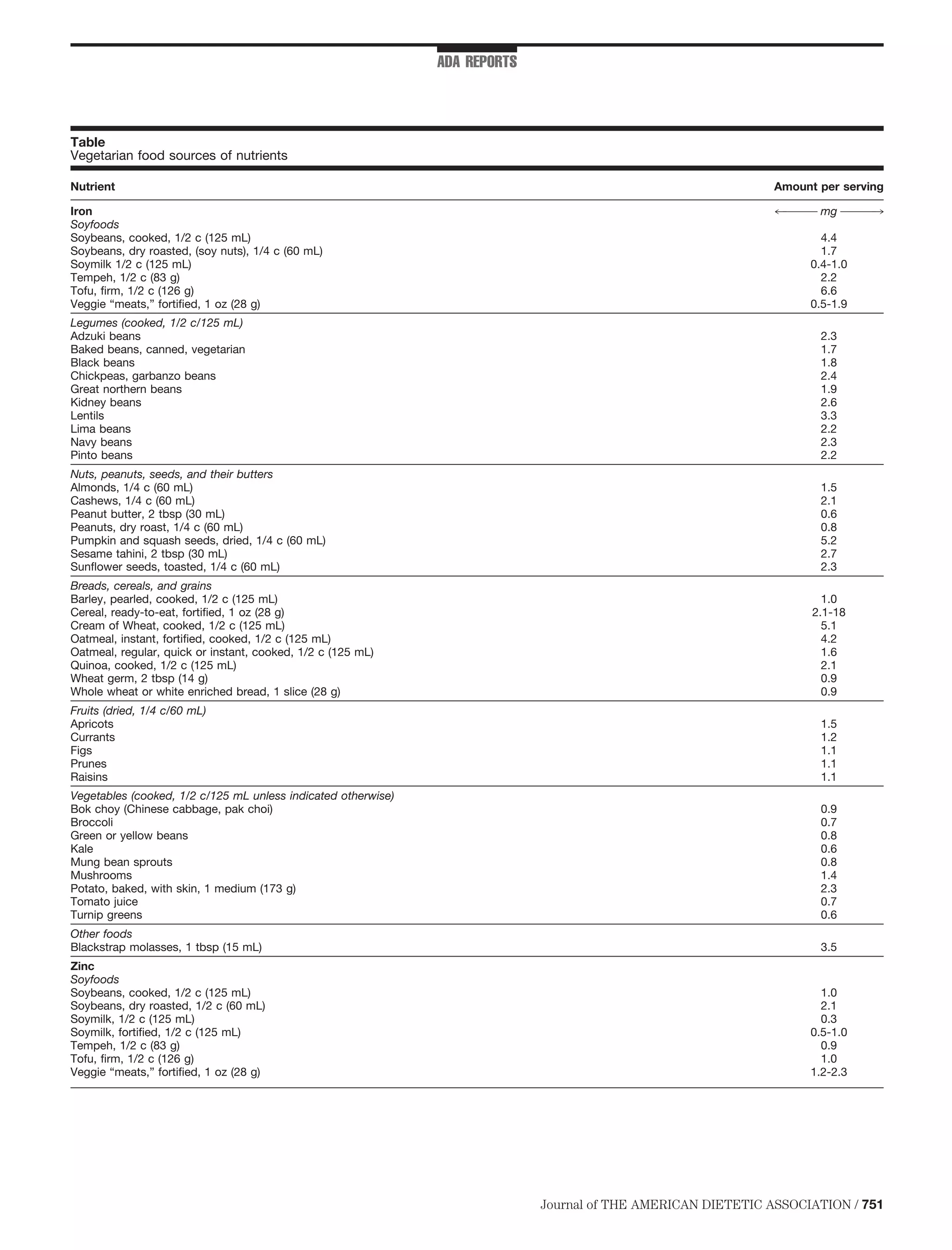
protein (35). Dietary adjustments such as the use of more             sources are shown in the Table.
beans and soy products in place of other protein sources that           Compensatory mechanisms may help vegetarians adapt to
are lower in lysine or an increase in dietary protein from all        lower intakes of zinc (65,67). Some food preparation tech-
sources can ensure an adequate intake of lysine.                      niques, such as soaking and sprouting beans, grains, and seeds
   Although some vegan women have protein intakes that are mar-       as well as leavening bread, can reduce binding of zinc by
ginal, typical protein intakes of lacto-ovo-vegetarians and of veg-   phytate and increase zinc bioavailability (49,50,68).
ans appear to meet and exceed requirements (29). Athletes can
also meet their protein needs on plant-based diets (38,39).           Calcium
                                                                      Calcium is present in many plant foods and fortified foods (see
Iron                                                                  Table). Low-oxalate greens (bok choy, broccoli, Chinese/Napa
Plant foods contain only nonheme iron, which is more sensitive        cabbage, collards, kale, okra, turnip greens) provide calcium
than heme iron to both inhibitors and enhancers of iron absorp-       with high bioavailability (49% to 61%), in comparison with cal-
tion. Inhibitors of iron absorption include phytate; calcium;         cium-set tofu, fortified fruit juices, and cow’s milk (bioavailabil-
teas, including some herb teas; coffee; cocoa; some spices; and       ity in the range of 31% to 32%) and with fortified soymilk,
fiber (40). Vitamin C and other organic acids found in fruits and      sesame seeds, almonds, and red and white beans (bioavailabil-
vegetables can enhance iron absorption and can help to reduce         ity of 21% to 24%) (69-71). Figs and soy foods such as cooked
effects of phytate (41-43). Studies show that iron absorption         soybeans, soy nuts, and tempeh provide additional calcium.
would be significantly reduced if a diet were to be high in in-        Calcium-fortified foods include fruit juices, tomato juice, and
hibitors and low in enhancers. Recommended iron intakes for           breakfast cereals. Thus, various food groups contribute dietary
vegetarians are 1.8 times those of nonvegetarians because of          calcium (72,73). Oxalates present in some foods can greatly
lower bioavailability of iron from a vegetarian diet (44).            reduce calcium absorption, so vegetables that are very high in
   The main inhibitor of iron absorption in vegetarian diets is       these compounds, such as spinach, beet greens, and Swiss
phytate. Because iron intake increases as phytate intake in-          chard, are not good sources of usable calcium despite their high
creases, effects on iron status are somewhat less than might be       calcium content. Phytate may also inhibit calcium absorption.
expected. Fiber appears to have a minor effect on iron absorp-        However, some foods with high contents of both phytate and
tion (45,46). Vitamin C, consumed at the same time as the iron        oxalate, such as soy foods, still provide well-absorbed calcium
source, can help to reduce the inhibitory effects of phytate          (71). Factors that enhance calcium absorption include ade-
(42,43), and some research links high vitamin C intake to im-         quate vitamin D and protein.
proved iron status (47,48). The same is true for organic acids in        Calcium intakes of lacto-vegetarians are comparable with or
fruits and vegetables (41). The higher intakes of vitamin C and       higher than those of nonvegetarians (74,75), whereas intakes
of vegetables and fruits by vegetarians can favorably impact          of vegans tend to be lower than both groups and often below
iron absorption (2). Some food preparation techniques such as         recommended intakes (27,31,71,75). Diets high in sulfur-con-
soaking and sprouting beans, grains, and seeds can hydrolyze          taining amino acids may increase losses of calcium from bone.
phytate (49-51) and may improve iron absorption (42,51,52).           Foods with a relatively high ratio of sulfur-containing amino
Leavening of breads hydrolyzes phytate and enhances iron ab-          acids to protein include eggs, meat, fish, poultry, dairy prod-
sorption (49-51,53,54). Other fermentation processes, such as         ucts, nuts, and many grains. There is some evidence that the
those used to make soy foods like miso and tempeh, may also           impact of sulfur-containing amino acids is only important with
make iron more available (55), although not all research sup-         low calcium intakes. Excessive sodium intake may also pro-
ports this. Whereas many studies of iron absorption have been         mote calcium losses. In addition, some studies show that the
short term, there is evidence that adaptation to low intakes          ratio of dietary calcium to protein is more predictive of bone
takes place over the longer term and involves both increased          health than calcium intake alone. Typically, this ratio is high in
absorption and decreased losses (56,57). It is likely that iron       lacto-ovo-vegetarian diets and favors bone health, whereas
needs will depend on the make up of the overall diet and be           vegans have a calcium to protein ratio that is similar to or lower
significantly lower for some vegetarians than for others.              than that of nonvegetarians (71,76).
   Studies typically show iron intake by vegans to be higher             All vegetarians should meet the recommended intakes for
than that of lacto-ovo-vegetarians and of nonvegetarians, and         calcium, established for their age group by the Institute of Med-
most studies show iron intake by lacto-ovo-vegetarians to be          icine (77). This can be accomplished, in nonpregnant, nonlac-
higher than that of nonvegetarians (29). Iron sources are             tating adults, by consuming at least 8 servings per day of foods
shown in the Table. Incidence of iron deficiency anemia among          that provide 10% to 15% of the Adequate Intake (AI) for cal-
vegetarians is similar to that of nonvegetarians (29,31,58). Al-      cium, as indicated in the Vegetarian Food Guide Pyramid and
though vegetarian adults have lower iron stores than nonveg-          Vegetarian Food Guide Rainbow (72,73). Adjustments for


750 / June 2003 Volume 103 Number 6
ADA REPORTS


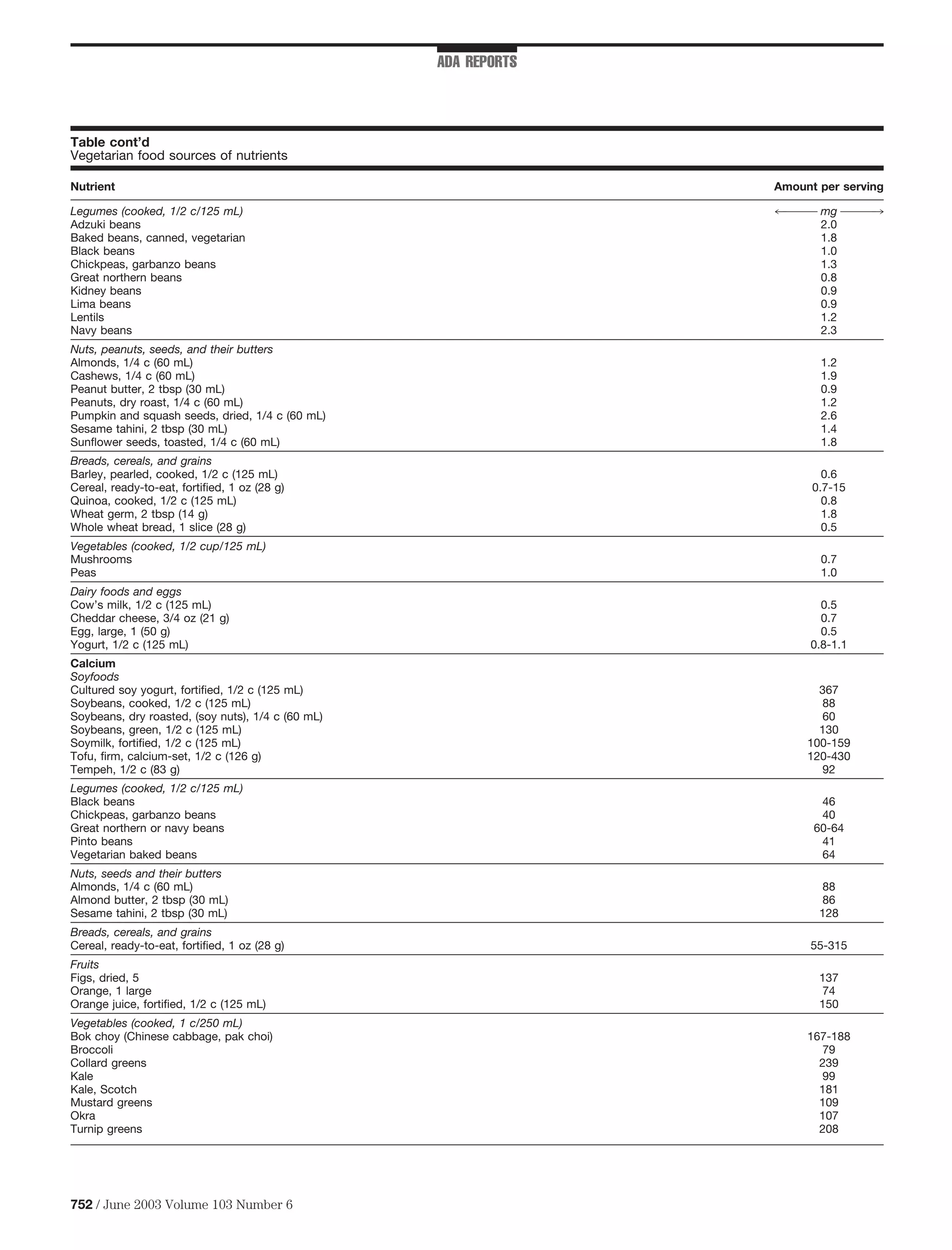
Table
Vegetarian food sources of nutrients

Nutrient                                                                                                       Amount per serving

Iron                                                                                                           4™™™™™™ mg ™™™™™™
                                                                                                                               3
Soyfoods
Soybeans, cooked, 1/2 c (125 mL)                                                                                      4.4
Soybeans, dry roasted, (soy nuts), 1/4 c (60 mL)                                                                      1.7
Soymilk 1/2 c (125 mL)                                                                                              0.4-1.0
Tempeh, 1/2 c (83 g)                                                                                                  2.2
Tofu, firm, 1/2 c (126 g)                                                                                              6.6
Veggie “meats,” fortified, 1 oz (28 g)                                                                               0.5-1.9
Legumes (cooked, 1/2 c/125 mL)
Adzuki beans                                                                                                          2.3
Baked beans, canned, vegetarian                                                                                       1.7
Black beans                                                                                                           1.8
Chickpeas, garbanzo beans                                                                                             2.4
Great northern beans                                                                                                  1.9
Kidney beans                                                                                                          2.6
Lentils                                                                                                               3.3
Lima beans                                                                                                            2.2
Navy beans                                                                                                            2.3
Pinto beans                                                                                                           2.2
Nuts, peanuts, seeds, and their butters
Almonds, 1/4 c (60 mL)                                                                                                1.5
Cashews, 1/4 c (60 mL)                                                                                                2.1
Peanut butter, 2 tbsp (30 mL)                                                                                         0.6
Peanuts, dry roast, 1/4 c (60 mL)                                                                                     0.8
Pumpkin and squash seeds, dried, 1/4 c (60 mL)                                                                        5.2
Sesame tahini, 2 tbsp (30 mL)                                                                                         2.7
Sunflower seeds, toasted, 1/4 c (60 mL)                                                                                2.3
Breads, cereals, and grains
Barley, pearled, cooked, 1/2 c (125 mL)                                                                                1.0
Cereal, ready-to-eat, fortified, 1 oz (28 g)                                                                          2.1-18
Cream of Wheat, cooked, 1/2 c (125 mL)                                                                                 5.1
Oatmeal, instant, fortified, cooked, 1/2 c (125 mL)                                                                     4.2
Oatmeal, regular, quick or instant, cooked, 1/2 c (125 mL)                                                             1.6
Quinoa, cooked, 1/2 c (125 mL)                                                                                         2.1
Wheat germ, 2 tbsp (14 g)                                                                                              0.9
Whole wheat or white enriched bread, 1 slice (28 g)                                                                    0.9
Fruits (dried, 1/4 c/60 mL)
Apricots                                                                                                              1.5
Currants                                                                                                              1.2
Figs                                                                                                                  1.1
Prunes                                                                                                                1.1
Raisins                                                                                                               1.1
Vegetables (cooked, 1/2 c/125 mL unless indicated otherwise)
Bok choy (Chinese cabbage, pak choi)                                                                                  0.9
Broccoli                                                                                                              0.7
Green or yellow beans                                                                                                 0.8
Kale                                                                                                                  0.6
Mung bean sprouts                                                                                                     0.8
Mushrooms                                                                                                             1.4
Potato, baked, with skin, 1 medium (173 g)                                                                            2.3
Tomato juice                                                                                                          0.7
Turnip greens                                                                                                         0.6
Other foods
Blackstrap molasses, 1 tbsp (15 mL)                                                                                   3.5
Zinc
Soyfoods
Soybeans, cooked, 1/2 c (125 mL)                                                                                      1.0
Soybeans, dry roasted, 1/2 c (60 mL)                                                                                  2.1
Soymilk, 1/2 c (125 mL)                                                                                               0.3
Soymilk, fortified, 1/2 c (125 mL)                                                                                   0.5-1.0
Tempeh, 1/2 c (83 g)                                                                                                  0.9
Tofu, firm, 1/2 c (126 g)                                                                                              1.0
Veggie “meats,” fortified, 1 oz (28 g)                                                                               1.2-2.3


                                                                             Journal of THE AMERICAN DIETETIC ASSOCIATION / 751
ADA REPORTS


Table cont’d
Vegetarian food sources of nutrients

Nutrient                                                         Amount per serving

Legumes (cooked, 1/2 c/125 mL)                                   4™™™™™™ mg ™™™™™™
                                                                                 3
Adzuki beans                                                             2.0
Baked beans, canned, vegetarian                                          1.8
Black beans                                                              1.0
Chickpeas, garbanzo beans                                                1.3
Great northern beans                                                     0.8
Kidney beans                                                             0.9
Lima beans                                                               0.9
Lentils                                                                  1.2
Navy beans                                                               2.3
Nuts, peanuts, seeds, and their butters
Almonds, 1/4 c (60 mL)                                                  1.2
Cashews, 1/4 c (60 mL)                                                  1.9
Peanut butter, 2 tbsp (30 mL)                                           0.9
Peanuts, dry roast, 1/4 c (60 mL)                                       1.2
Pumpkin and squash seeds, dried, 1/4 c (60 mL)                          2.6
Sesame tahini, 2 tbsp (30 mL)                                           1.4
Sunflower seeds, toasted, 1/4 c (60 mL)                                  1.8
Breads, cereals, and grains
Barley, pearled, cooked, 1/2 c (125 mL)                                  0.6
Cereal, ready-to-eat, fortified, 1 oz (28 g)                            0.7-15
Quinoa, cooked, 1/2 c (125 mL)                                           0.8
Wheat germ, 2 tbsp (14 g)                                                1.8
Whole wheat bread, 1 slice (28 g)                                        0.5
Vegetables (cooked, 1/2 cup/125 mL)
Mushrooms                                                               0.7
Peas                                                                    1.0
Dairy foods and eggs
Cow’s milk, 1/2 c (125 mL)                                              0.5
Cheddar cheese, 3/4 oz (21 g)                                           0.7
Egg, large, 1 (50 g)                                                    0.5
Yogurt, 1/2 c (125 mL)                                                0.8-1.1
Calcium
Soyfoods
Cultured soy yogurt, fortified, 1/2 c (125 mL)                           367
Soybeans, cooked, 1/2 c (125 mL)                                        88
Soybeans, dry roasted, (soy nuts), 1/4 c (60 mL)                        60
Soybeans, green, 1/2 c (125 mL)                                         130
Soymilk, fortified, 1/2 c (125 mL)                                     100-159
Tofu, firm, calcium-set, 1/2 c (126 g)                                 120-430
Tempeh, 1/2 c (83 g)                                                    92
Legumes (cooked, 1/2 c/125 mL)
Black beans                                                             46
Chickpeas, garbanzo beans                                               40
Great northern or navy beans                                           60-64
Pinto beans                                                             41
Vegetarian baked beans                                                  64
Nuts, seeds and their butters
Almonds, 1/4 c (60 mL)                                                  88
Almond butter, 2 tbsp (30 mL)                                           86
Sesame tahini, 2 tbsp (30 mL)                                           128
Breads, cereals, and grains
Cereal, ready-to-eat, fortified, 1 oz (28 g)                           55-315
Fruits
Figs, dried, 5                                                          137
Orange, 1 large                                                         74
Orange juice, fortified, 1/2 c (125 mL)                                  150
Vegetables (cooked, 1 c/250 mL)
Bok choy (Chinese cabbage, pak choi)                                  167-188
Broccoli                                                                79
Collard greens                                                          239
Kale                                                                    99
Kale, Scotch                                                            181
Mustard greens                                                          109
Okra                                                                    107
Turnip greens                                                           208


752 / June 2003 Volume 103 Number 6
ADA REPORTS


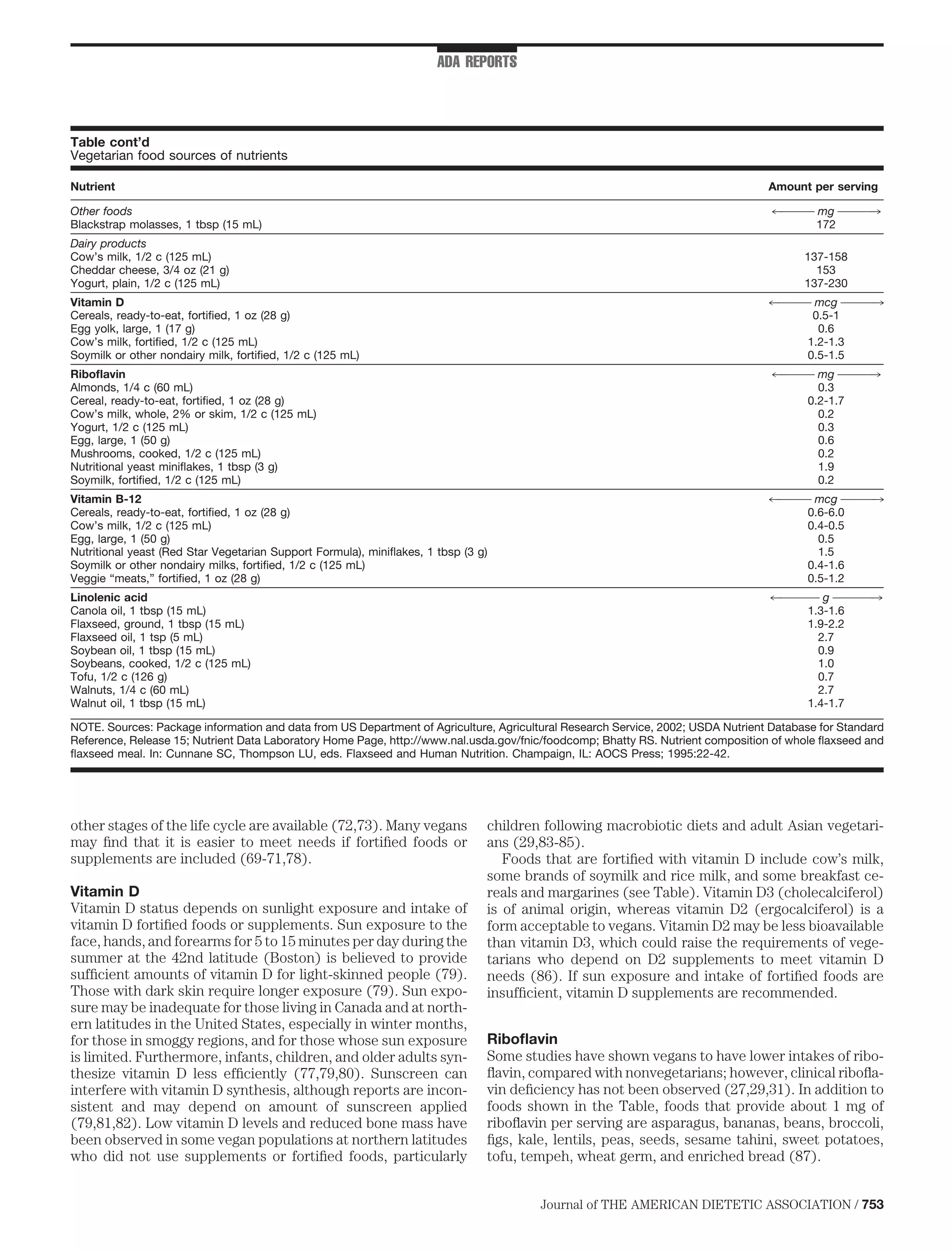
Table cont’d
Vegetarian food sources of nutrients

Nutrient                                                                                                                         Amount per serving

Other foods                                                                                                                       4™™™™™™ mg ™™™™™™
                                                                                                                                                  3
Blackstrap molasses, 1 tbsp (15 mL)                                                                                                       172
Dairy products
Cow’s milk, 1/2 c (125 mL)                                                                                                              137-158
Cheddar cheese, 3/4 oz (21 g)                                                                                                             153
Yogurt, plain, 1/2 c (125 mL)                                                                                                           137-230
Vitamin D                                                                                                                        4™™™™™™ mcg ™™™™™™
                                                                                                                                                  3
Cereals, ready-to-eat, fortified, 1 oz (28 g)                                                                                            0.5-1
Egg yolk, large, 1 (17 g)                                                                                                                0.6
Cow’s milk, fortified, 1/2 c (125 mL)                                                                                                   1.2-1.3
Soymilk or other nondairy milk, fortified, 1/2 c (125 mL)                                                                               0.5-1.5
Riboflavin                                                                                                                         4™™™™™™ mg ™™™™™™
                                                                                                                                                  3
Almonds, 1/4 c (60 mL)                                                                                                                    0.3
Cereal, ready-to-eat, fortified, 1 oz (28 g)                                                                                             0.2-1.7
Cow’s milk, whole, 2% or skim, 1/2 c (125 mL)                                                                                             0.2
Yogurt, 1/2 c (125 mL)                                                                                                                    0.3
Egg, large, 1 (50 g)                                                                                                                      0.6
Mushrooms, cooked, 1/2 c (125 mL)                                                                                                         0.2
Nutritional yeast miniflakes, 1 tbsp (3 g)                                                                                                 1.9
Soymilk, fortified, 1/2 c (125 mL)                                                                                                         0.2
Vitamin B-12                                                                                                                     4™™™™™™ mcg ™™™™™™
                                                                                                                                                  3
Cereals, ready-to-eat, fortified, 1 oz (28 g)                                                                                           0.6-6.0
Cow’s milk, 1/2 c (125 mL)                                                                                                             0.4-0.5
Egg, large, 1 (50 g)                                                                                                                     0.5
Nutritional yeast (Red Star Vegetarian Support Formula), miniflakes, 1 tbsp (3 g)                                                         1.5
Soymilk or other nondairy milks, fortified, 1/2 c (125 mL)                                                                              0.4-1.6
Veggie “meats,” fortified, 1 oz (28 g)                                                                                                  0.5-1.2
Linolenic acid                                                                                                                   4™™™™™™™ g ™™™™™™™3
Canola oil, 1 tbsp (15 mL)                                                                                                             1.3-1.6
Flaxseed, ground, 1 tbsp (15 mL)                                                                                                       1.9-2.2
Flaxseed oil, 1 tsp (5 mL)                                                                                                               2.7
Soybean oil, 1 tbsp (15 mL)                                                                                                              0.9
Soybeans, cooked, 1/2 c (125 mL)                                                                                                         1.0
Tofu, 1/2 c (126 g)                                                                                                                      0.7
Walnuts, 1/4 c (60 mL)                                                                                                                   2.7
Walnut oil, 1 tbsp (15 mL)                                                                                                             1.4-1.7

NOTE. Sources: Package information and data from US Department of Agriculture, Agricultural Research Service, 2002; USDA Nutrient Database for Standard
Reference, Release 15; Nutrient Data Laboratory Home Page, http://www.nal.usda.gov/fnic/foodcomp; Bhatty RS. Nutrient composition of whole flaxseed and
flaxseed meal. In: Cunnane SC, Thompson LU, eds. Flaxseed and Human Nutrition. Champaign, IL: AOCS Press; 1995:22-42.


other stages of the life cycle are available (72,73). Many vegans              children following macrobiotic diets and adult Asian vegetari-
may find that it is easier to meet needs if fortified foods or                   ans (29,83-85).
supplements are included (69-71,78).                                              Foods that are fortified with vitamin D include cow’s milk,
                                                                               some brands of soymilk and rice milk, and some breakfast ce-
Vitamin D                                                                      reals and margarines (see Table). Vitamin D3 (cholecalciferol)
Vitamin D status depends on sunlight exposure and intake of                    is of animal origin, whereas vitamin D2 (ergocalciferol) is a
vitamin D fortified foods or supplements. Sun exposure to the                   form acceptable to vegans. Vitamin D2 may be less bioavailable
face, hands, and forearms for 5 to 15 minutes per day during the               than vitamin D3, which could raise the requirements of vege-
summer at the 42nd latitude (Boston) is believed to provide                    tarians who depend on D2 supplements to meet vitamin D
sufficient amounts of vitamin D for light-skinned people (79).                  needs (86). If sun exposure and intake of fortified foods are
Those with dark skin require longer exposure (79). Sun expo-                   insufficient, vitamin D supplements are recommended.
sure may be inadequate for those living in Canada and at north-
ern latitudes in the United States, especially in winter months,
for those in smoggy regions, and for those whose sun exposure                  Riboflavin
is limited. Furthermore, infants, children, and older adults syn-              Some studies have shown vegans to have lower intakes of ribo-
thesize vitamin D less efficiently (77,79,80). Sunscreen can                    flavin, compared with nonvegetarians; however, clinical ribofla-
interfere with vitamin D synthesis, although reports are incon-                vin deficiency has not been observed (27,29,31). In addition to
sistent and may depend on amount of sunscreen applied                          foods shown in the Table, foods that provide about 1 mg of
(79,81,82). Low vitamin D levels and reduced bone mass have                    riboflavin per serving are asparagus, bananas, beans, broccoli,
been observed in some vegan populations at northern latitudes                  figs, kale, lentils, peas, seeds, sesame tahini, sweet potatoes,
who did not use supplements or fortified foods, particularly                    tofu, tempeh, wheat germ, and enriched bread (87).


                                                                                       Journal of THE AMERICAN DIETETIC ASSOCIATION / 753
ADA REPORTS


Vitamin B-12                                                           N-3 Fatty Acids
Sources of vitamin B-12 that are not derived from animals in-          Whereas vegetarian diets are generally rich in n-6 fatty acids
clude B-12 fortified foods (such as some brands of soymilk,             (especifically linoleic acid), these diets can be low in n-3 fatty
breakfast cereals, and nutritional yeast) or supplements (see          acids, resulting in an imbalance that can inhibit production of
Table). Unless fortified, no plant food contains significant             the physiologically active long chain n-3 fatty acids, eicosapen-
amounts of active vitamin B-12. Foods such as sea vegetables           taenoic acid (EPA), and docosahexaenoic acid (DHA). Diets
and spirulina may contain vitamin B-12 analogs; neither these          that do not include fish, eggs, or generous amounts of sea veg-
nor fermented soy products can be counted on as reliable               etables generally lack direct sources of EPA and DHA. Re-
sources of active vitamin B-12 (29,88). Lacto-ovo-vegetarians          cently, vegan sources of DHA derived from microalgae have
can get adequate vitamin B-12 from dairy foods and eggs if             become available as supplements in nongelatin capsules. Algae
these foods are consumed regularly.                                    sources of DHA have been shown to positively affect blood
   Vegetarian diets are typically high in folic acid, which can        levels of DHA and of EPA through retroconversion (100).
mask the hematological symptoms of vitamin B-12 deficiency.                Most studies show vegetarians, and particularly vegans, to
Therefore, some cases of deficiency may not be detected until           have lower blood levels of EPA and DHA than nonvegetarians
after the onset of neurological symptoms (89). If there are            (101-104). The new Dietary Reference Intakes recommend in-
concerns about vitamin B-12 status, serum homocysteine,                takes of 1.6 and 1.1 grams of -linolenic acid per day for men
methylmalonic acid, and holotranscobalamin II should be mea-           and women, respectively. These are designated as AIs rather
sured (90).                                                            than RDAs. These recommendations assume some intake of
   A regular source of vitamin B-12 is crucial for pregnant and        long-chain n-3 fatty acids and may not be optimal for vegetar-
lactating women and for breastfed infants if the mother’s diet is      ians who consume little if any DHA and EPA (35). The Joint
not supplemented. Infants born to vegan mothers whose diets            World Health Organization/Food Agriculture Organization
lack reliable sources of this vitamin are at especially high risk of   (WHO/FAO) Expert Consultation on Diet, Nutrition and the
deficiency. Maternal vitamin B-12 intake and absorption during          Prevention of Chronic Diseases (105) recommends 5% to 8% of
                                                                       calories from n-6 fatty acids and 1% to 2% of calories from n-3
pregnancy appear to have a more important influence on vita-
                                                                       fatty acids. Based on an energy intake of 2,000 kcal per day, this
min B-12 status of the infant than do maternal vitamin B-12
                                                                       would suggest a daily intake of 2.2 to 4.4 grams of n-3 fatty
stores (91). Because 10% to 30% of those over the age of 50
                                                                       acids. Those who do not receive a preformed source of EPA and
years, regardless of the type of diet they follow, lose their abil-
                                                                       DHA require increased amounts of n-3 fatty acids. The recom-
ity to digest the protein-bound form of the vitamin that is            mended ratio of n-6 to n-3 fatty acids is in the range of 2:1 to 4:1
present in eggs, dairy, and other animal products, all people          (106-109).
over the age of 50 should use vitamin B-12 supplements or                 It is recommended that vegetarians include good sources of
fortified foods (92).                                                     -linolenic acid in their diet (106,110). These would include
   Studies indicate that some vegans and other vegetarians do          foods like flaxseed and flaxseed oil (see Table). Those with
not regularly consume reliable sources of vitamin B-12 and that        increased requirements (eg, pregnant and lactating women or
this is reflected in less than adequate vitamin B-12 status             those with diseases associated with poor essential fatty acid
(27,29,88,89,93-95). It is essential that all vegetarians use a        status) or those at risk for poor conversion (eg, people with
supplement, fortified food, dairy products, or eggs to meet rec-        diabetes) may benefit from direct sources of long-chain n-3
ommended intakes of vitamin B-12 (see Table).                          fatty acids, such as DHA-rich microalgae (100,106,111).
   Absorption is most efficient when small amounts of vitamin
B-12 are consumed at frequent intervals. This could be                 Iodine
achieved through use of fortified foods. When less than 5 g of          Some studies suggest that vegans who do not consume iodized
crystalline vitamin B-12 is consumed at one time, approxi-             salt may be at risk for iodine deficiency; this appears to be
mately 60% is absorbed, whereas 1% of a dose of 500 g or               particularly true for those living in iodine-poor areas
higher of vitamin B-12 is absorbed (92).                               (29,112,113). Bread can be a source of iodine because some
                                                                       dough stabilizers contain iodine. In the United States, about
                                                                       50% of the general population uses iodized salt, whereas, in
Vitamin A/Beta Carotene                                                Canada, all table salt is fortified with iodine. Sea salt and kosher
Because preformed vitamin A is found only in animal foods,             salt are generally not iodized nor are salty seasonings such as
vegans get all of their vitamin A from conversion of dietary           tamari. Concern has been raised about vegetarian diets that
carotenoids, particularly beta carotene. Research suggests that        include foods, such as soybeans, cruciferous vegetables, and
absorption of beta carotene from plant foods is less efficient          sweet potatoes, that contain natural goitrogens. However,
than previously believed (44,96). This suggests that vegans            these foods have not been associated with thyroid insufficiency
intake of vitamin A is about half of what previous studies have        in healthy people provided iodine intake is adequate. The adult
suggested, and intake by lacto-ovo-vegetarians may be 25%              RDA for iodine is easily met by one-half teaspoon of iodized salt
lower than previously shown. Despite this, vegetarians have            daily (44). Some vegetarians may have very high intakes of
been reported to have higher serum carotenoid levels than              iodine because of consumption of sea vegetables.
nonvegetarians (29). Vitamin A requirements can be met with
the inclusion of three servings per day of deeply yellow or            VEGETARIANISM THROUGHOUT THE LIFE CYCLE
orange vegetables, leafy green vegetables, or fruits that are rich     Well-planned vegan, lacto-vegetarian, and lacto-ovo-vegetar-
in beta carotene (apricots, cantaloupe, mango, pumpkin).               ian diets are appropriate for all stages of the life cycle, including
Cooking increases beta carotene absorption, as does the addi-          pregnancy and lactation. Appropriately planned vegan, lacto-
tion of small amounts of fat to meals (97). Chopping and pu-           vegetarian, and lacto-ovo-vegetarian diets satisfy nutrient
reeing vegetables may also increase bioavailability (98,99).           needs of infants, children, and adolescents and promote normal


754 / June 2003 Volume 103 Number 6
ADA REPORTS


growth (36,114,115). Vegetarian diets in childhood and adoles-            Frequent meals and snacks and the use of some refined foods
cence can aid in the establishment of lifelong healthy eating          (such as fortified breakfast cereals, breads, and pasta) and
patterns and can offer some important nutritional advantages.          foods higher in unsaturated fat can help vegetarian children
Vegetarian children and adolescents have lower intakes of cho-         meet energy and nutrient needs. Average protein intake of
lesterol, saturated fat, and total fat and higher intakes of fruits,   vegetarian children (lacto-ovo, vegan, and macrobiotic) gener-
vegetables, and fiber than nonvegetarians (2,116-118). Vege-            ally meets or exceeds recommendations, although vegetarian
tarian children have also been reported to be leaner and to have       children may consume less protein than nonvegetarian chil-
lower serum cholesterol levels (119-121).                              dren (116,128). Vegan children may have protein needs that
                                                                       are slightly higher than those of nonvegan children because of
Infants                                                                differences in protein digestibility and amino acid composition
When vegetarian infants receive adequate amounts of breast             of plant food proteins (36,129), but these protein needs are
milk or commercial infant formula and their diets contain good         generally met when diets contain adequate energy and a vari-
sources of energy and nutrients such as iron, vitamin B-12, and        ety of plant foods (35). Good sources of calcium, iron, and zinc
vitamin D, growth throughout infancy is normal. Extremely              should be emphasized for vegetarian children along with di-
restrictive diets such as fruitarian and raw foods diets have          etary practices that enhance absorption of zinc and iron from
been associated with impaired growth and therefore cannot be           plant foods. A reliable source of vitamin B-12 is important for
recommended for infants and children (29).                             vegan children. If there is concern about vitamin D synthesis
   Many vegetarian women choose to breastfeed their infants            owing to limited sunlight exposure, skin tone, season, or sun-
(122), and this practice should be encouraged and supported.           screen use, vitamin D supplements or fortified foods should be
The breast milk of vegetarian women is similar in composition          used. The Table provides information about food sources of
to that of nonvegetarians and is nutritionally adequate. Com-          nutrients. Food guides for vegetarian children under 4 years of
mercial infant formulas should be used if infants are not breast-      age (36,130) and for older children (72,73) have been pub-
fed or are weaned before 1 year of age. Soy formula is the only        lished elsewhere.
option for vegan infants who are not being breastfed.
   Soymilk, rice milk, homemade formulas, cow’s milk, and              Adolescents
goat’s milk should not be used to replace breast milk or com-          There are limited data available on the growth of vegetarian
mercial infant formula during the first year because these foods        adolescents, although studies suggest there is little difference
do not contain the proper ratio of macronutrients nor do they          between vegetarians and nonvegetarians (131). In the West,
have appropriate micronutrient levels for the young infant.            vegetarian girls tend to reach menarche at a slightly later age
   Guidelines for the introduction of solid foods are the same for     than nonvegetarians (132,133), although not all research sup-
vegetarian and nonvegetarian infants (115). When it is time for        ports this finding (134,135). If slightly later menarche does
protein-rich foods to be introduced, vegetarian infants can            occur, it may offer health advantages, including lower risk of
have mashed or pureed tofu, legumes (pureed and strained if            developing breast cancer and obesity (136,137). Vegetarian
necessary), soy or dairy yogurt, cooked egg yolks, and cottage         diets appear to offer some nutritional advantages for adoles-
cheese. Later, foods such as cubes of tofu, cheese or soy              cents. Vegetarian adolescents are reported to consume more
cheese, and bite-size pieces of soy burger can be started. Com-        fiber, iron, folate, vitamin A, and vitamin C than nonvegetarians
mercial, full-fat, fortified soymilk, or cow’s milk can be used as      (2,60). Vegetarian adolescents also consume more fruits and
a primary beverage starting at age 1 year or older for a child         vegetables and fewer sweets, fast foods, and salty snacks com-
who is growing normally and is eating a variety of foods (115).        pared with nonvegetarian adolescents (2,118). Key nutrients
Foods that are rich in energy and nutrients such as legume             for adolescent vegetarians include calcium, vitamin D, iron,
spreads, tofu, and mashed avocado should be used when the              zinc, and vitamin B-12.
infant is being weaned. Dietary fat should not be restricted in           Vegetarian diets are somewhat more common among adoles-
children younger than 2 years.                                         cents with eating disorders than in the general adolescent pop-
   Breastfed infants whose mothers do not consume dairy prod-          ulation; therefore, dietetics professionals should be aware of
ucts, foods fortified with vitamin B-12, or B-12 supplements            young clients who greatly limit food choices and who exhibit
regularly will need vitamin B-12 supplements (115). Guidelines         symptoms of eating disorders (138,139). However, recent data
for the use of iron and vitamin D supplements in vegetarian            suggest that adopting a vegetarian diet does not lead to eating
infants do not differ from guidelines for nonvegetarian infants.       disorders, rather that vegetarian diets may be selected to cam-
Zinc supplements are not routinely recommended for vegetar-            ouflage an existing eating disorder (27,140,141). With guid-
ian infants because zinc deficiency is rarely seen (123). Zinc          ance in meal planning, vegetarian diets are appropriate and
intake should be individually assessed and zinc supplements or         healthful choices for adolescents.
zinc-fortified foods used during the time when complementary
foods are being introduced if the diet is low in zinc or mainly        Pregnant and Lactating Women
consists of foods with low zinc bioavailability (124,125).             Lacto-ovo-vegetarian and vegan diets can meet the nutrient
                                                                       and energy needs of pregnant women. Infants of vegetarian
Children                                                               mothers generally have birth weights that are similar to those
Lacto-ovo-vegetarian children exhibit growth similar to that of        of infants born to nonvegetarians and to birth weight norms
their nonvegetarian peers (114,119,126). Little information            (122,142,143). Diets of pregnant and lactating vegans should
about the growth of nonmacrobiotic vegan children is available,        contain reliable sources of vitamin B-12 daily. If there is con-
although findings suggest that children tend to be slightly             cern about vitamin D synthesis because of limited sunlight ex-
smaller but within the normal ranges of the standards for              posure, skin tone, season, or sunscreen use, pregnant and lac-
weight and height (114,122). Poor growth in children has been          tating women should use vitamin D supplements or fortified
seen primarily in those on very restricted diets (127).                foods. Iron supplements may be needed to prevent or treat


                                                                               Journal of THE AMERICAN DIETETIC ASSOCIATION / 755
ADA REPORTS


iron-deficiency anemia, which is commonly seen during preg-          foods, such as soy products, other legumes, grains, nuts, and
nancy. Women capable of becoming pregnant and women in              seeds, can provide adequate protein without the use of special
the periconceptional period are advised to consume 400 g of         foods or supplements (150). For adolescent athletes, special
folate daily from supplements, fortified foods, or both in addi-     attention should be given to meeting energy, protein, calcium,
tion to consuming food folate from a varied diet (92).              and iron needs. Amenorrhea may be more common among veg-
   Infants of vegetarian mothers have been reported to have         etarian than nonvegetarian athletes, although not all research
lower cord and plasma DHA than do infants of nonvegetarians,        supports this finding (151,152). Female vegetarian athletes
although the functional significance of this is not known            may benefit from diets that include adequate energy, higher
(104,143). Breast milk DHA levels in vegan and lacto-ovo-veg-       levels of fat, and generous amounts of calcium and iron.
etarian women appear to be lower than levels in nonvegetarians
(144). Because DHA seems to play a role in the development of       VEGETARIAN DIETS AND CHRONIC DISEASE
the brain and the eye and because a dietary supply of DHA may
be important for the fetus and newborn, pregnant and lactating      Obesity
vegans and vegetarians (unless eggs are eaten regularly)            Among Seventh-day Adventists (SDA), 40% of whom follow a
should include sources of the DHA precursor linolenic acid in       meatless diet, vegetarian eating patterns have been associated
their diet (ground flaxseed, flaxseed oil, canola oil, soybean oil)   with lower body mass index (BMI). In the Adventist Health
or use a vegetarian DHA supplement (from microalgae). Foods         Study, which compared vegetarians and nonvegetarians within
containing linoleic acid (corn, safflower, and sunflower oil) and     the Adventist population, BMI increased as the frequency of
trans-fatty acids (stick margarine, foods with hydrogenated         meat consumption increased in both men and women (4). In
fats) should be limited because these fatty acids can inhibit       the Oxford Vegetarian Study, BMI values were higher in non-
DHA production from linolenic acid (145).                           vegetarians compared with vegetarians in all age groups and for
                                                                    both men and women (112).
Older Adults                                                           In a study of 4,000 men and women in England comparing
Studies indicate that most older vegetarians have dietary in-       the relationship between meat consumption and obesity
takes that are similar to nonvegetarians (146,147). With aging,     among meat eaters, fish eaters, lacto-ovo-vegetarians, and veg-
energy needs decrease, but recommendations for several nu-          ans, mean BMI was highest in the meat eaters and lowest in the
trients, including calcium, vitamin D, vitamin B6, and possibly     vegans (153). BMI was lowest in those lacto-ovo-vegetarians
protein, are higher. Sunlight exposure is often limited, and vi-    and vegans who had adhered to their diet for 5 years or longer.
tamin D synthesis is decreased in older adults so that dietary or      Factors that may help to explain the lower BMI among vegetar-
supplemental sources of vitamin D are especially important.         ians include differences in macronutrient content (lower protein,
   Older adults may have difficulty with vitamin B-12 absorp-        fat, and animal fat intake), higher fiber consumption, decreased
tion from food so vitamin B-12-fortified foods or supplements        alcohol intake, and greater consumption of vegetables.
should be used because the vitamin B-12 in fortified foods and
supplements is usually well absorbed (92). Protein require-         Cardiovascular Disease
ments for older adults are controversial. The current DRIs do       An analysis of five prospective studies involving more than
not recommend additional protein for older adults (35). A           76,000 subjects showed that death from ischemic heart disease
metaanalysis of nitrogen balance studies concluded that there       was 31% lower among vegetarian men compared with nonveg-
is not enough evidence to recommend different protein intakes       etarian men and 20% lower among vegetarian women com-
for older adults but pointed out that the data are limited and      pared with nonvegetarian women (154). Death rates were also
contradictory (34). Others have concluded that protein re-          lower for vegetarian men and women compared with semiveg-
quirements of older adults may be around 1 to 1.25 g/kg body        etarians, those who ate fish only or ate meat less than once per
weight (148,149). Older adults can easily meet protein needs        week. Among SDA, vegetarian men had a 37% reduction in risk
on a vegetarian diet if a variety of protein-rich plant foods,      of developing ischemic heart disease compared with nonveg-
including legumes and soy products, are eaten daily.                etarian men (4). In the only study to include vegan subjects,
   Vegetarian diets, which are high in fiber, may be beneficial for   risk for developing heart disease was even lower among SDA
older adults with constipation. Older vegetarians may benefit from   vegan men than in the SDA lacto-ovo-vegetarians (155).
nutritional counseling on foods that are easy to chew, require         The lower rates of heart disease among vegetarians are ex-
minimal preparation, or are appropriate for therapeutic diets.      plained in part by their lower blood cholesterol levels. A review
                                                                    of 9 studies found that, in comparison to nonvegetarians, lacto-
Athletes                                                            ovo-vegetarians and vegans had mean blood cholesterol levels
Vegetarian diets can also meet the needs of competitive ath-        that were 14% and 35% lower, respectively (156). Although the
letes. Nutrition recommendations for vegetarian athletes            lower average BMI of vegetarians may help to explain this,
should be formulated with consideration of the effects of both      Sacks and colleagues found that, even when vegetarian sub-
vegetarianism and exercise. The position of the American Die-       jects were heavier than nonvegetarian subjects, the vegetari-
tetic Association and Dietitians of Canada on nutrition and ath-    ans had markedly lower plasma lipoprotein values (157), and
letic performance (39) provides appropriate dietary guidance        Thorogood and colleagues found that differences in plasma
for athletes, although some modification may be needed to            lipids in vegetarians, vegans, and meat eaters persisted, even
address vegetarians’ needs. Protein recommendations for en-         following adjustment for BMI (158). Some, but not all, studies
durance athletes are 1.2 to 1.4 g/kg body weight, whereas re-       have shown lower high-density lipoprotein (HDL) levels in veg-
sistance and strength-trained athletes may need as much as 1.6      etarian subjects (29). Lower HDL levels may be due to the type
to 1.7 g/kg body weight (39). Not all groups support an in-         or amount of dietary fat or to lower alcohol intake. This may
creased protein need for athletes (35). Vegetarian diets that       help to explain the smaller differences in heart disease rates
meet energy needs and contain a variety of plant-based protein      between vegetarian and nonvegetarian women because HDL


756 / June 2003 Volume 103 Number 6
ADA REPORTS


may be a more important risk factor than LDL levels for women        Hypertension
(159). Average triglyceride levels tend to be similar in vegetar-    Many studies show that vegetarians have both lower systolic
ians and nonvegetarians.                                             and diastolic pressures with differences between vegetarians
   A number of factors in vegetarian diets may affect choles-        and nonvegetarians generally falling between 5 and 10 mm Hg
terol levels. Although studies show that most vegetarians do         (29). In the Hypertension Detection and Follow-Up Program,
not typically consume low-fat diets, saturated fat intake is con-    blood pressure reduction of just 4 mm Hg caused marked re-
siderably lower among vegetarians than nonvegetarians, and           duction in mortality from all causes (174).
vegans have a lower ratio of saturated to unsaturated fat in            In addition to having lower blood pressures in general, veg-
their diets (29). Vegetarians also consume less cholesterol than     etarians have markedly lower rates of hypertension than meat
nonvegetarians, although the range of intake varies consider-        eaters (175,176). In one study, 42% of nonvegetarians had hy-
ably across studies. Vegan diets are free of cholesterol.            pertension (defined as 140/90 mm Hg) compared with only
   Vegetarians consume between 50% and 100% more fiber                13% of vegetarians. Even semivegetarians are 50% more likely
than nonvegetarians, and vegans have higher intakes than             to have hypertension than vegetarians (4). Even when body
lacto-ovo-vegetarians (29). Soluble fiber may lower risk for car-     weights were similar between subjects, vegetarians had lower
diovascular disease by reducing blood cholesterol levels (160).      blood pressures. Placing nonvegetarian subjects on a vegetar-
Limited research suggests that animal protein is directly asso-      ian diet led to reduced blood pressure in normotensive (177)
ciated with higher serum cholesterol levels even when other          and hypertensive subjects (178).
dietary factors are controlled (161). Lacto-ovo-vegetarians             A number of studies have controlled for various factors that
consume less animal protein than nonvegetarians, and vegans          might help to explain the lower blood pressures of vegetarians
consume no animal protein. Research shows that consumption           and the hypotensive effects of changing to a vegetarian diet.
of at least 25 g per day of soy protein, either in place of animal   The lower blood pressures do not appear to be due to lower
protein or in addition to the usual diet, reduces cholesterol        BMI (175), exercise habits (179), absence of meat (180), milk
levels in people with hypercholesterolemia (162). Soy protein        protein (181), fat content of diet (182), fiber (183) or differ-
may also raise HDL levels (162). Vegetarians are likely to con-      ences in potassium, magnesium, or calcium intakes (184). Be-
sume more soy protein than the general population.                   cause sodium intake of vegetarians is comparable or only mod-
   Other factors in vegetarian diets may impact cardiovascular       estly lower than that of nonvegetarians, sodium does not
disease risk independent of effects on cholesterol levels. Veg-      explain the differences either. Suggested explanations include
etarians have higher intakes of the vitamin antioxidants vita-       a difference in blood glucose-insulin response because of a
mins C and E, which may reduce oxidation of LDL cholesterol.         lower glycemic index of vegetarian diets (185) or a collective
Isoflavones, which are phytoestrogens found in soy foods, may         effect of beneficial compounds from plant foods (186).
also have antioxidant properties (163) as well as enhancing
endothelial function and arterial compliance (164). Although         Diabetes
there is limited information available about intake of specific       Vegetarian diets can meet guidelines for the treatment of dia-
phytochemicals among population groups, vegetarians appear           betes (187), and some research suggests that diets that are
to consume more phytochemicals than nonvegetarians be-               more plant-based reduce risk for type 2 diabetes. Rates of self-
cause a greater percentage of their energy comes from plant          reported diabetes among Seventh-day Adventists (SDA) were
foods. Some phytochemicals may affect plaque formation               less than half those of the general population, and, among SDA,
through effects on signal transduction and cell proliferation        vegetarians had lower rates of diabetes than nonvegetarians
(165) and may exert antiinflammatory effects (166). Research          (188). In the Adventist Health Study, age-adjusted risk for de-
from Taiwan found that vegetarians had significantly better           veloping diabetes for vegetarian, semivegetarian, and nonveg-
vasodilation responses, which correlated directly with years on      etarian men was 1.00, 1.35, and 1.97, respectively, and, for
a vegetarian diet, suggesting a direct beneficial effect of vege-     women, it was 1.00, 1.08, and 1.93 (4). Among the possible
tarian diet on vascular endothelial function (167).                  explanations for a protective effect of vegetarian diet are the
   Not all aspects of vegetarian diets are associated with re-       lower BMI of vegetarians and higher fiber intake, both of which
duced risk for heart disease. Some (89,103,168-171) but not all      improve insulin sensitivity. However, among men in the Ad-
(62,172) studies have found higher serum homocysteine levels         ventist Health Study, risk for diabetes was still 80% higher in
in vegetarians compared to nonvegetarians. Homocysteine is           nonvegetarian men after adjustment for weight. In men, meat
believed to be an independent risk factor for heart disease.         consumption was directly associated with increased risk of di-
Inadequate intake of vitamin B-12 may be the explanation. Vi-        abetes. Among women, risk increased only when meat con-
tamin B-12 injections lowered homocysteine levels in vegetar-        sumption exceeded five servings per week (188).
ians, many of whom had low B-12 levels and high serum homo-
cysteine (173). In addition, low intakes of n-3 fatty acids and a    Cancer
high ratio of n-6 to n-3 fatty acids in the diet may raise risk of   Vegetarians have an overall lower cancer rate compared with
heart disease among some vegetarians (173).                          the general population, but it is not clear to what extent this is
   There are only limited data on the role of vegetarian diets as    due to diet. When nondietary cancer risk factors are controlled
intervention for heart disease. Vegetarian diets used in these       for, differences in overall cancer rates between vegetarians and
studies have usually been very low in fat. Because these diets       nonvegetarians are greatly reduced, although marked differ-
have been used along with other lifestyle changes and they           ences remain in rates of certain cancers. An analysis from the
have produced weight loss, it has not been possible to ascertain     Adventist Health Study that controlled for age, sex, and smok-
any direct effect of adoption of vegetarian diet on risk factors     ing found no differences between vegetarians and nonvegetar-
for heart disease or mortality. Vegetarian diets can be planned      ians for lung, breast, uterine, or stomach cancer but did find
to conform to standard recommendations for the treatment of          that nonvegetarians had a 54% increased risk for prostate can-
hypercholesterolemia.                                                cer and an 88% increased risk for colorectal cancer (4). Other


                                                                             Journal of THE AMERICAN DIETETIC ASSOCIATION / 757
ADA REPORTS


research has shown lower rates of colon cell proliferation in        of hip fracture (211). Although excessive protein intake may
vegetarians compared with nonvegetarians (189) and lower             compromise bone health, there is evidence that low protein
levels of serum insulin-like growth factor-I, thought to be in-      intakes could raise risk for poorer bone health (212). Although
volved in the etiology of several cancers in vegans compared         there are very little reliable data on bone health of vegans, some
with both nonvegetarians and lacto-ovo-vegetarians (190).            studies suggest that bone density is lower among vegans com-
Both red and white meat have been independently linked to            pared with nonvegetarians (213-215). Vegan women, like other
increased risk for colon cancer (4). Observational studies have      women, may have low calcium intakes despite the availability of
found an association between high intake of dairy foods and          nondairy sources of well-absorbed calcium. Some vegan
calcium with increased risk for prostate cancer (191-193), al-       women may also have protein intakes that are marginal, and
though not all studies support this finding (194). A pooled           vitamin D status has shown to be compromised in some vegans
analysis of 8 observational studies found no link between meat       (216-218). The lower serum estrogen levels of vegetarians may
or dairy consumption and breast cancer (195).                        be a risk factor for osteoporosis. In contrast, short-term clinical
   Research suggests that a number of factors in vegetarian          studies suggest that soy protein rich in isoflavones decreases
diets may impact cancer risk. Vegetarian diets come closer to        spinal bone loss in postmenopausal women (219). Higher in-
matching the dietary guidelines issued by the National Cancer        take of potassium and vitamin K among vegetarians may also
Institute than do nonvegetarian diets, particularly in regard to     help to protect bone health. However, the data suggest that a
fat and fiber intakes (196). Although data on fruit and vegeta-       vegetarian diet does not necessarily protect against osteoporo-
ble intake of vegetarians are limited, a recent study found that     sis despite lower animal protein content.
intake was considerably higher among vegans compared with
nonvegetarians (62). High lifetime exposure to estrogen has          Renal Disease
been linked to increased breast cancer risk. Some research           High intake of dietary protein may worsen existing kidney dis-
shows that vegetarians have lower serum and urinary estrogen         ease or increase risk for those who are susceptible to this dis-
levels (197). There is also some evidence that vegetarian girls      ease because protein intake is associated with a higher glomer-
begin menstruation at a later age, which may reduce cancer           ular filtration rate (GFR) (220). The GFR of healthy
risk because of lower lifetime estrogen exposure (132,133).          vegetarians is lower than that of nonvegetarians and even lower
High fiber intake is believed to protect against colon cancer,        in vegans (221). The type of protein consumed may also have
although not all research supports this (198,199). The environ-      an effect, with plant foods having a more beneficial effect on
ment of the colon of vegetarians is strikingly different from that   GFR than animal protein (222, 223). GFR was 16% higher in
of nonvegetarians. Vegetarians have a lower concentration of         healthy subjects after eating a meal containing animal protein
potentially carcinogenic bile acids (200) and fewer intestinal       compared with a meal with soy protein (222). Because the
bacteria that convert the primary bile acids into carcinogenic       pathology of renal disease is similar to that of atherosclerosis,
secondary bile acids (201). More frequent elimination and the        the lower serum cholesterol levels and reduced cholesterol ox-
levels of certain enzymes in the colon enhance elimination of        idation resulting from a vegetarian diet may be beneficial for
potential colon carcinogens (200,202). Most research shows           those with kidney disease.
that vegetarians have lower levels of fecal mutagens (203).
   Vegetarians do not consume heme iron, which has been              Dementia
shown to lead to the formation of highly cytotoxic factors in the    Although rates of dementia differ markedly throughout the
colon increasing colon cancer risk (204). Finally, vegetarians       world, differences in diagnostic criteria make cross-cultural
most likely have higher intakes of phytochemicals, many of           comparisons difficult. In the United States, among SDA, those
which have anticancer activity. Isoflavones in soy foods have         who ate meat were more than twice as likely to develop demen-
been shown to have anticancer effects, particularly in regard to     tia (224). Those who had eaten meat for many years were more
breast and prostate cancer, although this is not supported by all    than three times as likely to develop signs of dementia. Diets
research (205,206).                                                  high in antioxidants have been found to protect cognitive func-
                                                                     tion (225-227). The lower blood pressure of vegetarians may
Osteoporosis                                                         also be protective. There is also some evidence that lower blood
Osteoporosis is a complex disease affected by a variety of life-     cholesterol protects against dementia (228). Higher homocys-
style, dietary, and genetic factors. Although some data indicate     teine levels are linked to increased risk of dementia, and this
that osteoporosis is less common in developing countries with a      may present one risk factor for vegetarians who do not get
mostly plant-based diet, these studies have relied on hip frac-      adequate vitamin B-12 (229-232). Although one observational
ture data, which has been found to be unreliable for comparing       study found an increased rate of dementia among Japanese
bone health across cultures. There is little evidence to suggest     American men who ate tofu regularly (233), the study had a
that bone mineral density differs between western nonvegetar-        number of methodological limitations, and other research has
ians and lacto-ovo-vegetarians.                                      not supported these findings (234).
   A number of studies have shown that high protein intake,
from animal foods in particular, causes increased excretion of
                                                                     Other Health Effects of Vegetarian Diets
calcium and raises calcium needs (207-209). The effect is be-
lieved to be due to the increased acid load from metabolism of       Diverticular disease
sulfur-containing amino acids (SAA). However, grains are also        Gear and colleagues found that both male and female vegetar-
high in these amino acids, and some research shows that SAA          ians aged 45 to 59 years were 50% as likely to have diverticulitis
intake was similar between nonvegetarians and vegetarians            compared with nonvegetarians (235). Although fiber is be-
(210). Despite this, there is some evidence that postmeno-           lieved to be the most important reason for this difference, other
pausal women with diets high in animal protein and low in plant      factors may have an effect as well. High-fat diets, independent
protein had a high rate of bone loss and a greatly increased risk    of fiber intake, have been associated with increased risk of


758 / June 2003 Volume 103 Number 6
ADA REPORTS


diverticulitis (236). Meat intake may also increase risk (236).         In Canada, school lunch, breakfast, and snack programs;
Older research suggests that meat consumption may promote             food selection standards; and provision for vegetarian meals
growth of bacteria that produce a toxic metabolite that weak-         vary from one region to another. Nationally, the Canadian Liv-
ens the wall of the colon (237).                                      ing Foundation’s Breakfast for Learning program is developing
                                                                      Best Practice Program Standards for breakfast, snack, and
Gallstones                                                            lunch programs. Vegetarian meals based on Canada’s Food
In a study of 800 women aged 40 to 69 years, nonvegetarians were      Guide to Healthy Eating fit within this framework (248).
more than twice as likely as vegetarians to suffer from gallstones
(238). The relationship held even after controlling for the three     Feeding Programs for the Elderly
known risk factors for gallstones: obesity, gender, and aging.        The federal Elderly Nutrition Program (ENP) distributes funds
                                                                      to states, territories, and tribal organizations for a national net-
Rheumatoid arthritis                                                  work of programs that provide congregate and home-delivered
Rheumatoid arthritis (RA), believed to be an autoimmune dis-          meals (often known as Meals on Wheels) for older Americans.
ease, involves inflammation of the joints. Several studies from one    Meals served under this program must provide at least one-
group of researchers in Finland suggest that fasting, followed by     third of the RDAs (249). Meals are often provided by local
vegan diet, may be useful in treatment of RA (239,240).               Meals on Wheels agencies. A 4-week set of vegetarian menus
                                                                      has been developed for use by the National Meals on Wheels
   Although data are very limited and more follow-up is needed        Foundation (250,251).
before conclusions can be drawn, some studies suggest that a
mostly raw foods vegan diet reduces symptoms of fibromyalgia           Corrections Facilities
(241) and that a vegetarian diet may reduce symptoms of top-          Court rulings in the United States and Canada have granted
ical dermatitis (242).                                                prison inmates the right to have vegetarian meals for religious
                                                                      and medical reasons (and in Canada, by choice, as well)
PROGRAMS AND AUDIENCES IMPACTED                                       (252,253). Federal institutions and those for many states and
                                                                      provinces provide vegetarian options for meals. The Canadian
Special Supplemental Nutrition Program for Women,                     federal court has ruled that prison inmates who are opposed to
Infants, and Children                                                 eating meat have a constitutional right to be served vegetarian
In the United States, the Special Supplemental Nutrition Pro-         meals. The Freedom of Conscience provisions in the Charter of
gram for Women, Infants, and Children (WIC) is a federal grant        Rights allow prisoners to demand vegetarian fare for moral
program that serves pregnant, postpartum, and breastfeeding           reasons, just as other inmates may request special meals on
women and infants and children up to 5 years of age who are           religious or medical grounds (252).
documented as being at nutritional risk and with family income
below state standards. This program provides checks or cou-           Military/Armed Forces
pons to purchase some foods suitable for vegetarians, including       The US Army’s Combat Feeding Program, which oversees all
infant formula, iron-fortified infant cereal, vitamin C-rich fruit     food regulations, provides a choice of vegetarian menus (254).
or vegetable juice, carrots, cow’s milk, cheese, eggs, iron-forti-    Canadian Forces Food Services offers one or more vegetarian
fied ready-to-eat cereal, dried beans or peas, and peanut but-         options at every meal (255). An estimated 10% to 15% of Ca-
ter. Individual state agencies are allowed to submit a plan to        nadian Forces members choose vegetarian meals for combat
USDA’s Food and Nutrition Service for substitution of foods to        rations (individual meal packs) (256).
allow for different cultural eating patterns, provided the pro-
posed substitute food is nutritionally equivalent or superior to      Other Institutions and Quantity Food Service
the food it replaces, is widely available, and does not cost more     Organizations
than the food it is to replace (243). This provision could possi-     Other institutions, including colleges, universities, hospitals,
bly allow more foods suitable for vegans to be purchased.             restaurants, and publicly funded museums and parks offer
   Canada Prenatal Nutrition Program (CPNP), federally                varying amounts and types of vegetarian selections. Resources
funded by Health Canada, and perinatal community programs             are available for vegetarian quantity food preparation (Figure
provide vouchers, coupons, or groceries to those who meet the         1). As interest in vegetarianism grows and because of the nu-
income and nutritional risk criteria for the program. Vouchers        tritional and health benefits of choosing a vegetarian diet, in-
can be used for some foods acceptable to vegetarians, including       creased provision of vegetarian meals on a daily basis should be
milk, juice, cheese, eggs, fortified soymilk, and other foods (244).   encouraged.

Child Nutrition Programs                                              ROLE OF DIETETICS PROFESSIONALS
In the United States, the National School Lunch Program               Vegetarian clients may seek nutrition counseling services for a
(NSLP) allows nonmeat protein products, including certain soy         specific clinical condition or for assistance in planning healthful
products, cheese, eggs, cooked dried beans or peas, yogurt,           vegetarian diets. They may sometimes be referred because of
peanut butter, other nut or seed butters, peanuts, tree nuts,         problems related to poor diet choices. Dietetics professionals
and seeds to be used (245,246). USDA information for school           have an important role in supporting clients who express an
foodservice personnel includes several vegetarian and vegan           interest in adopting vegetarian diets or who already eat a veg-
quantity recipes (247). Few public schools regularly feature          etarian diet. It is important for dietetics professionals to sup-
vegetarian menu items. School lunches are not adequate for            port any client who chooses this style of eating and to be able to
vegans even when some vegan options are available because             give current accurate information about vegetarian nutrition.
soymilk can only be served as a part of school lunch in cases of      Information should be individualized depending on type of veg-
documented lactose intolerance.                                       etarian diet, age of the client, food preparation skills, and ac-


                                                                               Journal of THE AMERICAN DIETETIC ASSOCIATION / 759
ADA REPORTS


tivity level. It is important to listen to the client’s own descrip-
tion of his or her diet to ascertain which foods can play a role in       A variety of menu planning approaches can provide adequate
meal planning. Figure 1 provides a listing of Web resources on            nutrition for vegetarians. The Vegetarian Food Guide Pyramid
vegetarianism. Figure 2 includes meal planning tips.                      and Vegetarian Food Guide Rainbow (72,73) suggest one ap-
   Qualified dietetics professionals can help vegetarian clients           proach. In addition, the following guidelines can help vegetari-
in the following ways:                                                    ans plan healthful diets:
                                                                          s Choose a variety of foods including whole grains, vegetables,
s provide information about meeting requirements for vitamin
                                                                            fruits, legumes, nuts, seeds, and if desired, dairy products,
B-12, calcium, vitamin D, zinc, iron, and n-3 fatty acids because           and eggs.
poorly planned vegetarian diets may sometimes fall short of               s Choose whole, unrefined foods often and minimize the intake
these nutrients;                                                            of highly sweetened, fatty and heavily refined foods.
s give specific guidelines for planning balanced lacto-ovo-veg-            s Choose a variety of fruits and vegetables.
etarian or vegan meals for all stages of the life cycle;                  s If animal foods such as dairy products and eggs are used,
s adapt guidelines for planning balanced lacto-ovo-vegetarian               choose lower-fat dairy products and use both eggs and dairy
or vegan meals for clients with special dietary needs because of            products in moderation.
                                                                          s Use a regular source of vitamin B-12 and, if sunlight expo-
allergies or chronic disease or other restrictions;
                                                                            sure is limited, of vitamin D.
s be familiar with vegetarian options at local restaurants;
s provide ideas for planning optimal vegetarian meals while              FIG 2. Meal planning.
traveling;
s instruct clients about the preparation and use of foods that
frequently are part of vegetarian diets; the growing selection of      knowledgeable about all such products. However, practitioners
products aimed at vegetarians may make it impossible to be             working with vegetarian clients should have a basic knowledge
                                                                       of preparation, use, and nutrient content of a variety of grains,
                                                                       beans, soy products, meat analogs and fortified foods.
   General Vegetarian Nutrition:                                       s be familiar with local sources for purchase of vegetarian foods.

   Food and Nutrition Information Center, USDA                         In some communities, mail order sources may be necessary.
   http://www.nal.usda.gov/fnic/etext/000058.html                      s work with family members, particularly the parents of vege-

   http://www.nal.usda.gov/fnic/pubs/bibs/gen/vegetarian.htm
                                                                       tarian children, to help provide the best possible environment
                                                                       for meeting nutrient needs on a vegetarian diet; and,
   Loma Linda University Vegetarian Nutrition & Health Letter          s if a practitioner is unfamiliar with vegetarian nutrition, he/she
   http://www.llu.edu/llu/vegetarian/vegnews.htm                       should assist the individual in finding someone who is qualified
   Seventh-day Adventist Dietetic Association                          to advise the client or should direct the client to reliable re-
   http://www.sdada.org/facts&fiction.htm                               sources.
   Vegan Outreach                                                      CONCLUSIONS
   http://www.veganoutreach.org/whyvegan/health.html;                  Appropriately planned vegetarian diets have been shown to be
   http://www.veganoutreach.org/health/stayinghealthy.html             healthful, nutritionally adequate, and beneficial in the preven-
   The Vegan Society (vitamin B-12)                                    tion and treatment of certain diseases. Vegetarian diets are
   www.vegansociety.com/html/info/b12sheet.htm                         appropriate for all stages of the life cycle. There are many
                                                                       reasons for the rising interest in vegetarianism. The number of
   Vegetarian Nutrition Dietetic Practice Group                        vegetarians in the United States and Canada is expected to
   http://www.vegetariannutrition.net/                                 increase over the next decade. Dietetics professionals can as-
   Vegetarian Resource Group                                           sist vegetarian clients by providing current, accurate informa-
   http://www.vrg.org/                                                 tion about vegetarian nutrition, foods, and resources.
   The Vegetarian Society of the United Kingdom
                                                                       References
   http://www.vegsoc.org/health/                                       1. Barr SI, Chapman GE. Perceptions and practices of self-defined current
   VegRD                                                               vegetarian, former vegetarian, and nonvegetarian women. J Am Diet Assoc.
                                                                       2002;102:354-360.
   http://vegrd.vegan.com/
                                                                       2. Perry CL, McGuire MT, Neumark-Sztainer D, Story M. Adolescent vege-
   Travel:                                                             tarians. How well do their dietary patterns meet the Healthy People 2010
                                                                       objectives? Arch Pediatr Adolesc Med. 2002;156:431-437.
   Happy Cow’s Global Guide to Vegetarian Restaurants                  3. Sabate J, Ratzin-Turner RA, Brown JE. Vegetarian diets: descriptions and
   www.happycow.net/                                                   trends. In: Sabate J, ed. Vegetarian Nutrition. Boca Raton, FL: CRC Press;
                                                                       2001:3-17.
   VegDining.com                                                       4. Fraser GE. Associations between diet and cancer, ischemic heart disease,
   www.vegdining.com/Home.cfm                                          and all-cause mortality in non-Hispanic white California Seventh-day Ad-
                                                                       ventists. Am J Clin Nutr. 1999;70:532S-538S.
   Vegetarian Resource Group                                           5. White RF, Seymour J, Frank E. Vegetarianism among US women physi-
   www.vrg.org/travel/                                                 cians. J Am Diet Assoc. 1999;99:595-598.
                                                                       6. Lea E, Worsley A. The cognitive contexts of beliefs about the healthiness of
   Quantity Food Preparation:                                          meat. Public Health Nutr. 2002;5:37-45.
   Vegetarian Resource Group                                           7. The Vegetarian Resource Group. How many vegetarians are there? Avail-
                                                                       able at: http://www.vrg.org/nutshell/poll2000.htm. Accessed February 10, 2003.
   http://www.vrg.org/fsupdate/
                                                                       8. The Vegetarian Resource Group. How many teens are vegetarian? How
                                                                       many kids don’t eat meat? Available at: http://www.vrg.org/journal/vj2001jan/
 FIG 1. Useful Web sites.                                              2001janteen.htm. Accessed February 10, 2003.
                                                                       9. National Institute of Nutrition. Tracking Nutrition Trends IV: An Update on


760 / June 2003 Volume 103 Number 6
ADA REPORTS


Canadians’ Nutrition-Related Attitudes, Knowledge and Actions, 2001. Avail-         38. Nieman DC. Physical fitness and vegetarian diets: Is there a relation? Am J
able at: www.nin.ca/public_html/EN/consumer_trends.html. Accessed Feb-              Clin Nutr. 1999;70:570S-575S.
ruary 10, 2003.                                                                     39. American Dietetic Association, Dietitians of Canada, the American College
10. Raj S, Ganganna P, Bowering J. Dietary habits of Asian Indians in relation      of Sports Medicine. Nutrition and athletic performance—Position of the Amer-
to length of residence in the United States. J Am Diet Assoc. 1999;99:1106-         ican Dietetic Association, Dietitians of Canada, and the American College of
1108.                                                                               Sports Medicine. J Am Diet Assoc. 2000;100:1543-1556.
11. Ginsberg C, Ostrowski A. The market for vegetarian foods. Vegetarian J.         40. Hurrell RF, Reddy M, Cook JD. Inhibition of non-haem iron absorption in
2002;4:25-29.                                                                       man by polyphenolic-containing beverages. Br J Nutr. 1999;81:289-295.
12. The Vegetarian Resource Group. How many people order vegetarian                 41. Gillooly M, Bothwell TH, Torrance JD, MacPhail AP, Derman DP, Bezwoda
foods when eating out? Available at: http://www.vrg.org/journal/vj99sep/            WR, Mills W, Charlton RW. The effects of organic acids, phytates, and poly-
999scientific.htm. Accessed February 10, 2003.                                       phenols on the absorption of iron from vegetables. Br J Nutr. 1983;49:331-342.
13. National Restaurant Association. Tableservice Restaurant Trends, 2001.          42. Hallberg L, Hulthen L. Prediction of dietary iron absorption: An algorithm
Washington, DC: 2001.                                                               for calculating absorption and bioavailability of dietary iron. Am J Clin Nutr.
14. Crosby M. College and university foodservice operations get high marks          2000;71:1147-1160.
from students; 1999. Available at: http://www.restaurant.org/rusa/magArticle.       43. Sandstrom B. Micronutrient interactions: Effects on absorption and bio-
cfm?ArticleID 327. Accessed February 10, 2003.                                      availability. Br J Nutr. 2001;85(suppl 2):S181-S185.
15. Sabate J, Duk A, Lee CL. Publication trends of vegetarian nutrition articles    44. Food and Nutrition Board, Institute of Medicine. Dietary Reference Intakes
in biomedical literature; 1966-1995. Am J Clin Nutr. 1999;70(suppl):601S-607S.      for Vitamin A, Vitamin K, Arsenic, Boron, Chromium, Copper, Iodine, Iron,
16. World Cancer Research Fund/AICR. Food, Nutrition, and the Prevention of         Manganese, Molybdenum, Nickel, Silicon, Vanadium, and Zinc. Washington,
Cancer: A Global Perspective. Washington, DC: AICR; 1997.                           DC: National Academy Press; 2001.
17. Byers T, Nestle M, McTiernan A, Doyle C, Currie-Williams A, Gansler T,          45. Brune M, Rossander-Hulten L, Hallberg L, Gleerup A, Sandberg AS. Iron
Thun M. American Cancer Society 2001 Nutrition and Physical Activity Guide-         absorption from bread in humans: Inhibiting effects of cereal fiber, phytate
lines Advisory Committee. American Cancer Society guidelines on nutrition           and inositol phosphates with different numbers of phosphate groups. J Nutr.
and physical activity for cancer prevention: Reducing the risk of cancer with       1992;122:442-449.
healthy food choices and physical activity. CA Cancer J Clin. 2002;52:92-119.       46. Coudray C, Bellanger J, Castiglia-Delavaud C, Remesy C, Vermorel M,
18. Nutrition Committee of the American Heart Association. AHA Dietary              Rayssignuier Y. Effect of soluble or partly soluble dietary fibres supplemen-
Guidelines Revision 2000: A Statement for Healthcare Professionals From the         tation on absorption and balance of calcium, magnesium, iron and zinc in
Nutrition Committee of the American Heart Association. Circulation. 2000;           healthy young men. Eur J Clin Nutr. 1997;51:375-380.
102:2296-2311.                                                                      47. Backstrand JR, Allen LH, Black AK, De Mata M, Pelto GH. Diet and iron
19. Heart and Stroke Foundation of Canada. Healthy Eating. Available at:            status of nonpregnant women in rural Central Mexico. Am J Clin Nutr. 2002;
http://ww2.heartandstroke.ca/Page.asp?PageID 33&ArticleID 551&Src                   76:156-164.
living&From SubCategory. Accessed February 10, 2003.                                48. Fleming DJ, Jacques PF, Dallal GE, Tucker KL, Wilson PW, Wood RJ.
20. Deckelbaum RJ, Fisher EA, Winston M, Kumanyika, Lauer RM, Pi-Sunyer             Dietary determinants of iron stores in a free-living elderly population: The
FX, St. Jeor, S, Schaefer EJ, Weinstein IB. Summary of a scientific conference       Framingham Heart Study. Am J Clin Nutr. 1998;67:722-733.
on preventive nutrition: Pediatrics to geriatrics. Circulation. 1999;100:450-456.   49. Frolich W. Chelating properties of dietary fiber and phytate: The role for
21. Mintel International Group Limited. The Vegetarian Food Market—US               mineral availability: In: Furda I, Brine CJ, eds. New Developments in Dietary
Report. Chicago, IL: Mintel International Group Limited; 2001.                      Fiber. New York, NY: Plenum Press; 1990.
22. AC Nielsen. Market Track for 1997 to 2001. New York, NY: AC Nielsen;            50. Harland BF, Morris E R. Phytate a good or bad food component. Nutr Res.
2001.                                                                               1995;15:733-754.
23. US Department of Agriculture. Dietary Guidelines for Americans, 5th ed.         51. Sandberg AS, Brune M, Carlsson NG, Hallberg L, Skoglund E, Rossander-
Washington, DC: US Government Printing Office; 2000.                                 Hulthen L. Inositol phosphates with different numbers of phosphate groups
24. Haddad EH. Vegetarian diets and dietary guidelines for chronic disease          influence iron absorption in humans. Am J Clin Nutr. 1999;70:240-246.
prevention: How meatless diets conform to current recommendations for               52. Manary MJ, Krebs NF, Gibson RS, Broadhead RL, Hambidge KM. Com-
healthy eating. In: Sabate J, ed. Vegetarian Nutrition. Boca Raton, FL: CRC         munity-based dietary phytate reduction and its effect on iron status in Mala-
Press; 2001:371-409.                                                                wian children. Ann Trop Paediatr. 2002;22:133-136.
25. Dietitians of Canada. Celebrating the pleasure of vegetarian eating. Avail-     53. Bhatia A, Khetarpaul N. Development, acceptability and nutritional eval-
able at: http://www.dietitians.ca/english/factsheets/e1995_02.html. Ac-             uation of “Doli Ki Roti”—an indigenously fermented bread. Nutr Health. 2001;
cessed February 10, 2003.                                                           15:113-120.
26. Health Canada. Nutrition for a Healthy Pregnancy: National Guidelines for       54. El-Guindi M, Lynch SR, Cook JD. Iron absorption from fortified flat breads.
the Childbearing Years. Ottawa: Minister of Public Works and Government             Br J Nutr. 1988;59:205-213.
Services Canada; 1999.                                                              55. Macfarlane BJ, van der Riet WB, Bothwell TH, Baynes RD, Siegenberg D,
27. Janelle KC, Barr SI. Nutrient intakes and eating behavior scores of             Schmidt U, Tol A, Taylor JRN, Mayet F. Effect of traditional Oriental soy
vegetarian and nonvegetarian women. J Am Diet Assoc. 1995;95:180-189.               products on iron absorption. Am J Clin Nutr. 1990;51:873-880.
28. Jacob RA, Burri BJ. Oxidative damage and defense. Am J Clin Nutr.               56. Hunt JR, Roughead ZK. Nonheme-iron absorption, fecal ferritin excretion,
1996;63:985S-990S.                                                                  and blood indexes of iron status in women consuming controlled lacto-
29. Messina MJ, Messina VL. The Dietitian’s Guide to Vegetarian Diets: Issues       ovovegetarian diets for 8 wk. Am J Clin Nutr. 1999;69:944-952.
and Applications. Gaithersburg, MD: Aspen Publishers; 1996.                         57. Hunt JR, Roughead ZK. Adaptation of iron absorption in men consuming
30. Rainey CJ, Nyquist LA, Christensen RE, Strong PL, Culver BD, Coughlin           diets with high or low iron bioavailability. Am J Clin Nutr. 2000;71:94-102.
JR. Daily boron intake from the American diet. J Am Diet Assoc. 1999;99:            58. Ball MJ, Bartlett MA. Dietary intake and iron status of Australian vegetarian
335-340.                                                                            women. Am J Clin Nutr. 1999;70:353-358.
31. Larsson CL, Johansson GK. Dietary intake and nutritional status of young        59. Alexander D, Ball MJ, Mann J. Nutrient intake and haematological status of
vegans and omnivores in Sweden. Am J Clin Nutr. 2002;76:100-106.                    vegetarians and age-sex matched omnivores. Eur J Clin Nutr. 1994;48:538-546.
32. Young VR, Pellett PL. Plant proteins in relation to human protein and           60. Donovan UM, Gibson RS. Iron and zinc status of young women aged 14
amino acid nutrition. Am J Clin Nutr. 1994;59:1203S-1212S.                          to 19 years consuming vegetarian and omnivorous diets. J Am Coll Nutr.
33. Joint FAO/WHO Expert Consultation. Protein Quality Evaluation. FAO              1995;14:463-472.
Food and Nutrition Paper 51. Rome; 1991.                                            61. Harman, SK, Parnell, WR The nutritional health of New Zealand vegetarian
34. Rand WM, Pellett PL, Young VR. Meta-analysis of nitrogen balance                and non-vegetarian Seventh-day Adventists: Selected vitamin, mineral and
studies for estimating protein requirements in healthy adults. Am J Clin Nutr.      lipid levels. N Z Med J. 1998;111:91-94.
2003;77:109-127.                                                                    62. Haddad EH, Berk LS, Kettering JD, Gubbard RW, Peters WR. Dietary
35. Food and Nutrition Board, Institute of Medicine. Dietary Reference Intakes      intake and biochemical, hematologic, and immune status of vegans com-
for Energy, Carbohydrate, Fiber, Fat, Fatty Acids, Cholesterol, Protein, and        pared with nonvegetarians. Am J Clin Nutr. 1999;70:586S-593S.
Amino Acids. Washington, DC: National Academy Press; 2002.                          63. Hunt JR, Matthys LA, Johnson LK. Zinc absorption, mineral balance, and
36. Messina V, Mangels AR. Considerations in planning vegan diets: Children.        blood lipids in women consuming controlled lactoovovegetarian and omniv-
J Am Diet Assoc. 2001;101:661-669.                                                  orous diets for 8 weeks. Am J Clin Nutr. 1998;67:421-430.
37. Young VR, Fajardo L, Murray E, Rand WM, Scrimshaw NS. Protein                   64. Ball MJ, Ackland ML. Zinc intake and status in Australian vegetarians. Br J
requirements of man: Comparative nitrogen balance response within the               Nutr. 2000;83:27-33.
submaintenance-to-maintenance range of intakes of wheat and beef proteins.          65. Gibson RS. Content and bioavailability of trace elements in vegetarian
J Nutr. 1975;105:534-542.                                                           diets. Am J Clin Nutr. 1994;59:1223S-1232S.


                                                                                              Journal of THE AMERICAN DIETETIC ASSOCIATION / 761
ADA REPORTS


66. Hunt JR. Moving toward a plant-based diet: Are iron and zinc at risk? Nutr   96. van het Hof KH, Brouwer IA, West CE, Haddeman E, Steegers-Theunissen
Rev. 2002;60:127-134.                                                            RP, von Dussledorp M, Weststrate JA, Ekes TK, Hautvast JG. Bioavailability
67. Lei S, Mingyan X, Miller LV, Tong L, Krebs NF, Hambidge KM. Zinc             of lutein from vegetables is five times higher than that of beta carotene. Am J
absorption and intestinal losses of endogenous zinc in young Chinese women       Clin Nutr. 1999;70:261-268.
with marginal zinc intakes. Am J Clin Nutr. 1996;63:348-353.                     97. Hedren E, Diaz V, Svanberg U. Estimation of carotenoid accessibility from
68. Gibson RS, Hotz C. Dietary diversification/modification strategies to en-      carrots determined by an in vitro digestion method. Eur J Clin Nutr 2002;
hance micronutrient content and bioavailability of diets in developing coun-     56:425-430.
tries. Br J Nutr. 2001;85(suppl 2):S159-S166.                                    98. Castenmiller JJ, West CE, Linssen JP, van het Hof KH, Voragen AG. The
69. Heaney R, Dowell M, Rafferty K, Bierman J. Bioavailability of the calcium    food matrix of spinach is a limiting factor in determining the bioavailability of
in fortified soy imitation milk, with some observations on method. Am J Clin      beta carotene and to a lesser extent of lutein in humans. J Nutr. 1999;129:
Nutr. 2000;71:1166-1169.                                                         349-355.
70. Weaver C, Plawecki K. Dietary calcium: Adequacy of a vegetarian diet.        99. Ribaya-Mercado JD. Influence of dietary fat on beta carotene absorption
Am J Clin Nutr. 1994;59:1238S-1241S.                                             and bioconversion into vitamin A. Nutr Rev. 2002;60:104-110.
71. Weaver C, Proulx W, Heaney R. Choices for achieving adequate dietary         100. Conquer JA, Holub BJ. Supplementation with an algae source of doco-
calcium with a vegetarian diet. Am J Clin Nutr. 1999;70:543S-548S.               sahexaenoic acid increases (n-3) fatty acid status and alters selected risk
72. Messina V, Melina V, Mangels AR. A new food guide for North American         factors for heart disease in vegetarian subjects. J Nutr. 1996;126:3032-3039.
vegetarians. J Am Diet Assoc. 2003;103:771-775.                                  101. Ågren JJ, Tormala ML, Nenonen MT, Hanninen OO. Fatty acid compo-
73. Messina V, Melina V, Mangels AR. A new food guide for North American         sition of erythrocyte, platelet, and serum lipids in strict vegans. Lipids. 1995;
vegetarians. Can J Diet Pract Res. 2003;64(2).                                   30:365-369.
74. Slattery ML, Jacobs DR Jr, Hilner JE, Caan BJ, Van Horn L, Bragg C,          102. Krajcovicova-Kudlackova M, Simoncic R, Babinska K, Bederova A.
Manolio TA, Kushi LH, Liu KA. Meat consumption and its associations with         Levels of lipid peroxidation and antioxidants in vegetarians. Eur J Epidemiol.
other diet and health factors in young adults: The CARDIA study. Am J Clin       1995;11:207-211.
Nutr. 1991;54:930-935.                                                           103. Mezzano D, Munoz X, Marinez C, Cuevas A, Panes O, Aranda E, Guasch
75. Tesar R, Notelovitz M, Shim E, Dauwell G, Brown J. Axial and peripheral      V, Strobel P, Munoz B, Rodriguez S, Pereira J, Leighton F. Vegetarians and
bone density and nutrient intakes of postmenopausal vegetarian and omniv-        cardiovascular risk factors: Hemostasis, inflammatory markers and plasma
orous women. Am J Clin Nutr. 1992;56:699-704.                                    homocysteine. Thromb Haemost. 1999;81:913-917.
76. Remer T. Influence of diet on acid-base balance. Semin Dial. 2000;13:         104. Reddy S, Sanders TA, Obeid O. The influence of maternal vegetarian diet
221-226.                                                                         on essential fatty acid status of the newborn. Eur J Clin Nutr. 1994;48:358-
77. Food and Nutrition Board, Institute of Medicine. Dietary Reference Intakes   368.
for Calcium, Phosphorus, Magnesium, Vitamin D and Fluoride. Washington,          105. Joint WHO/FAO Expert Consultation on Diet, Nutrition and the Preven-
DC: National Academy Press; 1997.                                                tion of Chronic Diseases. Diet, Nutrition and the Prevention of Chronic Dis-
78. Heaney RP, Dowell SD, Bierman J, Hale CA, Bendich A. Absorbability and       eases. Draft. Geneva, Switzerland. Jan 28 to Feb 1, 2002. Available at:
cost effectiveness in calcium supplementation. J Am Coll Nutr. 2001;20:239-      http://www.who.int/hpr/nutrition/26Aprildraftrev1.pdf. Accessed February 10,
246.                                                                             2003.
79. Holick MF. Vitamin D and bone health. J Nutr. 1996;126:1159S-1164S.
                                                                                 106. Davis B, Kris-Etherton P. Achieving optimal essential fatty acid status in
80. Lee LT, Drake WM, Kendler DL. Intake of calcium and vitamin D in 3
                                                                                 vegetarians: Current knowledge and practical implications. Am J Clin Nutr. In
Canadian long-term care facilities. J Am Diet Assoc. 2002;102:244-247.
                                                                                 press.
81. Moloney FJ, Collins S, Murphy GM. Sunscreens: Safety, efficacy and
                                                                                 107. Kris-Etherton PM, Taylor DS, Yu-Poth S, Huth P, Moriarty K, Fishell V,
appropriate use. Am J Clin Dermatol. 2002;3:185-191.
                                                                                 Hargrove RL, Zhao G, Etherton TD. Polyunsaturated fatty acids in the food
82. Weinstock MA. Do sunscreens increase or decrease melanoma risk: An
                                                                                 chain in the United States. Am J Clin Nutr. 2000;71:179S-188S.
epidemiologic evaluation. J Investig Dermatol Symp Proc. 1999;4:97-100.
                                                                                 108. Indu, M and Ghafoorunissa. N-3 fatty acids in Indian diets— comparison
83. Dagnelie PC, Vergote FJ, van Staveren WA, van den Berg H, Dingjan PG,
                                                                                 of the effects of precursor (alpha-linolenic acid) vs. product (long chain n-3
Hautvast JG. High prevalence of rickets in infants on macrobiotic diets. Am J
                                                                                 polyunsaturated fatty acids). Nutr Res. 1992;12:569-582.
Clin Nutr. 1990;51:202-208.
                                                                                 109. Masters C. Omega-3 fatty acids and the peroxisome. Mol Cell Biochem.
84. Parsons TJ, van Dusseldorp M, van der Vliet M, van de Werken K,
                                                                                 1996;165:83-93.
Schaafsma G, van Staveren WA. Reduced bone mass in Dutch adolescents
fed a macrobiotic diet in early life. J Bone Miner Res. 1997;12:1486-1494.       110. Pereira C, Li D, Sinclair AJ. The alpha-linolenic acid content of green
85. Fonseca V, Agnew JE, Nag D, Dandona P. Bone density and cortical             vegetables commonly available in Australia. Int J Vitam Nutr Res. 2001;71:
thickness in nutritional vitamin D deficiency: Effect of secondary hyperpara-     223-228.
thyroidism. Ann Clin Biochem. 1988;25:271-274.                                   111. Burdge GC, Jones AE, Wooton SA. Eicosapentaenoic and docosapen-
86. Trang HM, Cole DE, Rubin LA, Pierratos A, Siu S, Vieth R. Evidence that      taenoic acids are the principal products of alpha-linolenic acid metabolism in
vitamin D-3 increases serum 25-hydroxyvitamin D more efficiently than does        young men. Br J Nutr. 2002;88:355-363.
vitamin D-2. Am J Clin Nutr. 1998;68:854-858.                                    112. Appleby PN, Thorogood M, Mann JI, Key TJ. The Oxford Vegetarian
87. US Department of Agriculture, Agricultural Research Service, 2002. USDA      Study: An overview. Am J Clin Nutr. 1999;70:525S-531S.
Nutrient Database for Standard Reference, Release 15. Nutrient data labora-      113. Remer T, Neubert A, Manz F. Increased risk of iodine deficiency with
tory home page. Available at: http://www.nal.usda.gov/fnic/foodcomp. Ac-         vegetarian nutrition. Br J Nutr. 1999;81:45-49.
cessed February 10, 2003.                                                        114. Hebbelinck M, Clarys P. Physical growth and development of vegetarian
88. Donaldson MS. Metabolic vitamin B12 status on a mostly raw vegan diet        children and adolescents. In: Sabate J, ed. Vegetarian Nutrition. Boca Raton,
with follow-up using tablets, nutritional yeast, or probiotic supplements. Ann   Fl: CRC Press; 2001:173-193.
Nutr Metab. 2000;44:229-234.                                                     115. Mangels AR, Messina V. Considerations in planning vegan diets: infants.
89. Herrmann W, Schorr H, Purschwitz K, Rassoul F, Richter V. Total homo-        J Am Diet Assoc. 2001;101:670-677.
cysteine, vitamin B12, and total antioxidant status in vegetarians. Clin Chem.   116. Sanders TAB, Manning J. The growth and development of vegan chil-
2001;47:1094-1101.                                                               dren. J Hum Nutr Diet. 1992;5:11-21.
90. Herrmann W, Geisel J. Vegetarian lifestyle and monitoring of vitamin B-12    117. Fulton JR, Hutton CW, Stitt KR. Preschool vegetarian children. J Am Diet
status. Clin Chim Acta. 2002;326:47-59.                                          Assoc. 1980;76:360-365.
91. Luhby AL, Cooperman JM, Donnenfeld AM, Herman JM, Teller DN, Week            118. Neumark-Sztainer D, Story M, Resnick MD, Blum RW. Adolescent veg-
JB. Observations on transfer of vitamin B12 from mother to fetus and new-        etarians: A behavioural profile of a school-based population in Minnesota.
born. Am J Dis Child. 1958;96:532-533.                                           Arch Pediatr Adolesc Med. 1997;151:833-838.
92. Food and Nutrition Board, Institute of Medicine. Dietary Reference Intakes   119. Sabate J, Linsted KD, Harris RD, Johnston PK. Anthropometric param-
for Thiamin, Riboflavin, Niacin, Vitamin B6, Folate, Vitamin B12, Pantothenic     eters of school children with different life-styles. Am J Dis Child. 1990;144:
Acid, Biotin, and Choline. Washington, DC: National Academy Press; 1998.         1159-1163.
93. Barr SI, Broughton TM. Relative weight, weight loss efforts and nutrient     120. Ruys J, Hickie JB. Serum cholesterol and triglyceride levels in Australian
intakes among health-conscious vegetarian, past vegetarian and nonvegetar-       adolescent vegetarians. Br Med J. 1976;2:87.
ian women ages 18 to 50. J Am Coll Nutr. 2000;19:781-788.                        121. Krajcovicova-Kudlackova M, Simoncic R, Bederova A, Grancicova E,
94. Herbert V. Staging vitamin B12 (cobalamin) status in vegetarians. Am J       Megalova T. Influence of vegetarian and mixed nutrition on selected haema-
Clin Nutr. 1994;59:1213S-1222S.                                                  tological and biochemical parameters in children. Nahrung. 1997;41:311-314.
95. Hokin BD, Butler T. Cyanocobalamin (vitamin B-12) status in Seventh-day      122. O’Connell JM, Dibley MJ, Sierra J, Wallace B, Marks JS, Yip R. Growth
Adventist ministers in Australia. Am J Clin Nutr. 1999;70:576S-578S.             of vegetarian children. The Farm study. Pediatrics. 1989;84:475-481.


762 / June 2003 Volume 103 Number 6
ADA REPORTS


123. Committee on Nutrition, American Academy of Pediatrics. Pediatric            153. Key T, Davey G. Prevalence of obesity is low in people who do not eat
Nutrition Handbook. 4th ed. Elk Grove Village, IL: AAP; 1998.                     meat (letter). Br Med J. 1996;313:816-817.
124. Allen LH. Zinc and micronutrient supplements for children. Am J Clin         154. Key TJ, Fraser GE, Thorogood M, Appleby PN, Beral V, Reeves G, Burr
Nutr. 1998;68(suppl):495S-498S.                                                   ML, Chang-Claude J, Frentzel-Beyme R, Kuzma JW, Mann J, McPherson K.
125. Krebs NF. Zinc supplementation during lactation. Am J Clin Nutr. 1998;       Mortality in vegetarians and nonvegetarians: Detailed findings from a collab-
68(suppl):509S-512S.                                                              orative analysis of 5 prospective studies. Am J Clin Nutr. 1999;70:516S-524S.
126. Nathan I, Hackett AF, Kirby S. A longitudinal study of the growth of         155. Phillips RL, Lemon FR, Beeson L, Kuzma JW. Coronary heart disease
matched pairs of vegetarian and omnivorous children, aged 7-11 years, in the      mortality among Seventh-Day Adventists with differing dietary habits: A pre-
north-west of England. Eur J Clin Nutr. 1997;51:20-25.                            liminary report. Am J Clin Nutr. 1978;31:S191-S198.
127. van Dusseldorp M, Arts ICW, Bergsma JS, De Jong N, Dagnelie PC, Van          156. Resnicow K, Barone J, Engle A, Miller S, Haley NJ, Fleming D, Wynder
Staveren WA. Catch-up growth in children fed a macrobiotic diet in early          E. Diet and serum lipids in vegan vegetarians: A model for risk reduction. J Am
childhood. J Nutr. 1996;126:2977-2983.                                            Diet Assoc. 1991;91:447-453.
128. Nathan I, Hackett AF, Kirby S. The dietary intake of a group of vegetarian   157. Sacks FM, Castelli WP, Donner A, Kass EH. Plasma lipids and lipopro-
children aged 7-11 years compared with matched omnivores. Br J Nutr.              teins in vegetarians and controls. N Engl J Med. 1975;292:1148-1151.
1996;75:533-544.                                                                  158. Thorogood M, McPherson K, Mann J. Relationship of body mass index,
129. Millward DJ. The nutritional value of plant-based diets in relation to       weight, and height to plasma lipid levels in people with different diets in
human amino acid and protein requirements. Proc Nutr Soc. 1999;58:249-            Britain. Community Med. 1989;11:230-233.
260.                                                                              159. Mosca L, Grundy SM, Judelson D, King K, Limacher M, Oparil S,
130. Mangels AR. Nutrition management of the vegetarian child. In: Nevin-         Pasternak R, Pearson TA, Redberg RF, Smith SC, Winston M, Zinberg S.
Folino N, ed. Pediatric Manual of Clinical Dietetics, 2nd ed. Chicago, IL:        AHA/ACC Scientific Statement: Consensus Panel Statement: Guide to Pre-
American Dietetic Association, 2003.                                              ventive Cardiology for Women. Circulation. 1999;99:2480-2484.
131. Sabate J, Linsted KD, Harris RD, Sanchez A. Attained height of lacto-        160. Brown L, Rosner B, Willett WW, Sacks FM. Cholesterol-lowering effects
ovo-vegetarian children and adolescents. Eur J Clin Nutr. 1991;45:51-58.          of dietary fiber: A meta-analysis. Am J Clin Nutr. 1999;69:30-42.
132. Sanchez A, Kissinger DG, Phillips RI. A hypothesis on the etiological role   161. Smit E, Nieto FJ, Crespo CJ. Blood cholesterol and apolipoprotein B
of diet on age of menarch. Med Hypotheses. 1981;7:1339-1345.                      levels in relation to intakes of animal and plant proteins in US adults. Br J Nutr.
133. Kissinger DG, Sanchez A. The association of dietary factors with the age     1999;82:193-201.
of menarche. Nutr Res. 1987;7:471-479.                                            162. Anderson JW, Johnstone BM, Cook-Newell ME. Meta-analysis of the
134. Barr SI. Women’s reproductive function. In: Sabate J, ed. Vegetarian         effects of soy protein intake on serum lipids. N Engl J Med. 1995;333:276-
Nutrition. Boca Raton, Fl: CRC Press; 2001:221-249.                               282.
135. Hebbelinck M, Clarys P, De Malsche A. Growth, development, and               163. Wiseman H, O’Reilly JD, Adlercreutz H, Mallet AI, Bowey EA, Rowland
physical fitness of Flemish vegetarian children, adolescents, and young            IR, Sanders TA. Isoflavone phytoestrogens consumed in soy decrease F(2)-
adults. Am J Clin Nutr. 1999;70(suppl):579S-585S.                                 isoprostane concentrations and increase resistance of low-density lipoprotein
136. van Lenthe FJ, Kemper HCG, van Mechelen W. Rapid maturation in               to oxidation in humans. Am J Clin Nutr. 2000;72:395-400.
adolescence results in greater obesity in adulthood: The Amsterdam Growth         164. Simons PC, Algra A, Bots ML, Grobbee DE, van der Graaf Y. Common
and Health Study. Am J Clin Nutr. 1996;64:18-24.                                  carotid intima-media thickness and arterial stiffness: Indicators of cardiovas-
137. Berkey CS, Frazier AL, Gardner JD, Colditz GA. Adolescence and breast        cular risk in high-risk patients. The SMART Study (Secondary Manifestations
carcinoma risk. Cancer. 1999;85:2400-2409.                                        of ARTerial disease). Circulation. 1999;100:951-957.
138. O’Connor AM, Touyz WS, Dunn SM, Beumont PJ. Vegetarianism in                 165. Dubey RK, Gillespie DG, Imthurn B, Rosselli M, Jackson EK, Keller PJ.
anorexia nervosa? A review of 116 consecutive cases. Med J Aust. 1987;147:        Phytoestrogens inhibit growth and MAP kinase activity in human aortic
540-542.                                                                          smooth muscle cells. Hypertension. 1999;33:177-182.
139. Perry CL, McGuire MT, Newmark-Sztainer D, Story M. Characteristics of        166. Chan MM, Ho CT, Huang HI. Effects of three dietary phytochemicals
vegetarian adolescents in a multiethnic urban population. J Adolesc Health.       from tea, rosemary, and turmeric on inflammation-induced nitrite production.
2001;29:406-416.                                                                  Cancer Lett. 1995;96:23-29.
140. Martins Y, Pliner P, O’Connor R. Restrained eating among vegetarians:        167. Lin CL, Fang TC, Gueng MK. Vascular dilatory functions of ovo-lacto-
Does a vegetarian eating style mask concerns about weight? Appetite. 1999;        vegetarians compared with omnivores. Atherosclerosis. 2001;158:247-251.
32:145-154.                                                                       168. Mann NJ, Li D, Sinclair AJ, Dudman NP, Guo XW, Elsworth GR, Wilson
141. Barr SI. Vegetarianism and menstrual cycle disturbances: Is there an         AK, Kelly FD. The effect of diet on plasma homocysteine concentrations in
association? Am J Clin Nutr. 1999;70(suppl):549S-554S.                            healthy male subjects. Eur J Clin Nutr. 1999;53:895-899.
142. Drake R, Reddy S, Davies J. Nutrient intake during pregnancy and             169. Krajcovicova-Kudlackova M, Blazicek P, Kopcova J, Bederova A, Bab-
pregnancy outcome of lacto-ovo-vegetarians, fish-eaters and non-vegetari-          inska K. Homocysteine levels in vegetarians versus omnivores. Ann Nutr
ans. Veg Nutr. 1998;2:45-52.                                                      Metab. 2000;44:135-138.
143. Lakin V, Haggarty P, Abramovich DR. Dietary intake and tissue concen-        170. Hung CJ, Huang PC, Lu SC, Li YH, Huang HB, Lin BF, Chang SJ, Chou
trations of fatty acids in omnivore, vegetarian, and diabetic pregnancy. Prost    HF. Plasma homocysteine levels in Taiwanese vegetarians are higher than
Leuk Ess Fatty Acids. 1998;58:209-220.                                            those of omnivores. J Nutr. 2002;132:152-158.
144. Sanders TAB, Reddy S. The influence of a vegetarian diet on the fatty         171. Bissoli L, DiFrancesco V, Ballarin A, Mandragona R, Trespidi R, Brocco
acid composition of human milk and the essential fatty acid status of the         G, Caruso B, Bosello O, Zamboni M. Effect of vegetarian diet on homocys-
infant. J Pediatr. 1992;120:S71-S77.                                              teine levels. Ann Nutr Metab. 2002;46:73-79.
145. Hornstra G. Essential fatty acids in mothers and their neonates. Am J        172. Houghton LA, Green TJ, Donovan UM, Gibson RS, Stephen AM,
Clin Nutr. 2000;71(suppl):1262S-1269S.                                            O’Connor DL. Association between dietary fiber intake and the folate status of
146. Marsh AG, Christiansen DK, Sanchez TV, Mickelsen O, Chaffee FL.              a group of female adolescents. Am J Clin Nutr. 1997;66:1414-1421.
Nutrient similarities and differences of older lacto-ovo-vegetarian and omniv-    173. Mezzano D, Kosiel K, Martinez C, Cuevas A, Panes O, Aranda E, Strobel
orous women. Nutr Rep Int. 1989;39:19-24.                                         P, Perez DD, Pereira J, Rozowski J, Leighton F. Cardiovascular risk factors in
147. Brants HAM, Lowik MRH, Westenbrink S, Hulshof KFAM, Kistemaker C.            vegetarians. Normalization of hyperhomocysteinemia with vitamin B(12) and
Adequacy of a vegetarian diet at old age (Dutch Nutrition Surveillance Sys-       reduction of platelet aggregation with n-3 fatty acids. Thromb Res. 2000;100:
tem). J Am Coll Nutr. 1990;9:292-302.                                             153-160.
148. Campbell WW, Evans WJ. Protein requirements of elderly people. Eur           174. Hypertension Detection and Follow-up Program Cooperative Group.
J Clin Nutr. 1996;50(suppl):S180-S183.                                            Five-year findings of the hypertension detection and follow-up program. I.
149. American Dietetic Association. Nutrition, aging, and the continuum of        Reduction in mortality of person with high blood pressure, including mild
care—Position of ADA. J Am Diet Assoc. 2000;100:580-595.                          hypertension. J Am Med Assoc. 1979;242:2562-2571.
150. Larson DE. Vegetarian athletes. In: Rosenbloom CA, ed. Sports Nutrition.     175. Ophir O, Peer G, Gilad J, Blum M, Aviram A. Low blood pressure in
A Guide for the Professional Working with Active People, 3rd ed. Chicago, IL:     vegetarians: The possible roles of potassium. Am J Clin Nutr. 1983;37:755-
American Dietetic Association, Sports, Cardiovascular, and Wellness Dietetic      762.
Practice Group; 2000:405-425.                                                     176. Melby CL, Hyner GC, Zoog B. Blood pressure in vegetarians and
151. Kaiserauer S, Snyder AC, Sleeper M, Zierath J. Nutritional, physiological,   non-vegetarians: A cross-sectional analysis. Nutr Res. 1985;5:1077-1082.
and menstrual status of distance runners. Med Sci Sports Exerc. 1989;21:          177. Sciarrone SE, Strahan MT, Beilin LJ, Burke V, Rogers P, Rouse IL.
120-125.                                                                          Biochemical and neurohormonal responses to the introduction of a lacto-
152. Slavin J, Lutter J, Cushman S. Amenorrhea in vegetarian athletes.            ovovegetarian diet. J Hypertens. 1993;11:849-860.
Lancet. 1984;1:1974-1975.                                                         178. Rouse IL, Beilin LJ, Mahoney DP, Margetts BM, Armstrong BK, Record


                                                                                             Journal of THE AMERICAN DIETETIC ASSOCIATION / 763
ADA REPORTS


SJ, Vandongen R, Barden A. Nutrient intake, blood pressure, serum and             202. Davies GJ, Crowder M, Reid B, Dickerson JW. Bowel function measure-
urinary prostaglandins and serum thromboxane B2 in a controlled trial with a      ments of individuals with different eating patterns. Gut. 1986;27:164-169.
lacto-ovo-vegetarian diet. J Hypertens. 1986;4:241-250.                           203. Nader CJ, Potter JD, Weller RA. Diet and DNA-modifying activity in
179. Rouse IL, Armstrong BK, Beilin LJ. The relationship of blood pressure to     human fecal extracts. Nutr Rep Int. 1981;23:113-117.
diet and lifestyle in two religious populations. J Hypertens. 1983;1:65-71.       204. Sesink AL, Termont DS, Kleibeuker JH, van der Meer R. Red meat and
180. Prescott SL, Jenner DA, Beilin LJ, Margetts BM, Vandongen R. A               colon cancer: The cytotoxic and hyperproliferative effects of dietary heme.
randomized controlled trial of the effect on blood pressure of dietary non-       Cancer Res. 1999;59:5704-5709.
meat protein versus meat protein in normotensive omnivores. Clin Sci. 1988;       205. Griffiths K. Estrogens and prostatic disease. International Prostate
74:665-672.                                                                       Health Council Study Group. Prostate. 2000;45:87-100.
181. Brussard JH, Van Raaij JM, Stasse-Wolthuis M, Katan MB, Hautvast JG.         206. Messina MJ, Loprinzi CL. Soy for breast cancer survivors: A critical
Blood pressure and diet in normotensive volunteers: Absence of an effect of       review of the literature. J Nutr. 2001;131:3095S-3108S.
dietary fiber, protein, or fat. Am J Clin Nutr. 1981;34:2023-2029.                 207. Linkswiler HM, Zemel MB, Hegsted M, Schuette S. Protein induced
182. Sacks FM, Rouse IL, Stampfer MJ, Bishop LM, Lenherr CF, Walther RJ.          hypercalciuria. Fed Proc. 1981;40:2429-2433.
Effect of dietary fats and carbohydrate on blood pressure of mildly hyperten-     208. Kerstetter JE, Allen LH. Dietary protein increases urinary calcium. J Nutr.
sive patients. Hypertension. 1987;10:452-460.                                     1990;120:134-136.
183. Margetts BM, Beilin LJ, Vandongen R, Armstrong BK. A randomized              209. Itoh R, Nishiyama N, Suyama Y. Dietary protein intake and urinary
controlled trial of the effect of dietary fiber on blood pressure. Clin Sci.       excretion of calcium: A cross-sectional study in a healthy Japanese popula-
1987;72:343-350.                                                                  tion. Am J Clin Nutr. 1998;67:438-444.
184. Rouse IL, Beilin LJ, Armstrong BK, Vandongen R. Blood pressure low-          210. Kunkel ME, Beauchene RE. Protein intake and urinary excretion of
ering effect of a vegetarian diet: Controlled trial in normotensive subjects.     protein-derived metabolites in aging female vegetarians and nonvegetarians.
Lancet. 1983;1:5-10.                                                              J Am Coll Nutr. 1991;10:308-314.
185. Landsberg L, Young JB. The role of the sympathetic nervous system and        211. Sellmeyer DE, Stone KL, Sebastian A, Cummings SR. A high ratio of
catecholamines in the regulation of energy metabolism. Am J Clin Nutr.            dietary animal to vegetable protein increases the rate of bone loss and the risk
1983;38:1018-1024.                                                                of fracture in postmenopausal women. Am J Clin Nutr. 2001;73:118-122.
186. Sacks FM, Kass EH. Low blood pressure in vegetarians: Effects of             212. Kerstetter JE, Svastisalee CM, Caseria DM, Mitnick ME, Insogna KL. A
specific foods and nutrients. Am J Clin Nutr. 1988;48:795-800.                     threshold for low-protein diet-induced elevations in parathyroid hormone.
187. American Diabetes Association Position Statement: Evidence-based             Am J Clin Nutr. 2000;72:168-173.
nutrition principles and recommendations for the treatment and prevention of      213. Marsh AG, Sanchez TV, Michelsen O, Chaffee FL, Fagal SM. Vegetarian
diabetes and related complications. J Am Diet Assoc. 2002;102:109-118.            lifestyle and bone mineral density. Am J Clin Nutr. 1988;48:837-841.
188. Snowdon DA, Phillips RL. Does a vegetarian diet reduce the occurrence        214. Chiu JF, Lan SJ, Yang CY, Wang PW, Yao WJ, Su LH, Hsieh CC. Long
of diabetes? Am J Public Health. 1985;75:507-512.                                 term vegetarian diet and bone mineral density in postmenopausal Taiwanese
189. Lipkin M, Uehara K, Winawer S, Sanchez A, Bauer C, Phillips R, Lynch         women. Calcif Tissue Int. 1997;60:245-249.
HT, Blattner WA, Fraumeni JF Jr. Seventh-day Adventist vegetarians have a         215. Hu JF, Zhao XH, Jia JB, Parpia B, Campbell TC. Dietary calcium and
quiescent proliferative activity in colonic mucosa. Cancer Lett. 1985;26:139-     bone density among middle aged and elderly women in China. Am J Clin Nutr.
                                                                                  1993;58:219-227.
144.
                                                                                  216. Outila TA, Karkkainen MU, Seppanen RH, Lamberg-Allardt CJ. Dietary
190. Allen NE, Appleby PN, Davey GK, Key TJ. Hormones and diet: Low
                                                                                  intake of vitamin D in premenopausal, healthy vegans was insufficient to
insulin-like growth factor-I but normal bioavailable androgens in vegan men.
                                                                                  maintain concentrations of serum 25-hydroxyvitamin D and intact parathyroid
Br J Cancer. 2000;83:95-97.
                                                                                  hormone within normal ranges during the winter in Finland. J Am Diet Assoc.
191. Giovannucci E, Rimm EB, Wolk A, Ascherio A, Stampher MJ, Colditz GA,
                                                                                  2000;100:434-441.
Willett WC. Calcium and fructose intake in relation to risk of prostate cancer.
                                                                                  217. Outila TA, Lamberg-Allardt CJ. Ergocalciferol supplementation may pos-
Cancer Res. 1998;58:442-447.
                                                                                  itively affect lumbar spine bone mineral density of vegans (letter). J Am Diet
192. Chan JM, Giovannucci E, Andersson SO, Yuen J, Adami HO, Wolk A.
                                                                                  Assoc. 2000;100:629.
Dairy products, calcium, phosphorus, vitamin D, and risk of prostate cancer.
                                                                                  218. Lamberg-Allardt C, Karkkainen M, Seppanen R, Bistrom H. Low serum
Cancer Causes Control. 1998;9:559-566.
                                                                                  25-hydroxyvitamin D concentrations and secondary hyperparathyroidism in
193. Chan JM, Stampfer MJ, Ma J, Gann PH, Garziano JM, Giovannucci EL.
                                                                                  middle-aged white strict vegetarians. Am J Clin Nutr. 1993;58:684-689.
Dairy products, calcium, and prostate cancer risk in the Physician’s Health       219. Arjmandi BH, Smith BJ. Soy isoflavones’ osteoprotective role in post-
Study. Am J Clin Nutr. 2001;74:549-554.                                           menopausal women: Mechanism of action. J Nutr Biochem. 2002;13:130-
194. Tavani A, Gallus S, Franceschi S, La Vecchia C. Calcium, dairy products,     137.
and the risk of prostate cancer. Prostate. 2001;48:118-121.                       220. Bosch JP, Saccaggi A, Lauer A, Ronco C, Belledonne M, Glabman S.
195. Missmer SA, Smith-Warner SA, Spiegelman D, Yaun SS, Adami HO,                Renal functional reserve in humans. Effect of protein intake on glomerular
Beeson WL, van der Brandt PA, Fraser GE, Frendenheim JL, Goldbohm RA,             filtration rate. Am J Med. 1983;75:943-950.
Graham S, Kushi LH, Miller AB, Potter JD, Rohan TE, Speizer FE, Toniolo P,        221. Wiseman MJ, Hunt R, Goodwin A, Gross JL, Keen H, Viberti GC. Dietary
Willet WC, Wolk A, Zeleniuch-Jacquotte A, Hunter DJ. Meat and dairy food          composition and renal function in healthy subjects. Nephron. 1987;46:37-42.
consumption and breast cancer: a pooled analysis of cohort studies. Int J         222. Kontessis P, Jones S, Dodds R, Trevisan R, Nosadini R, Fioretto P,
Epidemiol. 2002;31:78-85.                                                         Borsato M, Sacerdoti D, Viberti G. Renal, metabolic and hormonal responses
196. Butrum RR, Clifford CK, Lanza E. National Cancer Institute dietary           to ingestion of animal and vegetable proteins. Kidney Int. 1990;38:136-144.
guidelines: rationale. Am J Clin Nutr. 1988;48:888-895.                           223. Kontessis PA, Bossinakou I, Sarika L, Iliopoulou E, Papantoniou A,
197. Barbosa JC, Shultz TD, Filley SJ, Nieman DC. The relationship among          Trevisan R, Roussi D, Stipsanelli K, Grigorakis S, Souvatzoglou A. Renal,
adiposity, diet, and hormone concentrations in vegetarian and nonvegetarian       metabolic, and hormonal responses to proteins of different origin in normo-
postmenopausal women. Am J Clin Nutr. 1990;51:798-803.                            tensive, nonproteinuric type 1 diabetic patients. Diabetes Care. 1995;18:1233.
198. Howe GR, Benito E, Castellato R, Cornee J, Esteve J, Gallagher RP,           224. Geim P, Beeson WL, Fraser GE. The incidence of dementia and intake of
Iscovich JM, Deng-ao J, Kaaks R, Kune GA. Dietary intake of fiber and              animal products: Preliminary findings from the Adventist Health Study. Neu-
decreased risk of cancers of the colon and rectum:evidence from the com-          roepidemiology. 1993;12:28-36.
bined analysis of 13 case-control studies. J Nat Canc Inst. 1992;84:1887-         225. Riedel WJ, Jorissen BL. Nutrients, age and cognitive function. Curr Opin
1896.                                                                             Clin Nutr Metab Care. 1998;1:579-585.
199. Alberts DS, Martinez ME, Roe DJ, Guillen-Rodriguez JM, Marshall JR,          226. Olson DA. Association of vitamin E and C supplement use with cognitive
van Leeuwen JB, Reid ME, Ritenbaugh C, Vargas PA, Bhattacharyya AB,               function and dementia in elderly men. Neurology. 2000;55:901-902.
Earnest DL, Sampliner RE. Lack of effect of a high-fiber cereal supplement on      227. Ross GW, Petrovitch H, White LR, Masaki KH, Li CY, Curb JD, Yano K,
the recurrence of colorectal adenomas. Phoenix Colon Cancer Prevention            Rodriguez BL, Foley DJ, Blanchette PL, Havlik R. Characterization of risk
Physicians’ Network. N Engl J Med. 2000;342:1156-1162.                            factors for vascular dementia: The Honolulu-Asia Aging Study. Neurology.
200. van Faassen A, Hazen JM, van den Brandt PA, van den Bogaard AE,              1999;53:337-343.
Hermus RJ, Janknegt RA. Bile acids and pH values in total feces and in fecal      228. Wolozin B, Kellman W, Ruosseau P, Celesia GG, Siegel G. Decreased
water from habitually omnivorous and vegetarian subjects. Am J Clin Nutr.         prevalence of Alzheimer’s Disease associated with 3-hydrozy-3-methylglu-
1993;58:917-922.                                                                  taryl coenzyme A reductase inhibitors. Arch Neurol. 2000;57:1439-1443.
201. Finegold SM, Sutter VL, Sugihara PT, Elder HA, Lehmann SM, Phillips          229. Snowdon DA, Tully CL, Smith CD, Riley KP, Markesbery WR. Serum
RL. Fecal microbial flora in Seventh Day Adventist populations and control         folate and the severity of atrophy of the neocortex in Alzheimer’s disease:
subjects. Am J Clin Nutr. 1977;30:1781-1792.                                      Findings from the Nun Study. Am J Clin Nutr. 2000;71:993-998.


764 / June 2003 Volume 103 Number 6
ADA REPORTS


230. Nourhashemi F, Gillette-Guyonnet S, Andrieu S, Ghisolfi A, Ousset PJ,        ADA Position adopted by the House of Delegates on October
Grandjean H, Grand A, Pous J, Vellas B, Albarede JL. Alzheimer’s Disease:        18, 1987, and reaffirmed on September 12, 1992, September 6,
Protective factors. Am J Clin Nutr. 2000;71:643S-649S.
231. Nilsson K, Gustafson L, Hultberg B. The plasma homocysteine concen-
                                                                                 1996 and June 22, 2000. This position was developed col-
tration is better than that of serum methylmalonic acid as a marker for          laboratively between the American Dietetic Association and
sociopsychological performance in a psychogeriatric population. Clin Chem.       Dietitians of Canada. This position will be in effect until Decem-
2000;46:691-696.                                                                 ber 31, 2007. ADA authorizes republication of the position
232. Delport R. Hyperhomocyst(e)inemia: Related vitamins and dementias. J
Nutr Health Aging. 2000;4:195-196.
                                                                                 statement/support paper, in its entirety, provided full and
233. White LR, Petrovitch H, Ross GW, Masaki K, Hardman J, Nelson J, Davis       proper credit is given. Requests to use portions of the position
D, Markesbery W. Brain aging and midlife tofu consumption. J Am Coll Nutr.       must be directed to ADA Headquarters at 800/877-1600, ext
2000;19:242-255.                                                                 4835, or ppapers@eatright.org Recognition is given to the fol-
234. Rice MM, Graves AB, McCurry SM, Gibbons L, Bowen J, McCormick W,            lowing for their contributions:
Larson EB. Tofu consumption and cognition in older Japanese American men
and women. J Nutr. 2000;130(suppl 3):676S.                                          Authors:
235. Gear JS, Ware A, Fursdon P, Mann JI, Nolan DJ, Broadribb AJ, Vessey            Ann Reed Mangels, PhD, RD, FADA (The Vegetarian Re-
MP. Symptomless diverticular disease and intake of dietary fibre. Lancet.         source Group, Baltimore, MD);
1979;1:511-514.                                                                     Virginia Messina, MPH, RD (Nutrition Matters, Inc., Port
236. Aldoori WH, Giovannucci EL, Rimm EB, Wing AL, Trichopoulos DV,
Willett WC, A prospective study of diet and the risk of symptomatic divertic-
                                                                                 Townsend, WA);
ular disease in men. Am J Clin Nutr 1994;60:757-764.                                Vesanto Melina, MS, RD (NUTRISPEAK.COM, Langley, BC,
237. Heaton KW. Diet and diverticulosis: New leads (editorial). Gut. 1985;26:    Canada).
541-543.                                                                            American Dietetic Association Reviewers:
238. Pixley F, Wilson D, McPherson K, Mann J. Effect of vegetarianism on            Judith G. Dausch, PhD, RD (American Dietetic Association
development of gall stones in women. Br Med J (Clin Res Ed). 1985:291:11-
12.                                                                              Government Relations, Washington, DC);
239. Kjeldsen-Kragh J. Rheumatoid arthritis treated with vegetarian diets.          Sharon Denny, MS, RD (American Dietetic Association
Am J Clin Nutr. 1999;70:594S-600S.                                               Knowledge Center, Chicago, IL);
240. Muller H, de Toledo FW, Resch KL. Fasting followed by vegetarian diet          Elaine K. Fleming, MPH, RD (Loma Linda University, Loma
in patients with rheumatoid arthritis: A systematic review. Scand J Rheumatol.
2001;30:1-10.
                                                                                 Linda, CA);
241. Donaldson MS, Speight N, Loomis S. Fibromyalgia syndrome improved              Food and Culinary Professionals DPG (Robin Kline, MS, RD,
using a mostly raw vegetarian diet: An Observational study. BMC Comple-          CCP, Savvy Food Communications, Des Moines, IA; Sylvia E.
ment Altern Med. 2001;1:7.                                                       Klinger, MS, RD, Hispanic Food Communications, La Grange, IL);
242. Tanaka T, Kouda K, Kotani M, Takeuchi A, Tabei T, Masamoto Y,                  D. Enette Larson-Meyer, PhD, RD (Pennington Biomedical
Nakamura H, Takigawa M, Suemura M, Takeuchi H, Kouda M. Vegetarian diet
ameliorates symptoms of atopic dermatitis through reduction of the number        Research Center, Baton Rouge, LA);
of peripheral eosinophisl and of PGE2 synthesis by monocytes. J Physiol             Nutrition in Complementary Care DPG (Dennis Gordon,
Anthropol Appl Human Sci. 2001;20:353-361.                                       MEd, RD, Saint Joseph Mercy Health System, Ann Arbor, MI;
243. Special Supplemental Nutrition Program for Women, Infants and Chil-         Rita Batheja, MS, RD, Private Practice, Long Island, NY);
dren (1-1-02 edition). Federal Register, Code of Federal Regulations, 7CFR,
Part 246; 2002.
                                                                                    Pediatric Nutrition DPG (Maria Hanna, MS, RD, Children’s
244. Canada Prenatal Nutrition Program. Projects directory online. Available     Hospital of Philadelphia, Philadelphia, PA; Cristine M. Trahms,
at: www.ssjs.hc-sc.gc.ca/cpnp. Accessed February 10, 2003.                       MS, RD, FADA, University of Washington, Seattle, WA; Tamara
245. Modification of the “Vegetable Protein Products” requirements for the        Schryver, MS, RD, University of Minnesota, St. Paul, MN);
National School Lunch Program, School Breakfast Program, Summer Food                Sports, Cardiovascular, and Wellness Nutritionist DPG (Gita
Service Program and Child And Adult Care Food Program. (7 CFR 210, 215,
220, 225, 226) Federal Register. March 9, 2000;65:12429-12442.                   B. Patel, MS, RD, Alice Peck Day Memorial Hospital, Lebanon,
246. US Department of Agriculture. Menu planning in the National School          NH; Pamela J. Edwards, MS, RD, University of Nebraska Lin-
Lunch Program. Available at: http://www.fns.usda.gov/cnd/MenuPlanning/           coln, Lincoln, NE);
menu.planning.approaches.for.lunches.doc. Accessed February 10, 2003.               Vegetarian Nutrition DPG (Winston J. Craig, PhD, RD, An-
247. US Department of Agriculture. A Toolkit for Healthy School Meals:
Recipes and Training Materials. Available at: http://www.nal.usda.gov/fnic/
                                                                                 drews University, Berrien Springs, MI; Catherine Conway, MS,
schoolmeals/Training/train.html. Accessed February 10, 2003.                     RD, Private Practice, New York, NY);
248. Canadian Living Foundation. Breakfast for learning. Available at: www.         Women and Reproductive Nutrition DPG (Judith B. Roepke,
breakfastforlearning.ca. Accessed February 10, 2003.                             PhD, RD, Ball State University, Muncie, IN).
249. Administration on Aging. The Elderly Nutrition Program. Available at:          Dietitians of Canada Reviewers:
http://www.aoa.gov/factsheets/enp.html. Accessed February 10, 2003.
250. The Vegetarian Resource Group. 4-week Vegetarian Menu Set for                  Karen Birkenhead, RD, (Group Health Centre, Sault Ste
Meals on Wheels Sites. Available at: http://www.vrg.org/fsupdate/fsu974/         Marie, ON);
fsu974menu.htm. Accessed February 10, 2003.                                         Samara Felesky Hunt (Consulting Dietitian, Calgary AB);
251. Havala S, Abate T. The National Meals on Wheels Foundation Vegetarian          Susie Langley MS, RD (Nutrition Consultant in Private Prac-
Initiative: A unique collaboration. J Nutr Elderly. 1997;17:45-50.
252. Docket T-1487-99, September 29, 2000 and January 21, 2002, between
                                                                                 tice, Toronto, ON);
Jack Maurice and Attorney General of Canada, Federal Court of Canada Trial          Pam Lynch, MHE, RD (Nutrition Counselling Services, Hali-
Division.                                                                        fax, NS);
253. Ogden A, Rebein P. Do Prison Inmates Have a Right to Vegetarian                Shefali Raja (Vancouver Coastal Health Authority, Vancou-
Meals? Vegetarian Journal Mar/Apr 2001. Available at: http://www.vrg.org/
                                                                                 ver BC);
journal/vj2001mar/2001marprison.htm. Accessed February 10, 2003.
254. US Department of Defense. DOD Combat Feeding Program. Available at:            Marilyn Rabin PDt (Douglas Hospital, Verdun, PQ);
http://www.sbccom.army.mil/programs/food/. Accessed February 10, 2003.              Laura Toews, RD (St. Boniface General Hospital, Winnipeg,
255. Department of National Defence. Food Services Direction & Guidance          MB).
Manual, Chapter 2. Ottawa, ON, Canada; 2003.                                        Members of the Association Positions Committee Work-
256. Canadian Forces Food Services. Maple Leaf. 2000; Volume 3, Issue 39,
page 14-15 and Issue 37, pages 14-15. Available at: www.forces.gc.ca/site/
                                                                                 group:
community/mapleleaf/html_files/html_view_e.asp. Accessed February 10,                Barbara Emison Gaffield, MS, RD (chair), Barbara Baron, MS,
2003.                                                                            RD; Suzanne Havala Hobbs, DrPH, RD, FADA (content advisor).


                                                                                         Journal of THE AMERICAN DIETETIC ASSOCIATION / 765

ADADC Vegetarian Diets

  • 1.
    ADA REPORTS Position ofthe American Dietetic Association and Dietitians of Canada: Vegetarian diets POSITION STATEMENT ABSTRACT It is the position of the American Dietetic Association and Dietitians of Canada that appropriately planned vegetar- It is the position of the American Dietetic Association and ian diets are healthful, nutritionally adequate, and pro- Dietitians of Canada that appropriately planned vegetarian diets vide health benefits in the prevention and treatment of cer- are healthful, nutritionally adequate, and provide health benefits tain diseases. in the prevention and treatment of certain diseases. Approxi- mately 2.5% of adults in the United States and 4% of adults in VEGETARIANISM IN PERSPECTIVE Canada follow vegetarian diets. A vegetarian diet is defined as A vegetarian is a person who does not eat meat, fish, or fowl or one that does not include meat, fish, or fowl. Interest in vege- products containing these foods. The eating patterns of vege- tarianism appears to be increasing, with many restaurants tarians may vary considerably. The lacto-ovo-vegetarian eating and college foodservices offering vegetarian meals routinely. pattern is based on grains, vegetables, fruits, legumes, seeds, Substantial growth in sales of foods attractive to vegetarians nuts, dairy products, and eggs but excludes meat, fish, and has occurred, and these foods appear in many supermarkets. fowl. The lacto-vegetarian excludes eggs as well as meat, fish, This position paper reviews the current scientific data related and fowl. The vegan, or total vegetarian, eating pattern is sim- to key nutrients for vegetarians, including protein, iron, zinc, ilar to the lacto-vegetarian pattern, with the additional exclu- calcium, vitamin D, riboflavin, vitamin B-12, vitamin A, n-3 sion of dairy and other animal products. Even within these fatty acids, and iodine. A vegetarian, including vegan, diet can patterns, considerable variation may exist in the extent to meet current recommendations for all of these nutrients. In which animal products are avoided. some cases, use of fortified foods or supplements can be help- People choosing macrobiotic diets are frequently identified ful in meeting recommendations for individual nutrients. as following a vegetarian diet. The macrobiotic diet is based Well-planned vegan and other types of vegetarian diets are largely on grains, legumes, and vegetables. Fruits, nuts, and appropriate for all stages of the life cycle, including during seeds are used to a lesser extent. Some people following a pregnancy, lactation, infancy, childhood, and adolescence. macrobiotic diet are not truly vegetarian because they use lim- Vegetarian diets offer a number of nutritional benefits, in- ited amounts of fish. Some “self-described” vegetarians, who cluding lower levels of saturated fat, cholesterol, and animal are not vegetarians at all, will eat fish, chicken, or even meat protein as well as higher levels of carbohydrates, fiber, mag- (1,2). Some research studies have identified these “self-de- nesium, potassium, folate, and antioxidants such as vitamins scribed” vegetarians as semivegetarians and have defined semi- C and E and phytochemicals. Vegetarians have been reported vegetarian as occasional meat eaters who predominately prac- to have lower body mass indices than nonvegetarians, as well tice a vegetarian diet (3) or those who eat fish and poultry but as lower rates of death from ischemic heart disease; vegetari- less than 1 time per week (4). Individual assessment is required ans also show lower blood cholesterol levels; lower blood to accurately evaluate the nutritional quality of the diet of a pressure; and lower rates of hypertension, type 2 diabetes, vegetarian or someone who says that they are vegetarian. and prostate and colon cancer. Although a number of feder- Common reasons for choosing a vegetarian diet include health ally funded and institutional feeding programs can accommo- considerations, concern for the environment, and animal welfare date vegetarians, few have foods suitable for vegans at this time. factors (5,6). Vegetarians also cite economic reasons, ethical con- Because of the variability of dietary practices among vegetari- siderations, world hunger issues, and religious beliefs as their rea- ans, individual assessment of dietary intakes of vegetarians is sons for following their chosen eating pattern. required. Dietetics professionals have a responsibility to support and encourage those who express an interest in consuming a Consumer Trends vegetarian diet. They can play key roles in educating vegetarian In 2000, approximately 2.5% of the US adult population (4.8 clients about food sources of specific nutrients, food purchase million people) consistently followed a vegetarian diet and af- and preparation, and any dietary modifications that may be nec- firmed that they never ate meat, fish, or poultry (7). Slightly essary to meet individual needs. Menu planning for vegetarians less than 1% of those polled were vegans (7). According to this can be simplified by use of a food guide that specifies food poll, vegetarians are most likely to live on the east or west coast, groups and serving sizes. J Am Diet Assoc. 2003;103:748-765. in large cities, and to be female. Approximately 2% of 6- to Copyright © 2003 by the American Dietetic Association. doi: 10.1053/jada.2003.50142 748 / June 2003 Volume 103 Number 6
  • 2.
    ADA REPORTS 17-year-old childrenand adolescents in the United States are from $310 million in 1996 (21). This market is expected to nearly vegetarians, and around 0.5% of this age group are vegan (8). double by 2006 to $2.8 billion (21). Canadian sales of meat analogs According to a 2002 survey (9), about 4% of Canadian adults more than tripled between 1997 and 2001 (22). are vegetarian; this represents an estimated 900,000 people. The ready availability of new products, including fortified Factors that may affect the number of vegetarians in the United foods and convenience foods would be expected to have a States and Canada in the future include an increased interest in marked impact on nutrient intake of vegetarians. Fortified vegetarianism and the arrival of immigrants from countries foods such as soymilks, meat analogs, juices, and breakfast where vegetarianism is commonly practiced (10). Twenty to cereals can add substantially to vegetarians’ intakes of calcium, 25% of adults in the United States report that they eat 4 or iron, zinc, vitamin B-12, vitamin D, and riboflavin. Vegetarian more meatless meals weekly or “usually or sometimes maintain convenience foods including veggie burgers and veggie dogs, a vegetarian diet,” suggesting an interest in vegetarianism (11). frozen entrees, meals in a cup, and soymilk can make it much Additional evidence for the increased interest in vegetarianism simpler to be a vegetarian today than in the past. includes the emergence of animal rights/ethics courses on col- Vegetarian foods are readily available, both in supermarkets lege and university campuses; the proliferation of Web sites, and in natural foods stores. About half of vegetarian foods vol- magazines and newsletters, and cookbooks with a vegetarian ume is sold through supermarkets and about half through nat- theme; and the public’s attitude toward ordering a vegetarian ural foods stores (21). Three-fourths of soymilk sales take meal when eating away from home. More than 5% of those place in supermarkets (21). surveyed in 1999 said they always order a vegetarian meal when they eat out; close to 60% “sometimes, often, or always” Public Policy Statements and Vegetarian Diets order a vegetarian item at a restaurant (12). The United States Dietary Guidelines (23) state, “Vegetarian Restaurants have responded to this interest in vegetarian- diets can be consistent with the Dietary Guidelines for Amer- ism. The National Restaurant Association reports that 8 out of icans, and meet Recommended Dietary Allowances for nutri- 10 restaurants in the United States with table service offer ents.” They give recommendations on meeting nutrient re- vegetarian entrees (13). Fast-food restaurants are beginning to quirements for those who choose to avoid all or most animal offer salads, veggie burgers, and other vegetarian options. products. Some have said that implementation of the Dietary Many college students consider themselves vegetarians. In re- Guidelines can best be achieved by use of vegetarian and plant- sponse to this, most university foodservices offer vegetarian rich diets (24). National food guides include some vegetarian options (14). options. Foods commonly eaten by vegetarians such as le- There has also been a growth in professional interest in veg- gumes, tofu, soyburgers, and soymilk with added calcium are etarian nutrition; the number of articles in the scientific litera- included in a table accompanying the USDA’s Food Guide Pyr- ture related to vegetarianism has increased from less than 10 amid (23). Canada’s Food Guide to Healthy Eating can be used articles per year in the late 1960s to 76 articles per year in the by lacto and lacto-ovo-vegetarians (25). Health Canada has 1990s (15). In addition, the main focus of the articles is chang- stated that well-planned vegetarian diets are supportive of ing. Twenty-five or more years ago, articles primarily had good nutritional status and health (26). themes questioning the nutritional adequacy of vegetarian di- ets. More recently, the theme has been the use of vegetarian HEALTH IMPLICATIONS OF VEGETARIANISM diets in the prevention and treatment of disease. More articles Vegetarian diets offer a number of advantages, including lower feature epidemiological studies, and fewer reports are case levels of saturated fat, cholesterol, and animal protein and studies and letters to the editor (15). higher levels of carbohydrates, fiber, magnesium, boron, folate, There is a growing appreciation for the benefits of plant- antioxidants such as vitamins C and E, carotenoids, and phyto- based diets, defined as diets that include generous amounts of chemicals (27-30). Some vegans may have intakes for vitamin plant foods and limited amounts of animal foods. The American B-12, vitamin D, calcium, zinc, and occasionally riboflavin that Institute for Cancer Research and the World Cancer Research are lower than recommended (27,29,31). Fund call for choosing predominantly plant-based diets rich in a variety of vegetables and fruits, legumes, and minimally pro- NUTRITION CONSIDERATIONS FOR VEGETARIANS cessed starchy staple foods and limiting red meat consumption, if red meat is eaten at all (16). The American Cancer Society Protein recommends choosing most food from plant sources (17). The Plant protein can meet requirements when a variety of plant foods American Heart Association recommends choosing a balanced is consumed and energy needs are met. Research indicates that an diet with an emphasis on vegetables, grains, and fruits (18), assortment of plant foods eaten over the course of a day can pro- and the Heart and Stroke Foundation of Canada recommends vide all essential amino acids and ensure adequate nitrogen reten- using grains and vegetables instead of meat as the centerpiece tion and use in healthy adults, thus complementary proteins do of meals (19). The Unified Dietary Guidelines developed by the not need to be consumed at the same meal (32). American Cancer Society, the American Heart Association, the Estimates of protein requirements of vegans vary, depending to National Institutes of Health, and the American Academy of some degree on diet choices (33). A recent metaanalysis of nitro- Pediatrics call for a diet based on a variety of plant foods, in- gen balance studies found no significant difference in protein cluding grain products, vegetables, and fruits to reduce risk of needs due to the source of dietary protein (34,35). Based primar- major chronic diseases (20). ily on the lower digestibility of plant proteins, other groups have suggested that protein requirements of vegans may be increased New Product Availability by 30% to 35% for infants up to the age of 2 years, 20% to 30% for The US market for vegetarian foods (foods like meat analogs, non- 2- to 6-year-old children, and 15% to 20% for those 6 years and dairy milks, and vegetarian entrees that directly replace meat or older, in comparison with those of nonvegetarians (36). other animal products) was estimated to be $1.5 billion in 2002, up The quality of plant proteins varies. Based on the protein Journal of THE AMERICAN DIETETIC ASSOCIATION / 749
  • 3.
    ADA REPORTS digestibility correctedamino acid score (PDCAAS), which is etarians, their serum ferritin levels are usually within the nor- the standard method for determining protein quality, isolated mal range (58-62). soy protein can meet protein needs as effectively as animal protein, whereas wheat protein eaten alone, for example, may Zinc be 50% less usable than animal protein (37). Nutrition care Because phytate binds zinc, and animal protein is believed to professionals should be aware that protein needs might be enhance zinc absorption, total zinc bioavailability appears to be higher than the RDA in vegetarians whose dietary protein lower on vegetarian diets (63). Also, some vegetarians have sources are mainly those that are less well digested, such as diets that are significantly below recommended intakes for zinc some cereals and legumes. (27,29,64,65). Although overt zinc deficiency has not been Cereals tend to be low in lysine, an essential amino acid. This seen in Western vegetarians, the effects of marginal intakes are may be relevant when evaluating diets of individuals who do poorly understood (66). Zinc requirements for vegetarians not consume animal protein sources and are relatively low in whose diets are high in phytate may exceed the RDA (44). Zinc protein (35). Dietary adjustments such as the use of more sources are shown in the Table. beans and soy products in place of other protein sources that Compensatory mechanisms may help vegetarians adapt to are lower in lysine or an increase in dietary protein from all lower intakes of zinc (65,67). Some food preparation tech- sources can ensure an adequate intake of lysine. niques, such as soaking and sprouting beans, grains, and seeds Although some vegan women have protein intakes that are mar- as well as leavening bread, can reduce binding of zinc by ginal, typical protein intakes of lacto-ovo-vegetarians and of veg- phytate and increase zinc bioavailability (49,50,68). ans appear to meet and exceed requirements (29). Athletes can also meet their protein needs on plant-based diets (38,39). Calcium Calcium is present in many plant foods and fortified foods (see Iron Table). Low-oxalate greens (bok choy, broccoli, Chinese/Napa Plant foods contain only nonheme iron, which is more sensitive cabbage, collards, kale, okra, turnip greens) provide calcium than heme iron to both inhibitors and enhancers of iron absorp- with high bioavailability (49% to 61%), in comparison with cal- tion. Inhibitors of iron absorption include phytate; calcium; cium-set tofu, fortified fruit juices, and cow’s milk (bioavailabil- teas, including some herb teas; coffee; cocoa; some spices; and ity in the range of 31% to 32%) and with fortified soymilk, fiber (40). Vitamin C and other organic acids found in fruits and sesame seeds, almonds, and red and white beans (bioavailabil- vegetables can enhance iron absorption and can help to reduce ity of 21% to 24%) (69-71). Figs and soy foods such as cooked effects of phytate (41-43). Studies show that iron absorption soybeans, soy nuts, and tempeh provide additional calcium. would be significantly reduced if a diet were to be high in in- Calcium-fortified foods include fruit juices, tomato juice, and hibitors and low in enhancers. Recommended iron intakes for breakfast cereals. Thus, various food groups contribute dietary vegetarians are 1.8 times those of nonvegetarians because of calcium (72,73). Oxalates present in some foods can greatly lower bioavailability of iron from a vegetarian diet (44). reduce calcium absorption, so vegetables that are very high in The main inhibitor of iron absorption in vegetarian diets is these compounds, such as spinach, beet greens, and Swiss phytate. Because iron intake increases as phytate intake in- chard, are not good sources of usable calcium despite their high creases, effects on iron status are somewhat less than might be calcium content. Phytate may also inhibit calcium absorption. expected. Fiber appears to have a minor effect on iron absorp- However, some foods with high contents of both phytate and tion (45,46). Vitamin C, consumed at the same time as the iron oxalate, such as soy foods, still provide well-absorbed calcium source, can help to reduce the inhibitory effects of phytate (71). Factors that enhance calcium absorption include ade- (42,43), and some research links high vitamin C intake to im- quate vitamin D and protein. proved iron status (47,48). The same is true for organic acids in Calcium intakes of lacto-vegetarians are comparable with or fruits and vegetables (41). The higher intakes of vitamin C and higher than those of nonvegetarians (74,75), whereas intakes of vegetables and fruits by vegetarians can favorably impact of vegans tend to be lower than both groups and often below iron absorption (2). Some food preparation techniques such as recommended intakes (27,31,71,75). Diets high in sulfur-con- soaking and sprouting beans, grains, and seeds can hydrolyze taining amino acids may increase losses of calcium from bone. phytate (49-51) and may improve iron absorption (42,51,52). Foods with a relatively high ratio of sulfur-containing amino Leavening of breads hydrolyzes phytate and enhances iron ab- acids to protein include eggs, meat, fish, poultry, dairy prod- sorption (49-51,53,54). Other fermentation processes, such as ucts, nuts, and many grains. There is some evidence that the those used to make soy foods like miso and tempeh, may also impact of sulfur-containing amino acids is only important with make iron more available (55), although not all research sup- low calcium intakes. Excessive sodium intake may also pro- ports this. Whereas many studies of iron absorption have been mote calcium losses. In addition, some studies show that the short term, there is evidence that adaptation to low intakes ratio of dietary calcium to protein is more predictive of bone takes place over the longer term and involves both increased health than calcium intake alone. Typically, this ratio is high in absorption and decreased losses (56,57). It is likely that iron lacto-ovo-vegetarian diets and favors bone health, whereas needs will depend on the make up of the overall diet and be vegans have a calcium to protein ratio that is similar to or lower significantly lower for some vegetarians than for others. than that of nonvegetarians (71,76). Studies typically show iron intake by vegans to be higher All vegetarians should meet the recommended intakes for than that of lacto-ovo-vegetarians and of nonvegetarians, and calcium, established for their age group by the Institute of Med- most studies show iron intake by lacto-ovo-vegetarians to be icine (77). This can be accomplished, in nonpregnant, nonlac- higher than that of nonvegetarians (29). Iron sources are tating adults, by consuming at least 8 servings per day of foods shown in the Table. Incidence of iron deficiency anemia among that provide 10% to 15% of the Adequate Intake (AI) for cal- vegetarians is similar to that of nonvegetarians (29,31,58). Al- cium, as indicated in the Vegetarian Food Guide Pyramid and though vegetarian adults have lower iron stores than nonveg- Vegetarian Food Guide Rainbow (72,73). Adjustments for 750 / June 2003 Volume 103 Number 6
  • 4.
    ADA REPORTS Table Vegetarian foodsources of nutrients Nutrient Amount per serving Iron 4™™™™™™ mg ™™™™™™ 3 Soyfoods Soybeans, cooked, 1/2 c (125 mL) 4.4 Soybeans, dry roasted, (soy nuts), 1/4 c (60 mL) 1.7 Soymilk 1/2 c (125 mL) 0.4-1.0 Tempeh, 1/2 c (83 g) 2.2 Tofu, firm, 1/2 c (126 g) 6.6 Veggie “meats,” fortified, 1 oz (28 g) 0.5-1.9 Legumes (cooked, 1/2 c/125 mL) Adzuki beans 2.3 Baked beans, canned, vegetarian 1.7 Black beans 1.8 Chickpeas, garbanzo beans 2.4 Great northern beans 1.9 Kidney beans 2.6 Lentils 3.3 Lima beans 2.2 Navy beans 2.3 Pinto beans 2.2 Nuts, peanuts, seeds, and their butters Almonds, 1/4 c (60 mL) 1.5 Cashews, 1/4 c (60 mL) 2.1 Peanut butter, 2 tbsp (30 mL) 0.6 Peanuts, dry roast, 1/4 c (60 mL) 0.8 Pumpkin and squash seeds, dried, 1/4 c (60 mL) 5.2 Sesame tahini, 2 tbsp (30 mL) 2.7 Sunflower seeds, toasted, 1/4 c (60 mL) 2.3 Breads, cereals, and grains Barley, pearled, cooked, 1/2 c (125 mL) 1.0 Cereal, ready-to-eat, fortified, 1 oz (28 g) 2.1-18 Cream of Wheat, cooked, 1/2 c (125 mL) 5.1 Oatmeal, instant, fortified, cooked, 1/2 c (125 mL) 4.2 Oatmeal, regular, quick or instant, cooked, 1/2 c (125 mL) 1.6 Quinoa, cooked, 1/2 c (125 mL) 2.1 Wheat germ, 2 tbsp (14 g) 0.9 Whole wheat or white enriched bread, 1 slice (28 g) 0.9 Fruits (dried, 1/4 c/60 mL) Apricots 1.5 Currants 1.2 Figs 1.1 Prunes 1.1 Raisins 1.1 Vegetables (cooked, 1/2 c/125 mL unless indicated otherwise) Bok choy (Chinese cabbage, pak choi) 0.9 Broccoli 0.7 Green or yellow beans 0.8 Kale 0.6 Mung bean sprouts 0.8 Mushrooms 1.4 Potato, baked, with skin, 1 medium (173 g) 2.3 Tomato juice 0.7 Turnip greens 0.6 Other foods Blackstrap molasses, 1 tbsp (15 mL) 3.5 Zinc Soyfoods Soybeans, cooked, 1/2 c (125 mL) 1.0 Soybeans, dry roasted, 1/2 c (60 mL) 2.1 Soymilk, 1/2 c (125 mL) 0.3 Soymilk, fortified, 1/2 c (125 mL) 0.5-1.0 Tempeh, 1/2 c (83 g) 0.9 Tofu, firm, 1/2 c (126 g) 1.0 Veggie “meats,” fortified, 1 oz (28 g) 1.2-2.3 Journal of THE AMERICAN DIETETIC ASSOCIATION / 751
  • 5.
    ADA REPORTS Table cont’d Vegetarianfood sources of nutrients Nutrient Amount per serving Legumes (cooked, 1/2 c/125 mL) 4™™™™™™ mg ™™™™™™ 3 Adzuki beans 2.0 Baked beans, canned, vegetarian 1.8 Black beans 1.0 Chickpeas, garbanzo beans 1.3 Great northern beans 0.8 Kidney beans 0.9 Lima beans 0.9 Lentils 1.2 Navy beans 2.3 Nuts, peanuts, seeds, and their butters Almonds, 1/4 c (60 mL) 1.2 Cashews, 1/4 c (60 mL) 1.9 Peanut butter, 2 tbsp (30 mL) 0.9 Peanuts, dry roast, 1/4 c (60 mL) 1.2 Pumpkin and squash seeds, dried, 1/4 c (60 mL) 2.6 Sesame tahini, 2 tbsp (30 mL) 1.4 Sunflower seeds, toasted, 1/4 c (60 mL) 1.8 Breads, cereals, and grains Barley, pearled, cooked, 1/2 c (125 mL) 0.6 Cereal, ready-to-eat, fortified, 1 oz (28 g) 0.7-15 Quinoa, cooked, 1/2 c (125 mL) 0.8 Wheat germ, 2 tbsp (14 g) 1.8 Whole wheat bread, 1 slice (28 g) 0.5 Vegetables (cooked, 1/2 cup/125 mL) Mushrooms 0.7 Peas 1.0 Dairy foods and eggs Cow’s milk, 1/2 c (125 mL) 0.5 Cheddar cheese, 3/4 oz (21 g) 0.7 Egg, large, 1 (50 g) 0.5 Yogurt, 1/2 c (125 mL) 0.8-1.1 Calcium Soyfoods Cultured soy yogurt, fortified, 1/2 c (125 mL) 367 Soybeans, cooked, 1/2 c (125 mL) 88 Soybeans, dry roasted, (soy nuts), 1/4 c (60 mL) 60 Soybeans, green, 1/2 c (125 mL) 130 Soymilk, fortified, 1/2 c (125 mL) 100-159 Tofu, firm, calcium-set, 1/2 c (126 g) 120-430 Tempeh, 1/2 c (83 g) 92 Legumes (cooked, 1/2 c/125 mL) Black beans 46 Chickpeas, garbanzo beans 40 Great northern or navy beans 60-64 Pinto beans 41 Vegetarian baked beans 64 Nuts, seeds and their butters Almonds, 1/4 c (60 mL) 88 Almond butter, 2 tbsp (30 mL) 86 Sesame tahini, 2 tbsp (30 mL) 128 Breads, cereals, and grains Cereal, ready-to-eat, fortified, 1 oz (28 g) 55-315 Fruits Figs, dried, 5 137 Orange, 1 large 74 Orange juice, fortified, 1/2 c (125 mL) 150 Vegetables (cooked, 1 c/250 mL) Bok choy (Chinese cabbage, pak choi) 167-188 Broccoli 79 Collard greens 239 Kale 99 Kale, Scotch 181 Mustard greens 109 Okra 107 Turnip greens 208 752 / June 2003 Volume 103 Number 6
  • 6.
    ADA REPORTS Table cont’d Vegetarianfood sources of nutrients Nutrient Amount per serving Other foods 4™™™™™™ mg ™™™™™™ 3 Blackstrap molasses, 1 tbsp (15 mL) 172 Dairy products Cow’s milk, 1/2 c (125 mL) 137-158 Cheddar cheese, 3/4 oz (21 g) 153 Yogurt, plain, 1/2 c (125 mL) 137-230 Vitamin D 4™™™™™™ mcg ™™™™™™ 3 Cereals, ready-to-eat, fortified, 1 oz (28 g) 0.5-1 Egg yolk, large, 1 (17 g) 0.6 Cow’s milk, fortified, 1/2 c (125 mL) 1.2-1.3 Soymilk or other nondairy milk, fortified, 1/2 c (125 mL) 0.5-1.5 Riboflavin 4™™™™™™ mg ™™™™™™ 3 Almonds, 1/4 c (60 mL) 0.3 Cereal, ready-to-eat, fortified, 1 oz (28 g) 0.2-1.7 Cow’s milk, whole, 2% or skim, 1/2 c (125 mL) 0.2 Yogurt, 1/2 c (125 mL) 0.3 Egg, large, 1 (50 g) 0.6 Mushrooms, cooked, 1/2 c (125 mL) 0.2 Nutritional yeast miniflakes, 1 tbsp (3 g) 1.9 Soymilk, fortified, 1/2 c (125 mL) 0.2 Vitamin B-12 4™™™™™™ mcg ™™™™™™ 3 Cereals, ready-to-eat, fortified, 1 oz (28 g) 0.6-6.0 Cow’s milk, 1/2 c (125 mL) 0.4-0.5 Egg, large, 1 (50 g) 0.5 Nutritional yeast (Red Star Vegetarian Support Formula), miniflakes, 1 tbsp (3 g) 1.5 Soymilk or other nondairy milks, fortified, 1/2 c (125 mL) 0.4-1.6 Veggie “meats,” fortified, 1 oz (28 g) 0.5-1.2 Linolenic acid 4™™™™™™™ g ™™™™™™™3 Canola oil, 1 tbsp (15 mL) 1.3-1.6 Flaxseed, ground, 1 tbsp (15 mL) 1.9-2.2 Flaxseed oil, 1 tsp (5 mL) 2.7 Soybean oil, 1 tbsp (15 mL) 0.9 Soybeans, cooked, 1/2 c (125 mL) 1.0 Tofu, 1/2 c (126 g) 0.7 Walnuts, 1/4 c (60 mL) 2.7 Walnut oil, 1 tbsp (15 mL) 1.4-1.7 NOTE. Sources: Package information and data from US Department of Agriculture, Agricultural Research Service, 2002; USDA Nutrient Database for Standard Reference, Release 15; Nutrient Data Laboratory Home Page, http://www.nal.usda.gov/fnic/foodcomp; Bhatty RS. Nutrient composition of whole flaxseed and flaxseed meal. In: Cunnane SC, Thompson LU, eds. Flaxseed and Human Nutrition. Champaign, IL: AOCS Press; 1995:22-42. other stages of the life cycle are available (72,73). Many vegans children following macrobiotic diets and adult Asian vegetari- may find that it is easier to meet needs if fortified foods or ans (29,83-85). supplements are included (69-71,78). Foods that are fortified with vitamin D include cow’s milk, some brands of soymilk and rice milk, and some breakfast ce- Vitamin D reals and margarines (see Table). Vitamin D3 (cholecalciferol) Vitamin D status depends on sunlight exposure and intake of is of animal origin, whereas vitamin D2 (ergocalciferol) is a vitamin D fortified foods or supplements. Sun exposure to the form acceptable to vegans. Vitamin D2 may be less bioavailable face, hands, and forearms for 5 to 15 minutes per day during the than vitamin D3, which could raise the requirements of vege- summer at the 42nd latitude (Boston) is believed to provide tarians who depend on D2 supplements to meet vitamin D sufficient amounts of vitamin D for light-skinned people (79). needs (86). If sun exposure and intake of fortified foods are Those with dark skin require longer exposure (79). Sun expo- insufficient, vitamin D supplements are recommended. sure may be inadequate for those living in Canada and at north- ern latitudes in the United States, especially in winter months, for those in smoggy regions, and for those whose sun exposure Riboflavin is limited. Furthermore, infants, children, and older adults syn- Some studies have shown vegans to have lower intakes of ribo- thesize vitamin D less efficiently (77,79,80). Sunscreen can flavin, compared with nonvegetarians; however, clinical ribofla- interfere with vitamin D synthesis, although reports are incon- vin deficiency has not been observed (27,29,31). In addition to sistent and may depend on amount of sunscreen applied foods shown in the Table, foods that provide about 1 mg of (79,81,82). Low vitamin D levels and reduced bone mass have riboflavin per serving are asparagus, bananas, beans, broccoli, been observed in some vegan populations at northern latitudes figs, kale, lentils, peas, seeds, sesame tahini, sweet potatoes, who did not use supplements or fortified foods, particularly tofu, tempeh, wheat germ, and enriched bread (87). Journal of THE AMERICAN DIETETIC ASSOCIATION / 753
  • 7.
    ADA REPORTS Vitamin B-12 N-3 Fatty Acids Sources of vitamin B-12 that are not derived from animals in- Whereas vegetarian diets are generally rich in n-6 fatty acids clude B-12 fortified foods (such as some brands of soymilk, (especifically linoleic acid), these diets can be low in n-3 fatty breakfast cereals, and nutritional yeast) or supplements (see acids, resulting in an imbalance that can inhibit production of Table). Unless fortified, no plant food contains significant the physiologically active long chain n-3 fatty acids, eicosapen- amounts of active vitamin B-12. Foods such as sea vegetables taenoic acid (EPA), and docosahexaenoic acid (DHA). Diets and spirulina may contain vitamin B-12 analogs; neither these that do not include fish, eggs, or generous amounts of sea veg- nor fermented soy products can be counted on as reliable etables generally lack direct sources of EPA and DHA. Re- sources of active vitamin B-12 (29,88). Lacto-ovo-vegetarians cently, vegan sources of DHA derived from microalgae have can get adequate vitamin B-12 from dairy foods and eggs if become available as supplements in nongelatin capsules. Algae these foods are consumed regularly. sources of DHA have been shown to positively affect blood Vegetarian diets are typically high in folic acid, which can levels of DHA and of EPA through retroconversion (100). mask the hematological symptoms of vitamin B-12 deficiency. Most studies show vegetarians, and particularly vegans, to Therefore, some cases of deficiency may not be detected until have lower blood levels of EPA and DHA than nonvegetarians after the onset of neurological symptoms (89). If there are (101-104). The new Dietary Reference Intakes recommend in- concerns about vitamin B-12 status, serum homocysteine, takes of 1.6 and 1.1 grams of -linolenic acid per day for men methylmalonic acid, and holotranscobalamin II should be mea- and women, respectively. These are designated as AIs rather sured (90). than RDAs. These recommendations assume some intake of A regular source of vitamin B-12 is crucial for pregnant and long-chain n-3 fatty acids and may not be optimal for vegetar- lactating women and for breastfed infants if the mother’s diet is ians who consume little if any DHA and EPA (35). The Joint not supplemented. Infants born to vegan mothers whose diets World Health Organization/Food Agriculture Organization lack reliable sources of this vitamin are at especially high risk of (WHO/FAO) Expert Consultation on Diet, Nutrition and the deficiency. Maternal vitamin B-12 intake and absorption during Prevention of Chronic Diseases (105) recommends 5% to 8% of calories from n-6 fatty acids and 1% to 2% of calories from n-3 pregnancy appear to have a more important influence on vita- fatty acids. Based on an energy intake of 2,000 kcal per day, this min B-12 status of the infant than do maternal vitamin B-12 would suggest a daily intake of 2.2 to 4.4 grams of n-3 fatty stores (91). Because 10% to 30% of those over the age of 50 acids. Those who do not receive a preformed source of EPA and years, regardless of the type of diet they follow, lose their abil- DHA require increased amounts of n-3 fatty acids. The recom- ity to digest the protein-bound form of the vitamin that is mended ratio of n-6 to n-3 fatty acids is in the range of 2:1 to 4:1 present in eggs, dairy, and other animal products, all people (106-109). over the age of 50 should use vitamin B-12 supplements or It is recommended that vegetarians include good sources of fortified foods (92). -linolenic acid in their diet (106,110). These would include Studies indicate that some vegans and other vegetarians do foods like flaxseed and flaxseed oil (see Table). Those with not regularly consume reliable sources of vitamin B-12 and that increased requirements (eg, pregnant and lactating women or this is reflected in less than adequate vitamin B-12 status those with diseases associated with poor essential fatty acid (27,29,88,89,93-95). It is essential that all vegetarians use a status) or those at risk for poor conversion (eg, people with supplement, fortified food, dairy products, or eggs to meet rec- diabetes) may benefit from direct sources of long-chain n-3 ommended intakes of vitamin B-12 (see Table). fatty acids, such as DHA-rich microalgae (100,106,111). Absorption is most efficient when small amounts of vitamin B-12 are consumed at frequent intervals. This could be Iodine achieved through use of fortified foods. When less than 5 g of Some studies suggest that vegans who do not consume iodized crystalline vitamin B-12 is consumed at one time, approxi- salt may be at risk for iodine deficiency; this appears to be mately 60% is absorbed, whereas 1% of a dose of 500 g or particularly true for those living in iodine-poor areas higher of vitamin B-12 is absorbed (92). (29,112,113). Bread can be a source of iodine because some dough stabilizers contain iodine. In the United States, about 50% of the general population uses iodized salt, whereas, in Vitamin A/Beta Carotene Canada, all table salt is fortified with iodine. Sea salt and kosher Because preformed vitamin A is found only in animal foods, salt are generally not iodized nor are salty seasonings such as vegans get all of their vitamin A from conversion of dietary tamari. Concern has been raised about vegetarian diets that carotenoids, particularly beta carotene. Research suggests that include foods, such as soybeans, cruciferous vegetables, and absorption of beta carotene from plant foods is less efficient sweet potatoes, that contain natural goitrogens. However, than previously believed (44,96). This suggests that vegans these foods have not been associated with thyroid insufficiency intake of vitamin A is about half of what previous studies have in healthy people provided iodine intake is adequate. The adult suggested, and intake by lacto-ovo-vegetarians may be 25% RDA for iodine is easily met by one-half teaspoon of iodized salt lower than previously shown. Despite this, vegetarians have daily (44). Some vegetarians may have very high intakes of been reported to have higher serum carotenoid levels than iodine because of consumption of sea vegetables. nonvegetarians (29). Vitamin A requirements can be met with the inclusion of three servings per day of deeply yellow or VEGETARIANISM THROUGHOUT THE LIFE CYCLE orange vegetables, leafy green vegetables, or fruits that are rich Well-planned vegan, lacto-vegetarian, and lacto-ovo-vegetar- in beta carotene (apricots, cantaloupe, mango, pumpkin). ian diets are appropriate for all stages of the life cycle, including Cooking increases beta carotene absorption, as does the addi- pregnancy and lactation. Appropriately planned vegan, lacto- tion of small amounts of fat to meals (97). Chopping and pu- vegetarian, and lacto-ovo-vegetarian diets satisfy nutrient reeing vegetables may also increase bioavailability (98,99). needs of infants, children, and adolescents and promote normal 754 / June 2003 Volume 103 Number 6
  • 8.
    ADA REPORTS growth (36,114,115).Vegetarian diets in childhood and adoles- Frequent meals and snacks and the use of some refined foods cence can aid in the establishment of lifelong healthy eating (such as fortified breakfast cereals, breads, and pasta) and patterns and can offer some important nutritional advantages. foods higher in unsaturated fat can help vegetarian children Vegetarian children and adolescents have lower intakes of cho- meet energy and nutrient needs. Average protein intake of lesterol, saturated fat, and total fat and higher intakes of fruits, vegetarian children (lacto-ovo, vegan, and macrobiotic) gener- vegetables, and fiber than nonvegetarians (2,116-118). Vege- ally meets or exceeds recommendations, although vegetarian tarian children have also been reported to be leaner and to have children may consume less protein than nonvegetarian chil- lower serum cholesterol levels (119-121). dren (116,128). Vegan children may have protein needs that are slightly higher than those of nonvegan children because of Infants differences in protein digestibility and amino acid composition When vegetarian infants receive adequate amounts of breast of plant food proteins (36,129), but these protein needs are milk or commercial infant formula and their diets contain good generally met when diets contain adequate energy and a vari- sources of energy and nutrients such as iron, vitamin B-12, and ety of plant foods (35). Good sources of calcium, iron, and zinc vitamin D, growth throughout infancy is normal. Extremely should be emphasized for vegetarian children along with di- restrictive diets such as fruitarian and raw foods diets have etary practices that enhance absorption of zinc and iron from been associated with impaired growth and therefore cannot be plant foods. A reliable source of vitamin B-12 is important for recommended for infants and children (29). vegan children. If there is concern about vitamin D synthesis Many vegetarian women choose to breastfeed their infants owing to limited sunlight exposure, skin tone, season, or sun- (122), and this practice should be encouraged and supported. screen use, vitamin D supplements or fortified foods should be The breast milk of vegetarian women is similar in composition used. The Table provides information about food sources of to that of nonvegetarians and is nutritionally adequate. Com- nutrients. Food guides for vegetarian children under 4 years of mercial infant formulas should be used if infants are not breast- age (36,130) and for older children (72,73) have been pub- fed or are weaned before 1 year of age. Soy formula is the only lished elsewhere. option for vegan infants who are not being breastfed. Soymilk, rice milk, homemade formulas, cow’s milk, and Adolescents goat’s milk should not be used to replace breast milk or com- There are limited data available on the growth of vegetarian mercial infant formula during the first year because these foods adolescents, although studies suggest there is little difference do not contain the proper ratio of macronutrients nor do they between vegetarians and nonvegetarians (131). In the West, have appropriate micronutrient levels for the young infant. vegetarian girls tend to reach menarche at a slightly later age Guidelines for the introduction of solid foods are the same for than nonvegetarians (132,133), although not all research sup- vegetarian and nonvegetarian infants (115). When it is time for ports this finding (134,135). If slightly later menarche does protein-rich foods to be introduced, vegetarian infants can occur, it may offer health advantages, including lower risk of have mashed or pureed tofu, legumes (pureed and strained if developing breast cancer and obesity (136,137). Vegetarian necessary), soy or dairy yogurt, cooked egg yolks, and cottage diets appear to offer some nutritional advantages for adoles- cheese. Later, foods such as cubes of tofu, cheese or soy cents. Vegetarian adolescents are reported to consume more cheese, and bite-size pieces of soy burger can be started. Com- fiber, iron, folate, vitamin A, and vitamin C than nonvegetarians mercial, full-fat, fortified soymilk, or cow’s milk can be used as (2,60). Vegetarian adolescents also consume more fruits and a primary beverage starting at age 1 year or older for a child vegetables and fewer sweets, fast foods, and salty snacks com- who is growing normally and is eating a variety of foods (115). pared with nonvegetarian adolescents (2,118). Key nutrients Foods that are rich in energy and nutrients such as legume for adolescent vegetarians include calcium, vitamin D, iron, spreads, tofu, and mashed avocado should be used when the zinc, and vitamin B-12. infant is being weaned. Dietary fat should not be restricted in Vegetarian diets are somewhat more common among adoles- children younger than 2 years. cents with eating disorders than in the general adolescent pop- Breastfed infants whose mothers do not consume dairy prod- ulation; therefore, dietetics professionals should be aware of ucts, foods fortified with vitamin B-12, or B-12 supplements young clients who greatly limit food choices and who exhibit regularly will need vitamin B-12 supplements (115). Guidelines symptoms of eating disorders (138,139). However, recent data for the use of iron and vitamin D supplements in vegetarian suggest that adopting a vegetarian diet does not lead to eating infants do not differ from guidelines for nonvegetarian infants. disorders, rather that vegetarian diets may be selected to cam- Zinc supplements are not routinely recommended for vegetar- ouflage an existing eating disorder (27,140,141). With guid- ian infants because zinc deficiency is rarely seen (123). Zinc ance in meal planning, vegetarian diets are appropriate and intake should be individually assessed and zinc supplements or healthful choices for adolescents. zinc-fortified foods used during the time when complementary foods are being introduced if the diet is low in zinc or mainly Pregnant and Lactating Women consists of foods with low zinc bioavailability (124,125). Lacto-ovo-vegetarian and vegan diets can meet the nutrient and energy needs of pregnant women. Infants of vegetarian Children mothers generally have birth weights that are similar to those Lacto-ovo-vegetarian children exhibit growth similar to that of of infants born to nonvegetarians and to birth weight norms their nonvegetarian peers (114,119,126). Little information (122,142,143). Diets of pregnant and lactating vegans should about the growth of nonmacrobiotic vegan children is available, contain reliable sources of vitamin B-12 daily. If there is con- although findings suggest that children tend to be slightly cern about vitamin D synthesis because of limited sunlight ex- smaller but within the normal ranges of the standards for posure, skin tone, season, or sunscreen use, pregnant and lac- weight and height (114,122). Poor growth in children has been tating women should use vitamin D supplements or fortified seen primarily in those on very restricted diets (127). foods. Iron supplements may be needed to prevent or treat Journal of THE AMERICAN DIETETIC ASSOCIATION / 755
  • 9.
    ADA REPORTS iron-deficiency anemia,which is commonly seen during preg- foods, such as soy products, other legumes, grains, nuts, and nancy. Women capable of becoming pregnant and women in seeds, can provide adequate protein without the use of special the periconceptional period are advised to consume 400 g of foods or supplements (150). For adolescent athletes, special folate daily from supplements, fortified foods, or both in addi- attention should be given to meeting energy, protein, calcium, tion to consuming food folate from a varied diet (92). and iron needs. Amenorrhea may be more common among veg- Infants of vegetarian mothers have been reported to have etarian than nonvegetarian athletes, although not all research lower cord and plasma DHA than do infants of nonvegetarians, supports this finding (151,152). Female vegetarian athletes although the functional significance of this is not known may benefit from diets that include adequate energy, higher (104,143). Breast milk DHA levels in vegan and lacto-ovo-veg- levels of fat, and generous amounts of calcium and iron. etarian women appear to be lower than levels in nonvegetarians (144). Because DHA seems to play a role in the development of VEGETARIAN DIETS AND CHRONIC DISEASE the brain and the eye and because a dietary supply of DHA may be important for the fetus and newborn, pregnant and lactating Obesity vegans and vegetarians (unless eggs are eaten regularly) Among Seventh-day Adventists (SDA), 40% of whom follow a should include sources of the DHA precursor linolenic acid in meatless diet, vegetarian eating patterns have been associated their diet (ground flaxseed, flaxseed oil, canola oil, soybean oil) with lower body mass index (BMI). In the Adventist Health or use a vegetarian DHA supplement (from microalgae). Foods Study, which compared vegetarians and nonvegetarians within containing linoleic acid (corn, safflower, and sunflower oil) and the Adventist population, BMI increased as the frequency of trans-fatty acids (stick margarine, foods with hydrogenated meat consumption increased in both men and women (4). In fats) should be limited because these fatty acids can inhibit the Oxford Vegetarian Study, BMI values were higher in non- DHA production from linolenic acid (145). vegetarians compared with vegetarians in all age groups and for both men and women (112). Older Adults In a study of 4,000 men and women in England comparing Studies indicate that most older vegetarians have dietary in- the relationship between meat consumption and obesity takes that are similar to nonvegetarians (146,147). With aging, among meat eaters, fish eaters, lacto-ovo-vegetarians, and veg- energy needs decrease, but recommendations for several nu- ans, mean BMI was highest in the meat eaters and lowest in the trients, including calcium, vitamin D, vitamin B6, and possibly vegans (153). BMI was lowest in those lacto-ovo-vegetarians protein, are higher. Sunlight exposure is often limited, and vi- and vegans who had adhered to their diet for 5 years or longer. tamin D synthesis is decreased in older adults so that dietary or Factors that may help to explain the lower BMI among vegetar- supplemental sources of vitamin D are especially important. ians include differences in macronutrient content (lower protein, Older adults may have difficulty with vitamin B-12 absorp- fat, and animal fat intake), higher fiber consumption, decreased tion from food so vitamin B-12-fortified foods or supplements alcohol intake, and greater consumption of vegetables. should be used because the vitamin B-12 in fortified foods and supplements is usually well absorbed (92). Protein require- Cardiovascular Disease ments for older adults are controversial. The current DRIs do An analysis of five prospective studies involving more than not recommend additional protein for older adults (35). A 76,000 subjects showed that death from ischemic heart disease metaanalysis of nitrogen balance studies concluded that there was 31% lower among vegetarian men compared with nonveg- is not enough evidence to recommend different protein intakes etarian men and 20% lower among vegetarian women com- for older adults but pointed out that the data are limited and pared with nonvegetarian women (154). Death rates were also contradictory (34). Others have concluded that protein re- lower for vegetarian men and women compared with semiveg- quirements of older adults may be around 1 to 1.25 g/kg body etarians, those who ate fish only or ate meat less than once per weight (148,149). Older adults can easily meet protein needs week. Among SDA, vegetarian men had a 37% reduction in risk on a vegetarian diet if a variety of protein-rich plant foods, of developing ischemic heart disease compared with nonveg- including legumes and soy products, are eaten daily. etarian men (4). In the only study to include vegan subjects, Vegetarian diets, which are high in fiber, may be beneficial for risk for developing heart disease was even lower among SDA older adults with constipation. Older vegetarians may benefit from vegan men than in the SDA lacto-ovo-vegetarians (155). nutritional counseling on foods that are easy to chew, require The lower rates of heart disease among vegetarians are ex- minimal preparation, or are appropriate for therapeutic diets. plained in part by their lower blood cholesterol levels. A review of 9 studies found that, in comparison to nonvegetarians, lacto- Athletes ovo-vegetarians and vegans had mean blood cholesterol levels Vegetarian diets can also meet the needs of competitive ath- that were 14% and 35% lower, respectively (156). Although the letes. Nutrition recommendations for vegetarian athletes lower average BMI of vegetarians may help to explain this, should be formulated with consideration of the effects of both Sacks and colleagues found that, even when vegetarian sub- vegetarianism and exercise. The position of the American Die- jects were heavier than nonvegetarian subjects, the vegetari- tetic Association and Dietitians of Canada on nutrition and ath- ans had markedly lower plasma lipoprotein values (157), and letic performance (39) provides appropriate dietary guidance Thorogood and colleagues found that differences in plasma for athletes, although some modification may be needed to lipids in vegetarians, vegans, and meat eaters persisted, even address vegetarians’ needs. Protein recommendations for en- following adjustment for BMI (158). Some, but not all, studies durance athletes are 1.2 to 1.4 g/kg body weight, whereas re- have shown lower high-density lipoprotein (HDL) levels in veg- sistance and strength-trained athletes may need as much as 1.6 etarian subjects (29). Lower HDL levels may be due to the type to 1.7 g/kg body weight (39). Not all groups support an in- or amount of dietary fat or to lower alcohol intake. This may creased protein need for athletes (35). Vegetarian diets that help to explain the smaller differences in heart disease rates meet energy needs and contain a variety of plant-based protein between vegetarian and nonvegetarian women because HDL 756 / June 2003 Volume 103 Number 6
  • 10.
    ADA REPORTS may bea more important risk factor than LDL levels for women Hypertension (159). Average triglyceride levels tend to be similar in vegetar- Many studies show that vegetarians have both lower systolic ians and nonvegetarians. and diastolic pressures with differences between vegetarians A number of factors in vegetarian diets may affect choles- and nonvegetarians generally falling between 5 and 10 mm Hg terol levels. Although studies show that most vegetarians do (29). In the Hypertension Detection and Follow-Up Program, not typically consume low-fat diets, saturated fat intake is con- blood pressure reduction of just 4 mm Hg caused marked re- siderably lower among vegetarians than nonvegetarians, and duction in mortality from all causes (174). vegans have a lower ratio of saturated to unsaturated fat in In addition to having lower blood pressures in general, veg- their diets (29). Vegetarians also consume less cholesterol than etarians have markedly lower rates of hypertension than meat nonvegetarians, although the range of intake varies consider- eaters (175,176). In one study, 42% of nonvegetarians had hy- ably across studies. Vegan diets are free of cholesterol. pertension (defined as 140/90 mm Hg) compared with only Vegetarians consume between 50% and 100% more fiber 13% of vegetarians. Even semivegetarians are 50% more likely than nonvegetarians, and vegans have higher intakes than to have hypertension than vegetarians (4). Even when body lacto-ovo-vegetarians (29). Soluble fiber may lower risk for car- weights were similar between subjects, vegetarians had lower diovascular disease by reducing blood cholesterol levels (160). blood pressures. Placing nonvegetarian subjects on a vegetar- Limited research suggests that animal protein is directly asso- ian diet led to reduced blood pressure in normotensive (177) ciated with higher serum cholesterol levels even when other and hypertensive subjects (178). dietary factors are controlled (161). Lacto-ovo-vegetarians A number of studies have controlled for various factors that consume less animal protein than nonvegetarians, and vegans might help to explain the lower blood pressures of vegetarians consume no animal protein. Research shows that consumption and the hypotensive effects of changing to a vegetarian diet. of at least 25 g per day of soy protein, either in place of animal The lower blood pressures do not appear to be due to lower protein or in addition to the usual diet, reduces cholesterol BMI (175), exercise habits (179), absence of meat (180), milk levels in people with hypercholesterolemia (162). Soy protein protein (181), fat content of diet (182), fiber (183) or differ- may also raise HDL levels (162). Vegetarians are likely to con- ences in potassium, magnesium, or calcium intakes (184). Be- sume more soy protein than the general population. cause sodium intake of vegetarians is comparable or only mod- Other factors in vegetarian diets may impact cardiovascular estly lower than that of nonvegetarians, sodium does not disease risk independent of effects on cholesterol levels. Veg- explain the differences either. Suggested explanations include etarians have higher intakes of the vitamin antioxidants vita- a difference in blood glucose-insulin response because of a mins C and E, which may reduce oxidation of LDL cholesterol. lower glycemic index of vegetarian diets (185) or a collective Isoflavones, which are phytoestrogens found in soy foods, may effect of beneficial compounds from plant foods (186). also have antioxidant properties (163) as well as enhancing endothelial function and arterial compliance (164). Although Diabetes there is limited information available about intake of specific Vegetarian diets can meet guidelines for the treatment of dia- phytochemicals among population groups, vegetarians appear betes (187), and some research suggests that diets that are to consume more phytochemicals than nonvegetarians be- more plant-based reduce risk for type 2 diabetes. Rates of self- cause a greater percentage of their energy comes from plant reported diabetes among Seventh-day Adventists (SDA) were foods. Some phytochemicals may affect plaque formation less than half those of the general population, and, among SDA, through effects on signal transduction and cell proliferation vegetarians had lower rates of diabetes than nonvegetarians (165) and may exert antiinflammatory effects (166). Research (188). In the Adventist Health Study, age-adjusted risk for de- from Taiwan found that vegetarians had significantly better veloping diabetes for vegetarian, semivegetarian, and nonveg- vasodilation responses, which correlated directly with years on etarian men was 1.00, 1.35, and 1.97, respectively, and, for a vegetarian diet, suggesting a direct beneficial effect of vege- women, it was 1.00, 1.08, and 1.93 (4). Among the possible tarian diet on vascular endothelial function (167). explanations for a protective effect of vegetarian diet are the Not all aspects of vegetarian diets are associated with re- lower BMI of vegetarians and higher fiber intake, both of which duced risk for heart disease. Some (89,103,168-171) but not all improve insulin sensitivity. However, among men in the Ad- (62,172) studies have found higher serum homocysteine levels ventist Health Study, risk for diabetes was still 80% higher in in vegetarians compared to nonvegetarians. Homocysteine is nonvegetarian men after adjustment for weight. In men, meat believed to be an independent risk factor for heart disease. consumption was directly associated with increased risk of di- Inadequate intake of vitamin B-12 may be the explanation. Vi- abetes. Among women, risk increased only when meat con- tamin B-12 injections lowered homocysteine levels in vegetar- sumption exceeded five servings per week (188). ians, many of whom had low B-12 levels and high serum homo- cysteine (173). In addition, low intakes of n-3 fatty acids and a Cancer high ratio of n-6 to n-3 fatty acids in the diet may raise risk of Vegetarians have an overall lower cancer rate compared with heart disease among some vegetarians (173). the general population, but it is not clear to what extent this is There are only limited data on the role of vegetarian diets as due to diet. When nondietary cancer risk factors are controlled intervention for heart disease. Vegetarian diets used in these for, differences in overall cancer rates between vegetarians and studies have usually been very low in fat. Because these diets nonvegetarians are greatly reduced, although marked differ- have been used along with other lifestyle changes and they ences remain in rates of certain cancers. An analysis from the have produced weight loss, it has not been possible to ascertain Adventist Health Study that controlled for age, sex, and smok- any direct effect of adoption of vegetarian diet on risk factors ing found no differences between vegetarians and nonvegetar- for heart disease or mortality. Vegetarian diets can be planned ians for lung, breast, uterine, or stomach cancer but did find to conform to standard recommendations for the treatment of that nonvegetarians had a 54% increased risk for prostate can- hypercholesterolemia. cer and an 88% increased risk for colorectal cancer (4). Other Journal of THE AMERICAN DIETETIC ASSOCIATION / 757
  • 11.
    ADA REPORTS research hasshown lower rates of colon cell proliferation in of hip fracture (211). Although excessive protein intake may vegetarians compared with nonvegetarians (189) and lower compromise bone health, there is evidence that low protein levels of serum insulin-like growth factor-I, thought to be in- intakes could raise risk for poorer bone health (212). Although volved in the etiology of several cancers in vegans compared there are very little reliable data on bone health of vegans, some with both nonvegetarians and lacto-ovo-vegetarians (190). studies suggest that bone density is lower among vegans com- Both red and white meat have been independently linked to pared with nonvegetarians (213-215). Vegan women, like other increased risk for colon cancer (4). Observational studies have women, may have low calcium intakes despite the availability of found an association between high intake of dairy foods and nondairy sources of well-absorbed calcium. Some vegan calcium with increased risk for prostate cancer (191-193), al- women may also have protein intakes that are marginal, and though not all studies support this finding (194). A pooled vitamin D status has shown to be compromised in some vegans analysis of 8 observational studies found no link between meat (216-218). The lower serum estrogen levels of vegetarians may or dairy consumption and breast cancer (195). be a risk factor for osteoporosis. In contrast, short-term clinical Research suggests that a number of factors in vegetarian studies suggest that soy protein rich in isoflavones decreases diets may impact cancer risk. Vegetarian diets come closer to spinal bone loss in postmenopausal women (219). Higher in- matching the dietary guidelines issued by the National Cancer take of potassium and vitamin K among vegetarians may also Institute than do nonvegetarian diets, particularly in regard to help to protect bone health. However, the data suggest that a fat and fiber intakes (196). Although data on fruit and vegeta- vegetarian diet does not necessarily protect against osteoporo- ble intake of vegetarians are limited, a recent study found that sis despite lower animal protein content. intake was considerably higher among vegans compared with nonvegetarians (62). High lifetime exposure to estrogen has Renal Disease been linked to increased breast cancer risk. Some research High intake of dietary protein may worsen existing kidney dis- shows that vegetarians have lower serum and urinary estrogen ease or increase risk for those who are susceptible to this dis- levels (197). There is also some evidence that vegetarian girls ease because protein intake is associated with a higher glomer- begin menstruation at a later age, which may reduce cancer ular filtration rate (GFR) (220). The GFR of healthy risk because of lower lifetime estrogen exposure (132,133). vegetarians is lower than that of nonvegetarians and even lower High fiber intake is believed to protect against colon cancer, in vegans (221). The type of protein consumed may also have although not all research supports this (198,199). The environ- an effect, with plant foods having a more beneficial effect on ment of the colon of vegetarians is strikingly different from that GFR than animal protein (222, 223). GFR was 16% higher in of nonvegetarians. Vegetarians have a lower concentration of healthy subjects after eating a meal containing animal protein potentially carcinogenic bile acids (200) and fewer intestinal compared with a meal with soy protein (222). Because the bacteria that convert the primary bile acids into carcinogenic pathology of renal disease is similar to that of atherosclerosis, secondary bile acids (201). More frequent elimination and the the lower serum cholesterol levels and reduced cholesterol ox- levels of certain enzymes in the colon enhance elimination of idation resulting from a vegetarian diet may be beneficial for potential colon carcinogens (200,202). Most research shows those with kidney disease. that vegetarians have lower levels of fecal mutagens (203). Vegetarians do not consume heme iron, which has been Dementia shown to lead to the formation of highly cytotoxic factors in the Although rates of dementia differ markedly throughout the colon increasing colon cancer risk (204). Finally, vegetarians world, differences in diagnostic criteria make cross-cultural most likely have higher intakes of phytochemicals, many of comparisons difficult. In the United States, among SDA, those which have anticancer activity. Isoflavones in soy foods have who ate meat were more than twice as likely to develop demen- been shown to have anticancer effects, particularly in regard to tia (224). Those who had eaten meat for many years were more breast and prostate cancer, although this is not supported by all than three times as likely to develop signs of dementia. Diets research (205,206). high in antioxidants have been found to protect cognitive func- tion (225-227). The lower blood pressure of vegetarians may Osteoporosis also be protective. There is also some evidence that lower blood Osteoporosis is a complex disease affected by a variety of life- cholesterol protects against dementia (228). Higher homocys- style, dietary, and genetic factors. Although some data indicate teine levels are linked to increased risk of dementia, and this that osteoporosis is less common in developing countries with a may present one risk factor for vegetarians who do not get mostly plant-based diet, these studies have relied on hip frac- adequate vitamin B-12 (229-232). Although one observational ture data, which has been found to be unreliable for comparing study found an increased rate of dementia among Japanese bone health across cultures. There is little evidence to suggest American men who ate tofu regularly (233), the study had a that bone mineral density differs between western nonvegetar- number of methodological limitations, and other research has ians and lacto-ovo-vegetarians. not supported these findings (234). A number of studies have shown that high protein intake, from animal foods in particular, causes increased excretion of Other Health Effects of Vegetarian Diets calcium and raises calcium needs (207-209). The effect is be- lieved to be due to the increased acid load from metabolism of Diverticular disease sulfur-containing amino acids (SAA). However, grains are also Gear and colleagues found that both male and female vegetar- high in these amino acids, and some research shows that SAA ians aged 45 to 59 years were 50% as likely to have diverticulitis intake was similar between nonvegetarians and vegetarians compared with nonvegetarians (235). Although fiber is be- (210). Despite this, there is some evidence that postmeno- lieved to be the most important reason for this difference, other pausal women with diets high in animal protein and low in plant factors may have an effect as well. High-fat diets, independent protein had a high rate of bone loss and a greatly increased risk of fiber intake, have been associated with increased risk of 758 / June 2003 Volume 103 Number 6
  • 12.
    ADA REPORTS diverticulitis (236).Meat intake may also increase risk (236). In Canada, school lunch, breakfast, and snack programs; Older research suggests that meat consumption may promote food selection standards; and provision for vegetarian meals growth of bacteria that produce a toxic metabolite that weak- vary from one region to another. Nationally, the Canadian Liv- ens the wall of the colon (237). ing Foundation’s Breakfast for Learning program is developing Best Practice Program Standards for breakfast, snack, and Gallstones lunch programs. Vegetarian meals based on Canada’s Food In a study of 800 women aged 40 to 69 years, nonvegetarians were Guide to Healthy Eating fit within this framework (248). more than twice as likely as vegetarians to suffer from gallstones (238). The relationship held even after controlling for the three Feeding Programs for the Elderly known risk factors for gallstones: obesity, gender, and aging. The federal Elderly Nutrition Program (ENP) distributes funds to states, territories, and tribal organizations for a national net- Rheumatoid arthritis work of programs that provide congregate and home-delivered Rheumatoid arthritis (RA), believed to be an autoimmune dis- meals (often known as Meals on Wheels) for older Americans. ease, involves inflammation of the joints. Several studies from one Meals served under this program must provide at least one- group of researchers in Finland suggest that fasting, followed by third of the RDAs (249). Meals are often provided by local vegan diet, may be useful in treatment of RA (239,240). Meals on Wheels agencies. A 4-week set of vegetarian menus has been developed for use by the National Meals on Wheels Although data are very limited and more follow-up is needed Foundation (250,251). before conclusions can be drawn, some studies suggest that a mostly raw foods vegan diet reduces symptoms of fibromyalgia Corrections Facilities (241) and that a vegetarian diet may reduce symptoms of top- Court rulings in the United States and Canada have granted ical dermatitis (242). prison inmates the right to have vegetarian meals for religious and medical reasons (and in Canada, by choice, as well) PROGRAMS AND AUDIENCES IMPACTED (252,253). Federal institutions and those for many states and provinces provide vegetarian options for meals. The Canadian Special Supplemental Nutrition Program for Women, federal court has ruled that prison inmates who are opposed to Infants, and Children eating meat have a constitutional right to be served vegetarian In the United States, the Special Supplemental Nutrition Pro- meals. The Freedom of Conscience provisions in the Charter of gram for Women, Infants, and Children (WIC) is a federal grant Rights allow prisoners to demand vegetarian fare for moral program that serves pregnant, postpartum, and breastfeeding reasons, just as other inmates may request special meals on women and infants and children up to 5 years of age who are religious or medical grounds (252). documented as being at nutritional risk and with family income below state standards. This program provides checks or cou- Military/Armed Forces pons to purchase some foods suitable for vegetarians, including The US Army’s Combat Feeding Program, which oversees all infant formula, iron-fortified infant cereal, vitamin C-rich fruit food regulations, provides a choice of vegetarian menus (254). or vegetable juice, carrots, cow’s milk, cheese, eggs, iron-forti- Canadian Forces Food Services offers one or more vegetarian fied ready-to-eat cereal, dried beans or peas, and peanut but- options at every meal (255). An estimated 10% to 15% of Ca- ter. Individual state agencies are allowed to submit a plan to nadian Forces members choose vegetarian meals for combat USDA’s Food and Nutrition Service for substitution of foods to rations (individual meal packs) (256). allow for different cultural eating patterns, provided the pro- posed substitute food is nutritionally equivalent or superior to Other Institutions and Quantity Food Service the food it replaces, is widely available, and does not cost more Organizations than the food it is to replace (243). This provision could possi- Other institutions, including colleges, universities, hospitals, bly allow more foods suitable for vegans to be purchased. restaurants, and publicly funded museums and parks offer Canada Prenatal Nutrition Program (CPNP), federally varying amounts and types of vegetarian selections. Resources funded by Health Canada, and perinatal community programs are available for vegetarian quantity food preparation (Figure provide vouchers, coupons, or groceries to those who meet the 1). As interest in vegetarianism grows and because of the nu- income and nutritional risk criteria for the program. Vouchers tritional and health benefits of choosing a vegetarian diet, in- can be used for some foods acceptable to vegetarians, including creased provision of vegetarian meals on a daily basis should be milk, juice, cheese, eggs, fortified soymilk, and other foods (244). encouraged. Child Nutrition Programs ROLE OF DIETETICS PROFESSIONALS In the United States, the National School Lunch Program Vegetarian clients may seek nutrition counseling services for a (NSLP) allows nonmeat protein products, including certain soy specific clinical condition or for assistance in planning healthful products, cheese, eggs, cooked dried beans or peas, yogurt, vegetarian diets. They may sometimes be referred because of peanut butter, other nut or seed butters, peanuts, tree nuts, problems related to poor diet choices. Dietetics professionals and seeds to be used (245,246). USDA information for school have an important role in supporting clients who express an foodservice personnel includes several vegetarian and vegan interest in adopting vegetarian diets or who already eat a veg- quantity recipes (247). Few public schools regularly feature etarian diet. It is important for dietetics professionals to sup- vegetarian menu items. School lunches are not adequate for port any client who chooses this style of eating and to be able to vegans even when some vegan options are available because give current accurate information about vegetarian nutrition. soymilk can only be served as a part of school lunch in cases of Information should be individualized depending on type of veg- documented lactose intolerance. etarian diet, age of the client, food preparation skills, and ac- Journal of THE AMERICAN DIETETIC ASSOCIATION / 759
  • 13.
    ADA REPORTS tivity level.It is important to listen to the client’s own descrip- tion of his or her diet to ascertain which foods can play a role in A variety of menu planning approaches can provide adequate meal planning. Figure 1 provides a listing of Web resources on nutrition for vegetarians. The Vegetarian Food Guide Pyramid vegetarianism. Figure 2 includes meal planning tips. and Vegetarian Food Guide Rainbow (72,73) suggest one ap- Qualified dietetics professionals can help vegetarian clients proach. In addition, the following guidelines can help vegetari- in the following ways: ans plan healthful diets: s Choose a variety of foods including whole grains, vegetables, s provide information about meeting requirements for vitamin fruits, legumes, nuts, seeds, and if desired, dairy products, B-12, calcium, vitamin D, zinc, iron, and n-3 fatty acids because and eggs. poorly planned vegetarian diets may sometimes fall short of s Choose whole, unrefined foods often and minimize the intake these nutrients; of highly sweetened, fatty and heavily refined foods. s give specific guidelines for planning balanced lacto-ovo-veg- s Choose a variety of fruits and vegetables. etarian or vegan meals for all stages of the life cycle; s If animal foods such as dairy products and eggs are used, s adapt guidelines for planning balanced lacto-ovo-vegetarian choose lower-fat dairy products and use both eggs and dairy or vegan meals for clients with special dietary needs because of products in moderation. s Use a regular source of vitamin B-12 and, if sunlight expo- allergies or chronic disease or other restrictions; sure is limited, of vitamin D. s be familiar with vegetarian options at local restaurants; s provide ideas for planning optimal vegetarian meals while FIG 2. Meal planning. traveling; s instruct clients about the preparation and use of foods that frequently are part of vegetarian diets; the growing selection of knowledgeable about all such products. However, practitioners products aimed at vegetarians may make it impossible to be working with vegetarian clients should have a basic knowledge of preparation, use, and nutrient content of a variety of grains, beans, soy products, meat analogs and fortified foods. General Vegetarian Nutrition: s be familiar with local sources for purchase of vegetarian foods. Food and Nutrition Information Center, USDA In some communities, mail order sources may be necessary. http://www.nal.usda.gov/fnic/etext/000058.html s work with family members, particularly the parents of vege- http://www.nal.usda.gov/fnic/pubs/bibs/gen/vegetarian.htm tarian children, to help provide the best possible environment for meeting nutrient needs on a vegetarian diet; and, Loma Linda University Vegetarian Nutrition & Health Letter s if a practitioner is unfamiliar with vegetarian nutrition, he/she http://www.llu.edu/llu/vegetarian/vegnews.htm should assist the individual in finding someone who is qualified Seventh-day Adventist Dietetic Association to advise the client or should direct the client to reliable re- http://www.sdada.org/facts&fiction.htm sources. Vegan Outreach CONCLUSIONS http://www.veganoutreach.org/whyvegan/health.html; Appropriately planned vegetarian diets have been shown to be http://www.veganoutreach.org/health/stayinghealthy.html healthful, nutritionally adequate, and beneficial in the preven- The Vegan Society (vitamin B-12) tion and treatment of certain diseases. Vegetarian diets are www.vegansociety.com/html/info/b12sheet.htm appropriate for all stages of the life cycle. There are many reasons for the rising interest in vegetarianism. The number of Vegetarian Nutrition Dietetic Practice Group vegetarians in the United States and Canada is expected to http://www.vegetariannutrition.net/ increase over the next decade. Dietetics professionals can as- Vegetarian Resource Group sist vegetarian clients by providing current, accurate informa- http://www.vrg.org/ tion about vegetarian nutrition, foods, and resources. The Vegetarian Society of the United Kingdom References http://www.vegsoc.org/health/ 1. Barr SI, Chapman GE. Perceptions and practices of self-defined current VegRD vegetarian, former vegetarian, and nonvegetarian women. J Am Diet Assoc. 2002;102:354-360. http://vegrd.vegan.com/ 2. Perry CL, McGuire MT, Neumark-Sztainer D, Story M. Adolescent vege- Travel: tarians. How well do their dietary patterns meet the Healthy People 2010 objectives? Arch Pediatr Adolesc Med. 2002;156:431-437. Happy Cow’s Global Guide to Vegetarian Restaurants 3. Sabate J, Ratzin-Turner RA, Brown JE. Vegetarian diets: descriptions and www.happycow.net/ trends. In: Sabate J, ed. Vegetarian Nutrition. Boca Raton, FL: CRC Press; 2001:3-17. VegDining.com 4. Fraser GE. Associations between diet and cancer, ischemic heart disease, www.vegdining.com/Home.cfm and all-cause mortality in non-Hispanic white California Seventh-day Ad- ventists. Am J Clin Nutr. 1999;70:532S-538S. Vegetarian Resource Group 5. White RF, Seymour J, Frank E. Vegetarianism among US women physi- www.vrg.org/travel/ cians. J Am Diet Assoc. 1999;99:595-598. 6. Lea E, Worsley A. The cognitive contexts of beliefs about the healthiness of Quantity Food Preparation: meat. Public Health Nutr. 2002;5:37-45. Vegetarian Resource Group 7. The Vegetarian Resource Group. How many vegetarians are there? Avail- able at: http://www.vrg.org/nutshell/poll2000.htm. Accessed February 10, 2003. http://www.vrg.org/fsupdate/ 8. The Vegetarian Resource Group. How many teens are vegetarian? How many kids don’t eat meat? Available at: http://www.vrg.org/journal/vj2001jan/ FIG 1. Useful Web sites. 2001janteen.htm. Accessed February 10, 2003. 9. National Institute of Nutrition. Tracking Nutrition Trends IV: An Update on 760 / June 2003 Volume 103 Number 6
  • 14.
    ADA REPORTS Canadians’ Nutrition-RelatedAttitudes, Knowledge and Actions, 2001. Avail- 38. Nieman DC. Physical fitness and vegetarian diets: Is there a relation? Am J able at: www.nin.ca/public_html/EN/consumer_trends.html. Accessed Feb- Clin Nutr. 1999;70:570S-575S. ruary 10, 2003. 39. American Dietetic Association, Dietitians of Canada, the American College 10. Raj S, Ganganna P, Bowering J. Dietary habits of Asian Indians in relation of Sports Medicine. Nutrition and athletic performance—Position of the Amer- to length of residence in the United States. J Am Diet Assoc. 1999;99:1106- ican Dietetic Association, Dietitians of Canada, and the American College of 1108. Sports Medicine. J Am Diet Assoc. 2000;100:1543-1556. 11. Ginsberg C, Ostrowski A. The market for vegetarian foods. Vegetarian J. 40. Hurrell RF, Reddy M, Cook JD. Inhibition of non-haem iron absorption in 2002;4:25-29. man by polyphenolic-containing beverages. Br J Nutr. 1999;81:289-295. 12. The Vegetarian Resource Group. How many people order vegetarian 41. Gillooly M, Bothwell TH, Torrance JD, MacPhail AP, Derman DP, Bezwoda foods when eating out? Available at: http://www.vrg.org/journal/vj99sep/ WR, Mills W, Charlton RW. The effects of organic acids, phytates, and poly- 999scientific.htm. Accessed February 10, 2003. phenols on the absorption of iron from vegetables. Br J Nutr. 1983;49:331-342. 13. National Restaurant Association. Tableservice Restaurant Trends, 2001. 42. Hallberg L, Hulthen L. Prediction of dietary iron absorption: An algorithm Washington, DC: 2001. for calculating absorption and bioavailability of dietary iron. Am J Clin Nutr. 14. Crosby M. College and university foodservice operations get high marks 2000;71:1147-1160. from students; 1999. Available at: http://www.restaurant.org/rusa/magArticle. 43. Sandstrom B. Micronutrient interactions: Effects on absorption and bio- cfm?ArticleID 327. Accessed February 10, 2003. availability. Br J Nutr. 2001;85(suppl 2):S181-S185. 15. Sabate J, Duk A, Lee CL. Publication trends of vegetarian nutrition articles 44. Food and Nutrition Board, Institute of Medicine. Dietary Reference Intakes in biomedical literature; 1966-1995. Am J Clin Nutr. 1999;70(suppl):601S-607S. for Vitamin A, Vitamin K, Arsenic, Boron, Chromium, Copper, Iodine, Iron, 16. World Cancer Research Fund/AICR. Food, Nutrition, and the Prevention of Manganese, Molybdenum, Nickel, Silicon, Vanadium, and Zinc. Washington, Cancer: A Global Perspective. Washington, DC: AICR; 1997. DC: National Academy Press; 2001. 17. Byers T, Nestle M, McTiernan A, Doyle C, Currie-Williams A, Gansler T, 45. Brune M, Rossander-Hulten L, Hallberg L, Gleerup A, Sandberg AS. Iron Thun M. American Cancer Society 2001 Nutrition and Physical Activity Guide- absorption from bread in humans: Inhibiting effects of cereal fiber, phytate lines Advisory Committee. American Cancer Society guidelines on nutrition and inositol phosphates with different numbers of phosphate groups. J Nutr. and physical activity for cancer prevention: Reducing the risk of cancer with 1992;122:442-449. healthy food choices and physical activity. CA Cancer J Clin. 2002;52:92-119. 46. Coudray C, Bellanger J, Castiglia-Delavaud C, Remesy C, Vermorel M, 18. Nutrition Committee of the American Heart Association. AHA Dietary Rayssignuier Y. Effect of soluble or partly soluble dietary fibres supplemen- Guidelines Revision 2000: A Statement for Healthcare Professionals From the tation on absorption and balance of calcium, magnesium, iron and zinc in Nutrition Committee of the American Heart Association. Circulation. 2000; healthy young men. Eur J Clin Nutr. 1997;51:375-380. 102:2296-2311. 47. Backstrand JR, Allen LH, Black AK, De Mata M, Pelto GH. Diet and iron 19. Heart and Stroke Foundation of Canada. Healthy Eating. Available at: status of nonpregnant women in rural Central Mexico. Am J Clin Nutr. 2002; http://ww2.heartandstroke.ca/Page.asp?PageID 33&ArticleID 551&Src 76:156-164. living&From SubCategory. Accessed February 10, 2003. 48. Fleming DJ, Jacques PF, Dallal GE, Tucker KL, Wilson PW, Wood RJ. 20. Deckelbaum RJ, Fisher EA, Winston M, Kumanyika, Lauer RM, Pi-Sunyer Dietary determinants of iron stores in a free-living elderly population: The FX, St. Jeor, S, Schaefer EJ, Weinstein IB. Summary of a scientific conference Framingham Heart Study. Am J Clin Nutr. 1998;67:722-733. on preventive nutrition: Pediatrics to geriatrics. Circulation. 1999;100:450-456. 49. Frolich W. Chelating properties of dietary fiber and phytate: The role for 21. Mintel International Group Limited. The Vegetarian Food Market—US mineral availability: In: Furda I, Brine CJ, eds. New Developments in Dietary Report. Chicago, IL: Mintel International Group Limited; 2001. Fiber. New York, NY: Plenum Press; 1990. 22. AC Nielsen. Market Track for 1997 to 2001. New York, NY: AC Nielsen; 50. Harland BF, Morris E R. Phytate a good or bad food component. Nutr Res. 2001. 1995;15:733-754. 23. US Department of Agriculture. Dietary Guidelines for Americans, 5th ed. 51. Sandberg AS, Brune M, Carlsson NG, Hallberg L, Skoglund E, Rossander- Washington, DC: US Government Printing Office; 2000. Hulthen L. Inositol phosphates with different numbers of phosphate groups 24. Haddad EH. Vegetarian diets and dietary guidelines for chronic disease influence iron absorption in humans. Am J Clin Nutr. 1999;70:240-246. prevention: How meatless diets conform to current recommendations for 52. Manary MJ, Krebs NF, Gibson RS, Broadhead RL, Hambidge KM. Com- healthy eating. In: Sabate J, ed. Vegetarian Nutrition. Boca Raton, FL: CRC munity-based dietary phytate reduction and its effect on iron status in Mala- Press; 2001:371-409. wian children. Ann Trop Paediatr. 2002;22:133-136. 25. Dietitians of Canada. Celebrating the pleasure of vegetarian eating. Avail- 53. Bhatia A, Khetarpaul N. Development, acceptability and nutritional eval- able at: http://www.dietitians.ca/english/factsheets/e1995_02.html. Ac- uation of “Doli Ki Roti”—an indigenously fermented bread. Nutr Health. 2001; cessed February 10, 2003. 15:113-120. 26. Health Canada. Nutrition for a Healthy Pregnancy: National Guidelines for 54. El-Guindi M, Lynch SR, Cook JD. Iron absorption from fortified flat breads. the Childbearing Years. Ottawa: Minister of Public Works and Government Br J Nutr. 1988;59:205-213. Services Canada; 1999. 55. Macfarlane BJ, van der Riet WB, Bothwell TH, Baynes RD, Siegenberg D, 27. Janelle KC, Barr SI. Nutrient intakes and eating behavior scores of Schmidt U, Tol A, Taylor JRN, Mayet F. Effect of traditional Oriental soy vegetarian and nonvegetarian women. J Am Diet Assoc. 1995;95:180-189. products on iron absorption. Am J Clin Nutr. 1990;51:873-880. 28. Jacob RA, Burri BJ. Oxidative damage and defense. Am J Clin Nutr. 56. Hunt JR, Roughead ZK. Nonheme-iron absorption, fecal ferritin excretion, 1996;63:985S-990S. and blood indexes of iron status in women consuming controlled lacto- 29. Messina MJ, Messina VL. The Dietitian’s Guide to Vegetarian Diets: Issues ovovegetarian diets for 8 wk. Am J Clin Nutr. 1999;69:944-952. and Applications. Gaithersburg, MD: Aspen Publishers; 1996. 57. Hunt JR, Roughead ZK. Adaptation of iron absorption in men consuming 30. Rainey CJ, Nyquist LA, Christensen RE, Strong PL, Culver BD, Coughlin diets with high or low iron bioavailability. Am J Clin Nutr. 2000;71:94-102. JR. Daily boron intake from the American diet. J Am Diet Assoc. 1999;99: 58. Ball MJ, Bartlett MA. Dietary intake and iron status of Australian vegetarian 335-340. women. Am J Clin Nutr. 1999;70:353-358. 31. Larsson CL, Johansson GK. Dietary intake and nutritional status of young 59. Alexander D, Ball MJ, Mann J. Nutrient intake and haematological status of vegans and omnivores in Sweden. Am J Clin Nutr. 2002;76:100-106. vegetarians and age-sex matched omnivores. Eur J Clin Nutr. 1994;48:538-546. 32. Young VR, Pellett PL. Plant proteins in relation to human protein and 60. Donovan UM, Gibson RS. Iron and zinc status of young women aged 14 amino acid nutrition. Am J Clin Nutr. 1994;59:1203S-1212S. to 19 years consuming vegetarian and omnivorous diets. J Am Coll Nutr. 33. Joint FAO/WHO Expert Consultation. Protein Quality Evaluation. FAO 1995;14:463-472. Food and Nutrition Paper 51. Rome; 1991. 61. Harman, SK, Parnell, WR The nutritional health of New Zealand vegetarian 34. Rand WM, Pellett PL, Young VR. Meta-analysis of nitrogen balance and non-vegetarian Seventh-day Adventists: Selected vitamin, mineral and studies for estimating protein requirements in healthy adults. Am J Clin Nutr. lipid levels. N Z Med J. 1998;111:91-94. 2003;77:109-127. 62. Haddad EH, Berk LS, Kettering JD, Gubbard RW, Peters WR. Dietary 35. Food and Nutrition Board, Institute of Medicine. Dietary Reference Intakes intake and biochemical, hematologic, and immune status of vegans com- for Energy, Carbohydrate, Fiber, Fat, Fatty Acids, Cholesterol, Protein, and pared with nonvegetarians. Am J Clin Nutr. 1999;70:586S-593S. Amino Acids. Washington, DC: National Academy Press; 2002. 63. Hunt JR, Matthys LA, Johnson LK. Zinc absorption, mineral balance, and 36. Messina V, Mangels AR. Considerations in planning vegan diets: Children. blood lipids in women consuming controlled lactoovovegetarian and omniv- J Am Diet Assoc. 2001;101:661-669. orous diets for 8 weeks. Am J Clin Nutr. 1998;67:421-430. 37. Young VR, Fajardo L, Murray E, Rand WM, Scrimshaw NS. Protein 64. Ball MJ, Ackland ML. Zinc intake and status in Australian vegetarians. Br J requirements of man: Comparative nitrogen balance response within the Nutr. 2000;83:27-33. submaintenance-to-maintenance range of intakes of wheat and beef proteins. 65. Gibson RS. Content and bioavailability of trace elements in vegetarian J Nutr. 1975;105:534-542. diets. Am J Clin Nutr. 1994;59:1223S-1232S. Journal of THE AMERICAN DIETETIC ASSOCIATION / 761
  • 15.
    ADA REPORTS 66. HuntJR. Moving toward a plant-based diet: Are iron and zinc at risk? Nutr 96. van het Hof KH, Brouwer IA, West CE, Haddeman E, Steegers-Theunissen Rev. 2002;60:127-134. RP, von Dussledorp M, Weststrate JA, Ekes TK, Hautvast JG. Bioavailability 67. Lei S, Mingyan X, Miller LV, Tong L, Krebs NF, Hambidge KM. Zinc of lutein from vegetables is five times higher than that of beta carotene. Am J absorption and intestinal losses of endogenous zinc in young Chinese women Clin Nutr. 1999;70:261-268. with marginal zinc intakes. Am J Clin Nutr. 1996;63:348-353. 97. Hedren E, Diaz V, Svanberg U. Estimation of carotenoid accessibility from 68. Gibson RS, Hotz C. Dietary diversification/modification strategies to en- carrots determined by an in vitro digestion method. Eur J Clin Nutr 2002; hance micronutrient content and bioavailability of diets in developing coun- 56:425-430. tries. Br J Nutr. 2001;85(suppl 2):S159-S166. 98. Castenmiller JJ, West CE, Linssen JP, van het Hof KH, Voragen AG. The 69. Heaney R, Dowell M, Rafferty K, Bierman J. Bioavailability of the calcium food matrix of spinach is a limiting factor in determining the bioavailability of in fortified soy imitation milk, with some observations on method. Am J Clin beta carotene and to a lesser extent of lutein in humans. J Nutr. 1999;129: Nutr. 2000;71:1166-1169. 349-355. 70. Weaver C, Plawecki K. Dietary calcium: Adequacy of a vegetarian diet. 99. Ribaya-Mercado JD. Influence of dietary fat on beta carotene absorption Am J Clin Nutr. 1994;59:1238S-1241S. and bioconversion into vitamin A. Nutr Rev. 2002;60:104-110. 71. Weaver C, Proulx W, Heaney R. Choices for achieving adequate dietary 100. Conquer JA, Holub BJ. Supplementation with an algae source of doco- calcium with a vegetarian diet. Am J Clin Nutr. 1999;70:543S-548S. sahexaenoic acid increases (n-3) fatty acid status and alters selected risk 72. Messina V, Melina V, Mangels AR. A new food guide for North American factors for heart disease in vegetarian subjects. J Nutr. 1996;126:3032-3039. vegetarians. J Am Diet Assoc. 2003;103:771-775. 101. Ågren JJ, Tormala ML, Nenonen MT, Hanninen OO. Fatty acid compo- 73. Messina V, Melina V, Mangels AR. A new food guide for North American sition of erythrocyte, platelet, and serum lipids in strict vegans. Lipids. 1995; vegetarians. Can J Diet Pract Res. 2003;64(2). 30:365-369. 74. Slattery ML, Jacobs DR Jr, Hilner JE, Caan BJ, Van Horn L, Bragg C, 102. Krajcovicova-Kudlackova M, Simoncic R, Babinska K, Bederova A. Manolio TA, Kushi LH, Liu KA. Meat consumption and its associations with Levels of lipid peroxidation and antioxidants in vegetarians. Eur J Epidemiol. other diet and health factors in young adults: The CARDIA study. Am J Clin 1995;11:207-211. Nutr. 1991;54:930-935. 103. Mezzano D, Munoz X, Marinez C, Cuevas A, Panes O, Aranda E, Guasch 75. Tesar R, Notelovitz M, Shim E, Dauwell G, Brown J. Axial and peripheral V, Strobel P, Munoz B, Rodriguez S, Pereira J, Leighton F. Vegetarians and bone density and nutrient intakes of postmenopausal vegetarian and omniv- cardiovascular risk factors: Hemostasis, inflammatory markers and plasma orous women. Am J Clin Nutr. 1992;56:699-704. homocysteine. Thromb Haemost. 1999;81:913-917. 76. Remer T. Influence of diet on acid-base balance. Semin Dial. 2000;13: 104. Reddy S, Sanders TA, Obeid O. The influence of maternal vegetarian diet 221-226. on essential fatty acid status of the newborn. Eur J Clin Nutr. 1994;48:358- 77. Food and Nutrition Board, Institute of Medicine. Dietary Reference Intakes 368. for Calcium, Phosphorus, Magnesium, Vitamin D and Fluoride. Washington, 105. Joint WHO/FAO Expert Consultation on Diet, Nutrition and the Preven- DC: National Academy Press; 1997. tion of Chronic Diseases. Diet, Nutrition and the Prevention of Chronic Dis- 78. Heaney RP, Dowell SD, Bierman J, Hale CA, Bendich A. Absorbability and eases. Draft. Geneva, Switzerland. Jan 28 to Feb 1, 2002. Available at: cost effectiveness in calcium supplementation. J Am Coll Nutr. 2001;20:239- http://www.who.int/hpr/nutrition/26Aprildraftrev1.pdf. Accessed February 10, 246. 2003. 79. Holick MF. Vitamin D and bone health. J Nutr. 1996;126:1159S-1164S. 106. Davis B, Kris-Etherton P. Achieving optimal essential fatty acid status in 80. Lee LT, Drake WM, Kendler DL. Intake of calcium and vitamin D in 3 vegetarians: Current knowledge and practical implications. Am J Clin Nutr. In Canadian long-term care facilities. J Am Diet Assoc. 2002;102:244-247. press. 81. Moloney FJ, Collins S, Murphy GM. Sunscreens: Safety, efficacy and 107. Kris-Etherton PM, Taylor DS, Yu-Poth S, Huth P, Moriarty K, Fishell V, appropriate use. Am J Clin Dermatol. 2002;3:185-191. Hargrove RL, Zhao G, Etherton TD. Polyunsaturated fatty acids in the food 82. Weinstock MA. Do sunscreens increase or decrease melanoma risk: An chain in the United States. Am J Clin Nutr. 2000;71:179S-188S. epidemiologic evaluation. J Investig Dermatol Symp Proc. 1999;4:97-100. 108. Indu, M and Ghafoorunissa. N-3 fatty acids in Indian diets— comparison 83. Dagnelie PC, Vergote FJ, van Staveren WA, van den Berg H, Dingjan PG, of the effects of precursor (alpha-linolenic acid) vs. product (long chain n-3 Hautvast JG. High prevalence of rickets in infants on macrobiotic diets. Am J polyunsaturated fatty acids). Nutr Res. 1992;12:569-582. Clin Nutr. 1990;51:202-208. 109. Masters C. Omega-3 fatty acids and the peroxisome. Mol Cell Biochem. 84. Parsons TJ, van Dusseldorp M, van der Vliet M, van de Werken K, 1996;165:83-93. Schaafsma G, van Staveren WA. Reduced bone mass in Dutch adolescents fed a macrobiotic diet in early life. J Bone Miner Res. 1997;12:1486-1494. 110. Pereira C, Li D, Sinclair AJ. The alpha-linolenic acid content of green 85. Fonseca V, Agnew JE, Nag D, Dandona P. Bone density and cortical vegetables commonly available in Australia. Int J Vitam Nutr Res. 2001;71: thickness in nutritional vitamin D deficiency: Effect of secondary hyperpara- 223-228. thyroidism. Ann Clin Biochem. 1988;25:271-274. 111. Burdge GC, Jones AE, Wooton SA. Eicosapentaenoic and docosapen- 86. Trang HM, Cole DE, Rubin LA, Pierratos A, Siu S, Vieth R. Evidence that taenoic acids are the principal products of alpha-linolenic acid metabolism in vitamin D-3 increases serum 25-hydroxyvitamin D more efficiently than does young men. Br J Nutr. 2002;88:355-363. vitamin D-2. Am J Clin Nutr. 1998;68:854-858. 112. Appleby PN, Thorogood M, Mann JI, Key TJ. The Oxford Vegetarian 87. US Department of Agriculture, Agricultural Research Service, 2002. USDA Study: An overview. Am J Clin Nutr. 1999;70:525S-531S. Nutrient Database for Standard Reference, Release 15. Nutrient data labora- 113. Remer T, Neubert A, Manz F. Increased risk of iodine deficiency with tory home page. Available at: http://www.nal.usda.gov/fnic/foodcomp. Ac- vegetarian nutrition. Br J Nutr. 1999;81:45-49. cessed February 10, 2003. 114. Hebbelinck M, Clarys P. Physical growth and development of vegetarian 88. Donaldson MS. Metabolic vitamin B12 status on a mostly raw vegan diet children and adolescents. In: Sabate J, ed. Vegetarian Nutrition. Boca Raton, with follow-up using tablets, nutritional yeast, or probiotic supplements. Ann Fl: CRC Press; 2001:173-193. Nutr Metab. 2000;44:229-234. 115. Mangels AR, Messina V. Considerations in planning vegan diets: infants. 89. Herrmann W, Schorr H, Purschwitz K, Rassoul F, Richter V. Total homo- J Am Diet Assoc. 2001;101:670-677. cysteine, vitamin B12, and total antioxidant status in vegetarians. Clin Chem. 116. Sanders TAB, Manning J. The growth and development of vegan chil- 2001;47:1094-1101. dren. J Hum Nutr Diet. 1992;5:11-21. 90. Herrmann W, Geisel J. Vegetarian lifestyle and monitoring of vitamin B-12 117. Fulton JR, Hutton CW, Stitt KR. Preschool vegetarian children. J Am Diet status. Clin Chim Acta. 2002;326:47-59. Assoc. 1980;76:360-365. 91. Luhby AL, Cooperman JM, Donnenfeld AM, Herman JM, Teller DN, Week 118. Neumark-Sztainer D, Story M, Resnick MD, Blum RW. Adolescent veg- JB. Observations on transfer of vitamin B12 from mother to fetus and new- etarians: A behavioural profile of a school-based population in Minnesota. born. Am J Dis Child. 1958;96:532-533. Arch Pediatr Adolesc Med. 1997;151:833-838. 92. Food and Nutrition Board, Institute of Medicine. Dietary Reference Intakes 119. Sabate J, Linsted KD, Harris RD, Johnston PK. Anthropometric param- for Thiamin, Riboflavin, Niacin, Vitamin B6, Folate, Vitamin B12, Pantothenic eters of school children with different life-styles. Am J Dis Child. 1990;144: Acid, Biotin, and Choline. Washington, DC: National Academy Press; 1998. 1159-1163. 93. Barr SI, Broughton TM. Relative weight, weight loss efforts and nutrient 120. Ruys J, Hickie JB. Serum cholesterol and triglyceride levels in Australian intakes among health-conscious vegetarian, past vegetarian and nonvegetar- adolescent vegetarians. Br Med J. 1976;2:87. ian women ages 18 to 50. J Am Coll Nutr. 2000;19:781-788. 121. Krajcovicova-Kudlackova M, Simoncic R, Bederova A, Grancicova E, 94. Herbert V. Staging vitamin B12 (cobalamin) status in vegetarians. Am J Megalova T. Influence of vegetarian and mixed nutrition on selected haema- Clin Nutr. 1994;59:1213S-1222S. tological and biochemical parameters in children. Nahrung. 1997;41:311-314. 95. Hokin BD, Butler T. Cyanocobalamin (vitamin B-12) status in Seventh-day 122. O’Connell JM, Dibley MJ, Sierra J, Wallace B, Marks JS, Yip R. Growth Adventist ministers in Australia. Am J Clin Nutr. 1999;70:576S-578S. of vegetarian children. The Farm study. Pediatrics. 1989;84:475-481. 762 / June 2003 Volume 103 Number 6
  • 16.
    ADA REPORTS 123. Committeeon Nutrition, American Academy of Pediatrics. Pediatric 153. Key T, Davey G. Prevalence of obesity is low in people who do not eat Nutrition Handbook. 4th ed. Elk Grove Village, IL: AAP; 1998. meat (letter). Br Med J. 1996;313:816-817. 124. Allen LH. Zinc and micronutrient supplements for children. Am J Clin 154. Key TJ, Fraser GE, Thorogood M, Appleby PN, Beral V, Reeves G, Burr Nutr. 1998;68(suppl):495S-498S. ML, Chang-Claude J, Frentzel-Beyme R, Kuzma JW, Mann J, McPherson K. 125. Krebs NF. Zinc supplementation during lactation. Am J Clin Nutr. 1998; Mortality in vegetarians and nonvegetarians: Detailed findings from a collab- 68(suppl):509S-512S. orative analysis of 5 prospective studies. Am J Clin Nutr. 1999;70:516S-524S. 126. Nathan I, Hackett AF, Kirby S. A longitudinal study of the growth of 155. Phillips RL, Lemon FR, Beeson L, Kuzma JW. Coronary heart disease matched pairs of vegetarian and omnivorous children, aged 7-11 years, in the mortality among Seventh-Day Adventists with differing dietary habits: A pre- north-west of England. Eur J Clin Nutr. 1997;51:20-25. liminary report. Am J Clin Nutr. 1978;31:S191-S198. 127. van Dusseldorp M, Arts ICW, Bergsma JS, De Jong N, Dagnelie PC, Van 156. Resnicow K, Barone J, Engle A, Miller S, Haley NJ, Fleming D, Wynder Staveren WA. Catch-up growth in children fed a macrobiotic diet in early E. Diet and serum lipids in vegan vegetarians: A model for risk reduction. J Am childhood. J Nutr. 1996;126:2977-2983. Diet Assoc. 1991;91:447-453. 128. Nathan I, Hackett AF, Kirby S. The dietary intake of a group of vegetarian 157. Sacks FM, Castelli WP, Donner A, Kass EH. Plasma lipids and lipopro- children aged 7-11 years compared with matched omnivores. Br J Nutr. teins in vegetarians and controls. N Engl J Med. 1975;292:1148-1151. 1996;75:533-544. 158. Thorogood M, McPherson K, Mann J. Relationship of body mass index, 129. Millward DJ. The nutritional value of plant-based diets in relation to weight, and height to plasma lipid levels in people with different diets in human amino acid and protein requirements. Proc Nutr Soc. 1999;58:249- Britain. Community Med. 1989;11:230-233. 260. 159. Mosca L, Grundy SM, Judelson D, King K, Limacher M, Oparil S, 130. Mangels AR. Nutrition management of the vegetarian child. In: Nevin- Pasternak R, Pearson TA, Redberg RF, Smith SC, Winston M, Zinberg S. Folino N, ed. Pediatric Manual of Clinical Dietetics, 2nd ed. Chicago, IL: AHA/ACC Scientific Statement: Consensus Panel Statement: Guide to Pre- American Dietetic Association, 2003. ventive Cardiology for Women. Circulation. 1999;99:2480-2484. 131. Sabate J, Linsted KD, Harris RD, Sanchez A. Attained height of lacto- 160. Brown L, Rosner B, Willett WW, Sacks FM. Cholesterol-lowering effects ovo-vegetarian children and adolescents. Eur J Clin Nutr. 1991;45:51-58. of dietary fiber: A meta-analysis. Am J Clin Nutr. 1999;69:30-42. 132. Sanchez A, Kissinger DG, Phillips RI. A hypothesis on the etiological role 161. Smit E, Nieto FJ, Crespo CJ. Blood cholesterol and apolipoprotein B of diet on age of menarch. Med Hypotheses. 1981;7:1339-1345. levels in relation to intakes of animal and plant proteins in US adults. Br J Nutr. 133. Kissinger DG, Sanchez A. The association of dietary factors with the age 1999;82:193-201. of menarche. Nutr Res. 1987;7:471-479. 162. Anderson JW, Johnstone BM, Cook-Newell ME. Meta-analysis of the 134. Barr SI. Women’s reproductive function. In: Sabate J, ed. Vegetarian effects of soy protein intake on serum lipids. N Engl J Med. 1995;333:276- Nutrition. Boca Raton, Fl: CRC Press; 2001:221-249. 282. 135. Hebbelinck M, Clarys P, De Malsche A. Growth, development, and 163. Wiseman H, O’Reilly JD, Adlercreutz H, Mallet AI, Bowey EA, Rowland physical fitness of Flemish vegetarian children, adolescents, and young IR, Sanders TA. Isoflavone phytoestrogens consumed in soy decrease F(2)- adults. Am J Clin Nutr. 1999;70(suppl):579S-585S. isoprostane concentrations and increase resistance of low-density lipoprotein 136. van Lenthe FJ, Kemper HCG, van Mechelen W. Rapid maturation in to oxidation in humans. Am J Clin Nutr. 2000;72:395-400. adolescence results in greater obesity in adulthood: The Amsterdam Growth 164. Simons PC, Algra A, Bots ML, Grobbee DE, van der Graaf Y. Common and Health Study. Am J Clin Nutr. 1996;64:18-24. carotid intima-media thickness and arterial stiffness: Indicators of cardiovas- 137. Berkey CS, Frazier AL, Gardner JD, Colditz GA. Adolescence and breast cular risk in high-risk patients. The SMART Study (Secondary Manifestations carcinoma risk. Cancer. 1999;85:2400-2409. of ARTerial disease). Circulation. 1999;100:951-957. 138. O’Connor AM, Touyz WS, Dunn SM, Beumont PJ. Vegetarianism in 165. Dubey RK, Gillespie DG, Imthurn B, Rosselli M, Jackson EK, Keller PJ. anorexia nervosa? A review of 116 consecutive cases. Med J Aust. 1987;147: Phytoestrogens inhibit growth and MAP kinase activity in human aortic 540-542. smooth muscle cells. Hypertension. 1999;33:177-182. 139. Perry CL, McGuire MT, Newmark-Sztainer D, Story M. Characteristics of 166. Chan MM, Ho CT, Huang HI. Effects of three dietary phytochemicals vegetarian adolescents in a multiethnic urban population. J Adolesc Health. from tea, rosemary, and turmeric on inflammation-induced nitrite production. 2001;29:406-416. Cancer Lett. 1995;96:23-29. 140. Martins Y, Pliner P, O’Connor R. Restrained eating among vegetarians: 167. Lin CL, Fang TC, Gueng MK. Vascular dilatory functions of ovo-lacto- Does a vegetarian eating style mask concerns about weight? Appetite. 1999; vegetarians compared with omnivores. Atherosclerosis. 2001;158:247-251. 32:145-154. 168. Mann NJ, Li D, Sinclair AJ, Dudman NP, Guo XW, Elsworth GR, Wilson 141. Barr SI. Vegetarianism and menstrual cycle disturbances: Is there an AK, Kelly FD. The effect of diet on plasma homocysteine concentrations in association? Am J Clin Nutr. 1999;70(suppl):549S-554S. healthy male subjects. Eur J Clin Nutr. 1999;53:895-899. 142. Drake R, Reddy S, Davies J. Nutrient intake during pregnancy and 169. Krajcovicova-Kudlackova M, Blazicek P, Kopcova J, Bederova A, Bab- pregnancy outcome of lacto-ovo-vegetarians, fish-eaters and non-vegetari- inska K. Homocysteine levels in vegetarians versus omnivores. Ann Nutr ans. Veg Nutr. 1998;2:45-52. Metab. 2000;44:135-138. 143. Lakin V, Haggarty P, Abramovich DR. Dietary intake and tissue concen- 170. Hung CJ, Huang PC, Lu SC, Li YH, Huang HB, Lin BF, Chang SJ, Chou trations of fatty acids in omnivore, vegetarian, and diabetic pregnancy. Prost HF. Plasma homocysteine levels in Taiwanese vegetarians are higher than Leuk Ess Fatty Acids. 1998;58:209-220. those of omnivores. J Nutr. 2002;132:152-158. 144. Sanders TAB, Reddy S. The influence of a vegetarian diet on the fatty 171. Bissoli L, DiFrancesco V, Ballarin A, Mandragona R, Trespidi R, Brocco acid composition of human milk and the essential fatty acid status of the G, Caruso B, Bosello O, Zamboni M. Effect of vegetarian diet on homocys- infant. J Pediatr. 1992;120:S71-S77. teine levels. Ann Nutr Metab. 2002;46:73-79. 145. Hornstra G. Essential fatty acids in mothers and their neonates. Am J 172. Houghton LA, Green TJ, Donovan UM, Gibson RS, Stephen AM, Clin Nutr. 2000;71(suppl):1262S-1269S. O’Connor DL. Association between dietary fiber intake and the folate status of 146. Marsh AG, Christiansen DK, Sanchez TV, Mickelsen O, Chaffee FL. a group of female adolescents. Am J Clin Nutr. 1997;66:1414-1421. Nutrient similarities and differences of older lacto-ovo-vegetarian and omniv- 173. Mezzano D, Kosiel K, Martinez C, Cuevas A, Panes O, Aranda E, Strobel orous women. Nutr Rep Int. 1989;39:19-24. P, Perez DD, Pereira J, Rozowski J, Leighton F. Cardiovascular risk factors in 147. Brants HAM, Lowik MRH, Westenbrink S, Hulshof KFAM, Kistemaker C. vegetarians. Normalization of hyperhomocysteinemia with vitamin B(12) and Adequacy of a vegetarian diet at old age (Dutch Nutrition Surveillance Sys- reduction of platelet aggregation with n-3 fatty acids. Thromb Res. 2000;100: tem). J Am Coll Nutr. 1990;9:292-302. 153-160. 148. Campbell WW, Evans WJ. Protein requirements of elderly people. Eur 174. Hypertension Detection and Follow-up Program Cooperative Group. J Clin Nutr. 1996;50(suppl):S180-S183. Five-year findings of the hypertension detection and follow-up program. I. 149. American Dietetic Association. Nutrition, aging, and the continuum of Reduction in mortality of person with high blood pressure, including mild care—Position of ADA. J Am Diet Assoc. 2000;100:580-595. hypertension. J Am Med Assoc. 1979;242:2562-2571. 150. Larson DE. Vegetarian athletes. In: Rosenbloom CA, ed. Sports Nutrition. 175. Ophir O, Peer G, Gilad J, Blum M, Aviram A. Low blood pressure in A Guide for the Professional Working with Active People, 3rd ed. Chicago, IL: vegetarians: The possible roles of potassium. Am J Clin Nutr. 1983;37:755- American Dietetic Association, Sports, Cardiovascular, and Wellness Dietetic 762. Practice Group; 2000:405-425. 176. Melby CL, Hyner GC, Zoog B. Blood pressure in vegetarians and 151. Kaiserauer S, Snyder AC, Sleeper M, Zierath J. Nutritional, physiological, non-vegetarians: A cross-sectional analysis. Nutr Res. 1985;5:1077-1082. and menstrual status of distance runners. Med Sci Sports Exerc. 1989;21: 177. Sciarrone SE, Strahan MT, Beilin LJ, Burke V, Rogers P, Rouse IL. 120-125. Biochemical and neurohormonal responses to the introduction of a lacto- 152. Slavin J, Lutter J, Cushman S. Amenorrhea in vegetarian athletes. ovovegetarian diet. J Hypertens. 1993;11:849-860. Lancet. 1984;1:1974-1975. 178. Rouse IL, Beilin LJ, Mahoney DP, Margetts BM, Armstrong BK, Record Journal of THE AMERICAN DIETETIC ASSOCIATION / 763
  • 17.
    ADA REPORTS SJ, VandongenR, Barden A. Nutrient intake, blood pressure, serum and 202. Davies GJ, Crowder M, Reid B, Dickerson JW. Bowel function measure- urinary prostaglandins and serum thromboxane B2 in a controlled trial with a ments of individuals with different eating patterns. Gut. 1986;27:164-169. lacto-ovo-vegetarian diet. J Hypertens. 1986;4:241-250. 203. Nader CJ, Potter JD, Weller RA. Diet and DNA-modifying activity in 179. Rouse IL, Armstrong BK, Beilin LJ. The relationship of blood pressure to human fecal extracts. Nutr Rep Int. 1981;23:113-117. diet and lifestyle in two religious populations. J Hypertens. 1983;1:65-71. 204. Sesink AL, Termont DS, Kleibeuker JH, van der Meer R. Red meat and 180. Prescott SL, Jenner DA, Beilin LJ, Margetts BM, Vandongen R. A colon cancer: The cytotoxic and hyperproliferative effects of dietary heme. randomized controlled trial of the effect on blood pressure of dietary non- Cancer Res. 1999;59:5704-5709. meat protein versus meat protein in normotensive omnivores. Clin Sci. 1988; 205. Griffiths K. Estrogens and prostatic disease. International Prostate 74:665-672. Health Council Study Group. Prostate. 2000;45:87-100. 181. Brussard JH, Van Raaij JM, Stasse-Wolthuis M, Katan MB, Hautvast JG. 206. Messina MJ, Loprinzi CL. Soy for breast cancer survivors: A critical Blood pressure and diet in normotensive volunteers: Absence of an effect of review of the literature. J Nutr. 2001;131:3095S-3108S. dietary fiber, protein, or fat. Am J Clin Nutr. 1981;34:2023-2029. 207. Linkswiler HM, Zemel MB, Hegsted M, Schuette S. Protein induced 182. Sacks FM, Rouse IL, Stampfer MJ, Bishop LM, Lenherr CF, Walther RJ. hypercalciuria. Fed Proc. 1981;40:2429-2433. Effect of dietary fats and carbohydrate on blood pressure of mildly hyperten- 208. Kerstetter JE, Allen LH. Dietary protein increases urinary calcium. J Nutr. sive patients. Hypertension. 1987;10:452-460. 1990;120:134-136. 183. Margetts BM, Beilin LJ, Vandongen R, Armstrong BK. A randomized 209. Itoh R, Nishiyama N, Suyama Y. Dietary protein intake and urinary controlled trial of the effect of dietary fiber on blood pressure. Clin Sci. excretion of calcium: A cross-sectional study in a healthy Japanese popula- 1987;72:343-350. tion. Am J Clin Nutr. 1998;67:438-444. 184. Rouse IL, Beilin LJ, Armstrong BK, Vandongen R. Blood pressure low- 210. Kunkel ME, Beauchene RE. Protein intake and urinary excretion of ering effect of a vegetarian diet: Controlled trial in normotensive subjects. protein-derived metabolites in aging female vegetarians and nonvegetarians. Lancet. 1983;1:5-10. J Am Coll Nutr. 1991;10:308-314. 185. Landsberg L, Young JB. The role of the sympathetic nervous system and 211. Sellmeyer DE, Stone KL, Sebastian A, Cummings SR. A high ratio of catecholamines in the regulation of energy metabolism. Am J Clin Nutr. dietary animal to vegetable protein increases the rate of bone loss and the risk 1983;38:1018-1024. of fracture in postmenopausal women. Am J Clin Nutr. 2001;73:118-122. 186. Sacks FM, Kass EH. Low blood pressure in vegetarians: Effects of 212. Kerstetter JE, Svastisalee CM, Caseria DM, Mitnick ME, Insogna KL. A specific foods and nutrients. Am J Clin Nutr. 1988;48:795-800. threshold for low-protein diet-induced elevations in parathyroid hormone. 187. American Diabetes Association Position Statement: Evidence-based Am J Clin Nutr. 2000;72:168-173. nutrition principles and recommendations for the treatment and prevention of 213. Marsh AG, Sanchez TV, Michelsen O, Chaffee FL, Fagal SM. Vegetarian diabetes and related complications. J Am Diet Assoc. 2002;102:109-118. lifestyle and bone mineral density. Am J Clin Nutr. 1988;48:837-841. 188. Snowdon DA, Phillips RL. Does a vegetarian diet reduce the occurrence 214. Chiu JF, Lan SJ, Yang CY, Wang PW, Yao WJ, Su LH, Hsieh CC. Long of diabetes? Am J Public Health. 1985;75:507-512. term vegetarian diet and bone mineral density in postmenopausal Taiwanese 189. Lipkin M, Uehara K, Winawer S, Sanchez A, Bauer C, Phillips R, Lynch women. Calcif Tissue Int. 1997;60:245-249. HT, Blattner WA, Fraumeni JF Jr. Seventh-day Adventist vegetarians have a 215. Hu JF, Zhao XH, Jia JB, Parpia B, Campbell TC. Dietary calcium and quiescent proliferative activity in colonic mucosa. Cancer Lett. 1985;26:139- bone density among middle aged and elderly women in China. Am J Clin Nutr. 1993;58:219-227. 144. 216. Outila TA, Karkkainen MU, Seppanen RH, Lamberg-Allardt CJ. Dietary 190. Allen NE, Appleby PN, Davey GK, Key TJ. Hormones and diet: Low intake of vitamin D in premenopausal, healthy vegans was insufficient to insulin-like growth factor-I but normal bioavailable androgens in vegan men. maintain concentrations of serum 25-hydroxyvitamin D and intact parathyroid Br J Cancer. 2000;83:95-97. hormone within normal ranges during the winter in Finland. J Am Diet Assoc. 191. Giovannucci E, Rimm EB, Wolk A, Ascherio A, Stampher MJ, Colditz GA, 2000;100:434-441. Willett WC. Calcium and fructose intake in relation to risk of prostate cancer. 217. Outila TA, Lamberg-Allardt CJ. Ergocalciferol supplementation may pos- Cancer Res. 1998;58:442-447. itively affect lumbar spine bone mineral density of vegans (letter). J Am Diet 192. Chan JM, Giovannucci E, Andersson SO, Yuen J, Adami HO, Wolk A. Assoc. 2000;100:629. Dairy products, calcium, phosphorus, vitamin D, and risk of prostate cancer. 218. Lamberg-Allardt C, Karkkainen M, Seppanen R, Bistrom H. Low serum Cancer Causes Control. 1998;9:559-566. 25-hydroxyvitamin D concentrations and secondary hyperparathyroidism in 193. Chan JM, Stampfer MJ, Ma J, Gann PH, Garziano JM, Giovannucci EL. middle-aged white strict vegetarians. Am J Clin Nutr. 1993;58:684-689. Dairy products, calcium, and prostate cancer risk in the Physician’s Health 219. Arjmandi BH, Smith BJ. Soy isoflavones’ osteoprotective role in post- Study. Am J Clin Nutr. 2001;74:549-554. menopausal women: Mechanism of action. J Nutr Biochem. 2002;13:130- 194. Tavani A, Gallus S, Franceschi S, La Vecchia C. Calcium, dairy products, 137. and the risk of prostate cancer. Prostate. 2001;48:118-121. 220. Bosch JP, Saccaggi A, Lauer A, Ronco C, Belledonne M, Glabman S. 195. Missmer SA, Smith-Warner SA, Spiegelman D, Yaun SS, Adami HO, Renal functional reserve in humans. Effect of protein intake on glomerular Beeson WL, van der Brandt PA, Fraser GE, Frendenheim JL, Goldbohm RA, filtration rate. Am J Med. 1983;75:943-950. Graham S, Kushi LH, Miller AB, Potter JD, Rohan TE, Speizer FE, Toniolo P, 221. Wiseman MJ, Hunt R, Goodwin A, Gross JL, Keen H, Viberti GC. Dietary Willet WC, Wolk A, Zeleniuch-Jacquotte A, Hunter DJ. Meat and dairy food composition and renal function in healthy subjects. Nephron. 1987;46:37-42. consumption and breast cancer: a pooled analysis of cohort studies. Int J 222. Kontessis P, Jones S, Dodds R, Trevisan R, Nosadini R, Fioretto P, Epidemiol. 2002;31:78-85. Borsato M, Sacerdoti D, Viberti G. Renal, metabolic and hormonal responses 196. Butrum RR, Clifford CK, Lanza E. National Cancer Institute dietary to ingestion of animal and vegetable proteins. Kidney Int. 1990;38:136-144. guidelines: rationale. Am J Clin Nutr. 1988;48:888-895. 223. Kontessis PA, Bossinakou I, Sarika L, Iliopoulou E, Papantoniou A, 197. Barbosa JC, Shultz TD, Filley SJ, Nieman DC. The relationship among Trevisan R, Roussi D, Stipsanelli K, Grigorakis S, Souvatzoglou A. Renal, adiposity, diet, and hormone concentrations in vegetarian and nonvegetarian metabolic, and hormonal responses to proteins of different origin in normo- postmenopausal women. Am J Clin Nutr. 1990;51:798-803. tensive, nonproteinuric type 1 diabetic patients. Diabetes Care. 1995;18:1233. 198. Howe GR, Benito E, Castellato R, Cornee J, Esteve J, Gallagher RP, 224. Geim P, Beeson WL, Fraser GE. The incidence of dementia and intake of Iscovich JM, Deng-ao J, Kaaks R, Kune GA. Dietary intake of fiber and animal products: Preliminary findings from the Adventist Health Study. Neu- decreased risk of cancers of the colon and rectum:evidence from the com- roepidemiology. 1993;12:28-36. bined analysis of 13 case-control studies. J Nat Canc Inst. 1992;84:1887- 225. Riedel WJ, Jorissen BL. Nutrients, age and cognitive function. Curr Opin 1896. Clin Nutr Metab Care. 1998;1:579-585. 199. Alberts DS, Martinez ME, Roe DJ, Guillen-Rodriguez JM, Marshall JR, 226. Olson DA. Association of vitamin E and C supplement use with cognitive van Leeuwen JB, Reid ME, Ritenbaugh C, Vargas PA, Bhattacharyya AB, function and dementia in elderly men. Neurology. 2000;55:901-902. Earnest DL, Sampliner RE. Lack of effect of a high-fiber cereal supplement on 227. Ross GW, Petrovitch H, White LR, Masaki KH, Li CY, Curb JD, Yano K, the recurrence of colorectal adenomas. Phoenix Colon Cancer Prevention Rodriguez BL, Foley DJ, Blanchette PL, Havlik R. Characterization of risk Physicians’ Network. N Engl J Med. 2000;342:1156-1162. factors for vascular dementia: The Honolulu-Asia Aging Study. Neurology. 200. van Faassen A, Hazen JM, van den Brandt PA, van den Bogaard AE, 1999;53:337-343. Hermus RJ, Janknegt RA. Bile acids and pH values in total feces and in fecal 228. Wolozin B, Kellman W, Ruosseau P, Celesia GG, Siegel G. Decreased water from habitually omnivorous and vegetarian subjects. Am J Clin Nutr. prevalence of Alzheimer’s Disease associated with 3-hydrozy-3-methylglu- 1993;58:917-922. taryl coenzyme A reductase inhibitors. Arch Neurol. 2000;57:1439-1443. 201. Finegold SM, Sutter VL, Sugihara PT, Elder HA, Lehmann SM, Phillips 229. Snowdon DA, Tully CL, Smith CD, Riley KP, Markesbery WR. Serum RL. Fecal microbial flora in Seventh Day Adventist populations and control folate and the severity of atrophy of the neocortex in Alzheimer’s disease: subjects. Am J Clin Nutr. 1977;30:1781-1792. Findings from the Nun Study. Am J Clin Nutr. 2000;71:993-998. 764 / June 2003 Volume 103 Number 6
  • 18.
    ADA REPORTS 230. NourhashemiF, Gillette-Guyonnet S, Andrieu S, Ghisolfi A, Ousset PJ, ADA Position adopted by the House of Delegates on October Grandjean H, Grand A, Pous J, Vellas B, Albarede JL. Alzheimer’s Disease: 18, 1987, and reaffirmed on September 12, 1992, September 6, Protective factors. Am J Clin Nutr. 2000;71:643S-649S. 231. Nilsson K, Gustafson L, Hultberg B. The plasma homocysteine concen- 1996 and June 22, 2000. This position was developed col- tration is better than that of serum methylmalonic acid as a marker for laboratively between the American Dietetic Association and sociopsychological performance in a psychogeriatric population. Clin Chem. Dietitians of Canada. This position will be in effect until Decem- 2000;46:691-696. ber 31, 2007. ADA authorizes republication of the position 232. Delport R. Hyperhomocyst(e)inemia: Related vitamins and dementias. J Nutr Health Aging. 2000;4:195-196. statement/support paper, in its entirety, provided full and 233. White LR, Petrovitch H, Ross GW, Masaki K, Hardman J, Nelson J, Davis proper credit is given. Requests to use portions of the position D, Markesbery W. Brain aging and midlife tofu consumption. J Am Coll Nutr. must be directed to ADA Headquarters at 800/877-1600, ext 2000;19:242-255. 4835, or ppapers@eatright.org Recognition is given to the fol- 234. Rice MM, Graves AB, McCurry SM, Gibbons L, Bowen J, McCormick W, lowing for their contributions: Larson EB. Tofu consumption and cognition in older Japanese American men and women. J Nutr. 2000;130(suppl 3):676S. Authors: 235. Gear JS, Ware A, Fursdon P, Mann JI, Nolan DJ, Broadribb AJ, Vessey Ann Reed Mangels, PhD, RD, FADA (The Vegetarian Re- MP. Symptomless diverticular disease and intake of dietary fibre. Lancet. source Group, Baltimore, MD); 1979;1:511-514. Virginia Messina, MPH, RD (Nutrition Matters, Inc., Port 236. Aldoori WH, Giovannucci EL, Rimm EB, Wing AL, Trichopoulos DV, Willett WC, A prospective study of diet and the risk of symptomatic divertic- Townsend, WA); ular disease in men. Am J Clin Nutr 1994;60:757-764. Vesanto Melina, MS, RD (NUTRISPEAK.COM, Langley, BC, 237. Heaton KW. Diet and diverticulosis: New leads (editorial). Gut. 1985;26: Canada). 541-543. American Dietetic Association Reviewers: 238. Pixley F, Wilson D, McPherson K, Mann J. Effect of vegetarianism on Judith G. Dausch, PhD, RD (American Dietetic Association development of gall stones in women. Br Med J (Clin Res Ed). 1985:291:11- 12. Government Relations, Washington, DC); 239. Kjeldsen-Kragh J. Rheumatoid arthritis treated with vegetarian diets. Sharon Denny, MS, RD (American Dietetic Association Am J Clin Nutr. 1999;70:594S-600S. Knowledge Center, Chicago, IL); 240. Muller H, de Toledo FW, Resch KL. Fasting followed by vegetarian diet Elaine K. Fleming, MPH, RD (Loma Linda University, Loma in patients with rheumatoid arthritis: A systematic review. Scand J Rheumatol. 2001;30:1-10. Linda, CA); 241. Donaldson MS, Speight N, Loomis S. Fibromyalgia syndrome improved Food and Culinary Professionals DPG (Robin Kline, MS, RD, using a mostly raw vegetarian diet: An Observational study. BMC Comple- CCP, Savvy Food Communications, Des Moines, IA; Sylvia E. ment Altern Med. 2001;1:7. Klinger, MS, RD, Hispanic Food Communications, La Grange, IL); 242. Tanaka T, Kouda K, Kotani M, Takeuchi A, Tabei T, Masamoto Y, D. Enette Larson-Meyer, PhD, RD (Pennington Biomedical Nakamura H, Takigawa M, Suemura M, Takeuchi H, Kouda M. Vegetarian diet ameliorates symptoms of atopic dermatitis through reduction of the number Research Center, Baton Rouge, LA); of peripheral eosinophisl and of PGE2 synthesis by monocytes. J Physiol Nutrition in Complementary Care DPG (Dennis Gordon, Anthropol Appl Human Sci. 2001;20:353-361. MEd, RD, Saint Joseph Mercy Health System, Ann Arbor, MI; 243. Special Supplemental Nutrition Program for Women, Infants and Chil- Rita Batheja, MS, RD, Private Practice, Long Island, NY); dren (1-1-02 edition). Federal Register, Code of Federal Regulations, 7CFR, Part 246; 2002. Pediatric Nutrition DPG (Maria Hanna, MS, RD, Children’s 244. Canada Prenatal Nutrition Program. Projects directory online. Available Hospital of Philadelphia, Philadelphia, PA; Cristine M. Trahms, at: www.ssjs.hc-sc.gc.ca/cpnp. Accessed February 10, 2003. MS, RD, FADA, University of Washington, Seattle, WA; Tamara 245. Modification of the “Vegetable Protein Products” requirements for the Schryver, MS, RD, University of Minnesota, St. Paul, MN); National School Lunch Program, School Breakfast Program, Summer Food Sports, Cardiovascular, and Wellness Nutritionist DPG (Gita Service Program and Child And Adult Care Food Program. (7 CFR 210, 215, 220, 225, 226) Federal Register. March 9, 2000;65:12429-12442. B. Patel, MS, RD, Alice Peck Day Memorial Hospital, Lebanon, 246. US Department of Agriculture. Menu planning in the National School NH; Pamela J. Edwards, MS, RD, University of Nebraska Lin- Lunch Program. Available at: http://www.fns.usda.gov/cnd/MenuPlanning/ coln, Lincoln, NE); menu.planning.approaches.for.lunches.doc. Accessed February 10, 2003. Vegetarian Nutrition DPG (Winston J. Craig, PhD, RD, An- 247. US Department of Agriculture. A Toolkit for Healthy School Meals: Recipes and Training Materials. Available at: http://www.nal.usda.gov/fnic/ drews University, Berrien Springs, MI; Catherine Conway, MS, schoolmeals/Training/train.html. Accessed February 10, 2003. RD, Private Practice, New York, NY); 248. Canadian Living Foundation. Breakfast for learning. Available at: www. Women and Reproductive Nutrition DPG (Judith B. Roepke, breakfastforlearning.ca. Accessed February 10, 2003. PhD, RD, Ball State University, Muncie, IN). 249. Administration on Aging. The Elderly Nutrition Program. Available at: Dietitians of Canada Reviewers: http://www.aoa.gov/factsheets/enp.html. Accessed February 10, 2003. 250. The Vegetarian Resource Group. 4-week Vegetarian Menu Set for Karen Birkenhead, RD, (Group Health Centre, Sault Ste Meals on Wheels Sites. Available at: http://www.vrg.org/fsupdate/fsu974/ Marie, ON); fsu974menu.htm. Accessed February 10, 2003. Samara Felesky Hunt (Consulting Dietitian, Calgary AB); 251. Havala S, Abate T. The National Meals on Wheels Foundation Vegetarian Susie Langley MS, RD (Nutrition Consultant in Private Prac- Initiative: A unique collaboration. J Nutr Elderly. 1997;17:45-50. 252. Docket T-1487-99, September 29, 2000 and January 21, 2002, between tice, Toronto, ON); Jack Maurice and Attorney General of Canada, Federal Court of Canada Trial Pam Lynch, MHE, RD (Nutrition Counselling Services, Hali- Division. fax, NS); 253. Ogden A, Rebein P. Do Prison Inmates Have a Right to Vegetarian Shefali Raja (Vancouver Coastal Health Authority, Vancou- Meals? Vegetarian Journal Mar/Apr 2001. Available at: http://www.vrg.org/ ver BC); journal/vj2001mar/2001marprison.htm. Accessed February 10, 2003. 254. US Department of Defense. DOD Combat Feeding Program. Available at: Marilyn Rabin PDt (Douglas Hospital, Verdun, PQ); http://www.sbccom.army.mil/programs/food/. Accessed February 10, 2003. Laura Toews, RD (St. Boniface General Hospital, Winnipeg, 255. Department of National Defence. Food Services Direction & Guidance MB). Manual, Chapter 2. Ottawa, ON, Canada; 2003. Members of the Association Positions Committee Work- 256. Canadian Forces Food Services. Maple Leaf. 2000; Volume 3, Issue 39, page 14-15 and Issue 37, pages 14-15. Available at: www.forces.gc.ca/site/ group: community/mapleleaf/html_files/html_view_e.asp. Accessed February 10, Barbara Emison Gaffield, MS, RD (chair), Barbara Baron, MS, 2003. RD; Suzanne Havala Hobbs, DrPH, RD, FADA (content advisor). Journal of THE AMERICAN DIETETIC ASSOCIATION / 765