ANIMAL WELFARE LAW What protection exists for animals in Western Australia? Dr. Maike Dorn  BSc BVMS (Hons) LLB (Hons)
Overview of presentation How I became interested and involved in animal welfare law Some case examples Overview of Legislation  Successful prosecution –  Dawson Case Problem of enforcement of Animal Welfare Laws  Animal Welfare Legislation fails to adequately protect many categories of animals
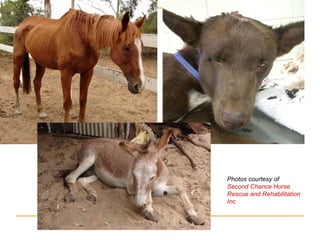
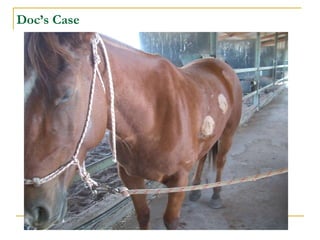
Photos courtesy of  Second Chance Horse Rescue and Rehabilitation Inc
Doc’s Case
Animal Welfare Law is gaining momentum In 2008 the President of the  Australian Law Reform Commission  stated that animal welfare and animal rights is perhaps the  ‘next great social justice movement’  Law Schools now offer animal law as a subject  First textbook of animal law in Australia was published in February 2009
Animal Welfare Legislation in WA Animal Welfare Act 2002 Animal Welfare (General) Regulations 2003 Codes of Practice Eg.  Code of Practice for Animals at Saleyards in Western Australia   (Full list of Codes available at: http://www.dlgrd.wa.gov.au/Legislation/AnimalWelfare/CodesPractice.asp?Return=True)
Animal Welfare Act 2002 Cruelty prohibition s.19(1) Duty of care provisions s.19(3) Range of Defences s.21 – 30 Eg. Code of Practice s.25 It is a defence to a charge under section 19(1) for a person to prove that the person was acting in accordance with a relevant code of practice.
Dawson’s case  Magistrates Court Western Australia 22 July 2008  Charged with ‘cruelty to animals’ under s.19 Animal Welfare Act 2002 Unloading sheep at Fremantle Port Penalty: $2500 fine and prohibited from transporting sheep and cattle for 1 year.
Dawson Video
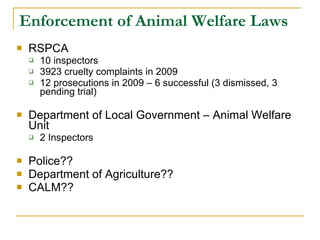
Enforcement of Animal Welfare Laws  RSPCA 10 inspectors 3923 cruelty complaints in 2009 12 prosecutions in 2009 – 6 successful (3 dismissed, 3 pending trial)  Department of Local Government – Animal Welfare Unit 2 Inspectors  Police?? Department of Agriculture?? CALM??
My Honours Thesis Legal Protection of Invasive Animals in Australia: A Paradox of Animal Welfare Law
Australia is  ‘ a world leader in animal welfare’   (taken from the  Department of Agriculture, Fisheries and Forestry  website)
Bear Baiting In Western Australia fighting of captive animals is prohibited under s.32  Animal Welfare Act 2002 In other countries, animal fights are considered a ‘sport’
 
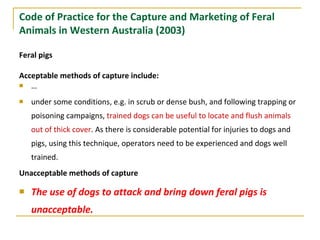
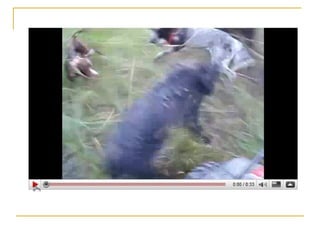
Code of Practice for the Capture and Marketing of Feral Animals in Western Australia (2003) Feral pigs Acceptable methods of capture include: … under some conditions, e.g. in scrub or dense bush, and following trapping or poisoning campaigns,  trained dogs can be useful to locate and flush animals out of thick cover . As there is considerable potential for injuries to dogs and pigs, using this technique, operators need to be experienced and dogs well trained. Unacceptable methods of capture The use of dogs to attack and bring down feral pigs is unacceptable.
BUT one search on “youtube” reveals over 700 Australian videos of this:
 
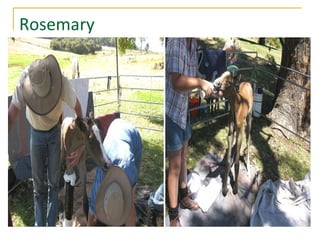
Rosemary
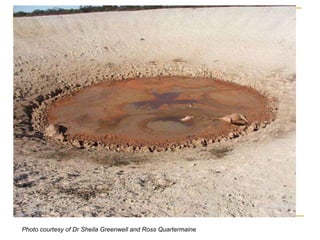
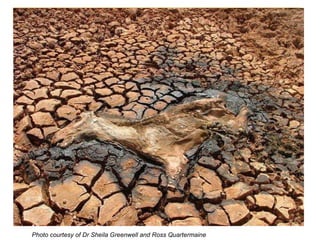
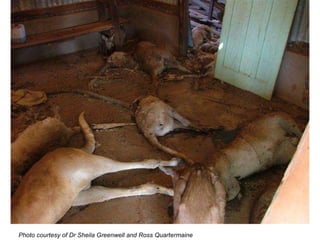
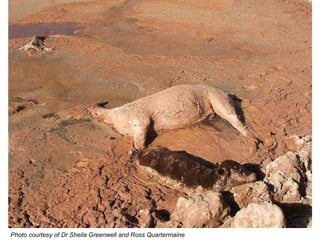
Earaheedy Station  Large station in the Murchison In 1999 the owners wanted to return the land to its original state  Turned off all six dams at once during a time of drought in an attempt to “cull” the feral animal population on the station Information provided by  The Outback Heritage Horse Association of WA (Inc)  Photos courtesy of  Dr Sheila Greenwell and Ross Quartermaine
Photo courtesy of Dr Sheila Greenwell and Ross Quartermaine
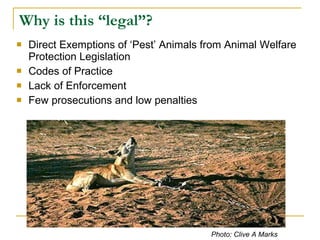
Why is this “legal”? Direct Exemptions of ‘Pest’ Animals from Animal Welfare Protection Legislation Codes of Practice Lack of Enforcement  Few prosecutions and low penalties  Photo: Clive A Marks
Direct Exemption  24. Defence — killing pests (1) It is a defence to a charge under section 19(1) for a person to prove — (a) that the act alleged to constitute the offence was  done while the person was attempting to kill pests ; (b) that the person was attempting to kill pests in a  manner that is generally accepted as usual and reasonable  for killing  pests of the kind the person was attempting to kill; and (c) if the animal the subject of the charge was not a pest, that the  person took reasonable steps to ensure that animals other than  pests would not be harmed. (2) In this section — pest  means a prescribed animal, fish or invertebrate.
Definition of ‘pest’ Animal Welfare (General) Regulations 2003  Regulation 5  5. Pests (s. 24(2)) An animal set out in the list of declared animals published under section 35 of the  Agriculture and Related Resources Protection Act 1976  is prescribed as a pest under section 24(2) of the Act, if — (a) the animal is not being kept as a domestic pet; (b) the animal is not being kept for the purposes of racing, riding or harnessing; (c) the animal is not being kept for the purpose of confined display or entertainment; (d) the animal is not being kept as a form of livestock; and (e) at the time a person attempts to kill the animal, it is not under effective control of an owner.
Code of Practice for the Capture and Marketing of Feral Animals in Western Australia (2003) Does NOT include introduced wild animals such as foxes and rabbits Outlines ‘acceptable’ and ‘unacceptable’ methods  Problem with language Eg. when ground shooting animals  ‘shots should be aimed to destroy the brain or heart/great vessels of the target animal. Shooting at other parts of the body is  undesirable ’
Other points from My Thesis  Impacts  AgVet Code and 1080 Trapping in other Jurisdictions Obligation on Landholders to control invasive animals on their land  Problem with new ‘more humane’ methods

Animal Law Talk - Maike Dorn

  • 1.
    ANIMAL WELFARE LAWWhat protection exists for animals in Western Australia? Dr. Maike Dorn BSc BVMS (Hons) LLB (Hons)
  • 2.
    Overview of presentationHow I became interested and involved in animal welfare law Some case examples Overview of Legislation Successful prosecution – Dawson Case Problem of enforcement of Animal Welfare Laws Animal Welfare Legislation fails to adequately protect many categories of animals
  • 3.
    Photos courtesy of Second Chance Horse Rescue and Rehabilitation Inc
  • 4.
  • 5.
    Animal Welfare Lawis gaining momentum In 2008 the President of the Australian Law Reform Commission stated that animal welfare and animal rights is perhaps the ‘next great social justice movement’ Law Schools now offer animal law as a subject First textbook of animal law in Australia was published in February 2009
  • 6.
    Animal Welfare Legislationin WA Animal Welfare Act 2002 Animal Welfare (General) Regulations 2003 Codes of Practice Eg. Code of Practice for Animals at Saleyards in Western Australia (Full list of Codes available at: http://www.dlgrd.wa.gov.au/Legislation/AnimalWelfare/CodesPractice.asp?Return=True)
  • 7.
    Animal Welfare Act2002 Cruelty prohibition s.19(1) Duty of care provisions s.19(3) Range of Defences s.21 – 30 Eg. Code of Practice s.25 It is a defence to a charge under section 19(1) for a person to prove that the person was acting in accordance with a relevant code of practice.
  • 8.
    Dawson’s case Magistrates Court Western Australia 22 July 2008 Charged with ‘cruelty to animals’ under s.19 Animal Welfare Act 2002 Unloading sheep at Fremantle Port Penalty: $2500 fine and prohibited from transporting sheep and cattle for 1 year.
  • 9.
  • 10.
    Enforcement of AnimalWelfare Laws RSPCA 10 inspectors 3923 cruelty complaints in 2009 12 prosecutions in 2009 – 6 successful (3 dismissed, 3 pending trial) Department of Local Government – Animal Welfare Unit 2 Inspectors Police?? Department of Agriculture?? CALM??
  • 11.
    My Honours ThesisLegal Protection of Invasive Animals in Australia: A Paradox of Animal Welfare Law
  • 12.
    Australia is ‘ a world leader in animal welfare’ (taken from the Department of Agriculture, Fisheries and Forestry website)
  • 13.
    Bear Baiting InWestern Australia fighting of captive animals is prohibited under s.32 Animal Welfare Act 2002 In other countries, animal fights are considered a ‘sport’
  • 14.
  • 15.
    Code of Practicefor the Capture and Marketing of Feral Animals in Western Australia (2003) Feral pigs Acceptable methods of capture include: … under some conditions, e.g. in scrub or dense bush, and following trapping or poisoning campaigns, trained dogs can be useful to locate and flush animals out of thick cover . As there is considerable potential for injuries to dogs and pigs, using this technique, operators need to be experienced and dogs well trained. Unacceptable methods of capture The use of dogs to attack and bring down feral pigs is unacceptable.
  • 16.
    BUT one searchon “youtube” reveals over 700 Australian videos of this:
  • 17.
  • 18.
  • 19.
    Earaheedy Station Large station in the Murchison In 1999 the owners wanted to return the land to its original state Turned off all six dams at once during a time of drought in an attempt to “cull” the feral animal population on the station Information provided by The Outback Heritage Horse Association of WA (Inc) Photos courtesy of Dr Sheila Greenwell and Ross Quartermaine
  • 20.
    Photo courtesy ofDr Sheila Greenwell and Ross Quartermaine
  • 21.
    Photo courtesy ofDr Sheila Greenwell and Ross Quartermaine
  • 22.
    Photo courtesy ofDr Sheila Greenwell and Ross Quartermaine
  • 23.
    Photo courtesy ofDr Sheila Greenwell and Ross Quartermaine
  • 24.
    Why is this“legal”? Direct Exemptions of ‘Pest’ Animals from Animal Welfare Protection Legislation Codes of Practice Lack of Enforcement Few prosecutions and low penalties Photo: Clive A Marks
  • 25.
    Direct Exemption 24. Defence — killing pests (1) It is a defence to a charge under section 19(1) for a person to prove — (a) that the act alleged to constitute the offence was done while the person was attempting to kill pests ; (b) that the person was attempting to kill pests in a manner that is generally accepted as usual and reasonable for killing pests of the kind the person was attempting to kill; and (c) if the animal the subject of the charge was not a pest, that the person took reasonable steps to ensure that animals other than pests would not be harmed. (2) In this section — pest means a prescribed animal, fish or invertebrate.
  • 26.
    Definition of ‘pest’Animal Welfare (General) Regulations 2003 Regulation 5 5. Pests (s. 24(2)) An animal set out in the list of declared animals published under section 35 of the Agriculture and Related Resources Protection Act 1976 is prescribed as a pest under section 24(2) of the Act, if — (a) the animal is not being kept as a domestic pet; (b) the animal is not being kept for the purposes of racing, riding or harnessing; (c) the animal is not being kept for the purpose of confined display or entertainment; (d) the animal is not being kept as a form of livestock; and (e) at the time a person attempts to kill the animal, it is not under effective control of an owner.
  • 27.
    Code of Practicefor the Capture and Marketing of Feral Animals in Western Australia (2003) Does NOT include introduced wild animals such as foxes and rabbits Outlines ‘acceptable’ and ‘unacceptable’ methods Problem with language Eg. when ground shooting animals ‘shots should be aimed to destroy the brain or heart/great vessels of the target animal. Shooting at other parts of the body is undesirable ’
  • 28.
    Other points fromMy Thesis Impacts AgVet Code and 1080 Trapping in other Jurisdictions Obligation on Landholders to control invasive animals on their land Problem with new ‘more humane’ methods

Editor's Notes