ACTIVITY SHEET #1
ROLLING BALL
GROUP #______ Group Members: __________________________________________
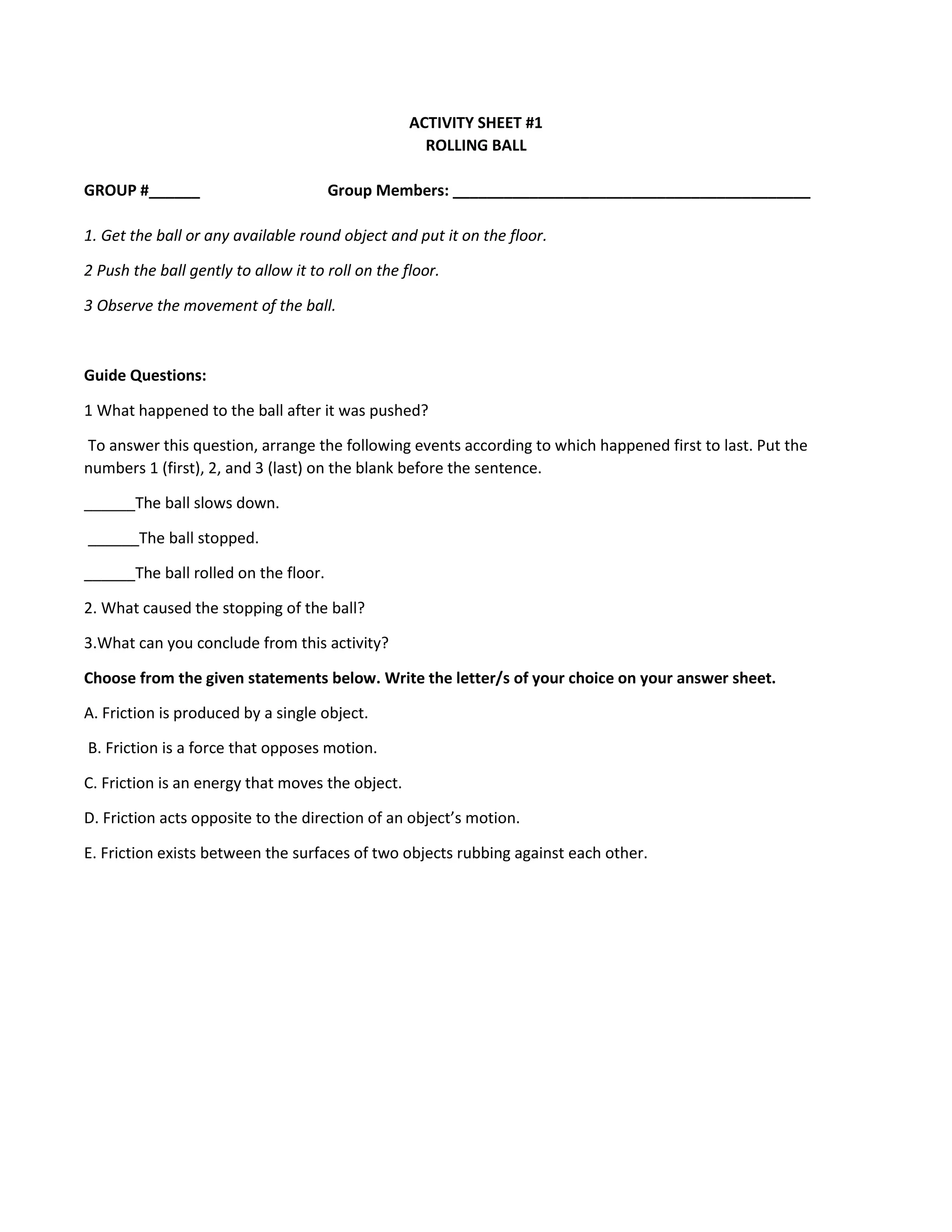
1. Get the ball or any available round object and put it on the floor.
2 Push the ball gently to allow it to roll on the floor.
3 Observe the movement of the ball.
Guide Questions:
1 What happened to the ball after it was pushed?
To answer this question, arrange the following events according to which happened first to last. Put the
numbers 1 (first), 2, and 3 (last) on the blank before the sentence.
______The ball slows down.
______The ball stopped.
______The ball rolled on the floor.
2. What caused the stopping of the ball?
3.What can you conclude from this activity?
Choose from the given statements below. Write the letter/s of your choice on your answer sheet.
A. Friction is produced by a single object.
B. Friction is a force that opposes motion.
C. Friction is an energy that moves the object.
D. Friction acts opposite to the direction of an object’s motion.
E. Friction exists between the surfaces of two objects rubbing against each other.
ACTIVITY SHEET #2
FALLING OBJECTS
GROUP #___ Group Members: __________________________________________
In this activity, you will be able to observe how air affects the movement of falling objects.
You will need 2 identical sheets of paper.
Instruction:
1. Perform the activity in your room.
2. Prepare two sheets of identical papers. Crumple one of the papers.
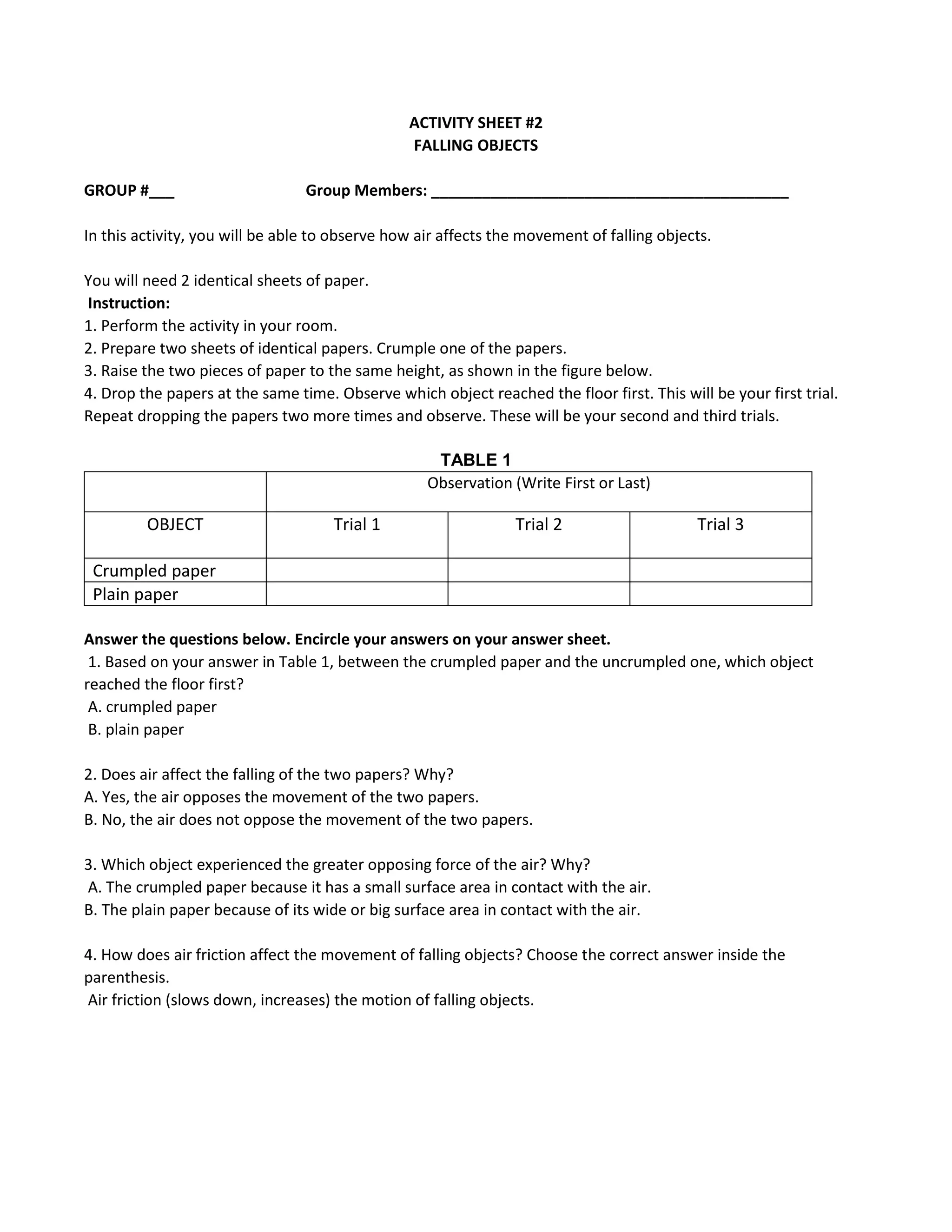
3. Raise the two pieces of paper to the same height, as shown in the figure below.
4. Drop the papers at the same time. Observe which object reached the floor first. This will be your first trial.
Repeat dropping the papers two more times and observe. These will be your second and third trials.
TABLE 1
Observation (Write First or Last)
OBJECT Trial 1 Trial 2 Trial 3
Crumpled paper
Plain paper
Answer the questions below. Encircle your answers on your answer sheet.
1. Based on your answer in Table 1, between the crumpled paper and the uncrumpled one, which object
reached the floor first?
A. crumpled paper
B. plain paper
2. Does air affect the falling of the two papers? Why?
A. Yes, the air opposes the movement of the two papers.
B. No, the air does not oppose the movement of the two papers.
3. Which object experienced the greater opposing force of the air? Why?
A. The crumpled paper because it has a small surface area in contact with the air.
B. The plain paper because of its wide or big surface area in contact with the air.
4. How does air friction affect the movement of falling objects? Choose the correct answer inside the
parenthesis.
Air friction (slows down, increases) the motion of falling objects.
ACTIVITY SHEET #3
ROLLING AND SLIDING
GROUP #___ Group Members: __________________________________________
I. Objective: In this activity, you will observe how friction affects the movement of objects. You will
also identify the factors affecting it.
II. Materials: a ball and a box with the same mass
III. Instruction:
1. Perform this activity on a floor or on a long table.
2. Put a mark on the floor. Place the ball on the mark.
3. Push the ball gently, as shown in Figure 1 below. Mark the point where the ball stopped. Repeat the steps
two more times.
4. Replace the ball with a small box. Place it on the same mark where the ball was initially placed.
5. Apply the same amount of push to the box as was given to the ball, as shown in Figure 2. Put a mark on the
point where the small box stopped. Repeat the steps two more times.
Answer the following questions.
Write your answers on your answer sheet. Questions Write BALL or BOX
1. Which object has the longer distance traveled?
2. Which object has bigger surface area in contact with the floor?
3. Which object was acted on by greater friction?
Based on the activity, complete the following statements by choosing the word that best completes the
following sentences. Write the words you have chosen on your answer sheet.
1.Why does the ball and the box travel at different distances?
The ball and the box travelled different distances because of the difference in their (shape/surface area,
push applied).
2. How does friction affect the movement of objects with big or small surface areas?
An object with a bigger surface area, experiences a (greater, lesser) friction while an object with a
smaller surface area has a (greater, lesser) friction.
3. How does friction affect the movement of objects such as the ball and the box?
Friction makes moving objects (slowdown, get faster). It can also (stop, move) moving objects.
4. In this activity, what is the factor affecting friction? (shape/surface area, distance travelled)
ACTIVITY SHEET #4
ROUGH AND SMOOTH
GROUP #___ Group Members: __________________________________________
I. Objective: In this activity, you will observe how objects’ different textures of surfaces affect friction.
II. Materials: a ball/marble and a piece of cloth
III. Procedure:
1. Perform this activity on a long table or the floor.
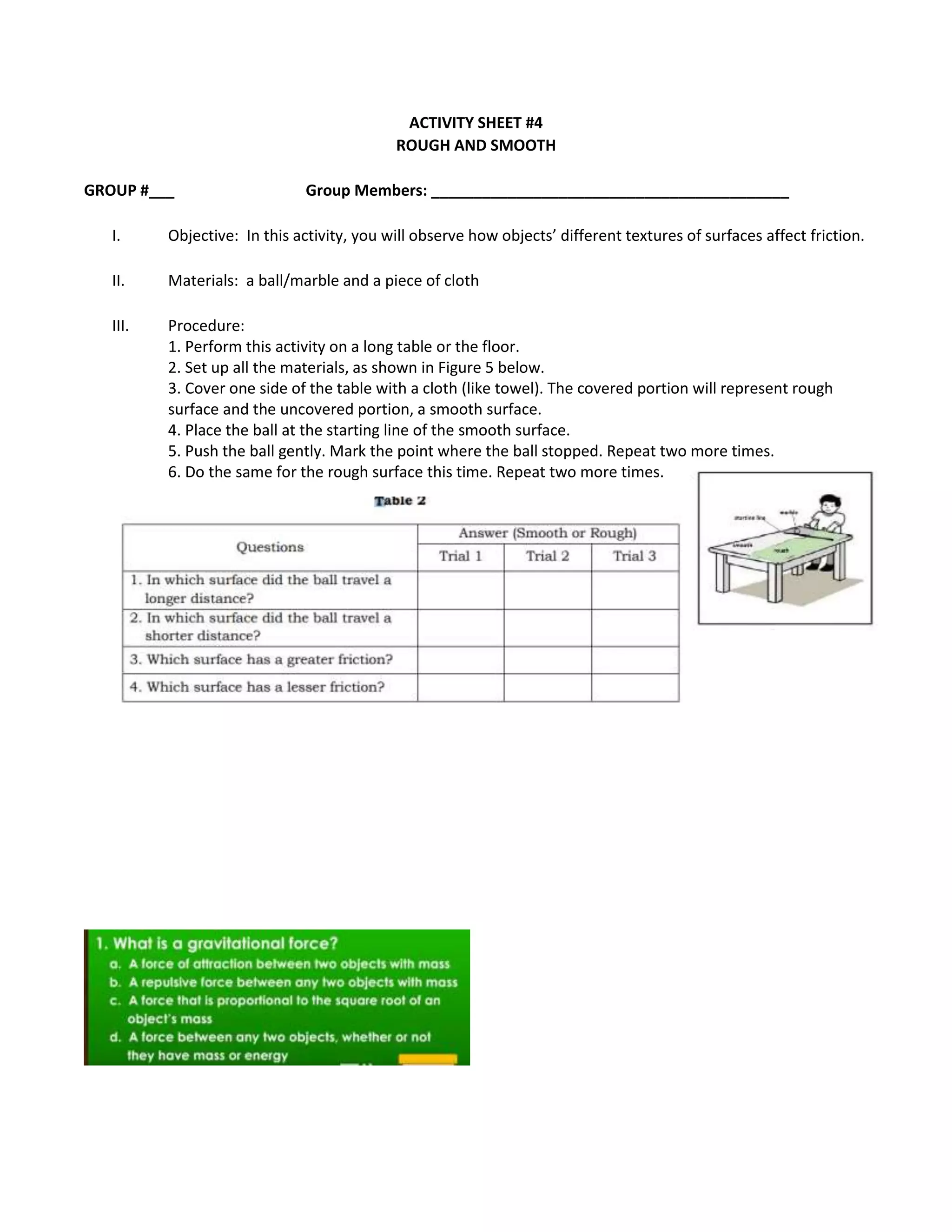
2. Set up all the materials, as shown in Figure 5 below.
3. Cover one side of the table with a cloth (like towel). The covered portion will represent rough
surface and the uncovered portion, a smooth surface.
4. Place the ball at the starting line of the smooth surface.
5. Push the ball gently. Mark the point where the ball stopped. Repeat two more times.
6. Do the same for the rough surface this time. Repeat two more times.
Activity Sheet-Science 6 Q3 Wk 1.docx

Activity Sheet-Science 6 Q3 Wk 1.docx

  • 1.
    ACTIVITY SHEET #1 ROLLINGBALL GROUP #______ Group Members: __________________________________________ 1. Get the ball or any available round object and put it on the floor. 2 Push the ball gently to allow it to roll on the floor. 3 Observe the movement of the ball. Guide Questions: 1 What happened to the ball after it was pushed? To answer this question, arrange the following events according to which happened first to last. Put the numbers 1 (first), 2, and 3 (last) on the blank before the sentence. ______The ball slows down. ______The ball stopped. ______The ball rolled on the floor. 2. What caused the stopping of the ball? 3.What can you conclude from this activity? Choose from the given statements below. Write the letter/s of your choice on your answer sheet. A. Friction is produced by a single object. B. Friction is a force that opposes motion. C. Friction is an energy that moves the object. D. Friction acts opposite to the direction of an object’s motion. E. Friction exists between the surfaces of two objects rubbing against each other.
  • 2.
    ACTIVITY SHEET #2 FALLINGOBJECTS GROUP #___ Group Members: __________________________________________ In this activity, you will be able to observe how air affects the movement of falling objects. You will need 2 identical sheets of paper. Instruction: 1. Perform the activity in your room. 2. Prepare two sheets of identical papers. Crumple one of the papers. 3. Raise the two pieces of paper to the same height, as shown in the figure below. 4. Drop the papers at the same time. Observe which object reached the floor first. This will be your first trial. Repeat dropping the papers two more times and observe. These will be your second and third trials. TABLE 1 Observation (Write First or Last) OBJECT Trial 1 Trial 2 Trial 3 Crumpled paper Plain paper Answer the questions below. Encircle your answers on your answer sheet. 1. Based on your answer in Table 1, between the crumpled paper and the uncrumpled one, which object reached the floor first? A. crumpled paper B. plain paper 2. Does air affect the falling of the two papers? Why? A. Yes, the air opposes the movement of the two papers. B. No, the air does not oppose the movement of the two papers. 3. Which object experienced the greater opposing force of the air? Why? A. The crumpled paper because it has a small surface area in contact with the air. B. The plain paper because of its wide or big surface area in contact with the air. 4. How does air friction affect the movement of falling objects? Choose the correct answer inside the parenthesis. Air friction (slows down, increases) the motion of falling objects.
  • 3.
    ACTIVITY SHEET #3 ROLLINGAND SLIDING GROUP #___ Group Members: __________________________________________ I. Objective: In this activity, you will observe how friction affects the movement of objects. You will also identify the factors affecting it. II. Materials: a ball and a box with the same mass III. Instruction: 1. Perform this activity on a floor or on a long table. 2. Put a mark on the floor. Place the ball on the mark. 3. Push the ball gently, as shown in Figure 1 below. Mark the point where the ball stopped. Repeat the steps two more times. 4. Replace the ball with a small box. Place it on the same mark where the ball was initially placed. 5. Apply the same amount of push to the box as was given to the ball, as shown in Figure 2. Put a mark on the point where the small box stopped. Repeat the steps two more times. Answer the following questions. Write your answers on your answer sheet. Questions Write BALL or BOX 1. Which object has the longer distance traveled? 2. Which object has bigger surface area in contact with the floor? 3. Which object was acted on by greater friction? Based on the activity, complete the following statements by choosing the word that best completes the following sentences. Write the words you have chosen on your answer sheet. 1.Why does the ball and the box travel at different distances? The ball and the box travelled different distances because of the difference in their (shape/surface area, push applied). 2. How does friction affect the movement of objects with big or small surface areas? An object with a bigger surface area, experiences a (greater, lesser) friction while an object with a smaller surface area has a (greater, lesser) friction. 3. How does friction affect the movement of objects such as the ball and the box? Friction makes moving objects (slowdown, get faster). It can also (stop, move) moving objects. 4. In this activity, what is the factor affecting friction? (shape/surface area, distance travelled)
  • 4.
    ACTIVITY SHEET #4 ROUGHAND SMOOTH GROUP #___ Group Members: __________________________________________ I. Objective: In this activity, you will observe how objects’ different textures of surfaces affect friction. II. Materials: a ball/marble and a piece of cloth III. Procedure: 1. Perform this activity on a long table or the floor. 2. Set up all the materials, as shown in Figure 5 below. 3. Cover one side of the table with a cloth (like towel). The covered portion will represent rough surface and the uncovered portion, a smooth surface. 4. Place the ball at the starting line of the smooth surface. 5. Push the ball gently. Mark the point where the ball stopped. Repeat two more times. 6. Do the same for the rough surface this time. Repeat two more times.