Presented by:-
Anil Kumar Yadav
Friction
 Ball rolling along the ground gradually slows down and
finally come to Rest.
 When you stop pedalling a bicycle, it gradually slows down
and finally come to a stop.
 When engine of car or bike switched off , it gradually slows
down and finally come to rest.
 any object, moving over the surface of another object slows
down when no external force is applied on it. Finally it
stops.
 We slips when we step on a banana peel.
 Why is it difficult to walk on a smooth and wet floor?
Friction
Force of Friction
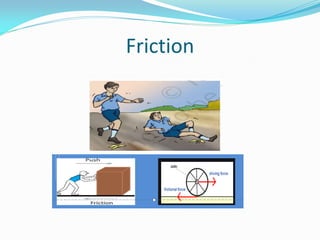
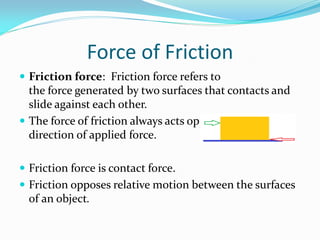
 Friction force: Friction force refers to
the force generated by two surfaces that contacts and
slide against each other.
 The force of friction always acts opposite to the
direction of applied force.
 Friction force is contact force.
 Friction opposes relative motion between the surfaces
of an object.
Factors affecting Friction
Friction depends on the nature of the surface.
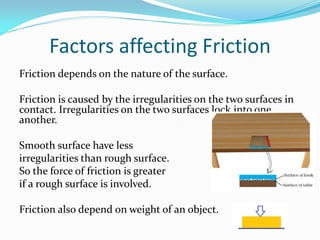
Friction is caused by the irregularities on the two surfaces in
contact. Irregularities on the two surfaces lock into one
another.
Smooth surface have less
irregularities than rough surface.
So the force of friction is greater
if a rough surface is involved.
Friction also depend on weight of an object.
Spring balance
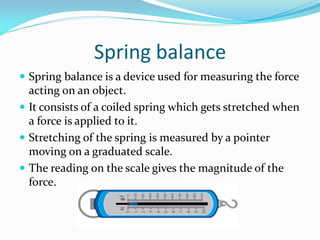
 Spring balance is a device used for measuring the force
acting on an object.
 It consists of a coiled spring which gets stretched when
a force is applied to it.
 Stretching of the spring is measured by a pointer
moving on a graduated scale.
 The reading on the scale gives the magnitude of the
force.
Types of friction
 Static friction : The force required to overcome
friction at the instant an object starts moving from rest
is a measure of static friction.
 Sliding friction: The force required to keep the object
moving with the same speed is a measure of sliding
friction.
 When an object is moving the contact points on its
surface, do not get enough time to lock into the
contact points on the other surface.
 Sliding friction is slightly smaller than the static
friction.
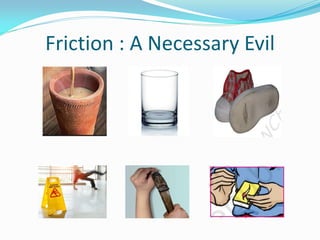
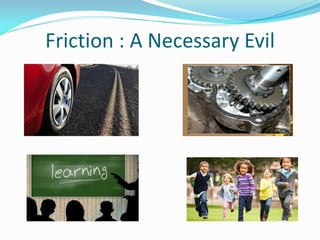
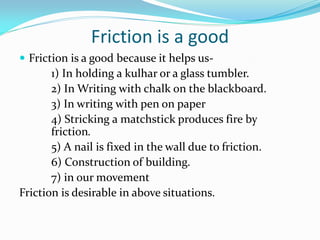
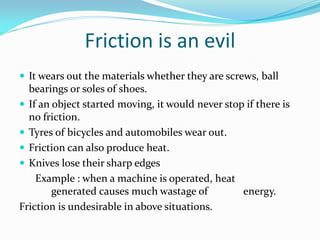
Friction : A Necessary Evil
Friction is a good
 Friction is a good because it helps us-
1) In holding a kulhar or a glass tumbler.
2) In Writing with chalk on the blackboard.
3) In writing with pen on paper
4) Stricking a matchstick produces fire by
friction.
5) A nail is fixed in the wall due to friction.
6) Construction of building.
7) in our movement
Friction is desirable in above situations.
Friction is an evil
 It wears out the materials whether they are screws, ball
bearings or soles of shoes.
 If an object started moving, it would never stop if there is
no friction.
 Tyres of bicycles and automobiles wear out.
 Friction can also produce heat.
 Knives lose their sharp edges
Example : when a machine is operated, heat
generated causes much wastage of energy.
Friction is undesirable in above situations.
Increasing Friction
 Friction can be increased by increasing the roughness
of the surface in contact.
Examples:
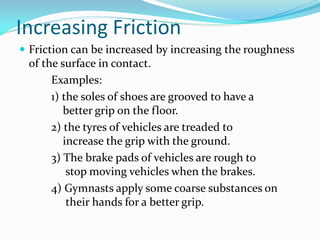
1) the soles of shoes are grooved to have a
better grip on the floor.
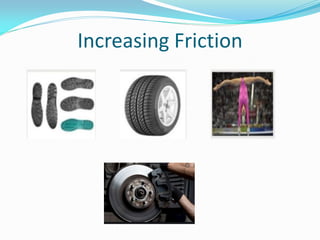
2) the tyres of vehicles are treaded to
increase the grip with the ground.
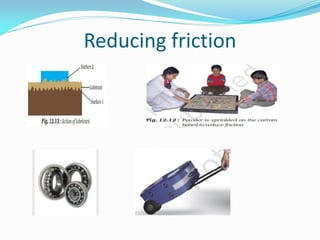
3) The brake pads of vehicles are rough to
stop moving vehicles when the brakes.
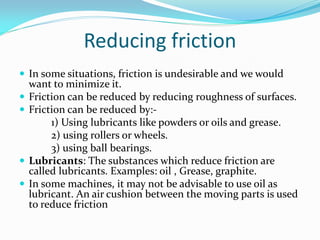
4) Gymnasts apply some coarse substances on
their hands for a better grip.
Increasing Friction
Reducing friction
 In some situations, friction is undesirable and we would
want to minimize it.
 Friction can be reduced by reducing roughness of surfaces.
 Friction can be reduced by:-
1) Using lubricants like powders or oils and grease.
2) using rollers or wheels.
3) using ball bearings.
 Lubricants: The substances which reduce friction are
called lubricants. Examples: oil , Grease, graphite.
 In some machines, it may not be advisable to use oil as
lubricant. An air cushion between the moving parts is used
to reduce friction
Reducing friction
Reducing friction
 Friction can never be entirely eleminated. No surface is
perfectly smooth. Some irregularities are always there.
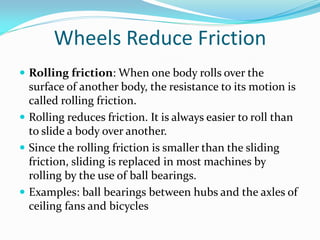
Wheels Reduce Friction
 Rolling friction: When one body rolls over the
surface of another body, the resistance to its motion is
called rolling friction.
 Rolling reduces friction. It is always easier to roll than
to slide a body over another.
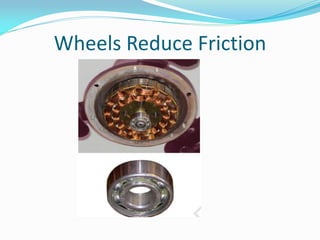
 Since the rolling friction is smaller than the sliding
friction, sliding is replaced in most machines by
rolling by the use of ball bearings.
 Examples: ball bearings between hubs and the axles of
ceiling fans and bicycles
Wheels Reduce Friction
Fluid Friction
 Fluid : A substance that can flow.
Example: All the liquids and gases are fluid.
 Fluid friction is the force of friction exerted by liquids
and gases on objects moving through them.
 The frictional force exerted by fluids is also called
drag.
 Fluid friction depends upon:-
1) The speed of an object.
2) Shape of an object.
3) The nature of the fluid.
Fluid Friction
 It is obvious that when objects move through fluids, they
have to overcome friction acting on them. In this process
they lose energy. Efforts are, therefore, made to minimize
friction.
 Examples:
1)Birds flying in air have streamlined body to reduce fluid
friction.
2) Fishes living in water have steamlined body to reduce fluid
friction.
3) Aeroplanes and spacecraft have steamlined body to reduce
fluid friction.
Fluid Friction
Thank you

Friction

  • 1.
  • 2.
    Friction  Ball rollingalong the ground gradually slows down and finally come to Rest.  When you stop pedalling a bicycle, it gradually slows down and finally come to a stop.  When engine of car or bike switched off , it gradually slows down and finally come to rest.  any object, moving over the surface of another object slows down when no external force is applied on it. Finally it stops.  We slips when we step on a banana peel.  Why is it difficult to walk on a smooth and wet floor?
  • 3.
  • 4.
    Force of Friction Friction force: Friction force refers to the force generated by two surfaces that contacts and slide against each other.  The force of friction always acts opposite to the direction of applied force.  Friction force is contact force.  Friction opposes relative motion between the surfaces of an object.
  • 5.
    Factors affecting Friction Frictiondepends on the nature of the surface. Friction is caused by the irregularities on the two surfaces in contact. Irregularities on the two surfaces lock into one another. Smooth surface have less irregularities than rough surface. So the force of friction is greater if a rough surface is involved. Friction also depend on weight of an object.
  • 6.
    Spring balance  Springbalance is a device used for measuring the force acting on an object.  It consists of a coiled spring which gets stretched when a force is applied to it.  Stretching of the spring is measured by a pointer moving on a graduated scale.  The reading on the scale gives the magnitude of the force.
  • 7.
    Types of friction Static friction : The force required to overcome friction at the instant an object starts moving from rest is a measure of static friction.  Sliding friction: The force required to keep the object moving with the same speed is a measure of sliding friction.  When an object is moving the contact points on its surface, do not get enough time to lock into the contact points on the other surface.  Sliding friction is slightly smaller than the static friction.
  • 8.
    Friction : ANecessary Evil
  • 9.
    Friction : ANecessary Evil
  • 10.
    Friction is agood  Friction is a good because it helps us- 1) In holding a kulhar or a glass tumbler. 2) In Writing with chalk on the blackboard. 3) In writing with pen on paper 4) Stricking a matchstick produces fire by friction. 5) A nail is fixed in the wall due to friction. 6) Construction of building. 7) in our movement Friction is desirable in above situations.
  • 11.
    Friction is anevil  It wears out the materials whether they are screws, ball bearings or soles of shoes.  If an object started moving, it would never stop if there is no friction.  Tyres of bicycles and automobiles wear out.  Friction can also produce heat.  Knives lose their sharp edges Example : when a machine is operated, heat generated causes much wastage of energy. Friction is undesirable in above situations.
  • 12.
    Increasing Friction  Frictioncan be increased by increasing the roughness of the surface in contact. Examples: 1) the soles of shoes are grooved to have a better grip on the floor. 2) the tyres of vehicles are treaded to increase the grip with the ground. 3) The brake pads of vehicles are rough to stop moving vehicles when the brakes. 4) Gymnasts apply some coarse substances on their hands for a better grip.
  • 13.
  • 14.
    Reducing friction  Insome situations, friction is undesirable and we would want to minimize it.  Friction can be reduced by reducing roughness of surfaces.  Friction can be reduced by:- 1) Using lubricants like powders or oils and grease. 2) using rollers or wheels. 3) using ball bearings.  Lubricants: The substances which reduce friction are called lubricants. Examples: oil , Grease, graphite.  In some machines, it may not be advisable to use oil as lubricant. An air cushion between the moving parts is used to reduce friction
  • 15.
  • 16.
    Reducing friction  Frictioncan never be entirely eleminated. No surface is perfectly smooth. Some irregularities are always there.
  • 17.
  • 18.
    Wheels Reduce Friction Rolling friction: When one body rolls over the surface of another body, the resistance to its motion is called rolling friction.  Rolling reduces friction. It is always easier to roll than to slide a body over another.  Since the rolling friction is smaller than the sliding friction, sliding is replaced in most machines by rolling by the use of ball bearings.  Examples: ball bearings between hubs and the axles of ceiling fans and bicycles
  • 19.
  • 20.
    Fluid Friction  Fluid: A substance that can flow. Example: All the liquids and gases are fluid.  Fluid friction is the force of friction exerted by liquids and gases on objects moving through them.  The frictional force exerted by fluids is also called drag.  Fluid friction depends upon:- 1) The speed of an object. 2) Shape of an object. 3) The nature of the fluid.
  • 21.
    Fluid Friction  Itis obvious that when objects move through fluids, they have to overcome friction acting on them. In this process they lose energy. Efforts are, therefore, made to minimize friction.  Examples: 1)Birds flying in air have streamlined body to reduce fluid friction. 2) Fishes living in water have steamlined body to reduce fluid friction. 3) Aeroplanes and spacecraft have steamlined body to reduce fluid friction.
  • 22.
  • 23.