Downloaded 990 times






![Transitionscomingout of DecisionPointsmust have a GUARD.[Condition 2][Condition 1]](https://image.slidesharecdn.com/activitydiagramtutorial-100503013956-phpapp01/85/Activity-diagram-tutorial-30-320.jpg)
![[IT WAS “Y”][IT WAS “X”]A Guardneeds to explicitly describe a conditionwhichmustbe true in order to proceeddown that path.](https://image.slidesharecdn.com/activitydiagramtutorial-100503013956-phpapp01/85/Activity-diagram-tutorial-31-320.jpg)
![IftheflowrejoinsthePrimaryPath, it is known as anAlternatePath.[Condition 2][Condition 1]](https://image.slidesharecdn.com/activitydiagramtutorial-100503013956-phpapp01/85/Activity-diagram-tutorial-32-320.jpg)
![[Condition 2][Condition 1]WithAlternatePaths, thegoal of the Use Case is stillachieved.](https://image.slidesharecdn.com/activitydiagramtutorial-100503013956-phpapp01/85/Activity-diagram-tutorial-33-320.jpg)
![There are othernamesforAlternatePaths.[Condition 2][Condition 1]](https://image.slidesharecdn.com/activitydiagramtutorial-100503013956-phpapp01/85/Activity-diagram-tutorial-34-320.jpg)
![Combine anywordontheleftwithanyphraseontheright.ALTERNATE……PATHALTERNATIVE……FLOWSECONDARY……COURSE OF EVENTS…SCENARIO[Condition 2][Condition 1]](https://image.slidesharecdn.com/activitydiagramtutorial-100503013956-phpapp01/85/Activity-diagram-tutorial-35-320.jpg)
![[Condition 2][Condition 1]You can show howpathsrejoinbyusing a MERGE POINT.](https://image.slidesharecdn.com/activitydiagramtutorial-100503013956-phpapp01/85/Activity-diagram-tutorial-36-320.jpg)
![[Condition 2][Condition 1]You can show howpathsrejoinbyusing a MERGE POINT.](https://image.slidesharecdn.com/activitydiagramtutorial-100503013956-phpapp01/85/Activity-diagram-tutorial-37-320.jpg)
![I don’tlikeMergePointsbecausetheytake up spacewithoutaddingclarity.[Condition 2][Condition 1]](https://image.slidesharecdn.com/activitydiagramtutorial-100503013956-phpapp01/85/Activity-diagram-tutorial-38-320.jpg)
![I prefer to modelmergingpathslikethis.[Condition 2][Condition 1]](https://image.slidesharecdn.com/activitydiagramtutorial-100503013956-phpapp01/85/Activity-diagram-tutorial-39-320.jpg)
![MergePoints can sometimesbeparticularlysuperfluous.[Condition 2][Condition 1]](https://image.slidesharecdn.com/activitydiagramtutorial-100503013956-phpapp01/85/Activity-diagram-tutorial-40-320.jpg)
![[Condition 2][Condition 1]I thinkit is neater to show themergethisway.](https://image.slidesharecdn.com/activitydiagramtutorial-100503013956-phpapp01/85/Activity-diagram-tutorial-41-320.jpg)
![Iftheflowdoes NOT rejointhePrimaryPath, it is known as anExceptionPath.[Condition 2][Condition3][Condition 1]](https://image.slidesharecdn.com/activitydiagramtutorial-100503013956-phpapp01/85/Activity-diagram-tutorial-42-320.jpg)
![WithExceptionPaths, thegoal of the Use Case is NOT achieved.[Condition 2][Condition3][Condition 1]Goal X achieved](https://image.slidesharecdn.com/activitydiagramtutorial-100503013956-phpapp01/85/Activity-diagram-tutorial-43-320.jpg)
![WithExceptionPaths, thegoal of the Use Case is NOT achieved.[Condition 2][Condition3][Condition 1]Uh, oh!Goal X achieved](https://image.slidesharecdn.com/activitydiagramtutorial-100503013956-phpapp01/85/Activity-diagram-tutorial-44-320.jpg)
![I like to use colour to highlightthedifferentpaths.[Condition 2][Condition3][Condition 1]](https://image.slidesharecdn.com/activitydiagramtutorial-100503013956-phpapp01/85/Activity-diagram-tutorial-45-320.jpg)
![[Condition 2][Condition3][Condition 1]](https://image.slidesharecdn.com/activitydiagramtutorial-100503013956-phpapp01/85/Activity-diagram-tutorial-46-320.jpg)
![[Condition 2][Condition3][Condition 1]](https://image.slidesharecdn.com/activitydiagramtutorial-100503013956-phpapp01/85/Activity-diagram-tutorial-47-320.jpg)
![This makesiteasy to identify test scenarios at a glance.[Condition3][Condition 2][Condition 1]](https://image.slidesharecdn.com/activitydiagramtutorial-100503013956-phpapp01/85/Activity-diagram-tutorial-48-320.jpg)
![I alsolike to labeltheGuards in order to easilyidentifythepaths.A1: [Condition 2]E1: [Condition 3]P: [Condition 1]](https://image.slidesharecdn.com/activitydiagramtutorial-100503013956-phpapp01/85/Activity-diagram-tutorial-49-320.jpg)
![And I like to labeltheStepsforeasybackwardreferencefrom Business Rules and a Logical Data Model.P1:A1: [Condition 2]E1: [Condition 3]P: [Condition 1]P2:A1.1:E1.1:](https://image.slidesharecdn.com/activitydiagramtutorial-100503013956-phpapp01/85/Activity-diagram-tutorial-50-320.jpg)
![PrimaryPath: P1, P2.P1:A1: [Condition 2]E1: [Condition 3]P: [Condition 1]P2:A1.1:E1.1:](https://image.slidesharecdn.com/activitydiagramtutorial-100503013956-phpapp01/85/Activity-diagram-tutorial-51-320.jpg)
![PrimaryPath: P1, P2.AlternatePath 1: P1, A1.1, P2.P1:A1: [Condition 2]E1: [Condition 3]P: [Condition 1]P2:A1.1:E1.1:](https://image.slidesharecdn.com/activitydiagramtutorial-100503013956-phpapp01/85/Activity-diagram-tutorial-52-320.jpg)
![PrimaryPath: P1, P2.AlternatePath 1: P1, A1.1, P2.ExceptionPath 1: P1, E1.1.P1:A1: [Condition 2]E1: [Condition 3]P: [Condition 1]P2:A1.1:E1.1:](https://image.slidesharecdn.com/activitydiagramtutorial-100503013956-phpapp01/85/Activity-diagram-tutorial-53-320.jpg)
![In some Use Cases, you willneed to modelparallelsteps[Condition 2][Condition3][Condition 1]](https://image.slidesharecdn.com/activitydiagramtutorial-100503013956-phpapp01/85/Activity-diagram-tutorial-54-320.jpg)
![[Condition 2][Condition3][Condition 1]XABIn thisexample, steps A and B mustbothstartafterstep X finishes and mustbothfinishbeforethe Use Case ends.](https://image.slidesharecdn.com/activitydiagramtutorial-100503013956-phpapp01/85/Activity-diagram-tutorial-55-320.jpg)
![[Condition 2][Condition3][Condition 1]XABButwe do notcareabouttheorder in which A and B happen.](https://image.slidesharecdn.com/activitydiagramtutorial-100503013956-phpapp01/85/Activity-diagram-tutorial-56-320.jpg)
![A and B couldevenhappen at thesame time.[Condition 2][Condition3][Condition 1]XAB](https://image.slidesharecdn.com/activitydiagramtutorial-100503013956-phpapp01/85/Activity-diagram-tutorial-57-320.jpg)
![In thisexample, B mustfollow A, butwe do notcarewhen C happens in relation to (A + B).[Condition 2][Condition3][Condition 1]ACB](https://image.slidesharecdn.com/activitydiagramtutorial-100503013956-phpapp01/85/Activity-diagram-tutorial-58-320.jpg)
![In some Use Cases, you willneed to modelrepeatedsteps.[Condition 2][Condition3][Condition 1]AB](https://image.slidesharecdn.com/activitydiagramtutorial-100503013956-phpapp01/85/Activity-diagram-tutorial-59-320.jpg)
![[Condition 2][Condition3][Condition 1]Foreach X:AIn thisexample, you repeat (A + B) untilthere is no more X.B](https://image.slidesharecdn.com/activitydiagramtutorial-100503013956-phpapp01/85/Activity-diagram-tutorial-60-320.jpg)
![[Condition 2][Condition3][Condition 1]Foreach X:AForexample, you might do thiswhenaddingpassengers to a holidaybooking.B](https://image.slidesharecdn.com/activitydiagramtutorial-100503013956-phpapp01/85/Activity-diagram-tutorial-61-320.jpg)
![START POINTDECISION POINT[Condition]END POINTGUARDSTEPPARALLEL STEPSForeach X:TRANSITIONREPEATED STEPS](https://image.slidesharecdn.com/activitydiagramtutorial-100503013956-phpapp01/85/Activity-diagram-tutorial-63-320.jpg)


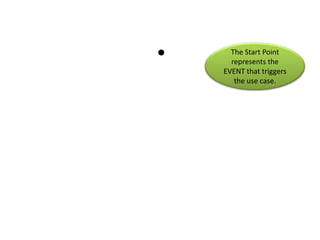
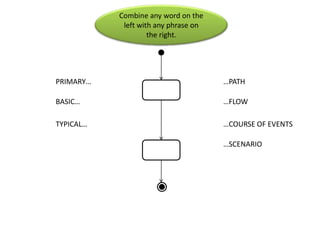
The document discusses using activity diagrams to model use cases visually. It begins by explaining the start point, which represents the triggering event, and the end point, which explicitly confirms the intent was achieved. The document then covers modeling the primary path of steps and transitions between them, with decision points allowing alternate paths based on guards. Exception paths are when the goal is not achieved, while parallel and repeated steps are also discussed. Labeling and coloring elements is recommended to improve clarity and testing.


![[RPL2] Pertemuan 3 - UML dan USECASE VIEW](https://cdn.slidesharecdn.com/ss_thumbnails/rpl2pertemuan3-umldanusecaseview-181013010605-thumbnail.jpg?width=640&height=640&fit=bounds)


